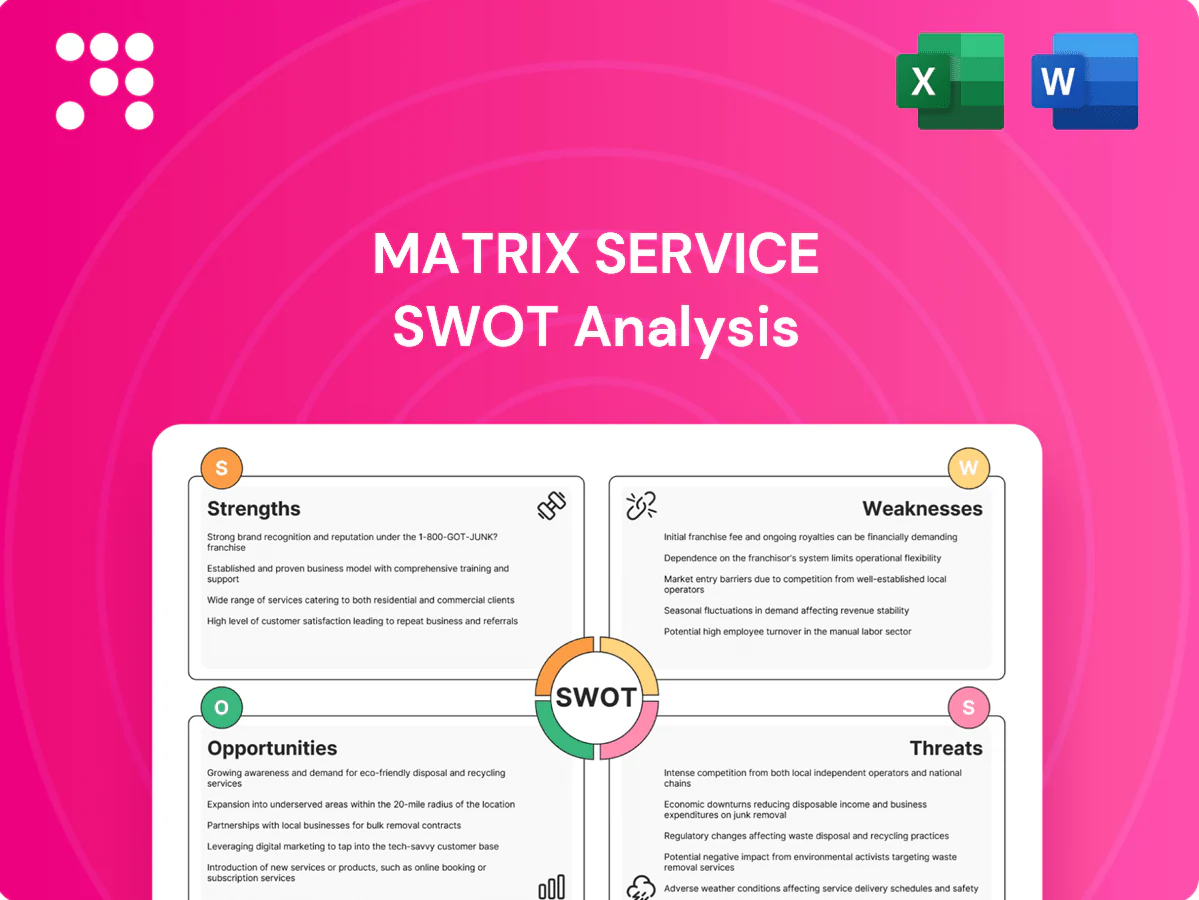
Matrix Service SWOT Analysis

Your Strategic Toolkit Starts Here
Explore Matrix Service's competitive edge and vulnerabilities with our concise SWOT snapshot—strategic strengths, key risks, and growth levers are highlighted to spark action. Want the full picture? Purchase the complete SWOT for a research-backed, editable Word report and Excel matrix to plan, pitch, or invest with confidence.
Strengths

End-to-end EPC and maintenance scope
Matrix Service delivers engineering through construction and lifecycle maintenance under one contract, simplifying vendor management for clients and reducing coordination overhead. This integrated EPC plus maintenance model shortens schedules and cuts interface risk on complex projects while enabling cross-selling of maintenance after capital builds. The cradle-to-grave offering supports steadier utilization across business cycles by smoothing demand between capital and service work.
Deep storage tank and terminal expertise
Matrix Service is recognized for design, fabrication and construction of large aboveground storage tanks and terminals, leveraging specialized codes, welding and plate-steel capabilities that create high barriers to entry. This niche expertise is critical for hydrocarbons, chemicals, LNG and emerging fuels, allowing the firm to win complex scopes and command premium pricing. Typical tank and terminal contracts often range in the multi-million-dollar band, supporting strong margin potential. Deep technical differentiation improves bid win rates on bespoke projects.

Recurring maintenance, repair, and turnarounds
Recurring maintenance, repair and turnaround contracts give Matrix Service steady, repeat revenue—supporting its historical >$1 billion annual top line—and enhance client stickiness. Scheduled turnarounds smooth backlog between megaprojects, reducing cyclicality. Embedded on-site presence boosts visibility and win rates for capital projects. This mix mitigates exposure to new-build cycles.

Multi-market exposure: energy, power, industrial
Matrix Service's multi-market exposure across upstream-midstream, power and process industries broadens opportunity sets and enables pivoting into segments with healthier capex cycles, while cross-industry learnings raise execution standards. Client diversification reduces single-market dependence and smooths revenue volatility.
- diversified revenue streams
- capex-cycle optionality
- operational best-practices transfer
- reduced single-market risk
Safety, compliance, and quality culture
Strong safety performance and strict compliance with API, ASME and industry codes are core differentiators for Matrix Service, driving client confidence in high-risk EPC projects. Owners consistently prioritize contractors with proven safety records, making adherence to these standards a gateway to large-scale awards. Robust quality credentials lower rework and claims, protecting margins and enhancing reputation for repeat business.
- API/ASME compliance
- Proven safety record preferred by owners
- Quality credentials reduce rework/claims
- Reputation drives repeat awards
Integrated EPC and lifecycle maintenance accelerates schedules, boosts cross-selling, $1B+
Matrix Service integrates EPC and lifecycle maintenance, enabling faster schedules, cross‑selling and steadier utilization; historical revenue exceeds $1B annually. Niche strength in aboveground storage tanks, terminals and code‑intensive fabrication yields premium margins and high bid win rates. Strong safety and API/ASME compliance reduce rework and secure repeat large-scale awards.
| Metric | Data |
|---|---|
| Annual revenue | >$1B |
| Core capabilities | Tank/terminal fabrication, EPC, MRO |
| Compliance | API/ASME, strong safety record |
What is included in the product
 Detailed Word Document
Provides a strategic overview of Matrix Service's internal strengths and weaknesses and external opportunities and threats, highlighting operational capabilities, market growth drivers, and risks to its energy and industrial services business.

 Customizable Excel Spreadsheet
Provides a concise, visual SWOT matrix tailored to Matrix Service for swift strategic alignment and stakeholder-ready summaries.
Weaknesses

Cyclical exposure to energy capex
Matrix Service faces cyclical exposure to energy capex as upstream and midstream spending cycles drive order intake volatility; prolonged oil and gas downturns have historically compressed backlog and margins, and industrial clients often defer projects during recessions, risking underutilization of craft and fabrication assets.
Margin volatility on large projects
Fixed-price EPC engagements expose Matrix Service to cost overrun and schedule-penalty risk, compressing margins when site conditions or supply-chain issues arise. Change orders and scope growth are often contested, delaying recovery and tying up working capital. A few problematic jobs can swing quarterly results and repeatedly test the firm’s risk-management and estimating discipline.

Working capital intensity and cash flow timing
Projects often require substantial upfront labor and materials before milestone billing, creating negative working capital pressure. Retainage, commonly 5–10% of contract value, and slow owner approvals further tie up cash. Supply‑chain deposits for steel plate and specialty equipment can reach about 15–20% of purchase price, increasing liquidity strain. This dynamic can elevate reliance on revolvers and secured credit facilities during growth.

Limited scale versus mega-EPC competitors
Larger global EPCs can outcompete Matrix on mega-project balance sheet strength, broader geographic coverage and procurement leverage, which can depress Matrix’s win rates on very large bids. To access certain opportunities Matrix may need joint ventures or subcontracting arrangements to bridge capability and capital gaps.
- Larger EPCs: multi-billion balance sheets
- Geography: global coverage
- Procurement: scale lowers costs
- Mitigation: partner on mega-bids
Skilled labor and subcontractor dependence
Tight craft labor markets push execution risk and labor costs higher for Matrix Service; 2024 industry surveys show ~78% of contractors struggled to fill skilled roles, driving construction wage inflation near 5–6% YoY and compressing margins. Subcontractor variability and ~4–5% typical rework rates can delay schedules and erode quality, while turnover near 20% on peak workloads intensifies recruiting and retention strain.
- Labor shortage: ~78% firms report hiring difficulty
- Wage inflation: ~5–6% YoY
- Rework impact: ~4–5% of contract value
- Turnover on peaks: ~20%
EPCs face volatile backlog, margin squeeze, labor tightness and cash drag
Matrix Service is exposed to cyclical energy capex causing volatile backlog and margin pressure; prolonged downturns reduce utilization. Fixed‑price EPC work raises overrun and working‑capital risk; retainage (5–10%) and supply deposits (15–20%) tie cash. Tight labor markets (78% firms report hiring difficulty, wage inflation 5–6%, turnover ~20%) increase execution risk and rework (~4–5%).
| Metric | Value (2024–25) |
|---|---|
| Hiring difficulty | 78% |
| Wage inflation | 5–6% YoY |
| Retainage | 5–10% |
| Supply deposits | 15–20% |
| Rework | 4–5% |
Preview the Actual Deliverable
Matrix Service SWOT Analysis
This is the actual Matrix Service SWOT analysis document you’ll receive upon purchase—no surprises, just professional quality. The preview below is taken directly from the full report; purchasing unlocks the complete, editable version with detailed strengths, weaknesses, opportunities, and threats.

Your Strategic Toolkit Starts Here
Explore Matrix Service's competitive edge and vulnerabilities with our concise SWOT snapshot—strategic strengths, key risks, and growth levers are highlighted to spark action. Want the full picture? Purchase the complete SWOT for a research-backed, editable Word report and Excel matrix to plan, pitch, or invest with confidence.
Strengths
End-to-end EPC and maintenance scope
Matrix Service delivers engineering through construction and lifecycle maintenance under one contract, simplifying vendor management for clients and reducing coordination overhead. This integrated EPC plus maintenance model shortens schedules and cuts interface risk on complex projects while enabling cross-selling of maintenance after capital builds. The cradle-to-grave offering supports steadier utilization across business cycles by smoothing demand between capital and service work.
Deep storage tank and terminal expertise
Matrix Service is recognized for design, fabrication and construction of large aboveground storage tanks and terminals, leveraging specialized codes, welding and plate-steel capabilities that create high barriers to entry. This niche expertise is critical for hydrocarbons, chemicals, LNG and emerging fuels, allowing the firm to win complex scopes and command premium pricing. Typical tank and terminal contracts often range in the multi-million-dollar band, supporting strong margin potential. Deep technical differentiation improves bid win rates on bespoke projects.
Recurring maintenance, repair, and turnarounds
Recurring maintenance, repair and turnaround contracts give Matrix Service steady, repeat revenue—supporting its historical >$1 billion annual top line—and enhance client stickiness. Scheduled turnarounds smooth backlog between megaprojects, reducing cyclicality. Embedded on-site presence boosts visibility and win rates for capital projects. This mix mitigates exposure to new-build cycles.
Multi-market exposure: energy, power, industrial
Matrix Service's multi-market exposure across upstream-midstream, power and process industries broadens opportunity sets and enables pivoting into segments with healthier capex cycles, while cross-industry learnings raise execution standards. Client diversification reduces single-market dependence and smooths revenue volatility.
- diversified revenue streams
- capex-cycle optionality
- operational best-practices transfer
- reduced single-market risk
Safety, compliance, and quality culture
Strong safety performance and strict compliance with API, ASME and industry codes are core differentiators for Matrix Service, driving client confidence in high-risk EPC projects. Owners consistently prioritize contractors with proven safety records, making adherence to these standards a gateway to large-scale awards. Robust quality credentials lower rework and claims, protecting margins and enhancing reputation for repeat business.
- API/ASME compliance
- Proven safety record preferred by owners
- Quality credentials reduce rework/claims
- Reputation drives repeat awards
Integrated EPC and lifecycle maintenance accelerates schedules, boosts cross-selling, $1B+
Matrix Service integrates EPC and lifecycle maintenance, enabling faster schedules, cross‑selling and steadier utilization; historical revenue exceeds $1B annually. Niche strength in aboveground storage tanks, terminals and code‑intensive fabrication yields premium margins and high bid win rates. Strong safety and API/ASME compliance reduce rework and secure repeat large-scale awards.
| Metric | Data |
|---|---|
| Annual revenue | >$1B |
| Core capabilities | Tank/terminal fabrication, EPC, MRO |
| Compliance | API/ASME, strong safety record |
What is included in the product
Detailed Word Document
Provides a strategic overview of Matrix Service's internal strengths and weaknesses and external opportunities and threats, highlighting operational capabilities, market growth drivers, and risks to its energy and industrial services business.
Customizable Excel Spreadsheet
Provides a concise, visual SWOT matrix tailored to Matrix Service for swift strategic alignment and stakeholder-ready summaries.
Weaknesses
Cyclical exposure to energy capex
Matrix Service faces cyclical exposure to energy capex as upstream and midstream spending cycles drive order intake volatility; prolonged oil and gas downturns have historically compressed backlog and margins, and industrial clients often defer projects during recessions, risking underutilization of craft and fabrication assets.
Margin volatility on large projects
Fixed-price EPC engagements expose Matrix Service to cost overrun and schedule-penalty risk, compressing margins when site conditions or supply-chain issues arise. Change orders and scope growth are often contested, delaying recovery and tying up working capital. A few problematic jobs can swing quarterly results and repeatedly test the firm’s risk-management and estimating discipline.
Working capital intensity and cash flow timing
Projects often require substantial upfront labor and materials before milestone billing, creating negative working capital pressure. Retainage, commonly 5–10% of contract value, and slow owner approvals further tie up cash. Supply‑chain deposits for steel plate and specialty equipment can reach about 15–20% of purchase price, increasing liquidity strain. This dynamic can elevate reliance on revolvers and secured credit facilities during growth.
Limited scale versus mega-EPC competitors
Larger global EPCs can outcompete Matrix on mega-project balance sheet strength, broader geographic coverage and procurement leverage, which can depress Matrix’s win rates on very large bids. To access certain opportunities Matrix may need joint ventures or subcontracting arrangements to bridge capability and capital gaps.
- Larger EPCs: multi-billion balance sheets
- Geography: global coverage
- Procurement: scale lowers costs
- Mitigation: partner on mega-bids
Skilled labor and subcontractor dependence
Tight craft labor markets push execution risk and labor costs higher for Matrix Service; 2024 industry surveys show ~78% of contractors struggled to fill skilled roles, driving construction wage inflation near 5–6% YoY and compressing margins. Subcontractor variability and ~4–5% typical rework rates can delay schedules and erode quality, while turnover near 20% on peak workloads intensifies recruiting and retention strain.
- Labor shortage: ~78% firms report hiring difficulty
- Wage inflation: ~5–6% YoY
- Rework impact: ~4–5% of contract value
- Turnover on peaks: ~20%
EPCs face volatile backlog, margin squeeze, labor tightness and cash drag
Matrix Service is exposed to cyclical energy capex causing volatile backlog and margin pressure; prolonged downturns reduce utilization. Fixed‑price EPC work raises overrun and working‑capital risk; retainage (5–10%) and supply deposits (15–20%) tie cash. Tight labor markets (78% firms report hiring difficulty, wage inflation 5–6%, turnover ~20%) increase execution risk and rework (~4–5%).
| Metric | Value (2024–25) |
|---|---|
| Hiring difficulty | 78% |
| Wage inflation | 5–6% YoY |
| Retainage | 5–10% |
| Supply deposits | 15–20% |
| Rework | 4–5% |
Preview the Actual Deliverable
Matrix Service SWOT Analysis
This is the actual Matrix Service SWOT analysis document you’ll receive upon purchase—no surprises, just professional quality. The preview below is taken directly from the full report; purchasing unlocks the complete, editable version with detailed strengths, weaknesses, opportunities, and threats.
Description
Your Strategic Toolkit Starts Here
Explore Matrix Service's competitive edge and vulnerabilities with our concise SWOT snapshot—strategic strengths, key risks, and growth levers are highlighted to spark action. Want the full picture? Purchase the complete SWOT for a research-backed, editable Word report and Excel matrix to plan, pitch, or invest with confidence.
Strengths
End-to-end EPC and maintenance scope
Matrix Service delivers engineering through construction and lifecycle maintenance under one contract, simplifying vendor management for clients and reducing coordination overhead. This integrated EPC plus maintenance model shortens schedules and cuts interface risk on complex projects while enabling cross-selling of maintenance after capital builds. The cradle-to-grave offering supports steadier utilization across business cycles by smoothing demand between capital and service work.
Deep storage tank and terminal expertise
Matrix Service is recognized for design, fabrication and construction of large aboveground storage tanks and terminals, leveraging specialized codes, welding and plate-steel capabilities that create high barriers to entry. This niche expertise is critical for hydrocarbons, chemicals, LNG and emerging fuels, allowing the firm to win complex scopes and command premium pricing. Typical tank and terminal contracts often range in the multi-million-dollar band, supporting strong margin potential. Deep technical differentiation improves bid win rates on bespoke projects.
Recurring maintenance, repair, and turnarounds
Recurring maintenance, repair and turnaround contracts give Matrix Service steady, repeat revenue—supporting its historical >$1 billion annual top line—and enhance client stickiness. Scheduled turnarounds smooth backlog between megaprojects, reducing cyclicality. Embedded on-site presence boosts visibility and win rates for capital projects. This mix mitigates exposure to new-build cycles.
Multi-market exposure: energy, power, industrial
Matrix Service's multi-market exposure across upstream-midstream, power and process industries broadens opportunity sets and enables pivoting into segments with healthier capex cycles, while cross-industry learnings raise execution standards. Client diversification reduces single-market dependence and smooths revenue volatility.
- diversified revenue streams
- capex-cycle optionality
- operational best-practices transfer
- reduced single-market risk
Safety, compliance, and quality culture
Strong safety performance and strict compliance with API, ASME and industry codes are core differentiators for Matrix Service, driving client confidence in high-risk EPC projects. Owners consistently prioritize contractors with proven safety records, making adherence to these standards a gateway to large-scale awards. Robust quality credentials lower rework and claims, protecting margins and enhancing reputation for repeat business.
- API/ASME compliance
- Proven safety record preferred by owners
- Quality credentials reduce rework/claims
- Reputation drives repeat awards
Integrated EPC and lifecycle maintenance accelerates schedules, boosts cross-selling, $1B+
Matrix Service integrates EPC and lifecycle maintenance, enabling faster schedules, cross‑selling and steadier utilization; historical revenue exceeds $1B annually. Niche strength in aboveground storage tanks, terminals and code‑intensive fabrication yields premium margins and high bid win rates. Strong safety and API/ASME compliance reduce rework and secure repeat large-scale awards.
| Metric | Data |
|---|---|
| Annual revenue | >$1B |
| Core capabilities | Tank/terminal fabrication, EPC, MRO |
| Compliance | API/ASME, strong safety record |
What is included in the product
Detailed Word Document
Provides a strategic overview of Matrix Service's internal strengths and weaknesses and external opportunities and threats, highlighting operational capabilities, market growth drivers, and risks to its energy and industrial services business.
Customizable Excel Spreadsheet
Provides a concise, visual SWOT matrix tailored to Matrix Service for swift strategic alignment and stakeholder-ready summaries.
Weaknesses
Cyclical exposure to energy capex
Matrix Service faces cyclical exposure to energy capex as upstream and midstream spending cycles drive order intake volatility; prolonged oil and gas downturns have historically compressed backlog and margins, and industrial clients often defer projects during recessions, risking underutilization of craft and fabrication assets.
Margin volatility on large projects
Fixed-price EPC engagements expose Matrix Service to cost overrun and schedule-penalty risk, compressing margins when site conditions or supply-chain issues arise. Change orders and scope growth are often contested, delaying recovery and tying up working capital. A few problematic jobs can swing quarterly results and repeatedly test the firm’s risk-management and estimating discipline.
Working capital intensity and cash flow timing
Projects often require substantial upfront labor and materials before milestone billing, creating negative working capital pressure. Retainage, commonly 5–10% of contract value, and slow owner approvals further tie up cash. Supply‑chain deposits for steel plate and specialty equipment can reach about 15–20% of purchase price, increasing liquidity strain. This dynamic can elevate reliance on revolvers and secured credit facilities during growth.
Limited scale versus mega-EPC competitors
Larger global EPCs can outcompete Matrix on mega-project balance sheet strength, broader geographic coverage and procurement leverage, which can depress Matrix’s win rates on very large bids. To access certain opportunities Matrix may need joint ventures or subcontracting arrangements to bridge capability and capital gaps.
- Larger EPCs: multi-billion balance sheets
- Geography: global coverage
- Procurement: scale lowers costs
- Mitigation: partner on mega-bids
Skilled labor and subcontractor dependence
Tight craft labor markets push execution risk and labor costs higher for Matrix Service; 2024 industry surveys show ~78% of contractors struggled to fill skilled roles, driving construction wage inflation near 5–6% YoY and compressing margins. Subcontractor variability and ~4–5% typical rework rates can delay schedules and erode quality, while turnover near 20% on peak workloads intensifies recruiting and retention strain.
- Labor shortage: ~78% firms report hiring difficulty
- Wage inflation: ~5–6% YoY
- Rework impact: ~4–5% of contract value
- Turnover on peaks: ~20%
EPCs face volatile backlog, margin squeeze, labor tightness and cash drag
Matrix Service is exposed to cyclical energy capex causing volatile backlog and margin pressure; prolonged downturns reduce utilization. Fixed‑price EPC work raises overrun and working‑capital risk; retainage (5–10%) and supply deposits (15–20%) tie cash. Tight labor markets (78% firms report hiring difficulty, wage inflation 5–6%, turnover ~20%) increase execution risk and rework (~4–5%).
| Metric | Value (2024–25) |
|---|---|
| Hiring difficulty | 78% |
| Wage inflation | 5–6% YoY |
| Retainage | 5–10% |
| Supply deposits | 15–20% |
| Rework | 4–5% |
Preview the Actual Deliverable
Matrix Service SWOT Analysis
This is the actual Matrix Service SWOT analysis document you’ll receive upon purchase—no surprises, just professional quality. The preview below is taken directly from the full report; purchasing unlocks the complete, editable version with detailed strengths, weaknesses, opportunities, and threats.











