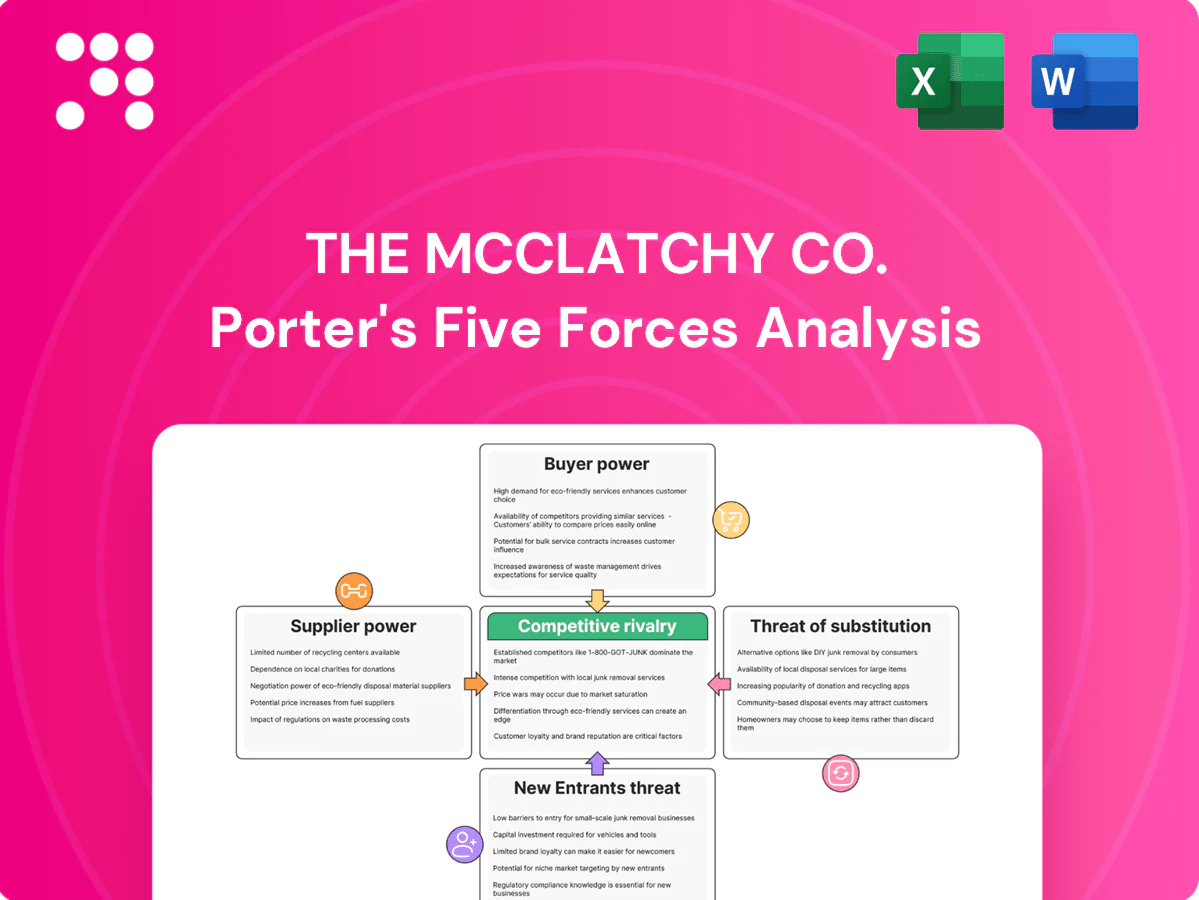
The McClatchy Co. Porter's Five Forces Analysis

From Overview to Strategy Blueprint
The McClatchy Co. faces intense buyer power and substitute threats as digital media cuts print volumes, while advertising concentration and slim margins increase competitive pressure; supplier leverage is moderate and barriers to entry are low in digital segments. This preview is just the beginning. The full analysis provides a complete strategic snapshot with force-by-force ratings, visuals, and business implications tailored to The McClatchy Co..
Suppliers Bargaining Power

Concentrated newsprint and print vendors
Newsprint and press vendors remain highly concentrated, giving suppliers leverage on pricing and terms; McClatchy, which operates 30+ daily newspapers, faces limited supplier options. Volatile pulp and energy costs often get passed through to publishers, squeezing margins. Long-term contracts and mill capacity constraints reduce McClatchy’s ability to pivot quickly. Digital circulation growth lowers but does not eliminate print dependencies in legacy markets.
Platform and ad-tech dependency
Distribution and monetization for McClatchy depend heavily on Google, Meta, Apple and ad-tech intermediaries, with Google+Meta capturing about 58% of US digital ad spend in 2024; algorithm, fee or privacy shifts (eg. iOS ATT) can sharply cut traffic and ad yield. Ecosystem lock-in and bespoke tooling create high switching costs, and these platforms' gatekeeper status elevates supplier power materially.

Wire services and syndicated content
AP, Reuters and specialty syndicates supply essential national and international coverage to most U.S. publishers; their scale and global bureaus concentrate bargaining power among a few providers. Alternatives exist, but quality and breadth gaps lock in dependence, and publishers often faced tightened licensing terms in downturns such as 2020. McClatchy’s own reporting across about 30 daily newsrooms reduces but does not eliminate reliance on wire services.

Freelancers and niche talent
Specialized journalists, data reporters and photographers command premiums and thin local talent pools heighten supplier leverage; U.S. newsroom employment fell from about 57,900 in 2008 to ~37,900 in 2022 (Pew Research), tightening supply.
Rising unionization—over 200 newsrooms had organized by 2023—and labor-market tightness push costs up; McClatchy’s brand aids hiring but attracts unevenly across markets.
- Specialists command premiums
- Thin local pools = higher leverage
- 200+ unionized newsrooms (2023)
- Brand helps, not uniform
Technology stack and SaaS tools
CMS, analytics, paywall, CDP and cloud vendors are core to McClatchy’s digital ops; complex integrations raise switching costs and amplify supplier power. Usage-based fees and price escalators compress margins, while negotiating leverage improves with scale but varies by tool and vendor concentration.
- Integration-driven switching costs
- Usage fees pressure margins
- Scale improves bargaining
Supplier concentration squeezes margins; Google and Meta own 58% of US ad spend
Newsprint and press vendors are highly concentrated, limiting McClatchy’s procurement options and passing volatile pulp and energy costs into margins. Google and Meta captured about 58% of US digital ad spend in 2024, creating gatekeeper power over distribution and ad yield. Wire services, specialist journalists and CMS/cloud vendors maintain pricing leverage amid thin newsroom labor pools and high switching costs.
| Supplier | Concentration | Impact | 2024 metric |
|---|---|---|---|
| Digital platforms | High | Ad yield/control | 58% US ad spend |
| Newsprint/pulp | High | Price pass-through | Mill capacity constraints |
| Labor/wires/CMS | Medium-High | Costs/switching | ~37,900 newsroom staff (2022) |
What is included in the product
 Detailed Word Document
Tailored exclusively for The McClatchy Co., this Porter's Five Forces overview uncovers key drivers of competition and customer influence, highlights digital disruption and substitutes threatening print revenues, evaluates advertiser and subscriber bargaining power, assesses supplier and distribution pressures, and identifies entry barriers and strategic levers to protect market share and profitability.

 Customizable Excel Spreadsheet
One-sheet Porter's Five Forces for The McClatchy Co.—condenses competitive pressures into a quick, decision-ready snapshot. Customize force levels and swap your own data or view as a radar chart to instantly show strategic pressure for decks or boardroom discussions.
Customers Bargaining Power

Advertisers with multi-homing options
Local and national advertisers can multi-home across Google and Meta, which together captured roughly 52% of US digital ad revenue in 2023–24, plus TV and radio alternatives, increasing buyer options. Programmatic buying now handles over 80% of US display transactions (2023), raising price transparency and advertiser leverage. Switching costs are low and performance-driven; advertisers reallocate spend quickly based on ROAS. McClatchy must demonstrate superior ROAS to maintain or raise rates.
Price-sensitive readers
Price-sensitive readers can switch to free or cheaper digital alternatives easily, pressuring McClatchy’s subscription pricing; the company operates about 30 daily newspapers across 14 states, where paywall tolerance varies by market and content exclusivity. Bundling and low-cost intro offers face high churn risk, while unique local reporting reduces but does not eliminate buyer power.

Agencies and programmatic desks
Agencies and programmatic desks aggregate demand—programmatic comprised roughly 85% of US display spend in 2024—letting them secure volume discounts that compress McClatchy CPMs. They benchmark CPMs across markets, pressuring yields; median display CPMs were about $3–4 in 2023–24 while video CPMs reached ~$20+. Data-driven optimization favors platforms with richer targeting; private marketplace deals can mitigate pressure but require premium inventory and higher floors.

Enterprise and SMB segmentation
Large national advertisers leverage scale to demand custom packages and favorable payment and performance terms, concentrating bargaining power in enterprise segmentation.
SMBs are fragmented and highly price/performance sensitive; growing self-serve platforms reduce switching friction and increase churn risk.
- Enterprise: high-negotiation leverage
- SMB: price-sensitive, fragmented
- Self-serve: lowers switching costs
- Attribution/education: reduces perceived risk
Audience expectations on UX
Readers expect fast, ad-light, mobile-first experiences; mobile made about 60% of global web traffic in 2024 (StatCounter), raising immediacy for publishers like McClatchy. Poor UX triggers immediate switching, reinforcing buyer power as alternatives are one tap away. Ad load, granular privacy controls, and relevant personalization directly influence retention, and investment in product quality reduces buyer leverage.
- Mobile-first: ~60% web traffic (StatCounter, 2024)
- Immediate switching: high
- Key levers: ad load, privacy controls, personalization
- Mitigation: product-quality investment
Buyers control ~52% of digital ad dollars; programmatic >80% of display; mobile ~60% web
Buyers (advertisers and readers) exert strong leverage: Google and Meta captured ~52% of US digital ad revenue in 2023–24, forcing price competition. Programmatic exceeds ~80% of US display (2023–24) with median display CPM ~$3–4 and video ~$20, raising transparency. Low switching costs and mobile ~60% web traffic (2024) increase churn; local exclusives and PMPs can mitigate.
| Metric | Value |
|---|---|
| Google+Meta share | ~52% (2023–24) |
| Programmatic display | >80% (2023–24) |
| Mobile web traffic | ~60% (2024) |
Full Version Awaits
The McClatchy Co. Porter's Five Forces Analysis
This preview shows the exact Porter’s Five Forces analysis of The McClatchy Co. you’ll receive—comprehensive, professionally formatted, and ready to use immediately after purchase. It covers competitive rivalry, supplier and buyer power, threat of entrants, and substitutes with actionable insights. No placeholders or samples; this is the final deliverable.

From Overview to Strategy Blueprint
The McClatchy Co. faces intense buyer power and substitute threats as digital media cuts print volumes, while advertising concentration and slim margins increase competitive pressure; supplier leverage is moderate and barriers to entry are low in digital segments. This preview is just the beginning. The full analysis provides a complete strategic snapshot with force-by-force ratings, visuals, and business implications tailored to The McClatchy Co..
Suppliers Bargaining Power
Concentrated newsprint and print vendors
Newsprint and press vendors remain highly concentrated, giving suppliers leverage on pricing and terms; McClatchy, which operates 30+ daily newspapers, faces limited supplier options. Volatile pulp and energy costs often get passed through to publishers, squeezing margins. Long-term contracts and mill capacity constraints reduce McClatchy’s ability to pivot quickly. Digital circulation growth lowers but does not eliminate print dependencies in legacy markets.
Platform and ad-tech dependency
Distribution and monetization for McClatchy depend heavily on Google, Meta, Apple and ad-tech intermediaries, with Google+Meta capturing about 58% of US digital ad spend in 2024; algorithm, fee or privacy shifts (eg. iOS ATT) can sharply cut traffic and ad yield. Ecosystem lock-in and bespoke tooling create high switching costs, and these platforms' gatekeeper status elevates supplier power materially.
Wire services and syndicated content
AP, Reuters and specialty syndicates supply essential national and international coverage to most U.S. publishers; their scale and global bureaus concentrate bargaining power among a few providers. Alternatives exist, but quality and breadth gaps lock in dependence, and publishers often faced tightened licensing terms in downturns such as 2020. McClatchy’s own reporting across about 30 daily newsrooms reduces but does not eliminate reliance on wire services.
Freelancers and niche talent
Specialized journalists, data reporters and photographers command premiums and thin local talent pools heighten supplier leverage; U.S. newsroom employment fell from about 57,900 in 2008 to ~37,900 in 2022 (Pew Research), tightening supply.
Rising unionization—over 200 newsrooms had organized by 2023—and labor-market tightness push costs up; McClatchy’s brand aids hiring but attracts unevenly across markets.
- Specialists command premiums
- Thin local pools = higher leverage
- 200+ unionized newsrooms (2023)
- Brand helps, not uniform
Technology stack and SaaS tools
CMS, analytics, paywall, CDP and cloud vendors are core to McClatchy’s digital ops; complex integrations raise switching costs and amplify supplier power. Usage-based fees and price escalators compress margins, while negotiating leverage improves with scale but varies by tool and vendor concentration.
- Integration-driven switching costs
- Usage fees pressure margins
- Scale improves bargaining
Supplier concentration squeezes margins; Google and Meta own 58% of US ad spend
Newsprint and press vendors are highly concentrated, limiting McClatchy’s procurement options and passing volatile pulp and energy costs into margins. Google and Meta captured about 58% of US digital ad spend in 2024, creating gatekeeper power over distribution and ad yield. Wire services, specialist journalists and CMS/cloud vendors maintain pricing leverage amid thin newsroom labor pools and high switching costs.
| Supplier | Concentration | Impact | 2024 metric |
|---|---|---|---|
| Digital platforms | High | Ad yield/control | 58% US ad spend |
| Newsprint/pulp | High | Price pass-through | Mill capacity constraints |
| Labor/wires/CMS | Medium-High | Costs/switching | ~37,900 newsroom staff (2022) |
What is included in the product
Detailed Word Document
Tailored exclusively for The McClatchy Co., this Porter's Five Forces overview uncovers key drivers of competition and customer influence, highlights digital disruption and substitutes threatening print revenues, evaluates advertiser and subscriber bargaining power, assesses supplier and distribution pressures, and identifies entry barriers and strategic levers to protect market share and profitability.
Customizable Excel Spreadsheet
One-sheet Porter's Five Forces for The McClatchy Co.—condenses competitive pressures into a quick, decision-ready snapshot. Customize force levels and swap your own data or view as a radar chart to instantly show strategic pressure for decks or boardroom discussions.
Customers Bargaining Power
Advertisers with multi-homing options
Local and national advertisers can multi-home across Google and Meta, which together captured roughly 52% of US digital ad revenue in 2023–24, plus TV and radio alternatives, increasing buyer options. Programmatic buying now handles over 80% of US display transactions (2023), raising price transparency and advertiser leverage. Switching costs are low and performance-driven; advertisers reallocate spend quickly based on ROAS. McClatchy must demonstrate superior ROAS to maintain or raise rates.
Price-sensitive readers
Price-sensitive readers can switch to free or cheaper digital alternatives easily, pressuring McClatchy’s subscription pricing; the company operates about 30 daily newspapers across 14 states, where paywall tolerance varies by market and content exclusivity. Bundling and low-cost intro offers face high churn risk, while unique local reporting reduces but does not eliminate buyer power.
Agencies and programmatic desks
Agencies and programmatic desks aggregate demand—programmatic comprised roughly 85% of US display spend in 2024—letting them secure volume discounts that compress McClatchy CPMs. They benchmark CPMs across markets, pressuring yields; median display CPMs were about $3–4 in 2023–24 while video CPMs reached ~$20+. Data-driven optimization favors platforms with richer targeting; private marketplace deals can mitigate pressure but require premium inventory and higher floors.
Enterprise and SMB segmentation
Large national advertisers leverage scale to demand custom packages and favorable payment and performance terms, concentrating bargaining power in enterprise segmentation.
SMBs are fragmented and highly price/performance sensitive; growing self-serve platforms reduce switching friction and increase churn risk.
- Enterprise: high-negotiation leverage
- SMB: price-sensitive, fragmented
- Self-serve: lowers switching costs
- Attribution/education: reduces perceived risk
Audience expectations on UX
Readers expect fast, ad-light, mobile-first experiences; mobile made about 60% of global web traffic in 2024 (StatCounter), raising immediacy for publishers like McClatchy. Poor UX triggers immediate switching, reinforcing buyer power as alternatives are one tap away. Ad load, granular privacy controls, and relevant personalization directly influence retention, and investment in product quality reduces buyer leverage.
- Mobile-first: ~60% web traffic (StatCounter, 2024)
- Immediate switching: high
- Key levers: ad load, privacy controls, personalization
- Mitigation: product-quality investment
Buyers control ~52% of digital ad dollars; programmatic >80% of display; mobile ~60% web
Buyers (advertisers and readers) exert strong leverage: Google and Meta captured ~52% of US digital ad revenue in 2023–24, forcing price competition. Programmatic exceeds ~80% of US display (2023–24) with median display CPM ~$3–4 and video ~$20, raising transparency. Low switching costs and mobile ~60% web traffic (2024) increase churn; local exclusives and PMPs can mitigate.
| Metric | Value |
|---|---|
| Google+Meta share | ~52% (2023–24) |
| Programmatic display | >80% (2023–24) |
| Mobile web traffic | ~60% (2024) |
Full Version Awaits
The McClatchy Co. Porter's Five Forces Analysis
This preview shows the exact Porter’s Five Forces analysis of The McClatchy Co. you’ll receive—comprehensive, professionally formatted, and ready to use immediately after purchase. It covers competitive rivalry, supplier and buyer power, threat of entrants, and substitutes with actionable insights. No placeholders or samples; this is the final deliverable.
Description
From Overview to Strategy Blueprint
The McClatchy Co. faces intense buyer power and substitute threats as digital media cuts print volumes, while advertising concentration and slim margins increase competitive pressure; supplier leverage is moderate and barriers to entry are low in digital segments. This preview is just the beginning. The full analysis provides a complete strategic snapshot with force-by-force ratings, visuals, and business implications tailored to The McClatchy Co..
Suppliers Bargaining Power
Concentrated newsprint and print vendors
Newsprint and press vendors remain highly concentrated, giving suppliers leverage on pricing and terms; McClatchy, which operates 30+ daily newspapers, faces limited supplier options. Volatile pulp and energy costs often get passed through to publishers, squeezing margins. Long-term contracts and mill capacity constraints reduce McClatchy’s ability to pivot quickly. Digital circulation growth lowers but does not eliminate print dependencies in legacy markets.
Platform and ad-tech dependency
Distribution and monetization for McClatchy depend heavily on Google, Meta, Apple and ad-tech intermediaries, with Google+Meta capturing about 58% of US digital ad spend in 2024; algorithm, fee or privacy shifts (eg. iOS ATT) can sharply cut traffic and ad yield. Ecosystem lock-in and bespoke tooling create high switching costs, and these platforms' gatekeeper status elevates supplier power materially.
Wire services and syndicated content
AP, Reuters and specialty syndicates supply essential national and international coverage to most U.S. publishers; their scale and global bureaus concentrate bargaining power among a few providers. Alternatives exist, but quality and breadth gaps lock in dependence, and publishers often faced tightened licensing terms in downturns such as 2020. McClatchy’s own reporting across about 30 daily newsrooms reduces but does not eliminate reliance on wire services.
Freelancers and niche talent
Specialized journalists, data reporters and photographers command premiums and thin local talent pools heighten supplier leverage; U.S. newsroom employment fell from about 57,900 in 2008 to ~37,900 in 2022 (Pew Research), tightening supply.
Rising unionization—over 200 newsrooms had organized by 2023—and labor-market tightness push costs up; McClatchy’s brand aids hiring but attracts unevenly across markets.
- Specialists command premiums
- Thin local pools = higher leverage
- 200+ unionized newsrooms (2023)
- Brand helps, not uniform
Technology stack and SaaS tools
CMS, analytics, paywall, CDP and cloud vendors are core to McClatchy’s digital ops; complex integrations raise switching costs and amplify supplier power. Usage-based fees and price escalators compress margins, while negotiating leverage improves with scale but varies by tool and vendor concentration.
- Integration-driven switching costs
- Usage fees pressure margins
- Scale improves bargaining
Supplier concentration squeezes margins; Google and Meta own 58% of US ad spend
Newsprint and press vendors are highly concentrated, limiting McClatchy’s procurement options and passing volatile pulp and energy costs into margins. Google and Meta captured about 58% of US digital ad spend in 2024, creating gatekeeper power over distribution and ad yield. Wire services, specialist journalists and CMS/cloud vendors maintain pricing leverage amid thin newsroom labor pools and high switching costs.
| Supplier | Concentration | Impact | 2024 metric |
|---|---|---|---|
| Digital platforms | High | Ad yield/control | 58% US ad spend |
| Newsprint/pulp | High | Price pass-through | Mill capacity constraints |
| Labor/wires/CMS | Medium-High | Costs/switching | ~37,900 newsroom staff (2022) |
What is included in the product
Detailed Word Document
Tailored exclusively for The McClatchy Co., this Porter's Five Forces overview uncovers key drivers of competition and customer influence, highlights digital disruption and substitutes threatening print revenues, evaluates advertiser and subscriber bargaining power, assesses supplier and distribution pressures, and identifies entry barriers and strategic levers to protect market share and profitability.
Customizable Excel Spreadsheet
One-sheet Porter's Five Forces for The McClatchy Co.—condenses competitive pressures into a quick, decision-ready snapshot. Customize force levels and swap your own data or view as a radar chart to instantly show strategic pressure for decks or boardroom discussions.
Customers Bargaining Power
Advertisers with multi-homing options
Local and national advertisers can multi-home across Google and Meta, which together captured roughly 52% of US digital ad revenue in 2023–24, plus TV and radio alternatives, increasing buyer options. Programmatic buying now handles over 80% of US display transactions (2023), raising price transparency and advertiser leverage. Switching costs are low and performance-driven; advertisers reallocate spend quickly based on ROAS. McClatchy must demonstrate superior ROAS to maintain or raise rates.
Price-sensitive readers
Price-sensitive readers can switch to free or cheaper digital alternatives easily, pressuring McClatchy’s subscription pricing; the company operates about 30 daily newspapers across 14 states, where paywall tolerance varies by market and content exclusivity. Bundling and low-cost intro offers face high churn risk, while unique local reporting reduces but does not eliminate buyer power.
Agencies and programmatic desks
Agencies and programmatic desks aggregate demand—programmatic comprised roughly 85% of US display spend in 2024—letting them secure volume discounts that compress McClatchy CPMs. They benchmark CPMs across markets, pressuring yields; median display CPMs were about $3–4 in 2023–24 while video CPMs reached ~$20+. Data-driven optimization favors platforms with richer targeting; private marketplace deals can mitigate pressure but require premium inventory and higher floors.
Enterprise and SMB segmentation
Large national advertisers leverage scale to demand custom packages and favorable payment and performance terms, concentrating bargaining power in enterprise segmentation.
SMBs are fragmented and highly price/performance sensitive; growing self-serve platforms reduce switching friction and increase churn risk.
- Enterprise: high-negotiation leverage
- SMB: price-sensitive, fragmented
- Self-serve: lowers switching costs
- Attribution/education: reduces perceived risk
Audience expectations on UX
Readers expect fast, ad-light, mobile-first experiences; mobile made about 60% of global web traffic in 2024 (StatCounter), raising immediacy for publishers like McClatchy. Poor UX triggers immediate switching, reinforcing buyer power as alternatives are one tap away. Ad load, granular privacy controls, and relevant personalization directly influence retention, and investment in product quality reduces buyer leverage.
- Mobile-first: ~60% web traffic (StatCounter, 2024)
- Immediate switching: high
- Key levers: ad load, privacy controls, personalization
- Mitigation: product-quality investment
Buyers control ~52% of digital ad dollars; programmatic >80% of display; mobile ~60% web
Buyers (advertisers and readers) exert strong leverage: Google and Meta captured ~52% of US digital ad revenue in 2023–24, forcing price competition. Programmatic exceeds ~80% of US display (2023–24) with median display CPM ~$3–4 and video ~$20, raising transparency. Low switching costs and mobile ~60% web traffic (2024) increase churn; local exclusives and PMPs can mitigate.
| Metric | Value |
|---|---|
| Google+Meta share | ~52% (2023–24) |
| Programmatic display | >80% (2023–24) |
| Mobile web traffic | ~60% (2024) |
Full Version Awaits
The McClatchy Co. Porter's Five Forces Analysis
This preview shows the exact Porter’s Five Forces analysis of The McClatchy Co. you’ll receive—comprehensive, professionally formatted, and ready to use immediately after purchase. It covers competitive rivalry, supplier and buyer power, threat of entrants, and substitutes with actionable insights. No placeholders or samples; this is the final deliverable.











