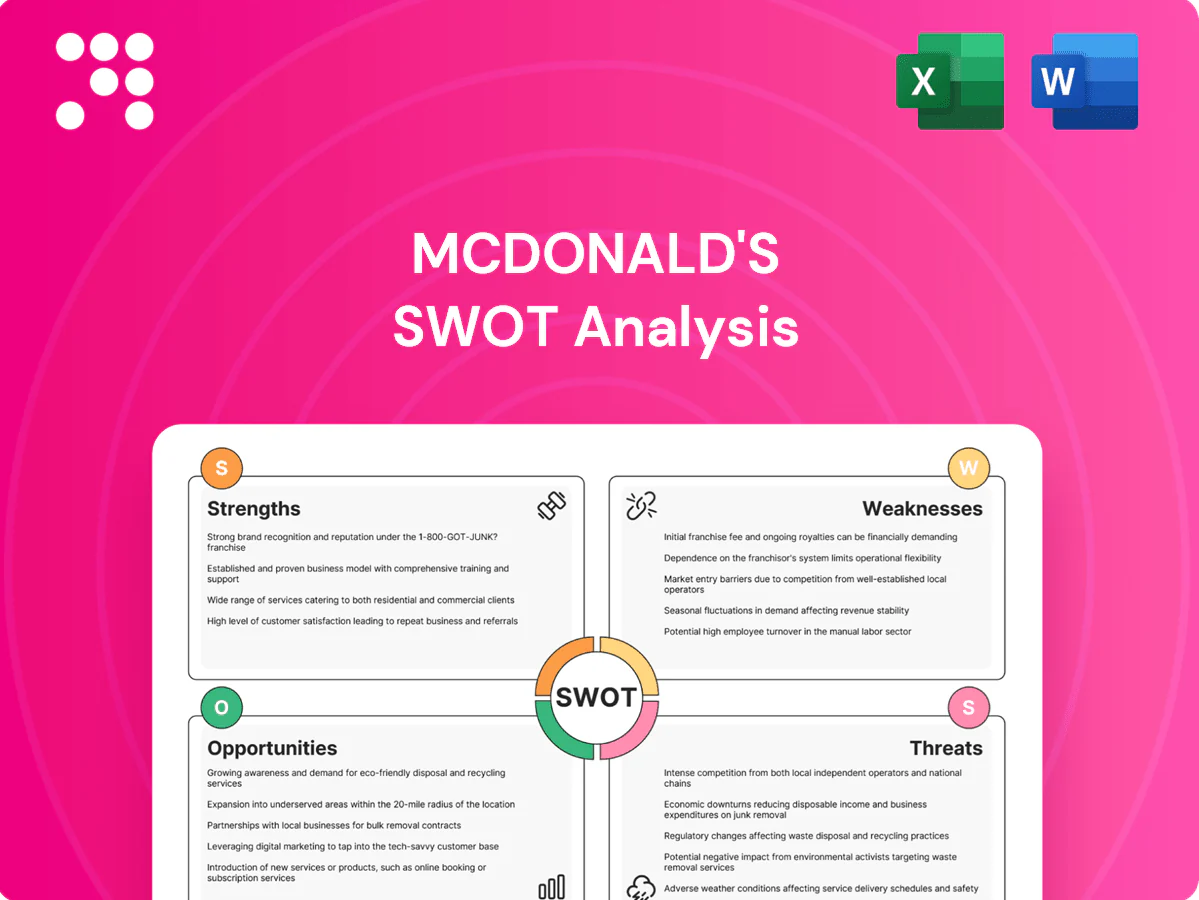
McDonald's SWOT Analysis

Your Strategic Toolkit Starts Here
McDonald's leverages a vast global footprint, iconic brand and efficient franchise model, but faces changing consumer tastes and regulatory pressures; digital ordering and delivery are key growth drivers while supply-chain risks and labor costs remain challenges. Want the full story behind the company’s strengths, risks, and growth drivers? Purchase the complete SWOT analysis to gain a professionally written, fully editable report.
Strengths

Iconic global brand
McDonald’s enjoys one of the most recognized brands worldwide, with over 40,000 restaurants in more than 100 countries, driving strong customer trust and consistent traffic. Its brand equity—reinforced by the Golden Arches and sustained global marketing—supports pricing power and resilient demand across economic cycles. Serving roughly 69 million customers daily, this recognition materially lowers customer acquisition costs globally.
Scale and supply chain
McDonald's scale—over 40,000 restaurants in 119 countries serving ~69 million customers daily—drives massive purchasing power that lowers unit costs and stabilizes supply. Centralized sourcing and strict quality standards ensure menu consistency across markets. The scale underpins efficient logistics and broad menu availability, and it cushions commodity-price swings far better than smaller rivals.

Franchise-led model
Asset-light franchising generates high-margin, recurring rent and royalty income, supported by a network of about 40,000 restaurants worldwide and over 93% franchised. Local operators tailor menus to cultural tastes while adhering to system standards, preserving brand consistency. Lower capital requirements enable faster expansion and stronger unit-level returns, with aligned incentives driving operational discipline and performance.

Operational consistency
Standardized processes at McDonald’s ensure speed, predictability and food safety, supported by kitchen systems and training that deliver uniform experiences across over 40,000 restaurants worldwide. This operational consistency underpins customer loyalty and drive-thru efficiency, with drive-thru present in roughly 70% of U.S. locations. It also enables scalable digital and delivery integration, with delivery available in 100+ countries.
- Operational scale: 40,000+ restaurants
- Drive-thru reach: ~70% of U.S. sites
- Delivery footprint: 100+ countries
- Outcome: consistent speed, safety, and repeatability
Digital and delivery ecosystem
McDonald's digital and delivery ecosystem—mobile ordering, MyMcDonald's loyalty, drive-thru tech and delivery partnerships—extends reach and, per McDonald's 2024 reporting, digital channels now drive over 20% of global sales; data from these channels enables tighter personalization and promotions, while off-premise strength sustains throughput during demand shifts and boosts check size and visit frequency.
- Digital >20% of sales (2024)
- Delivery checks +15–20%
- Loyalty fuels repeat visits
Global franchise scale: 40,000+ restaurants, asset-light royalties
McDonald’s global brand and scale—40,000+ restaurants in 119 countries serving ~69M customers daily—drive pricing power and low acquisition costs. Asset-light model (~93% franchised) yields high-margin royalties and steady cash flow. Digital/delivery >20% of sales (2024), boosting average check +15–20% and repeat visits via loyalty.
| Metric | Figure |
|---|---|
| Restaurants | 40,000+ |
| Countries | 119 |
| Customers/day | ~69M |
| Franchised | ~93% |
| Digital % sales (2024) | >20% |
| Delivery check uplift | +15–20% |
What is included in the product
 Detailed Word Document
Provides a clear SWOT framework examining McDonald's strengths, weaknesses, opportunities, and threats to assess its competitive position and strategic risks.

 Customizable Excel Spreadsheet
Provides a concise McDonald's SWOT matrix for fast, visual strategy alignment, pinpointing strengths (global brand, scale), weaknesses (franchise inconsistency), opportunities (digital delivery, menu innovation) and threats (competition, supply shocks) to speed stakeholder decisions.
Weaknesses

Health perception gap
McDonald's core menu is widely perceived as less healthy amid rising wellness trends, challenging retention of health-conscious diners; the chain operates over 39,000 restaurants in 100+ countries, so perception impacts large-scale traffic. Reformulating items risks diluting expected taste and menu complexity, while any meaningful health repositioning requires multi-year, high-cost marketing and product investments.
Franchisee dependence
System performance relies on thousands of independent operators. Approximately 93% of McDonald's ~40,000 restaurants are franchised (~37,000), so variability in execution can affect service, quality, and brand image. Franchisee disputes over fees, capex and remodels have in recent years slowed initiatives like tech rollouts and menu changes.

Menu complexity
Balancing frequent menu innovation with speed strains kitchen workflows, especially across McDonald's more than 40,000 global restaurants. Excessive SKUs slows service and raises errors and waste, increasing training hours and specialised equipment needs. Operational complexity risks eroding McDonald's hallmark of fast, consistent service.

Labor intensity
McDonald's labor intensity drives high turnover and training costs, with U.S. quick-service turnover commonly exceeding 100% annually, pressuring recruiting and onboarding budgets. Wage inflation and scheduling constraints compress unit economics and raise hourly labor as a larger share of operating costs. Tight labor markets slow service speed and hospitality, while retention programs require ongoing expense and managerial focus.
- High turnover >100% annually
- Rising wage pressure on margins
- Service speed risk from tight labor markets
- Ongoing costs for retention programs
FX and exposure mix
McDonald’s derives roughly 60% of systemwide sales from outside the U.S., creating currency-driven volatility in reported revenue and EPS; quarterly FX moves can shift reported growth by mid-single-digit percentage points. Varied market maturities produce uneven same-store sales and margins across regions, while political and economic swings can materially affect franchisee performance. Hedging reduces but does not eliminate these impacts.
- ~60% revenue outside U.S.; FX causes mid-single-digit swings
- Uneven growth/margins by market maturity
- Political/economic shifts hit franchisees; hedging partial
Legacy fast-food menu risks: health trends, franchise rollout friction, labor costs, FX volatility
McDonald's core menu is seen as less healthy, risking traffic amid wellness trends; reformulation and marketing require multi-year, high-cost investment. ~40,000 restaurants (≈93% franchised) create execution variability and franchisee disputes can slow rollouts. Labor intensity (US turnover >100%) and wage inflation compress margins; ~60% systemwide sales outside US drive FX volatility.
| Metric | Value |
|---|---|
| Restaurants | ~40,000 |
| Franchised | ~93% (~37,000) |
| Intl sales | ~60% |
| US turnover | >100% annually |
Same Document Delivered
McDonald's SWOT Analysis
This is a real excerpt from the complete McDonald's SWOT analysis you’ll receive upon purchase—no surprises, just professional quality. The preview below is taken directly from the full report and reflects the structured, editable file included in your download. Buy now to unlock the entire detailed version immediately after checkout.

Your Strategic Toolkit Starts Here
McDonald's leverages a vast global footprint, iconic brand and efficient franchise model, but faces changing consumer tastes and regulatory pressures; digital ordering and delivery are key growth drivers while supply-chain risks and labor costs remain challenges. Want the full story behind the company’s strengths, risks, and growth drivers? Purchase the complete SWOT analysis to gain a professionally written, fully editable report.
Strengths
Iconic global brand
McDonald’s enjoys one of the most recognized brands worldwide, with over 40,000 restaurants in more than 100 countries, driving strong customer trust and consistent traffic. Its brand equity—reinforced by the Golden Arches and sustained global marketing—supports pricing power and resilient demand across economic cycles. Serving roughly 69 million customers daily, this recognition materially lowers customer acquisition costs globally.
Scale and supply chain
McDonald's scale—over 40,000 restaurants in 119 countries serving ~69 million customers daily—drives massive purchasing power that lowers unit costs and stabilizes supply. Centralized sourcing and strict quality standards ensure menu consistency across markets. The scale underpins efficient logistics and broad menu availability, and it cushions commodity-price swings far better than smaller rivals.
Franchise-led model
Asset-light franchising generates high-margin, recurring rent and royalty income, supported by a network of about 40,000 restaurants worldwide and over 93% franchised. Local operators tailor menus to cultural tastes while adhering to system standards, preserving brand consistency. Lower capital requirements enable faster expansion and stronger unit-level returns, with aligned incentives driving operational discipline and performance.
Operational consistency
Standardized processes at McDonald’s ensure speed, predictability and food safety, supported by kitchen systems and training that deliver uniform experiences across over 40,000 restaurants worldwide. This operational consistency underpins customer loyalty and drive-thru efficiency, with drive-thru present in roughly 70% of U.S. locations. It also enables scalable digital and delivery integration, with delivery available in 100+ countries.
- Operational scale: 40,000+ restaurants
- Drive-thru reach: ~70% of U.S. sites
- Delivery footprint: 100+ countries
- Outcome: consistent speed, safety, and repeatability
Digital and delivery ecosystem
McDonald's digital and delivery ecosystem—mobile ordering, MyMcDonald's loyalty, drive-thru tech and delivery partnerships—extends reach and, per McDonald's 2024 reporting, digital channels now drive over 20% of global sales; data from these channels enables tighter personalization and promotions, while off-premise strength sustains throughput during demand shifts and boosts check size and visit frequency.
- Digital >20% of sales (2024)
- Delivery checks +15–20%
- Loyalty fuels repeat visits
Global franchise scale: 40,000+ restaurants, asset-light royalties
McDonald’s global brand and scale—40,000+ restaurants in 119 countries serving ~69M customers daily—drive pricing power and low acquisition costs. Asset-light model (~93% franchised) yields high-margin royalties and steady cash flow. Digital/delivery >20% of sales (2024), boosting average check +15–20% and repeat visits via loyalty.
| Metric | Figure |
|---|---|
| Restaurants | 40,000+ |
| Countries | 119 |
| Customers/day | ~69M |
| Franchised | ~93% |
| Digital % sales (2024) | >20% |
| Delivery check uplift | +15–20% |
What is included in the product
Detailed Word Document
Provides a clear SWOT framework examining McDonald's strengths, weaknesses, opportunities, and threats to assess its competitive position and strategic risks.
Customizable Excel Spreadsheet
Provides a concise McDonald's SWOT matrix for fast, visual strategy alignment, pinpointing strengths (global brand, scale), weaknesses (franchise inconsistency), opportunities (digital delivery, menu innovation) and threats (competition, supply shocks) to speed stakeholder decisions.
Weaknesses
Health perception gap
McDonald's core menu is widely perceived as less healthy amid rising wellness trends, challenging retention of health-conscious diners; the chain operates over 39,000 restaurants in 100+ countries, so perception impacts large-scale traffic. Reformulating items risks diluting expected taste and menu complexity, while any meaningful health repositioning requires multi-year, high-cost marketing and product investments.
Franchisee dependence
System performance relies on thousands of independent operators. Approximately 93% of McDonald's ~40,000 restaurants are franchised (~37,000), so variability in execution can affect service, quality, and brand image. Franchisee disputes over fees, capex and remodels have in recent years slowed initiatives like tech rollouts and menu changes.
Menu complexity
Balancing frequent menu innovation with speed strains kitchen workflows, especially across McDonald's more than 40,000 global restaurants. Excessive SKUs slows service and raises errors and waste, increasing training hours and specialised equipment needs. Operational complexity risks eroding McDonald's hallmark of fast, consistent service.
Labor intensity
McDonald's labor intensity drives high turnover and training costs, with U.S. quick-service turnover commonly exceeding 100% annually, pressuring recruiting and onboarding budgets. Wage inflation and scheduling constraints compress unit economics and raise hourly labor as a larger share of operating costs. Tight labor markets slow service speed and hospitality, while retention programs require ongoing expense and managerial focus.
- High turnover >100% annually
- Rising wage pressure on margins
- Service speed risk from tight labor markets
- Ongoing costs for retention programs
FX and exposure mix
McDonald’s derives roughly 60% of systemwide sales from outside the U.S., creating currency-driven volatility in reported revenue and EPS; quarterly FX moves can shift reported growth by mid-single-digit percentage points. Varied market maturities produce uneven same-store sales and margins across regions, while political and economic swings can materially affect franchisee performance. Hedging reduces but does not eliminate these impacts.
- ~60% revenue outside U.S.; FX causes mid-single-digit swings
- Uneven growth/margins by market maturity
- Political/economic shifts hit franchisees; hedging partial
Legacy fast-food menu risks: health trends, franchise rollout friction, labor costs, FX volatility
McDonald's core menu is seen as less healthy, risking traffic amid wellness trends; reformulation and marketing require multi-year, high-cost investment. ~40,000 restaurants (≈93% franchised) create execution variability and franchisee disputes can slow rollouts. Labor intensity (US turnover >100%) and wage inflation compress margins; ~60% systemwide sales outside US drive FX volatility.
| Metric | Value |
|---|---|
| Restaurants | ~40,000 |
| Franchised | ~93% (~37,000) |
| Intl sales | ~60% |
| US turnover | >100% annually |
Same Document Delivered
McDonald's SWOT Analysis
This is a real excerpt from the complete McDonald's SWOT analysis you’ll receive upon purchase—no surprises, just professional quality. The preview below is taken directly from the full report and reflects the structured, editable file included in your download. Buy now to unlock the entire detailed version immediately after checkout.
Description
Your Strategic Toolkit Starts Here
McDonald's leverages a vast global footprint, iconic brand and efficient franchise model, but faces changing consumer tastes and regulatory pressures; digital ordering and delivery are key growth drivers while supply-chain risks and labor costs remain challenges. Want the full story behind the company’s strengths, risks, and growth drivers? Purchase the complete SWOT analysis to gain a professionally written, fully editable report.
Strengths
Iconic global brand
McDonald’s enjoys one of the most recognized brands worldwide, with over 40,000 restaurants in more than 100 countries, driving strong customer trust and consistent traffic. Its brand equity—reinforced by the Golden Arches and sustained global marketing—supports pricing power and resilient demand across economic cycles. Serving roughly 69 million customers daily, this recognition materially lowers customer acquisition costs globally.
Scale and supply chain
McDonald's scale—over 40,000 restaurants in 119 countries serving ~69 million customers daily—drives massive purchasing power that lowers unit costs and stabilizes supply. Centralized sourcing and strict quality standards ensure menu consistency across markets. The scale underpins efficient logistics and broad menu availability, and it cushions commodity-price swings far better than smaller rivals.
Franchise-led model
Asset-light franchising generates high-margin, recurring rent and royalty income, supported by a network of about 40,000 restaurants worldwide and over 93% franchised. Local operators tailor menus to cultural tastes while adhering to system standards, preserving brand consistency. Lower capital requirements enable faster expansion and stronger unit-level returns, with aligned incentives driving operational discipline and performance.
Operational consistency
Standardized processes at McDonald’s ensure speed, predictability and food safety, supported by kitchen systems and training that deliver uniform experiences across over 40,000 restaurants worldwide. This operational consistency underpins customer loyalty and drive-thru efficiency, with drive-thru present in roughly 70% of U.S. locations. It also enables scalable digital and delivery integration, with delivery available in 100+ countries.
- Operational scale: 40,000+ restaurants
- Drive-thru reach: ~70% of U.S. sites
- Delivery footprint: 100+ countries
- Outcome: consistent speed, safety, and repeatability
Digital and delivery ecosystem
McDonald's digital and delivery ecosystem—mobile ordering, MyMcDonald's loyalty, drive-thru tech and delivery partnerships—extends reach and, per McDonald's 2024 reporting, digital channels now drive over 20% of global sales; data from these channels enables tighter personalization and promotions, while off-premise strength sustains throughput during demand shifts and boosts check size and visit frequency.
- Digital >20% of sales (2024)
- Delivery checks +15–20%
- Loyalty fuels repeat visits
Global franchise scale: 40,000+ restaurants, asset-light royalties
McDonald’s global brand and scale—40,000+ restaurants in 119 countries serving ~69M customers daily—drive pricing power and low acquisition costs. Asset-light model (~93% franchised) yields high-margin royalties and steady cash flow. Digital/delivery >20% of sales (2024), boosting average check +15–20% and repeat visits via loyalty.
| Metric | Figure |
|---|---|
| Restaurants | 40,000+ |
| Countries | 119 |
| Customers/day | ~69M |
| Franchised | ~93% |
| Digital % sales (2024) | >20% |
| Delivery check uplift | +15–20% |
What is included in the product
Detailed Word Document
Provides a clear SWOT framework examining McDonald's strengths, weaknesses, opportunities, and threats to assess its competitive position and strategic risks.
Customizable Excel Spreadsheet
Provides a concise McDonald's SWOT matrix for fast, visual strategy alignment, pinpointing strengths (global brand, scale), weaknesses (franchise inconsistency), opportunities (digital delivery, menu innovation) and threats (competition, supply shocks) to speed stakeholder decisions.
Weaknesses
Health perception gap
McDonald's core menu is widely perceived as less healthy amid rising wellness trends, challenging retention of health-conscious diners; the chain operates over 39,000 restaurants in 100+ countries, so perception impacts large-scale traffic. Reformulating items risks diluting expected taste and menu complexity, while any meaningful health repositioning requires multi-year, high-cost marketing and product investments.
Franchisee dependence
System performance relies on thousands of independent operators. Approximately 93% of McDonald's ~40,000 restaurants are franchised (~37,000), so variability in execution can affect service, quality, and brand image. Franchisee disputes over fees, capex and remodels have in recent years slowed initiatives like tech rollouts and menu changes.
Menu complexity
Balancing frequent menu innovation with speed strains kitchen workflows, especially across McDonald's more than 40,000 global restaurants. Excessive SKUs slows service and raises errors and waste, increasing training hours and specialised equipment needs. Operational complexity risks eroding McDonald's hallmark of fast, consistent service.
Labor intensity
McDonald's labor intensity drives high turnover and training costs, with U.S. quick-service turnover commonly exceeding 100% annually, pressuring recruiting and onboarding budgets. Wage inflation and scheduling constraints compress unit economics and raise hourly labor as a larger share of operating costs. Tight labor markets slow service speed and hospitality, while retention programs require ongoing expense and managerial focus.
- High turnover >100% annually
- Rising wage pressure on margins
- Service speed risk from tight labor markets
- Ongoing costs for retention programs
FX and exposure mix
McDonald’s derives roughly 60% of systemwide sales from outside the U.S., creating currency-driven volatility in reported revenue and EPS; quarterly FX moves can shift reported growth by mid-single-digit percentage points. Varied market maturities produce uneven same-store sales and margins across regions, while political and economic swings can materially affect franchisee performance. Hedging reduces but does not eliminate these impacts.
- ~60% revenue outside U.S.; FX causes mid-single-digit swings
- Uneven growth/margins by market maturity
- Political/economic shifts hit franchisees; hedging partial
Legacy fast-food menu risks: health trends, franchise rollout friction, labor costs, FX volatility
McDonald's core menu is seen as less healthy, risking traffic amid wellness trends; reformulation and marketing require multi-year, high-cost investment. ~40,000 restaurants (≈93% franchised) create execution variability and franchisee disputes can slow rollouts. Labor intensity (US turnover >100%) and wage inflation compress margins; ~60% systemwide sales outside US drive FX volatility.
| Metric | Value |
|---|---|
| Restaurants | ~40,000 |
| Franchised | ~93% (~37,000) |
| Intl sales | ~60% |
| US turnover | >100% annually |
Same Document Delivered
McDonald's SWOT Analysis
This is a real excerpt from the complete McDonald's SWOT analysis you’ll receive upon purchase—no surprises, just professional quality. The preview below is taken directly from the full report and reflects the structured, editable file included in your download. Buy now to unlock the entire detailed version immediately after checkout.











