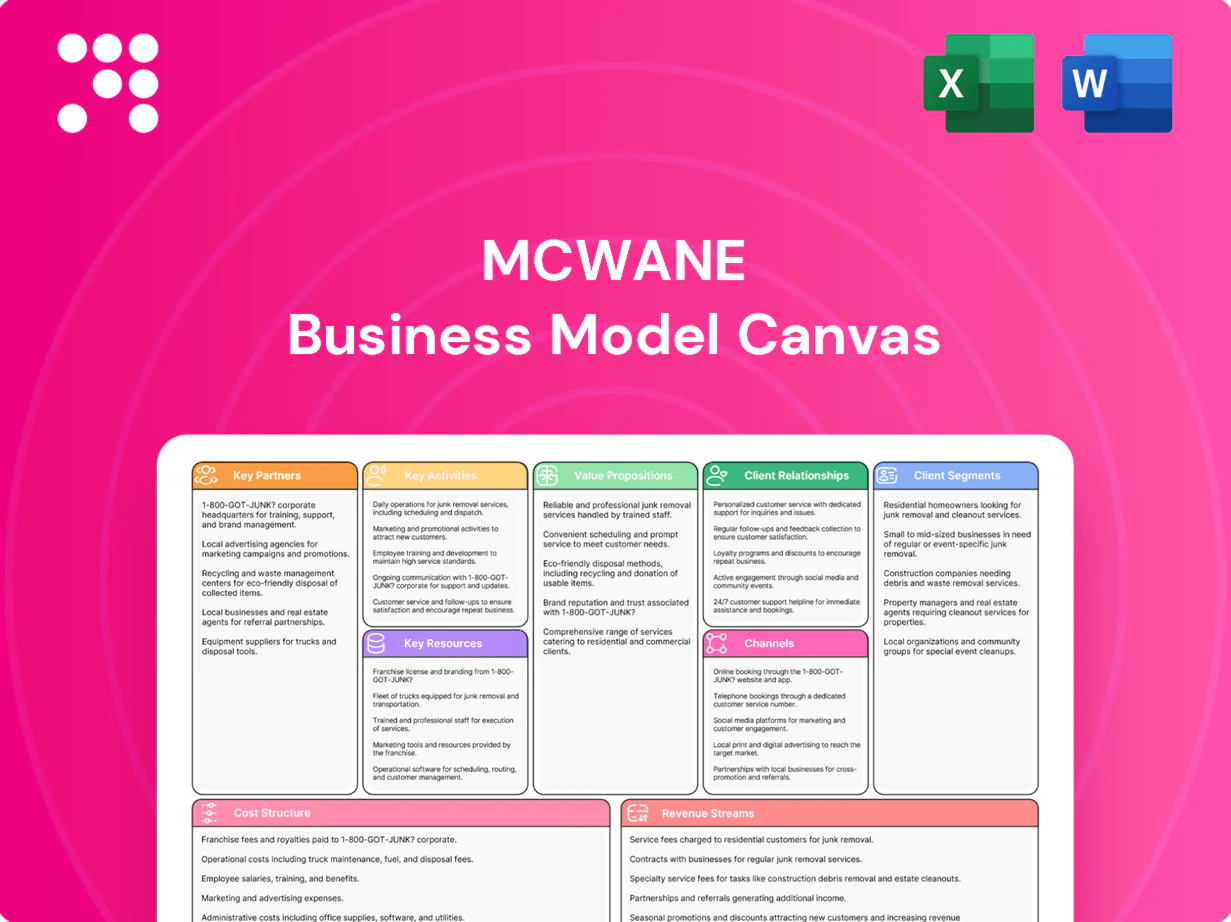
McWane Business Model Canvas

Unlock a full Business Model Canvas for industrial waterworks: clear value, scale, margin levers
Unlock McWane’s strategic blueprint with the full Business Model Canvas—three-sentence clarity on how the company creates value, scales operations, and protects margins. This downloadable Word/Excel pack delivers all nine blocks with company-specific insights, revenue levers, and cost drivers. Purchase the complete canvas to benchmark strategy, inform due diligence, and accelerate decision-making.
Partnerships

Raw material and alloy suppliers
Stable sources of scrap iron, alloys, and chemicals underpin casting throughput and cost predictability; in 2024 McWane emphasized secured scrap channels to protect mill utilization and margins. Multi-sourcing reduces price volatility risk and supply shocks by diversifying feedstock origins and contract tenors. Long-term contracts support volume planning and hedging strategies while vendor collaboration ensures metallurgical specs for ductile iron performance are met.
Foundry equipment and maintenance vendors
Foundry equipment and maintenance vendors supply melting furnaces, molds, core-making, machining centers and coating lines, with 2024 industry data showing technology upgrades can cut energy use by up to 15% and lower emissions. Preventive maintenance agreements typically reduce unplanned downtime by ~30–40% and raise yield. Joint trials with vendors accelerate process improvements and can cut defect/scrap rates by as much as 20–25%.

Distributors and manufacturer reps
Channel distributors and manufacturer reps extend McWane’s reach into regional waterworks and plumbing markets by aggregating demand, managing local inventory, and executing last-mile delivery. Joint marketing and hands-on training raise specification rates and improve win rates on municipal bids. Performance-based incentives tie distributor sell-through and service levels to rebate and margin structures, aligning local execution with corporate targets.

Engineering firms and EPC contractors
Specifiers in capital projects heavily influence pipe, valve, and hydrant selections, so McWane engages engineering firms and EPC contractors early to secure approved-equal status and design fit; the US Infrastructure Investment and Jobs Act committed roughly 55 billion USD for water infrastructure, increasing specification-driven opportunities. Coordination ensures product lead-times match construction schedules, while field feedback drives product enhancements and installation aids.
- Specifier influence: drives win rate on municipal projects
- Early engagement: secures approved-equal listings
- Coordination: aligns lead-times with project milestones
- Field feedback: informs product and installation improvements
Technology and IoT solution providers
Alliances with Technology and IoT solution providers enable smart hydrants, valve monitoring, and seamless asset management integrations, driving operational pilots and commercial rollouts in 2024. Interoperability with GIS, SCADA, and AMI systems has become a key procurement criterion boosting utility adoption. Data partnerships underpin analytics modules and condition monitoring while cybersecurity and standards compliance are co-developed with vendors.
- Smart hydrants: system integration
- GIS/SCADA/AMI: interoperability
- Data partnerships: analytics & condition monitoring
- Cybersecurity: joint standards development
Partnerships secure feedstock, cut costs: 15% energy, 30–40% less downtime
Key partnerships secure scrap and long-term feedstock contracts, supporting mill utilization and margins and aligning with 2024 infrastructure spending (US IIJA water funding ~55 billion USD). Equipment/vendor alliances delivered up to 15% energy savings, ~30–40% lower unplanned downtime and 20–25% scrap reduction in joint trials. Distributors, specifiers and IoT partners expand market reach, enable GIS/SCADA integration and co-develop cybersecurity standards.
| Partner | Benefit | 2024 Impact |
|---|---|---|
| Scrap suppliers | Feedstock stability | Supports mill utilization |
| Equipment vendors | Efficiency & uptime | Energy -15% | Downtime -30–40% | Scrap -20–25% |
| Specifiers/Distributors | Market access | IIJA water funding 55B USD |
| IoT partners | Asset monitoring | GIS/SCADA integration, cybersecurity |
What is included in the product
 Detailed Word Document
A comprehensive, pre-written McWane Business Model Canvas detailing customer segments, channels, value propositions and the 9 classic BMC blocks with narrative, competitive advantages and linked SWOT analysis—designed for presentations, investor discussions and strategic decision-making with clean, polished layout and real-world operational insights.

 Customizable Excel Spreadsheet
Condenses McWane’s strategy into a clean, one-page Business Model Canvas with editable cells, saving hours of formatting and enabling teams to quickly identify core components for fast decision-making and collaboration.
Activities

Casting, machining, and finishing
Core casting, machining, and finishing produce ductile iron pipe, valves, fittings, and hydrants; precision machining holds tolerances around 0.1 mm to ensure performance and safety. Coating and lining (epoxy, zinc) add corrosion resistance and support service lives exceeding 100 years. Continuous improvement in 2024 targeted yield gains, cutting scrap by 12% and improving throughput about 8%.
Quality assurance and compliance testing
Rigorous inspections verify dimensional, pressure, and metallurgical specs across production lines, with nonconformances logged for corrective action. As of 2024, certifications to AWWA, UL, FM and municipal standards are maintained. Batch traceability and lab testing safeguard component reliability and failure analysis. Audit readiness and complete documentation support customer approvals and specification sign-offs.

Supply chain and logistics management
Inbound materials, foundry scheduling and outbound freight are synchronized to support municipal projects driven by the Bipartisan Infrastructure Law’s roughly 55 billion USD water infrastructure program; demand planning accounts for municipal fiscal-year seasonality. Inventory buffering smooths lead-time variability while rail (≈40% of US freight ton-miles) and truck (≈72% of freight by value) partnerships cut cost-to-serve.

R&D and digital solutions development
R&D focuses on materials research to boost strength, durability and corrosion protection, while new product introductions align with evolving codes and installation requirements. Software and sensor features extend asset-management value and lifecycle visibility. Pilots with utilities and contractors in 2024 validated installation workflows and performance metrics.
- materials: enhanced corrosion resistance
- products: code-aligned launches
- digital: sensors + software for AM
- pilots: 2024 utility/contractor validation
Sales, bidding, and technical support
Sales, bidding, and technical support teams handle RFQs, submittals, and specification queries, driving accurate proposals and reducing procurement cycle time. Value engineering evaluates materials and installation methods to optimize total installed cost for customers. Training programs certify installers and maintenance crews to improve field reliability. Post-sale service manages warranty claims and field performance remediation to protect uptime.
- RFQ/submittal response
- Specification clarification
- Value engineering for cost optimization
- Installer and maintenance training
- Warranty and field service management
Core casting epoxy/zinc coatings > 100 yrs; 2024 +12% yield, +8% throughput
Core casting/machining (±0.1 mm) with epoxy/zinc coatings for >100-year service; 2024 continuous-improvement delivered +12% yield and +8% throughput. Inspections meet AWWA, UL, FM in 2024 with full traceability. Logistics aligned to Bipartisan Infrastructure Law (≈55 billion USD); rail ≈40% ton-miles, truck ≈72% freight value. Sales: RFQ/submittals, value engineering, installer training, warranty service.
| Metric | 2024 |
|---|---|
| Yield gain | +12% |
| Throughput | +8% |
| Service life | >100 yrs |
| Infra funding | $55B |
Preview Before You Purchase
Business Model Canvas
The document you're previewing is the actual McWane Business Model Canvas—not a mockup—and it is identical to the file you'll receive after purchase. When you complete your order you'll get the full, editable document ready for use. No placeholders, no surprises.

Unlock a full Business Model Canvas for industrial waterworks: clear value, scale, margin levers
Unlock McWane’s strategic blueprint with the full Business Model Canvas—three-sentence clarity on how the company creates value, scales operations, and protects margins. This downloadable Word/Excel pack delivers all nine blocks with company-specific insights, revenue levers, and cost drivers. Purchase the complete canvas to benchmark strategy, inform due diligence, and accelerate decision-making.
Partnerships
Raw material and alloy suppliers
Stable sources of scrap iron, alloys, and chemicals underpin casting throughput and cost predictability; in 2024 McWane emphasized secured scrap channels to protect mill utilization and margins. Multi-sourcing reduces price volatility risk and supply shocks by diversifying feedstock origins and contract tenors. Long-term contracts support volume planning and hedging strategies while vendor collaboration ensures metallurgical specs for ductile iron performance are met.
Foundry equipment and maintenance vendors
Foundry equipment and maintenance vendors supply melting furnaces, molds, core-making, machining centers and coating lines, with 2024 industry data showing technology upgrades can cut energy use by up to 15% and lower emissions. Preventive maintenance agreements typically reduce unplanned downtime by ~30–40% and raise yield. Joint trials with vendors accelerate process improvements and can cut defect/scrap rates by as much as 20–25%.
Distributors and manufacturer reps
Channel distributors and manufacturer reps extend McWane’s reach into regional waterworks and plumbing markets by aggregating demand, managing local inventory, and executing last-mile delivery. Joint marketing and hands-on training raise specification rates and improve win rates on municipal bids. Performance-based incentives tie distributor sell-through and service levels to rebate and margin structures, aligning local execution with corporate targets.
Engineering firms and EPC contractors
Specifiers in capital projects heavily influence pipe, valve, and hydrant selections, so McWane engages engineering firms and EPC contractors early to secure approved-equal status and design fit; the US Infrastructure Investment and Jobs Act committed roughly 55 billion USD for water infrastructure, increasing specification-driven opportunities. Coordination ensures product lead-times match construction schedules, while field feedback drives product enhancements and installation aids.
- Specifier influence: drives win rate on municipal projects
- Early engagement: secures approved-equal listings
- Coordination: aligns lead-times with project milestones
- Field feedback: informs product and installation improvements
Technology and IoT solution providers
Alliances with Technology and IoT solution providers enable smart hydrants, valve monitoring, and seamless asset management integrations, driving operational pilots and commercial rollouts in 2024. Interoperability with GIS, SCADA, and AMI systems has become a key procurement criterion boosting utility adoption. Data partnerships underpin analytics modules and condition monitoring while cybersecurity and standards compliance are co-developed with vendors.
- Smart hydrants: system integration
- GIS/SCADA/AMI: interoperability
- Data partnerships: analytics & condition monitoring
- Cybersecurity: joint standards development
Partnerships secure feedstock, cut costs: 15% energy, 30–40% less downtime
Key partnerships secure scrap and long-term feedstock contracts, supporting mill utilization and margins and aligning with 2024 infrastructure spending (US IIJA water funding ~55 billion USD). Equipment/vendor alliances delivered up to 15% energy savings, ~30–40% lower unplanned downtime and 20–25% scrap reduction in joint trials. Distributors, specifiers and IoT partners expand market reach, enable GIS/SCADA integration and co-develop cybersecurity standards.
| Partner | Benefit | 2024 Impact |
|---|---|---|
| Scrap suppliers | Feedstock stability | Supports mill utilization |
| Equipment vendors | Efficiency & uptime | Energy -15% | Downtime -30–40% | Scrap -20–25% |
| Specifiers/Distributors | Market access | IIJA water funding 55B USD |
| IoT partners | Asset monitoring | GIS/SCADA integration, cybersecurity |
What is included in the product
Detailed Word Document
A comprehensive, pre-written McWane Business Model Canvas detailing customer segments, channels, value propositions and the 9 classic BMC blocks with narrative, competitive advantages and linked SWOT analysis—designed for presentations, investor discussions and strategic decision-making with clean, polished layout and real-world operational insights.
Customizable Excel Spreadsheet
Condenses McWane’s strategy into a clean, one-page Business Model Canvas with editable cells, saving hours of formatting and enabling teams to quickly identify core components for fast decision-making and collaboration.
Activities
Casting, machining, and finishing
Core casting, machining, and finishing produce ductile iron pipe, valves, fittings, and hydrants; precision machining holds tolerances around 0.1 mm to ensure performance and safety. Coating and lining (epoxy, zinc) add corrosion resistance and support service lives exceeding 100 years. Continuous improvement in 2024 targeted yield gains, cutting scrap by 12% and improving throughput about 8%.
Quality assurance and compliance testing
Rigorous inspections verify dimensional, pressure, and metallurgical specs across production lines, with nonconformances logged for corrective action. As of 2024, certifications to AWWA, UL, FM and municipal standards are maintained. Batch traceability and lab testing safeguard component reliability and failure analysis. Audit readiness and complete documentation support customer approvals and specification sign-offs.
Supply chain and logistics management
Inbound materials, foundry scheduling and outbound freight are synchronized to support municipal projects driven by the Bipartisan Infrastructure Law’s roughly 55 billion USD water infrastructure program; demand planning accounts for municipal fiscal-year seasonality. Inventory buffering smooths lead-time variability while rail (≈40% of US freight ton-miles) and truck (≈72% of freight by value) partnerships cut cost-to-serve.
R&D and digital solutions development
R&D focuses on materials research to boost strength, durability and corrosion protection, while new product introductions align with evolving codes and installation requirements. Software and sensor features extend asset-management value and lifecycle visibility. Pilots with utilities and contractors in 2024 validated installation workflows and performance metrics.
- materials: enhanced corrosion resistance
- products: code-aligned launches
- digital: sensors + software for AM
- pilots: 2024 utility/contractor validation
Sales, bidding, and technical support
Sales, bidding, and technical support teams handle RFQs, submittals, and specification queries, driving accurate proposals and reducing procurement cycle time. Value engineering evaluates materials and installation methods to optimize total installed cost for customers. Training programs certify installers and maintenance crews to improve field reliability. Post-sale service manages warranty claims and field performance remediation to protect uptime.
- RFQ/submittal response
- Specification clarification
- Value engineering for cost optimization
- Installer and maintenance training
- Warranty and field service management
Core casting epoxy/zinc coatings > 100 yrs; 2024 +12% yield, +8% throughput
Core casting/machining (±0.1 mm) with epoxy/zinc coatings for >100-year service; 2024 continuous-improvement delivered +12% yield and +8% throughput. Inspections meet AWWA, UL, FM in 2024 with full traceability. Logistics aligned to Bipartisan Infrastructure Law (≈55 billion USD); rail ≈40% ton-miles, truck ≈72% freight value. Sales: RFQ/submittals, value engineering, installer training, warranty service.
| Metric | 2024 |
|---|---|
| Yield gain | +12% |
| Throughput | +8% |
| Service life | >100 yrs |
| Infra funding | $55B |
Preview Before You Purchase
Business Model Canvas
The document you're previewing is the actual McWane Business Model Canvas—not a mockup—and it is identical to the file you'll receive after purchase. When you complete your order you'll get the full, editable document ready for use. No placeholders, no surprises.
Original: $10.00
-65%$10.00
$3.50Description
Unlock a full Business Model Canvas for industrial waterworks: clear value, scale, margin levers
Unlock McWane’s strategic blueprint with the full Business Model Canvas—three-sentence clarity on how the company creates value, scales operations, and protects margins. This downloadable Word/Excel pack delivers all nine blocks with company-specific insights, revenue levers, and cost drivers. Purchase the complete canvas to benchmark strategy, inform due diligence, and accelerate decision-making.
Partnerships
Raw material and alloy suppliers
Stable sources of scrap iron, alloys, and chemicals underpin casting throughput and cost predictability; in 2024 McWane emphasized secured scrap channels to protect mill utilization and margins. Multi-sourcing reduces price volatility risk and supply shocks by diversifying feedstock origins and contract tenors. Long-term contracts support volume planning and hedging strategies while vendor collaboration ensures metallurgical specs for ductile iron performance are met.
Foundry equipment and maintenance vendors
Foundry equipment and maintenance vendors supply melting furnaces, molds, core-making, machining centers and coating lines, with 2024 industry data showing technology upgrades can cut energy use by up to 15% and lower emissions. Preventive maintenance agreements typically reduce unplanned downtime by ~30–40% and raise yield. Joint trials with vendors accelerate process improvements and can cut defect/scrap rates by as much as 20–25%.
Distributors and manufacturer reps
Channel distributors and manufacturer reps extend McWane’s reach into regional waterworks and plumbing markets by aggregating demand, managing local inventory, and executing last-mile delivery. Joint marketing and hands-on training raise specification rates and improve win rates on municipal bids. Performance-based incentives tie distributor sell-through and service levels to rebate and margin structures, aligning local execution with corporate targets.
Engineering firms and EPC contractors
Specifiers in capital projects heavily influence pipe, valve, and hydrant selections, so McWane engages engineering firms and EPC contractors early to secure approved-equal status and design fit; the US Infrastructure Investment and Jobs Act committed roughly 55 billion USD for water infrastructure, increasing specification-driven opportunities. Coordination ensures product lead-times match construction schedules, while field feedback drives product enhancements and installation aids.
- Specifier influence: drives win rate on municipal projects
- Early engagement: secures approved-equal listings
- Coordination: aligns lead-times with project milestones
- Field feedback: informs product and installation improvements
Technology and IoT solution providers
Alliances with Technology and IoT solution providers enable smart hydrants, valve monitoring, and seamless asset management integrations, driving operational pilots and commercial rollouts in 2024. Interoperability with GIS, SCADA, and AMI systems has become a key procurement criterion boosting utility adoption. Data partnerships underpin analytics modules and condition monitoring while cybersecurity and standards compliance are co-developed with vendors.
- Smart hydrants: system integration
- GIS/SCADA/AMI: interoperability
- Data partnerships: analytics & condition monitoring
- Cybersecurity: joint standards development
Partnerships secure feedstock, cut costs: 15% energy, 30–40% less downtime
Key partnerships secure scrap and long-term feedstock contracts, supporting mill utilization and margins and aligning with 2024 infrastructure spending (US IIJA water funding ~55 billion USD). Equipment/vendor alliances delivered up to 15% energy savings, ~30–40% lower unplanned downtime and 20–25% scrap reduction in joint trials. Distributors, specifiers and IoT partners expand market reach, enable GIS/SCADA integration and co-develop cybersecurity standards.
| Partner | Benefit | 2024 Impact |
|---|---|---|
| Scrap suppliers | Feedstock stability | Supports mill utilization |
| Equipment vendors | Efficiency & uptime | Energy -15% | Downtime -30–40% | Scrap -20–25% |
| Specifiers/Distributors | Market access | IIJA water funding 55B USD |
| IoT partners | Asset monitoring | GIS/SCADA integration, cybersecurity |
What is included in the product
Detailed Word Document
A comprehensive, pre-written McWane Business Model Canvas detailing customer segments, channels, value propositions and the 9 classic BMC blocks with narrative, competitive advantages and linked SWOT analysis—designed for presentations, investor discussions and strategic decision-making with clean, polished layout and real-world operational insights.
Customizable Excel Spreadsheet
Condenses McWane’s strategy into a clean, one-page Business Model Canvas with editable cells, saving hours of formatting and enabling teams to quickly identify core components for fast decision-making and collaboration.
Activities
Casting, machining, and finishing
Core casting, machining, and finishing produce ductile iron pipe, valves, fittings, and hydrants; precision machining holds tolerances around 0.1 mm to ensure performance and safety. Coating and lining (epoxy, zinc) add corrosion resistance and support service lives exceeding 100 years. Continuous improvement in 2024 targeted yield gains, cutting scrap by 12% and improving throughput about 8%.
Quality assurance and compliance testing
Rigorous inspections verify dimensional, pressure, and metallurgical specs across production lines, with nonconformances logged for corrective action. As of 2024, certifications to AWWA, UL, FM and municipal standards are maintained. Batch traceability and lab testing safeguard component reliability and failure analysis. Audit readiness and complete documentation support customer approvals and specification sign-offs.
Supply chain and logistics management
Inbound materials, foundry scheduling and outbound freight are synchronized to support municipal projects driven by the Bipartisan Infrastructure Law’s roughly 55 billion USD water infrastructure program; demand planning accounts for municipal fiscal-year seasonality. Inventory buffering smooths lead-time variability while rail (≈40% of US freight ton-miles) and truck (≈72% of freight by value) partnerships cut cost-to-serve.
R&D and digital solutions development
R&D focuses on materials research to boost strength, durability and corrosion protection, while new product introductions align with evolving codes and installation requirements. Software and sensor features extend asset-management value and lifecycle visibility. Pilots with utilities and contractors in 2024 validated installation workflows and performance metrics.
- materials: enhanced corrosion resistance
- products: code-aligned launches
- digital: sensors + software for AM
- pilots: 2024 utility/contractor validation
Sales, bidding, and technical support
Sales, bidding, and technical support teams handle RFQs, submittals, and specification queries, driving accurate proposals and reducing procurement cycle time. Value engineering evaluates materials and installation methods to optimize total installed cost for customers. Training programs certify installers and maintenance crews to improve field reliability. Post-sale service manages warranty claims and field performance remediation to protect uptime.
- RFQ/submittal response
- Specification clarification
- Value engineering for cost optimization
- Installer and maintenance training
- Warranty and field service management
Core casting epoxy/zinc coatings > 100 yrs; 2024 +12% yield, +8% throughput
Core casting/machining (±0.1 mm) with epoxy/zinc coatings for >100-year service; 2024 continuous-improvement delivered +12% yield and +8% throughput. Inspections meet AWWA, UL, FM in 2024 with full traceability. Logistics aligned to Bipartisan Infrastructure Law (≈55 billion USD); rail ≈40% ton-miles, truck ≈72% freight value. Sales: RFQ/submittals, value engineering, installer training, warranty service.
| Metric | 2024 |
|---|---|
| Yield gain | +12% |
| Throughput | +8% |
| Service life | >100 yrs |
| Infra funding | $55B |
Preview Before You Purchase
Business Model Canvas
The document you're previewing is the actual McWane Business Model Canvas—not a mockup—and it is identical to the file you'll receive after purchase. When you complete your order you'll get the full, editable document ready for use. No placeholders, no surprises.











