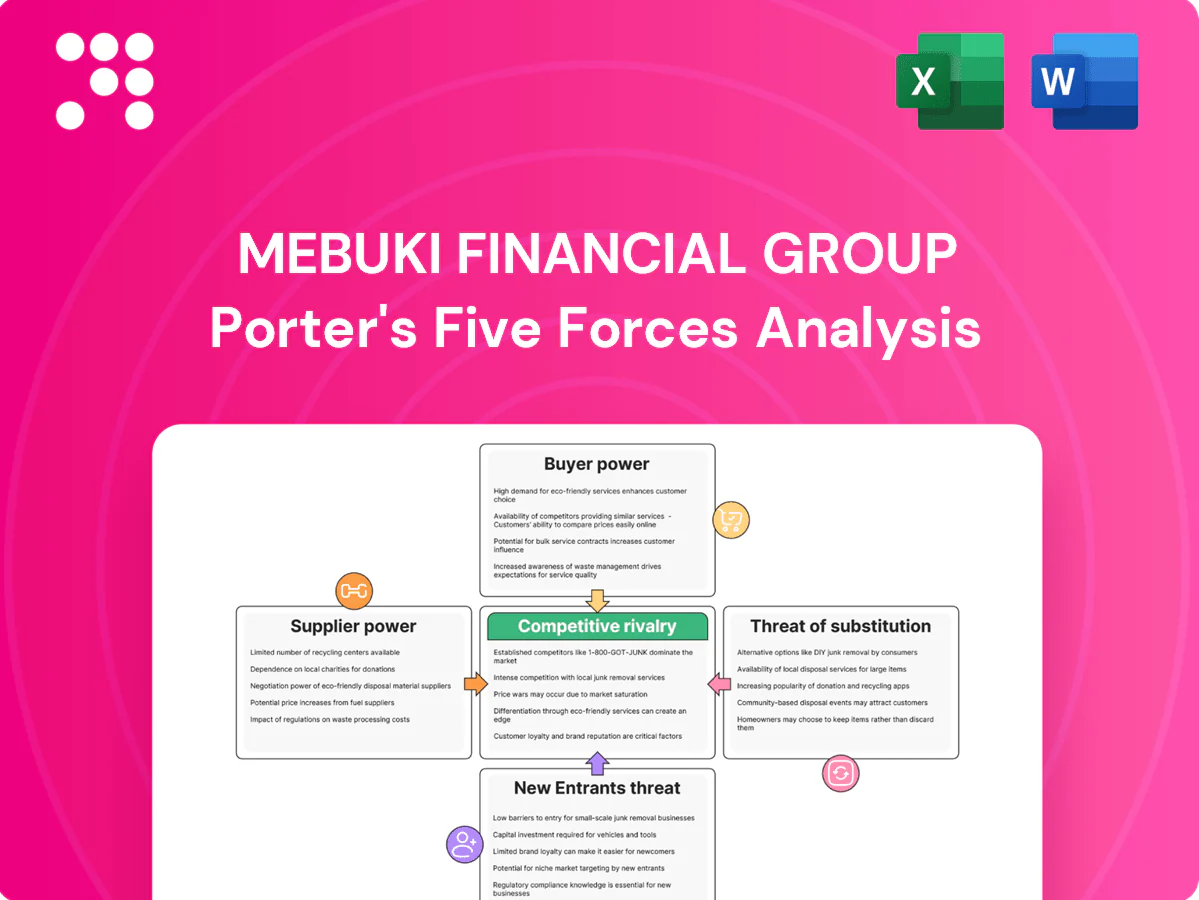
Mebuki Financial Group Porter's Five Forces Analysis

Don't Miss the Bigger Picture
Mebuki Financial Group faces moderate buyer power, evolving digital threats, and regulatory constraints that shape its margin dynamics; supplier leverage is limited but substitute financial platforms are rising. This snapshot highlights key competitive tensions. Unlock the full Porter's Five Forces Analysis for force-by-force ratings, visuals, and strategic recommendations to inform investment or strategy decisions.
Suppliers Bargaining Power

Wholesale funding and interbank lenders
Access to wholesale markets and interbank lines determines pricing and liquidity buffers; 10-year JGB yields rose to about 1.0% in 2024, tightening liquidity and lifting market funding costs.
When spreads widened during 2023–24, funding costs rose and compressed net interest margins across regional banks, narrowing NIMs versus prior years.
Mebuki’s regional scale limits bargaining power versus megabanks, so diversifying maturities and collateral is essential to improve terms and resilience.
Retail depositors as core funding
Retail deposits remain Mebuki's core funding in 2024, providing low-cost, sticky liquidity but prone to repricing as market rates rise. Competition from megabanks and online banks offering higher yields has increased deposit beta and short-term volatility in 2024. Maintaining local trust, branch convenience, loyalty programs and improved digital UX reduces sensitivity and helps retain balances.

Technology vendors and core systems
Reliance on core banking, cloud and payment rails creates high switching costs for Mebuki, with hyperscalers concentrated (2024 share: AWS ~32%, Microsoft Azure ~22%, Google Cloud ~11%) giving vendors negotiating leverage on contracts, timelines and integration scope. Multi-vendor strategies and open APIs can lower dependency, while joint procurement across group entities boosts bargaining scale and price leverage.

Talent and specialized human capital
Regulators as quasi-suppliers of licenses/liquidity
Regulatory licenses, deposit insurance (coverage cap 10 million yen per depositor) and BOJ liquidity facilities are essential inputs that function as quasi-suppliers for Mebuki Financial Group; compliance requirements add measurable costs and operational constraints while strong governance improves access to these backstops and reduces funding uncertainty.
- Licenses: mandatory for operations
- Deposit insurance: 10 million yen cap
- BOJ facilities: liquidity backstop
- Compliance: adds cost/constraints
- Governance: enhances credibility
10y JGB ~1.0% lifts funding costs; hyperscaler top ~32%
Wholesale funding tightened as 10-year JGB yields rose to ~1.0% in 2024, lifting market funding costs and compressing regional NIMs. Retail deposits remain core but deposit beta rose versus megabank/online competition. Hyperscaler concentration (AWS ~32%, Azure ~22%, Google ~11%) increases vendor leverage. Labor scarcity (unemployment ~2.5% in 2024) and a 10m yen deposit-insurance cap add cost and operational constraints.
| Metric | 2024 value | Impact |
|---|---|---|
| 10y JGB yield | ~1.0% | Higher funding costs |
| Deposit insurance cap | 10m yen | Limits depositor protection |
| AWS market share | ~32% | Vendor concentration |
| Azure | ~22% | Alternate vendor |
| Unemployment | ~2.5% | Talent cost pressure |
What is included in the product
 Detailed Word Document
Concise Porter's Five Forces for Mebuki Financial Group highlighting competitive rivalry, buyer and supplier power, entry barriers, and substitutes—identifying disruptive fintech threats, regulatory impacts, and strategic levers to protect margins and market share.

 Customizable Excel Spreadsheet
A concise, one-sheet Porter's Five Forces for Mebuki Financial Group that clarifies competitive pressures and speeds strategic decisions; customize pressure levels and swap in your own data to reflect regulatory or market shifts. Instant radar visualization and clean layout make it ready for pitch decks or integration into broader dashboards.
Customers Bargaining Power

SME borrowers in Ibaraki/Tochigi
SME borrowers in Ibaraki and Tochigi remain relationship-driven but can shop terms across regional peers, increasing bargaining power. In Japan SMEs account for 99.7% of firms and roughly 70% of employment (METI, 2024), so pricing pressure during rate upcycles materially affects loan yields. Bundled advisory and cash-management services reduce pure price comparisons. Local knowledge and execution speed are persistent differentiators.
Retail deposit and mortgage customers
Retail deposit and mortgage customers exert elevated bargaining power as online rate comparison drives price transparency; by 2024 many Japanese consumers reference web aggregators when choosing banks. Moderate switching costs persist given competitors offering digital onboarding and account opening in days. Branch proximity, loyalty programs and omni-channel service can temper this power, while cross-selling insurance and cards raises customer lifetime value and retention.

Large corporates and municipalities
Large corporates and municipalities command volume-driven fee concessions, with typical ticket sizes often exceeding ¥100 million, forcing banks to offer 10–20% price discounts on standard fees. Tender-based procurement for public entities heightens price competition and can compress margins during bid cycles. Offering underwriting, leasing and FX services increases client stickiness and cross-sell rates by an estimated 15–25%, while long-tenured relationships help absorb short-term pricing pressures.

Multi-banking behavior
Japanese retail clients routinely maintain multiple bank relationships; a 2024 FSA survey shows about 72% hold two or more bank accounts, enabling cherry-picking of rates and fees and increasing customer bargaining power against Mebuki.
Data-driven personalization and cross-product offers can raise share-of-wallet; banks using analytics reported up to 15% higher product penetration in 2024 pilots.
Seamless digital experiences and fee transparency reduce leakage to competitors, with digital-first churn rates falling by ~20% in 2024 for regional banks that upgraded UX.
- multi-banking: 72% (2024 FSA survey)
- product penetration lift: +15% (2024 analytics pilots)
- digital churn reduction: -20% (2024 UX upgrades)
Digital-first expectations
Clients now expect instant payments, 24/7 service, and low fees; fintech UX benchmarks (easy onboarding and one-click switching) raise customer bargaining power and increase churn risk, while continuous app enhancements and open-banking integrations serve as defenses; transparent pricing and rapid credit decisions (often minutes) are key trust drivers for Mebuki Financial Group.
- Customer expectations: instant payments, 24/7 access, low fees
- Fintech UX: lowers switching costs, raises bargaining power
- Defensive tech: continuous app updates, open-banking integrations
- Trust builders: transparent fees, rapid credit decisions
99.7% SMEs, 72% multi-bank, UX cuts churn -20%
SME and retail clients exert elevated bargaining power: SMEs are 99.7% of firms and ~70% of employment (METI 2024), while 72% of households multi-bank (FSA 2024). Large corporates force 10–20% fee discounts on >¥100m deals. Digital UX, analytics and cross-sell (pilot +15%) cut churn (~-20%) and mitigate pressure.
| Metric | Value |
|---|---|
| SME share | 99.7% |
| Employment (SMEs) | ~70% |
| Multi-banking | 72% |
| Cross-sell lift | +15% |
| Churn reduction | -20% |
| Large-ticket discount | 10–20% (¥100m+) |
Same Document Delivered
Mebuki Financial Group Porter's Five Forces Analysis
This preview shows the exact Mebuki Financial Group Porter's Five Forces Analysis you'll receive—fully written and professionally formatted. The file displayed is the same deliverable available for instant download after purchase. No placeholders, no mockups; ready for immediate use in your research or presentations.

Don't Miss the Bigger Picture
Mebuki Financial Group faces moderate buyer power, evolving digital threats, and regulatory constraints that shape its margin dynamics; supplier leverage is limited but substitute financial platforms are rising. This snapshot highlights key competitive tensions. Unlock the full Porter's Five Forces Analysis for force-by-force ratings, visuals, and strategic recommendations to inform investment or strategy decisions.
Suppliers Bargaining Power
Wholesale funding and interbank lenders
Access to wholesale markets and interbank lines determines pricing and liquidity buffers; 10-year JGB yields rose to about 1.0% in 2024, tightening liquidity and lifting market funding costs.
When spreads widened during 2023–24, funding costs rose and compressed net interest margins across regional banks, narrowing NIMs versus prior years.
Mebuki’s regional scale limits bargaining power versus megabanks, so diversifying maturities and collateral is essential to improve terms and resilience.
Retail depositors as core funding
Retail deposits remain Mebuki's core funding in 2024, providing low-cost, sticky liquidity but prone to repricing as market rates rise. Competition from megabanks and online banks offering higher yields has increased deposit beta and short-term volatility in 2024. Maintaining local trust, branch convenience, loyalty programs and improved digital UX reduces sensitivity and helps retain balances.
Technology vendors and core systems
Reliance on core banking, cloud and payment rails creates high switching costs for Mebuki, with hyperscalers concentrated (2024 share: AWS ~32%, Microsoft Azure ~22%, Google Cloud ~11%) giving vendors negotiating leverage on contracts, timelines and integration scope. Multi-vendor strategies and open APIs can lower dependency, while joint procurement across group entities boosts bargaining scale and price leverage.
Talent and specialized human capital
Regulators as quasi-suppliers of licenses/liquidity
Regulatory licenses, deposit insurance (coverage cap 10 million yen per depositor) and BOJ liquidity facilities are essential inputs that function as quasi-suppliers for Mebuki Financial Group; compliance requirements add measurable costs and operational constraints while strong governance improves access to these backstops and reduces funding uncertainty.
- Licenses: mandatory for operations
- Deposit insurance: 10 million yen cap
- BOJ facilities: liquidity backstop
- Compliance: adds cost/constraints
- Governance: enhances credibility
10y JGB ~1.0% lifts funding costs; hyperscaler top ~32%
Wholesale funding tightened as 10-year JGB yields rose to ~1.0% in 2024, lifting market funding costs and compressing regional NIMs. Retail deposits remain core but deposit beta rose versus megabank/online competition. Hyperscaler concentration (AWS ~32%, Azure ~22%, Google ~11%) increases vendor leverage. Labor scarcity (unemployment ~2.5% in 2024) and a 10m yen deposit-insurance cap add cost and operational constraints.
| Metric | 2024 value | Impact |
|---|---|---|
| 10y JGB yield | ~1.0% | Higher funding costs |
| Deposit insurance cap | 10m yen | Limits depositor protection |
| AWS market share | ~32% | Vendor concentration |
| Azure | ~22% | Alternate vendor |
| Unemployment | ~2.5% | Talent cost pressure |
What is included in the product
Detailed Word Document
Concise Porter's Five Forces for Mebuki Financial Group highlighting competitive rivalry, buyer and supplier power, entry barriers, and substitutes—identifying disruptive fintech threats, regulatory impacts, and strategic levers to protect margins and market share.
Customizable Excel Spreadsheet
A concise, one-sheet Porter's Five Forces for Mebuki Financial Group that clarifies competitive pressures and speeds strategic decisions; customize pressure levels and swap in your own data to reflect regulatory or market shifts. Instant radar visualization and clean layout make it ready for pitch decks or integration into broader dashboards.
Customers Bargaining Power
SME borrowers in Ibaraki/Tochigi
SME borrowers in Ibaraki and Tochigi remain relationship-driven but can shop terms across regional peers, increasing bargaining power. In Japan SMEs account for 99.7% of firms and roughly 70% of employment (METI, 2024), so pricing pressure during rate upcycles materially affects loan yields. Bundled advisory and cash-management services reduce pure price comparisons. Local knowledge and execution speed are persistent differentiators.
Retail deposit and mortgage customers
Retail deposit and mortgage customers exert elevated bargaining power as online rate comparison drives price transparency; by 2024 many Japanese consumers reference web aggregators when choosing banks. Moderate switching costs persist given competitors offering digital onboarding and account opening in days. Branch proximity, loyalty programs and omni-channel service can temper this power, while cross-selling insurance and cards raises customer lifetime value and retention.
Large corporates and municipalities
Large corporates and municipalities command volume-driven fee concessions, with typical ticket sizes often exceeding ¥100 million, forcing banks to offer 10–20% price discounts on standard fees. Tender-based procurement for public entities heightens price competition and can compress margins during bid cycles. Offering underwriting, leasing and FX services increases client stickiness and cross-sell rates by an estimated 15–25%, while long-tenured relationships help absorb short-term pricing pressures.
Multi-banking behavior
Japanese retail clients routinely maintain multiple bank relationships; a 2024 FSA survey shows about 72% hold two or more bank accounts, enabling cherry-picking of rates and fees and increasing customer bargaining power against Mebuki.
Data-driven personalization and cross-product offers can raise share-of-wallet; banks using analytics reported up to 15% higher product penetration in 2024 pilots.
Seamless digital experiences and fee transparency reduce leakage to competitors, with digital-first churn rates falling by ~20% in 2024 for regional banks that upgraded UX.
- multi-banking: 72% (2024 FSA survey)
- product penetration lift: +15% (2024 analytics pilots)
- digital churn reduction: -20% (2024 UX upgrades)
Digital-first expectations
Clients now expect instant payments, 24/7 service, and low fees; fintech UX benchmarks (easy onboarding and one-click switching) raise customer bargaining power and increase churn risk, while continuous app enhancements and open-banking integrations serve as defenses; transparent pricing and rapid credit decisions (often minutes) are key trust drivers for Mebuki Financial Group.
- Customer expectations: instant payments, 24/7 access, low fees
- Fintech UX: lowers switching costs, raises bargaining power
- Defensive tech: continuous app updates, open-banking integrations
- Trust builders: transparent fees, rapid credit decisions
99.7% SMEs, 72% multi-bank, UX cuts churn -20%
SME and retail clients exert elevated bargaining power: SMEs are 99.7% of firms and ~70% of employment (METI 2024), while 72% of households multi-bank (FSA 2024). Large corporates force 10–20% fee discounts on >¥100m deals. Digital UX, analytics and cross-sell (pilot +15%) cut churn (~-20%) and mitigate pressure.
| Metric | Value |
|---|---|
| SME share | 99.7% |
| Employment (SMEs) | ~70% |
| Multi-banking | 72% |
| Cross-sell lift | +15% |
| Churn reduction | -20% |
| Large-ticket discount | 10–20% (¥100m+) |
Same Document Delivered
Mebuki Financial Group Porter's Five Forces Analysis
This preview shows the exact Mebuki Financial Group Porter's Five Forces Analysis you'll receive—fully written and professionally formatted. The file displayed is the same deliverable available for instant download after purchase. No placeholders, no mockups; ready for immediate use in your research or presentations.
Original: $10.00
-65%$10.00
$3.50Description
Don't Miss the Bigger Picture
Mebuki Financial Group faces moderate buyer power, evolving digital threats, and regulatory constraints that shape its margin dynamics; supplier leverage is limited but substitute financial platforms are rising. This snapshot highlights key competitive tensions. Unlock the full Porter's Five Forces Analysis for force-by-force ratings, visuals, and strategic recommendations to inform investment or strategy decisions.
Suppliers Bargaining Power
Wholesale funding and interbank lenders
Access to wholesale markets and interbank lines determines pricing and liquidity buffers; 10-year JGB yields rose to about 1.0% in 2024, tightening liquidity and lifting market funding costs.
When spreads widened during 2023–24, funding costs rose and compressed net interest margins across regional banks, narrowing NIMs versus prior years.
Mebuki’s regional scale limits bargaining power versus megabanks, so diversifying maturities and collateral is essential to improve terms and resilience.
Retail depositors as core funding
Retail deposits remain Mebuki's core funding in 2024, providing low-cost, sticky liquidity but prone to repricing as market rates rise. Competition from megabanks and online banks offering higher yields has increased deposit beta and short-term volatility in 2024. Maintaining local trust, branch convenience, loyalty programs and improved digital UX reduces sensitivity and helps retain balances.
Technology vendors and core systems
Reliance on core banking, cloud and payment rails creates high switching costs for Mebuki, with hyperscalers concentrated (2024 share: AWS ~32%, Microsoft Azure ~22%, Google Cloud ~11%) giving vendors negotiating leverage on contracts, timelines and integration scope. Multi-vendor strategies and open APIs can lower dependency, while joint procurement across group entities boosts bargaining scale and price leverage.
Talent and specialized human capital
Regulators as quasi-suppliers of licenses/liquidity
Regulatory licenses, deposit insurance (coverage cap 10 million yen per depositor) and BOJ liquidity facilities are essential inputs that function as quasi-suppliers for Mebuki Financial Group; compliance requirements add measurable costs and operational constraints while strong governance improves access to these backstops and reduces funding uncertainty.
- Licenses: mandatory for operations
- Deposit insurance: 10 million yen cap
- BOJ facilities: liquidity backstop
- Compliance: adds cost/constraints
- Governance: enhances credibility
10y JGB ~1.0% lifts funding costs; hyperscaler top ~32%
Wholesale funding tightened as 10-year JGB yields rose to ~1.0% in 2024, lifting market funding costs and compressing regional NIMs. Retail deposits remain core but deposit beta rose versus megabank/online competition. Hyperscaler concentration (AWS ~32%, Azure ~22%, Google ~11%) increases vendor leverage. Labor scarcity (unemployment ~2.5% in 2024) and a 10m yen deposit-insurance cap add cost and operational constraints.
| Metric | 2024 value | Impact |
|---|---|---|
| 10y JGB yield | ~1.0% | Higher funding costs |
| Deposit insurance cap | 10m yen | Limits depositor protection |
| AWS market share | ~32% | Vendor concentration |
| Azure | ~22% | Alternate vendor |
| Unemployment | ~2.5% | Talent cost pressure |
What is included in the product
Detailed Word Document
Concise Porter's Five Forces for Mebuki Financial Group highlighting competitive rivalry, buyer and supplier power, entry barriers, and substitutes—identifying disruptive fintech threats, regulatory impacts, and strategic levers to protect margins and market share.
Customizable Excel Spreadsheet
A concise, one-sheet Porter's Five Forces for Mebuki Financial Group that clarifies competitive pressures and speeds strategic decisions; customize pressure levels and swap in your own data to reflect regulatory or market shifts. Instant radar visualization and clean layout make it ready for pitch decks or integration into broader dashboards.
Customers Bargaining Power
SME borrowers in Ibaraki/Tochigi
SME borrowers in Ibaraki and Tochigi remain relationship-driven but can shop terms across regional peers, increasing bargaining power. In Japan SMEs account for 99.7% of firms and roughly 70% of employment (METI, 2024), so pricing pressure during rate upcycles materially affects loan yields. Bundled advisory and cash-management services reduce pure price comparisons. Local knowledge and execution speed are persistent differentiators.
Retail deposit and mortgage customers
Retail deposit and mortgage customers exert elevated bargaining power as online rate comparison drives price transparency; by 2024 many Japanese consumers reference web aggregators when choosing banks. Moderate switching costs persist given competitors offering digital onboarding and account opening in days. Branch proximity, loyalty programs and omni-channel service can temper this power, while cross-selling insurance and cards raises customer lifetime value and retention.
Large corporates and municipalities
Large corporates and municipalities command volume-driven fee concessions, with typical ticket sizes often exceeding ¥100 million, forcing banks to offer 10–20% price discounts on standard fees. Tender-based procurement for public entities heightens price competition and can compress margins during bid cycles. Offering underwriting, leasing and FX services increases client stickiness and cross-sell rates by an estimated 15–25%, while long-tenured relationships help absorb short-term pricing pressures.
Multi-banking behavior
Japanese retail clients routinely maintain multiple bank relationships; a 2024 FSA survey shows about 72% hold two or more bank accounts, enabling cherry-picking of rates and fees and increasing customer bargaining power against Mebuki.
Data-driven personalization and cross-product offers can raise share-of-wallet; banks using analytics reported up to 15% higher product penetration in 2024 pilots.
Seamless digital experiences and fee transparency reduce leakage to competitors, with digital-first churn rates falling by ~20% in 2024 for regional banks that upgraded UX.
- multi-banking: 72% (2024 FSA survey)
- product penetration lift: +15% (2024 analytics pilots)
- digital churn reduction: -20% (2024 UX upgrades)
Digital-first expectations
Clients now expect instant payments, 24/7 service, and low fees; fintech UX benchmarks (easy onboarding and one-click switching) raise customer bargaining power and increase churn risk, while continuous app enhancements and open-banking integrations serve as defenses; transparent pricing and rapid credit decisions (often minutes) are key trust drivers for Mebuki Financial Group.
- Customer expectations: instant payments, 24/7 access, low fees
- Fintech UX: lowers switching costs, raises bargaining power
- Defensive tech: continuous app updates, open-banking integrations
- Trust builders: transparent fees, rapid credit decisions
99.7% SMEs, 72% multi-bank, UX cuts churn -20%
SME and retail clients exert elevated bargaining power: SMEs are 99.7% of firms and ~70% of employment (METI 2024), while 72% of households multi-bank (FSA 2024). Large corporates force 10–20% fee discounts on >¥100m deals. Digital UX, analytics and cross-sell (pilot +15%) cut churn (~-20%) and mitigate pressure.
| Metric | Value |
|---|---|
| SME share | 99.7% |
| Employment (SMEs) | ~70% |
| Multi-banking | 72% |
| Cross-sell lift | +15% |
| Churn reduction | -20% |
| Large-ticket discount | 10–20% (¥100m+) |
Same Document Delivered
Mebuki Financial Group Porter's Five Forces Analysis
This preview shows the exact Mebuki Financial Group Porter's Five Forces Analysis you'll receive—fully written and professionally formatted. The file displayed is the same deliverable available for instant download after purchase. No placeholders, no mockups; ready for immediate use in your research or presentations.











