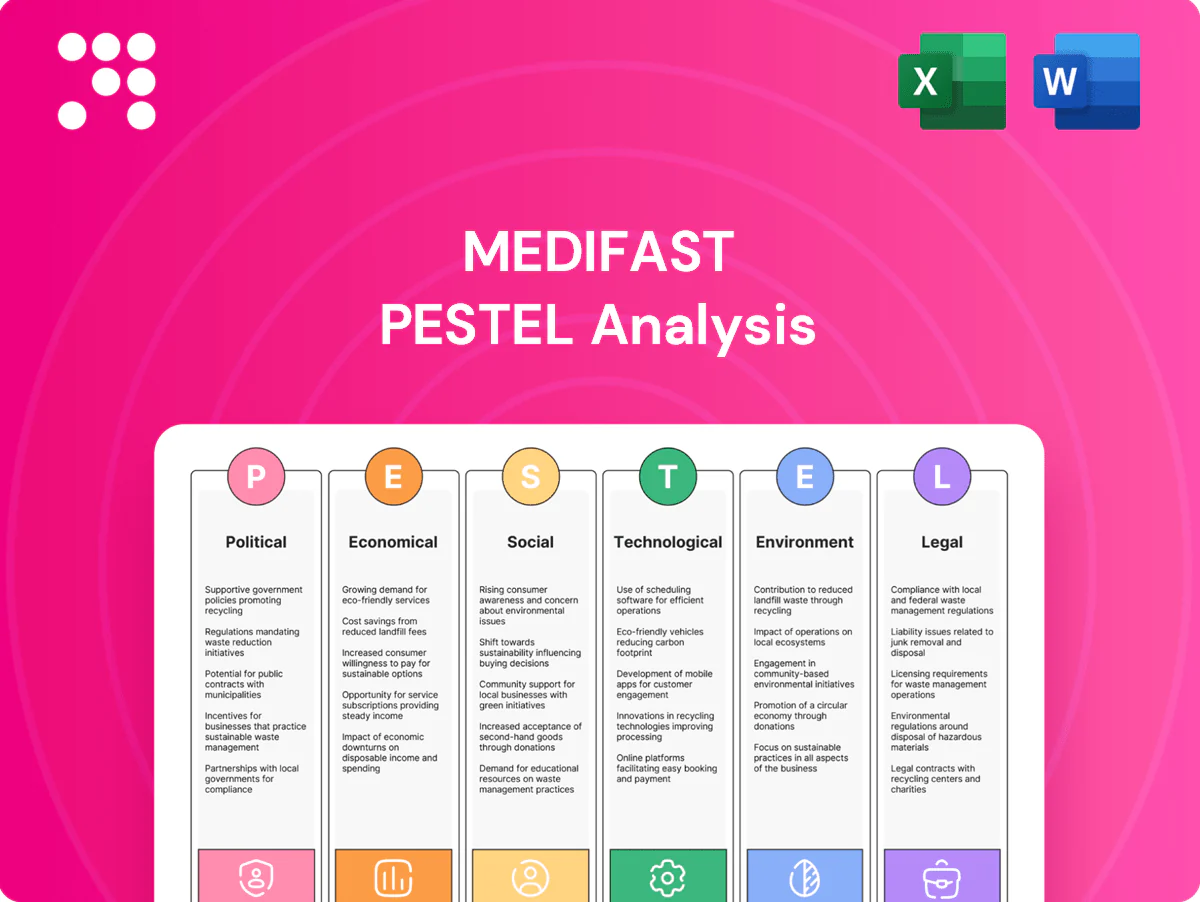
Medifast PESTLE Analysis

Your Competitive Advantage Starts with This Report
Discover how political, economic, social, technological, legal, and environmental forces are shaping Medifast’s outlook in our concise PESTLE analysis. Three actionable insights reveal regulatory risks, market opportunities, and tech drivers impacting growth. Buy the full report for the complete breakdown and immediate, editable intelligence to inform strategy and investment decisions.
Political factors

Regulatory scrutiny of direct-selling
As a direct-selling model, Medifast faces shifting oversight as policymakers scrutinize multi-level marketing; US direct-selling retail sales were about 40.1 billion in 2023, underscoring sector exposure. Changes in disclosure or earnings-claim rules can raise compliance costs and constrain growth relative to Medifast’s ~1.05 billion FY2023 revenue. Political attention spikes after high-profile enforcement, hurting recruiting and reputation, so proactive government relations and transparent coach economics help mitigate risk.
Nutrition and public health policy
Government initiatives tackling US obesity (41.9% of adults per CDC) and diabetes (about 37.3 million Americans, ~11.2%, per ADA) can boost demand for structured weight programs like Medifast. Subsidies, clinical guidance, or public–private partnerships tend to favor evidence-based interventions and reimbursement, while prescriptive dietary guidelines may challenge proprietary protocols. Active engagement with public health agendas helps align product offerings with policy direction.

Trade and tariff dynamics on inputs
Ingredients, packaging and manufacturing equipment for Medifast can be exposed to trade barriers such as the Section 301 tariffs that in 2018 targeted roughly $370 billion of Chinese goods with rates up to 25%, raising input costs and supply-chain risk. Political shifts in US–China or North American trade agreements can materially alter cost structures; diversified sourcing and nearshoring strategies reduce vulnerability. Active scenario planning for tariff volatility preserves margins by modeling 10–25% cost shocks and alternate supplier mixes.

Healthcare integration incentives
Policies promoting preventive care (ACA preventive coverage since 2010) and value-based payment shifts create referral and collaboration opportunities for Medifast; US health spending reached about $4.5 trillion in 2023, underscoring market scale. Political support for employer wellness expands B2B channels; HSA/reimbursement rule changes directly affect product affordability, and strict anti-kickback/referral rules require careful compliance.
- Preventive-care coverage: ACA (since 2010) — facilitates provider referrals
- Employer wellness: expands B2B sales channels
- Reimbursement/HSA policy: affects consumer affordability
- Regulatory risk: anti-kickback and referral compliance essential
State-level regulatory fragmentation
US regulatory fragmentation across 50 states affects food safety standards, direct-selling registration and auto-renewal rules, creating uneven obligations for Medifast coach networks. The patchwork raises administrative burdens and compliance costs, while 2024 political turnover has amplified enforcement variability. Centralized compliance support enables more uniform coach operations.
- 50 states: differing rules
- Higher admin/compliance costs
- 2024 enforcement shifts
- Centralized support reduces variability
Direct-selling diet firms face scrutiny as $40.1B industry meets obesity-driven demand
Medifast faces stronger direct-selling scrutiny while US direct-selling sales were $40.1B (2023) and Medifast revenue ~$1.05B (FY2023); high obesity (41.9%) and diabetes (~37.3M) support demand; tariffs and US–China shifts raise input risk; 50-state regulatory variance increases compliance costs while ACA preventive coverage and employer wellness widen B2B channels.
| Metric | Value |
|---|---|
| Direct-selling sales (2023) | $40.1B |
| Medifast rev (FY2023) | $1.05B |
| US adult obesity | 41.9% |
What is included in the product
 Detailed Word Document
Explores how external macro-environmental factors uniquely affect Medifast across Political, Economic, Social, Technological, Environmental and Legal dimensions; data-backed, forward-looking insights designed for executives, consultants and investors to identify threats, opportunities and inform strategy.

 Customizable Excel Spreadsheet
Clean, visually segmented Medifast PESTLE summary that’s editable for region- or product-specific notes, easily dropped into presentations or shared across teams to streamline risk discussions and strategic planning.
Economic factors

Consumer discretionary spending
Weight-management programs like Medifast are sensitive to household budgets; with US adult obesity at 41.9% (CDC 2017–2020) demand is large but discretionary spend tightened through 2024 as households prioritized essentials. Rising unemployment (around 3.9% average in 2024) depresses new client acquisition and retention, pressuring enrollment-driven revenue. Premium positioning must demonstrate clear ROI on health outcomes, while flexible pricing and subscription models help smooth revenue volatility across economic cycles.
Food and commodity inflation
Input costs for proteins, sweeteners and packaging have pressured Medifast gross margins—company-level gross margin was about 39% in 2023 while US food-at-home CPI rose roughly 2.9% in 2024, forcing selective price increases that risk demand elasticity. Strategic hedging and product reformulation can partially offset commodity spikes, while operational efficiency and SKU rationalization help preserve perceived value and margin resilience.

Channel economics and coach incentives
Channel economics for Medifast depend on attractive coach earnings and manageable churn; fiscal 2023 net sales were 1.09 billion, underscoring reliance on field productivity. Incentive redesigns materially affect growth, customer acquisition cost and lifetime value by shifting payout leverage and retention. Rising macro cost pressures drive some coaches toward alternative gig income, while data-driven compensation tuning is critical to sustain field motivation and reduce churn.

FX and international expansion
International growth exposes Medifast to currency risk and local price sensitivity, with FX swings having materially affected multinational consumer-health firms in 2023–2025.
A strong US dollar can compress reported overseas revenue and margins; localized sourcing and pricing reduce pass-through and protect margin stability.
Phased market entry and distributor-based models limit capital at risk and allow testing price elasticity before scaling.
- FX risk: impacts reported revenue and margins
- Mitigation: local sourcing/pricing
- Strategy: phased entry reduces capital exposure
Competitive intensity in weight loss
Prescription GLP-1s and digital weight-loss apps have sharply raised competitive intensity, with industry GLP-1 sales estimated near $40B in 2024 while Medifast reported roughly $1.1B revenue in FY2024, forcing economic trade-offs between high-cost pharmaceuticals and lower-cost meal replacements for market share. Bundling behavioral coaching increases retention and price justification, and strategic partnerships (retail, insurers, digital platforms) expand Medifast’s addressable market.
- GLP-1 sales ~ $40B (2024)
- Medifast FY2024 revenue ~ $1.1B
- Bundled coaching = higher LTV
- Partnerships expand TAM (insurers, digital, retail)
Direct-selling diet firms face scrutiny as $40.1B industry meets obesity-driven demand
Household budget pressure muted discretionary spend despite US adult obesity at 41.9% (CDC 2017–2020) and ~3.9% average unemployment in 2024, hurting Medifast enrollment-driven revenue. Input-costs pushed gross margin near 39% in 2023 while US food-at-home CPI rose ~2.9% in 2024, forcing selective price actions. Competitive disruption from GLP-1s (~$40B sales in 2024) pressures pricing and drives bundling with coaching; FY2024 revenue ~ $1.1B.
| Metric | Value |
|---|---|
| US adult obesity | 41.9% |
| Unemployment (2024) | ~3.9% |
| Medifast FY2024 | $1.1B |
| GLP-1 sales (2024) | ~$40B |
| Gross margin (2023) | ~39% |
Preview Before You Purchase
Medifast PESTLE Analysis
The preview shown here is the exact Medifast PESTLE Analysis you’ll receive after purchase—fully formatted and ready to use. It covers Political, Economic, Social, Technological, Legal, and Environmental factors with actionable insights and clear structure. No placeholders or teasers—this is the final file you’ll be able to download immediately after checkout.

Your Competitive Advantage Starts with This Report
Discover how political, economic, social, technological, legal, and environmental forces are shaping Medifast’s outlook in our concise PESTLE analysis. Three actionable insights reveal regulatory risks, market opportunities, and tech drivers impacting growth. Buy the full report for the complete breakdown and immediate, editable intelligence to inform strategy and investment decisions.
Political factors
Regulatory scrutiny of direct-selling
As a direct-selling model, Medifast faces shifting oversight as policymakers scrutinize multi-level marketing; US direct-selling retail sales were about 40.1 billion in 2023, underscoring sector exposure. Changes in disclosure or earnings-claim rules can raise compliance costs and constrain growth relative to Medifast’s ~1.05 billion FY2023 revenue. Political attention spikes after high-profile enforcement, hurting recruiting and reputation, so proactive government relations and transparent coach economics help mitigate risk.
Nutrition and public health policy
Government initiatives tackling US obesity (41.9% of adults per CDC) and diabetes (about 37.3 million Americans, ~11.2%, per ADA) can boost demand for structured weight programs like Medifast. Subsidies, clinical guidance, or public–private partnerships tend to favor evidence-based interventions and reimbursement, while prescriptive dietary guidelines may challenge proprietary protocols. Active engagement with public health agendas helps align product offerings with policy direction.
Trade and tariff dynamics on inputs
Ingredients, packaging and manufacturing equipment for Medifast can be exposed to trade barriers such as the Section 301 tariffs that in 2018 targeted roughly $370 billion of Chinese goods with rates up to 25%, raising input costs and supply-chain risk. Political shifts in US–China or North American trade agreements can materially alter cost structures; diversified sourcing and nearshoring strategies reduce vulnerability. Active scenario planning for tariff volatility preserves margins by modeling 10–25% cost shocks and alternate supplier mixes.
Healthcare integration incentives
Policies promoting preventive care (ACA preventive coverage since 2010) and value-based payment shifts create referral and collaboration opportunities for Medifast; US health spending reached about $4.5 trillion in 2023, underscoring market scale. Political support for employer wellness expands B2B channels; HSA/reimbursement rule changes directly affect product affordability, and strict anti-kickback/referral rules require careful compliance.
- Preventive-care coverage: ACA (since 2010) — facilitates provider referrals
- Employer wellness: expands B2B sales channels
- Reimbursement/HSA policy: affects consumer affordability
- Regulatory risk: anti-kickback and referral compliance essential
State-level regulatory fragmentation
US regulatory fragmentation across 50 states affects food safety standards, direct-selling registration and auto-renewal rules, creating uneven obligations for Medifast coach networks. The patchwork raises administrative burdens and compliance costs, while 2024 political turnover has amplified enforcement variability. Centralized compliance support enables more uniform coach operations.
- 50 states: differing rules
- Higher admin/compliance costs
- 2024 enforcement shifts
- Centralized support reduces variability
Direct-selling diet firms face scrutiny as $40.1B industry meets obesity-driven demand
Medifast faces stronger direct-selling scrutiny while US direct-selling sales were $40.1B (2023) and Medifast revenue ~$1.05B (FY2023); high obesity (41.9%) and diabetes (~37.3M) support demand; tariffs and US–China shifts raise input risk; 50-state regulatory variance increases compliance costs while ACA preventive coverage and employer wellness widen B2B channels.
| Metric | Value |
|---|---|
| Direct-selling sales (2023) | $40.1B |
| Medifast rev (FY2023) | $1.05B |
| US adult obesity | 41.9% |
What is included in the product
Detailed Word Document
Explores how external macro-environmental factors uniquely affect Medifast across Political, Economic, Social, Technological, Environmental and Legal dimensions; data-backed, forward-looking insights designed for executives, consultants and investors to identify threats, opportunities and inform strategy.
Customizable Excel Spreadsheet
Clean, visually segmented Medifast PESTLE summary that’s editable for region- or product-specific notes, easily dropped into presentations or shared across teams to streamline risk discussions and strategic planning.
Economic factors
Consumer discretionary spending
Weight-management programs like Medifast are sensitive to household budgets; with US adult obesity at 41.9% (CDC 2017–2020) demand is large but discretionary spend tightened through 2024 as households prioritized essentials. Rising unemployment (around 3.9% average in 2024) depresses new client acquisition and retention, pressuring enrollment-driven revenue. Premium positioning must demonstrate clear ROI on health outcomes, while flexible pricing and subscription models help smooth revenue volatility across economic cycles.
Food and commodity inflation
Input costs for proteins, sweeteners and packaging have pressured Medifast gross margins—company-level gross margin was about 39% in 2023 while US food-at-home CPI rose roughly 2.9% in 2024, forcing selective price increases that risk demand elasticity. Strategic hedging and product reformulation can partially offset commodity spikes, while operational efficiency and SKU rationalization help preserve perceived value and margin resilience.
Channel economics and coach incentives
Channel economics for Medifast depend on attractive coach earnings and manageable churn; fiscal 2023 net sales were 1.09 billion, underscoring reliance on field productivity. Incentive redesigns materially affect growth, customer acquisition cost and lifetime value by shifting payout leverage and retention. Rising macro cost pressures drive some coaches toward alternative gig income, while data-driven compensation tuning is critical to sustain field motivation and reduce churn.
FX and international expansion
International growth exposes Medifast to currency risk and local price sensitivity, with FX swings having materially affected multinational consumer-health firms in 2023–2025.
A strong US dollar can compress reported overseas revenue and margins; localized sourcing and pricing reduce pass-through and protect margin stability.
Phased market entry and distributor-based models limit capital at risk and allow testing price elasticity before scaling.
- FX risk: impacts reported revenue and margins
- Mitigation: local sourcing/pricing
- Strategy: phased entry reduces capital exposure
Competitive intensity in weight loss
Prescription GLP-1s and digital weight-loss apps have sharply raised competitive intensity, with industry GLP-1 sales estimated near $40B in 2024 while Medifast reported roughly $1.1B revenue in FY2024, forcing economic trade-offs between high-cost pharmaceuticals and lower-cost meal replacements for market share. Bundling behavioral coaching increases retention and price justification, and strategic partnerships (retail, insurers, digital platforms) expand Medifast’s addressable market.
- GLP-1 sales ~ $40B (2024)
- Medifast FY2024 revenue ~ $1.1B
- Bundled coaching = higher LTV
- Partnerships expand TAM (insurers, digital, retail)
Direct-selling diet firms face scrutiny as $40.1B industry meets obesity-driven demand
Household budget pressure muted discretionary spend despite US adult obesity at 41.9% (CDC 2017–2020) and ~3.9% average unemployment in 2024, hurting Medifast enrollment-driven revenue. Input-costs pushed gross margin near 39% in 2023 while US food-at-home CPI rose ~2.9% in 2024, forcing selective price actions. Competitive disruption from GLP-1s (~$40B sales in 2024) pressures pricing and drives bundling with coaching; FY2024 revenue ~ $1.1B.
| Metric | Value |
|---|---|
| US adult obesity | 41.9% |
| Unemployment (2024) | ~3.9% |
| Medifast FY2024 | $1.1B |
| GLP-1 sales (2024) | ~$40B |
| Gross margin (2023) | ~39% |
Preview Before You Purchase
Medifast PESTLE Analysis
The preview shown here is the exact Medifast PESTLE Analysis you’ll receive after purchase—fully formatted and ready to use. It covers Political, Economic, Social, Technological, Legal, and Environmental factors with actionable insights and clear structure. No placeholders or teasers—this is the final file you’ll be able to download immediately after checkout.
Original: $10.00
-65%$10.00
$3.50Description
Your Competitive Advantage Starts with This Report
Discover how political, economic, social, technological, legal, and environmental forces are shaping Medifast’s outlook in our concise PESTLE analysis. Three actionable insights reveal regulatory risks, market opportunities, and tech drivers impacting growth. Buy the full report for the complete breakdown and immediate, editable intelligence to inform strategy and investment decisions.
Political factors
Regulatory scrutiny of direct-selling
As a direct-selling model, Medifast faces shifting oversight as policymakers scrutinize multi-level marketing; US direct-selling retail sales were about 40.1 billion in 2023, underscoring sector exposure. Changes in disclosure or earnings-claim rules can raise compliance costs and constrain growth relative to Medifast’s ~1.05 billion FY2023 revenue. Political attention spikes after high-profile enforcement, hurting recruiting and reputation, so proactive government relations and transparent coach economics help mitigate risk.
Nutrition and public health policy
Government initiatives tackling US obesity (41.9% of adults per CDC) and diabetes (about 37.3 million Americans, ~11.2%, per ADA) can boost demand for structured weight programs like Medifast. Subsidies, clinical guidance, or public–private partnerships tend to favor evidence-based interventions and reimbursement, while prescriptive dietary guidelines may challenge proprietary protocols. Active engagement with public health agendas helps align product offerings with policy direction.
Trade and tariff dynamics on inputs
Ingredients, packaging and manufacturing equipment for Medifast can be exposed to trade barriers such as the Section 301 tariffs that in 2018 targeted roughly $370 billion of Chinese goods with rates up to 25%, raising input costs and supply-chain risk. Political shifts in US–China or North American trade agreements can materially alter cost structures; diversified sourcing and nearshoring strategies reduce vulnerability. Active scenario planning for tariff volatility preserves margins by modeling 10–25% cost shocks and alternate supplier mixes.
Healthcare integration incentives
Policies promoting preventive care (ACA preventive coverage since 2010) and value-based payment shifts create referral and collaboration opportunities for Medifast; US health spending reached about $4.5 trillion in 2023, underscoring market scale. Political support for employer wellness expands B2B channels; HSA/reimbursement rule changes directly affect product affordability, and strict anti-kickback/referral rules require careful compliance.
- Preventive-care coverage: ACA (since 2010) — facilitates provider referrals
- Employer wellness: expands B2B sales channels
- Reimbursement/HSA policy: affects consumer affordability
- Regulatory risk: anti-kickback and referral compliance essential
State-level regulatory fragmentation
US regulatory fragmentation across 50 states affects food safety standards, direct-selling registration and auto-renewal rules, creating uneven obligations for Medifast coach networks. The patchwork raises administrative burdens and compliance costs, while 2024 political turnover has amplified enforcement variability. Centralized compliance support enables more uniform coach operations.
- 50 states: differing rules
- Higher admin/compliance costs
- 2024 enforcement shifts
- Centralized support reduces variability
Direct-selling diet firms face scrutiny as $40.1B industry meets obesity-driven demand
Medifast faces stronger direct-selling scrutiny while US direct-selling sales were $40.1B (2023) and Medifast revenue ~$1.05B (FY2023); high obesity (41.9%) and diabetes (~37.3M) support demand; tariffs and US–China shifts raise input risk; 50-state regulatory variance increases compliance costs while ACA preventive coverage and employer wellness widen B2B channels.
| Metric | Value |
|---|---|
| Direct-selling sales (2023) | $40.1B |
| Medifast rev (FY2023) | $1.05B |
| US adult obesity | 41.9% |
What is included in the product
Detailed Word Document
Explores how external macro-environmental factors uniquely affect Medifast across Political, Economic, Social, Technological, Environmental and Legal dimensions; data-backed, forward-looking insights designed for executives, consultants and investors to identify threats, opportunities and inform strategy.
Customizable Excel Spreadsheet
Clean, visually segmented Medifast PESTLE summary that’s editable for region- or product-specific notes, easily dropped into presentations or shared across teams to streamline risk discussions and strategic planning.
Economic factors
Consumer discretionary spending
Weight-management programs like Medifast are sensitive to household budgets; with US adult obesity at 41.9% (CDC 2017–2020) demand is large but discretionary spend tightened through 2024 as households prioritized essentials. Rising unemployment (around 3.9% average in 2024) depresses new client acquisition and retention, pressuring enrollment-driven revenue. Premium positioning must demonstrate clear ROI on health outcomes, while flexible pricing and subscription models help smooth revenue volatility across economic cycles.
Food and commodity inflation
Input costs for proteins, sweeteners and packaging have pressured Medifast gross margins—company-level gross margin was about 39% in 2023 while US food-at-home CPI rose roughly 2.9% in 2024, forcing selective price increases that risk demand elasticity. Strategic hedging and product reformulation can partially offset commodity spikes, while operational efficiency and SKU rationalization help preserve perceived value and margin resilience.
Channel economics and coach incentives
Channel economics for Medifast depend on attractive coach earnings and manageable churn; fiscal 2023 net sales were 1.09 billion, underscoring reliance on field productivity. Incentive redesigns materially affect growth, customer acquisition cost and lifetime value by shifting payout leverage and retention. Rising macro cost pressures drive some coaches toward alternative gig income, while data-driven compensation tuning is critical to sustain field motivation and reduce churn.
FX and international expansion
International growth exposes Medifast to currency risk and local price sensitivity, with FX swings having materially affected multinational consumer-health firms in 2023–2025.
A strong US dollar can compress reported overseas revenue and margins; localized sourcing and pricing reduce pass-through and protect margin stability.
Phased market entry and distributor-based models limit capital at risk and allow testing price elasticity before scaling.
- FX risk: impacts reported revenue and margins
- Mitigation: local sourcing/pricing
- Strategy: phased entry reduces capital exposure
Competitive intensity in weight loss
Prescription GLP-1s and digital weight-loss apps have sharply raised competitive intensity, with industry GLP-1 sales estimated near $40B in 2024 while Medifast reported roughly $1.1B revenue in FY2024, forcing economic trade-offs between high-cost pharmaceuticals and lower-cost meal replacements for market share. Bundling behavioral coaching increases retention and price justification, and strategic partnerships (retail, insurers, digital platforms) expand Medifast’s addressable market.
- GLP-1 sales ~ $40B (2024)
- Medifast FY2024 revenue ~ $1.1B
- Bundled coaching = higher LTV
- Partnerships expand TAM (insurers, digital, retail)
Direct-selling diet firms face scrutiny as $40.1B industry meets obesity-driven demand
Household budget pressure muted discretionary spend despite US adult obesity at 41.9% (CDC 2017–2020) and ~3.9% average unemployment in 2024, hurting Medifast enrollment-driven revenue. Input-costs pushed gross margin near 39% in 2023 while US food-at-home CPI rose ~2.9% in 2024, forcing selective price actions. Competitive disruption from GLP-1s (~$40B sales in 2024) pressures pricing and drives bundling with coaching; FY2024 revenue ~ $1.1B.
| Metric | Value |
|---|---|
| US adult obesity | 41.9% |
| Unemployment (2024) | ~3.9% |
| Medifast FY2024 | $1.1B |
| GLP-1 sales (2024) | ~$40B |
| Gross margin (2023) | ~39% |
Preview Before You Purchase
Medifast PESTLE Analysis
The preview shown here is the exact Medifast PESTLE Analysis you’ll receive after purchase—fully formatted and ready to use. It covers Political, Economic, Social, Technological, Legal, and Environmental factors with actionable insights and clear structure. No placeholders or teasers—this is the final file you’ll be able to download immediately after checkout.











