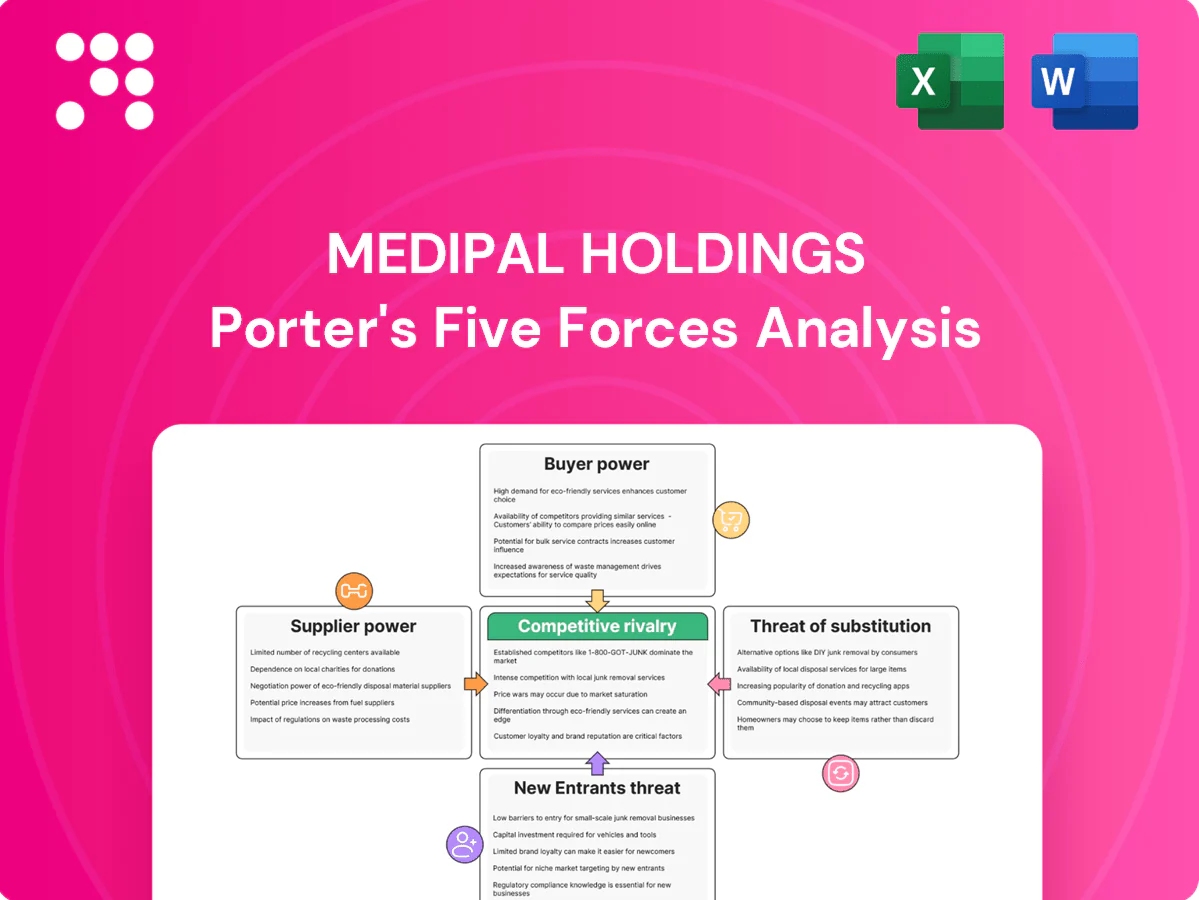
Medipal Holdings Porter's Five Forces Analysis

From Overview to Strategy Blueprint
Medipal Holdings faces moderate supplier power, intense buyer expectations, and steady rivalry amid healthcare distribution consolidation, while regulatory and substitution risks merit attention. This snapshot highlights key pressure points shaping margins and strategic choices. Unlock the full Porter's Five Forces Analysis to explore force-by-force ratings, visuals, and actionable recommendations.
Suppliers Bargaining Power

Concentrated pharma manufacturers
Japan’s prescription drug supply is concentrated among a few originator and leading generic firms, giving product-holding companies outsized control over allocation and terms; the Japanese prescription market is about ¥11 trillion (2024). Portfolio exclusivity plus regulated pricing allows suppliers to dictate allocation and margins, while Medipal offsets this via scale purchasing and multi-year supply agreements that secure core SKUs. Nevertheless, episodic shortages or recalls have historically tightened supply, forcing spot purchases at higher cost.
Strong consumer brands in cosmetics
Strong global and domestic beauty brands command shelf power and marketing pull in a global beauty market that exceeded $500 billion in 2024, making access to hero SKUs critical for category sales. Gaining those SKUs hinges on strict compliance with brand merchandising and display standards. Medipal’s broad distribution footprint helps secure allocations, but brand owners often dictate margins and selective or exclusive distribution deals compress wholesalers’ bargaining room.

Animal health product dependencies
Veterinary vaccines and specialty drugs have few substitutes, concentrating supplier power as the global animal health market exceeded $50bn in 2023 and remained supply-constrained in 2024. Producers favor channels with robust data-sharing and cold-chain (2–8°C) performance; Medipal’s logistics and traceability earn preferred status with key suppliers. Persistent tightness means Medipal likely must commit volumes or long-term contracts to secure continuity and favorable terms.

Regulatory and quality compliance costs
Suppliers impose GDP/GMP requirements that shift costs downstream, mandating serialization, temperature control and rapid recall responsiveness. Medipal bears integration, IT and third‑party audit expenses—often exceeding $100,000 per supplier annually—to remain a core partner. Non‑compliance risks delisting or reduced allocation, directly pressuring inventory levels and margins.
- Mandates: serialization, cold‑chain, recall responsiveness
- Cost: integration and audits > $100,000 per supplier/year
- Risk: delisting or reduced allocation; inventory and margin impact
Potential for direct distribution
Large manufacturers increasingly bypass wholesalers to supply major retail chains and hospital groups, and FY2024 direct-to-customer channel expansion has strengthened supplier negotiation leverage against intermediaries.
Medipal defends margins through nationwide distribution footprints and value-added services (logistics, clinical support), yet selective direct pilots by suppliers compress margins in dense urban markets.
- Supplier bypass risk: higher in hospital/chain segments
- Medipal strengths: nationwide reach, value-added services
- Urban pressure: direct pilots squeeze margins
Japan ¥11T, beauty $500B, audits ¥15M+ - supplier power
Supplier power is high: Japan prescription market ¥11 trillion (2024) and brand beauty >$500bn (2024) concentrate allocation and pricing leverage. Medipal offsets via scale, multi‑year contracts and logistics, but recalls, cold‑chain mandates and supplier bypass (FY2024 D2C growth) compress margins. Audit/integration costs often exceed ¥15m (> $100k) per supplier annually.
| Metric | Value |
|---|---|
| Japan prescription market | ¥11T (2024) |
| Global beauty | $500B+ (2024) |
| Animal health | $50B (2023) |
| Supplier audit cost | ¥15M+ /yr (~$100k) |
What is included in the product
 Detailed Word Document
Tailored Porter's Five Forces analysis for Medipal Holdings that uncovers competitive pressures, supplier and buyer bargaining power, threat of substitutes, and entry barriers, highlighting disruptive forces and strategic levers to protect margins and market share.

 Customizable Excel Spreadsheet
A concise, one-sheet Porter's Five Forces for Medipal Holdings that highlights competitive pressures and supplier/customer risks for quick decision-making, with adjustable pressure levels and a clean layout ready to drop into pitch decks or Excel dashboards.
Customers Bargaining Power

Consolidated hospitals and clinics
Consolidated hospitals, IDNs and clinic groups—Japan had about 8,372 hospitals (MHLW 2022)—pool volumes to run tenders and extract deep purchase discounts while enforcing strict SLAs and KPI-linked penalties. Medipal competes by emphasizing distribution reliability, formulary support and competitive pricing to retain contracts. High switching costs for critical medicines and cold-chain products partially blunt buyer power, keeping margin pressure but protecting core sales.
Large pharmacy chains and drugstores
Large pharmacy chains command scale and transactional data, pressing for lower net pricing and rebates—top chains accounted for >50% of retail pharmacy sales in many markets in 2024, increasing negotiation leverage. They routinely require EDI integration and category-management support, squeezing suppliers’ margins. Medipal’s breadth across Rx and OTC boosts basket value and cross-sell, but chains can dual-source to keep price tension high.

Government and NHI pricing effects
Biennial NHI price revisions compress upstream prices and prompt buyers to demand pass-throughs to providers, with recent revision cycles producing average drug price cuts around 2% that squeeze distribution margins. Providers expect wholesalers like Medipal to absorb or rapidly share impacts, increasing short-term cash flow pressure. Medipal must defend gross margins through tighter contract structures, SKU mix optimization and margin-guarantee clauses.

E-commerce and marketplaces
E-commerce and marketplaces raise price transparency for OTC and daily necessities, enabling instant benchmarking that compresses wholesale margins and strengthens buyer bargaining power.
Medipal counters with faster logistics and verified-authenticity guarantees to preserve customer trust and reduce churn.
However, rampant price-matching on commoditized SKUs erodes differentiation and shifts competition to service and fulfillment.
- Price transparency: instant benchmarking
- Medipal strengths: logistics speed, authenticity assurance
- Risk: price-matching erodes commoditized margins
Data and service expectations
Buyers demand real-time inventory visibility, demand forecasting, and rapid recall responsiveness; in 2024 58% of healthcare purchasers prioritized real-time supply data, pushing value-added services into baseline expectations. Medipal’s information services increase customer stickiness but raise operating costs and capex. Sophisticated buyers enforce SLAs with penalties or concessions to extract service guarantees.
- Inventory visibility: 58% 2024 demand
- Value-added services: now table stakes
- Medipal IT: boosts stickiness, adds cost
- SLAs: leverage for penalties/concessions
Buyers wield leverage: 8,372 hospitals, chains >50%, NHI cuts ~2%, 58% demand real-time
Buyers wield strong leverage: consolidated hospitals (8,372 in Japan, MHLW 2022) and pharmacy chains (>50% retail share 2024) force discounts, SLAs and rebates; NHI price revisions cut ~2% on average, and 58% of purchasers in 2024 demanded real-time inventory—boosting service expectations while squeezing Medipal margins.
| Metric | 2022/2024 |
|---|---|
| Hospitals (Japan) | 8,372 (MHLW 2022) |
| Top chains retail share | >50% (2024) |
| NHI avg price cut | ~2% (recent) |
| Buyers needing real-time | 58% (2024) |
Full Version Awaits
Medipal Holdings Porter's Five Forces Analysis
This preview shows the exact Medipal Holdings Porter's Five Forces Analysis you'll receive immediately after purchase—no placeholders or samples. The document displayed is fully formatted, professionally written and ready for download and use the moment you buy. What you see is the deliverable.

From Overview to Strategy Blueprint
Medipal Holdings faces moderate supplier power, intense buyer expectations, and steady rivalry amid healthcare distribution consolidation, while regulatory and substitution risks merit attention. This snapshot highlights key pressure points shaping margins and strategic choices. Unlock the full Porter's Five Forces Analysis to explore force-by-force ratings, visuals, and actionable recommendations.
Suppliers Bargaining Power
Concentrated pharma manufacturers
Japan’s prescription drug supply is concentrated among a few originator and leading generic firms, giving product-holding companies outsized control over allocation and terms; the Japanese prescription market is about ¥11 trillion (2024). Portfolio exclusivity plus regulated pricing allows suppliers to dictate allocation and margins, while Medipal offsets this via scale purchasing and multi-year supply agreements that secure core SKUs. Nevertheless, episodic shortages or recalls have historically tightened supply, forcing spot purchases at higher cost.
Strong consumer brands in cosmetics
Strong global and domestic beauty brands command shelf power and marketing pull in a global beauty market that exceeded $500 billion in 2024, making access to hero SKUs critical for category sales. Gaining those SKUs hinges on strict compliance with brand merchandising and display standards. Medipal’s broad distribution footprint helps secure allocations, but brand owners often dictate margins and selective or exclusive distribution deals compress wholesalers’ bargaining room.
Animal health product dependencies
Veterinary vaccines and specialty drugs have few substitutes, concentrating supplier power as the global animal health market exceeded $50bn in 2023 and remained supply-constrained in 2024. Producers favor channels with robust data-sharing and cold-chain (2–8°C) performance; Medipal’s logistics and traceability earn preferred status with key suppliers. Persistent tightness means Medipal likely must commit volumes or long-term contracts to secure continuity and favorable terms.
Regulatory and quality compliance costs
Suppliers impose GDP/GMP requirements that shift costs downstream, mandating serialization, temperature control and rapid recall responsiveness. Medipal bears integration, IT and third‑party audit expenses—often exceeding $100,000 per supplier annually—to remain a core partner. Non‑compliance risks delisting or reduced allocation, directly pressuring inventory levels and margins.
- Mandates: serialization, cold‑chain, recall responsiveness
- Cost: integration and audits > $100,000 per supplier/year
- Risk: delisting or reduced allocation; inventory and margin impact
Potential for direct distribution
Large manufacturers increasingly bypass wholesalers to supply major retail chains and hospital groups, and FY2024 direct-to-customer channel expansion has strengthened supplier negotiation leverage against intermediaries.
Medipal defends margins through nationwide distribution footprints and value-added services (logistics, clinical support), yet selective direct pilots by suppliers compress margins in dense urban markets.
- Supplier bypass risk: higher in hospital/chain segments
- Medipal strengths: nationwide reach, value-added services
- Urban pressure: direct pilots squeeze margins
Japan ¥11T, beauty $500B, audits ¥15M+ - supplier power
Supplier power is high: Japan prescription market ¥11 trillion (2024) and brand beauty >$500bn (2024) concentrate allocation and pricing leverage. Medipal offsets via scale, multi‑year contracts and logistics, but recalls, cold‑chain mandates and supplier bypass (FY2024 D2C growth) compress margins. Audit/integration costs often exceed ¥15m (> $100k) per supplier annually.
| Metric | Value |
|---|---|
| Japan prescription market | ¥11T (2024) |
| Global beauty | $500B+ (2024) |
| Animal health | $50B (2023) |
| Supplier audit cost | ¥15M+ /yr (~$100k) |
What is included in the product
Detailed Word Document
Tailored Porter's Five Forces analysis for Medipal Holdings that uncovers competitive pressures, supplier and buyer bargaining power, threat of substitutes, and entry barriers, highlighting disruptive forces and strategic levers to protect margins and market share.
Customizable Excel Spreadsheet
A concise, one-sheet Porter's Five Forces for Medipal Holdings that highlights competitive pressures and supplier/customer risks for quick decision-making, with adjustable pressure levels and a clean layout ready to drop into pitch decks or Excel dashboards.
Customers Bargaining Power
Consolidated hospitals and clinics
Consolidated hospitals, IDNs and clinic groups—Japan had about 8,372 hospitals (MHLW 2022)—pool volumes to run tenders and extract deep purchase discounts while enforcing strict SLAs and KPI-linked penalties. Medipal competes by emphasizing distribution reliability, formulary support and competitive pricing to retain contracts. High switching costs for critical medicines and cold-chain products partially blunt buyer power, keeping margin pressure but protecting core sales.
Large pharmacy chains and drugstores
Large pharmacy chains command scale and transactional data, pressing for lower net pricing and rebates—top chains accounted for >50% of retail pharmacy sales in many markets in 2024, increasing negotiation leverage. They routinely require EDI integration and category-management support, squeezing suppliers’ margins. Medipal’s breadth across Rx and OTC boosts basket value and cross-sell, but chains can dual-source to keep price tension high.
Government and NHI pricing effects
Biennial NHI price revisions compress upstream prices and prompt buyers to demand pass-throughs to providers, with recent revision cycles producing average drug price cuts around 2% that squeeze distribution margins. Providers expect wholesalers like Medipal to absorb or rapidly share impacts, increasing short-term cash flow pressure. Medipal must defend gross margins through tighter contract structures, SKU mix optimization and margin-guarantee clauses.
E-commerce and marketplaces
E-commerce and marketplaces raise price transparency for OTC and daily necessities, enabling instant benchmarking that compresses wholesale margins and strengthens buyer bargaining power.
Medipal counters with faster logistics and verified-authenticity guarantees to preserve customer trust and reduce churn.
However, rampant price-matching on commoditized SKUs erodes differentiation and shifts competition to service and fulfillment.
- Price transparency: instant benchmarking
- Medipal strengths: logistics speed, authenticity assurance
- Risk: price-matching erodes commoditized margins
Data and service expectations
Buyers demand real-time inventory visibility, demand forecasting, and rapid recall responsiveness; in 2024 58% of healthcare purchasers prioritized real-time supply data, pushing value-added services into baseline expectations. Medipal’s information services increase customer stickiness but raise operating costs and capex. Sophisticated buyers enforce SLAs with penalties or concessions to extract service guarantees.
- Inventory visibility: 58% 2024 demand
- Value-added services: now table stakes
- Medipal IT: boosts stickiness, adds cost
- SLAs: leverage for penalties/concessions
Buyers wield leverage: 8,372 hospitals, chains >50%, NHI cuts ~2%, 58% demand real-time
Buyers wield strong leverage: consolidated hospitals (8,372 in Japan, MHLW 2022) and pharmacy chains (>50% retail share 2024) force discounts, SLAs and rebates; NHI price revisions cut ~2% on average, and 58% of purchasers in 2024 demanded real-time inventory—boosting service expectations while squeezing Medipal margins.
| Metric | 2022/2024 |
|---|---|
| Hospitals (Japan) | 8,372 (MHLW 2022) |
| Top chains retail share | >50% (2024) |
| NHI avg price cut | ~2% (recent) |
| Buyers needing real-time | 58% (2024) |
Full Version Awaits
Medipal Holdings Porter's Five Forces Analysis
This preview shows the exact Medipal Holdings Porter's Five Forces Analysis you'll receive immediately after purchase—no placeholders or samples. The document displayed is fully formatted, professionally written and ready for download and use the moment you buy. What you see is the deliverable.
Original: $10.00
-65%$10.00
$3.50Description
From Overview to Strategy Blueprint
Medipal Holdings faces moderate supplier power, intense buyer expectations, and steady rivalry amid healthcare distribution consolidation, while regulatory and substitution risks merit attention. This snapshot highlights key pressure points shaping margins and strategic choices. Unlock the full Porter's Five Forces Analysis to explore force-by-force ratings, visuals, and actionable recommendations.
Suppliers Bargaining Power
Concentrated pharma manufacturers
Japan’s prescription drug supply is concentrated among a few originator and leading generic firms, giving product-holding companies outsized control over allocation and terms; the Japanese prescription market is about ¥11 trillion (2024). Portfolio exclusivity plus regulated pricing allows suppliers to dictate allocation and margins, while Medipal offsets this via scale purchasing and multi-year supply agreements that secure core SKUs. Nevertheless, episodic shortages or recalls have historically tightened supply, forcing spot purchases at higher cost.
Strong consumer brands in cosmetics
Strong global and domestic beauty brands command shelf power and marketing pull in a global beauty market that exceeded $500 billion in 2024, making access to hero SKUs critical for category sales. Gaining those SKUs hinges on strict compliance with brand merchandising and display standards. Medipal’s broad distribution footprint helps secure allocations, but brand owners often dictate margins and selective or exclusive distribution deals compress wholesalers’ bargaining room.
Animal health product dependencies
Veterinary vaccines and specialty drugs have few substitutes, concentrating supplier power as the global animal health market exceeded $50bn in 2023 and remained supply-constrained in 2024. Producers favor channels with robust data-sharing and cold-chain (2–8°C) performance; Medipal’s logistics and traceability earn preferred status with key suppliers. Persistent tightness means Medipal likely must commit volumes or long-term contracts to secure continuity and favorable terms.
Regulatory and quality compliance costs
Suppliers impose GDP/GMP requirements that shift costs downstream, mandating serialization, temperature control and rapid recall responsiveness. Medipal bears integration, IT and third‑party audit expenses—often exceeding $100,000 per supplier annually—to remain a core partner. Non‑compliance risks delisting or reduced allocation, directly pressuring inventory levels and margins.
- Mandates: serialization, cold‑chain, recall responsiveness
- Cost: integration and audits > $100,000 per supplier/year
- Risk: delisting or reduced allocation; inventory and margin impact
Potential for direct distribution
Large manufacturers increasingly bypass wholesalers to supply major retail chains and hospital groups, and FY2024 direct-to-customer channel expansion has strengthened supplier negotiation leverage against intermediaries.
Medipal defends margins through nationwide distribution footprints and value-added services (logistics, clinical support), yet selective direct pilots by suppliers compress margins in dense urban markets.
- Supplier bypass risk: higher in hospital/chain segments
- Medipal strengths: nationwide reach, value-added services
- Urban pressure: direct pilots squeeze margins
Japan ¥11T, beauty $500B, audits ¥15M+ - supplier power
Supplier power is high: Japan prescription market ¥11 trillion (2024) and brand beauty >$500bn (2024) concentrate allocation and pricing leverage. Medipal offsets via scale, multi‑year contracts and logistics, but recalls, cold‑chain mandates and supplier bypass (FY2024 D2C growth) compress margins. Audit/integration costs often exceed ¥15m (> $100k) per supplier annually.
| Metric | Value |
|---|---|
| Japan prescription market | ¥11T (2024) |
| Global beauty | $500B+ (2024) |
| Animal health | $50B (2023) |
| Supplier audit cost | ¥15M+ /yr (~$100k) |
What is included in the product
Detailed Word Document
Tailored Porter's Five Forces analysis for Medipal Holdings that uncovers competitive pressures, supplier and buyer bargaining power, threat of substitutes, and entry barriers, highlighting disruptive forces and strategic levers to protect margins and market share.
Customizable Excel Spreadsheet
A concise, one-sheet Porter's Five Forces for Medipal Holdings that highlights competitive pressures and supplier/customer risks for quick decision-making, with adjustable pressure levels and a clean layout ready to drop into pitch decks or Excel dashboards.
Customers Bargaining Power
Consolidated hospitals and clinics
Consolidated hospitals, IDNs and clinic groups—Japan had about 8,372 hospitals (MHLW 2022)—pool volumes to run tenders and extract deep purchase discounts while enforcing strict SLAs and KPI-linked penalties. Medipal competes by emphasizing distribution reliability, formulary support and competitive pricing to retain contracts. High switching costs for critical medicines and cold-chain products partially blunt buyer power, keeping margin pressure but protecting core sales.
Large pharmacy chains and drugstores
Large pharmacy chains command scale and transactional data, pressing for lower net pricing and rebates—top chains accounted for >50% of retail pharmacy sales in many markets in 2024, increasing negotiation leverage. They routinely require EDI integration and category-management support, squeezing suppliers’ margins. Medipal’s breadth across Rx and OTC boosts basket value and cross-sell, but chains can dual-source to keep price tension high.
Government and NHI pricing effects
Biennial NHI price revisions compress upstream prices and prompt buyers to demand pass-throughs to providers, with recent revision cycles producing average drug price cuts around 2% that squeeze distribution margins. Providers expect wholesalers like Medipal to absorb or rapidly share impacts, increasing short-term cash flow pressure. Medipal must defend gross margins through tighter contract structures, SKU mix optimization and margin-guarantee clauses.
E-commerce and marketplaces
E-commerce and marketplaces raise price transparency for OTC and daily necessities, enabling instant benchmarking that compresses wholesale margins and strengthens buyer bargaining power.
Medipal counters with faster logistics and verified-authenticity guarantees to preserve customer trust and reduce churn.
However, rampant price-matching on commoditized SKUs erodes differentiation and shifts competition to service and fulfillment.
- Price transparency: instant benchmarking
- Medipal strengths: logistics speed, authenticity assurance
- Risk: price-matching erodes commoditized margins
Data and service expectations
Buyers demand real-time inventory visibility, demand forecasting, and rapid recall responsiveness; in 2024 58% of healthcare purchasers prioritized real-time supply data, pushing value-added services into baseline expectations. Medipal’s information services increase customer stickiness but raise operating costs and capex. Sophisticated buyers enforce SLAs with penalties or concessions to extract service guarantees.
- Inventory visibility: 58% 2024 demand
- Value-added services: now table stakes
- Medipal IT: boosts stickiness, adds cost
- SLAs: leverage for penalties/concessions
Buyers wield leverage: 8,372 hospitals, chains >50%, NHI cuts ~2%, 58% demand real-time
Buyers wield strong leverage: consolidated hospitals (8,372 in Japan, MHLW 2022) and pharmacy chains (>50% retail share 2024) force discounts, SLAs and rebates; NHI price revisions cut ~2% on average, and 58% of purchasers in 2024 demanded real-time inventory—boosting service expectations while squeezing Medipal margins.
| Metric | 2022/2024 |
|---|---|
| Hospitals (Japan) | 8,372 (MHLW 2022) |
| Top chains retail share | >50% (2024) |
| NHI avg price cut | ~2% (recent) |
| Buyers needing real-time | 58% (2024) |
Full Version Awaits
Medipal Holdings Porter's Five Forces Analysis
This preview shows the exact Medipal Holdings Porter's Five Forces Analysis you'll receive immediately after purchase—no placeholders or samples. The document displayed is fully formatted, professionally written and ready for download and use the moment you buy. What you see is the deliverable.











