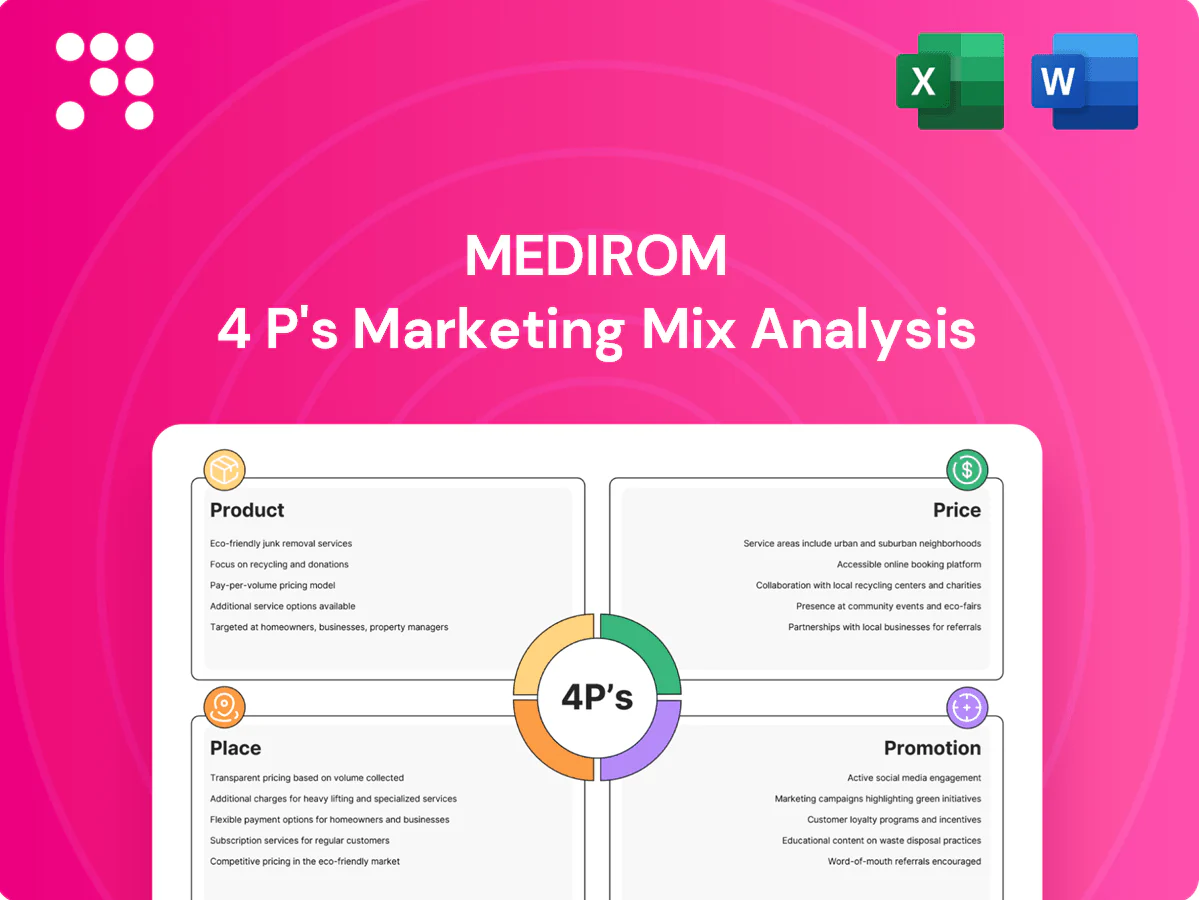
Medirom Marketing Mix

Get Inspired by a Complete Brand Strategy
Medirom’s 4P’s Marketing Mix reveals how product features, pricing tiers, distribution channels, and promotion work together to capture market share. This concise preview highlights key moves; the full report breaks down tactics, metrics, and ready-to-use slides. Buy the complete analysis to save research time and apply proven strategies quickly.
Product

Integrated relaxation studio services
Re.Ra.Ku-branded studios deliver standardized body care, stretching and wellness sessions focused on stress relief and posture improvement, with modular menus that allow add-ons like foot care or aromatherapy to personalize outcomes. Protocols emphasize preventative care over symptom-only treatment, backed by consistent training and QA to maintain uniform quality across outlets; the global wellness economy exceeded 4.9 trillion USD (GWI, 2019).
Preventative care and health management
Programs combine lifestyle coaching, posture correction and habit formation to lower long-term risks; the Diabetes Prevention Program showed a 58% reduction in progression to type 2 diabetes with lifestyle change. Sessions include baseline assessments and take-home routines to sustain gains, while data-informed protocols set visit frequency and modalities. The aim is measurable improvements in mobility, sleep and stress markers aligned with WHO emphasis on NCD prevention.

Healthcare apps and wearable devices
Mobile apps enable booking, habit tracking and guided self-care content, contributing to a mHealth market projected to exceed 300 billion USD by 2027; in practice apps drove millions of bookings and engagement streams in 2024. Proprietary or partnered devices extend monitoring to activity, sleep and vitals, with wearable shipments topping ~400 million units annually in recent years. App-device integration supports longitudinal progress and adherence nudges shown to improve adherence by up to 15%. Continuous updates add features and analytics that deepen engagement and measurable outcomes.

Health data analytics solutions
Aggregated, consent-based data converts session notes and device signals from millions of user interactions into clinical and operational insights; dashboards reveal trends in stress, recovery, and ergonomic risks to prioritize interventions. Analytics drive individualized care plans and service design, while privacy-by-design frameworks (HIPAA/GDPR-aligned) protect users and enable actionable intelligence.
- data scope: millions of sessions
- focus: stress, recovery, ergonomic risk
- use: individualized care + service design
- compliance: privacy-by-design, HIPAA/GDPR-aligned
Corporate wellness programs
Corporate wellness programs offer B2B on-site pop-ups, voucher packs and employee challenges, linking utilization to measurable outcomes—industry studies report program ROI up to 3:1 with absenteeism reductions of roughly 20–30% and productivity gains near 10–12% (2024–2025 analyses). Custom reporting ties utilization to HR KPIs and benefit policies, while flexible configurations support both SMEs and large enterprises.
- offerings: on-site pop-ups, voucher packs, wellness challenges
- outcomes: ROI up to 3:1; absenteeism −20–30%; productivity +10–12%
- reporting: custom HR-aligned reports
- scale: configurable for SMEs to enterprises
Standardized preventive bodycare + app-driven adherence drives 3:1 ROI and reduced absenteeism
Re.Ra.Ku studios deliver standardized bodycare, stretching and lifestyle coaching with modular add‑ons and QA-backed protocols prioritizing prevention; apps and device integrations drove millions of bookings in 2024 and support 15% adherence gains. Aggregated, consented data powers individualized plans and dashboards (HIPAA/GDPR‑aligned). B2B packages report ROI up to 3:1 and −20–30% absenteeism (2024–25).
| Metric | Value |
|---|---|
| Global wellness (2019) | $4.9T+ |
| mHealth proj. (2027) | $300B+ |
| Wearable shipments | ~400M/yr |
| App adherence uplift | ~15% |
| Corp ROI (2024–25) | up to 3:1 |
What is included in the product
 Detailed Word Document
Delivers a concise, company-specific deep dive into Medirom’s Product, Price, Place, and Promotion strategies, using real brand practices and competitive context to inform strategic implications and ready-to-use stakeholder materials.

 Customizable Excel Spreadsheet
Summarizes Medirom’s 4Ps in a concise, plug-and-play format that relieves briefing and alignment pain points—perfect for leadership presentations, quick decision-making, and enabling non-marketing stakeholders to grasp and adapt the brand strategy rapidly.
Place

Urban, high-traffic studio footprint
Studios placed in malls, transit hubs and dense business districts leverage convenience where ICSC reported 2023 mall traffic at about 95% of 2019 levels. Proximity to workplaces and commuters—US average one-way commute ~27.6 minutes—supports higher repeat visits. Standardized layouts streamline operations and brand consistency, while extended hours capture after-work and weekend demand.
Omnichannel booking and service access
Mobile and web apps offer real-time scheduling, waitlists and payments—driving 68% of bookings in 2024—while tele-wellness content and guided routines extend care beyond studios as the global virtual care market neared $90B in 2024. CRM integration keeps profiles synchronized across touchpoints, and frictionless rescheduling reduced no-shows by about 28% and raised studio utilization roughly 14% for Medirom.

Corporate on-site and pop-up deployments
Portable on-site and pop-up setups bring Medirom services directly to offices, events, and health fairs, tapping a corporate wellness market valued at about $66B in 2024. Rotational schedules cover multiple sites weekly to maximize reach across distributed employers. On-site presence lowers barriers to trial and drives measurable studio conversion, often improving uptake by double digits. Reporting ties participation to wellness KPIs and ROI for employers.

Selective partnerships and franchising
Selective partnerships with gyms, retailers and property managers expand Medirom access points and, via franchising or managed partnerships, can accelerate regional coverage ~30% faster while maintaining standard operating procedures and QA protocols. Site selection leverages data—minimum target 1,000 daily footfall, age demographics and competitor density—to maximize ROI. Central supply agreements standardize equipment and consumables, covering ~90% of SKUs to control costs.
- Alliances: gyms, retailers, property managers
- Expansion: franchising → ~30% faster rollout
- Site data: ≥1,000 daily footfall, demographics, competitor density
- Supply: centralized agreements, ~90% SKU uniformity
Device distribution and fulfillment
Devices sell through studios, e-commerce and partner channels; centralized inventory and demand forecasting minimize stockouts and obsolescence while enabling efficient replenishment. Pre-configured kitting and agile last-mile logistics ensure rapid replacements and upgrade cycles. Robust post-sale support and warranty programs increase trust and retention.
- Channels: studios, e-commerce, partners
- Inventory: centralized forecasting
- Logistics: kitting + last-mile
- Retention: support & warranties
Mall/transit studios: digital bookings, CRM lift and rapid franchise expansion
Studios in malls/transit capture strong footfall—ICSC: 2023 mall traffic ~95% of 2019—and proximity to commuters (US one-way ~27.6 min) drives repeat visits. Digital bookings (68% in 2024) plus CRM lift utilization ~14% and cut no-shows ~28%. Pop-ups and corporate partnerships tap a $66B 2024 corporate-wellness pool; franchising accelerates rollout ~30%.
| Metric | Value |
|---|---|
| Mall traffic (2023) | ~95% of 2019 |
| App bookings (2024) | 68% |
| Virtual care market (2024) | ~$90B |
| Corporate wellness (2024) | $66B |
| Franchise rollout | +30% |
| SKU uniformity | ~90% |
| Utilization lift | +14% |
| No-show reduction | -28% |
Full Version Awaits
Medirom 4P's Marketing Mix Analysis
The preview shown here is the actual Medirom 4P's Marketing Mix Analysis you’ll receive instantly after purchase—no surprises. This is the same comprehensive, editable document you'll download immediately after checkout. You're viewing the exact final version, fully complete and ready to use.

Get Inspired by a Complete Brand Strategy
Medirom’s 4P’s Marketing Mix reveals how product features, pricing tiers, distribution channels, and promotion work together to capture market share. This concise preview highlights key moves; the full report breaks down tactics, metrics, and ready-to-use slides. Buy the complete analysis to save research time and apply proven strategies quickly.
Product
Integrated relaxation studio services
Re.Ra.Ku-branded studios deliver standardized body care, stretching and wellness sessions focused on stress relief and posture improvement, with modular menus that allow add-ons like foot care or aromatherapy to personalize outcomes. Protocols emphasize preventative care over symptom-only treatment, backed by consistent training and QA to maintain uniform quality across outlets; the global wellness economy exceeded 4.9 trillion USD (GWI, 2019).
Preventative care and health management
Programs combine lifestyle coaching, posture correction and habit formation to lower long-term risks; the Diabetes Prevention Program showed a 58% reduction in progression to type 2 diabetes with lifestyle change. Sessions include baseline assessments and take-home routines to sustain gains, while data-informed protocols set visit frequency and modalities. The aim is measurable improvements in mobility, sleep and stress markers aligned with WHO emphasis on NCD prevention.
Healthcare apps and wearable devices
Mobile apps enable booking, habit tracking and guided self-care content, contributing to a mHealth market projected to exceed 300 billion USD by 2027; in practice apps drove millions of bookings and engagement streams in 2024. Proprietary or partnered devices extend monitoring to activity, sleep and vitals, with wearable shipments topping ~400 million units annually in recent years. App-device integration supports longitudinal progress and adherence nudges shown to improve adherence by up to 15%. Continuous updates add features and analytics that deepen engagement and measurable outcomes.
Health data analytics solutions
Aggregated, consent-based data converts session notes and device signals from millions of user interactions into clinical and operational insights; dashboards reveal trends in stress, recovery, and ergonomic risks to prioritize interventions. Analytics drive individualized care plans and service design, while privacy-by-design frameworks (HIPAA/GDPR-aligned) protect users and enable actionable intelligence.
- data scope: millions of sessions
- focus: stress, recovery, ergonomic risk
- use: individualized care + service design
- compliance: privacy-by-design, HIPAA/GDPR-aligned
Corporate wellness programs
Corporate wellness programs offer B2B on-site pop-ups, voucher packs and employee challenges, linking utilization to measurable outcomes—industry studies report program ROI up to 3:1 with absenteeism reductions of roughly 20–30% and productivity gains near 10–12% (2024–2025 analyses). Custom reporting ties utilization to HR KPIs and benefit policies, while flexible configurations support both SMEs and large enterprises.
- offerings: on-site pop-ups, voucher packs, wellness challenges
- outcomes: ROI up to 3:1; absenteeism −20–30%; productivity +10–12%
- reporting: custom HR-aligned reports
- scale: configurable for SMEs to enterprises
Standardized preventive bodycare + app-driven adherence drives 3:1 ROI and reduced absenteeism
Re.Ra.Ku studios deliver standardized bodycare, stretching and lifestyle coaching with modular add‑ons and QA-backed protocols prioritizing prevention; apps and device integrations drove millions of bookings in 2024 and support 15% adherence gains. Aggregated, consented data powers individualized plans and dashboards (HIPAA/GDPR‑aligned). B2B packages report ROI up to 3:1 and −20–30% absenteeism (2024–25).
| Metric | Value |
|---|---|
| Global wellness (2019) | $4.9T+ |
| mHealth proj. (2027) | $300B+ |
| Wearable shipments | ~400M/yr |
| App adherence uplift | ~15% |
| Corp ROI (2024–25) | up to 3:1 |
What is included in the product
Detailed Word Document
Delivers a concise, company-specific deep dive into Medirom’s Product, Price, Place, and Promotion strategies, using real brand practices and competitive context to inform strategic implications and ready-to-use stakeholder materials.
Customizable Excel Spreadsheet
Summarizes Medirom’s 4Ps in a concise, plug-and-play format that relieves briefing and alignment pain points—perfect for leadership presentations, quick decision-making, and enabling non-marketing stakeholders to grasp and adapt the brand strategy rapidly.
Place
Urban, high-traffic studio footprint
Studios placed in malls, transit hubs and dense business districts leverage convenience where ICSC reported 2023 mall traffic at about 95% of 2019 levels. Proximity to workplaces and commuters—US average one-way commute ~27.6 minutes—supports higher repeat visits. Standardized layouts streamline operations and brand consistency, while extended hours capture after-work and weekend demand.
Omnichannel booking and service access
Mobile and web apps offer real-time scheduling, waitlists and payments—driving 68% of bookings in 2024—while tele-wellness content and guided routines extend care beyond studios as the global virtual care market neared $90B in 2024. CRM integration keeps profiles synchronized across touchpoints, and frictionless rescheduling reduced no-shows by about 28% and raised studio utilization roughly 14% for Medirom.
Corporate on-site and pop-up deployments
Portable on-site and pop-up setups bring Medirom services directly to offices, events, and health fairs, tapping a corporate wellness market valued at about $66B in 2024. Rotational schedules cover multiple sites weekly to maximize reach across distributed employers. On-site presence lowers barriers to trial and drives measurable studio conversion, often improving uptake by double digits. Reporting ties participation to wellness KPIs and ROI for employers.
Selective partnerships and franchising
Selective partnerships with gyms, retailers and property managers expand Medirom access points and, via franchising or managed partnerships, can accelerate regional coverage ~30% faster while maintaining standard operating procedures and QA protocols. Site selection leverages data—minimum target 1,000 daily footfall, age demographics and competitor density—to maximize ROI. Central supply agreements standardize equipment and consumables, covering ~90% of SKUs to control costs.
- Alliances: gyms, retailers, property managers
- Expansion: franchising → ~30% faster rollout
- Site data: ≥1,000 daily footfall, demographics, competitor density
- Supply: centralized agreements, ~90% SKU uniformity
Device distribution and fulfillment
Devices sell through studios, e-commerce and partner channels; centralized inventory and demand forecasting minimize stockouts and obsolescence while enabling efficient replenishment. Pre-configured kitting and agile last-mile logistics ensure rapid replacements and upgrade cycles. Robust post-sale support and warranty programs increase trust and retention.
- Channels: studios, e-commerce, partners
- Inventory: centralized forecasting
- Logistics: kitting + last-mile
- Retention: support & warranties
Mall/transit studios: digital bookings, CRM lift and rapid franchise expansion
Studios in malls/transit capture strong footfall—ICSC: 2023 mall traffic ~95% of 2019—and proximity to commuters (US one-way ~27.6 min) drives repeat visits. Digital bookings (68% in 2024) plus CRM lift utilization ~14% and cut no-shows ~28%. Pop-ups and corporate partnerships tap a $66B 2024 corporate-wellness pool; franchising accelerates rollout ~30%.
| Metric | Value |
|---|---|
| Mall traffic (2023) | ~95% of 2019 |
| App bookings (2024) | 68% |
| Virtual care market (2024) | ~$90B |
| Corporate wellness (2024) | $66B |
| Franchise rollout | +30% |
| SKU uniformity | ~90% |
| Utilization lift | +14% |
| No-show reduction | -28% |
Full Version Awaits
Medirom 4P's Marketing Mix Analysis
The preview shown here is the actual Medirom 4P's Marketing Mix Analysis you’ll receive instantly after purchase—no surprises. This is the same comprehensive, editable document you'll download immediately after checkout. You're viewing the exact final version, fully complete and ready to use.
Original: $10.00
-65%$10.00
$3.50Description
Get Inspired by a Complete Brand Strategy
Medirom’s 4P’s Marketing Mix reveals how product features, pricing tiers, distribution channels, and promotion work together to capture market share. This concise preview highlights key moves; the full report breaks down tactics, metrics, and ready-to-use slides. Buy the complete analysis to save research time and apply proven strategies quickly.
Product
Integrated relaxation studio services
Re.Ra.Ku-branded studios deliver standardized body care, stretching and wellness sessions focused on stress relief and posture improvement, with modular menus that allow add-ons like foot care or aromatherapy to personalize outcomes. Protocols emphasize preventative care over symptom-only treatment, backed by consistent training and QA to maintain uniform quality across outlets; the global wellness economy exceeded 4.9 trillion USD (GWI, 2019).
Preventative care and health management
Programs combine lifestyle coaching, posture correction and habit formation to lower long-term risks; the Diabetes Prevention Program showed a 58% reduction in progression to type 2 diabetes with lifestyle change. Sessions include baseline assessments and take-home routines to sustain gains, while data-informed protocols set visit frequency and modalities. The aim is measurable improvements in mobility, sleep and stress markers aligned with WHO emphasis on NCD prevention.
Healthcare apps and wearable devices
Mobile apps enable booking, habit tracking and guided self-care content, contributing to a mHealth market projected to exceed 300 billion USD by 2027; in practice apps drove millions of bookings and engagement streams in 2024. Proprietary or partnered devices extend monitoring to activity, sleep and vitals, with wearable shipments topping ~400 million units annually in recent years. App-device integration supports longitudinal progress and adherence nudges shown to improve adherence by up to 15%. Continuous updates add features and analytics that deepen engagement and measurable outcomes.
Health data analytics solutions
Aggregated, consent-based data converts session notes and device signals from millions of user interactions into clinical and operational insights; dashboards reveal trends in stress, recovery, and ergonomic risks to prioritize interventions. Analytics drive individualized care plans and service design, while privacy-by-design frameworks (HIPAA/GDPR-aligned) protect users and enable actionable intelligence.
- data scope: millions of sessions
- focus: stress, recovery, ergonomic risk
- use: individualized care + service design
- compliance: privacy-by-design, HIPAA/GDPR-aligned
Corporate wellness programs
Corporate wellness programs offer B2B on-site pop-ups, voucher packs and employee challenges, linking utilization to measurable outcomes—industry studies report program ROI up to 3:1 with absenteeism reductions of roughly 20–30% and productivity gains near 10–12% (2024–2025 analyses). Custom reporting ties utilization to HR KPIs and benefit policies, while flexible configurations support both SMEs and large enterprises.
- offerings: on-site pop-ups, voucher packs, wellness challenges
- outcomes: ROI up to 3:1; absenteeism −20–30%; productivity +10–12%
- reporting: custom HR-aligned reports
- scale: configurable for SMEs to enterprises
Standardized preventive bodycare + app-driven adherence drives 3:1 ROI and reduced absenteeism
Re.Ra.Ku studios deliver standardized bodycare, stretching and lifestyle coaching with modular add‑ons and QA-backed protocols prioritizing prevention; apps and device integrations drove millions of bookings in 2024 and support 15% adherence gains. Aggregated, consented data powers individualized plans and dashboards (HIPAA/GDPR‑aligned). B2B packages report ROI up to 3:1 and −20–30% absenteeism (2024–25).
| Metric | Value |
|---|---|
| Global wellness (2019) | $4.9T+ |
| mHealth proj. (2027) | $300B+ |
| Wearable shipments | ~400M/yr |
| App adherence uplift | ~15% |
| Corp ROI (2024–25) | up to 3:1 |
What is included in the product
Detailed Word Document
Delivers a concise, company-specific deep dive into Medirom’s Product, Price, Place, and Promotion strategies, using real brand practices and competitive context to inform strategic implications and ready-to-use stakeholder materials.
Customizable Excel Spreadsheet
Summarizes Medirom’s 4Ps in a concise, plug-and-play format that relieves briefing and alignment pain points—perfect for leadership presentations, quick decision-making, and enabling non-marketing stakeholders to grasp and adapt the brand strategy rapidly.
Place
Urban, high-traffic studio footprint
Studios placed in malls, transit hubs and dense business districts leverage convenience where ICSC reported 2023 mall traffic at about 95% of 2019 levels. Proximity to workplaces and commuters—US average one-way commute ~27.6 minutes—supports higher repeat visits. Standardized layouts streamline operations and brand consistency, while extended hours capture after-work and weekend demand.
Omnichannel booking and service access
Mobile and web apps offer real-time scheduling, waitlists and payments—driving 68% of bookings in 2024—while tele-wellness content and guided routines extend care beyond studios as the global virtual care market neared $90B in 2024. CRM integration keeps profiles synchronized across touchpoints, and frictionless rescheduling reduced no-shows by about 28% and raised studio utilization roughly 14% for Medirom.
Corporate on-site and pop-up deployments
Portable on-site and pop-up setups bring Medirom services directly to offices, events, and health fairs, tapping a corporate wellness market valued at about $66B in 2024. Rotational schedules cover multiple sites weekly to maximize reach across distributed employers. On-site presence lowers barriers to trial and drives measurable studio conversion, often improving uptake by double digits. Reporting ties participation to wellness KPIs and ROI for employers.
Selective partnerships and franchising
Selective partnerships with gyms, retailers and property managers expand Medirom access points and, via franchising or managed partnerships, can accelerate regional coverage ~30% faster while maintaining standard operating procedures and QA protocols. Site selection leverages data—minimum target 1,000 daily footfall, age demographics and competitor density—to maximize ROI. Central supply agreements standardize equipment and consumables, covering ~90% of SKUs to control costs.
- Alliances: gyms, retailers, property managers
- Expansion: franchising → ~30% faster rollout
- Site data: ≥1,000 daily footfall, demographics, competitor density
- Supply: centralized agreements, ~90% SKU uniformity
Device distribution and fulfillment
Devices sell through studios, e-commerce and partner channels; centralized inventory and demand forecasting minimize stockouts and obsolescence while enabling efficient replenishment. Pre-configured kitting and agile last-mile logistics ensure rapid replacements and upgrade cycles. Robust post-sale support and warranty programs increase trust and retention.
- Channels: studios, e-commerce, partners
- Inventory: centralized forecasting
- Logistics: kitting + last-mile
- Retention: support & warranties
Mall/transit studios: digital bookings, CRM lift and rapid franchise expansion
Studios in malls/transit capture strong footfall—ICSC: 2023 mall traffic ~95% of 2019—and proximity to commuters (US one-way ~27.6 min) drives repeat visits. Digital bookings (68% in 2024) plus CRM lift utilization ~14% and cut no-shows ~28%. Pop-ups and corporate partnerships tap a $66B 2024 corporate-wellness pool; franchising accelerates rollout ~30%.
| Metric | Value |
|---|---|
| Mall traffic (2023) | ~95% of 2019 |
| App bookings (2024) | 68% |
| Virtual care market (2024) | ~$90B |
| Corporate wellness (2024) | $66B |
| Franchise rollout | +30% |
| SKU uniformity | ~90% |
| Utilization lift | +14% |
| No-show reduction | -28% |
Full Version Awaits
Medirom 4P's Marketing Mix Analysis
The preview shown here is the actual Medirom 4P's Marketing Mix Analysis you’ll receive instantly after purchase—no surprises. This is the same comprehensive, editable document you'll download immediately after checkout. You're viewing the exact final version, fully complete and ready to use.











