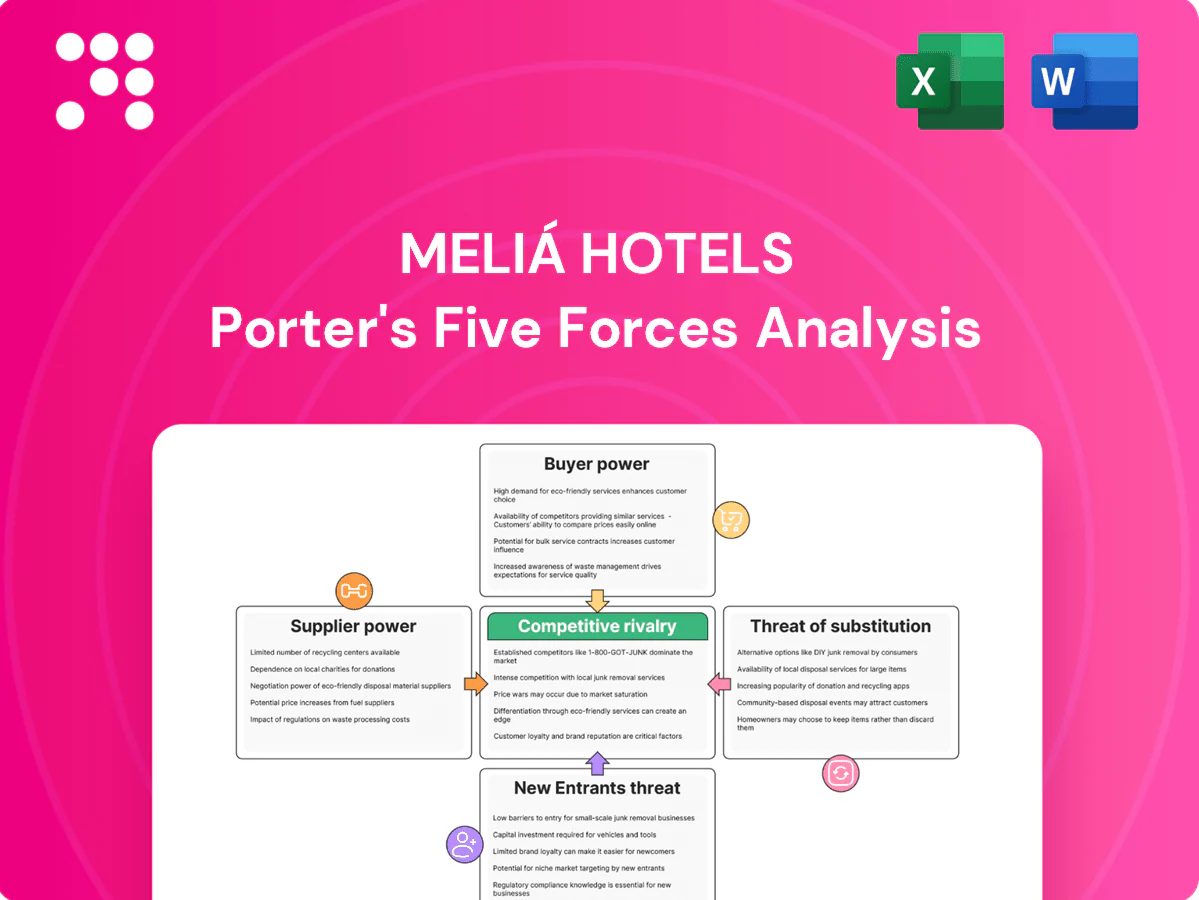
Meliá Hotels Porter's Five Forces Analysis

Don't Miss the Bigger Picture
Meliá Hotels faces moderate buyer power and high rivalry from global and boutique chains, while supplier influence and the threat of substitutes vary by segment and geography; barriers to entry are moderate. This snapshot highlights key tensions shaping strategy and margins. Unlock the full Porter's Five Forces Analysis for force-by-force ratings, visuals, and actionable insights to guide investment or strategy decisions.
Suppliers Bargaining Power

Diverse, fragmented inputs
Melía sources F&B, linens, guest amenities and maintenance services from a wide range of vendors, which limits any single supplier’s bargaining power. Commodity-like inputs (food staples, generic linens) enable multi-bidding and easy substitution. Centralized procurement for 380+ properties (2024) supports long-term contracts and volume discounts. Specialty items for premium brands can modestly increase supplier dependence.
Labor and unions
Staffing, roughly 30% of hotel operating costs, gives local labor markets and unions strong leverage in Meliá’s key destinations; post-pandemic wage pressures—industry-wide wage growth of about 5–8% in 2022–24—plus recruitment shortages have elevated bargaining risk. Standardized training and multi-skilling reduce but do not eliminate exposure, while outsourcing housekeeping or F&B can flex labor costs at the expense of increased vendor reliance.

Property owners & lessors
In managed and leased assets property owners act as critical suppliers of real estate, extracting higher fees or performance clauses for prime locations and limited inventory. Prime urban and resort sites command stronger terms and tighter KPI-linked payments. Meliá’s brand equity and a 2024 pipeline of over 100 hotels across 40+ countries strengthen its bargaining position to secure balanced fee structures. Contract tenors and renewal options, often multi‑year, determine long‑run leverage between owner and operator.

Technology stack dependence
Technology-stack dependence raises supplier power for Meliá as PMS, CRS, channel managers and payment providers create switching costs and integration complexity, while vendor consolidation can drive higher fees and limit flexibility; open APIs and in-house digital capabilities strengthen negotiating leverage, and cybersecurity/compliance needs make reliable partners critical.
- PMS/CRS integration = switching friction
- Channel manager consolidation limits options
- Open APIs + internal IT = better bargaining
- Cybersecurity/compliance heightens supplier criticality
Energy and utilities volatility
Hotels are energy-intensive, making utilities a quasi-supplier with limited substitution; price spikes and 2024 IEA-reported electricity market volatility have tightened margins and amplified sustainability mandate costs for Meliá.
Hedging, efficiency retrofits and on-site renewables lower exposure, while destination-specific regulation (zoning, grid access) can constrain procurement options and price negotiation.
- Energy intensity: high
- 2024: market volatility elevated
- Mitigants: hedging, retrofits, onsite renewables
- Constraint: local regulation
Supplier power moderate - 380+ properties, 100+ pipeline, wages 5–8%
Supplier power is moderate: diversified sourcing (380+ properties), staffing ~30% of costs with 2022–24 wage inflation 5–8%, and tech/energy create switching costs; Meliá’s 2024 pipeline (100+ hotels) and centralized procurement bolster leverage but specialty suppliers and local owners retain pockets of strong bargaining power.
| Item | 2024 metric | Impact |
|---|---|---|
| Staffing | ~30% op. costs; wages +5–8% | High |
| Properties | 380+; pipeline 100+ | Lower supplier power |
| Energy | IEA: market volatility 2024 | Elevated |
What is included in the product
 Detailed Word Document
Uncovers key drivers of competition, customer influence, and market entry risks tailored to Meliá Hotels, evaluating supplier and buyer power, substitutes, rivalry intensity, and barriers that shape its pricing, profit margins and strategic positioning.

 Customizable Excel Spreadsheet
A concise Porter's Five Forces one-sheet for Meliá Hotels that quickly reveals competitive threats, supplier/customer bargaining power and substitution risks—ready to drop into decks for faster strategic decisions.
Customers Bargaining Power

High price transparency
OTAs and meta-search engines make Meliá rates instantly comparable, increasing buyer leverage, with OTA commission averages of 15–25% in 2024. Even small gaps (single-digit percent) prompt switching, pressuring ADR. Rate-parity rules and best-rate guarantees mitigate some leakage. Therefore service differentiation and loyalty benefits are essential to protect RevPAR.
OTA and wholesaler influence
Distribution partners aggregate demand for Meliá, negotiate visibility and typical OTA commissions of 15–25%, and 2024 industry data show OTAs still drive roughly 40% of online hotel bookings. Dependency rises in off-peak periods and new-market entries, while direct-booking engines, loyalty programs and bundled packages reduce reliance; a balanced channel mix protects margins.

Corporate and MICE contracts
Volume-based corporate and MICE deals give buyers leverage to secure lower rates and concessions, while multi-year RFPs (commonly 12–36 months) intensify pricing pressure but guarantee occupancy stability for Meliá. Meliá’s multi-brand portfolio — Meliá, Gran Meliá, Paradisus — strengthens its position to win multi-destination agreements. Value-added services such as F&B credits, meeting space upgrades and loyalty points are frequently traded against direct discounting.

Loyalty program stickiness
Loyalty program stickiness: membership perks and points raise switching costs by tying spend to future stays; Meliá reported MeliáRewards crossed 10 million members in 2024 and app-driven direct bookings grew about 18% year-on-year, reinforcing buyer lock-in. Cross-brand redemption across Meliá’s 350+ hotels strengthens retention, while personalization and UX further anchor direct demand; weak economics or benefit dilution can quickly erode this effect.
- members: 10M+ (2024)
- app direct bookings: +18% YoY (2024)
- portfolio size: 350+ hotels
Seasonality and demand shocks
In shoulder and low seasons buyers gain leverage as Meliá and peers chase occupancy, while peak periods flip power back to the operator; UNWTO noted 2023 international arrivals recovered to about 87% of 2019, amplifying season-driven swings. Revenue management optimizes rate mix and length-of-stay controls to balance yield; geographic diversification across Europe, Latin America and Asia reduces local demand shocks.
- Shoulder seasons: higher buyer leverage
- Peak periods: operator pricing power
- RevPAR mix & LOS controls
- Geographic diversification smooths volatility
OTAs 15–25% fees and ~40% share boost buyer leverage
OTAs and meta-searchers (15–25% commission, ~40% of online bookings in 2024) heighten buyer leverage and rate sensitivity, pressuring ADR. Corporate/MICE RFPs and shoulder-season demand increase discounting, while loyalty (MeliáRewards 10M+ members) and app-driven direct bookings (+18% YoY in 2024) raise switching costs. Portfolio scale (350+ hotels) and revenue management mitigate but do not eliminate customer bargaining power.
| Metric | 2024 value |
|---|---|
| OTA commission | 15–25% |
| OTA share of bookings | ~40% |
| MeliáRewards members | 10M+ |
| App direct growth | +18% YoY |
| Portfolio | 350+ hotels |
What You See Is What You Get
Meliá Hotels Porter's Five Forces Analysis
This preview shows the exact Porter's Five Forces analysis for Meliá Hotels you'll receive after purchase—no placeholders or samples. The full document is fully formatted and ready for download and immediate use, covering supplier power, buyer power, rivalry, threat of substitutes, and barriers to entry with data-backed insights. Purchase grants instant access to this identical file for immediate strategic or investment use.

Don't Miss the Bigger Picture
Meliá Hotels faces moderate buyer power and high rivalry from global and boutique chains, while supplier influence and the threat of substitutes vary by segment and geography; barriers to entry are moderate. This snapshot highlights key tensions shaping strategy and margins. Unlock the full Porter's Five Forces Analysis for force-by-force ratings, visuals, and actionable insights to guide investment or strategy decisions.
Suppliers Bargaining Power
Diverse, fragmented inputs
Melía sources F&B, linens, guest amenities and maintenance services from a wide range of vendors, which limits any single supplier’s bargaining power. Commodity-like inputs (food staples, generic linens) enable multi-bidding and easy substitution. Centralized procurement for 380+ properties (2024) supports long-term contracts and volume discounts. Specialty items for premium brands can modestly increase supplier dependence.
Labor and unions
Staffing, roughly 30% of hotel operating costs, gives local labor markets and unions strong leverage in Meliá’s key destinations; post-pandemic wage pressures—industry-wide wage growth of about 5–8% in 2022–24—plus recruitment shortages have elevated bargaining risk. Standardized training and multi-skilling reduce but do not eliminate exposure, while outsourcing housekeeping or F&B can flex labor costs at the expense of increased vendor reliance.
Property owners & lessors
In managed and leased assets property owners act as critical suppliers of real estate, extracting higher fees or performance clauses for prime locations and limited inventory. Prime urban and resort sites command stronger terms and tighter KPI-linked payments. Meliá’s brand equity and a 2024 pipeline of over 100 hotels across 40+ countries strengthen its bargaining position to secure balanced fee structures. Contract tenors and renewal options, often multi‑year, determine long‑run leverage between owner and operator.
Technology stack dependence
Technology-stack dependence raises supplier power for Meliá as PMS, CRS, channel managers and payment providers create switching costs and integration complexity, while vendor consolidation can drive higher fees and limit flexibility; open APIs and in-house digital capabilities strengthen negotiating leverage, and cybersecurity/compliance needs make reliable partners critical.
- PMS/CRS integration = switching friction
- Channel manager consolidation limits options
- Open APIs + internal IT = better bargaining
- Cybersecurity/compliance heightens supplier criticality
Energy and utilities volatility
Hotels are energy-intensive, making utilities a quasi-supplier with limited substitution; price spikes and 2024 IEA-reported electricity market volatility have tightened margins and amplified sustainability mandate costs for Meliá.
Hedging, efficiency retrofits and on-site renewables lower exposure, while destination-specific regulation (zoning, grid access) can constrain procurement options and price negotiation.
- Energy intensity: high
- 2024: market volatility elevated
- Mitigants: hedging, retrofits, onsite renewables
- Constraint: local regulation
Supplier power moderate - 380+ properties, 100+ pipeline, wages 5–8%
Supplier power is moderate: diversified sourcing (380+ properties), staffing ~30% of costs with 2022–24 wage inflation 5–8%, and tech/energy create switching costs; Meliá’s 2024 pipeline (100+ hotels) and centralized procurement bolster leverage but specialty suppliers and local owners retain pockets of strong bargaining power.
| Item | 2024 metric | Impact |
|---|---|---|
| Staffing | ~30% op. costs; wages +5–8% | High |
| Properties | 380+; pipeline 100+ | Lower supplier power |
| Energy | IEA: market volatility 2024 | Elevated |
What is included in the product
Detailed Word Document
Uncovers key drivers of competition, customer influence, and market entry risks tailored to Meliá Hotels, evaluating supplier and buyer power, substitutes, rivalry intensity, and barriers that shape its pricing, profit margins and strategic positioning.
Customizable Excel Spreadsheet
A concise Porter's Five Forces one-sheet for Meliá Hotels that quickly reveals competitive threats, supplier/customer bargaining power and substitution risks—ready to drop into decks for faster strategic decisions.
Customers Bargaining Power
High price transparency
OTAs and meta-search engines make Meliá rates instantly comparable, increasing buyer leverage, with OTA commission averages of 15–25% in 2024. Even small gaps (single-digit percent) prompt switching, pressuring ADR. Rate-parity rules and best-rate guarantees mitigate some leakage. Therefore service differentiation and loyalty benefits are essential to protect RevPAR.
OTA and wholesaler influence
Distribution partners aggregate demand for Meliá, negotiate visibility and typical OTA commissions of 15–25%, and 2024 industry data show OTAs still drive roughly 40% of online hotel bookings. Dependency rises in off-peak periods and new-market entries, while direct-booking engines, loyalty programs and bundled packages reduce reliance; a balanced channel mix protects margins.
Corporate and MICE contracts
Volume-based corporate and MICE deals give buyers leverage to secure lower rates and concessions, while multi-year RFPs (commonly 12–36 months) intensify pricing pressure but guarantee occupancy stability for Meliá. Meliá’s multi-brand portfolio — Meliá, Gran Meliá, Paradisus — strengthens its position to win multi-destination agreements. Value-added services such as F&B credits, meeting space upgrades and loyalty points are frequently traded against direct discounting.
Loyalty program stickiness
Loyalty program stickiness: membership perks and points raise switching costs by tying spend to future stays; Meliá reported MeliáRewards crossed 10 million members in 2024 and app-driven direct bookings grew about 18% year-on-year, reinforcing buyer lock-in. Cross-brand redemption across Meliá’s 350+ hotels strengthens retention, while personalization and UX further anchor direct demand; weak economics or benefit dilution can quickly erode this effect.
- members: 10M+ (2024)
- app direct bookings: +18% YoY (2024)
- portfolio size: 350+ hotels
Seasonality and demand shocks
In shoulder and low seasons buyers gain leverage as Meliá and peers chase occupancy, while peak periods flip power back to the operator; UNWTO noted 2023 international arrivals recovered to about 87% of 2019, amplifying season-driven swings. Revenue management optimizes rate mix and length-of-stay controls to balance yield; geographic diversification across Europe, Latin America and Asia reduces local demand shocks.
- Shoulder seasons: higher buyer leverage
- Peak periods: operator pricing power
- RevPAR mix & LOS controls
- Geographic diversification smooths volatility
OTAs 15–25% fees and ~40% share boost buyer leverage
OTAs and meta-searchers (15–25% commission, ~40% of online bookings in 2024) heighten buyer leverage and rate sensitivity, pressuring ADR. Corporate/MICE RFPs and shoulder-season demand increase discounting, while loyalty (MeliáRewards 10M+ members) and app-driven direct bookings (+18% YoY in 2024) raise switching costs. Portfolio scale (350+ hotels) and revenue management mitigate but do not eliminate customer bargaining power.
| Metric | 2024 value |
|---|---|
| OTA commission | 15–25% |
| OTA share of bookings | ~40% |
| MeliáRewards members | 10M+ |
| App direct growth | +18% YoY |
| Portfolio | 350+ hotels |
What You See Is What You Get
Meliá Hotels Porter's Five Forces Analysis
This preview shows the exact Porter's Five Forces analysis for Meliá Hotels you'll receive after purchase—no placeholders or samples. The full document is fully formatted and ready for download and immediate use, covering supplier power, buyer power, rivalry, threat of substitutes, and barriers to entry with data-backed insights. Purchase grants instant access to this identical file for immediate strategic or investment use.
Original: $10.00
-65%$10.00
$3.50Description
Don't Miss the Bigger Picture
Meliá Hotels faces moderate buyer power and high rivalry from global and boutique chains, while supplier influence and the threat of substitutes vary by segment and geography; barriers to entry are moderate. This snapshot highlights key tensions shaping strategy and margins. Unlock the full Porter's Five Forces Analysis for force-by-force ratings, visuals, and actionable insights to guide investment or strategy decisions.
Suppliers Bargaining Power
Diverse, fragmented inputs
Melía sources F&B, linens, guest amenities and maintenance services from a wide range of vendors, which limits any single supplier’s bargaining power. Commodity-like inputs (food staples, generic linens) enable multi-bidding and easy substitution. Centralized procurement for 380+ properties (2024) supports long-term contracts and volume discounts. Specialty items for premium brands can modestly increase supplier dependence.
Labor and unions
Staffing, roughly 30% of hotel operating costs, gives local labor markets and unions strong leverage in Meliá’s key destinations; post-pandemic wage pressures—industry-wide wage growth of about 5–8% in 2022–24—plus recruitment shortages have elevated bargaining risk. Standardized training and multi-skilling reduce but do not eliminate exposure, while outsourcing housekeeping or F&B can flex labor costs at the expense of increased vendor reliance.
Property owners & lessors
In managed and leased assets property owners act as critical suppliers of real estate, extracting higher fees or performance clauses for prime locations and limited inventory. Prime urban and resort sites command stronger terms and tighter KPI-linked payments. Meliá’s brand equity and a 2024 pipeline of over 100 hotels across 40+ countries strengthen its bargaining position to secure balanced fee structures. Contract tenors and renewal options, often multi‑year, determine long‑run leverage between owner and operator.
Technology stack dependence
Technology-stack dependence raises supplier power for Meliá as PMS, CRS, channel managers and payment providers create switching costs and integration complexity, while vendor consolidation can drive higher fees and limit flexibility; open APIs and in-house digital capabilities strengthen negotiating leverage, and cybersecurity/compliance needs make reliable partners critical.
- PMS/CRS integration = switching friction
- Channel manager consolidation limits options
- Open APIs + internal IT = better bargaining
- Cybersecurity/compliance heightens supplier criticality
Energy and utilities volatility
Hotels are energy-intensive, making utilities a quasi-supplier with limited substitution; price spikes and 2024 IEA-reported electricity market volatility have tightened margins and amplified sustainability mandate costs for Meliá.
Hedging, efficiency retrofits and on-site renewables lower exposure, while destination-specific regulation (zoning, grid access) can constrain procurement options and price negotiation.
- Energy intensity: high
- 2024: market volatility elevated
- Mitigants: hedging, retrofits, onsite renewables
- Constraint: local regulation
Supplier power moderate - 380+ properties, 100+ pipeline, wages 5–8%
Supplier power is moderate: diversified sourcing (380+ properties), staffing ~30% of costs with 2022–24 wage inflation 5–8%, and tech/energy create switching costs; Meliá’s 2024 pipeline (100+ hotels) and centralized procurement bolster leverage but specialty suppliers and local owners retain pockets of strong bargaining power.
| Item | 2024 metric | Impact |
|---|---|---|
| Staffing | ~30% op. costs; wages +5–8% | High |
| Properties | 380+; pipeline 100+ | Lower supplier power |
| Energy | IEA: market volatility 2024 | Elevated |
What is included in the product
Detailed Word Document
Uncovers key drivers of competition, customer influence, and market entry risks tailored to Meliá Hotels, evaluating supplier and buyer power, substitutes, rivalry intensity, and barriers that shape its pricing, profit margins and strategic positioning.
Customizable Excel Spreadsheet
A concise Porter's Five Forces one-sheet for Meliá Hotels that quickly reveals competitive threats, supplier/customer bargaining power and substitution risks—ready to drop into decks for faster strategic decisions.
Customers Bargaining Power
High price transparency
OTAs and meta-search engines make Meliá rates instantly comparable, increasing buyer leverage, with OTA commission averages of 15–25% in 2024. Even small gaps (single-digit percent) prompt switching, pressuring ADR. Rate-parity rules and best-rate guarantees mitigate some leakage. Therefore service differentiation and loyalty benefits are essential to protect RevPAR.
OTA and wholesaler influence
Distribution partners aggregate demand for Meliá, negotiate visibility and typical OTA commissions of 15–25%, and 2024 industry data show OTAs still drive roughly 40% of online hotel bookings. Dependency rises in off-peak periods and new-market entries, while direct-booking engines, loyalty programs and bundled packages reduce reliance; a balanced channel mix protects margins.
Corporate and MICE contracts
Volume-based corporate and MICE deals give buyers leverage to secure lower rates and concessions, while multi-year RFPs (commonly 12–36 months) intensify pricing pressure but guarantee occupancy stability for Meliá. Meliá’s multi-brand portfolio — Meliá, Gran Meliá, Paradisus — strengthens its position to win multi-destination agreements. Value-added services such as F&B credits, meeting space upgrades and loyalty points are frequently traded against direct discounting.
Loyalty program stickiness
Loyalty program stickiness: membership perks and points raise switching costs by tying spend to future stays; Meliá reported MeliáRewards crossed 10 million members in 2024 and app-driven direct bookings grew about 18% year-on-year, reinforcing buyer lock-in. Cross-brand redemption across Meliá’s 350+ hotels strengthens retention, while personalization and UX further anchor direct demand; weak economics or benefit dilution can quickly erode this effect.
- members: 10M+ (2024)
- app direct bookings: +18% YoY (2024)
- portfolio size: 350+ hotels
Seasonality and demand shocks
In shoulder and low seasons buyers gain leverage as Meliá and peers chase occupancy, while peak periods flip power back to the operator; UNWTO noted 2023 international arrivals recovered to about 87% of 2019, amplifying season-driven swings. Revenue management optimizes rate mix and length-of-stay controls to balance yield; geographic diversification across Europe, Latin America and Asia reduces local demand shocks.
- Shoulder seasons: higher buyer leverage
- Peak periods: operator pricing power
- RevPAR mix & LOS controls
- Geographic diversification smooths volatility
OTAs 15–25% fees and ~40% share boost buyer leverage
OTAs and meta-searchers (15–25% commission, ~40% of online bookings in 2024) heighten buyer leverage and rate sensitivity, pressuring ADR. Corporate/MICE RFPs and shoulder-season demand increase discounting, while loyalty (MeliáRewards 10M+ members) and app-driven direct bookings (+18% YoY in 2024) raise switching costs. Portfolio scale (350+ hotels) and revenue management mitigate but do not eliminate customer bargaining power.
| Metric | 2024 value |
|---|---|
| OTA commission | 15–25% |
| OTA share of bookings | ~40% |
| MeliáRewards members | 10M+ |
| App direct growth | +18% YoY |
| Portfolio | 350+ hotels |
What You See Is What You Get
Meliá Hotels Porter's Five Forces Analysis
This preview shows the exact Porter's Five Forces analysis for Meliá Hotels you'll receive after purchase—no placeholders or samples. The full document is fully formatted and ready for download and immediate use, covering supplier power, buyer power, rivalry, threat of substitutes, and barriers to entry with data-backed insights. Purchase grants instant access to this identical file for immediate strategic or investment use.











