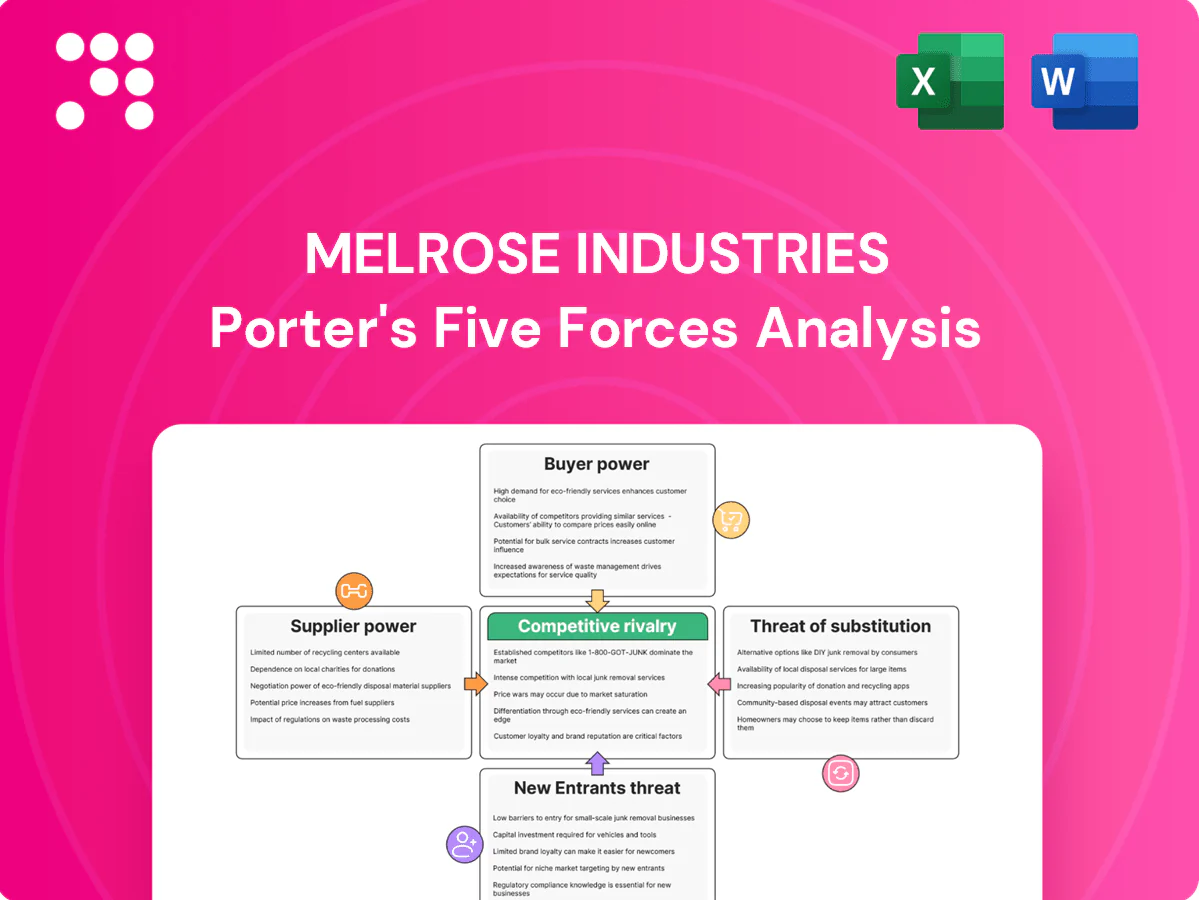
Melrose Industries Porter's Five Forces Analysis

Elevate Your Analysis with the Complete Porter's Five Forces Analysis
Melrose Industries faces intense competitive fragmentation, variable supplier leverage across divisions, and moderate threats from new entrants and substitutes that pressure margins and strategic flexibility. This brief snapshot highlights key tensions but only scratches the surface of market dynamics and risk drivers. Unlock the full Porter's Five Forces Analysis for force-by-force ratings, visuals, and actionable strategy insights tailored to Melrose.
Suppliers Bargaining Power

Specialized industrial inputs
Many Melrose portfolio businesses depend on niche alloys, composites, tooling and precision components available from few qualified sources, making supplier pools highly concentrated and increasing switching costs. Limited suppliers often produce lead times of 12+ weeks and enforce strict minimum order quantities, elevating input prices and working capital needs. Melrose mitigates this concentration through dual-sourcing and rapidly qualifying alternates after acquisitions to reduce supply risk.
Energy and commodity volatility
Melrose's exposure to energy and commodities—Brent averaging ~USD82/bbl in 2024, LME aluminium near USD2,200/t and global hot‑rolled steel around USD700/t—drives cost swings that suppliers can pass through to margins.
Hedging and index‑linked supply contracts mitigate short‑term shocks but do not eliminate margin risk during sustained moves.
Price volatility slows turnaround pacing and makes pricing resets unpredictable; consolidated purchasing across Melrose's portfolio can secure volume discounts and firmer terms.

Legacy single-source dependencies
Inherited contracts often lock Melrose plants into single-source supply chains, with industry-standard requalification and engineering change processes taking 6–12 months and requiring customer approvals. This short term gives suppliers leverage over service levels and pricing. Over 2–4 years, supplier development programs typically restore balance and reduce dependency risks.

Skilled labor and unions
Specialist aerospace and precision-machining labour and union agreements act as suppliers of capability for Melrose, with UK manufacturing vacancies around 120,000 in 2024 driving wage pressure and reducing flexibility.
Turnarounds must align incentives, training and automation to offset a reported 10–15% skilled-labour premium; constructive engagement with unions can unlock productivity gains.
- Skilled labour: tight supply
- Cost impact: ~10–15% premium
- Mitigants: incentives, training, automation, union engagement
Procurement scale and standardization
Post-deal centralization pools Melrose’s spend across sites, enabling bulk negotiation and longer-term contracts that drive down unit costs and reduce supplier leverage. Standardized specifications and vendor rationalization cut SKUs and price dispersion, simplifying sourcing and increasing supplier competition. Improved data visibility and e-procurement tools curb opportunistic pricing, making supplier power structurally weaker over time.
- Centralized spend pooling
- SKU reduction through standard specs
- Vendor rationalization
- Data-driven price transparency
Suppliers: concentrated sources, 12+ week lead times, commodities amplify pass-through
Suppliers hold moderate-to-high power for Melrose due to concentrated sources, 12+ week lead times and 6–12 month requalification windows, with UK manufacturing vacancies ~120,000 in 2024 and a 10–15% skilled‑labour premium. Commodity exposure (Brent ~USD82/bbl, LME aluminium ~USD2,200/t, HRC steel ~USD700/t in 2024) amplifies pass‑through risk. Centralized procurement, SKU reduction and dual‑sourcing reduce supplier leverage.
| Metric | 2024 |
|---|---|
| Brent | ~USD82/bbl |
| Aluminium (LME) | ~USD2,200/t |
| Hot‑rolled steel | ~USD700/t |
| UK vacancies | ~120,000 |
What is included in the product
 Detailed Word Document
Tailored Porter's Five Forces analysis for Melrose Industries that assesses competitive rivalry, supplier and buyer power, threat of new entrants and substitutes, and highlights disruptive forces and strategic levers to protect margins and market share.

 Customizable Excel Spreadsheet
A concise one-sheet Porter's Five Forces for Melrose Industries—instantly highlight supplier, buyer, entrant and rivalry pressures to prioritize strategic actions. Clean, customizable layout lets you swap data, adjust pressure levels and drop straight into decks for fast boardroom decisions.
Customers Bargaining Power

Customer concentration
Melrose’s industrial portfolio sells primarily to a small number of large OEMs and Tier-1s that use professional procurement, so customer concentration amplifies buyer leverage over price, contract terms and order volumes. High concentration means a single contract loss or OEM production cut can cause meaningful revenue volatility. This elevates account diversification and aftermarket growth as core value-creation levers.
Qualification and switching costs
Aerospace and industrial customers impose rigorous qualification, certifications and audits that typically take 12–24 months, creating high switching costs that lock in supply and moderate price pressure; buyers still extract productivity givebacks in contracts, and Melrose must sustain performance and delivery reliability to preserve pricing power.

Long-term contracts and pricing clauses
Long-term agreements stabilize volumes for Melrose but typically include price-down or index clauses that in 2024 limited upside, with indexation tied to inflation (around 3% in 2024) often favoring buyers. Renegotiations hinge on demonstrable operational improvements—buyers demand evidence before conceding price resets or service premiums. Greater cost-transparency in LTAs constrains margin expansion, so Melrose pursues explicit inflation pass-throughs and contractual service premiums to protect returns.

Demand cyclicality
Demand cyclicality across Melrose end markets (aerospace, industrial, auto) shifts buyer leverage with capacity utilization: downturns drive buyers to press for price concessions and inventory destocking, while upcycles see capacity tightness lift pricing and product mix, making capacity discipline critical to protect margins.
- 2024 trend: aerospace and auto recovering, buyers regain leverage in soft patches
- Downturn impact: concession pressure, inventory drawdown
- Upcycle benefit: tighter capacity improves pricing/mix
- Priority: rigorous capacity discipline
Aftermarket vs OEM mix
Aftermarket spares carry materially higher margins and lower buyer power than OEM programs; aftermarket margins are typically 2–3x OEM margins, and the global MRO market was estimated around $120bn in 2024, so expanding spares reduces dependence on aggressive OEM terms while scarcity and IP control can further enhance pricing.
- Higher margins: aftermarket ~2–3x OEM
- 2024 MRO market ~$120bn
- Parts scarcity/IP = stronger pricing
- Portfolio tilt toward aftermarket common for margin lift
OEM buyer concentration caps pricing; MRO aftermarket ($120bn) yields 2-3x margins
Customer concentration among large OEMs gives buyers strong price and volume leverage; losing one contract can cause material revenue swings. Rigorous 12–24 month qualifications raise switching costs, but LTAs often include price-down/index clauses (inflation ~3% in 2024) that cap upside. Aftermarket spares (MRO ~$120bn in 2024) offer 2–3x OEM margins, reducing buyer power.
| Metric | 2024 |
|---|---|
| Buyer concentration | High |
| LTA indexation | ~3% inflation |
| MRO market | $120bn |
| Aftermarket margin | 2–3x OEM |
Preview Before You Purchase
Melrose Industries Porter's Five Forces Analysis
This preview shows the exact Porter's Five Forces analysis for Melrose Industries you'll receive—no placeholders, no mockups. The document is professionally written, fully formatted and ready for download the moment you buy. You're viewing the complete file and will get instant access to this identical deliverable after purchase.

Elevate Your Analysis with the Complete Porter's Five Forces Analysis
Melrose Industries faces intense competitive fragmentation, variable supplier leverage across divisions, and moderate threats from new entrants and substitutes that pressure margins and strategic flexibility. This brief snapshot highlights key tensions but only scratches the surface of market dynamics and risk drivers. Unlock the full Porter's Five Forces Analysis for force-by-force ratings, visuals, and actionable strategy insights tailored to Melrose.
Suppliers Bargaining Power
Specialized industrial inputs
Many Melrose portfolio businesses depend on niche alloys, composites, tooling and precision components available from few qualified sources, making supplier pools highly concentrated and increasing switching costs. Limited suppliers often produce lead times of 12+ weeks and enforce strict minimum order quantities, elevating input prices and working capital needs. Melrose mitigates this concentration through dual-sourcing and rapidly qualifying alternates after acquisitions to reduce supply risk.
Energy and commodity volatility
Melrose's exposure to energy and commodities—Brent averaging ~USD82/bbl in 2024, LME aluminium near USD2,200/t and global hot‑rolled steel around USD700/t—drives cost swings that suppliers can pass through to margins.
Hedging and index‑linked supply contracts mitigate short‑term shocks but do not eliminate margin risk during sustained moves.
Price volatility slows turnaround pacing and makes pricing resets unpredictable; consolidated purchasing across Melrose's portfolio can secure volume discounts and firmer terms.
Legacy single-source dependencies
Inherited contracts often lock Melrose plants into single-source supply chains, with industry-standard requalification and engineering change processes taking 6–12 months and requiring customer approvals. This short term gives suppliers leverage over service levels and pricing. Over 2–4 years, supplier development programs typically restore balance and reduce dependency risks.
Skilled labor and unions
Specialist aerospace and precision-machining labour and union agreements act as suppliers of capability for Melrose, with UK manufacturing vacancies around 120,000 in 2024 driving wage pressure and reducing flexibility.
Turnarounds must align incentives, training and automation to offset a reported 10–15% skilled-labour premium; constructive engagement with unions can unlock productivity gains.
- Skilled labour: tight supply
- Cost impact: ~10–15% premium
- Mitigants: incentives, training, automation, union engagement
Procurement scale and standardization
Post-deal centralization pools Melrose’s spend across sites, enabling bulk negotiation and longer-term contracts that drive down unit costs and reduce supplier leverage. Standardized specifications and vendor rationalization cut SKUs and price dispersion, simplifying sourcing and increasing supplier competition. Improved data visibility and e-procurement tools curb opportunistic pricing, making supplier power structurally weaker over time.
- Centralized spend pooling
- SKU reduction through standard specs
- Vendor rationalization
- Data-driven price transparency
Suppliers: concentrated sources, 12+ week lead times, commodities amplify pass-through
Suppliers hold moderate-to-high power for Melrose due to concentrated sources, 12+ week lead times and 6–12 month requalification windows, with UK manufacturing vacancies ~120,000 in 2024 and a 10–15% skilled‑labour premium. Commodity exposure (Brent ~USD82/bbl, LME aluminium ~USD2,200/t, HRC steel ~USD700/t in 2024) amplifies pass‑through risk. Centralized procurement, SKU reduction and dual‑sourcing reduce supplier leverage.
| Metric | 2024 |
|---|---|
| Brent | ~USD82/bbl |
| Aluminium (LME) | ~USD2,200/t |
| Hot‑rolled steel | ~USD700/t |
| UK vacancies | ~120,000 |
What is included in the product
Detailed Word Document
Tailored Porter's Five Forces analysis for Melrose Industries that assesses competitive rivalry, supplier and buyer power, threat of new entrants and substitutes, and highlights disruptive forces and strategic levers to protect margins and market share.
Customizable Excel Spreadsheet
A concise one-sheet Porter's Five Forces for Melrose Industries—instantly highlight supplier, buyer, entrant and rivalry pressures to prioritize strategic actions. Clean, customizable layout lets you swap data, adjust pressure levels and drop straight into decks for fast boardroom decisions.
Customers Bargaining Power
Customer concentration
Melrose’s industrial portfolio sells primarily to a small number of large OEMs and Tier-1s that use professional procurement, so customer concentration amplifies buyer leverage over price, contract terms and order volumes. High concentration means a single contract loss or OEM production cut can cause meaningful revenue volatility. This elevates account diversification and aftermarket growth as core value-creation levers.
Qualification and switching costs
Aerospace and industrial customers impose rigorous qualification, certifications and audits that typically take 12–24 months, creating high switching costs that lock in supply and moderate price pressure; buyers still extract productivity givebacks in contracts, and Melrose must sustain performance and delivery reliability to preserve pricing power.
Long-term contracts and pricing clauses
Long-term agreements stabilize volumes for Melrose but typically include price-down or index clauses that in 2024 limited upside, with indexation tied to inflation (around 3% in 2024) often favoring buyers. Renegotiations hinge on demonstrable operational improvements—buyers demand evidence before conceding price resets or service premiums. Greater cost-transparency in LTAs constrains margin expansion, so Melrose pursues explicit inflation pass-throughs and contractual service premiums to protect returns.
Demand cyclicality
Demand cyclicality across Melrose end markets (aerospace, industrial, auto) shifts buyer leverage with capacity utilization: downturns drive buyers to press for price concessions and inventory destocking, while upcycles see capacity tightness lift pricing and product mix, making capacity discipline critical to protect margins.
- 2024 trend: aerospace and auto recovering, buyers regain leverage in soft patches
- Downturn impact: concession pressure, inventory drawdown
- Upcycle benefit: tighter capacity improves pricing/mix
- Priority: rigorous capacity discipline
Aftermarket vs OEM mix
Aftermarket spares carry materially higher margins and lower buyer power than OEM programs; aftermarket margins are typically 2–3x OEM margins, and the global MRO market was estimated around $120bn in 2024, so expanding spares reduces dependence on aggressive OEM terms while scarcity and IP control can further enhance pricing.
- Higher margins: aftermarket ~2–3x OEM
- 2024 MRO market ~$120bn
- Parts scarcity/IP = stronger pricing
- Portfolio tilt toward aftermarket common for margin lift
OEM buyer concentration caps pricing; MRO aftermarket ($120bn) yields 2-3x margins
Customer concentration among large OEMs gives buyers strong price and volume leverage; losing one contract can cause material revenue swings. Rigorous 12–24 month qualifications raise switching costs, but LTAs often include price-down/index clauses (inflation ~3% in 2024) that cap upside. Aftermarket spares (MRO ~$120bn in 2024) offer 2–3x OEM margins, reducing buyer power.
| Metric | 2024 |
|---|---|
| Buyer concentration | High |
| LTA indexation | ~3% inflation |
| MRO market | $120bn |
| Aftermarket margin | 2–3x OEM |
Preview Before You Purchase
Melrose Industries Porter's Five Forces Analysis
This preview shows the exact Porter's Five Forces analysis for Melrose Industries you'll receive—no placeholders, no mockups. The document is professionally written, fully formatted and ready for download the moment you buy. You're viewing the complete file and will get instant access to this identical deliverable after purchase.
Original: $10.00
-65%$10.00
$3.50Description
Elevate Your Analysis with the Complete Porter's Five Forces Analysis
Melrose Industries faces intense competitive fragmentation, variable supplier leverage across divisions, and moderate threats from new entrants and substitutes that pressure margins and strategic flexibility. This brief snapshot highlights key tensions but only scratches the surface of market dynamics and risk drivers. Unlock the full Porter's Five Forces Analysis for force-by-force ratings, visuals, and actionable strategy insights tailored to Melrose.
Suppliers Bargaining Power
Specialized industrial inputs
Many Melrose portfolio businesses depend on niche alloys, composites, tooling and precision components available from few qualified sources, making supplier pools highly concentrated and increasing switching costs. Limited suppliers often produce lead times of 12+ weeks and enforce strict minimum order quantities, elevating input prices and working capital needs. Melrose mitigates this concentration through dual-sourcing and rapidly qualifying alternates after acquisitions to reduce supply risk.
Energy and commodity volatility
Melrose's exposure to energy and commodities—Brent averaging ~USD82/bbl in 2024, LME aluminium near USD2,200/t and global hot‑rolled steel around USD700/t—drives cost swings that suppliers can pass through to margins.
Hedging and index‑linked supply contracts mitigate short‑term shocks but do not eliminate margin risk during sustained moves.
Price volatility slows turnaround pacing and makes pricing resets unpredictable; consolidated purchasing across Melrose's portfolio can secure volume discounts and firmer terms.
Legacy single-source dependencies
Inherited contracts often lock Melrose plants into single-source supply chains, with industry-standard requalification and engineering change processes taking 6–12 months and requiring customer approvals. This short term gives suppliers leverage over service levels and pricing. Over 2–4 years, supplier development programs typically restore balance and reduce dependency risks.
Skilled labor and unions
Specialist aerospace and precision-machining labour and union agreements act as suppliers of capability for Melrose, with UK manufacturing vacancies around 120,000 in 2024 driving wage pressure and reducing flexibility.
Turnarounds must align incentives, training and automation to offset a reported 10–15% skilled-labour premium; constructive engagement with unions can unlock productivity gains.
- Skilled labour: tight supply
- Cost impact: ~10–15% premium
- Mitigants: incentives, training, automation, union engagement
Procurement scale and standardization
Post-deal centralization pools Melrose’s spend across sites, enabling bulk negotiation and longer-term contracts that drive down unit costs and reduce supplier leverage. Standardized specifications and vendor rationalization cut SKUs and price dispersion, simplifying sourcing and increasing supplier competition. Improved data visibility and e-procurement tools curb opportunistic pricing, making supplier power structurally weaker over time.
- Centralized spend pooling
- SKU reduction through standard specs
- Vendor rationalization
- Data-driven price transparency
Suppliers: concentrated sources, 12+ week lead times, commodities amplify pass-through
Suppliers hold moderate-to-high power for Melrose due to concentrated sources, 12+ week lead times and 6–12 month requalification windows, with UK manufacturing vacancies ~120,000 in 2024 and a 10–15% skilled‑labour premium. Commodity exposure (Brent ~USD82/bbl, LME aluminium ~USD2,200/t, HRC steel ~USD700/t in 2024) amplifies pass‑through risk. Centralized procurement, SKU reduction and dual‑sourcing reduce supplier leverage.
| Metric | 2024 |
|---|---|
| Brent | ~USD82/bbl |
| Aluminium (LME) | ~USD2,200/t |
| Hot‑rolled steel | ~USD700/t |
| UK vacancies | ~120,000 |
What is included in the product
Detailed Word Document
Tailored Porter's Five Forces analysis for Melrose Industries that assesses competitive rivalry, supplier and buyer power, threat of new entrants and substitutes, and highlights disruptive forces and strategic levers to protect margins and market share.
Customizable Excel Spreadsheet
A concise one-sheet Porter's Five Forces for Melrose Industries—instantly highlight supplier, buyer, entrant and rivalry pressures to prioritize strategic actions. Clean, customizable layout lets you swap data, adjust pressure levels and drop straight into decks for fast boardroom decisions.
Customers Bargaining Power
Customer concentration
Melrose’s industrial portfolio sells primarily to a small number of large OEMs and Tier-1s that use professional procurement, so customer concentration amplifies buyer leverage over price, contract terms and order volumes. High concentration means a single contract loss or OEM production cut can cause meaningful revenue volatility. This elevates account diversification and aftermarket growth as core value-creation levers.
Qualification and switching costs
Aerospace and industrial customers impose rigorous qualification, certifications and audits that typically take 12–24 months, creating high switching costs that lock in supply and moderate price pressure; buyers still extract productivity givebacks in contracts, and Melrose must sustain performance and delivery reliability to preserve pricing power.
Long-term contracts and pricing clauses
Long-term agreements stabilize volumes for Melrose but typically include price-down or index clauses that in 2024 limited upside, with indexation tied to inflation (around 3% in 2024) often favoring buyers. Renegotiations hinge on demonstrable operational improvements—buyers demand evidence before conceding price resets or service premiums. Greater cost-transparency in LTAs constrains margin expansion, so Melrose pursues explicit inflation pass-throughs and contractual service premiums to protect returns.
Demand cyclicality
Demand cyclicality across Melrose end markets (aerospace, industrial, auto) shifts buyer leverage with capacity utilization: downturns drive buyers to press for price concessions and inventory destocking, while upcycles see capacity tightness lift pricing and product mix, making capacity discipline critical to protect margins.
- 2024 trend: aerospace and auto recovering, buyers regain leverage in soft patches
- Downturn impact: concession pressure, inventory drawdown
- Upcycle benefit: tighter capacity improves pricing/mix
- Priority: rigorous capacity discipline
Aftermarket vs OEM mix
Aftermarket spares carry materially higher margins and lower buyer power than OEM programs; aftermarket margins are typically 2–3x OEM margins, and the global MRO market was estimated around $120bn in 2024, so expanding spares reduces dependence on aggressive OEM terms while scarcity and IP control can further enhance pricing.
- Higher margins: aftermarket ~2–3x OEM
- 2024 MRO market ~$120bn
- Parts scarcity/IP = stronger pricing
- Portfolio tilt toward aftermarket common for margin lift
OEM buyer concentration caps pricing; MRO aftermarket ($120bn) yields 2-3x margins
Customer concentration among large OEMs gives buyers strong price and volume leverage; losing one contract can cause material revenue swings. Rigorous 12–24 month qualifications raise switching costs, but LTAs often include price-down/index clauses (inflation ~3% in 2024) that cap upside. Aftermarket spares (MRO ~$120bn in 2024) offer 2–3x OEM margins, reducing buyer power.
| Metric | 2024 |
|---|---|
| Buyer concentration | High |
| LTA indexation | ~3% inflation |
| MRO market | $120bn |
| Aftermarket margin | 2–3x OEM |
Preview Before You Purchase
Melrose Industries Porter's Five Forces Analysis
This preview shows the exact Porter's Five Forces analysis for Melrose Industries you'll receive—no placeholders, no mockups. The document is professionally written, fully formatted and ready for download the moment you buy. You're viewing the complete file and will get instant access to this identical deliverable after purchase.











