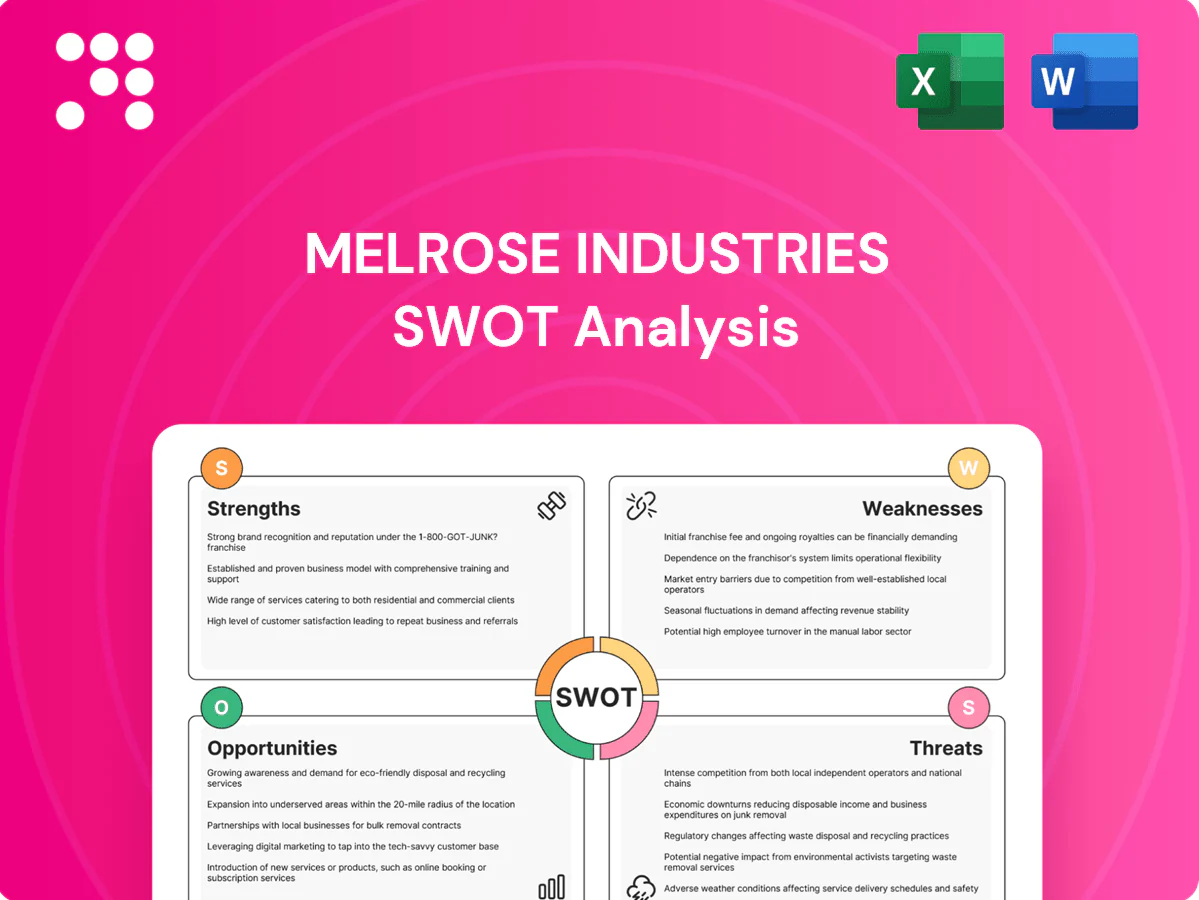
Melrose Industries SWOT Analysis

Go Beyond the Preview—Access the Full Strategic Report
Melrose Industries' SWOT highlights strong turnaround expertise and a diversified industrial portfolio, tempered by cyclical demand and elevated leverage. Our full SWOT unpacks competitive advantages, operational risks, and strategic growth levers with financial context and expert commentary. Purchase the complete, editable Word+Excel report to strategize, pitch, or invest with confidence.
Strengths

Proven buy-improve-sell model
Repeatable turnaround playbooks at Melrose create a clear path from acquisition to value creation and exit, as evidenced by the 2018 £8bn purchase of GKN that showcased scalable integration processes. The firm’s institutionalized focus on operational uplift, portfolio simplification and margin expansion standardizes execution and reduces ambiguity for management and investors. This consistency supports reliable shareholder communications and bid discipline. A strong track record lowers perceived deal risk.
Operational excellence in turnarounds
Deep restructuring expertise since Melrose’s 2003 founding and landmark 2018 GKN acquisition enables rapid cost-out and footprint optimization; strict KPI, cash-conversion and ROCE discipline underpin post-deal performance, while lean, procurement and working-capital programs deliver faster improvements than purely financial buyers.

Disciplined capital allocation
Disciplined capital allocation at Melrose—built around rigorous valuations, clear hurdle rates and timing of exits—underpinned the post-GKN turnaround since the £8.1bn GKN acquisition in 2018. Recycling proceeds from disposals into higher-return opportunities compounds value. Shareholder-focused distributions and buybacks signal financial discipline, lowering empire-building risk and preserving investment quality.

Portfolio agility and focus
Active ownership at Melrose enables rapid decisions and resource reallocation, pruning non-core assets to concentrate on high-return levers; in FY2024 the group reported c.£9.8bn revenue and returned c.£1.2bn to shareholders, illustrating cash conversion and focus. This model avoids permanent capital drag from underperformers and the resulting agility helps navigate cycles and sector shifts.
- Active ownership: rapid reallocations
- Non-core pruning: focus on high-return levers
- Capital efficiency: ~£1.2bn returned FY2024
- Agility: better cycle and sector navigation
Incentive alignment with shareholders
- Compensation linked to value creation
- Milestones on margin, cash, exit value
- Stronger accountability and market confidence
- Attracts specialist operators
Repeatable turnaround playbook drives rapid margin expansion and ROCE improvement
Melrose’s repeatable turnaround playbook and deep restructuring expertise (since 2003) drive rapid margin expansion and ROCE improvement, proven in the £8.1bn GKN deal (2018). Disciplined capital allocation and active ownership enabled c.£9.8bn revenue and c.£1.2bn returned to shareholders in FY2024, reducing deal risk and attracting specialist operators.
| Metric | Value |
|---|---|
| Founded | 2003 |
| GKN acquisition | £8.1bn (2018) |
| FY2024 Revenue | £9.8bn |
| Returns to shareholders FY2024 | £1.2bn (approx) |
What is included in the product
 Detailed Word Document
Provides a concise SWOT analysis of Melrose Industries, highlighting its operational strengths and efficiency-driven advantages, key weaknesses and integration risks from serial acquisitions, growth opportunities in aftermarket services and recycling, and external threats from market cyclicality, commodity volatility, and geopolitical supply-chain pressures.

 Customizable Excel Spreadsheet
Provides a concise SWOT matrix of Melrose Industries for fast strategic alignment and stakeholder-ready presentations. Editable format enables quick updates to reflect M&A activity and changing asset performance.
Weaknesses

Dependence on deal flow
Melrose’s model requires a steady pipeline of underperforming targets at attractive valuations; its landmark £8.1bn GKN takeover in 2018 shows scale but such opportunities are rare. Scarcity of suitable assets can slow deal-driven growth, while competitive auctions and rising bid multiples compress returns or force more conservative deployment. Extended inactivity or missed buys can quickly weigh on investor sentiment and share performance.
Integration and execution risk
Turnarounds carry cultural, operational and systems challenges that for Melrose can span dozens of plants and supply chains, and management-consulting literature estimates roughly 70% of large transformations fail to deliver expected value. Missteps can delay targeted savings, erode liquidity or impair asset values, pushing net cash needs higher. Multi-site restructurings amplify implementation risk, and execution slippage directly reduces exit timing and proceeds.

Cyclical industrial exposure
End-markets for Melrose’s businesses often track global industrial cycles, driving swings in volumes and pricing. Downturns can sharply cut demand just as restructuring and turnaround investment peak, squeezing cashflow. High operating leverage across asset-heavy divisions magnifies earnings volatility. That volatility complicates timing and value capture on planned exits.

Finite ownership horizon
Melrose's finite ownership horizon, typically three to five years, can constrain very long-term R&D or capacity investments, pushing management toward margin and cash-focused measures that stakeholders may perceive as short-termist. Potential buyers may price assets lower if improvements are seen as harvested, and planned exits create timing pressure in weak markets, risking sales at suboptimal valuations.
- Hold period: typically 3–5 years
- Short-term focus: margins/cash over decade-scale R&D
- Buyer discounting: harvested-improvement risk
- Exit timing: vulnerability in weak markets
Leverage and refinancing needs
Leverage underpins Melrose’s buy-and-restructure model—notably the £8bn GKN takeover in 2018—so acquisitions often rely on debt; the Bank of England base rate peak of 5.25% in 2023 and elevated global rates since 2022 raise refinancing and interest costs, squeezing margins. Debt covenants can limit operational flexibility during turnarounds, and near-term refinancing risk may constrain timing of disposals or reinvestment.
- Debt-funded acquisitions: GKN takeover c.£8bn
- Higher rates: BoE peak 5.25% (2023)
- Covenant pressure: limits during restructurings
- Refinancing risk: constrains strategic options
Deal scarcity, ~70% turnaround failures and high rates compress returns
Melrose depends on a steady flow of underperforming targets—GKN takeover £8.1bn—so scarcity or higher bid multiples compress returns and slow growth. Turnarounds (≈70% failure rate) and multi-site restructurings raise execution, cash and timing risk. High leverage and elevated rates (BoE peak 5.25% in 2023) increase refinancing and covenant pressure. Short 3–5 year hold fuels potential short-termism.
| Weakness | Key metric | Impact |
|---|---|---|
| Deal scarcity | GKN £8.1bn | Compresses returns |
| Execution risk | ~70% transform failures | Delays/value loss |
| Rate/leverage | BoE 5.25% (2023) | Refinancing/covenants |
| Hold horizon | 3–5 years | Short-term bias |
What You See Is What You Get
Melrose Industries SWOT Analysis
This is a real excerpt from the complete Melrose Industries SWOT analysis you’ll receive upon purchase—no surprises, just professional quality. The preview below is taken directly from the full report you'll get. Buy now to unlock the full, editable version.

Go Beyond the Preview—Access the Full Strategic Report
Melrose Industries' SWOT highlights strong turnaround expertise and a diversified industrial portfolio, tempered by cyclical demand and elevated leverage. Our full SWOT unpacks competitive advantages, operational risks, and strategic growth levers with financial context and expert commentary. Purchase the complete, editable Word+Excel report to strategize, pitch, or invest with confidence.
Strengths
Proven buy-improve-sell model
Repeatable turnaround playbooks at Melrose create a clear path from acquisition to value creation and exit, as evidenced by the 2018 £8bn purchase of GKN that showcased scalable integration processes. The firm’s institutionalized focus on operational uplift, portfolio simplification and margin expansion standardizes execution and reduces ambiguity for management and investors. This consistency supports reliable shareholder communications and bid discipline. A strong track record lowers perceived deal risk.
Operational excellence in turnarounds
Deep restructuring expertise since Melrose’s 2003 founding and landmark 2018 GKN acquisition enables rapid cost-out and footprint optimization; strict KPI, cash-conversion and ROCE discipline underpin post-deal performance, while lean, procurement and working-capital programs deliver faster improvements than purely financial buyers.
Disciplined capital allocation
Disciplined capital allocation at Melrose—built around rigorous valuations, clear hurdle rates and timing of exits—underpinned the post-GKN turnaround since the £8.1bn GKN acquisition in 2018. Recycling proceeds from disposals into higher-return opportunities compounds value. Shareholder-focused distributions and buybacks signal financial discipline, lowering empire-building risk and preserving investment quality.
Portfolio agility and focus
Active ownership at Melrose enables rapid decisions and resource reallocation, pruning non-core assets to concentrate on high-return levers; in FY2024 the group reported c.£9.8bn revenue and returned c.£1.2bn to shareholders, illustrating cash conversion and focus. This model avoids permanent capital drag from underperformers and the resulting agility helps navigate cycles and sector shifts.
- Active ownership: rapid reallocations
- Non-core pruning: focus on high-return levers
- Capital efficiency: ~£1.2bn returned FY2024
- Agility: better cycle and sector navigation
Incentive alignment with shareholders
- Compensation linked to value creation
- Milestones on margin, cash, exit value
- Stronger accountability and market confidence
- Attracts specialist operators
Repeatable turnaround playbook drives rapid margin expansion and ROCE improvement
Melrose’s repeatable turnaround playbook and deep restructuring expertise (since 2003) drive rapid margin expansion and ROCE improvement, proven in the £8.1bn GKN deal (2018). Disciplined capital allocation and active ownership enabled c.£9.8bn revenue and c.£1.2bn returned to shareholders in FY2024, reducing deal risk and attracting specialist operators.
| Metric | Value |
|---|---|
| Founded | 2003 |
| GKN acquisition | £8.1bn (2018) |
| FY2024 Revenue | £9.8bn |
| Returns to shareholders FY2024 | £1.2bn (approx) |
What is included in the product
Detailed Word Document
Provides a concise SWOT analysis of Melrose Industries, highlighting its operational strengths and efficiency-driven advantages, key weaknesses and integration risks from serial acquisitions, growth opportunities in aftermarket services and recycling, and external threats from market cyclicality, commodity volatility, and geopolitical supply-chain pressures.
Customizable Excel Spreadsheet
Provides a concise SWOT matrix of Melrose Industries for fast strategic alignment and stakeholder-ready presentations. Editable format enables quick updates to reflect M&A activity and changing asset performance.
Weaknesses
Dependence on deal flow
Melrose’s model requires a steady pipeline of underperforming targets at attractive valuations; its landmark £8.1bn GKN takeover in 2018 shows scale but such opportunities are rare. Scarcity of suitable assets can slow deal-driven growth, while competitive auctions and rising bid multiples compress returns or force more conservative deployment. Extended inactivity or missed buys can quickly weigh on investor sentiment and share performance.
Integration and execution risk
Turnarounds carry cultural, operational and systems challenges that for Melrose can span dozens of plants and supply chains, and management-consulting literature estimates roughly 70% of large transformations fail to deliver expected value. Missteps can delay targeted savings, erode liquidity or impair asset values, pushing net cash needs higher. Multi-site restructurings amplify implementation risk, and execution slippage directly reduces exit timing and proceeds.
Cyclical industrial exposure
End-markets for Melrose’s businesses often track global industrial cycles, driving swings in volumes and pricing. Downturns can sharply cut demand just as restructuring and turnaround investment peak, squeezing cashflow. High operating leverage across asset-heavy divisions magnifies earnings volatility. That volatility complicates timing and value capture on planned exits.
Finite ownership horizon
Melrose's finite ownership horizon, typically three to five years, can constrain very long-term R&D or capacity investments, pushing management toward margin and cash-focused measures that stakeholders may perceive as short-termist. Potential buyers may price assets lower if improvements are seen as harvested, and planned exits create timing pressure in weak markets, risking sales at suboptimal valuations.
- Hold period: typically 3–5 years
- Short-term focus: margins/cash over decade-scale R&D
- Buyer discounting: harvested-improvement risk
- Exit timing: vulnerability in weak markets
Leverage and refinancing needs
Leverage underpins Melrose’s buy-and-restructure model—notably the £8bn GKN takeover in 2018—so acquisitions often rely on debt; the Bank of England base rate peak of 5.25% in 2023 and elevated global rates since 2022 raise refinancing and interest costs, squeezing margins. Debt covenants can limit operational flexibility during turnarounds, and near-term refinancing risk may constrain timing of disposals or reinvestment.
- Debt-funded acquisitions: GKN takeover c.£8bn
- Higher rates: BoE peak 5.25% (2023)
- Covenant pressure: limits during restructurings
- Refinancing risk: constrains strategic options
Deal scarcity, ~70% turnaround failures and high rates compress returns
Melrose depends on a steady flow of underperforming targets—GKN takeover £8.1bn—so scarcity or higher bid multiples compress returns and slow growth. Turnarounds (≈70% failure rate) and multi-site restructurings raise execution, cash and timing risk. High leverage and elevated rates (BoE peak 5.25% in 2023) increase refinancing and covenant pressure. Short 3–5 year hold fuels potential short-termism.
| Weakness | Key metric | Impact |
|---|---|---|
| Deal scarcity | GKN £8.1bn | Compresses returns |
| Execution risk | ~70% transform failures | Delays/value loss |
| Rate/leverage | BoE 5.25% (2023) | Refinancing/covenants |
| Hold horizon | 3–5 years | Short-term bias |
What You See Is What You Get
Melrose Industries SWOT Analysis
This is a real excerpt from the complete Melrose Industries SWOT analysis you’ll receive upon purchase—no surprises, just professional quality. The preview below is taken directly from the full report you'll get. Buy now to unlock the full, editable version.
Description
Go Beyond the Preview—Access the Full Strategic Report
Melrose Industries' SWOT highlights strong turnaround expertise and a diversified industrial portfolio, tempered by cyclical demand and elevated leverage. Our full SWOT unpacks competitive advantages, operational risks, and strategic growth levers with financial context and expert commentary. Purchase the complete, editable Word+Excel report to strategize, pitch, or invest with confidence.
Strengths
Proven buy-improve-sell model
Repeatable turnaround playbooks at Melrose create a clear path from acquisition to value creation and exit, as evidenced by the 2018 £8bn purchase of GKN that showcased scalable integration processes. The firm’s institutionalized focus on operational uplift, portfolio simplification and margin expansion standardizes execution and reduces ambiguity for management and investors. This consistency supports reliable shareholder communications and bid discipline. A strong track record lowers perceived deal risk.
Operational excellence in turnarounds
Deep restructuring expertise since Melrose’s 2003 founding and landmark 2018 GKN acquisition enables rapid cost-out and footprint optimization; strict KPI, cash-conversion and ROCE discipline underpin post-deal performance, while lean, procurement and working-capital programs deliver faster improvements than purely financial buyers.
Disciplined capital allocation
Disciplined capital allocation at Melrose—built around rigorous valuations, clear hurdle rates and timing of exits—underpinned the post-GKN turnaround since the £8.1bn GKN acquisition in 2018. Recycling proceeds from disposals into higher-return opportunities compounds value. Shareholder-focused distributions and buybacks signal financial discipline, lowering empire-building risk and preserving investment quality.
Portfolio agility and focus
Active ownership at Melrose enables rapid decisions and resource reallocation, pruning non-core assets to concentrate on high-return levers; in FY2024 the group reported c.£9.8bn revenue and returned c.£1.2bn to shareholders, illustrating cash conversion and focus. This model avoids permanent capital drag from underperformers and the resulting agility helps navigate cycles and sector shifts.
- Active ownership: rapid reallocations
- Non-core pruning: focus on high-return levers
- Capital efficiency: ~£1.2bn returned FY2024
- Agility: better cycle and sector navigation
Incentive alignment with shareholders
- Compensation linked to value creation
- Milestones on margin, cash, exit value
- Stronger accountability and market confidence
- Attracts specialist operators
Repeatable turnaround playbook drives rapid margin expansion and ROCE improvement
Melrose’s repeatable turnaround playbook and deep restructuring expertise (since 2003) drive rapid margin expansion and ROCE improvement, proven in the £8.1bn GKN deal (2018). Disciplined capital allocation and active ownership enabled c.£9.8bn revenue and c.£1.2bn returned to shareholders in FY2024, reducing deal risk and attracting specialist operators.
| Metric | Value |
|---|---|
| Founded | 2003 |
| GKN acquisition | £8.1bn (2018) |
| FY2024 Revenue | £9.8bn |
| Returns to shareholders FY2024 | £1.2bn (approx) |
What is included in the product
Detailed Word Document
Provides a concise SWOT analysis of Melrose Industries, highlighting its operational strengths and efficiency-driven advantages, key weaknesses and integration risks from serial acquisitions, growth opportunities in aftermarket services and recycling, and external threats from market cyclicality, commodity volatility, and geopolitical supply-chain pressures.
Customizable Excel Spreadsheet
Provides a concise SWOT matrix of Melrose Industries for fast strategic alignment and stakeholder-ready presentations. Editable format enables quick updates to reflect M&A activity and changing asset performance.
Weaknesses
Dependence on deal flow
Melrose’s model requires a steady pipeline of underperforming targets at attractive valuations; its landmark £8.1bn GKN takeover in 2018 shows scale but such opportunities are rare. Scarcity of suitable assets can slow deal-driven growth, while competitive auctions and rising bid multiples compress returns or force more conservative deployment. Extended inactivity or missed buys can quickly weigh on investor sentiment and share performance.
Integration and execution risk
Turnarounds carry cultural, operational and systems challenges that for Melrose can span dozens of plants and supply chains, and management-consulting literature estimates roughly 70% of large transformations fail to deliver expected value. Missteps can delay targeted savings, erode liquidity or impair asset values, pushing net cash needs higher. Multi-site restructurings amplify implementation risk, and execution slippage directly reduces exit timing and proceeds.
Cyclical industrial exposure
End-markets for Melrose’s businesses often track global industrial cycles, driving swings in volumes and pricing. Downturns can sharply cut demand just as restructuring and turnaround investment peak, squeezing cashflow. High operating leverage across asset-heavy divisions magnifies earnings volatility. That volatility complicates timing and value capture on planned exits.
Finite ownership horizon
Melrose's finite ownership horizon, typically three to five years, can constrain very long-term R&D or capacity investments, pushing management toward margin and cash-focused measures that stakeholders may perceive as short-termist. Potential buyers may price assets lower if improvements are seen as harvested, and planned exits create timing pressure in weak markets, risking sales at suboptimal valuations.
- Hold period: typically 3–5 years
- Short-term focus: margins/cash over decade-scale R&D
- Buyer discounting: harvested-improvement risk
- Exit timing: vulnerability in weak markets
Leverage and refinancing needs
Leverage underpins Melrose’s buy-and-restructure model—notably the £8bn GKN takeover in 2018—so acquisitions often rely on debt; the Bank of England base rate peak of 5.25% in 2023 and elevated global rates since 2022 raise refinancing and interest costs, squeezing margins. Debt covenants can limit operational flexibility during turnarounds, and near-term refinancing risk may constrain timing of disposals or reinvestment.
- Debt-funded acquisitions: GKN takeover c.£8bn
- Higher rates: BoE peak 5.25% (2023)
- Covenant pressure: limits during restructurings
- Refinancing risk: constrains strategic options
Deal scarcity, ~70% turnaround failures and high rates compress returns
Melrose depends on a steady flow of underperforming targets—GKN takeover £8.1bn—so scarcity or higher bid multiples compress returns and slow growth. Turnarounds (≈70% failure rate) and multi-site restructurings raise execution, cash and timing risk. High leverage and elevated rates (BoE peak 5.25% in 2023) increase refinancing and covenant pressure. Short 3–5 year hold fuels potential short-termism.
| Weakness | Key metric | Impact |
|---|---|---|
| Deal scarcity | GKN £8.1bn | Compresses returns |
| Execution risk | ~70% transform failures | Delays/value loss |
| Rate/leverage | BoE 5.25% (2023) | Refinancing/covenants |
| Hold horizon | 3–5 years | Short-term bias |
What You See Is What You Get
Melrose Industries SWOT Analysis
This is a real excerpt from the complete Melrose Industries SWOT analysis you’ll receive upon purchase—no surprises, just professional quality. The preview below is taken directly from the full report you'll get. Buy now to unlock the full, editable version.











