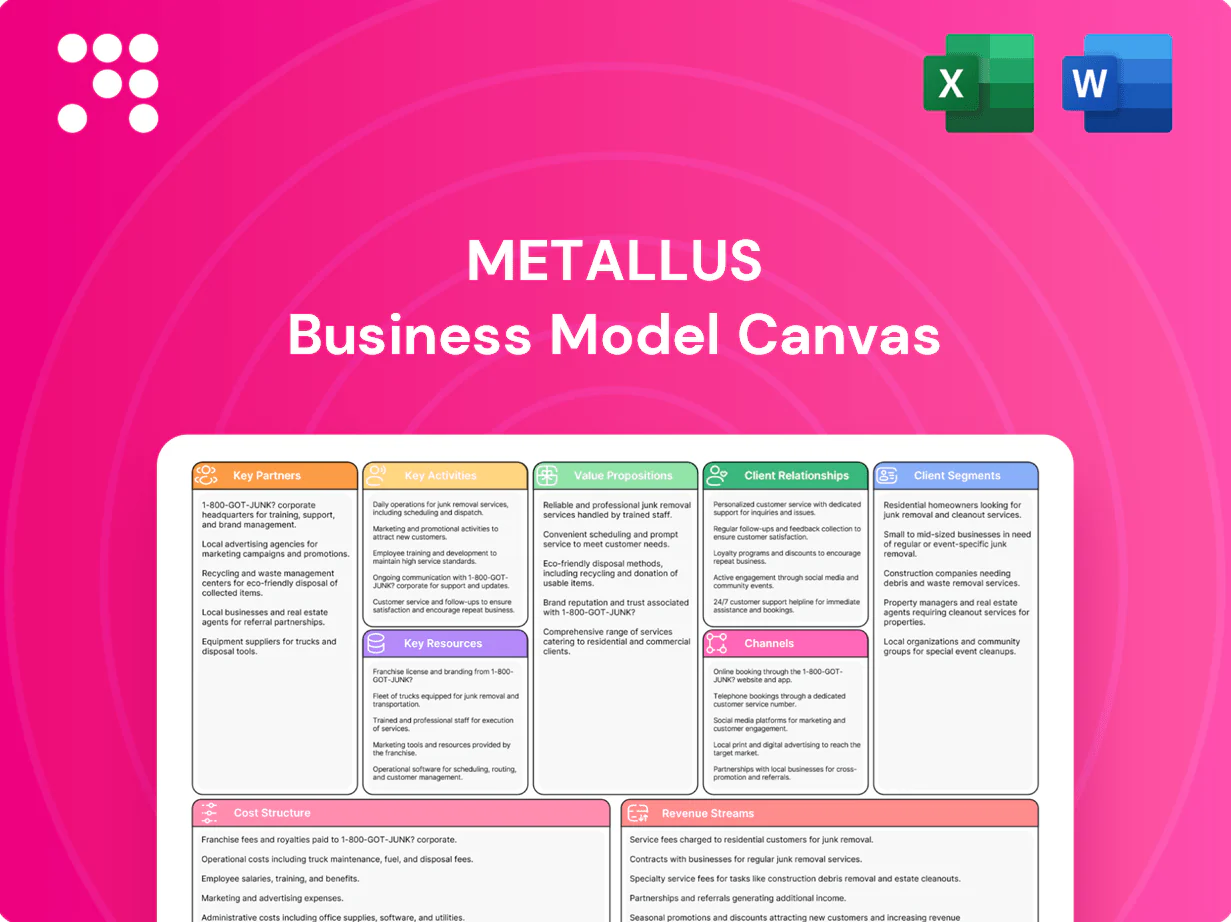
Metallus Business Model Canvas

Unlock the strategic blueprint of a metals firm Business Model Canvas
Unlock the full strategic blueprint behind Metallus’s Business Model Canvas and discover how the company creates value, scales operations, and protects margins. This concise, actionable report breaks down customer segments, revenue streams, and key partnerships. Purchase the complete, editable Canvas to benchmark strategies and accelerate decision-making.
Partnerships

Alloy and raw material suppliers
Securing high-purity scrap and alloying elements ensures consistent metallurgy and repeatable mechanical properties; long-term supplier contracts (typical tenure 3–5 years) stabilize pricing and availability through cycles. Joint quality programs deliver chemical consistency with batch-level traceability and 100% material certification. Co-development with suppliers shortens alloy qualification timelines, often by 6–12 months, speeding customer qualification.
Heat-treat, coating, and finishing specialists
Partner heat-treat, coating, and finishing specialists enable quench-and-temper, induction hardening, and specialty coatings services, expanding Metallus’s product scope without major capex; industry outsourcing trends supported a global heat-treatment and surface‑treatment market estimated near USD 17.5B in 2024 with ~4% CAGR. Shared quality systems and PPAP alignment secure critical end‑use specs, while contracted partners provide 20–30% flexible capacity buffers to absorb demand surges and niche treatments.

OEMs and Tier 1/Tier 2 integrators
Design-in partnerships with OEMs and Tier 1/2 integrators align material specs early in 2024 platform development cycles, enabling Metallus to co-engineer bar and tubing solutions that reduce weight and improve fatigue life while targeting cost metrics. Joint testing validates performance across real-world duty cycles and accelerates qualification. Multi-year awards lock volume and pricing frameworks to de-risk investments and secure supply continuity.

Technology, testing, and academic institutions
Universities and national labs deliver advanced metallurgy research and rigorous failure analysis, enabling Metallus to improve cleanliness, microstructure control, and formability through joint projects and shared test facilities.
Collaborative pilot trials and shared IP arrangements de-risk new alloy grades and scale-up, while certifications such as ISO 9001, AS9100, and peer-reviewed publications increase credibility with regulated industries.
- Research partners: advanced metallurgy & failure analysis
- Pilot trials: de-risk scale-up via shared IP
- Focus areas: cleanliness, microstructure, formability
- Credibility: ISO, AS standards, peer-reviewed publications
Logistics and service center networks
Freight partners optimize inbound scrap and outbound finished-goods lead times, often cutting transit times 20-30% and enabling >95% on-time delivery for critical production lines in 2024; service centers extend reach with cut-to-length, JIT, and regional stocking to reduce customer lead times by ~25%.
- EDI/VMI integration: lowers customer inventory 15-30%
- Freight lead-time cut: 20-30% (2024)
- On-time delivery: >95% for critical lines (2024)
Contracts cut alloy qual to 6–12 mo, on-time > 95%
Secured long‑term supplier contracts (3–5 yrs) and batch traceability ensure chemical consistency and faster alloy qualification (6–12 months). Outsourced heat‑treat/coatings expand scope without capex; global heat‑treat market ~USD 17.5B in 2024. Freight and service centers cut transit 20–30% and sustain >95% on‑time for critical lines.
| Metric | 2024 |
|---|---|
| Supplier tenure | 3–5 yrs |
| Alloy qual. time saved | 6–12 mo |
| Heat‑treat market | USD 17.5B |
| Freight lead‑time cut | 20–30% |
| On‑time delivery | >95% |
What is included in the product
 Detailed Word Document
A comprehensive, pre-written Business Model Canvas for Metallus that details customer segments, channels, value propositions, revenue streams, key activities, resources, partners, cost structure and customer relationships with full narrative and insights, including linked SWOT analysis and competitive advantages for investor-ready presentations.

 Customizable Excel Spreadsheet
High-level view of Metallus’s business model with editable cells, saving hours of formatting while enabling quick comparison, team collaboration, and fast executive deliverables.
Activities

Steel melting, refining, and casting
Operate integrated EAF/LF/VD routes (US EAF share ~70% in 2024) to achieve tight chemistries and low inclusion content (<100 ppm) while VD degassing meets cleanliness specs. Solidification control (thermal gradients, mold practice) minimizes billets/blooms defects and segregations. Process capability monitoring with Cpk >1.33 ensures repeatability across heats. Continuous improvement targets 3–5% yield gains and energy intensity reductions via heat optimization and waste-heat recovery.
Rolling, piercing, and tube manufacturing
Hot rolling produces precision-engineered bars with controlled grain flow, delivering material properties that support 20% higher fatigue life in critical components (2024 supplier benchmarks). Rotary piercing and multi-pass drawing yield seamless mechanical tubing with uniform wall thickness ±0.15 mm, serving oil & gas and automotive markets. Inline NDT and dimensional control cut scrap rates by ~25% versus offline inspection, and flexible mill scheduling aligns output to customer takt to improve on-time delivery to above 95% in 2024.

Heat treatment and metallurgical conditioning
Tailor microstructure via quench & temper, normalizing and spheroidizing to optimize machinability and strength across grades, with process recipes delivering typical hardness tolerances of ±2 HRC. Recipe discipline and SPC maintain required hardness and toughness per ASTM A370. On-site metallurgical labs validate micro-cleanliness and mechanicals; 2024 feedback loops adjust cycles for diameters and alloy grades to maximize yield and limit rework.

Custom engineering and application support
Collaborate with customers on part design to optimize machinability and fatigue performance, using finite element and failure analyses to inform material selection and reduce iteration cycles. Prototype runs de-risk production launches while documentation supports PPAP, APQP, and full traceability across the supply chain.
- Customer co-design: machinability & fatigue
- FEA & failure analysis → material choice
- Prototype runs to de-risk launch
- Documentation for PPAP, APQP, traceability
Quality assurance and compliance
Metallus implements ISO/IATF-driven systems (IATF 16949 aligned) and multimodal inspection—ultrasonic, eddy current, and surface scanning—to meet automotive and industrial standards. SPC and MSA underpin process control, while corrective actions and regular audits sustain zero-defect targets and supplier on-time delivery above 95% in 2024.
- ISO/IATF alignment
- Ultrasonic, eddy, surface inspection
- SPC & MSA process control
- Corrective actions & audits
Integrated EAF/LF/VD, ~70% EAF, under 100 ppm inclusions, OTD >95%
Operate integrated EAF/LF/VD (EAF ~70% in 2024) with Cpk >1.33 and VD degassing to achieve <100 ppm inclusions; hot rolling and piercing deliver ±0.15 mm tolerance and ~25% lower scrap versus offline inspection. Quench/temper processes hold ±2 HRC, supporting ~20% higher fatigue life; on-time delivery >95% in 2024. Continuous improvement targets 3–5% yield and energy reductions.
| Metric | 2024 Value |
|---|---|
| EAF share | ~70% |
| Cpk | >1.33 |
| Inclusions | <100 ppm |
| Scrap reduction | ~25% |
| OTD | >95% |
Preview Before You Purchase
Business Model Canvas
The Metallus Business Model Canvas preview shown here is the actual deliverable, not a mockup. When you purchase, you’ll receive this exact file—complete, fully formatted and editable—in Word and Excel. No placeholders or surprises: what you see is what you’ll download and use immediately.

Unlock the strategic blueprint of a metals firm Business Model Canvas
Unlock the full strategic blueprint behind Metallus’s Business Model Canvas and discover how the company creates value, scales operations, and protects margins. This concise, actionable report breaks down customer segments, revenue streams, and key partnerships. Purchase the complete, editable Canvas to benchmark strategies and accelerate decision-making.
Partnerships
Alloy and raw material suppliers
Securing high-purity scrap and alloying elements ensures consistent metallurgy and repeatable mechanical properties; long-term supplier contracts (typical tenure 3–5 years) stabilize pricing and availability through cycles. Joint quality programs deliver chemical consistency with batch-level traceability and 100% material certification. Co-development with suppliers shortens alloy qualification timelines, often by 6–12 months, speeding customer qualification.
Heat-treat, coating, and finishing specialists
Partner heat-treat, coating, and finishing specialists enable quench-and-temper, induction hardening, and specialty coatings services, expanding Metallus’s product scope without major capex; industry outsourcing trends supported a global heat-treatment and surface‑treatment market estimated near USD 17.5B in 2024 with ~4% CAGR. Shared quality systems and PPAP alignment secure critical end‑use specs, while contracted partners provide 20–30% flexible capacity buffers to absorb demand surges and niche treatments.
OEMs and Tier 1/Tier 2 integrators
Design-in partnerships with OEMs and Tier 1/2 integrators align material specs early in 2024 platform development cycles, enabling Metallus to co-engineer bar and tubing solutions that reduce weight and improve fatigue life while targeting cost metrics. Joint testing validates performance across real-world duty cycles and accelerates qualification. Multi-year awards lock volume and pricing frameworks to de-risk investments and secure supply continuity.
Technology, testing, and academic institutions
Universities and national labs deliver advanced metallurgy research and rigorous failure analysis, enabling Metallus to improve cleanliness, microstructure control, and formability through joint projects and shared test facilities.
Collaborative pilot trials and shared IP arrangements de-risk new alloy grades and scale-up, while certifications such as ISO 9001, AS9100, and peer-reviewed publications increase credibility with regulated industries.
- Research partners: advanced metallurgy & failure analysis
- Pilot trials: de-risk scale-up via shared IP
- Focus areas: cleanliness, microstructure, formability
- Credibility: ISO, AS standards, peer-reviewed publications
Logistics and service center networks
Freight partners optimize inbound scrap and outbound finished-goods lead times, often cutting transit times 20-30% and enabling >95% on-time delivery for critical production lines in 2024; service centers extend reach with cut-to-length, JIT, and regional stocking to reduce customer lead times by ~25%.
- EDI/VMI integration: lowers customer inventory 15-30%
- Freight lead-time cut: 20-30% (2024)
- On-time delivery: >95% for critical lines (2024)
Contracts cut alloy qual to 6–12 mo, on-time > 95%
Secured long‑term supplier contracts (3–5 yrs) and batch traceability ensure chemical consistency and faster alloy qualification (6–12 months). Outsourced heat‑treat/coatings expand scope without capex; global heat‑treat market ~USD 17.5B in 2024. Freight and service centers cut transit 20–30% and sustain >95% on‑time for critical lines.
| Metric | 2024 |
|---|---|
| Supplier tenure | 3–5 yrs |
| Alloy qual. time saved | 6–12 mo |
| Heat‑treat market | USD 17.5B |
| Freight lead‑time cut | 20–30% |
| On‑time delivery | >95% |
What is included in the product
Detailed Word Document
A comprehensive, pre-written Business Model Canvas for Metallus that details customer segments, channels, value propositions, revenue streams, key activities, resources, partners, cost structure and customer relationships with full narrative and insights, including linked SWOT analysis and competitive advantages for investor-ready presentations.
Customizable Excel Spreadsheet
High-level view of Metallus’s business model with editable cells, saving hours of formatting while enabling quick comparison, team collaboration, and fast executive deliverables.
Activities
Steel melting, refining, and casting
Operate integrated EAF/LF/VD routes (US EAF share ~70% in 2024) to achieve tight chemistries and low inclusion content (<100 ppm) while VD degassing meets cleanliness specs. Solidification control (thermal gradients, mold practice) minimizes billets/blooms defects and segregations. Process capability monitoring with Cpk >1.33 ensures repeatability across heats. Continuous improvement targets 3–5% yield gains and energy intensity reductions via heat optimization and waste-heat recovery.
Rolling, piercing, and tube manufacturing
Hot rolling produces precision-engineered bars with controlled grain flow, delivering material properties that support 20% higher fatigue life in critical components (2024 supplier benchmarks). Rotary piercing and multi-pass drawing yield seamless mechanical tubing with uniform wall thickness ±0.15 mm, serving oil & gas and automotive markets. Inline NDT and dimensional control cut scrap rates by ~25% versus offline inspection, and flexible mill scheduling aligns output to customer takt to improve on-time delivery to above 95% in 2024.
Heat treatment and metallurgical conditioning
Tailor microstructure via quench & temper, normalizing and spheroidizing to optimize machinability and strength across grades, with process recipes delivering typical hardness tolerances of ±2 HRC. Recipe discipline and SPC maintain required hardness and toughness per ASTM A370. On-site metallurgical labs validate micro-cleanliness and mechanicals; 2024 feedback loops adjust cycles for diameters and alloy grades to maximize yield and limit rework.
Custom engineering and application support
Collaborate with customers on part design to optimize machinability and fatigue performance, using finite element and failure analyses to inform material selection and reduce iteration cycles. Prototype runs de-risk production launches while documentation supports PPAP, APQP, and full traceability across the supply chain.
- Customer co-design: machinability & fatigue
- FEA & failure analysis → material choice
- Prototype runs to de-risk launch
- Documentation for PPAP, APQP, traceability
Quality assurance and compliance
Metallus implements ISO/IATF-driven systems (IATF 16949 aligned) and multimodal inspection—ultrasonic, eddy current, and surface scanning—to meet automotive and industrial standards. SPC and MSA underpin process control, while corrective actions and regular audits sustain zero-defect targets and supplier on-time delivery above 95% in 2024.
- ISO/IATF alignment
- Ultrasonic, eddy, surface inspection
- SPC & MSA process control
- Corrective actions & audits
Integrated EAF/LF/VD, ~70% EAF, under 100 ppm inclusions, OTD >95%
Operate integrated EAF/LF/VD (EAF ~70% in 2024) with Cpk >1.33 and VD degassing to achieve <100 ppm inclusions; hot rolling and piercing deliver ±0.15 mm tolerance and ~25% lower scrap versus offline inspection. Quench/temper processes hold ±2 HRC, supporting ~20% higher fatigue life; on-time delivery >95% in 2024. Continuous improvement targets 3–5% yield and energy reductions.
| Metric | 2024 Value |
|---|---|
| EAF share | ~70% |
| Cpk | >1.33 |
| Inclusions | <100 ppm |
| Scrap reduction | ~25% |
| OTD | >95% |
Preview Before You Purchase
Business Model Canvas
The Metallus Business Model Canvas preview shown here is the actual deliverable, not a mockup. When you purchase, you’ll receive this exact file—complete, fully formatted and editable—in Word and Excel. No placeholders or surprises: what you see is what you’ll download and use immediately.
Original: $10.00
-65%$10.00
$3.50Description
Unlock the strategic blueprint of a metals firm Business Model Canvas
Unlock the full strategic blueprint behind Metallus’s Business Model Canvas and discover how the company creates value, scales operations, and protects margins. This concise, actionable report breaks down customer segments, revenue streams, and key partnerships. Purchase the complete, editable Canvas to benchmark strategies and accelerate decision-making.
Partnerships
Alloy and raw material suppliers
Securing high-purity scrap and alloying elements ensures consistent metallurgy and repeatable mechanical properties; long-term supplier contracts (typical tenure 3–5 years) stabilize pricing and availability through cycles. Joint quality programs deliver chemical consistency with batch-level traceability and 100% material certification. Co-development with suppliers shortens alloy qualification timelines, often by 6–12 months, speeding customer qualification.
Heat-treat, coating, and finishing specialists
Partner heat-treat, coating, and finishing specialists enable quench-and-temper, induction hardening, and specialty coatings services, expanding Metallus’s product scope without major capex; industry outsourcing trends supported a global heat-treatment and surface‑treatment market estimated near USD 17.5B in 2024 with ~4% CAGR. Shared quality systems and PPAP alignment secure critical end‑use specs, while contracted partners provide 20–30% flexible capacity buffers to absorb demand surges and niche treatments.
OEMs and Tier 1/Tier 2 integrators
Design-in partnerships with OEMs and Tier 1/2 integrators align material specs early in 2024 platform development cycles, enabling Metallus to co-engineer bar and tubing solutions that reduce weight and improve fatigue life while targeting cost metrics. Joint testing validates performance across real-world duty cycles and accelerates qualification. Multi-year awards lock volume and pricing frameworks to de-risk investments and secure supply continuity.
Technology, testing, and academic institutions
Universities and national labs deliver advanced metallurgy research and rigorous failure analysis, enabling Metallus to improve cleanliness, microstructure control, and formability through joint projects and shared test facilities.
Collaborative pilot trials and shared IP arrangements de-risk new alloy grades and scale-up, while certifications such as ISO 9001, AS9100, and peer-reviewed publications increase credibility with regulated industries.
- Research partners: advanced metallurgy & failure analysis
- Pilot trials: de-risk scale-up via shared IP
- Focus areas: cleanliness, microstructure, formability
- Credibility: ISO, AS standards, peer-reviewed publications
Logistics and service center networks
Freight partners optimize inbound scrap and outbound finished-goods lead times, often cutting transit times 20-30% and enabling >95% on-time delivery for critical production lines in 2024; service centers extend reach with cut-to-length, JIT, and regional stocking to reduce customer lead times by ~25%.
- EDI/VMI integration: lowers customer inventory 15-30%
- Freight lead-time cut: 20-30% (2024)
- On-time delivery: >95% for critical lines (2024)
Contracts cut alloy qual to 6–12 mo, on-time > 95%
Secured long‑term supplier contracts (3–5 yrs) and batch traceability ensure chemical consistency and faster alloy qualification (6–12 months). Outsourced heat‑treat/coatings expand scope without capex; global heat‑treat market ~USD 17.5B in 2024. Freight and service centers cut transit 20–30% and sustain >95% on‑time for critical lines.
| Metric | 2024 |
|---|---|
| Supplier tenure | 3–5 yrs |
| Alloy qual. time saved | 6–12 mo |
| Heat‑treat market | USD 17.5B |
| Freight lead‑time cut | 20–30% |
| On‑time delivery | >95% |
What is included in the product
Detailed Word Document
A comprehensive, pre-written Business Model Canvas for Metallus that details customer segments, channels, value propositions, revenue streams, key activities, resources, partners, cost structure and customer relationships with full narrative and insights, including linked SWOT analysis and competitive advantages for investor-ready presentations.
Customizable Excel Spreadsheet
High-level view of Metallus’s business model with editable cells, saving hours of formatting while enabling quick comparison, team collaboration, and fast executive deliverables.
Activities
Steel melting, refining, and casting
Operate integrated EAF/LF/VD routes (US EAF share ~70% in 2024) to achieve tight chemistries and low inclusion content (<100 ppm) while VD degassing meets cleanliness specs. Solidification control (thermal gradients, mold practice) minimizes billets/blooms defects and segregations. Process capability monitoring with Cpk >1.33 ensures repeatability across heats. Continuous improvement targets 3–5% yield gains and energy intensity reductions via heat optimization and waste-heat recovery.
Rolling, piercing, and tube manufacturing
Hot rolling produces precision-engineered bars with controlled grain flow, delivering material properties that support 20% higher fatigue life in critical components (2024 supplier benchmarks). Rotary piercing and multi-pass drawing yield seamless mechanical tubing with uniform wall thickness ±0.15 mm, serving oil & gas and automotive markets. Inline NDT and dimensional control cut scrap rates by ~25% versus offline inspection, and flexible mill scheduling aligns output to customer takt to improve on-time delivery to above 95% in 2024.
Heat treatment and metallurgical conditioning
Tailor microstructure via quench & temper, normalizing and spheroidizing to optimize machinability and strength across grades, with process recipes delivering typical hardness tolerances of ±2 HRC. Recipe discipline and SPC maintain required hardness and toughness per ASTM A370. On-site metallurgical labs validate micro-cleanliness and mechanicals; 2024 feedback loops adjust cycles for diameters and alloy grades to maximize yield and limit rework.
Custom engineering and application support
Collaborate with customers on part design to optimize machinability and fatigue performance, using finite element and failure analyses to inform material selection and reduce iteration cycles. Prototype runs de-risk production launches while documentation supports PPAP, APQP, and full traceability across the supply chain.
- Customer co-design: machinability & fatigue
- FEA & failure analysis → material choice
- Prototype runs to de-risk launch
- Documentation for PPAP, APQP, traceability
Quality assurance and compliance
Metallus implements ISO/IATF-driven systems (IATF 16949 aligned) and multimodal inspection—ultrasonic, eddy current, and surface scanning—to meet automotive and industrial standards. SPC and MSA underpin process control, while corrective actions and regular audits sustain zero-defect targets and supplier on-time delivery above 95% in 2024.
- ISO/IATF alignment
- Ultrasonic, eddy, surface inspection
- SPC & MSA process control
- Corrective actions & audits
Integrated EAF/LF/VD, ~70% EAF, under 100 ppm inclusions, OTD >95%
Operate integrated EAF/LF/VD (EAF ~70% in 2024) with Cpk >1.33 and VD degassing to achieve <100 ppm inclusions; hot rolling and piercing deliver ±0.15 mm tolerance and ~25% lower scrap versus offline inspection. Quench/temper processes hold ±2 HRC, supporting ~20% higher fatigue life; on-time delivery >95% in 2024. Continuous improvement targets 3–5% yield and energy reductions.
| Metric | 2024 Value |
|---|---|
| EAF share | ~70% |
| Cpk | >1.33 |
| Inclusions | <100 ppm |
| Scrap reduction | ~25% |
| OTD | >95% |
Preview Before You Purchase
Business Model Canvas
The Metallus Business Model Canvas preview shown here is the actual deliverable, not a mockup. When you purchase, you’ll receive this exact file—complete, fully formatted and editable—in Word and Excel. No placeholders or surprises: what you see is what you’ll download and use immediately.











