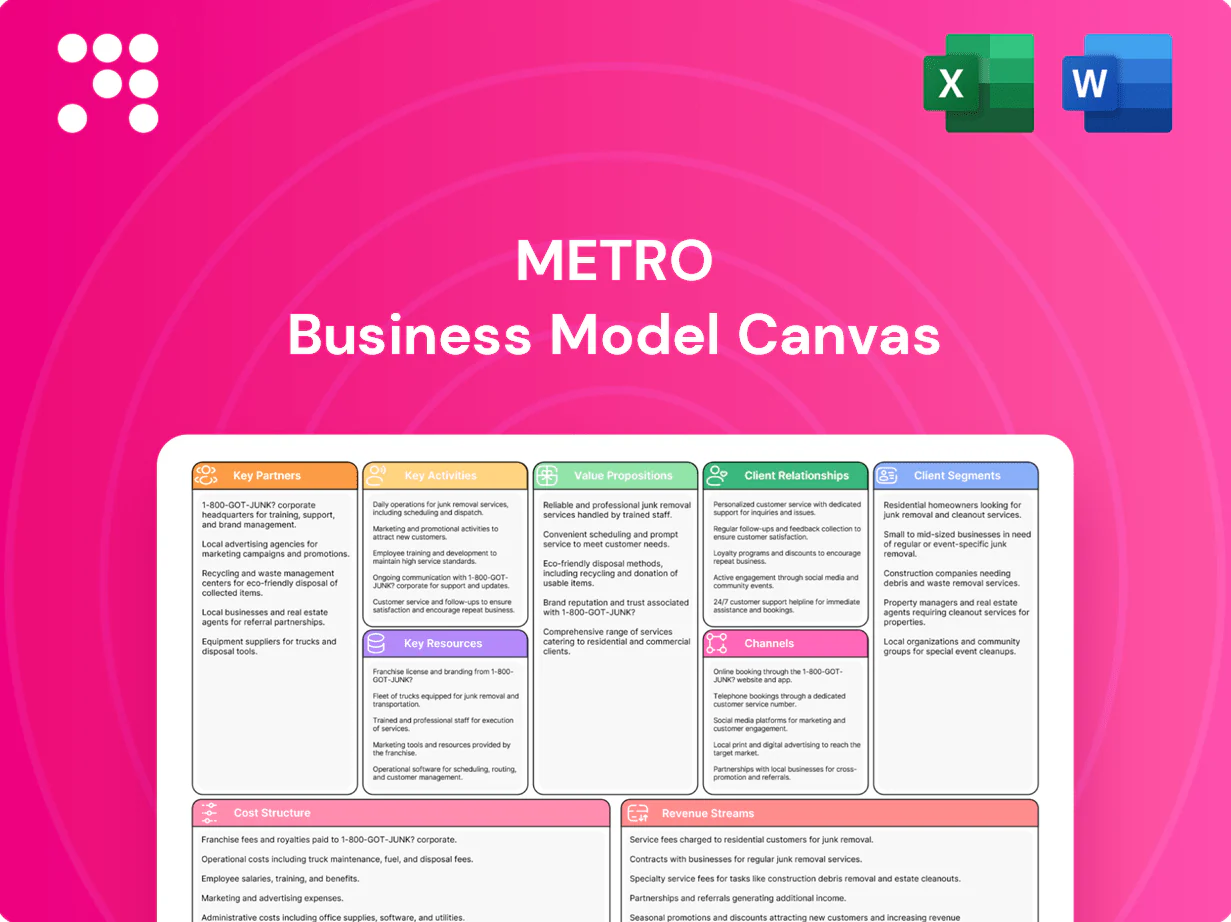
Metro Business Model Canvas

Unlock Metro’s strategic blueprint with our concise Business Model Canvas—three to five actionable insights reveal how Metro creates value, scales channels, and sustains competitive advantage. Perfect for entrepreneurs, analysts, and investors who need a turnkey framework. Purchase the full editable Canvas to access all nine blocks, financial implications, and practical recommendations for immediate use.
Partnerships

CPG & Fresh Suppliers
Strategic relationships with national brands and fresh producers secure breadth and depth of assortment across Metro stores. Long-term contracts, often spanning 3–5 years, stabilize pricing and availability. Joint planning aligns promotions and new product launches, while strict quality and safety standards are enforced across all categories.
Local Producers & Farmers
Regional sourcing at Metro boosts freshness and traceability while strengthening community ties; shorter supply chains can cut lead times 30–50% and lower food waste by about 20% (WRAP/EU studies). Seasonal assortments differentiate banners and have been shown to increase store traffic 5–12% in retail trials. Co-marketing local provenance can command 10–20% price premiums and lift local product sales by mid-teens.

Logistics & Last‑Mile Providers
3PLs and delivery partners expand Metro’s capacity and speed—the global 3PL market reached about $1.3 trillion in 2024 and last‑mile now represents up to 53% of total shipping cost, making partnerships critical to cost control. Flexible, on‑demand contracts smooth peak demand and regional variability, cutting capacity shortfalls by ~30% during spikes. Temperature‑controlled handling preserves perishables and data sharing (GPS, inventory) improves routing, fill rates and on‑time performance by double‑digit percentages.

Tech, Data & Payments Vendors
- E-commerce & POS integration: real-time inventory, unified CX
- Personalization engines: +10–15% revenue impact (2024)
- Payments & fraud tools: reduce chargebacks, secure transactions
- Cloud & cybersecurity: 99.9%+ uptime, disaster recovery
Franchisees & Pharmacy Networks
Franchisees expand Metro's footprint while enforcing aligned operational and brand standards, enabling faster market entry and local knowledge leverage. Shared IT systems and centralized procurement drove reported supply-cost savings of about 12% in comparable retail franchises in 2024, improving margin scalability. Pharmacy partners extend clinical services and regulatory compliance, supporting medicine adherence programs and cold-chain requirements. Co-investment models funded renovations and new openings, lowering capital barriers for franchise growth.
- franchise expansion: local scale + brand consistency
- procurement savings: ~12% COGS reduction (2024 industry comps)
- pharmacy partnership: clinical services + compliance
- co-investment: capital for renovations and store growth
3–5y contracts and regional sourcing cut lead times 30–50%, lift sales
Strategic supplier and brand contracts (typ. 3–5y) secure assortment, stabilize pricing and enforce safety standards.
Regional sourcing cuts lead times 30–50% and food waste ~20%, while local provenance can lift sales mid‑teens and premiums 10–20% (2024).
3PLs/tech partners (3PL market ~$1.3T 2024) plus personalization (+10–15%) and cloud (99.9% uptime) drive omnichannel efficiency.
| Partnership | Key metric |
|---|---|
| 3PL | $1.3T (2024) |
| Regional sourcing | -30–50% lead time |
| Personalization | +10–15% |
| Procurement savings | ~12% |
What is included in the product
 Detailed Word Document
A comprehensive, pre-written Metro Business Model Canvas detailing customer segments, channels, value propositions and real-world operations across the 9 classic BMC blocks, with narrative, competitive-advantage analysis, linked strengths/weaknesses/opportunities/threats, and a polished format ideal for presentations, investor discussions and validation of business ideas.

 Customizable Excel Spreadsheet
Condenses company strategy into a digestible, editable one-page snapshot that saves hours of formatting and structuring, enabling quick team collaboration and easy side-by-side comparisons.
Activities

Procurement & Category Mgmt
Procurement & Category Mgmt drives vendor negotiation to secure cost savings and curate assortments that shape pricing-led value perception; Metro targets gross-margin improvements while keeping assortment depth lean. Demand forecasting cuts stockouts and balances shrink, aiming to reduce out-of-stocks by up to 20%. Promo planning with suppliers drives typical lift of 15–25%, and compliance enforces food safety and ethical sourcing standards.
Store Ops & Merchandising
Daily execution drives freshness, service and conversion with rigorous resets boosting perishable sell‑through up to 15% (2024 retail studies). Planograms and seasonal displays lift basket size 5–12% and raise impulse attach rates. Traffic‑aligned labor scheduling cuts overtime/labor cost 8–12% while improving service levels. Loss prevention and hygiene keep shrink near industry averages (~1.5–1.7% of sales) and protect margins.

Distribution & Inventory
DC operations optimize inbound, picking and outbound flows to support high throughput (inventory turns ~10–12x) while cold-chain controls maintain product quality and reduce spoilage to under 1% of volume. Dynamic replenishment logic cuts stockouts and overstock, improving fill rates to >98%. KPI dashboards track waste, turns and service levels in real time to drive continuous improvement.

Omnichannel & Fulfillment
Omnichannel fulfillment leverages online assortment, precise slotting, and efficient order picking to drive convenience and same-day readiness; global e-commerce sales reached about 5.7 trillion USD in 2023. Curbside, delivery, and ship-to-home expand market reach and basket size, while promise dates and automated substitutions protect NPS. Continuous UX testing lifts conversion and retention through iterative A/B learnings.
- Online assortment: broad SKUs, dynamic slotting
- Fulfillment: fast picking, accurate promise dates
- Reach: curbside, delivery, ship-to-home
- UX: continuous testing to boost conversion
Private Label Development
Private label development focuses on product design, tight sourcing and QA to protect margin and build customer loyalty; METRO reported Group sales of €27.8 billion in FY 2023/24, underscoring scale for private-label leverage. Tiered brands target value, core and premium segments; packaging and verified sustainability claims differentiate on shelf. Continuous renovation refreshes ranges and drives repeat purchase.
- product-design
- sourcing-&-QA
- tiered-brands
- packaging-sustainability
- range-renovation
Procurement & DC ops boost margins; €27.8bn sales, turns 10–12x
Procurement, DC ops and omnichannel fulfilment drive margin and service: Metro (Group sales €27.8bn FY23/24) targets gross‑margin gains via category sourcing and promo lift (15–25%); inventory turns ~10–12x, fill rates >98% and shrink ~1.5–1.7%. Private label and UX testing boost repeat buys and conversion.
| Metric | 2024 |
|---|---|
| Sales | €27.8bn |
| Turns | 10–12x |
| Fill rate | >98% |
| Shrink | 1.5–1.7% |
Delivered as Displayed
Business Model Canvas
The Metro Business Model Canvas you’re previewing is the actual deliverable, not a mockup—what you see here is a direct excerpt from the final file. After purchase you’ll receive this same complete, professionally formatted document ready to edit, present, and share in Word and Excel formats.

Unlock Metro’s strategic blueprint with our concise Business Model Canvas—three to five actionable insights reveal how Metro creates value, scales channels, and sustains competitive advantage. Perfect for entrepreneurs, analysts, and investors who need a turnkey framework. Purchase the full editable Canvas to access all nine blocks, financial implications, and practical recommendations for immediate use.
Partnerships
CPG & Fresh Suppliers
Strategic relationships with national brands and fresh producers secure breadth and depth of assortment across Metro stores. Long-term contracts, often spanning 3–5 years, stabilize pricing and availability. Joint planning aligns promotions and new product launches, while strict quality and safety standards are enforced across all categories.
Local Producers & Farmers
Regional sourcing at Metro boosts freshness and traceability while strengthening community ties; shorter supply chains can cut lead times 30–50% and lower food waste by about 20% (WRAP/EU studies). Seasonal assortments differentiate banners and have been shown to increase store traffic 5–12% in retail trials. Co-marketing local provenance can command 10–20% price premiums and lift local product sales by mid-teens.
Logistics & Last‑Mile Providers
3PLs and delivery partners expand Metro’s capacity and speed—the global 3PL market reached about $1.3 trillion in 2024 and last‑mile now represents up to 53% of total shipping cost, making partnerships critical to cost control. Flexible, on‑demand contracts smooth peak demand and regional variability, cutting capacity shortfalls by ~30% during spikes. Temperature‑controlled handling preserves perishables and data sharing (GPS, inventory) improves routing, fill rates and on‑time performance by double‑digit percentages.
Tech, Data & Payments Vendors
- E-commerce & POS integration: real-time inventory, unified CX
- Personalization engines: +10–15% revenue impact (2024)
- Payments & fraud tools: reduce chargebacks, secure transactions
- Cloud & cybersecurity: 99.9%+ uptime, disaster recovery
Franchisees & Pharmacy Networks
Franchisees expand Metro's footprint while enforcing aligned operational and brand standards, enabling faster market entry and local knowledge leverage. Shared IT systems and centralized procurement drove reported supply-cost savings of about 12% in comparable retail franchises in 2024, improving margin scalability. Pharmacy partners extend clinical services and regulatory compliance, supporting medicine adherence programs and cold-chain requirements. Co-investment models funded renovations and new openings, lowering capital barriers for franchise growth.
- franchise expansion: local scale + brand consistency
- procurement savings: ~12% COGS reduction (2024 industry comps)
- pharmacy partnership: clinical services + compliance
- co-investment: capital for renovations and store growth
3–5y contracts and regional sourcing cut lead times 30–50%, lift sales
Strategic supplier and brand contracts (typ. 3–5y) secure assortment, stabilize pricing and enforce safety standards.
Regional sourcing cuts lead times 30–50% and food waste ~20%, while local provenance can lift sales mid‑teens and premiums 10–20% (2024).
3PLs/tech partners (3PL market ~$1.3T 2024) plus personalization (+10–15%) and cloud (99.9% uptime) drive omnichannel efficiency.
| Partnership | Key metric |
|---|---|
| 3PL | $1.3T (2024) |
| Regional sourcing | -30–50% lead time |
| Personalization | +10–15% |
| Procurement savings | ~12% |
What is included in the product
Detailed Word Document
A comprehensive, pre-written Metro Business Model Canvas detailing customer segments, channels, value propositions and real-world operations across the 9 classic BMC blocks, with narrative, competitive-advantage analysis, linked strengths/weaknesses/opportunities/threats, and a polished format ideal for presentations, investor discussions and validation of business ideas.
Customizable Excel Spreadsheet
Condenses company strategy into a digestible, editable one-page snapshot that saves hours of formatting and structuring, enabling quick team collaboration and easy side-by-side comparisons.
Activities
Procurement & Category Mgmt
Procurement & Category Mgmt drives vendor negotiation to secure cost savings and curate assortments that shape pricing-led value perception; Metro targets gross-margin improvements while keeping assortment depth lean. Demand forecasting cuts stockouts and balances shrink, aiming to reduce out-of-stocks by up to 20%. Promo planning with suppliers drives typical lift of 15–25%, and compliance enforces food safety and ethical sourcing standards.
Store Ops & Merchandising
Daily execution drives freshness, service and conversion with rigorous resets boosting perishable sell‑through up to 15% (2024 retail studies). Planograms and seasonal displays lift basket size 5–12% and raise impulse attach rates. Traffic‑aligned labor scheduling cuts overtime/labor cost 8–12% while improving service levels. Loss prevention and hygiene keep shrink near industry averages (~1.5–1.7% of sales) and protect margins.
Distribution & Inventory
DC operations optimize inbound, picking and outbound flows to support high throughput (inventory turns ~10–12x) while cold-chain controls maintain product quality and reduce spoilage to under 1% of volume. Dynamic replenishment logic cuts stockouts and overstock, improving fill rates to >98%. KPI dashboards track waste, turns and service levels in real time to drive continuous improvement.
Omnichannel & Fulfillment
Omnichannel fulfillment leverages online assortment, precise slotting, and efficient order picking to drive convenience and same-day readiness; global e-commerce sales reached about 5.7 trillion USD in 2023. Curbside, delivery, and ship-to-home expand market reach and basket size, while promise dates and automated substitutions protect NPS. Continuous UX testing lifts conversion and retention through iterative A/B learnings.
- Online assortment: broad SKUs, dynamic slotting
- Fulfillment: fast picking, accurate promise dates
- Reach: curbside, delivery, ship-to-home
- UX: continuous testing to boost conversion
Private Label Development
Private label development focuses on product design, tight sourcing and QA to protect margin and build customer loyalty; METRO reported Group sales of €27.8 billion in FY 2023/24, underscoring scale for private-label leverage. Tiered brands target value, core and premium segments; packaging and verified sustainability claims differentiate on shelf. Continuous renovation refreshes ranges and drives repeat purchase.
- product-design
- sourcing-&-QA
- tiered-brands
- packaging-sustainability
- range-renovation
Procurement & DC ops boost margins; €27.8bn sales, turns 10–12x
Procurement, DC ops and omnichannel fulfilment drive margin and service: Metro (Group sales €27.8bn FY23/24) targets gross‑margin gains via category sourcing and promo lift (15–25%); inventory turns ~10–12x, fill rates >98% and shrink ~1.5–1.7%. Private label and UX testing boost repeat buys and conversion.
| Metric | 2024 |
|---|---|
| Sales | €27.8bn |
| Turns | 10–12x |
| Fill rate | >98% |
| Shrink | 1.5–1.7% |
Delivered as Displayed
Business Model Canvas
The Metro Business Model Canvas you’re previewing is the actual deliverable, not a mockup—what you see here is a direct excerpt from the final file. After purchase you’ll receive this same complete, professionally formatted document ready to edit, present, and share in Word and Excel formats.
Original: $10.00
-65%$10.00
$3.50Description
Unlock Metro’s strategic blueprint with our concise Business Model Canvas—three to five actionable insights reveal how Metro creates value, scales channels, and sustains competitive advantage. Perfect for entrepreneurs, analysts, and investors who need a turnkey framework. Purchase the full editable Canvas to access all nine blocks, financial implications, and practical recommendations for immediate use.
Partnerships
CPG & Fresh Suppliers
Strategic relationships with national brands and fresh producers secure breadth and depth of assortment across Metro stores. Long-term contracts, often spanning 3–5 years, stabilize pricing and availability. Joint planning aligns promotions and new product launches, while strict quality and safety standards are enforced across all categories.
Local Producers & Farmers
Regional sourcing at Metro boosts freshness and traceability while strengthening community ties; shorter supply chains can cut lead times 30–50% and lower food waste by about 20% (WRAP/EU studies). Seasonal assortments differentiate banners and have been shown to increase store traffic 5–12% in retail trials. Co-marketing local provenance can command 10–20% price premiums and lift local product sales by mid-teens.
Logistics & Last‑Mile Providers
3PLs and delivery partners expand Metro’s capacity and speed—the global 3PL market reached about $1.3 trillion in 2024 and last‑mile now represents up to 53% of total shipping cost, making partnerships critical to cost control. Flexible, on‑demand contracts smooth peak demand and regional variability, cutting capacity shortfalls by ~30% during spikes. Temperature‑controlled handling preserves perishables and data sharing (GPS, inventory) improves routing, fill rates and on‑time performance by double‑digit percentages.
Tech, Data & Payments Vendors
- E-commerce & POS integration: real-time inventory, unified CX
- Personalization engines: +10–15% revenue impact (2024)
- Payments & fraud tools: reduce chargebacks, secure transactions
- Cloud & cybersecurity: 99.9%+ uptime, disaster recovery
Franchisees & Pharmacy Networks
Franchisees expand Metro's footprint while enforcing aligned operational and brand standards, enabling faster market entry and local knowledge leverage. Shared IT systems and centralized procurement drove reported supply-cost savings of about 12% in comparable retail franchises in 2024, improving margin scalability. Pharmacy partners extend clinical services and regulatory compliance, supporting medicine adherence programs and cold-chain requirements. Co-investment models funded renovations and new openings, lowering capital barriers for franchise growth.
- franchise expansion: local scale + brand consistency
- procurement savings: ~12% COGS reduction (2024 industry comps)
- pharmacy partnership: clinical services + compliance
- co-investment: capital for renovations and store growth
3–5y contracts and regional sourcing cut lead times 30–50%, lift sales
Strategic supplier and brand contracts (typ. 3–5y) secure assortment, stabilize pricing and enforce safety standards.
Regional sourcing cuts lead times 30–50% and food waste ~20%, while local provenance can lift sales mid‑teens and premiums 10–20% (2024).
3PLs/tech partners (3PL market ~$1.3T 2024) plus personalization (+10–15%) and cloud (99.9% uptime) drive omnichannel efficiency.
| Partnership | Key metric |
|---|---|
| 3PL | $1.3T (2024) |
| Regional sourcing | -30–50% lead time |
| Personalization | +10–15% |
| Procurement savings | ~12% |
What is included in the product
Detailed Word Document
A comprehensive, pre-written Metro Business Model Canvas detailing customer segments, channels, value propositions and real-world operations across the 9 classic BMC blocks, with narrative, competitive-advantage analysis, linked strengths/weaknesses/opportunities/threats, and a polished format ideal for presentations, investor discussions and validation of business ideas.
Customizable Excel Spreadsheet
Condenses company strategy into a digestible, editable one-page snapshot that saves hours of formatting and structuring, enabling quick team collaboration and easy side-by-side comparisons.
Activities
Procurement & Category Mgmt
Procurement & Category Mgmt drives vendor negotiation to secure cost savings and curate assortments that shape pricing-led value perception; Metro targets gross-margin improvements while keeping assortment depth lean. Demand forecasting cuts stockouts and balances shrink, aiming to reduce out-of-stocks by up to 20%. Promo planning with suppliers drives typical lift of 15–25%, and compliance enforces food safety and ethical sourcing standards.
Store Ops & Merchandising
Daily execution drives freshness, service and conversion with rigorous resets boosting perishable sell‑through up to 15% (2024 retail studies). Planograms and seasonal displays lift basket size 5–12% and raise impulse attach rates. Traffic‑aligned labor scheduling cuts overtime/labor cost 8–12% while improving service levels. Loss prevention and hygiene keep shrink near industry averages (~1.5–1.7% of sales) and protect margins.
Distribution & Inventory
DC operations optimize inbound, picking and outbound flows to support high throughput (inventory turns ~10–12x) while cold-chain controls maintain product quality and reduce spoilage to under 1% of volume. Dynamic replenishment logic cuts stockouts and overstock, improving fill rates to >98%. KPI dashboards track waste, turns and service levels in real time to drive continuous improvement.
Omnichannel & Fulfillment
Omnichannel fulfillment leverages online assortment, precise slotting, and efficient order picking to drive convenience and same-day readiness; global e-commerce sales reached about 5.7 trillion USD in 2023. Curbside, delivery, and ship-to-home expand market reach and basket size, while promise dates and automated substitutions protect NPS. Continuous UX testing lifts conversion and retention through iterative A/B learnings.
- Online assortment: broad SKUs, dynamic slotting
- Fulfillment: fast picking, accurate promise dates
- Reach: curbside, delivery, ship-to-home
- UX: continuous testing to boost conversion
Private Label Development
Private label development focuses on product design, tight sourcing and QA to protect margin and build customer loyalty; METRO reported Group sales of €27.8 billion in FY 2023/24, underscoring scale for private-label leverage. Tiered brands target value, core and premium segments; packaging and verified sustainability claims differentiate on shelf. Continuous renovation refreshes ranges and drives repeat purchase.
- product-design
- sourcing-&-QA
- tiered-brands
- packaging-sustainability
- range-renovation
Procurement & DC ops boost margins; €27.8bn sales, turns 10–12x
Procurement, DC ops and omnichannel fulfilment drive margin and service: Metro (Group sales €27.8bn FY23/24) targets gross‑margin gains via category sourcing and promo lift (15–25%); inventory turns ~10–12x, fill rates >98% and shrink ~1.5–1.7%. Private label and UX testing boost repeat buys and conversion.
| Metric | 2024 |
|---|---|
| Sales | €27.8bn |
| Turns | 10–12x |
| Fill rate | >98% |
| Shrink | 1.5–1.7% |
Delivered as Displayed
Business Model Canvas
The Metro Business Model Canvas you’re previewing is the actual deliverable, not a mockup—what you see here is a direct excerpt from the final file. After purchase you’ll receive this same complete, professionally formatted document ready to edit, present, and share in Word and Excel formats.











