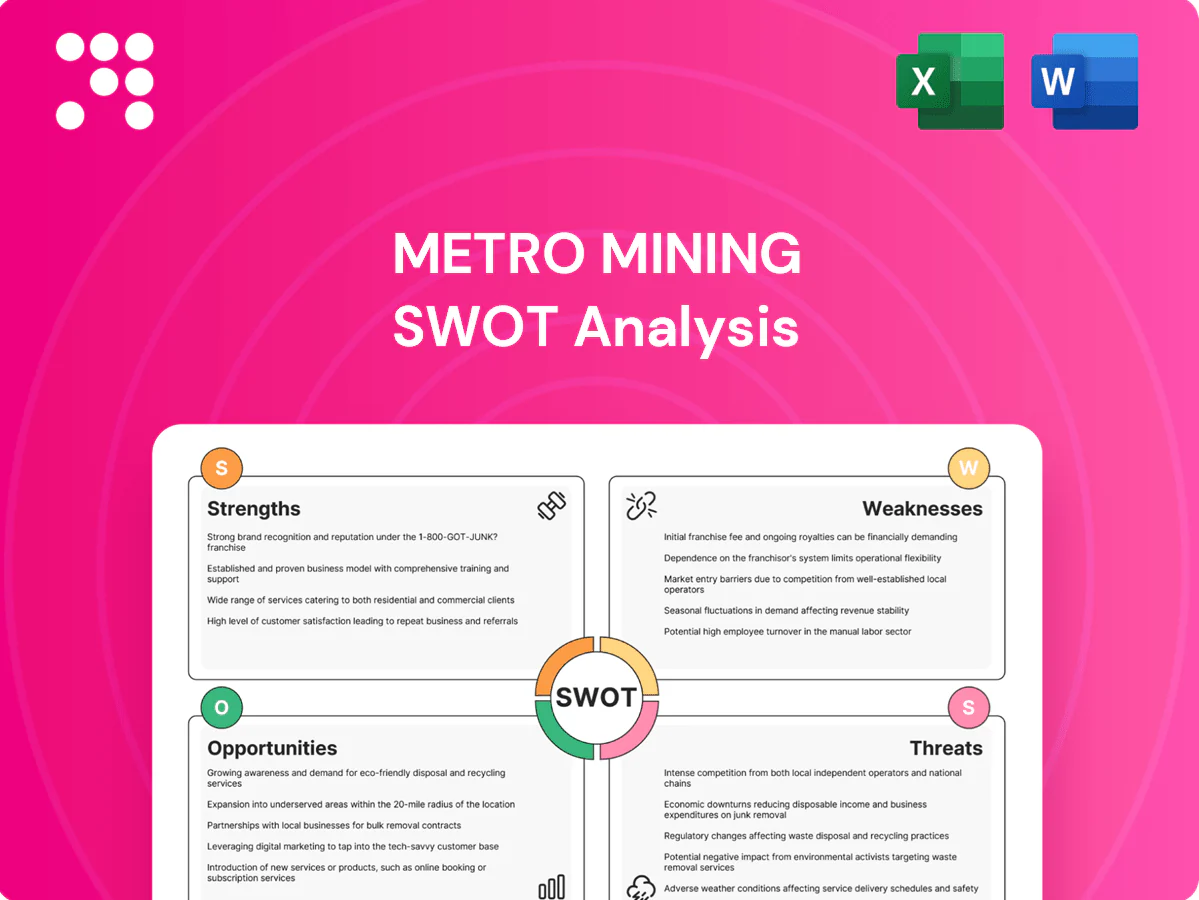
Metro Mining SWOT Analysis

Elevate Your Analysis with the Complete SWOT Report
Metro Mining’s SWOT highlights robust bauxite assets and low-cost operations, balanced by project concentration and capital needs. Opportunities include rising aluminium demand and expansion into value-added products; threats stem from commodity cycles and regulatory shifts. Want the full strategic picture with editable Word and Excel deliverables? Purchase the complete SWOT to plan, pitch, and invest with confidence.
Strengths

Low-cost, simple ore-to-ship operations
Direct shipping ore (DSO) at Metro Mining, producing ≈6.5 Mtpa (FY24), cuts processing complexity and capital intensity, enabling simple mining and crushing that drive competitive unit costs. Lower technical risk supports reliable output and margin resilience in down cycles, and this cost base underpins multi‑year offtake relationships and stable cashflow visibility.
Strategic Bauxite Hills resource in Queensland
Bauxite Hills in Queensland provides a multi-decade, long-life resource footprint supporting sustained supply and scale for Metro Mining. Its location offers shorter sea freight to Asian alumina refineries, typically reducing transits to major North Asian ports to around 7–10 days. Australian rule-of-law and strict mining standards enhance offtake credibility and investor confidence. Scale enables consistent volumes, underpinning long-term customer contracts.

Established export logistics and transshipment
On-site river load-out and transshipment let Metro ship bauxite seaborne without relying on a deep-water port, accelerating project ramp-up and cutting infrastructure bottlenecks; the arrangement also allows matching barges and mother vessels to fluctuating vessel sizes and schedules, and optimized river-to-vessel logistics support higher plant utilization during peak export seasons.

Supplier to global aluminum value chain
Bauxite feedstock is indispensable to alumina and primary aluminum production; global primary aluminum output was about 68 million tonnes in 2023, underpinning steady demand for bauxite. Participation in this structurally important value chain anchors baseline demand and supports pricing resilience. Reliable, quality-assured ore attracts long-term industrial customers, enabling multi-year contracts and revenue visibility.
- Essential feedstock
- Anchored baseline demand (~68 Mt Al, 2023)
- Attractive for long-term offtakes
- Supports multi-year contract visibility
Regulatory and operating experience in Far North QLD
Metro Mining’s operations at Bauxite Hills near Weipa leverage local permitting, environmental approvals and ongoing community engagement to reduce execution risk; established operating procedures have improved safety and continuity. Familiarity with the Nov–Apr wet season supports maintenance and logistics planning, and accumulated institutional knowledge compounds efficiency over time.
- Local permitting & compliance
- Safety & continuity
- Wet-season planning (Nov–Apr)
- Institutional efficiency
DSO bauxite operation: low capex/opex, resilient margins, 7–10 day Asia transit, river load‑out
Metro Mining’s DSO model (≈6.5 Mtpa FY24) yields low capex/Opex and resilient margins, supporting multi‑year offtakes and stable cashflow. Bauxite Hills offers multi‑decade resource scale with short 7–10 day sea transit to North Asia. River load‑out avoids deep‑water port capex and improves ramp‑up and reliability.
| Metric | Value |
|---|---|
| Production (FY24) | ≈6.5 Mtpa |
| Transit to N. Asia | 7–10 days |
| Global Al output (2023) | ≈68 Mt |
What is included in the product
 Detailed Word Document
Provides a concise SWOT overview of Metro Mining, highlighting its operational strengths and project pipeline, financial and regulatory weaknesses, growth opportunities in bauxite and alumina markets, and external threats from commodity volatility, environmental constraints, and geopolitical risks.

 Customizable Excel Spreadsheet
Provides a concise, Metro Mining–focused SWOT matrix for rapid strategy alignment and clear visualization of operational risks and market opportunities. Ideal for executives and teams needing a quick, editable snapshot to support fast decision-making.
Weaknesses

Single-asset concentration risk
Reliance on the Bauxite Hills mine in Weipa, Queensland means Bauxite Hills accounts for 100% of Metro Mining’s current production, concentrating geological, operational and permitting risks in one asset. Any disruption therefore directly reduces total output and cash flow. Limited diversification across mines or products amplifies asset-specific event exposure, increasing investor volatility.
Seasonal exposure to wet-season downtime
Tropical rainfall and cyclones during the November–April wet season (the Australian region averages about 11 tropical cyclones per season per BOM) routinely curtail mining and shipping windows for Bauxite Hills, forcing lost days to be compressed into shorter dry periods. That compression elevates unit costs and strains port and barge logistics. Shipment timing also makes working capital flows lumpier, increasing short-term financing needs.

Limited value-add beyond DSO
Relying on direct-shipping ore limits Metro Mining’s pricing leverage since minimal processing prevents access to premium or blended bauxite markets, and quality differentiation versus washed/beneficiated bauxite is narrow. Margin capture therefore depends heavily on freight rates and contract terms, exposing profits to shipping cost volatility and short-term contract repricing. Any meaningful upgrading to improve margins would require material capital expenditure and operational changes.

Customer and market concentration
Metro Mining's exports remain heavily geared to Asian alumina refineries, notably China; in 2024 the company reported the majority of shipments destined for Chinese buyers, concentrating revenue exposure. This concentrated offtake heightens counterparty and policy risks, while contract rollovers can create material volume and price gaps. Market depth outside core buyers often thins in downturns, increasing selling flexibility risk.
- Concentration: majority exports to China
- Risk: heightened counterparty and policy exposure
- Contract rollovers: potential volume/price gaps
- Liquidity: thinner alternative market depth in downturns
Exposure to FX and freight volatility
Revenue is largely USD-linked while a significant portion of operating and capex costs are AUD-denominated, so AUD/USD swings can materially erode margins. Seaborne freight rate volatility and bunker fuel costs directly affect Metro Mining’s delivered price competitiveness to Asian offtakers. Hedging programs can reduce but not eliminate FX and freight exposure, leaving residual market risk.
- USD-linked revenue vs AUD costs
- Freight and fuel drive delivered cost
- Hedging limits but does not remove risk
100% single-mine risk; ~11 cyclones shrink shipping, USD rev/AUD FX
Bauxite Hills supplies 100% of Metro Mining’s production, concentrating geological, operational and permitting risk; wet-season cyclones (BOM ~11/season) compress shipping windows and raise unit costs. Direct-shipping ore limits pricing/margin upside without material CAPEX. Exports were majority to Chinese buyers in 2024; revenues are USD-linked while many costs are AUD, creating FX exposure.
| Metric | Value |
|---|---|
| Bauxite Hills share | 100% |
| Avg tropical cyclones (AUS season) | ~11/season (BOM) |
| 2024 offtake | Majority to China |
| Currency mix | Revenue USD / Costs AUD |
What You See Is What You Get
Metro Mining SWOT Analysis
This is the actual Metro Mining SWOT analysis document you’ll receive upon purchase—no surprises, just professional quality. The preview below is taken directly from the full report you'll get. Once purchased, you’ll receive the complete, editable version immediately.

Elevate Your Analysis with the Complete SWOT Report
Metro Mining’s SWOT highlights robust bauxite assets and low-cost operations, balanced by project concentration and capital needs. Opportunities include rising aluminium demand and expansion into value-added products; threats stem from commodity cycles and regulatory shifts. Want the full strategic picture with editable Word and Excel deliverables? Purchase the complete SWOT to plan, pitch, and invest with confidence.
Strengths
Low-cost, simple ore-to-ship operations
Direct shipping ore (DSO) at Metro Mining, producing ≈6.5 Mtpa (FY24), cuts processing complexity and capital intensity, enabling simple mining and crushing that drive competitive unit costs. Lower technical risk supports reliable output and margin resilience in down cycles, and this cost base underpins multi‑year offtake relationships and stable cashflow visibility.
Strategic Bauxite Hills resource in Queensland
Bauxite Hills in Queensland provides a multi-decade, long-life resource footprint supporting sustained supply and scale for Metro Mining. Its location offers shorter sea freight to Asian alumina refineries, typically reducing transits to major North Asian ports to around 7–10 days. Australian rule-of-law and strict mining standards enhance offtake credibility and investor confidence. Scale enables consistent volumes, underpinning long-term customer contracts.
Established export logistics and transshipment
On-site river load-out and transshipment let Metro ship bauxite seaborne without relying on a deep-water port, accelerating project ramp-up and cutting infrastructure bottlenecks; the arrangement also allows matching barges and mother vessels to fluctuating vessel sizes and schedules, and optimized river-to-vessel logistics support higher plant utilization during peak export seasons.
Supplier to global aluminum value chain
Bauxite feedstock is indispensable to alumina and primary aluminum production; global primary aluminum output was about 68 million tonnes in 2023, underpinning steady demand for bauxite. Participation in this structurally important value chain anchors baseline demand and supports pricing resilience. Reliable, quality-assured ore attracts long-term industrial customers, enabling multi-year contracts and revenue visibility.
- Essential feedstock
- Anchored baseline demand (~68 Mt Al, 2023)
- Attractive for long-term offtakes
- Supports multi-year contract visibility
Regulatory and operating experience in Far North QLD
Metro Mining’s operations at Bauxite Hills near Weipa leverage local permitting, environmental approvals and ongoing community engagement to reduce execution risk; established operating procedures have improved safety and continuity. Familiarity with the Nov–Apr wet season supports maintenance and logistics planning, and accumulated institutional knowledge compounds efficiency over time.
- Local permitting & compliance
- Safety & continuity
- Wet-season planning (Nov–Apr)
- Institutional efficiency
DSO bauxite operation: low capex/opex, resilient margins, 7–10 day Asia transit, river load‑out
Metro Mining’s DSO model (≈6.5 Mtpa FY24) yields low capex/Opex and resilient margins, supporting multi‑year offtakes and stable cashflow. Bauxite Hills offers multi‑decade resource scale with short 7–10 day sea transit to North Asia. River load‑out avoids deep‑water port capex and improves ramp‑up and reliability.
| Metric | Value |
|---|---|
| Production (FY24) | ≈6.5 Mtpa |
| Transit to N. Asia | 7–10 days |
| Global Al output (2023) | ≈68 Mt |
What is included in the product
Detailed Word Document
Provides a concise SWOT overview of Metro Mining, highlighting its operational strengths and project pipeline, financial and regulatory weaknesses, growth opportunities in bauxite and alumina markets, and external threats from commodity volatility, environmental constraints, and geopolitical risks.
Customizable Excel Spreadsheet
Provides a concise, Metro Mining–focused SWOT matrix for rapid strategy alignment and clear visualization of operational risks and market opportunities. Ideal for executives and teams needing a quick, editable snapshot to support fast decision-making.
Weaknesses
Single-asset concentration risk
Reliance on the Bauxite Hills mine in Weipa, Queensland means Bauxite Hills accounts for 100% of Metro Mining’s current production, concentrating geological, operational and permitting risks in one asset. Any disruption therefore directly reduces total output and cash flow. Limited diversification across mines or products amplifies asset-specific event exposure, increasing investor volatility.
Seasonal exposure to wet-season downtime
Tropical rainfall and cyclones during the November–April wet season (the Australian region averages about 11 tropical cyclones per season per BOM) routinely curtail mining and shipping windows for Bauxite Hills, forcing lost days to be compressed into shorter dry periods. That compression elevates unit costs and strains port and barge logistics. Shipment timing also makes working capital flows lumpier, increasing short-term financing needs.
Limited value-add beyond DSO
Relying on direct-shipping ore limits Metro Mining’s pricing leverage since minimal processing prevents access to premium or blended bauxite markets, and quality differentiation versus washed/beneficiated bauxite is narrow. Margin capture therefore depends heavily on freight rates and contract terms, exposing profits to shipping cost volatility and short-term contract repricing. Any meaningful upgrading to improve margins would require material capital expenditure and operational changes.
Customer and market concentration
Metro Mining's exports remain heavily geared to Asian alumina refineries, notably China; in 2024 the company reported the majority of shipments destined for Chinese buyers, concentrating revenue exposure. This concentrated offtake heightens counterparty and policy risks, while contract rollovers can create material volume and price gaps. Market depth outside core buyers often thins in downturns, increasing selling flexibility risk.
- Concentration: majority exports to China
- Risk: heightened counterparty and policy exposure
- Contract rollovers: potential volume/price gaps
- Liquidity: thinner alternative market depth in downturns
Exposure to FX and freight volatility
Revenue is largely USD-linked while a significant portion of operating and capex costs are AUD-denominated, so AUD/USD swings can materially erode margins. Seaborne freight rate volatility and bunker fuel costs directly affect Metro Mining’s delivered price competitiveness to Asian offtakers. Hedging programs can reduce but not eliminate FX and freight exposure, leaving residual market risk.
- USD-linked revenue vs AUD costs
- Freight and fuel drive delivered cost
- Hedging limits but does not remove risk
100% single-mine risk; ~11 cyclones shrink shipping, USD rev/AUD FX
Bauxite Hills supplies 100% of Metro Mining’s production, concentrating geological, operational and permitting risk; wet-season cyclones (BOM ~11/season) compress shipping windows and raise unit costs. Direct-shipping ore limits pricing/margin upside without material CAPEX. Exports were majority to Chinese buyers in 2024; revenues are USD-linked while many costs are AUD, creating FX exposure.
| Metric | Value |
|---|---|
| Bauxite Hills share | 100% |
| Avg tropical cyclones (AUS season) | ~11/season (BOM) |
| 2024 offtake | Majority to China |
| Currency mix | Revenue USD / Costs AUD |
What You See Is What You Get
Metro Mining SWOT Analysis
This is the actual Metro Mining SWOT analysis document you’ll receive upon purchase—no surprises, just professional quality. The preview below is taken directly from the full report you'll get. Once purchased, you’ll receive the complete, editable version immediately.
Original: $10.00
-65%$10.00
$3.50Description
Elevate Your Analysis with the Complete SWOT Report
Metro Mining’s SWOT highlights robust bauxite assets and low-cost operations, balanced by project concentration and capital needs. Opportunities include rising aluminium demand and expansion into value-added products; threats stem from commodity cycles and regulatory shifts. Want the full strategic picture with editable Word and Excel deliverables? Purchase the complete SWOT to plan, pitch, and invest with confidence.
Strengths
Low-cost, simple ore-to-ship operations
Direct shipping ore (DSO) at Metro Mining, producing ≈6.5 Mtpa (FY24), cuts processing complexity and capital intensity, enabling simple mining and crushing that drive competitive unit costs. Lower technical risk supports reliable output and margin resilience in down cycles, and this cost base underpins multi‑year offtake relationships and stable cashflow visibility.
Strategic Bauxite Hills resource in Queensland
Bauxite Hills in Queensland provides a multi-decade, long-life resource footprint supporting sustained supply and scale for Metro Mining. Its location offers shorter sea freight to Asian alumina refineries, typically reducing transits to major North Asian ports to around 7–10 days. Australian rule-of-law and strict mining standards enhance offtake credibility and investor confidence. Scale enables consistent volumes, underpinning long-term customer contracts.
Established export logistics and transshipment
On-site river load-out and transshipment let Metro ship bauxite seaborne without relying on a deep-water port, accelerating project ramp-up and cutting infrastructure bottlenecks; the arrangement also allows matching barges and mother vessels to fluctuating vessel sizes and schedules, and optimized river-to-vessel logistics support higher plant utilization during peak export seasons.
Supplier to global aluminum value chain
Bauxite feedstock is indispensable to alumina and primary aluminum production; global primary aluminum output was about 68 million tonnes in 2023, underpinning steady demand for bauxite. Participation in this structurally important value chain anchors baseline demand and supports pricing resilience. Reliable, quality-assured ore attracts long-term industrial customers, enabling multi-year contracts and revenue visibility.
- Essential feedstock
- Anchored baseline demand (~68 Mt Al, 2023)
- Attractive for long-term offtakes
- Supports multi-year contract visibility
Regulatory and operating experience in Far North QLD
Metro Mining’s operations at Bauxite Hills near Weipa leverage local permitting, environmental approvals and ongoing community engagement to reduce execution risk; established operating procedures have improved safety and continuity. Familiarity with the Nov–Apr wet season supports maintenance and logistics planning, and accumulated institutional knowledge compounds efficiency over time.
- Local permitting & compliance
- Safety & continuity
- Wet-season planning (Nov–Apr)
- Institutional efficiency
DSO bauxite operation: low capex/opex, resilient margins, 7–10 day Asia transit, river load‑out
Metro Mining’s DSO model (≈6.5 Mtpa FY24) yields low capex/Opex and resilient margins, supporting multi‑year offtakes and stable cashflow. Bauxite Hills offers multi‑decade resource scale with short 7–10 day sea transit to North Asia. River load‑out avoids deep‑water port capex and improves ramp‑up and reliability.
| Metric | Value |
|---|---|
| Production (FY24) | ≈6.5 Mtpa |
| Transit to N. Asia | 7–10 days |
| Global Al output (2023) | ≈68 Mt |
What is included in the product
Detailed Word Document
Provides a concise SWOT overview of Metro Mining, highlighting its operational strengths and project pipeline, financial and regulatory weaknesses, growth opportunities in bauxite and alumina markets, and external threats from commodity volatility, environmental constraints, and geopolitical risks.
Customizable Excel Spreadsheet
Provides a concise, Metro Mining–focused SWOT matrix for rapid strategy alignment and clear visualization of operational risks and market opportunities. Ideal for executives and teams needing a quick, editable snapshot to support fast decision-making.
Weaknesses
Single-asset concentration risk
Reliance on the Bauxite Hills mine in Weipa, Queensland means Bauxite Hills accounts for 100% of Metro Mining’s current production, concentrating geological, operational and permitting risks in one asset. Any disruption therefore directly reduces total output and cash flow. Limited diversification across mines or products amplifies asset-specific event exposure, increasing investor volatility.
Seasonal exposure to wet-season downtime
Tropical rainfall and cyclones during the November–April wet season (the Australian region averages about 11 tropical cyclones per season per BOM) routinely curtail mining and shipping windows for Bauxite Hills, forcing lost days to be compressed into shorter dry periods. That compression elevates unit costs and strains port and barge logistics. Shipment timing also makes working capital flows lumpier, increasing short-term financing needs.
Limited value-add beyond DSO
Relying on direct-shipping ore limits Metro Mining’s pricing leverage since minimal processing prevents access to premium or blended bauxite markets, and quality differentiation versus washed/beneficiated bauxite is narrow. Margin capture therefore depends heavily on freight rates and contract terms, exposing profits to shipping cost volatility and short-term contract repricing. Any meaningful upgrading to improve margins would require material capital expenditure and operational changes.
Customer and market concentration
Metro Mining's exports remain heavily geared to Asian alumina refineries, notably China; in 2024 the company reported the majority of shipments destined for Chinese buyers, concentrating revenue exposure. This concentrated offtake heightens counterparty and policy risks, while contract rollovers can create material volume and price gaps. Market depth outside core buyers often thins in downturns, increasing selling flexibility risk.
- Concentration: majority exports to China
- Risk: heightened counterparty and policy exposure
- Contract rollovers: potential volume/price gaps
- Liquidity: thinner alternative market depth in downturns
Exposure to FX and freight volatility
Revenue is largely USD-linked while a significant portion of operating and capex costs are AUD-denominated, so AUD/USD swings can materially erode margins. Seaborne freight rate volatility and bunker fuel costs directly affect Metro Mining’s delivered price competitiveness to Asian offtakers. Hedging programs can reduce but not eliminate FX and freight exposure, leaving residual market risk.
- USD-linked revenue vs AUD costs
- Freight and fuel drive delivered cost
- Hedging limits but does not remove risk
100% single-mine risk; ~11 cyclones shrink shipping, USD rev/AUD FX
Bauxite Hills supplies 100% of Metro Mining’s production, concentrating geological, operational and permitting risk; wet-season cyclones (BOM ~11/season) compress shipping windows and raise unit costs. Direct-shipping ore limits pricing/margin upside without material CAPEX. Exports were majority to Chinese buyers in 2024; revenues are USD-linked while many costs are AUD, creating FX exposure.
| Metric | Value |
|---|---|
| Bauxite Hills share | 100% |
| Avg tropical cyclones (AUS season) | ~11/season (BOM) |
| 2024 offtake | Majority to China |
| Currency mix | Revenue USD / Costs AUD |
What You See Is What You Get
Metro Mining SWOT Analysis
This is the actual Metro Mining SWOT analysis document you’ll receive upon purchase—no surprises, just professional quality. The preview below is taken directly from the full report you'll get. Once purchased, you’ll receive the complete, editable version immediately.











