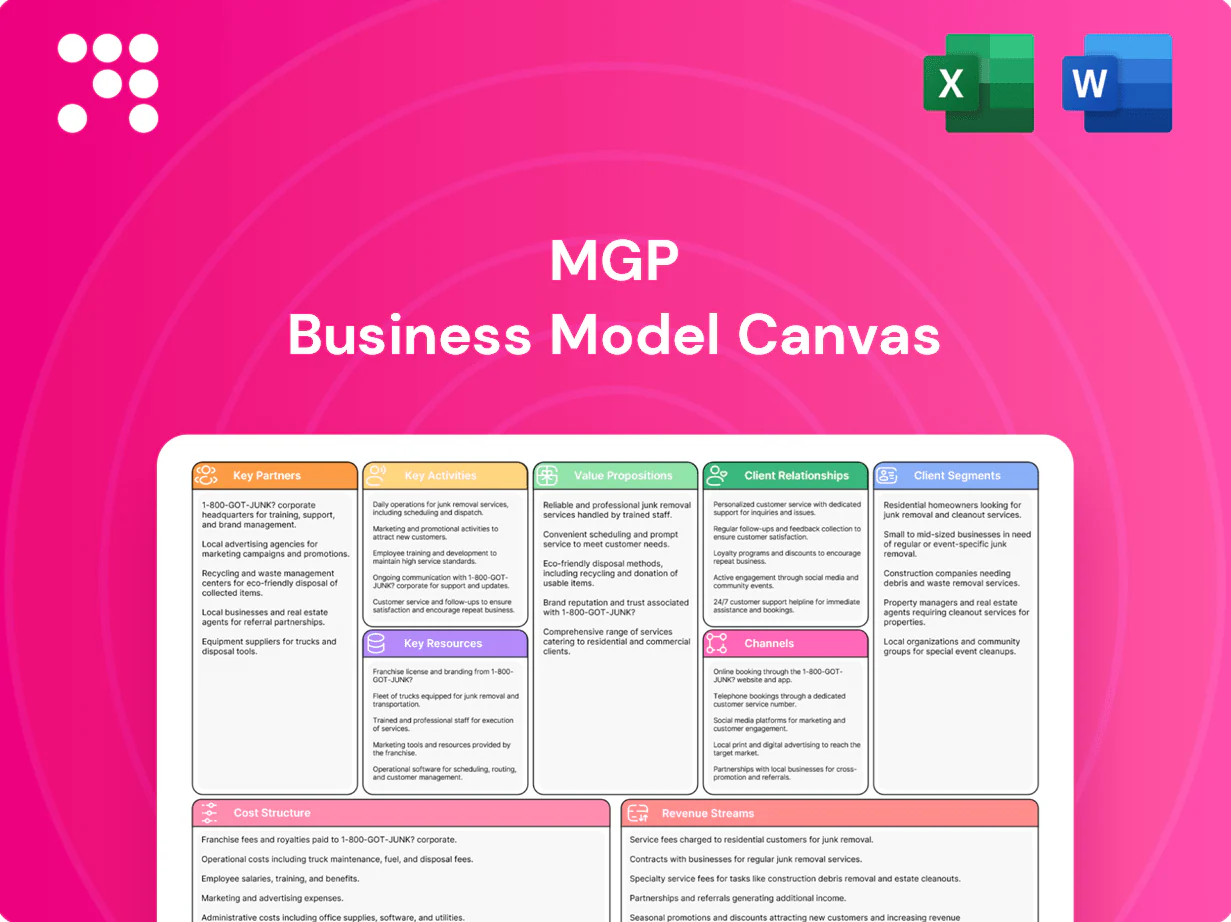
MGP Business Model Canvas

Unlock the Strategic Business Model Canvas: A Concise Blueprint for Investors and Founders
Unlock the full strategic blueprint behind MGP’s business model with our concise Business Model Canvas. This in-depth download reveals how MGP creates value, scales revenue, and manages costs across nine core blocks. Ideal for investors, consultants, and founders seeking actionable insights. Purchase the complete Word and Excel files to apply these tactics directly to your analysis.
Partnerships

Grain suppliers and farmers
Securing high-quality corn, rye, wheat and barley under 3–5 year contracts stabilizes input costs and ensures consistency across MGP spirits and ingredient lines. Close agronomic collaboration targets grain specs (protein, test weight) and mycotoxin reduction, supporting yield and quality. Identity-preserved and sustainably sourced programs often command 5–10% price premiums and strengthen brand claims. Seasonal hedging and logistics partners cut supply-risk and price exposure.
Co-packers and private-label clients
Partnerships with retailers and brand owners expand volume via private-label spirits and custom formulations, often accounting for roughly 20–30% of plant throughput; joint planning aligns production schedules, packaging, and brand standards to hit seasonal demand. Co-development of mash bills and sensory targets accelerates time-to-market, while 3–5 year contracts give capacity visibility and support steady margin stability.

Distribution and retail networks
Tiered spirits distribution partners enable national reach across all 50 states and regulatory compliance in 17 control states. On-premise and off-premise retail alliances drive shelf presence and velocity, improving market penetration. Data-sharing with distributors and retailers enhances demand forecasting and promotional ROI. International importers open export channels for branded SKUs into global markets.

Flavor, enzyme, and fermentation tech providers
Upstream partners supply yeasts, enzymes, botanicals and flavors to optimize yields and sensory profiles; joint trials in 2024 reduced process variance and accelerated scale-up, while co-innovation cut time-to-market for new whiskey finishes and functional ingredient properties. Quality programs ensure compliance with food and beverage standards and traceability across supply chains.
- 2024 industrial enzymes market ≈ $10.6B supporting R&D
- Joint trials drive faster scale-up and differentiation
- Co-innovation shortens finish development timelines
- Quality programs ensure regulatory compliance
Regulatory, certification, and sustainability bodies
Engagement with TTB, FDA and state agencies ensures labeling, formula and plant compliance, with TTB formula reviews commonly processed within 90 days. Certifications such as BRC/FSMA and Non-GMO bolster trust with CPG and retail buyers (BRCGS ~29,000 certified sites in 2024). Industry associations set standards and advocacy; environmental partners support water stewardship and science-based emissions targets.
- Regulatory: TTB/FDA/state compliance (TTB ~90-day reviews)
- Certifications: BRC/FSMA, Non-GMO (BRCGS ~29,000 sites, 2024)
- Associations: standards & advocacy
- Environmental: water stewardship, SBTi-like emissions goals
Long-term grain contracts stabilize costs; 5–10% premiums, 20–30% throughput
Long-term grain contracts (3–5y) and agronomic partners stabilize costs and quality; identity-preserved/sustainable programs command 5–10% premiums. Retail, private-label and distributor partnerships drive 20–30% plant throughput and national reach; TTB reviews ~90 days. Suppliers of enzymes/yeast (industrial enzymes market ≈ $10.6B in 2024) and certifications (BRCGS ~29,000 sites, 2024) ensure scale and compliance.
| Metric | 2024 |
|---|---|
| Plant throughput from partners | 20–30% |
| TTB review | ~90 days |
| Enzymes market | $10.6B |
| BRCGS sites | ~29,000 |
What is included in the product
 Detailed Word Document
A comprehensive, pre-written Business Model Canvas for MGP that maps customer segments, channels, value propositions, revenue streams, cost structure, key partners, activities, resources, and customer relationships in full detail. Designed for presentations and investor discussions, it links SWOT insights and competitive advantages to each BMC block to support validation and strategic decisions.

 Customizable Excel Spreadsheet
High-level view of MGP’s business model with editable cells that saves hours of formatting and structuring, condensing company strategy into a digestible, shareable one-page snapshot perfect for brainstorming, boardrooms, or quick team alignment.
Activities

Distillation and maturation operations
Producing bourbon, rye, gin and vodka at scale requires precise mashing, fermenting, distilling and barreling; straight bourbon legally ages at least 2 years and warehouses manage maturation and angel’s share (typically 2–5% loss per year). Regular sensory panels and QC, often weekly, ensure consistency across lots. Barrel procurement, rotation and blending craft target flavor outcomes and control inventory.
Ingredient processing and functionalization
Manufacturing specialty wheat starches and proteins uses milling, separation, drying (target moisture <12%), and chemical/physical modification to achieve protein isolates >80% purity; process parameters tune viscosity, binding and texture for food, beverage and industrial uses. Application labs validate performance in end-use recipes, cutting formulation failures up to 30%. Continuous improvement lifts yields and trims waste; the global modified starch market was about USD 10B in 2024.

Product development and customization
R&D crafts custom mash bills, botanical blends and ingredient functionalities for B2B clients; pilot runs shorten iteration cycles to 2–8 weeks and de-risk scale-up; technical service teams convert customer requirements into manufacturable specs and SOPs; IP protections (patents with up to 20-year terms) and trade-secret know-how safeguard differentiated offerings.

Supply chain and quality management
Inbound grain logistics, tight inventory control and strategic hedging stabilize costs and availability, minimizing exposure to commodity price swings and ensuring production continuity. HACCP, GMP and sensory QC programs enforce food-safety standards and product uniformity across batches. Electronic traceability systems enable rapid audit support and streamlined recalls while vendor and distributor scorecards drive measurable performance improvements.
- Inbound logistics
- Inventory control & hedging
- HACCP, GMP, sensory QC
- Traceability for audits/recalls
- Vendor/distributor scorecards
Brand building and commercial execution
Brand building and commercial execution activates MGP’s owned spirits through digital, trade and experiential programs while revenue management balances branded versus private-label mixes to protect margins; MGP reported FY2024 net sales of approximately $709 million, reflecting branded growth and bulk/contract production demand.
- Marketing: digital, trade, experiential
- Revenue mgmt: branded vs private label
- Category & data: assortment/pricing analytics
- Sales enablement: distributor education/activation
Bourbon & specialty starches, FY2024 sales $709M
Operate large-scale distillation, maturation and blending (bourbon min 2 yrs; angel’s share 2–5%/yr) with weekly QC to ensure consistency.
Produce specialty starches/proteins (moisture <12%, protein >80%); CI lifts yields; modified starch market ≈ USD 10B (2024).
Manage inbound grain logistics, hedging, traceability, HACCP/GMP, and brand/commercial execution; FY2024 net sales ≈ $709M.
| Metric | Value |
|---|---|
| FY2024 Sales | $709M |
| Angel’s share | 2–5%/yr |
| Starch market 2024 | $10B |
Full Document Unlocks After Purchase
Business Model Canvas
The MGP Business Model Canvas shown here is the actual deliverable, not a mockup, and reflects the full structure and content you’ll receive after purchase. When you complete your order, you’ll download this same professional file ready for editing and presentation. No surprises—what you preview is what you’ll own.

Unlock the Strategic Business Model Canvas: A Concise Blueprint for Investors and Founders
Unlock the full strategic blueprint behind MGP’s business model with our concise Business Model Canvas. This in-depth download reveals how MGP creates value, scales revenue, and manages costs across nine core blocks. Ideal for investors, consultants, and founders seeking actionable insights. Purchase the complete Word and Excel files to apply these tactics directly to your analysis.
Partnerships
Grain suppliers and farmers
Securing high-quality corn, rye, wheat and barley under 3–5 year contracts stabilizes input costs and ensures consistency across MGP spirits and ingredient lines. Close agronomic collaboration targets grain specs (protein, test weight) and mycotoxin reduction, supporting yield and quality. Identity-preserved and sustainably sourced programs often command 5–10% price premiums and strengthen brand claims. Seasonal hedging and logistics partners cut supply-risk and price exposure.
Co-packers and private-label clients
Partnerships with retailers and brand owners expand volume via private-label spirits and custom formulations, often accounting for roughly 20–30% of plant throughput; joint planning aligns production schedules, packaging, and brand standards to hit seasonal demand. Co-development of mash bills and sensory targets accelerates time-to-market, while 3–5 year contracts give capacity visibility and support steady margin stability.
Distribution and retail networks
Tiered spirits distribution partners enable national reach across all 50 states and regulatory compliance in 17 control states. On-premise and off-premise retail alliances drive shelf presence and velocity, improving market penetration. Data-sharing with distributors and retailers enhances demand forecasting and promotional ROI. International importers open export channels for branded SKUs into global markets.
Flavor, enzyme, and fermentation tech providers
Upstream partners supply yeasts, enzymes, botanicals and flavors to optimize yields and sensory profiles; joint trials in 2024 reduced process variance and accelerated scale-up, while co-innovation cut time-to-market for new whiskey finishes and functional ingredient properties. Quality programs ensure compliance with food and beverage standards and traceability across supply chains.
- 2024 industrial enzymes market ≈ $10.6B supporting R&D
- Joint trials drive faster scale-up and differentiation
- Co-innovation shortens finish development timelines
- Quality programs ensure regulatory compliance
Regulatory, certification, and sustainability bodies
Engagement with TTB, FDA and state agencies ensures labeling, formula and plant compliance, with TTB formula reviews commonly processed within 90 days. Certifications such as BRC/FSMA and Non-GMO bolster trust with CPG and retail buyers (BRCGS ~29,000 certified sites in 2024). Industry associations set standards and advocacy; environmental partners support water stewardship and science-based emissions targets.
- Regulatory: TTB/FDA/state compliance (TTB ~90-day reviews)
- Certifications: BRC/FSMA, Non-GMO (BRCGS ~29,000 sites, 2024)
- Associations: standards & advocacy
- Environmental: water stewardship, SBTi-like emissions goals
Long-term grain contracts stabilize costs; 5–10% premiums, 20–30% throughput
Long-term grain contracts (3–5y) and agronomic partners stabilize costs and quality; identity-preserved/sustainable programs command 5–10% premiums. Retail, private-label and distributor partnerships drive 20–30% plant throughput and national reach; TTB reviews ~90 days. Suppliers of enzymes/yeast (industrial enzymes market ≈ $10.6B in 2024) and certifications (BRCGS ~29,000 sites, 2024) ensure scale and compliance.
| Metric | 2024 |
|---|---|
| Plant throughput from partners | 20–30% |
| TTB review | ~90 days |
| Enzymes market | $10.6B |
| BRCGS sites | ~29,000 |
What is included in the product
Detailed Word Document
A comprehensive, pre-written Business Model Canvas for MGP that maps customer segments, channels, value propositions, revenue streams, cost structure, key partners, activities, resources, and customer relationships in full detail. Designed for presentations and investor discussions, it links SWOT insights and competitive advantages to each BMC block to support validation and strategic decisions.
Customizable Excel Spreadsheet
High-level view of MGP’s business model with editable cells that saves hours of formatting and structuring, condensing company strategy into a digestible, shareable one-page snapshot perfect for brainstorming, boardrooms, or quick team alignment.
Activities
Distillation and maturation operations
Producing bourbon, rye, gin and vodka at scale requires precise mashing, fermenting, distilling and barreling; straight bourbon legally ages at least 2 years and warehouses manage maturation and angel’s share (typically 2–5% loss per year). Regular sensory panels and QC, often weekly, ensure consistency across lots. Barrel procurement, rotation and blending craft target flavor outcomes and control inventory.
Ingredient processing and functionalization
Manufacturing specialty wheat starches and proteins uses milling, separation, drying (target moisture <12%), and chemical/physical modification to achieve protein isolates >80% purity; process parameters tune viscosity, binding and texture for food, beverage and industrial uses. Application labs validate performance in end-use recipes, cutting formulation failures up to 30%. Continuous improvement lifts yields and trims waste; the global modified starch market was about USD 10B in 2024.
Product development and customization
R&D crafts custom mash bills, botanical blends and ingredient functionalities for B2B clients; pilot runs shorten iteration cycles to 2–8 weeks and de-risk scale-up; technical service teams convert customer requirements into manufacturable specs and SOPs; IP protections (patents with up to 20-year terms) and trade-secret know-how safeguard differentiated offerings.
Supply chain and quality management
Inbound grain logistics, tight inventory control and strategic hedging stabilize costs and availability, minimizing exposure to commodity price swings and ensuring production continuity. HACCP, GMP and sensory QC programs enforce food-safety standards and product uniformity across batches. Electronic traceability systems enable rapid audit support and streamlined recalls while vendor and distributor scorecards drive measurable performance improvements.
- Inbound logistics
- Inventory control & hedging
- HACCP, GMP, sensory QC
- Traceability for audits/recalls
- Vendor/distributor scorecards
Brand building and commercial execution
Brand building and commercial execution activates MGP’s owned spirits through digital, trade and experiential programs while revenue management balances branded versus private-label mixes to protect margins; MGP reported FY2024 net sales of approximately $709 million, reflecting branded growth and bulk/contract production demand.
- Marketing: digital, trade, experiential
- Revenue mgmt: branded vs private label
- Category & data: assortment/pricing analytics
- Sales enablement: distributor education/activation
Bourbon & specialty starches, FY2024 sales $709M
Operate large-scale distillation, maturation and blending (bourbon min 2 yrs; angel’s share 2–5%/yr) with weekly QC to ensure consistency.
Produce specialty starches/proteins (moisture <12%, protein >80%); CI lifts yields; modified starch market ≈ USD 10B (2024).
Manage inbound grain logistics, hedging, traceability, HACCP/GMP, and brand/commercial execution; FY2024 net sales ≈ $709M.
| Metric | Value |
|---|---|
| FY2024 Sales | $709M |
| Angel’s share | 2–5%/yr |
| Starch market 2024 | $10B |
Full Document Unlocks After Purchase
Business Model Canvas
The MGP Business Model Canvas shown here is the actual deliverable, not a mockup, and reflects the full structure and content you’ll receive after purchase. When you complete your order, you’ll download this same professional file ready for editing and presentation. No surprises—what you preview is what you’ll own.
Description
Unlock the Strategic Business Model Canvas: A Concise Blueprint for Investors and Founders
Unlock the full strategic blueprint behind MGP’s business model with our concise Business Model Canvas. This in-depth download reveals how MGP creates value, scales revenue, and manages costs across nine core blocks. Ideal for investors, consultants, and founders seeking actionable insights. Purchase the complete Word and Excel files to apply these tactics directly to your analysis.
Partnerships
Grain suppliers and farmers
Securing high-quality corn, rye, wheat and barley under 3–5 year contracts stabilizes input costs and ensures consistency across MGP spirits and ingredient lines. Close agronomic collaboration targets grain specs (protein, test weight) and mycotoxin reduction, supporting yield and quality. Identity-preserved and sustainably sourced programs often command 5–10% price premiums and strengthen brand claims. Seasonal hedging and logistics partners cut supply-risk and price exposure.
Co-packers and private-label clients
Partnerships with retailers and brand owners expand volume via private-label spirits and custom formulations, often accounting for roughly 20–30% of plant throughput; joint planning aligns production schedules, packaging, and brand standards to hit seasonal demand. Co-development of mash bills and sensory targets accelerates time-to-market, while 3–5 year contracts give capacity visibility and support steady margin stability.
Distribution and retail networks
Tiered spirits distribution partners enable national reach across all 50 states and regulatory compliance in 17 control states. On-premise and off-premise retail alliances drive shelf presence and velocity, improving market penetration. Data-sharing with distributors and retailers enhances demand forecasting and promotional ROI. International importers open export channels for branded SKUs into global markets.
Flavor, enzyme, and fermentation tech providers
Upstream partners supply yeasts, enzymes, botanicals and flavors to optimize yields and sensory profiles; joint trials in 2024 reduced process variance and accelerated scale-up, while co-innovation cut time-to-market for new whiskey finishes and functional ingredient properties. Quality programs ensure compliance with food and beverage standards and traceability across supply chains.
- 2024 industrial enzymes market ≈ $10.6B supporting R&D
- Joint trials drive faster scale-up and differentiation
- Co-innovation shortens finish development timelines
- Quality programs ensure regulatory compliance
Regulatory, certification, and sustainability bodies
Engagement with TTB, FDA and state agencies ensures labeling, formula and plant compliance, with TTB formula reviews commonly processed within 90 days. Certifications such as BRC/FSMA and Non-GMO bolster trust with CPG and retail buyers (BRCGS ~29,000 certified sites in 2024). Industry associations set standards and advocacy; environmental partners support water stewardship and science-based emissions targets.
- Regulatory: TTB/FDA/state compliance (TTB ~90-day reviews)
- Certifications: BRC/FSMA, Non-GMO (BRCGS ~29,000 sites, 2024)
- Associations: standards & advocacy
- Environmental: water stewardship, SBTi-like emissions goals
Long-term grain contracts stabilize costs; 5–10% premiums, 20–30% throughput
Long-term grain contracts (3–5y) and agronomic partners stabilize costs and quality; identity-preserved/sustainable programs command 5–10% premiums. Retail, private-label and distributor partnerships drive 20–30% plant throughput and national reach; TTB reviews ~90 days. Suppliers of enzymes/yeast (industrial enzymes market ≈ $10.6B in 2024) and certifications (BRCGS ~29,000 sites, 2024) ensure scale and compliance.
| Metric | 2024 |
|---|---|
| Plant throughput from partners | 20–30% |
| TTB review | ~90 days |
| Enzymes market | $10.6B |
| BRCGS sites | ~29,000 |
What is included in the product
Detailed Word Document
A comprehensive, pre-written Business Model Canvas for MGP that maps customer segments, channels, value propositions, revenue streams, cost structure, key partners, activities, resources, and customer relationships in full detail. Designed for presentations and investor discussions, it links SWOT insights and competitive advantages to each BMC block to support validation and strategic decisions.
Customizable Excel Spreadsheet
High-level view of MGP’s business model with editable cells that saves hours of formatting and structuring, condensing company strategy into a digestible, shareable one-page snapshot perfect for brainstorming, boardrooms, or quick team alignment.
Activities
Distillation and maturation operations
Producing bourbon, rye, gin and vodka at scale requires precise mashing, fermenting, distilling and barreling; straight bourbon legally ages at least 2 years and warehouses manage maturation and angel’s share (typically 2–5% loss per year). Regular sensory panels and QC, often weekly, ensure consistency across lots. Barrel procurement, rotation and blending craft target flavor outcomes and control inventory.
Ingredient processing and functionalization
Manufacturing specialty wheat starches and proteins uses milling, separation, drying (target moisture <12%), and chemical/physical modification to achieve protein isolates >80% purity; process parameters tune viscosity, binding and texture for food, beverage and industrial uses. Application labs validate performance in end-use recipes, cutting formulation failures up to 30%. Continuous improvement lifts yields and trims waste; the global modified starch market was about USD 10B in 2024.
Product development and customization
R&D crafts custom mash bills, botanical blends and ingredient functionalities for B2B clients; pilot runs shorten iteration cycles to 2–8 weeks and de-risk scale-up; technical service teams convert customer requirements into manufacturable specs and SOPs; IP protections (patents with up to 20-year terms) and trade-secret know-how safeguard differentiated offerings.
Supply chain and quality management
Inbound grain logistics, tight inventory control and strategic hedging stabilize costs and availability, minimizing exposure to commodity price swings and ensuring production continuity. HACCP, GMP and sensory QC programs enforce food-safety standards and product uniformity across batches. Electronic traceability systems enable rapid audit support and streamlined recalls while vendor and distributor scorecards drive measurable performance improvements.
- Inbound logistics
- Inventory control & hedging
- HACCP, GMP, sensory QC
- Traceability for audits/recalls
- Vendor/distributor scorecards
Brand building and commercial execution
Brand building and commercial execution activates MGP’s owned spirits through digital, trade and experiential programs while revenue management balances branded versus private-label mixes to protect margins; MGP reported FY2024 net sales of approximately $709 million, reflecting branded growth and bulk/contract production demand.
- Marketing: digital, trade, experiential
- Revenue mgmt: branded vs private label
- Category & data: assortment/pricing analytics
- Sales enablement: distributor education/activation
Bourbon & specialty starches, FY2024 sales $709M
Operate large-scale distillation, maturation and blending (bourbon min 2 yrs; angel’s share 2–5%/yr) with weekly QC to ensure consistency.
Produce specialty starches/proteins (moisture <12%, protein >80%); CI lifts yields; modified starch market ≈ USD 10B (2024).
Manage inbound grain logistics, hedging, traceability, HACCP/GMP, and brand/commercial execution; FY2024 net sales ≈ $709M.
| Metric | Value |
|---|---|
| FY2024 Sales | $709M |
| Angel’s share | 2–5%/yr |
| Starch market 2024 | $10B |
Full Document Unlocks After Purchase
Business Model Canvas
The MGP Business Model Canvas shown here is the actual deliverable, not a mockup, and reflects the full structure and content you’ll receive after purchase. When you complete your order, you’ll download this same professional file ready for editing and presentation. No surprises—what you preview is what you’ll own.











