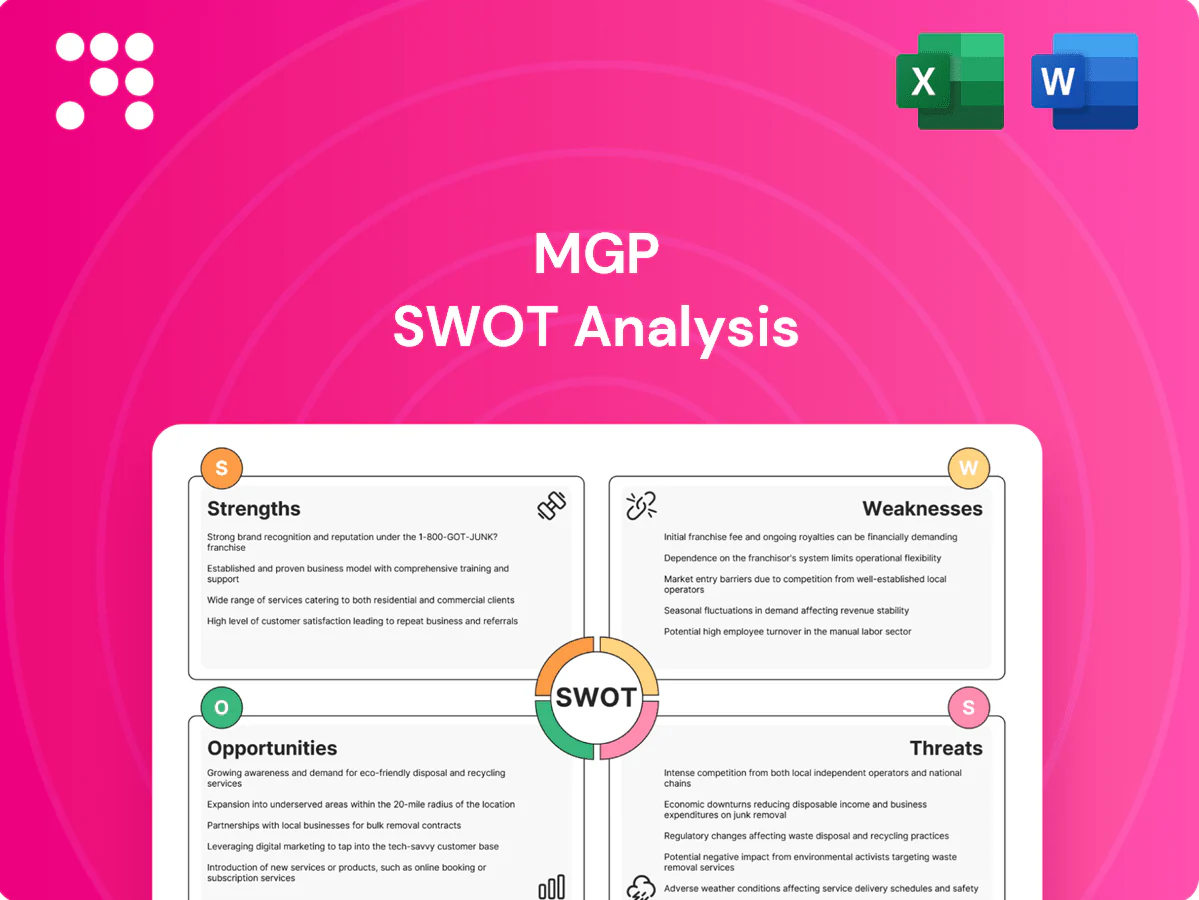
MGP SWOT Analysis

Dive Deeper Into the Company’s Strategic Blueprint
MGP’s SWOT highlights resilient brand strength, diversified product mix, and margin resilience, alongside regulatory exposure and commodity risk; opportunities include premiumization and international expansion. Want deeper, research-backed implications and editable Word/Excel deliverables? Purchase the full SWOT to turn insight into strategic action.
Strengths

Diversified revenue streams
MGP Ingredients' mix of premium distilled spirits and specialty ingredients smooths cyclical swings by reducing reliance on a single category, with spirits delivering higher brand and private-label margins while ingredients supply steady B2B volume. The dual portfolio enables cross-selling and shared production, distribution and R&D capabilities. It also balances capital intensity—higher for spirits—with recurring demand from ingredient customers.
Deep distillation expertise & capacity
Owned distilleries in Lawrenceburg, IN and Atchison, KS give MGP direct control over mash bills, aging and quality across bourbon, rye, gin and vodka. Scale and technical know-how enable consistent supply for its own brands and contract customers. Long production runs and multi-year barrel programs create defensible manufacturing capabilities. This positions MGP as a reliable partner for premium and private-label spirits.

Specialty starch & protein know-how
Proprietary wheat starches and proteins supply food, beverage and industrial customers, with MGP’s Ingredient Solutions diversifying its mix and historically representing roughly one-quarter of net sales (about $150–200M range in FY2024).
Ongoing functional-ingredient R&D drives formulation differentiation beyond commodity starches, supporting higher-margin specialty products and formulations.
Technical formulation support creates sticky customer relationships and broadens end-market exposure, enabling better margin capture versus bulk commodity sales.

Private-label and B2B relationships
Private-label and B2B relationships give MGP anchored, predictable demand via longstanding supply agreements and steady capacity utilization, with co-development work raising customer switching costs and lock-in. Growth in private-label aligns with retailer brand strategies and expands volume without heavy marketing spend, complementing MGP’s owned brands and margin profile.
- Longstanding supply agreements
- Co-development = higher switching costs
- Private-label growth complements owned brands
- Lower marketing spend per volume
Operational integration & flexibility
Combined spirits and ingredient plants enable process efficiencies, byproduct utilization, and logistics leverage; MGP reported roughly $1.0B in net sales in FY2024, highlighting scale benefits. The ability to pivot production toward higher-margin SKUs supports profitability and margin resilience. Vertical coordination improves traceability and quality control and shortens response times to shifting customer needs.
- Scale: FY2024 ~ $1.0B net sales
- Flex: rapid SKU pivoting
- Quality: improved traceability & faster response
Dual spirits + Ingredients (~25%) and owned distilleries boost margins
MGP’s dual spirits and ingredients mix (~$1.0B net sales FY2024) balances higher-margin branded/private-label spirits with steady Ingredient Solutions (~25% of sales; $150–200M), smoothing cycles.
Owned distilleries in Lawrenceburg and Atchison provide control over mash bills, aging and scale for contract and brand supply.
Private-label, co-development and R&D drive stickiness, faster SKU pivots and margin resilience.
| Metric | FY2024 |
|---|---|
| Net sales | $1.0B |
| Ingredients % | ~25% ($150–200M) |
| Distilleries | Lawrenceburg, Atchison |
What is included in the product
 Detailed Word Document
Provides a clear SWOT framework analyzing MGP’s internal capabilities, market strengths, operational gaps, growth opportunities and external threats shaping its competitive and strategic position.

 Customizable Excel Spreadsheet
Provides a concise MGP SWOT matrix for fast, visual strategy alignment across its distilled spirits, ingredients, and contract-manufacturing segments, easing stakeholder briefings and decision-making.
Weaknesses

Commodity and energy exposure
Grain and natural gas volatility compresses MGP margins despite hedging; corn futures moved about 22% in 2024 and Henry Hub averaged roughly $3.20/MMBtu that year, amplifying input cost swings. Sudden cost spikes are difficult to fully pass through in contracts, creating margin squeeze in 2024–2025 commercial cycles. Ingredient pricing often lags input moves, adding earnings variability and planning complexity.
Inventory intensity and aging cycles
Whiskey requires multi-year aging—commonly 3–12 years—tying up working capital and warehouse capacity. Forecast errors can produce shortages or excess aged stock, increasing carrying costs and sales volatility. Angel’s share typically reduces barrel volume by about 2–3% annually, while storage, insurance and rackhouse costs further erode margins. The result is a cash conversion cycle materially slower than typical CPG peers (often 30–60 days).

Brand scale versus global majors
Owned brands compete with multinationals that outspend on marketing and distribution, with global spirits giants investing billions annually in A&P (e.g., Diageo and Pernod Ricard each spend >$1.5B‑$2B per year), limiting MGP's ability to match visibility.
Route‑to‑market reach for MGP can be uneven across geographies, constraining rollouts outside core US and select EU channels.
Shelf and bar placement is highly contested and costly, with slotting and on‑premise promotion budgets creating barriers to entry.
These factors can cap share gains in crowded categories where incumbents hold dominant distribution and promotional share.

Regulatory complexity
Regulatory complexity: alcohol production and distribution face layered federal, state and local rules that raise compliance costs and operational friction; federal distilled spirits excise tax is $13.50 per proof gallon, and labeling, excise and tied-house laws constrain pricing and channel choices, while regulatory changes can force rapid process and system adjustments.
- Layered rules across federal/state/local
- Federal excise: $13.50 per proof gallon
- Labeling, excise, tied-house limit flexibility
End-market concentration risk
End-market concentration leaves MGP exposed: a heavy reliance on North American demand and a small set of channel partners can create outsized revenue swings, and customer consolidation has historically pressured pricing and contract terms. Dependence on a subset of SKUs and mash bills amplifies supply‑side or demand shocks, while geographic and product diversification will require multi-year capital and marketing investment to meaningfully reduce risk.
- Exposure: North America and key channel partners
- Pricing risk: customer consolidation
- Product risk: limited SKU/mash bill breadth
- Mitigation: diversification needs time and capex
Input volatility, aging inventory and excise taxes squeeze margins while rivals outspend A&P
Input volatility squeezed margins in 2024 (corn futures ±22%; Henry Hub ~ $3.20/MMBtu), aging ties up capital (3–12 years; angel’s share 2–3%/yr) and elevates carrying costs, global competitors outspend on A&P (Diageo/Pernod > $1.5–2B/yr), federal excise is $13.50/proof gallon, and reliance on North America/key partners concentrates revenue risk.
| Metric | Value |
|---|---|
| Corn 2024 move | ~22% |
| Henry Hub 2024 | $3.20/MMBtu |
| Angel’s share | 2–3%/yr |
| Federal excise | $13.50/proof gal |
What You See Is What You Get
MGP SWOT Analysis
This is the actual MGP SWOT analysis document you’ll receive upon purchase—no surprises, just professional quality. The preview below is taken directly from the full report you'll get. Purchase unlocks the complete, editable version with detailed strengths, weaknesses, opportunities, and threats.

Dive Deeper Into the Company’s Strategic Blueprint
MGP’s SWOT highlights resilient brand strength, diversified product mix, and margin resilience, alongside regulatory exposure and commodity risk; opportunities include premiumization and international expansion. Want deeper, research-backed implications and editable Word/Excel deliverables? Purchase the full SWOT to turn insight into strategic action.
Strengths
Diversified revenue streams
MGP Ingredients' mix of premium distilled spirits and specialty ingredients smooths cyclical swings by reducing reliance on a single category, with spirits delivering higher brand and private-label margins while ingredients supply steady B2B volume. The dual portfolio enables cross-selling and shared production, distribution and R&D capabilities. It also balances capital intensity—higher for spirits—with recurring demand from ingredient customers.
Deep distillation expertise & capacity
Owned distilleries in Lawrenceburg, IN and Atchison, KS give MGP direct control over mash bills, aging and quality across bourbon, rye, gin and vodka. Scale and technical know-how enable consistent supply for its own brands and contract customers. Long production runs and multi-year barrel programs create defensible manufacturing capabilities. This positions MGP as a reliable partner for premium and private-label spirits.
Specialty starch & protein know-how
Proprietary wheat starches and proteins supply food, beverage and industrial customers, with MGP’s Ingredient Solutions diversifying its mix and historically representing roughly one-quarter of net sales (about $150–200M range in FY2024).
Ongoing functional-ingredient R&D drives formulation differentiation beyond commodity starches, supporting higher-margin specialty products and formulations.
Technical formulation support creates sticky customer relationships and broadens end-market exposure, enabling better margin capture versus bulk commodity sales.
Private-label and B2B relationships
Private-label and B2B relationships give MGP anchored, predictable demand via longstanding supply agreements and steady capacity utilization, with co-development work raising customer switching costs and lock-in. Growth in private-label aligns with retailer brand strategies and expands volume without heavy marketing spend, complementing MGP’s owned brands and margin profile.
- Longstanding supply agreements
- Co-development = higher switching costs
- Private-label growth complements owned brands
- Lower marketing spend per volume
Operational integration & flexibility
Combined spirits and ingredient plants enable process efficiencies, byproduct utilization, and logistics leverage; MGP reported roughly $1.0B in net sales in FY2024, highlighting scale benefits. The ability to pivot production toward higher-margin SKUs supports profitability and margin resilience. Vertical coordination improves traceability and quality control and shortens response times to shifting customer needs.
- Scale: FY2024 ~ $1.0B net sales
- Flex: rapid SKU pivoting
- Quality: improved traceability & faster response
Dual spirits + Ingredients (~25%) and owned distilleries boost margins
MGP’s dual spirits and ingredients mix (~$1.0B net sales FY2024) balances higher-margin branded/private-label spirits with steady Ingredient Solutions (~25% of sales; $150–200M), smoothing cycles.
Owned distilleries in Lawrenceburg and Atchison provide control over mash bills, aging and scale for contract and brand supply.
Private-label, co-development and R&D drive stickiness, faster SKU pivots and margin resilience.
| Metric | FY2024 |
|---|---|
| Net sales | $1.0B |
| Ingredients % | ~25% ($150–200M) |
| Distilleries | Lawrenceburg, Atchison |
What is included in the product
Detailed Word Document
Provides a clear SWOT framework analyzing MGP’s internal capabilities, market strengths, operational gaps, growth opportunities and external threats shaping its competitive and strategic position.
Customizable Excel Spreadsheet
Provides a concise MGP SWOT matrix for fast, visual strategy alignment across its distilled spirits, ingredients, and contract-manufacturing segments, easing stakeholder briefings and decision-making.
Weaknesses
Commodity and energy exposure
Grain and natural gas volatility compresses MGP margins despite hedging; corn futures moved about 22% in 2024 and Henry Hub averaged roughly $3.20/MMBtu that year, amplifying input cost swings. Sudden cost spikes are difficult to fully pass through in contracts, creating margin squeeze in 2024–2025 commercial cycles. Ingredient pricing often lags input moves, adding earnings variability and planning complexity.
Inventory intensity and aging cycles
Whiskey requires multi-year aging—commonly 3–12 years—tying up working capital and warehouse capacity. Forecast errors can produce shortages or excess aged stock, increasing carrying costs and sales volatility. Angel’s share typically reduces barrel volume by about 2–3% annually, while storage, insurance and rackhouse costs further erode margins. The result is a cash conversion cycle materially slower than typical CPG peers (often 30–60 days).
Brand scale versus global majors
Owned brands compete with multinationals that outspend on marketing and distribution, with global spirits giants investing billions annually in A&P (e.g., Diageo and Pernod Ricard each spend >$1.5B‑$2B per year), limiting MGP's ability to match visibility.
Route‑to‑market reach for MGP can be uneven across geographies, constraining rollouts outside core US and select EU channels.
Shelf and bar placement is highly contested and costly, with slotting and on‑premise promotion budgets creating barriers to entry.
These factors can cap share gains in crowded categories where incumbents hold dominant distribution and promotional share.
Regulatory complexity
Regulatory complexity: alcohol production and distribution face layered federal, state and local rules that raise compliance costs and operational friction; federal distilled spirits excise tax is $13.50 per proof gallon, and labeling, excise and tied-house laws constrain pricing and channel choices, while regulatory changes can force rapid process and system adjustments.
- Layered rules across federal/state/local
- Federal excise: $13.50 per proof gallon
- Labeling, excise, tied-house limit flexibility
End-market concentration risk
End-market concentration leaves MGP exposed: a heavy reliance on North American demand and a small set of channel partners can create outsized revenue swings, and customer consolidation has historically pressured pricing and contract terms. Dependence on a subset of SKUs and mash bills amplifies supply‑side or demand shocks, while geographic and product diversification will require multi-year capital and marketing investment to meaningfully reduce risk.
- Exposure: North America and key channel partners
- Pricing risk: customer consolidation
- Product risk: limited SKU/mash bill breadth
- Mitigation: diversification needs time and capex
Input volatility, aging inventory and excise taxes squeeze margins while rivals outspend A&P
Input volatility squeezed margins in 2024 (corn futures ±22%; Henry Hub ~ $3.20/MMBtu), aging ties up capital (3–12 years; angel’s share 2–3%/yr) and elevates carrying costs, global competitors outspend on A&P (Diageo/Pernod > $1.5–2B/yr), federal excise is $13.50/proof gallon, and reliance on North America/key partners concentrates revenue risk.
| Metric | Value |
|---|---|
| Corn 2024 move | ~22% |
| Henry Hub 2024 | $3.20/MMBtu |
| Angel’s share | 2–3%/yr |
| Federal excise | $13.50/proof gal |
What You See Is What You Get
MGP SWOT Analysis
This is the actual MGP SWOT analysis document you’ll receive upon purchase—no surprises, just professional quality. The preview below is taken directly from the full report you'll get. Purchase unlocks the complete, editable version with detailed strengths, weaknesses, opportunities, and threats.
Original: $10.00
-65%$10.00
$3.50Description
Dive Deeper Into the Company’s Strategic Blueprint
MGP’s SWOT highlights resilient brand strength, diversified product mix, and margin resilience, alongside regulatory exposure and commodity risk; opportunities include premiumization and international expansion. Want deeper, research-backed implications and editable Word/Excel deliverables? Purchase the full SWOT to turn insight into strategic action.
Strengths
Diversified revenue streams
MGP Ingredients' mix of premium distilled spirits and specialty ingredients smooths cyclical swings by reducing reliance on a single category, with spirits delivering higher brand and private-label margins while ingredients supply steady B2B volume. The dual portfolio enables cross-selling and shared production, distribution and R&D capabilities. It also balances capital intensity—higher for spirits—with recurring demand from ingredient customers.
Deep distillation expertise & capacity
Owned distilleries in Lawrenceburg, IN and Atchison, KS give MGP direct control over mash bills, aging and quality across bourbon, rye, gin and vodka. Scale and technical know-how enable consistent supply for its own brands and contract customers. Long production runs and multi-year barrel programs create defensible manufacturing capabilities. This positions MGP as a reliable partner for premium and private-label spirits.
Specialty starch & protein know-how
Proprietary wheat starches and proteins supply food, beverage and industrial customers, with MGP’s Ingredient Solutions diversifying its mix and historically representing roughly one-quarter of net sales (about $150–200M range in FY2024).
Ongoing functional-ingredient R&D drives formulation differentiation beyond commodity starches, supporting higher-margin specialty products and formulations.
Technical formulation support creates sticky customer relationships and broadens end-market exposure, enabling better margin capture versus bulk commodity sales.
Private-label and B2B relationships
Private-label and B2B relationships give MGP anchored, predictable demand via longstanding supply agreements and steady capacity utilization, with co-development work raising customer switching costs and lock-in. Growth in private-label aligns with retailer brand strategies and expands volume without heavy marketing spend, complementing MGP’s owned brands and margin profile.
- Longstanding supply agreements
- Co-development = higher switching costs
- Private-label growth complements owned brands
- Lower marketing spend per volume
Operational integration & flexibility
Combined spirits and ingredient plants enable process efficiencies, byproduct utilization, and logistics leverage; MGP reported roughly $1.0B in net sales in FY2024, highlighting scale benefits. The ability to pivot production toward higher-margin SKUs supports profitability and margin resilience. Vertical coordination improves traceability and quality control and shortens response times to shifting customer needs.
- Scale: FY2024 ~ $1.0B net sales
- Flex: rapid SKU pivoting
- Quality: improved traceability & faster response
Dual spirits + Ingredients (~25%) and owned distilleries boost margins
MGP’s dual spirits and ingredients mix (~$1.0B net sales FY2024) balances higher-margin branded/private-label spirits with steady Ingredient Solutions (~25% of sales; $150–200M), smoothing cycles.
Owned distilleries in Lawrenceburg and Atchison provide control over mash bills, aging and scale for contract and brand supply.
Private-label, co-development and R&D drive stickiness, faster SKU pivots and margin resilience.
| Metric | FY2024 |
|---|---|
| Net sales | $1.0B |
| Ingredients % | ~25% ($150–200M) |
| Distilleries | Lawrenceburg, Atchison |
What is included in the product
Detailed Word Document
Provides a clear SWOT framework analyzing MGP’s internal capabilities, market strengths, operational gaps, growth opportunities and external threats shaping its competitive and strategic position.
Customizable Excel Spreadsheet
Provides a concise MGP SWOT matrix for fast, visual strategy alignment across its distilled spirits, ingredients, and contract-manufacturing segments, easing stakeholder briefings and decision-making.
Weaknesses
Commodity and energy exposure
Grain and natural gas volatility compresses MGP margins despite hedging; corn futures moved about 22% in 2024 and Henry Hub averaged roughly $3.20/MMBtu that year, amplifying input cost swings. Sudden cost spikes are difficult to fully pass through in contracts, creating margin squeeze in 2024–2025 commercial cycles. Ingredient pricing often lags input moves, adding earnings variability and planning complexity.
Inventory intensity and aging cycles
Whiskey requires multi-year aging—commonly 3–12 years—tying up working capital and warehouse capacity. Forecast errors can produce shortages or excess aged stock, increasing carrying costs and sales volatility. Angel’s share typically reduces barrel volume by about 2–3% annually, while storage, insurance and rackhouse costs further erode margins. The result is a cash conversion cycle materially slower than typical CPG peers (often 30–60 days).
Brand scale versus global majors
Owned brands compete with multinationals that outspend on marketing and distribution, with global spirits giants investing billions annually in A&P (e.g., Diageo and Pernod Ricard each spend >$1.5B‑$2B per year), limiting MGP's ability to match visibility.
Route‑to‑market reach for MGP can be uneven across geographies, constraining rollouts outside core US and select EU channels.
Shelf and bar placement is highly contested and costly, with slotting and on‑premise promotion budgets creating barriers to entry.
These factors can cap share gains in crowded categories where incumbents hold dominant distribution and promotional share.
Regulatory complexity
Regulatory complexity: alcohol production and distribution face layered federal, state and local rules that raise compliance costs and operational friction; federal distilled spirits excise tax is $13.50 per proof gallon, and labeling, excise and tied-house laws constrain pricing and channel choices, while regulatory changes can force rapid process and system adjustments.
- Layered rules across federal/state/local
- Federal excise: $13.50 per proof gallon
- Labeling, excise, tied-house limit flexibility
End-market concentration risk
End-market concentration leaves MGP exposed: a heavy reliance on North American demand and a small set of channel partners can create outsized revenue swings, and customer consolidation has historically pressured pricing and contract terms. Dependence on a subset of SKUs and mash bills amplifies supply‑side or demand shocks, while geographic and product diversification will require multi-year capital and marketing investment to meaningfully reduce risk.
- Exposure: North America and key channel partners
- Pricing risk: customer consolidation
- Product risk: limited SKU/mash bill breadth
- Mitigation: diversification needs time and capex
Input volatility, aging inventory and excise taxes squeeze margins while rivals outspend A&P
Input volatility squeezed margins in 2024 (corn futures ±22%; Henry Hub ~ $3.20/MMBtu), aging ties up capital (3–12 years; angel’s share 2–3%/yr) and elevates carrying costs, global competitors outspend on A&P (Diageo/Pernod > $1.5–2B/yr), federal excise is $13.50/proof gallon, and reliance on North America/key partners concentrates revenue risk.
| Metric | Value |
|---|---|
| Corn 2024 move | ~22% |
| Henry Hub 2024 | $3.20/MMBtu |
| Angel’s share | 2–3%/yr |
| Federal excise | $13.50/proof gal |
What You See Is What You Get
MGP SWOT Analysis
This is the actual MGP SWOT analysis document you’ll receive upon purchase—no surprises, just professional quality. The preview below is taken directly from the full report you'll get. Purchase unlocks the complete, editable version with detailed strengths, weaknesses, opportunities, and threats.











