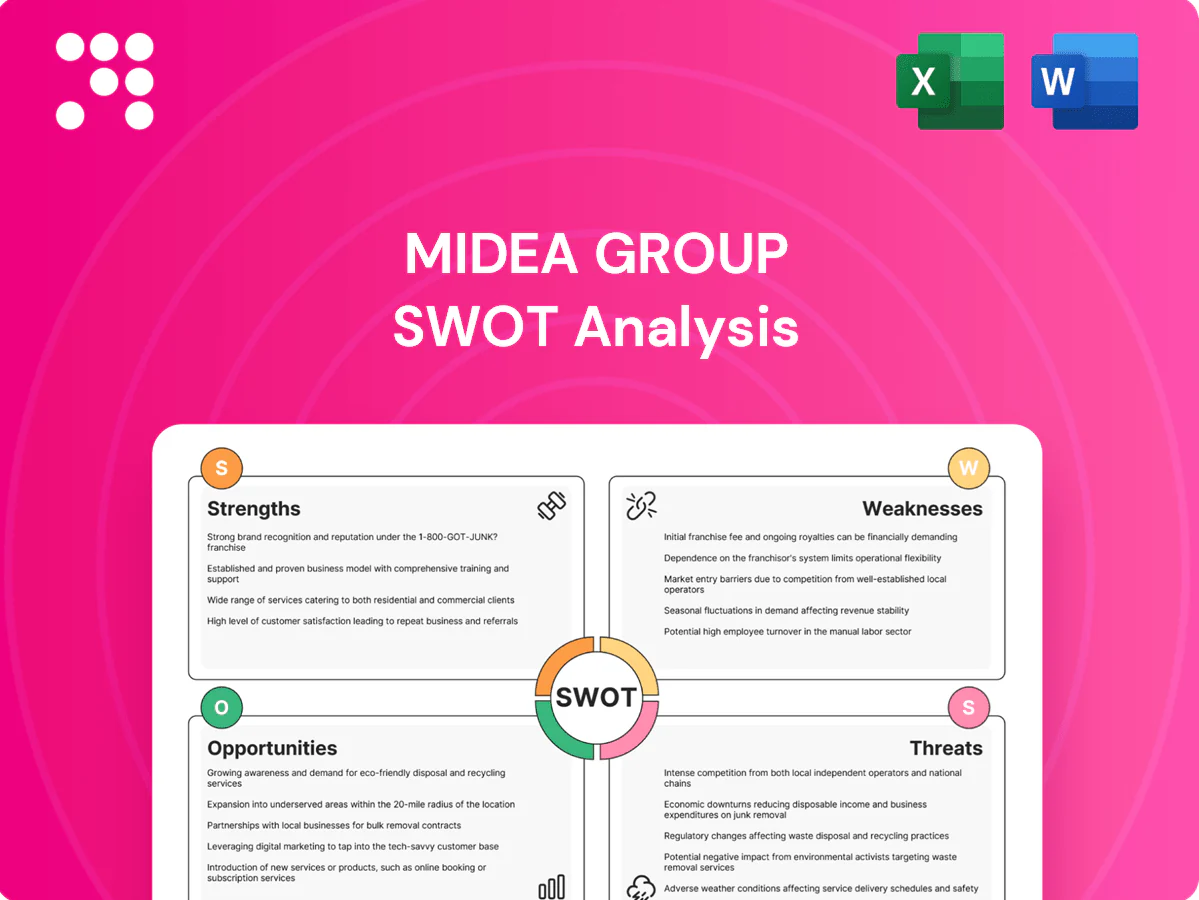
Midea Group SWOT Analysis

Your Strategic Toolkit Starts Here
Midea Group combines global scale, strong R&D and a diversified product portfolio, yet faces intense competition, supply-chain exposure and geopolitical risks; shifting consumer trends and smart‑home adoption present clear growth opportunities. Want the full story behind Midea’s strengths, risks, and strategic levers? Purchase the complete SWOT analysis for a professionally written, editable report and Excel matrix to plan and pitch with confidence.
Strengths

Broad, diversified product portfolio
Midea spans HVAC, major and small appliances and industrial automation, cutting reliance on any single category and supporting cross-selling across channels; the group reported revenue of RMB 377.8 billion in 2023, reflecting scale across segments. This breadth smooths cyclical swings by balancing residential, commercial and industrial demand and enables channel leverage through integrated product offers.
Scale and cost-efficient manufacturing
Midea leverages a global network of over 200 factories and suppliers to sustain cost leadership, enabling scale procurement and low logistics costs. High-volume production delivers strong bargaining power with suppliers and improved overhead absorption, lowering unit costs. This cost structure supports aggressive pricing strategies that defend share in price-sensitive markets, particularly in Asia and emerging economies.

R&D and innovation in HVAC and automation
Continuous R&D investment—R&D spend reported above RMB 8 billion in recent annual filings—drives gains in energy-efficient heat pumps, inverter technology and smart HVAC controls, lifting product efficiency and lowering lifecycle costs. Robotics and industrial automation units leverage Midea’s >30,000 R&D staff to create high-margin growth vectors in factories and commercial systems. Technology spillovers boost unit margins and shorten time-to-market for premium launches.

Global distribution and OEM/ODM capabilities
Global distribution and strong retail, e-commerce, and distributor relationships accelerate Midea's market access, supporting rapid rollout across over 200 countries and regions. OEM/ODM partnerships help fill manufacturing capacity and diversify revenue streams while lowering fixed-cost risk. Localized designs adapt to regional standards and consumer preferences, boosting acceptance and channel performance.
Robotics and smart logistics foothold
Midea has extended beyond consumer durables into factory automation and smart logistics, leveraging its 2016 KUKA investment to scale robotics and AI-enabled warehouse solutions. This moves the group into higher-growth industrial segments, improving resilience to consumer cyclicality and supporting higher blended margins as automation demand rises. The shift also strengthens recurring B2B service streams and aftermarket revenue.
- KUKA acquisition (2016)
- Moves into warehouse automation and AI systems
- Improves resilience and blended margins
Diversified appliances & automation: RMB 377.8bn revenue; >200 factories; R&D > RMB 8bn
Midea reported RMB 377.8 billion revenue in 2023 and spans HVAC, appliances and industrial automation, reducing single-market dependence.
Over 200 factories and presence in >200 countries enable scale-driven cost leadership and channel reach.
R&D spend >RMB 8 billion and >30,000 R&D staff fuel inverter, heat-pump and smart systems, boosting margins.
KUKA (2016) expanded robotics and warehouse automation, growing higher-margin B2B streams.
| Metric | Value |
|---|---|
| 2023 Revenue | RMB 377.8bn |
| R&D spend | >RMB 8bn |
| R&D staff | >30,000 |
| Factories/Markets | >200 / >200 countries |
What is included in the product
 Detailed Word Document
Provides a clear SWOT framework analyzing Midea Group’s internal strengths and weaknesses and external opportunities and threats, mapping market strengths, operational gaps, and strategic risks shaping its competitive position.

 Customizable Excel Spreadsheet
Provides a concise Midea Group SWOT matrix for fast strategic alignment and stakeholder-ready summaries, streamlining decision-making and cross–business unit planning.
Weaknesses

Exposure to price competition
Core categories face aggressive pricing from global and regional rivals, forcing Midea to match discounts that in 2024 contributed to a reported gross margin of about 26.9% on full-year revenue of RMB 315.7 billion, compressing profitability during downturns. Deep discounting cycles reduced appliance ASPs by low-single digits industry-wide, making premium positioning harder to sustain in mature markets where competition and channel-led promotions intensify.
Brand strength uneven across regions
Midea is well-known across Asia and emerging markets but lags premium perception versus top-tier brands in developed economies, limiting ASPs and high-margin mix growth. Building brand equity will require sustained marketing and after-sales investment; Midea reported FY2023 revenue of about RMB 358bn, so shifting mix could materially affect margins. This catch-up can slow ASP growth and margin expansion in 2024–25.

Operational complexity and execution risk
Managing thousands of SKUs across hundreds of plants and operations in over 200 countries raises operational complexity for Midea, which reported revenue of RMB 374.7 billion in 2023 and employs roughly 200,000 staff, amplifying coordination challenges. Quality-control and compliance risks scale with this footprint, and integrating automation (KUKA/business units) with consumer appliances strains capital and management resources.

Seasonality and demand cyclicality
HVAC sales at Midea concentrate in Q2–Q3 and track weather and construction cycles, creating revenue volatility; weak macro conditions in 2022–2024 slowed appliance replacement demand and pressured channel orders; regional inventory balancing became more complex amid uneven recovery across China, Europe and Southeast Asia.
- Seasonal HVAC concentration: Q2–Q3 peak
- Replacement cycles slowed during 2022–2024
- Cross‑region inventory imbalances increased
Currency and commodity cost exposure
Raw-material swings in steel, copper and resins compress Midea Group margins on appliance and HVAC lines, with volatility transmitted through procurement and production costs. FX volatility affects export competitiveness and can swing reported RMB earnings when translated; hedging programs mitigate but do not eliminate basis, timing or counterparty risks.
- Raw material pass-through lag
- FX translation exposure
- Hedging reduces but leaves residual risk
Discounting cuts margin to 26.9% on RMB 315.7bn
Aggressive discounting compressed 2024 gross margin to about 26.9% on revenue of RMB 315.7 billion, weakening premium positioning in developed markets. Brand perception gaps vs top-tier rivals limit ASP and high-margin mix growth despite FY2023 scale (RMB 374.7bn) and ~200,000 employees. Large SKU/plant footprint across 200+ countries raises quality, compliance and integration costs, while HVAC seasonality (Q2–Q3) and raw‑material/FX swings add volatility.
| Metric | Value |
|---|---|
| 2024 revenue | RMB 315.7bn |
| FY2023 revenue | RMB 374.7bn |
| Gross margin (2024) | ~26.9% |
| Employees / footprint | ~200,000; 200+ countries |
Preview the Actual Deliverable
Midea Group SWOT Analysis
This is a real excerpt from the Midea Group SWOT analysis you’re viewing—the exact document you’ll receive after purchase. No surprises, just professional quality and structured insights. Buy to unlock the full, editable report.

Your Strategic Toolkit Starts Here
Midea Group combines global scale, strong R&D and a diversified product portfolio, yet faces intense competition, supply-chain exposure and geopolitical risks; shifting consumer trends and smart‑home adoption present clear growth opportunities. Want the full story behind Midea’s strengths, risks, and strategic levers? Purchase the complete SWOT analysis for a professionally written, editable report and Excel matrix to plan and pitch with confidence.
Strengths
Broad, diversified product portfolio
Midea spans HVAC, major and small appliances and industrial automation, cutting reliance on any single category and supporting cross-selling across channels; the group reported revenue of RMB 377.8 billion in 2023, reflecting scale across segments. This breadth smooths cyclical swings by balancing residential, commercial and industrial demand and enables channel leverage through integrated product offers.
Scale and cost-efficient manufacturing
Midea leverages a global network of over 200 factories and suppliers to sustain cost leadership, enabling scale procurement and low logistics costs. High-volume production delivers strong bargaining power with suppliers and improved overhead absorption, lowering unit costs. This cost structure supports aggressive pricing strategies that defend share in price-sensitive markets, particularly in Asia and emerging economies.
R&D and innovation in HVAC and automation
Continuous R&D investment—R&D spend reported above RMB 8 billion in recent annual filings—drives gains in energy-efficient heat pumps, inverter technology and smart HVAC controls, lifting product efficiency and lowering lifecycle costs. Robotics and industrial automation units leverage Midea’s >30,000 R&D staff to create high-margin growth vectors in factories and commercial systems. Technology spillovers boost unit margins and shorten time-to-market for premium launches.
Global distribution and OEM/ODM capabilities
Global distribution and strong retail, e-commerce, and distributor relationships accelerate Midea's market access, supporting rapid rollout across over 200 countries and regions. OEM/ODM partnerships help fill manufacturing capacity and diversify revenue streams while lowering fixed-cost risk. Localized designs adapt to regional standards and consumer preferences, boosting acceptance and channel performance.
Robotics and smart logistics foothold
Midea has extended beyond consumer durables into factory automation and smart logistics, leveraging its 2016 KUKA investment to scale robotics and AI-enabled warehouse solutions. This moves the group into higher-growth industrial segments, improving resilience to consumer cyclicality and supporting higher blended margins as automation demand rises. The shift also strengthens recurring B2B service streams and aftermarket revenue.
- KUKA acquisition (2016)
- Moves into warehouse automation and AI systems
- Improves resilience and blended margins
Diversified appliances & automation: RMB 377.8bn revenue; >200 factories; R&D > RMB 8bn
Midea reported RMB 377.8 billion revenue in 2023 and spans HVAC, appliances and industrial automation, reducing single-market dependence.
Over 200 factories and presence in >200 countries enable scale-driven cost leadership and channel reach.
R&D spend >RMB 8 billion and >30,000 R&D staff fuel inverter, heat-pump and smart systems, boosting margins.
KUKA (2016) expanded robotics and warehouse automation, growing higher-margin B2B streams.
| Metric | Value |
|---|---|
| 2023 Revenue | RMB 377.8bn |
| R&D spend | >RMB 8bn |
| R&D staff | >30,000 |
| Factories/Markets | >200 / >200 countries |
What is included in the product
Detailed Word Document
Provides a clear SWOT framework analyzing Midea Group’s internal strengths and weaknesses and external opportunities and threats, mapping market strengths, operational gaps, and strategic risks shaping its competitive position.
Customizable Excel Spreadsheet
Provides a concise Midea Group SWOT matrix for fast strategic alignment and stakeholder-ready summaries, streamlining decision-making and cross–business unit planning.
Weaknesses
Exposure to price competition
Core categories face aggressive pricing from global and regional rivals, forcing Midea to match discounts that in 2024 contributed to a reported gross margin of about 26.9% on full-year revenue of RMB 315.7 billion, compressing profitability during downturns. Deep discounting cycles reduced appliance ASPs by low-single digits industry-wide, making premium positioning harder to sustain in mature markets where competition and channel-led promotions intensify.
Brand strength uneven across regions
Midea is well-known across Asia and emerging markets but lags premium perception versus top-tier brands in developed economies, limiting ASPs and high-margin mix growth. Building brand equity will require sustained marketing and after-sales investment; Midea reported FY2023 revenue of about RMB 358bn, so shifting mix could materially affect margins. This catch-up can slow ASP growth and margin expansion in 2024–25.
Operational complexity and execution risk
Managing thousands of SKUs across hundreds of plants and operations in over 200 countries raises operational complexity for Midea, which reported revenue of RMB 374.7 billion in 2023 and employs roughly 200,000 staff, amplifying coordination challenges. Quality-control and compliance risks scale with this footprint, and integrating automation (KUKA/business units) with consumer appliances strains capital and management resources.
Seasonality and demand cyclicality
HVAC sales at Midea concentrate in Q2–Q3 and track weather and construction cycles, creating revenue volatility; weak macro conditions in 2022–2024 slowed appliance replacement demand and pressured channel orders; regional inventory balancing became more complex amid uneven recovery across China, Europe and Southeast Asia.
- Seasonal HVAC concentration: Q2–Q3 peak
- Replacement cycles slowed during 2022–2024
- Cross‑region inventory imbalances increased
Currency and commodity cost exposure
Raw-material swings in steel, copper and resins compress Midea Group margins on appliance and HVAC lines, with volatility transmitted through procurement and production costs. FX volatility affects export competitiveness and can swing reported RMB earnings when translated; hedging programs mitigate but do not eliminate basis, timing or counterparty risks.
- Raw material pass-through lag
- FX translation exposure
- Hedging reduces but leaves residual risk
Discounting cuts margin to 26.9% on RMB 315.7bn
Aggressive discounting compressed 2024 gross margin to about 26.9% on revenue of RMB 315.7 billion, weakening premium positioning in developed markets. Brand perception gaps vs top-tier rivals limit ASP and high-margin mix growth despite FY2023 scale (RMB 374.7bn) and ~200,000 employees. Large SKU/plant footprint across 200+ countries raises quality, compliance and integration costs, while HVAC seasonality (Q2–Q3) and raw‑material/FX swings add volatility.
| Metric | Value |
|---|---|
| 2024 revenue | RMB 315.7bn |
| FY2023 revenue | RMB 374.7bn |
| Gross margin (2024) | ~26.9% |
| Employees / footprint | ~200,000; 200+ countries |
Preview the Actual Deliverable
Midea Group SWOT Analysis
This is a real excerpt from the Midea Group SWOT analysis you’re viewing—the exact document you’ll receive after purchase. No surprises, just professional quality and structured insights. Buy to unlock the full, editable report.
Original: $10.00
-65%$10.00
$3.50Description
Your Strategic Toolkit Starts Here
Midea Group combines global scale, strong R&D and a diversified product portfolio, yet faces intense competition, supply-chain exposure and geopolitical risks; shifting consumer trends and smart‑home adoption present clear growth opportunities. Want the full story behind Midea’s strengths, risks, and strategic levers? Purchase the complete SWOT analysis for a professionally written, editable report and Excel matrix to plan and pitch with confidence.
Strengths
Broad, diversified product portfolio
Midea spans HVAC, major and small appliances and industrial automation, cutting reliance on any single category and supporting cross-selling across channels; the group reported revenue of RMB 377.8 billion in 2023, reflecting scale across segments. This breadth smooths cyclical swings by balancing residential, commercial and industrial demand and enables channel leverage through integrated product offers.
Scale and cost-efficient manufacturing
Midea leverages a global network of over 200 factories and suppliers to sustain cost leadership, enabling scale procurement and low logistics costs. High-volume production delivers strong bargaining power with suppliers and improved overhead absorption, lowering unit costs. This cost structure supports aggressive pricing strategies that defend share in price-sensitive markets, particularly in Asia and emerging economies.
R&D and innovation in HVAC and automation
Continuous R&D investment—R&D spend reported above RMB 8 billion in recent annual filings—drives gains in energy-efficient heat pumps, inverter technology and smart HVAC controls, lifting product efficiency and lowering lifecycle costs. Robotics and industrial automation units leverage Midea’s >30,000 R&D staff to create high-margin growth vectors in factories and commercial systems. Technology spillovers boost unit margins and shorten time-to-market for premium launches.
Global distribution and OEM/ODM capabilities
Global distribution and strong retail, e-commerce, and distributor relationships accelerate Midea's market access, supporting rapid rollout across over 200 countries and regions. OEM/ODM partnerships help fill manufacturing capacity and diversify revenue streams while lowering fixed-cost risk. Localized designs adapt to regional standards and consumer preferences, boosting acceptance and channel performance.
Robotics and smart logistics foothold
Midea has extended beyond consumer durables into factory automation and smart logistics, leveraging its 2016 KUKA investment to scale robotics and AI-enabled warehouse solutions. This moves the group into higher-growth industrial segments, improving resilience to consumer cyclicality and supporting higher blended margins as automation demand rises. The shift also strengthens recurring B2B service streams and aftermarket revenue.
- KUKA acquisition (2016)
- Moves into warehouse automation and AI systems
- Improves resilience and blended margins
Diversified appliances & automation: RMB 377.8bn revenue; >200 factories; R&D > RMB 8bn
Midea reported RMB 377.8 billion revenue in 2023 and spans HVAC, appliances and industrial automation, reducing single-market dependence.
Over 200 factories and presence in >200 countries enable scale-driven cost leadership and channel reach.
R&D spend >RMB 8 billion and >30,000 R&D staff fuel inverter, heat-pump and smart systems, boosting margins.
KUKA (2016) expanded robotics and warehouse automation, growing higher-margin B2B streams.
| Metric | Value |
|---|---|
| 2023 Revenue | RMB 377.8bn |
| R&D spend | >RMB 8bn |
| R&D staff | >30,000 |
| Factories/Markets | >200 / >200 countries |
What is included in the product
Detailed Word Document
Provides a clear SWOT framework analyzing Midea Group’s internal strengths and weaknesses and external opportunities and threats, mapping market strengths, operational gaps, and strategic risks shaping its competitive position.
Customizable Excel Spreadsheet
Provides a concise Midea Group SWOT matrix for fast strategic alignment and stakeholder-ready summaries, streamlining decision-making and cross–business unit planning.
Weaknesses
Exposure to price competition
Core categories face aggressive pricing from global and regional rivals, forcing Midea to match discounts that in 2024 contributed to a reported gross margin of about 26.9% on full-year revenue of RMB 315.7 billion, compressing profitability during downturns. Deep discounting cycles reduced appliance ASPs by low-single digits industry-wide, making premium positioning harder to sustain in mature markets where competition and channel-led promotions intensify.
Brand strength uneven across regions
Midea is well-known across Asia and emerging markets but lags premium perception versus top-tier brands in developed economies, limiting ASPs and high-margin mix growth. Building brand equity will require sustained marketing and after-sales investment; Midea reported FY2023 revenue of about RMB 358bn, so shifting mix could materially affect margins. This catch-up can slow ASP growth and margin expansion in 2024–25.
Operational complexity and execution risk
Managing thousands of SKUs across hundreds of plants and operations in over 200 countries raises operational complexity for Midea, which reported revenue of RMB 374.7 billion in 2023 and employs roughly 200,000 staff, amplifying coordination challenges. Quality-control and compliance risks scale with this footprint, and integrating automation (KUKA/business units) with consumer appliances strains capital and management resources.
Seasonality and demand cyclicality
HVAC sales at Midea concentrate in Q2–Q3 and track weather and construction cycles, creating revenue volatility; weak macro conditions in 2022–2024 slowed appliance replacement demand and pressured channel orders; regional inventory balancing became more complex amid uneven recovery across China, Europe and Southeast Asia.
- Seasonal HVAC concentration: Q2–Q3 peak
- Replacement cycles slowed during 2022–2024
- Cross‑region inventory imbalances increased
Currency and commodity cost exposure
Raw-material swings in steel, copper and resins compress Midea Group margins on appliance and HVAC lines, with volatility transmitted through procurement and production costs. FX volatility affects export competitiveness and can swing reported RMB earnings when translated; hedging programs mitigate but do not eliminate basis, timing or counterparty risks.
- Raw material pass-through lag
- FX translation exposure
- Hedging reduces but leaves residual risk
Discounting cuts margin to 26.9% on RMB 315.7bn
Aggressive discounting compressed 2024 gross margin to about 26.9% on revenue of RMB 315.7 billion, weakening premium positioning in developed markets. Brand perception gaps vs top-tier rivals limit ASP and high-margin mix growth despite FY2023 scale (RMB 374.7bn) and ~200,000 employees. Large SKU/plant footprint across 200+ countries raises quality, compliance and integration costs, while HVAC seasonality (Q2–Q3) and raw‑material/FX swings add volatility.
| Metric | Value |
|---|---|
| 2024 revenue | RMB 315.7bn |
| FY2023 revenue | RMB 374.7bn |
| Gross margin (2024) | ~26.9% |
| Employees / footprint | ~200,000; 200+ countries |
Preview the Actual Deliverable
Midea Group SWOT Analysis
This is a real excerpt from the Midea Group SWOT analysis you’re viewing—the exact document you’ll receive after purchase. No surprises, just professional quality and structured insights. Buy to unlock the full, editable report.











