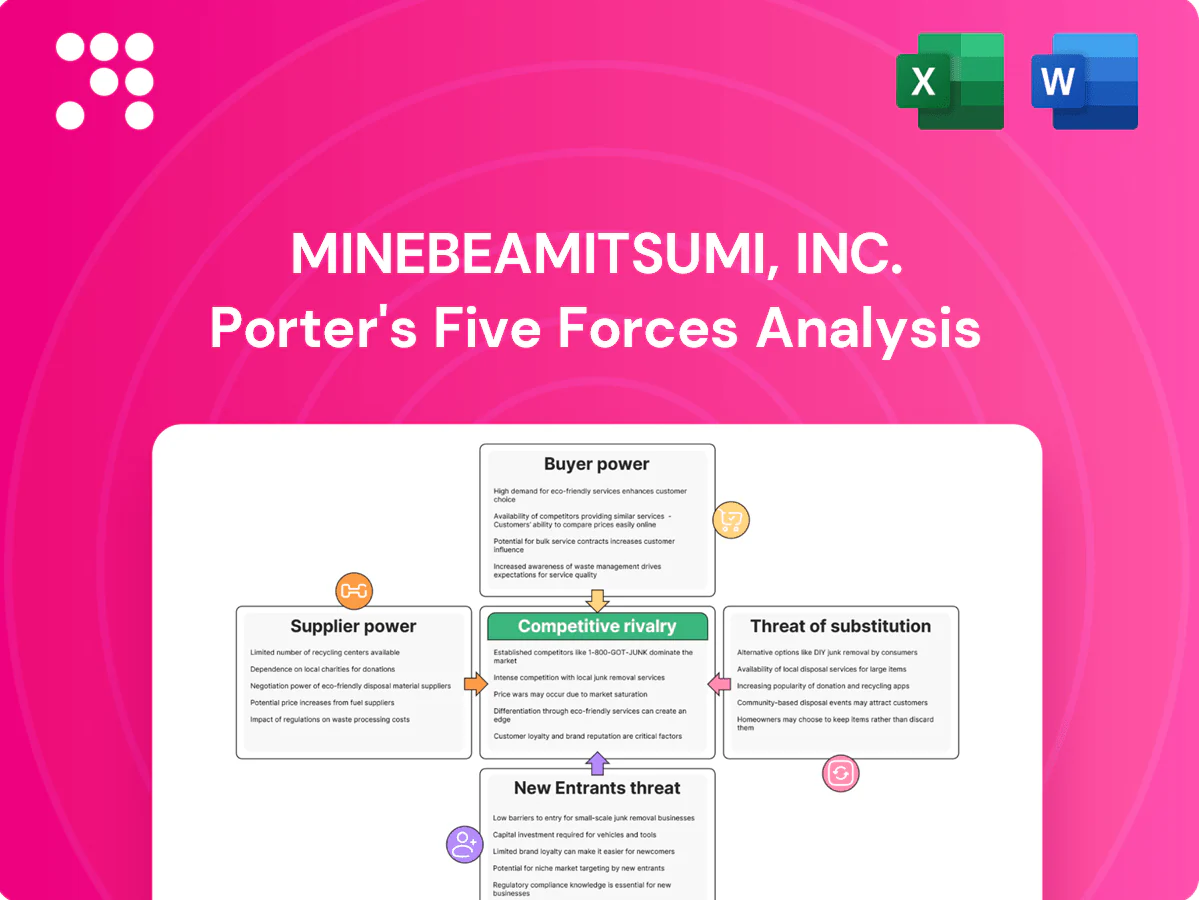
MinebeaMitsumi, Inc. Porter's Five Forces Analysis

Elevate Your Analysis with the Complete Porter's Five Forces Analysis
MinebeaMitsumi faces varied competitive pressures—from consolidated suppliers and low-cost Asian competitors to moderate buyer power in electronics markets—while diversification and scale temper new entrant and substitute threats. This brief snapshot only scratches the surface. Unlock the full Porter's Five Forces Analysis to explore force-by-force ratings, visuals, and actionable strategy insights tailored to MinebeaMitsumi.
Suppliers Bargaining Power

Specialty materials concentration
Miniature bearings and motors depend on high-grade steel, Si3N4 ceramics, NdFeB rare-earth magnets and precision resins, with only a handful of qualified suppliers; China accounts for roughly 80–90% of NdFeB processing capacity as of 2024, boosting upstream pricing power. Limited alternatives for Si3N4 and NdFeB and multi-month qualification cycles entrench incumbents and raise switching costs. MinebeaMitsumi uses multi-sourcing and strategic inventory but cannot fully eliminate supplier concentration risk.
Process equipment and tooling dependence
Ultra-precision grinding, metrology and cleanroom assembly tools come from a handful of specialized OEMs, creating concentrated supplier power for MinebeaMitsumi; switching platforms requires retraining, recalibration and carries yield risk. Suppliers embed lock-in via proprietary software and fixtures, elevating switching costs—especially during new production ramps when downtime and qualification are most costly. Industry capital intensity remains high in 2024, sustaining supplier leverage.

Vertical integration softens leverage
By 2024 MinebeaMitsumi’s vertical integration—in-house coil winding, machining and Mitsumi-derived electronics—reduces external spend and shifts cost exposure toward internal control. Backward integration into components and design lowers vulnerability to supplier price hikes and creates credible make-or-buy negotiation leverage. Not all inputs are integrable, however; dependency on rare earths and specialty magnets sustains supplier power.

Long qualification and compliance cycles
Long qualification and compliance cycles for automotive, aerospace and medical end-uses force certified inputs; re-qualifying suppliers typically requires 6–18 months and can cost hundreds of thousands of dollars, giving incumbent suppliers measurable bargaining room. Dual qualification is pursued to mitigate risk but is often infeasible for safety-critical parts where AS9100 or ISO 13485 traceability and testing regimes dominate.
- Impact: extended lead times raise switching costs
- Time: 6–18 months typical re-qualification
- Cost: often hundreds of thousands USD per supplier
- Severity: acute for safety-critical components
Geopolitical and energy cost pass-through
- Regional supply concentration elevates pass‑through risk
- Buffers mitigate but not offset sudden spikes
- Indexed contracts provide partial cost predictability
Supplier squeeze — China holds 80–90% of NdFeB processing; re-qualification 6–18 months
MinebeaMitsumi faces concentrated supplier power for NdFeB, Si3N4 and precision tools; China held roughly 80–90% of NdFeB processing capacity in 2024, raising upstream pricing leverage. Re-qualification for certified suppliers typically takes 6–18 months and often costs hundreds of thousands USD. Vertical integration reduces but cannot eliminate exposure to rare‑earth and specialty magnet supply risk.
| Metric | Value |
|---|---|
| NdFeB processing (China, 2024) | 80–90% |
| Supplier re‑qualification time | 6–18 months |
| Re‑qualification cost | hundreds of thousands USD |
What is included in the product
 Detailed Word Document
Tailored exclusively for MinebeaMitsumi, Inc., this Porter's Five Forces overview analyzes competitive rivalry, supplier and buyer power, substitution threats, and entry barriers to identify disruptive forces, pricing pressures, and strategic advantages shaping the company's profitability and market position.

 Customizable Excel Spreadsheet
Clear one-sheet Porter's Five Forces for MinebeaMitsumi—instantly visualize supplier, buyer, rivalry, entrant and substitute pressure with a spider chart and customizable levels to reflect new data or regulations; clean layout ready to drop into pitch decks or Excel dashboards for rapid decision-making.
Customers Bargaining Power

Large OEMs with scale
Large OEMs in automotive, consumer electronics and aerospace buy components in very high volumes and impose strict contract terms, annual price-downs and vendor performance scorecards, giving them strong bargaining leverage. Their scale and visibility amplify negotiating power over suppliers. MinebeaMitsumi counters with a breadth of portfolio and proven reliability, supported by consolidated net sales of JPY 1.34 trillion in FY2024, which underpins its supply resilience.
Design-in lock-in
Precision components at MinebeaMitsumi are engineered into platforms with multi-year lifecycles, commonly 3–7 years, so mid-cycle switching risks months-long redesign, compliance delays and revalidation expenses. These factors materially raise buyer switching costs once parts are designed-in. Early engagement and co-development increase entrenchment by securing design wins and long-term supply commitments.

Demand cyclicality and mix
Consumer electronics demand cyclicality sharpens price pressure in downturns, forcing MinebeaMitsumi to accept lower margins on volume-sensitive components. Automotive and medical customers provide longer order visibility but negotiate aggressively on cost, pressuring ASPs. Shifts in product mix toward higher-spec, differentiated components can offset pricing erosion. Flexible capacity and rapid call-off fulfillment help preserve share during volatility.

Dual-sourcing practices
Many OEMs mandate at least two qualified vendors to reduce supply risk, which caps any single supplier’s pricing power and forces competitive bidding; MinebeaMitsumi must therefore compete on cost, quality, and lead times while protecting margins through product differentiation in tolerances, noise, and efficiency.
- dual-sourcing limits pricing power
- differentiation can command premiums
- service and logistics often decide awards
Customization versus standardization
Customized bearings, motors, and sensors increase customer stickiness by tailoring performance to application needs, while standard parts face easier comparability and price pressure. In 2024 MinebeaMitsumi pushed application engineering to drive semi-custom adoption and lengthen customer relationships. Documentation, PPAP, and data services (traceability, supply-chain reports) invoice value beyond unit price, lowering buyer bargaining power.
- customization: product lock-in
- standardization: price competition
- semi-custom: engineering-led shift (2024)
- PPAP/data: value-added services
Scale shields supplier: JPY 1.34T and 3–7 year design locks curb OEM price pressure
Large OEMs exert strong price pressure via volume, scorecards and annual price-downs, but MinebeaMitsumi's JPY 1.34 trillion FY2024 scale and broad portfolio bolster negotiating resilience. Multi-year design cycles (3–7 years) raise switching costs and entrench design wins; dual-sourcing mandates cap single-supplier pricing power. Engineering-led semi-customization and value-added data/PPAP lift margins versus standard parts.
| Metric | Value |
|---|---|
| FY2024 consolidated sales | JPY 1.34 trillion |
| Typical design lifecycle | 3–7 years |
Preview the Actual Deliverable
MinebeaMitsumi, Inc. Porter's Five Forces Analysis
This preview shows the exact MinebeaMitsumi, Inc. Porter's Five Forces analysis you'll receive—no placeholders or mockups. The full document is professionally formatted and ready for immediate download upon purchase. You're getting the same complete file shown here, prepared for instant use.

Elevate Your Analysis with the Complete Porter's Five Forces Analysis
MinebeaMitsumi faces varied competitive pressures—from consolidated suppliers and low-cost Asian competitors to moderate buyer power in electronics markets—while diversification and scale temper new entrant and substitute threats. This brief snapshot only scratches the surface. Unlock the full Porter's Five Forces Analysis to explore force-by-force ratings, visuals, and actionable strategy insights tailored to MinebeaMitsumi.
Suppliers Bargaining Power
Specialty materials concentration
Miniature bearings and motors depend on high-grade steel, Si3N4 ceramics, NdFeB rare-earth magnets and precision resins, with only a handful of qualified suppliers; China accounts for roughly 80–90% of NdFeB processing capacity as of 2024, boosting upstream pricing power. Limited alternatives for Si3N4 and NdFeB and multi-month qualification cycles entrench incumbents and raise switching costs. MinebeaMitsumi uses multi-sourcing and strategic inventory but cannot fully eliminate supplier concentration risk.
Process equipment and tooling dependence
Ultra-precision grinding, metrology and cleanroom assembly tools come from a handful of specialized OEMs, creating concentrated supplier power for MinebeaMitsumi; switching platforms requires retraining, recalibration and carries yield risk. Suppliers embed lock-in via proprietary software and fixtures, elevating switching costs—especially during new production ramps when downtime and qualification are most costly. Industry capital intensity remains high in 2024, sustaining supplier leverage.
Vertical integration softens leverage
By 2024 MinebeaMitsumi’s vertical integration—in-house coil winding, machining and Mitsumi-derived electronics—reduces external spend and shifts cost exposure toward internal control. Backward integration into components and design lowers vulnerability to supplier price hikes and creates credible make-or-buy negotiation leverage. Not all inputs are integrable, however; dependency on rare earths and specialty magnets sustains supplier power.
Long qualification and compliance cycles
Long qualification and compliance cycles for automotive, aerospace and medical end-uses force certified inputs; re-qualifying suppliers typically requires 6–18 months and can cost hundreds of thousands of dollars, giving incumbent suppliers measurable bargaining room. Dual qualification is pursued to mitigate risk but is often infeasible for safety-critical parts where AS9100 or ISO 13485 traceability and testing regimes dominate.
- Impact: extended lead times raise switching costs
- Time: 6–18 months typical re-qualification
- Cost: often hundreds of thousands USD per supplier
- Severity: acute for safety-critical components
Geopolitical and energy cost pass-through
- Regional supply concentration elevates pass‑through risk
- Buffers mitigate but not offset sudden spikes
- Indexed contracts provide partial cost predictability
Supplier squeeze — China holds 80–90% of NdFeB processing; re-qualification 6–18 months
MinebeaMitsumi faces concentrated supplier power for NdFeB, Si3N4 and precision tools; China held roughly 80–90% of NdFeB processing capacity in 2024, raising upstream pricing leverage. Re-qualification for certified suppliers typically takes 6–18 months and often costs hundreds of thousands USD. Vertical integration reduces but cannot eliminate exposure to rare‑earth and specialty magnet supply risk.
| Metric | Value |
|---|---|
| NdFeB processing (China, 2024) | 80–90% |
| Supplier re‑qualification time | 6–18 months |
| Re‑qualification cost | hundreds of thousands USD |
What is included in the product
Detailed Word Document
Tailored exclusively for MinebeaMitsumi, Inc., this Porter's Five Forces overview analyzes competitive rivalry, supplier and buyer power, substitution threats, and entry barriers to identify disruptive forces, pricing pressures, and strategic advantages shaping the company's profitability and market position.
Customizable Excel Spreadsheet
Clear one-sheet Porter's Five Forces for MinebeaMitsumi—instantly visualize supplier, buyer, rivalry, entrant and substitute pressure with a spider chart and customizable levels to reflect new data or regulations; clean layout ready to drop into pitch decks or Excel dashboards for rapid decision-making.
Customers Bargaining Power
Large OEMs with scale
Large OEMs in automotive, consumer electronics and aerospace buy components in very high volumes and impose strict contract terms, annual price-downs and vendor performance scorecards, giving them strong bargaining leverage. Their scale and visibility amplify negotiating power over suppliers. MinebeaMitsumi counters with a breadth of portfolio and proven reliability, supported by consolidated net sales of JPY 1.34 trillion in FY2024, which underpins its supply resilience.
Design-in lock-in
Precision components at MinebeaMitsumi are engineered into platforms with multi-year lifecycles, commonly 3–7 years, so mid-cycle switching risks months-long redesign, compliance delays and revalidation expenses. These factors materially raise buyer switching costs once parts are designed-in. Early engagement and co-development increase entrenchment by securing design wins and long-term supply commitments.
Demand cyclicality and mix
Consumer electronics demand cyclicality sharpens price pressure in downturns, forcing MinebeaMitsumi to accept lower margins on volume-sensitive components. Automotive and medical customers provide longer order visibility but negotiate aggressively on cost, pressuring ASPs. Shifts in product mix toward higher-spec, differentiated components can offset pricing erosion. Flexible capacity and rapid call-off fulfillment help preserve share during volatility.
Dual-sourcing practices
Many OEMs mandate at least two qualified vendors to reduce supply risk, which caps any single supplier’s pricing power and forces competitive bidding; MinebeaMitsumi must therefore compete on cost, quality, and lead times while protecting margins through product differentiation in tolerances, noise, and efficiency.
- dual-sourcing limits pricing power
- differentiation can command premiums
- service and logistics often decide awards
Customization versus standardization
Customized bearings, motors, and sensors increase customer stickiness by tailoring performance to application needs, while standard parts face easier comparability and price pressure. In 2024 MinebeaMitsumi pushed application engineering to drive semi-custom adoption and lengthen customer relationships. Documentation, PPAP, and data services (traceability, supply-chain reports) invoice value beyond unit price, lowering buyer bargaining power.
- customization: product lock-in
- standardization: price competition
- semi-custom: engineering-led shift (2024)
- PPAP/data: value-added services
Scale shields supplier: JPY 1.34T and 3–7 year design locks curb OEM price pressure
Large OEMs exert strong price pressure via volume, scorecards and annual price-downs, but MinebeaMitsumi's JPY 1.34 trillion FY2024 scale and broad portfolio bolster negotiating resilience. Multi-year design cycles (3–7 years) raise switching costs and entrench design wins; dual-sourcing mandates cap single-supplier pricing power. Engineering-led semi-customization and value-added data/PPAP lift margins versus standard parts.
| Metric | Value |
|---|---|
| FY2024 consolidated sales | JPY 1.34 trillion |
| Typical design lifecycle | 3–7 years |
Preview the Actual Deliverable
MinebeaMitsumi, Inc. Porter's Five Forces Analysis
This preview shows the exact MinebeaMitsumi, Inc. Porter's Five Forces analysis you'll receive—no placeholders or mockups. The full document is professionally formatted and ready for immediate download upon purchase. You're getting the same complete file shown here, prepared for instant use.
Original: $10.00
-65%$10.00
$3.50Description
Elevate Your Analysis with the Complete Porter's Five Forces Analysis
MinebeaMitsumi faces varied competitive pressures—from consolidated suppliers and low-cost Asian competitors to moderate buyer power in electronics markets—while diversification and scale temper new entrant and substitute threats. This brief snapshot only scratches the surface. Unlock the full Porter's Five Forces Analysis to explore force-by-force ratings, visuals, and actionable strategy insights tailored to MinebeaMitsumi.
Suppliers Bargaining Power
Specialty materials concentration
Miniature bearings and motors depend on high-grade steel, Si3N4 ceramics, NdFeB rare-earth magnets and precision resins, with only a handful of qualified suppliers; China accounts for roughly 80–90% of NdFeB processing capacity as of 2024, boosting upstream pricing power. Limited alternatives for Si3N4 and NdFeB and multi-month qualification cycles entrench incumbents and raise switching costs. MinebeaMitsumi uses multi-sourcing and strategic inventory but cannot fully eliminate supplier concentration risk.
Process equipment and tooling dependence
Ultra-precision grinding, metrology and cleanroom assembly tools come from a handful of specialized OEMs, creating concentrated supplier power for MinebeaMitsumi; switching platforms requires retraining, recalibration and carries yield risk. Suppliers embed lock-in via proprietary software and fixtures, elevating switching costs—especially during new production ramps when downtime and qualification are most costly. Industry capital intensity remains high in 2024, sustaining supplier leverage.
Vertical integration softens leverage
By 2024 MinebeaMitsumi’s vertical integration—in-house coil winding, machining and Mitsumi-derived electronics—reduces external spend and shifts cost exposure toward internal control. Backward integration into components and design lowers vulnerability to supplier price hikes and creates credible make-or-buy negotiation leverage. Not all inputs are integrable, however; dependency on rare earths and specialty magnets sustains supplier power.
Long qualification and compliance cycles
Long qualification and compliance cycles for automotive, aerospace and medical end-uses force certified inputs; re-qualifying suppliers typically requires 6–18 months and can cost hundreds of thousands of dollars, giving incumbent suppliers measurable bargaining room. Dual qualification is pursued to mitigate risk but is often infeasible for safety-critical parts where AS9100 or ISO 13485 traceability and testing regimes dominate.
- Impact: extended lead times raise switching costs
- Time: 6–18 months typical re-qualification
- Cost: often hundreds of thousands USD per supplier
- Severity: acute for safety-critical components
Geopolitical and energy cost pass-through
- Regional supply concentration elevates pass‑through risk
- Buffers mitigate but not offset sudden spikes
- Indexed contracts provide partial cost predictability
Supplier squeeze — China holds 80–90% of NdFeB processing; re-qualification 6–18 months
MinebeaMitsumi faces concentrated supplier power for NdFeB, Si3N4 and precision tools; China held roughly 80–90% of NdFeB processing capacity in 2024, raising upstream pricing leverage. Re-qualification for certified suppliers typically takes 6–18 months and often costs hundreds of thousands USD. Vertical integration reduces but cannot eliminate exposure to rare‑earth and specialty magnet supply risk.
| Metric | Value |
|---|---|
| NdFeB processing (China, 2024) | 80–90% |
| Supplier re‑qualification time | 6–18 months |
| Re‑qualification cost | hundreds of thousands USD |
What is included in the product
Detailed Word Document
Tailored exclusively for MinebeaMitsumi, Inc., this Porter's Five Forces overview analyzes competitive rivalry, supplier and buyer power, substitution threats, and entry barriers to identify disruptive forces, pricing pressures, and strategic advantages shaping the company's profitability and market position.
Customizable Excel Spreadsheet
Clear one-sheet Porter's Five Forces for MinebeaMitsumi—instantly visualize supplier, buyer, rivalry, entrant and substitute pressure with a spider chart and customizable levels to reflect new data or regulations; clean layout ready to drop into pitch decks or Excel dashboards for rapid decision-making.
Customers Bargaining Power
Large OEMs with scale
Large OEMs in automotive, consumer electronics and aerospace buy components in very high volumes and impose strict contract terms, annual price-downs and vendor performance scorecards, giving them strong bargaining leverage. Their scale and visibility amplify negotiating power over suppliers. MinebeaMitsumi counters with a breadth of portfolio and proven reliability, supported by consolidated net sales of JPY 1.34 trillion in FY2024, which underpins its supply resilience.
Design-in lock-in
Precision components at MinebeaMitsumi are engineered into platforms with multi-year lifecycles, commonly 3–7 years, so mid-cycle switching risks months-long redesign, compliance delays and revalidation expenses. These factors materially raise buyer switching costs once parts are designed-in. Early engagement and co-development increase entrenchment by securing design wins and long-term supply commitments.
Demand cyclicality and mix
Consumer electronics demand cyclicality sharpens price pressure in downturns, forcing MinebeaMitsumi to accept lower margins on volume-sensitive components. Automotive and medical customers provide longer order visibility but negotiate aggressively on cost, pressuring ASPs. Shifts in product mix toward higher-spec, differentiated components can offset pricing erosion. Flexible capacity and rapid call-off fulfillment help preserve share during volatility.
Dual-sourcing practices
Many OEMs mandate at least two qualified vendors to reduce supply risk, which caps any single supplier’s pricing power and forces competitive bidding; MinebeaMitsumi must therefore compete on cost, quality, and lead times while protecting margins through product differentiation in tolerances, noise, and efficiency.
- dual-sourcing limits pricing power
- differentiation can command premiums
- service and logistics often decide awards
Customization versus standardization
Customized bearings, motors, and sensors increase customer stickiness by tailoring performance to application needs, while standard parts face easier comparability and price pressure. In 2024 MinebeaMitsumi pushed application engineering to drive semi-custom adoption and lengthen customer relationships. Documentation, PPAP, and data services (traceability, supply-chain reports) invoice value beyond unit price, lowering buyer bargaining power.
- customization: product lock-in
- standardization: price competition
- semi-custom: engineering-led shift (2024)
- PPAP/data: value-added services
Scale shields supplier: JPY 1.34T and 3–7 year design locks curb OEM price pressure
Large OEMs exert strong price pressure via volume, scorecards and annual price-downs, but MinebeaMitsumi's JPY 1.34 trillion FY2024 scale and broad portfolio bolster negotiating resilience. Multi-year design cycles (3–7 years) raise switching costs and entrench design wins; dual-sourcing mandates cap single-supplier pricing power. Engineering-led semi-customization and value-added data/PPAP lift margins versus standard parts.
| Metric | Value |
|---|---|
| FY2024 consolidated sales | JPY 1.34 trillion |
| Typical design lifecycle | 3–7 years |
Preview the Actual Deliverable
MinebeaMitsumi, Inc. Porter's Five Forces Analysis
This preview shows the exact MinebeaMitsumi, Inc. Porter's Five Forces analysis you'll receive—no placeholders or mockups. The full document is professionally formatted and ready for immediate download upon purchase. You're getting the same complete file shown here, prepared for instant use.











