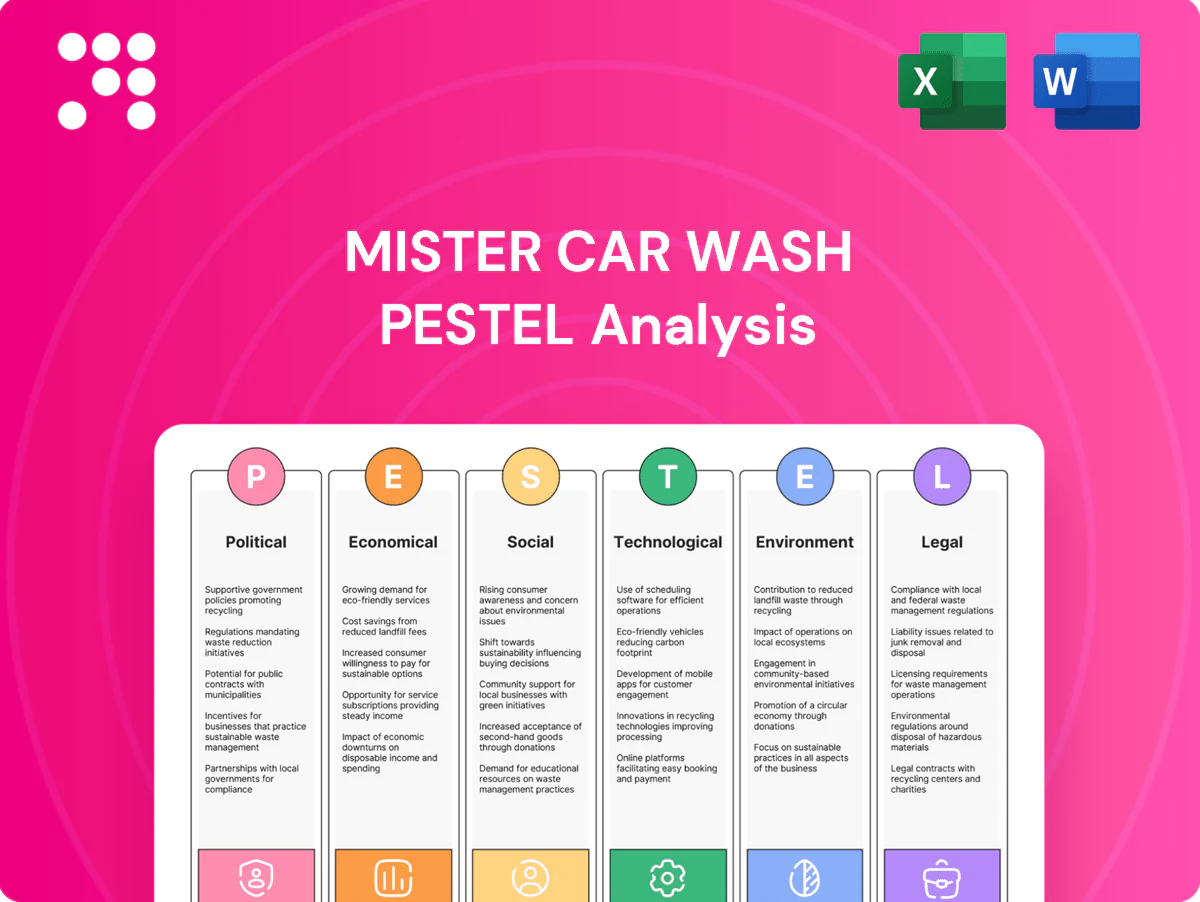
Mister Car Wash PESTLE Analysis

Your Competitive Advantage Starts with This Report
Discover how political shifts, economic trends, social preferences, technology, legal rules, and environmental pressures are reshaping Mister Car Wash—our PESTLE distills these forces into clear, actionable risks and opportunities. Perfect for investors and strategists; purchase the full report to get the complete, editable analysis and start making smarter decisions today.
Political factors

Municipal zoning and permits
Local governments control siting, signage, traffic flow and noise limits for new Mister Car Wash locations; median commercial permit approval ranges 30–60 days (NAHB 2023), and longer reviews can trigger material delays.
Denials or protracted approvals raise soft costs via holding, design revisions and legal fees—often adding single-digit to low-double-digit percent overruns—slowing rollout and ROI.
Proactive community engagement and placing sites near commercial corridors with existing compliance histories reduces permit risk and cycle time.
Building multi-jurisdiction permitting teams and standardized site packages becomes a measurable competitive advantage in speeding approvals and cutting soft-cost volatility.
Water-use policy and drought directives
City and state directives can cap daily water draw or mandate recycling thresholds; EPA estimates home washing can use up to 140 gallons per vehicle versus roughly 40 gallons at commercial washes, and reclaim systems can recover up to about 90% of water. During droughts priority allocations often favor commercial reclaim systems over at-home washing. Documented compliance can be a marketing differentiator, while noncompliance risks fines and temporary shutdowns.

Utility incentives and infrastructure funding
Public incentives and infrastructure funding—for example WIFIA financing supporting over $45 billion in projects and Clean Water State Revolving Funds totaling over $155 billion to date—can materially lower Mister Car Wash capex and accelerate water reclamation and efficiency projects. Participation demands rigorous paperwork and measurement & verification to qualify. Tapping programs improves unit economics and ESG optics, but sudden policy shifts or budget changes can abruptly curtail or expand available rebates.

Local taxation and fees
Local business license taxes, special assessments and stormwater fees vary by municipality and can materially compress store-level EBITDA for Mister Car Wash, especially in urban markets with higher infrastructure levies. Proactive tax planning, site clustering and negotiating assessment credits lower overhead per unit. Rapid shifts in local tax regimes demand agile pricing and margin management to preserve profitability.
- Special assessments vary by jurisdiction
- Stormwater fees can be recurring site-level costs
- Clustering reduces overhead per wash
- Agile pricing mitigates tax regime changes
Minimum-wage and labor policy stance
- Federal min: 7.25 USD; many jurisdictions 15+ USD
- California ~16.00 USD (2024–25)
- Automation/staffing offsets margin pressure
- Trade associations influence phased rollouts
Permits (30–60d), reuse (90%) and wage hikes push automation capex
Local permitting (median 30–60 days) and water reuse mandates materially affect rollouts and capex. Water regs favor reclaim systems (commercial ~40 gal/vehicle; home ~140 gal; reclaim up to 90%). Federal min wage 7.25 USD; many locales 15+ and California ~16.00 USD (2024–25), pressuring labor costs and automation CAPEX.
| Metric | Value |
|---|---|
| Permit cycle | 30–60 days (NAHB 2023) |
| Water use | Commercial ~40 gal / vehicle; reclaim ≤90% |
| Funding | WIFIA ~$45B; CWSRF ~$155B |
| Wage | Federal 7.25 USD; CA ~16.00 USD (2024–25) |
What is included in the product
 Detailed Word Document
Explores how Political, Economic, Social, Technological, Environmental and Legal forces specifically impact Mister Car Wash, with data-backed trends and forward-looking insights to help executives, investors and strategists identify risks, opportunities and actionable responses tailored to the carwash industry and regions served.

 Customizable Excel Spreadsheet
A concise, neatly segmented PESTLE summary for Mister Car Wash that highlights external risks and opportunities at a glance, making it easy to drop into presentations, share across teams, or annotate with region‑specific notes for faster, aligned strategic decisions.
Economic factors

Consumer discretionary cycles
Car washing is a modest-ticket, discretionary service highly sensitive to consumer confidence and disposable income, making demand cyclically vulnerable. Memberships provide recurring revenue and smooth volatility but still see elevated churn during downturns. Value-tier pricing, bundled promotions and unlimited plans aid retention and lifetime value. Short-term weather volatility can overwhelm macro trends in individual quarters.
Labor availability and wage inflation
Tight labor markets raise hourly rates and training costs; US unemployment averaged 3.8% in 2024 and average hourly earnings grew about 4.2% year-over-year (BLS 2024), pressuring Mister Car Wash margins.
Cross-training staff and optimizing throughput mitigate wage pressure by boosting productivity and reducing overtime.
Targeted automation in tunnels and kiosks cuts dependency on peak staffing and lowers variable labor spend.
Monitoring local unemployment rates guides staffing levels and timing for new site openings to control labor cost risk.

Input costs: chemicals, utilities, rents
Surfactants, polymers and packaging costs track petrochemical and transport prices — Brent crude averaged roughly $80–90/bbl in 2024, keeping feedstock-linked input inflation elevated. Electricity (~$0.16/kWh commercial average in 2024) and rising water tariffs directly raise variable cost per vehicle. Long leases indexed to CPI (US CPI ~3.4% in 2024) pass inflation to occupancy expenses. Supplier diversification and hedging can dampen COGS volatility.

Interest rates and expansion economics
Higher rates lift WACC and compress NPV on new builds and acquisitions; federal funds at 5.25–5.50% and the 10-year Treasury near 4.3% (July 2025) materially raise discount rates.
Sale-leaseback structures and staggered debt maturities are proven levers to lower effective capital costs and preserve liquidity.
Robust membership cash conversion supports self-funding of rollout, but site-selection hurdle rates must be recalibrated to current rate regimes.
- WACC pressure: adjust discounting to Fed 5.25–5.50%
- Capital tactics: sale-leaseback, staggered maturities
- Funding: membership cash conversion enables internal finance
- Hurdles: set higher site IRR targets
Competitive density and pricing power
Regional competitors and independents drive local price elasticity, forcing Mister Car Wash to use differentiation—speed, consistent quality, and membership perks—to sustain higher ARPU; membership penetration in the industry reached roughly 40% in 2024, boosting recurring revenue. Dynamic, demand-based pricing can lift utilization in off-peak bays by 5-10%. M&A roll-ups continue to rationalize crowded submarkets, improving route density and margin.
- Regional competitors: shape local elasticity
- Memberships ~40% (2024): raise ARPU
- Dynamic pricing: +5-10% off-peak utilization
- M&A roll-ups: improve density & margins
Permits (30–60d), reuse (90%) and wage hikes push automation capex
Demand sensitive to consumer confidence and disposable income; memberships (~40% penetration in 2024) stabilize revenue but churn in downturns. Wage pressure (unemployment 3.8% and avg hourly earnings +4.2% in 2024) and input inflation (Brent $80–90/bbl, commercial electricity ~$0.16/kWh in 2024) raise unit costs. Higher rates (Fed 5.25–5.50%, 10yr ~4.3% Jul 2025) lift WACC, forcing higher hurdle IRRs and capital tactics.
| Metric | Value |
|---|---|
| Membership penetration | ~40% (2024) |
| Unemployment | 3.8% (2024) |
| Avg hourly earnings | +4.2% YoY (2024) |
| Brent crude | $80–90/bbl (2024) |
| Electricity (commercial) | $0.16/kWh (2024) |
| Fed funds | 5.25–5.50% (Jul 2025) |
| 10yr Treasury | ~4.3% (Jul 2025) |
Full Version Awaits
Mister Car Wash PESTLE Analysis
The preview shown here is the exact document you’ll receive after purchase—fully formatted and ready to use. This Mister Car Wash PESTLE analysis covers Political, Economic, Social, Technological, Legal and Environmental factors affecting strategy and operations, with concise insights and data-driven implications. No placeholders—this is the final file you’ll download immediately after checkout.

Your Competitive Advantage Starts with This Report
Discover how political shifts, economic trends, social preferences, technology, legal rules, and environmental pressures are reshaping Mister Car Wash—our PESTLE distills these forces into clear, actionable risks and opportunities. Perfect for investors and strategists; purchase the full report to get the complete, editable analysis and start making smarter decisions today.
Political factors
Municipal zoning and permits
Local governments control siting, signage, traffic flow and noise limits for new Mister Car Wash locations; median commercial permit approval ranges 30–60 days (NAHB 2023), and longer reviews can trigger material delays.
Denials or protracted approvals raise soft costs via holding, design revisions and legal fees—often adding single-digit to low-double-digit percent overruns—slowing rollout and ROI.
Proactive community engagement and placing sites near commercial corridors with existing compliance histories reduces permit risk and cycle time.
Building multi-jurisdiction permitting teams and standardized site packages becomes a measurable competitive advantage in speeding approvals and cutting soft-cost volatility.
Water-use policy and drought directives
City and state directives can cap daily water draw or mandate recycling thresholds; EPA estimates home washing can use up to 140 gallons per vehicle versus roughly 40 gallons at commercial washes, and reclaim systems can recover up to about 90% of water. During droughts priority allocations often favor commercial reclaim systems over at-home washing. Documented compliance can be a marketing differentiator, while noncompliance risks fines and temporary shutdowns.
Utility incentives and infrastructure funding
Public incentives and infrastructure funding—for example WIFIA financing supporting over $45 billion in projects and Clean Water State Revolving Funds totaling over $155 billion to date—can materially lower Mister Car Wash capex and accelerate water reclamation and efficiency projects. Participation demands rigorous paperwork and measurement & verification to qualify. Tapping programs improves unit economics and ESG optics, but sudden policy shifts or budget changes can abruptly curtail or expand available rebates.
Local taxation and fees
Local business license taxes, special assessments and stormwater fees vary by municipality and can materially compress store-level EBITDA for Mister Car Wash, especially in urban markets with higher infrastructure levies. Proactive tax planning, site clustering and negotiating assessment credits lower overhead per unit. Rapid shifts in local tax regimes demand agile pricing and margin management to preserve profitability.
- Special assessments vary by jurisdiction
- Stormwater fees can be recurring site-level costs
- Clustering reduces overhead per wash
- Agile pricing mitigates tax regime changes
Minimum-wage and labor policy stance
- Federal min: 7.25 USD; many jurisdictions 15+ USD
- California ~16.00 USD (2024–25)
- Automation/staffing offsets margin pressure
- Trade associations influence phased rollouts
Permits (30–60d), reuse (90%) and wage hikes push automation capex
Local permitting (median 30–60 days) and water reuse mandates materially affect rollouts and capex. Water regs favor reclaim systems (commercial ~40 gal/vehicle; home ~140 gal; reclaim up to 90%). Federal min wage 7.25 USD; many locales 15+ and California ~16.00 USD (2024–25), pressuring labor costs and automation CAPEX.
| Metric | Value |
|---|---|
| Permit cycle | 30–60 days (NAHB 2023) |
| Water use | Commercial ~40 gal / vehicle; reclaim ≤90% |
| Funding | WIFIA ~$45B; CWSRF ~$155B |
| Wage | Federal 7.25 USD; CA ~16.00 USD (2024–25) |
What is included in the product
Detailed Word Document
Explores how Political, Economic, Social, Technological, Environmental and Legal forces specifically impact Mister Car Wash, with data-backed trends and forward-looking insights to help executives, investors and strategists identify risks, opportunities and actionable responses tailored to the carwash industry and regions served.
Customizable Excel Spreadsheet
A concise, neatly segmented PESTLE summary for Mister Car Wash that highlights external risks and opportunities at a glance, making it easy to drop into presentations, share across teams, or annotate with region‑specific notes for faster, aligned strategic decisions.
Economic factors
Consumer discretionary cycles
Car washing is a modest-ticket, discretionary service highly sensitive to consumer confidence and disposable income, making demand cyclically vulnerable. Memberships provide recurring revenue and smooth volatility but still see elevated churn during downturns. Value-tier pricing, bundled promotions and unlimited plans aid retention and lifetime value. Short-term weather volatility can overwhelm macro trends in individual quarters.
Labor availability and wage inflation
Tight labor markets raise hourly rates and training costs; US unemployment averaged 3.8% in 2024 and average hourly earnings grew about 4.2% year-over-year (BLS 2024), pressuring Mister Car Wash margins.
Cross-training staff and optimizing throughput mitigate wage pressure by boosting productivity and reducing overtime.
Targeted automation in tunnels and kiosks cuts dependency on peak staffing and lowers variable labor spend.
Monitoring local unemployment rates guides staffing levels and timing for new site openings to control labor cost risk.
Input costs: chemicals, utilities, rents
Surfactants, polymers and packaging costs track petrochemical and transport prices — Brent crude averaged roughly $80–90/bbl in 2024, keeping feedstock-linked input inflation elevated. Electricity (~$0.16/kWh commercial average in 2024) and rising water tariffs directly raise variable cost per vehicle. Long leases indexed to CPI (US CPI ~3.4% in 2024) pass inflation to occupancy expenses. Supplier diversification and hedging can dampen COGS volatility.
Interest rates and expansion economics
Higher rates lift WACC and compress NPV on new builds and acquisitions; federal funds at 5.25–5.50% and the 10-year Treasury near 4.3% (July 2025) materially raise discount rates.
Sale-leaseback structures and staggered debt maturities are proven levers to lower effective capital costs and preserve liquidity.
Robust membership cash conversion supports self-funding of rollout, but site-selection hurdle rates must be recalibrated to current rate regimes.
- WACC pressure: adjust discounting to Fed 5.25–5.50%
- Capital tactics: sale-leaseback, staggered maturities
- Funding: membership cash conversion enables internal finance
- Hurdles: set higher site IRR targets
Competitive density and pricing power
Regional competitors and independents drive local price elasticity, forcing Mister Car Wash to use differentiation—speed, consistent quality, and membership perks—to sustain higher ARPU; membership penetration in the industry reached roughly 40% in 2024, boosting recurring revenue. Dynamic, demand-based pricing can lift utilization in off-peak bays by 5-10%. M&A roll-ups continue to rationalize crowded submarkets, improving route density and margin.
- Regional competitors: shape local elasticity
- Memberships ~40% (2024): raise ARPU
- Dynamic pricing: +5-10% off-peak utilization
- M&A roll-ups: improve density & margins
Permits (30–60d), reuse (90%) and wage hikes push automation capex
Demand sensitive to consumer confidence and disposable income; memberships (~40% penetration in 2024) stabilize revenue but churn in downturns. Wage pressure (unemployment 3.8% and avg hourly earnings +4.2% in 2024) and input inflation (Brent $80–90/bbl, commercial electricity ~$0.16/kWh in 2024) raise unit costs. Higher rates (Fed 5.25–5.50%, 10yr ~4.3% Jul 2025) lift WACC, forcing higher hurdle IRRs and capital tactics.
| Metric | Value |
|---|---|
| Membership penetration | ~40% (2024) |
| Unemployment | 3.8% (2024) |
| Avg hourly earnings | +4.2% YoY (2024) |
| Brent crude | $80–90/bbl (2024) |
| Electricity (commercial) | $0.16/kWh (2024) |
| Fed funds | 5.25–5.50% (Jul 2025) |
| 10yr Treasury | ~4.3% (Jul 2025) |
Full Version Awaits
Mister Car Wash PESTLE Analysis
The preview shown here is the exact document you’ll receive after purchase—fully formatted and ready to use. This Mister Car Wash PESTLE analysis covers Political, Economic, Social, Technological, Legal and Environmental factors affecting strategy and operations, with concise insights and data-driven implications. No placeholders—this is the final file you’ll download immediately after checkout.
Original: $10.00
-65%$10.00
$3.50Description
Your Competitive Advantage Starts with This Report
Discover how political shifts, economic trends, social preferences, technology, legal rules, and environmental pressures are reshaping Mister Car Wash—our PESTLE distills these forces into clear, actionable risks and opportunities. Perfect for investors and strategists; purchase the full report to get the complete, editable analysis and start making smarter decisions today.
Political factors
Municipal zoning and permits
Local governments control siting, signage, traffic flow and noise limits for new Mister Car Wash locations; median commercial permit approval ranges 30–60 days (NAHB 2023), and longer reviews can trigger material delays.
Denials or protracted approvals raise soft costs via holding, design revisions and legal fees—often adding single-digit to low-double-digit percent overruns—slowing rollout and ROI.
Proactive community engagement and placing sites near commercial corridors with existing compliance histories reduces permit risk and cycle time.
Building multi-jurisdiction permitting teams and standardized site packages becomes a measurable competitive advantage in speeding approvals and cutting soft-cost volatility.
Water-use policy and drought directives
City and state directives can cap daily water draw or mandate recycling thresholds; EPA estimates home washing can use up to 140 gallons per vehicle versus roughly 40 gallons at commercial washes, and reclaim systems can recover up to about 90% of water. During droughts priority allocations often favor commercial reclaim systems over at-home washing. Documented compliance can be a marketing differentiator, while noncompliance risks fines and temporary shutdowns.
Utility incentives and infrastructure funding
Public incentives and infrastructure funding—for example WIFIA financing supporting over $45 billion in projects and Clean Water State Revolving Funds totaling over $155 billion to date—can materially lower Mister Car Wash capex and accelerate water reclamation and efficiency projects. Participation demands rigorous paperwork and measurement & verification to qualify. Tapping programs improves unit economics and ESG optics, but sudden policy shifts or budget changes can abruptly curtail or expand available rebates.
Local taxation and fees
Local business license taxes, special assessments and stormwater fees vary by municipality and can materially compress store-level EBITDA for Mister Car Wash, especially in urban markets with higher infrastructure levies. Proactive tax planning, site clustering and negotiating assessment credits lower overhead per unit. Rapid shifts in local tax regimes demand agile pricing and margin management to preserve profitability.
- Special assessments vary by jurisdiction
- Stormwater fees can be recurring site-level costs
- Clustering reduces overhead per wash
- Agile pricing mitigates tax regime changes
Minimum-wage and labor policy stance
- Federal min: 7.25 USD; many jurisdictions 15+ USD
- California ~16.00 USD (2024–25)
- Automation/staffing offsets margin pressure
- Trade associations influence phased rollouts
Permits (30–60d), reuse (90%) and wage hikes push automation capex
Local permitting (median 30–60 days) and water reuse mandates materially affect rollouts and capex. Water regs favor reclaim systems (commercial ~40 gal/vehicle; home ~140 gal; reclaim up to 90%). Federal min wage 7.25 USD; many locales 15+ and California ~16.00 USD (2024–25), pressuring labor costs and automation CAPEX.
| Metric | Value |
|---|---|
| Permit cycle | 30–60 days (NAHB 2023) |
| Water use | Commercial ~40 gal / vehicle; reclaim ≤90% |
| Funding | WIFIA ~$45B; CWSRF ~$155B |
| Wage | Federal 7.25 USD; CA ~16.00 USD (2024–25) |
What is included in the product
Detailed Word Document
Explores how Political, Economic, Social, Technological, Environmental and Legal forces specifically impact Mister Car Wash, with data-backed trends and forward-looking insights to help executives, investors and strategists identify risks, opportunities and actionable responses tailored to the carwash industry and regions served.
Customizable Excel Spreadsheet
A concise, neatly segmented PESTLE summary for Mister Car Wash that highlights external risks and opportunities at a glance, making it easy to drop into presentations, share across teams, or annotate with region‑specific notes for faster, aligned strategic decisions.
Economic factors
Consumer discretionary cycles
Car washing is a modest-ticket, discretionary service highly sensitive to consumer confidence and disposable income, making demand cyclically vulnerable. Memberships provide recurring revenue and smooth volatility but still see elevated churn during downturns. Value-tier pricing, bundled promotions and unlimited plans aid retention and lifetime value. Short-term weather volatility can overwhelm macro trends in individual quarters.
Labor availability and wage inflation
Tight labor markets raise hourly rates and training costs; US unemployment averaged 3.8% in 2024 and average hourly earnings grew about 4.2% year-over-year (BLS 2024), pressuring Mister Car Wash margins.
Cross-training staff and optimizing throughput mitigate wage pressure by boosting productivity and reducing overtime.
Targeted automation in tunnels and kiosks cuts dependency on peak staffing and lowers variable labor spend.
Monitoring local unemployment rates guides staffing levels and timing for new site openings to control labor cost risk.
Input costs: chemicals, utilities, rents
Surfactants, polymers and packaging costs track petrochemical and transport prices — Brent crude averaged roughly $80–90/bbl in 2024, keeping feedstock-linked input inflation elevated. Electricity (~$0.16/kWh commercial average in 2024) and rising water tariffs directly raise variable cost per vehicle. Long leases indexed to CPI (US CPI ~3.4% in 2024) pass inflation to occupancy expenses. Supplier diversification and hedging can dampen COGS volatility.
Interest rates and expansion economics
Higher rates lift WACC and compress NPV on new builds and acquisitions; federal funds at 5.25–5.50% and the 10-year Treasury near 4.3% (July 2025) materially raise discount rates.
Sale-leaseback structures and staggered debt maturities are proven levers to lower effective capital costs and preserve liquidity.
Robust membership cash conversion supports self-funding of rollout, but site-selection hurdle rates must be recalibrated to current rate regimes.
- WACC pressure: adjust discounting to Fed 5.25–5.50%
- Capital tactics: sale-leaseback, staggered maturities
- Funding: membership cash conversion enables internal finance
- Hurdles: set higher site IRR targets
Competitive density and pricing power
Regional competitors and independents drive local price elasticity, forcing Mister Car Wash to use differentiation—speed, consistent quality, and membership perks—to sustain higher ARPU; membership penetration in the industry reached roughly 40% in 2024, boosting recurring revenue. Dynamic, demand-based pricing can lift utilization in off-peak bays by 5-10%. M&A roll-ups continue to rationalize crowded submarkets, improving route density and margin.
- Regional competitors: shape local elasticity
- Memberships ~40% (2024): raise ARPU
- Dynamic pricing: +5-10% off-peak utilization
- M&A roll-ups: improve density & margins
Permits (30–60d), reuse (90%) and wage hikes push automation capex
Demand sensitive to consumer confidence and disposable income; memberships (~40% penetration in 2024) stabilize revenue but churn in downturns. Wage pressure (unemployment 3.8% and avg hourly earnings +4.2% in 2024) and input inflation (Brent $80–90/bbl, commercial electricity ~$0.16/kWh in 2024) raise unit costs. Higher rates (Fed 5.25–5.50%, 10yr ~4.3% Jul 2025) lift WACC, forcing higher hurdle IRRs and capital tactics.
| Metric | Value |
|---|---|
| Membership penetration | ~40% (2024) |
| Unemployment | 3.8% (2024) |
| Avg hourly earnings | +4.2% YoY (2024) |
| Brent crude | $80–90/bbl (2024) |
| Electricity (commercial) | $0.16/kWh (2024) |
| Fed funds | 5.25–5.50% (Jul 2025) |
| 10yr Treasury | ~4.3% (Jul 2025) |
Full Version Awaits
Mister Car Wash PESTLE Analysis
The preview shown here is the exact document you’ll receive after purchase—fully formatted and ready to use. This Mister Car Wash PESTLE analysis covers Political, Economic, Social, Technological, Legal and Environmental factors affecting strategy and operations, with concise insights and data-driven implications. No placeholders—this is the final file you’ll download immediately after checkout.











