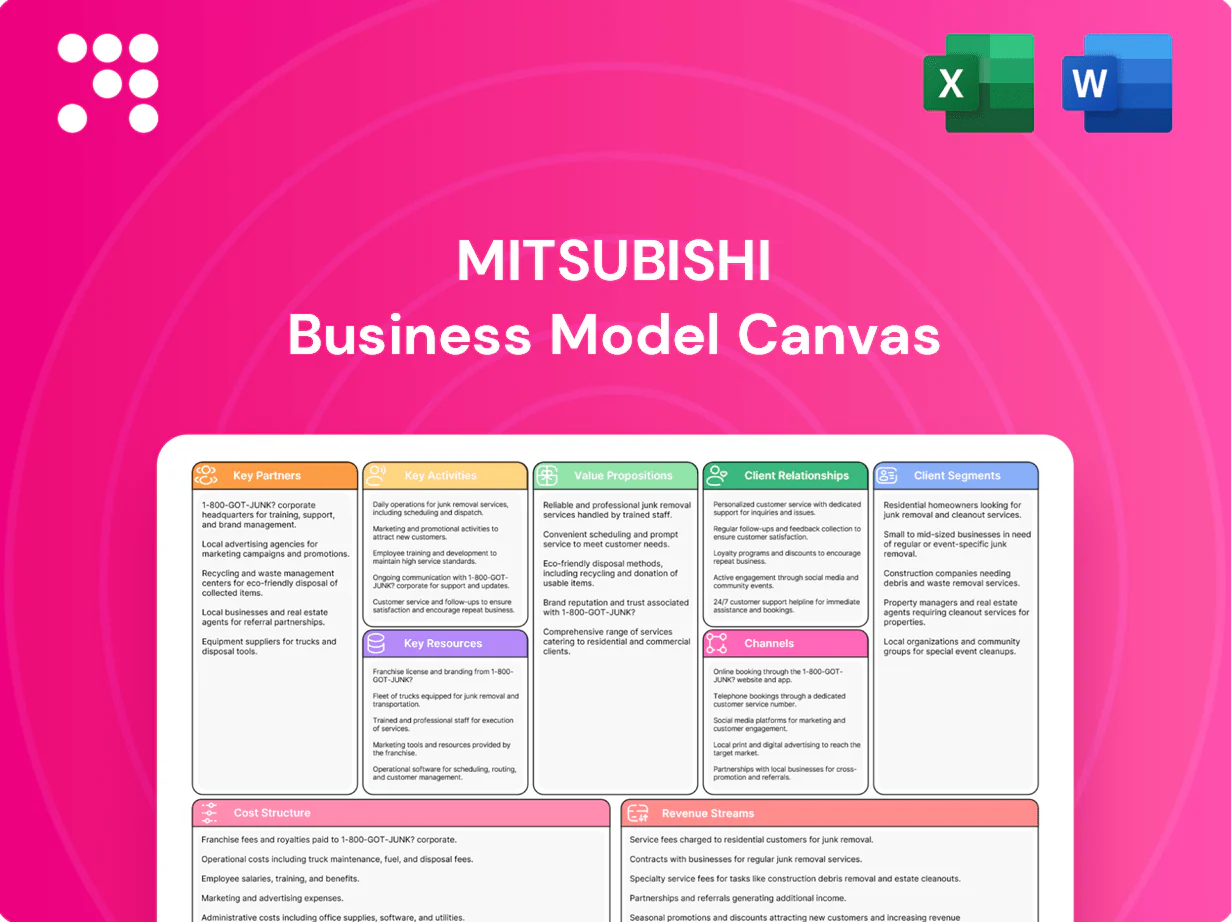
Mitsubishi Business Model Canvas

Unlock a concise Business Model Canvas for a leading conglomerate with editable templates
Unlock the full strategic blueprint behind Mitsubishi’s business model in this concise Business Model Canvas. Discover how Mitsubishi creates value through diversified customer segments, key partnerships and scalable revenue streams, and where operational efficiencies drive margins. Download the full, editable Canvas in Word and Excel to benchmark strategies, support investor pitches, or accelerate your own planning.
Partnerships

Resource developers
Partner with upstream oil, gas, and mineral producers to secure long-term offtake and equity stakes, locking supply and creating natural hedges via contracted volumes and minority ownership.
Form joint ventures to share capital intensity and reduce exploration and development risk while leveraging partner technical expertise.
Engage local partners to streamline permitting, fulfill regulatory requirements, and manage community relations for project social license to operate.
Industrial OEMs
Collaborate with machinery, automotive and equipment OEMs to co-develop components and integrated systems, coordinating procurement and logistics across Mitsubishi’s footprint in roughly 90 countries and regions. Share technology, harmonize quality standards and bundle after-sales service offerings to capture lifecycle revenues. Use OEM volume commitments to secure capacity and reduce per-unit costs, supporting predictable revenue streams and long-term service margins.

Chemical producers
Form strategic alliances with chemical producers to secure basic and specialty chemicals in a global market valued at about $4.7 trillion in 2024, ensuring stable pricing and supply. Optimize feedstock integration and by-product utilization to improve material efficiency and reduce waste. Coordinate logistics, storage, and stringent safety compliance across supply chains. Enable joint downstream application development to accelerate customer adoption.

Financial institutions
Mitsubishi partners with banks, insurers and funds for project and trade finance, structuring PPPs and long-tenor facilities for infrastructure and energy, leveraging risk-mitigation tools like guarantees and hedging while co-investing to scale capital-intensive ventures; global infrastructure needs remain about 3.9 trillion USD per year (2016–2040 Outlook) highlighting demand for long-term capital.
Technology and EPC partners
- Partnering: tech firms + EPCs
- Productivity: engineering + data platforms
- Focus: renewables, hydrogen, circular economy
- Delivery: on-time, on-budget, global
Partner upstream and form JVs with OEMs and financiers to secure feedstock and long-term finance
Partner with upstream producers for offtake/equity to secure supply and hedge volumes. Form JVs and local alliances to share capex, de-risk projects and manage permits/community relations. Align with OEMs, chemicals, tech/EPCs and financiers to co-develop products, secure feedstocks and long-tenor finance; 2024 renewable investment $430B, global chemicals $4.7T.
| Partnership | Purpose | 2024 data |
|---|---|---|
| Upstream/JVs | Secure supply, share risk | Offtake/equity |
| OEMs/Chemicals | Co-dev, feedstock | Chemicals $4.7T |
| Tech/EPC/Finance | Digitalize, fund projects | Renewables $430B |
What is included in the product
 Detailed Word Document
A comprehensive Business Model Canvas for Mitsubishi detailing customer segments, value propositions, channels, key partners, activities, resources, cost structure and revenue streams across the nine BMC blocks, with narrative, competitive-advantage analysis and linked SWOT — ideal for investor presentations, bank funding discussions and strategic validation using real company data.

 Customizable Excel Spreadsheet
Streamlines Mitsubishi’s complex conglomerate structure into a single editable canvas so teams can quickly identify core businesses, value chains, and partnership gaps. Perfect for boardrooms, strategy sessions, or fast executive summaries, saving hours of formatting while enabling side-by-side comparisons and collaborative edits.
Activities

Global trading
Source, transport and market commodities, manufactured goods and chemicals across global hubs, executing physical flow and hedging strategies while handling volumes aligned with global seaborne trade of about 11 billion tonnes in 2023 (UNCTAD). Manage price, counterparty and logistics risks via derivatives, credit limits and multimodal networks. Leverage market intelligence and real‑time analytics to optimize positions. Ensure compliance with sanctions, ESG and trade rules such as the EU CSRD roll‑out in 2024.
Project development
Originate, finance and build upstream and infrastructure assets using SPVs for non-recourse financing and long-term offtake contracts typically spanning 15–25 years. Conduct feasibility studies, permitting and stakeholder engagement with regulatory timelines often 3–7 years. Structure project finance and equity stacks, then oversee construction to COD and ramp-up to stable operations within agreed commissioning windows.

Portfolio management
Acquire, divest, and optimize equity in operating companies to concentrate capital on strategic themes, recycling proceeds into higher-return opportunities; monitor portfolio performance with KPIs and board governance; implement targeted improvement programs and synergies to lift operational returns and cost efficiency; use regular board reviews and KPI dashboards to drive divestment or further investment decisions.

Manufacturing and processing
Mitsubishi operates and partners in metals, chemicals, and food processing plants, focusing on yield, quality, and safety improvements across the value chain. Operations are being digitized for predictive maintenance and throughput optimization, while process innovation targets emission and waste reduction aligned with industry net-zero transitions.
- Operate/co-operate plants: metals, chemicals, food
- Improve yields, quality, safety
- Digitize ops: predictive maintenance
- Reduce emissions & waste via process innovation
Distribution and retail
Mitsubishi manages downstream channels for daily essentials and industrial products across retail and B2B, coordinating warehousing, last‑mile (can represent up to 53% of delivery cost) and after‑sales; it builds private labels and localized assortments while leveraging transaction, IoT and CRM data to continually enhance customer experience and retention.
- Channel management: retail & B2B
- Logistics: warehousing, last‑mile, after‑sales
- Private labels & localization
- Data-driven CX: IoT, CRM, transaction analytics
Integrated commodity sourcing, multimodal logistics, SPV financing and digitized plant ops
Source, transport and hedge commodities and goods across global hubs, managing price, counterparty and logistics risk with multimodal networks and real‑time analytics. Originate and finance upstream and infrastructure via SPVs and long‑term offtakes, overseeing permitting, construction and COD. Operate/process plants with digitized ops for predictive maintenance and emissions reduction; manage downstream retail/B2B channels, warehousing and last‑mile.
| Metric | Value |
|---|---|
| Global seaborne trade (2023) | ~11bn tonnes (UNCTAD) |
| EU CSRD | Roll‑out 2024 |
Full Version Awaits
Business Model Canvas
The Mitsubishi Business Model Canvas previewed here is the exact document you’ll receive after purchase, not a mockup or sample; it reflects the real content, structure, and formatting. Upon completing your order you’ll instantly download the full, editable file—ready to use in Word and Excel for presentation or modification. No hidden pages, no placeholders—what you see is what you get.

Unlock a concise Business Model Canvas for a leading conglomerate with editable templates
Unlock the full strategic blueprint behind Mitsubishi’s business model in this concise Business Model Canvas. Discover how Mitsubishi creates value through diversified customer segments, key partnerships and scalable revenue streams, and where operational efficiencies drive margins. Download the full, editable Canvas in Word and Excel to benchmark strategies, support investor pitches, or accelerate your own planning.
Partnerships
Resource developers
Partner with upstream oil, gas, and mineral producers to secure long-term offtake and equity stakes, locking supply and creating natural hedges via contracted volumes and minority ownership.
Form joint ventures to share capital intensity and reduce exploration and development risk while leveraging partner technical expertise.
Engage local partners to streamline permitting, fulfill regulatory requirements, and manage community relations for project social license to operate.
Industrial OEMs
Collaborate with machinery, automotive and equipment OEMs to co-develop components and integrated systems, coordinating procurement and logistics across Mitsubishi’s footprint in roughly 90 countries and regions. Share technology, harmonize quality standards and bundle after-sales service offerings to capture lifecycle revenues. Use OEM volume commitments to secure capacity and reduce per-unit costs, supporting predictable revenue streams and long-term service margins.
Chemical producers
Form strategic alliances with chemical producers to secure basic and specialty chemicals in a global market valued at about $4.7 trillion in 2024, ensuring stable pricing and supply. Optimize feedstock integration and by-product utilization to improve material efficiency and reduce waste. Coordinate logistics, storage, and stringent safety compliance across supply chains. Enable joint downstream application development to accelerate customer adoption.
Financial institutions
Mitsubishi partners with banks, insurers and funds for project and trade finance, structuring PPPs and long-tenor facilities for infrastructure and energy, leveraging risk-mitigation tools like guarantees and hedging while co-investing to scale capital-intensive ventures; global infrastructure needs remain about 3.9 trillion USD per year (2016–2040 Outlook) highlighting demand for long-term capital.
Technology and EPC partners
- Partnering: tech firms + EPCs
- Productivity: engineering + data platforms
- Focus: renewables, hydrogen, circular economy
- Delivery: on-time, on-budget, global
Partner upstream and form JVs with OEMs and financiers to secure feedstock and long-term finance
Partner with upstream producers for offtake/equity to secure supply and hedge volumes. Form JVs and local alliances to share capex, de-risk projects and manage permits/community relations. Align with OEMs, chemicals, tech/EPCs and financiers to co-develop products, secure feedstocks and long-tenor finance; 2024 renewable investment $430B, global chemicals $4.7T.
| Partnership | Purpose | 2024 data |
|---|---|---|
| Upstream/JVs | Secure supply, share risk | Offtake/equity |
| OEMs/Chemicals | Co-dev, feedstock | Chemicals $4.7T |
| Tech/EPC/Finance | Digitalize, fund projects | Renewables $430B |
What is included in the product
Detailed Word Document
A comprehensive Business Model Canvas for Mitsubishi detailing customer segments, value propositions, channels, key partners, activities, resources, cost structure and revenue streams across the nine BMC blocks, with narrative, competitive-advantage analysis and linked SWOT — ideal for investor presentations, bank funding discussions and strategic validation using real company data.
Customizable Excel Spreadsheet
Streamlines Mitsubishi’s complex conglomerate structure into a single editable canvas so teams can quickly identify core businesses, value chains, and partnership gaps. Perfect for boardrooms, strategy sessions, or fast executive summaries, saving hours of formatting while enabling side-by-side comparisons and collaborative edits.
Activities
Global trading
Source, transport and market commodities, manufactured goods and chemicals across global hubs, executing physical flow and hedging strategies while handling volumes aligned with global seaborne trade of about 11 billion tonnes in 2023 (UNCTAD). Manage price, counterparty and logistics risks via derivatives, credit limits and multimodal networks. Leverage market intelligence and real‑time analytics to optimize positions. Ensure compliance with sanctions, ESG and trade rules such as the EU CSRD roll‑out in 2024.
Project development
Originate, finance and build upstream and infrastructure assets using SPVs for non-recourse financing and long-term offtake contracts typically spanning 15–25 years. Conduct feasibility studies, permitting and stakeholder engagement with regulatory timelines often 3–7 years. Structure project finance and equity stacks, then oversee construction to COD and ramp-up to stable operations within agreed commissioning windows.
Portfolio management
Acquire, divest, and optimize equity in operating companies to concentrate capital on strategic themes, recycling proceeds into higher-return opportunities; monitor portfolio performance with KPIs and board governance; implement targeted improvement programs and synergies to lift operational returns and cost efficiency; use regular board reviews and KPI dashboards to drive divestment or further investment decisions.
Manufacturing and processing
Mitsubishi operates and partners in metals, chemicals, and food processing plants, focusing on yield, quality, and safety improvements across the value chain. Operations are being digitized for predictive maintenance and throughput optimization, while process innovation targets emission and waste reduction aligned with industry net-zero transitions.
- Operate/co-operate plants: metals, chemicals, food
- Improve yields, quality, safety
- Digitize ops: predictive maintenance
- Reduce emissions & waste via process innovation
Distribution and retail
Mitsubishi manages downstream channels for daily essentials and industrial products across retail and B2B, coordinating warehousing, last‑mile (can represent up to 53% of delivery cost) and after‑sales; it builds private labels and localized assortments while leveraging transaction, IoT and CRM data to continually enhance customer experience and retention.
- Channel management: retail & B2B
- Logistics: warehousing, last‑mile, after‑sales
- Private labels & localization
- Data-driven CX: IoT, CRM, transaction analytics
Integrated commodity sourcing, multimodal logistics, SPV financing and digitized plant ops
Source, transport and hedge commodities and goods across global hubs, managing price, counterparty and logistics risk with multimodal networks and real‑time analytics. Originate and finance upstream and infrastructure via SPVs and long‑term offtakes, overseeing permitting, construction and COD. Operate/process plants with digitized ops for predictive maintenance and emissions reduction; manage downstream retail/B2B channels, warehousing and last‑mile.
| Metric | Value |
|---|---|
| Global seaborne trade (2023) | ~11bn tonnes (UNCTAD) |
| EU CSRD | Roll‑out 2024 |
Full Version Awaits
Business Model Canvas
The Mitsubishi Business Model Canvas previewed here is the exact document you’ll receive after purchase, not a mockup or sample; it reflects the real content, structure, and formatting. Upon completing your order you’ll instantly download the full, editable file—ready to use in Word and Excel for presentation or modification. No hidden pages, no placeholders—what you see is what you get.
Original: $10.00
-65%$10.00
$3.50Description
Unlock a concise Business Model Canvas for a leading conglomerate with editable templates
Unlock the full strategic blueprint behind Mitsubishi’s business model in this concise Business Model Canvas. Discover how Mitsubishi creates value through diversified customer segments, key partnerships and scalable revenue streams, and where operational efficiencies drive margins. Download the full, editable Canvas in Word and Excel to benchmark strategies, support investor pitches, or accelerate your own planning.
Partnerships
Resource developers
Partner with upstream oil, gas, and mineral producers to secure long-term offtake and equity stakes, locking supply and creating natural hedges via contracted volumes and minority ownership.
Form joint ventures to share capital intensity and reduce exploration and development risk while leveraging partner technical expertise.
Engage local partners to streamline permitting, fulfill regulatory requirements, and manage community relations for project social license to operate.
Industrial OEMs
Collaborate with machinery, automotive and equipment OEMs to co-develop components and integrated systems, coordinating procurement and logistics across Mitsubishi’s footprint in roughly 90 countries and regions. Share technology, harmonize quality standards and bundle after-sales service offerings to capture lifecycle revenues. Use OEM volume commitments to secure capacity and reduce per-unit costs, supporting predictable revenue streams and long-term service margins.
Chemical producers
Form strategic alliances with chemical producers to secure basic and specialty chemicals in a global market valued at about $4.7 trillion in 2024, ensuring stable pricing and supply. Optimize feedstock integration and by-product utilization to improve material efficiency and reduce waste. Coordinate logistics, storage, and stringent safety compliance across supply chains. Enable joint downstream application development to accelerate customer adoption.
Financial institutions
Mitsubishi partners with banks, insurers and funds for project and trade finance, structuring PPPs and long-tenor facilities for infrastructure and energy, leveraging risk-mitigation tools like guarantees and hedging while co-investing to scale capital-intensive ventures; global infrastructure needs remain about 3.9 trillion USD per year (2016–2040 Outlook) highlighting demand for long-term capital.
Technology and EPC partners
- Partnering: tech firms + EPCs
- Productivity: engineering + data platforms
- Focus: renewables, hydrogen, circular economy
- Delivery: on-time, on-budget, global
Partner upstream and form JVs with OEMs and financiers to secure feedstock and long-term finance
Partner with upstream producers for offtake/equity to secure supply and hedge volumes. Form JVs and local alliances to share capex, de-risk projects and manage permits/community relations. Align with OEMs, chemicals, tech/EPCs and financiers to co-develop products, secure feedstocks and long-tenor finance; 2024 renewable investment $430B, global chemicals $4.7T.
| Partnership | Purpose | 2024 data |
|---|---|---|
| Upstream/JVs | Secure supply, share risk | Offtake/equity |
| OEMs/Chemicals | Co-dev, feedstock | Chemicals $4.7T |
| Tech/EPC/Finance | Digitalize, fund projects | Renewables $430B |
What is included in the product
Detailed Word Document
A comprehensive Business Model Canvas for Mitsubishi detailing customer segments, value propositions, channels, key partners, activities, resources, cost structure and revenue streams across the nine BMC blocks, with narrative, competitive-advantage analysis and linked SWOT — ideal for investor presentations, bank funding discussions and strategic validation using real company data.
Customizable Excel Spreadsheet
Streamlines Mitsubishi’s complex conglomerate structure into a single editable canvas so teams can quickly identify core businesses, value chains, and partnership gaps. Perfect for boardrooms, strategy sessions, or fast executive summaries, saving hours of formatting while enabling side-by-side comparisons and collaborative edits.
Activities
Global trading
Source, transport and market commodities, manufactured goods and chemicals across global hubs, executing physical flow and hedging strategies while handling volumes aligned with global seaborne trade of about 11 billion tonnes in 2023 (UNCTAD). Manage price, counterparty and logistics risks via derivatives, credit limits and multimodal networks. Leverage market intelligence and real‑time analytics to optimize positions. Ensure compliance with sanctions, ESG and trade rules such as the EU CSRD roll‑out in 2024.
Project development
Originate, finance and build upstream and infrastructure assets using SPVs for non-recourse financing and long-term offtake contracts typically spanning 15–25 years. Conduct feasibility studies, permitting and stakeholder engagement with regulatory timelines often 3–7 years. Structure project finance and equity stacks, then oversee construction to COD and ramp-up to stable operations within agreed commissioning windows.
Portfolio management
Acquire, divest, and optimize equity in operating companies to concentrate capital on strategic themes, recycling proceeds into higher-return opportunities; monitor portfolio performance with KPIs and board governance; implement targeted improvement programs and synergies to lift operational returns and cost efficiency; use regular board reviews and KPI dashboards to drive divestment or further investment decisions.
Manufacturing and processing
Mitsubishi operates and partners in metals, chemicals, and food processing plants, focusing on yield, quality, and safety improvements across the value chain. Operations are being digitized for predictive maintenance and throughput optimization, while process innovation targets emission and waste reduction aligned with industry net-zero transitions.
- Operate/co-operate plants: metals, chemicals, food
- Improve yields, quality, safety
- Digitize ops: predictive maintenance
- Reduce emissions & waste via process innovation
Distribution and retail
Mitsubishi manages downstream channels for daily essentials and industrial products across retail and B2B, coordinating warehousing, last‑mile (can represent up to 53% of delivery cost) and after‑sales; it builds private labels and localized assortments while leveraging transaction, IoT and CRM data to continually enhance customer experience and retention.
- Channel management: retail & B2B
- Logistics: warehousing, last‑mile, after‑sales
- Private labels & localization
- Data-driven CX: IoT, CRM, transaction analytics
Integrated commodity sourcing, multimodal logistics, SPV financing and digitized plant ops
Source, transport and hedge commodities and goods across global hubs, managing price, counterparty and logistics risk with multimodal networks and real‑time analytics. Originate and finance upstream and infrastructure via SPVs and long‑term offtakes, overseeing permitting, construction and COD. Operate/process plants with digitized ops for predictive maintenance and emissions reduction; manage downstream retail/B2B channels, warehousing and last‑mile.
| Metric | Value |
|---|---|
| Global seaborne trade (2023) | ~11bn tonnes (UNCTAD) |
| EU CSRD | Roll‑out 2024 |
Full Version Awaits
Business Model Canvas
The Mitsubishi Business Model Canvas previewed here is the exact document you’ll receive after purchase, not a mockup or sample; it reflects the real content, structure, and formatting. Upon completing your order you’ll instantly download the full, editable file—ready to use in Word and Excel for presentation or modification. No hidden pages, no placeholders—what you see is what you get.











