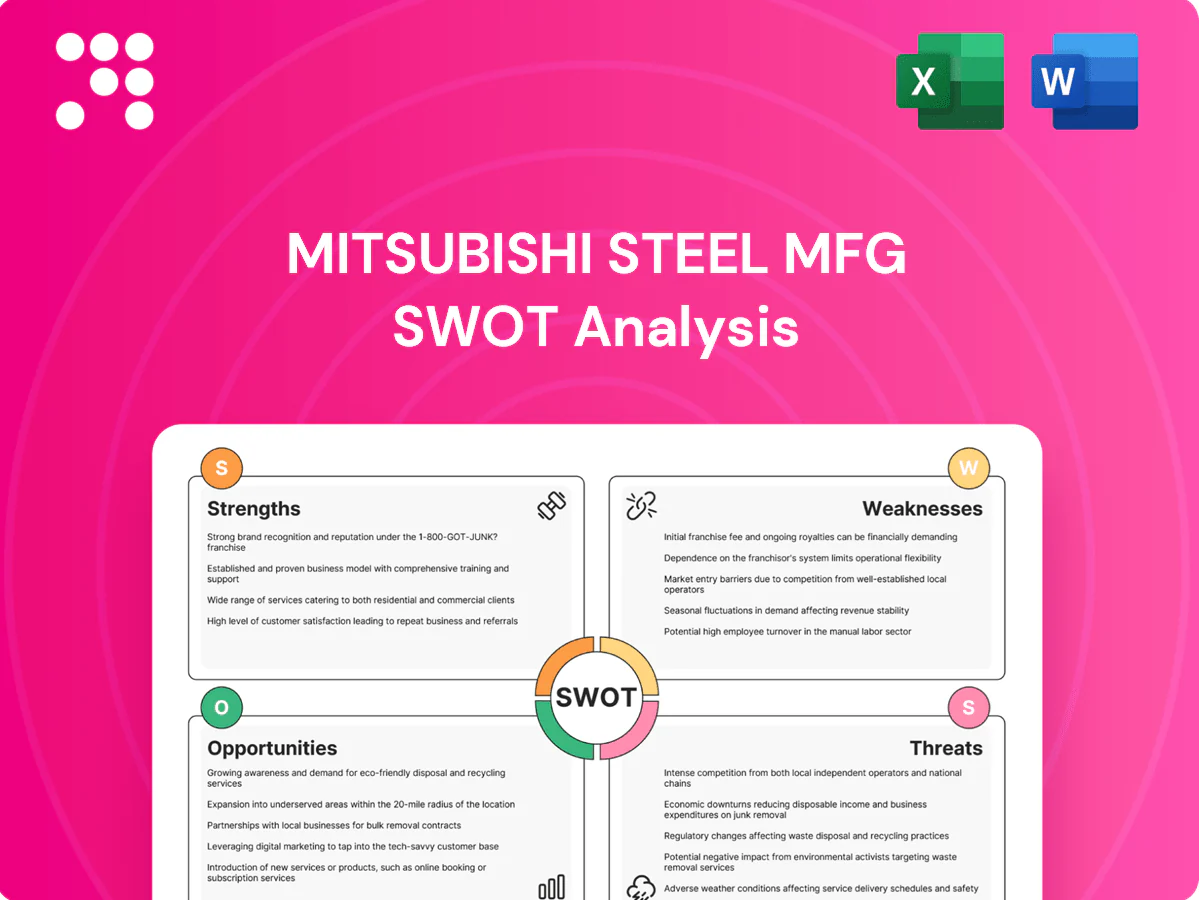
Mitsubishi Steel Mfg SWOT Analysis

Make Insightful Decisions Backed by Expert Research
Mitsubishi Steel Mfg. combines advanced steel-processing tech and niche specialty alloys with steady OEM relationships, yet faces cyclical demand and raw-material cost pressure. Growth opportunities lie in EV, renewable and precision manufacturing markets, while global competition and supply risks temper upside. Purchase the full SWOT analysis for a detailed, editable Word and Excel report to inform investment or strategic decisions.
Strengths

Diverse specialty steel portfolio
Mitsubishi Steel Mfg’s portfolio spans specialty bars, springs, powder metallurgy, castings and forgings, delivering multi-segment exposure across automotive, industrial machinery and construction. This breadth smooths demand cyclicality and enables cross-selling and material substitution that deepen customer stickiness. The range also supports tailored, high-spec solutions for applications such as engine components and industrial bearings in FY2024.
Deep automotive OEM relationships
Supplying critical components like suspension springs and high-strength bars positions Mitsubishi Steel as a trusted Tier 1/2 supplier to global automotive OEMs. OEM qualification cycles typically run 12–24 months with strict quality gates, creating high switching costs. Long-term programs (commonly 3–7 year contracts) stabilize volumes, enable co-development, enhance demand visibility and improve capacity planning.

Materials and process engineering know-how
Deep expertise in heat treatment, forging and powder metallurgy lets Mitsubishi Steel Mfg deliver superior performance-to-cost across critical applications. Proprietary material recipes and tight process controls ensure consistent mechanical properties and lot-to-lot reliability. Process know-how reduces scrap and improves throughput through optimized yields. Rapid iteration capability accelerates new alloy grades and complex part geometries.

Quality reputation and reliability
Mitsubishi Steel Mfg’s reputation for meeting automotive/industrial tolerances (typically ±0.01 mm) and fatigue-life targets (>1×10^6 cycles) allows premium pricing for safety-critical parts; IATF 16949 and ISO 9001 certification and regular audit readiness accelerate new business awards and support multi-year OEM framework agreements often lasting 3–5 years.
- High-precision tolerances ±0.01 mm
- Fatigue resistance >1×10^6 cycles
- IATF 16949 & ISO 9001 certified
- Framework agreements 3–5 years
Integrated manufacturing footprint
Vertical integration across bars, springs, castings and forgings allows Mitsubishi Steel to streamline supply, with internal sourcing reducing lead times and coordination risk while supporting faster prototype-to-production cycles.
- Internal sourcing: lower lead times
- Shared services: cost and quality control
- Metallurgy labs: faster design iteration
- Agility: quick response to design changes
Metallurgy + long-term OEM: ±0.01 mm, >1×10^6-cycle
Mitsubishi Steel Mfg combines diversified product lines (bars, springs, PM, castings, forgings) with Tier 1/2 OEM status, long-term framework contracts (3–7 years), and proprietary metallurgy/heat-treatment expertise that enable ±0.01 mm tolerances and >1×10^6-cycle fatigue reliability, supporting premium pricing and low customer churn.
| Metric | Value |
|---|---|
| Tolerances | ±0.01 mm |
| Fatigue life | >1×10^6 cycles |
| Contract length | 3–7 years |
What is included in the product
 Detailed Word Document
Delivers a strategic overview of Mitsubishi Steel Mfg’s internal strengths and weaknesses and evaluates external opportunities and threats shaping its competitive position and growth prospects.

 Customizable Excel Spreadsheet
Provides a concise, editable SWOT matrix for Mitsubishi Steel Mfg that streamlines strategic clarity and relieves stakeholder alignment pain points by enabling quick updates and easy integration into reports and presentations.
Weaknesses

High exposure to auto cycles
High exposure to auto cycles leaves Mitsubishi Steel vulnerable as vehicle production swings—global light-vehicle output of roughly 75 million units in 2024 translated directly into volatile demand for springs and specialty bars. Program delays or platform cancellations can rapidly underutilize capacity, given long lead-times for press lines and heat-treatment. Dependence on ICE-heavy segments raises transition risk to EV architectures, concentrating revenue and pressuring margins during downturns.
Energy- and labor-intensive cost base
Heat treatment and forging make Mitsubishi Steel highly energy-sensitive; Japan industrial electricity prices near 18 JPY/kWh (METI, 2023) amplify cost swings. Rising wage pressure—average hourly minimum wage ≈ 961 JPY in 2024—increases labor costs and compresses margins when pricing lags. Older furnaces and presses are typically less energy-efficient, raising unit costs. Customer resistance limits pass-through of surcharges, squeezing profitability.

Scale disadvantage vs mega-mills
Lacking the scale of mega-mills like ArcelorMittal (≈50 Mtpa crude steel) and POSCO, Mitsubishi Steel faces weaker raw-material bargaining power and narrower supply networks, allowing larger peers to undercut on commodity-adjacent grades. Limited scale constrains capex for rapid decarbonization investments and hydrogen/direct-reduction projects. It also hampers winning multi-region global programs that require multi-continent supply footprints.

Product mix complexity
Managing a wide SKU range across bars, springs, PM parts and forgings strains production scheduling, raising inventory carrying and changeover costs and amplifying forecast sensitivity that can cause bottlenecks or idle time; quality assurance workload grows as variant count increases, complicating traceability and corrective action.
- Scheduling strain
- Higher inventory & changeover costs
- Forecast-driven bottlenecks/idle time
- Increased QA burden
FX and raw material volatility
Yen volatility (USD/JPY swings from ~115 in 2021 to peaks near 160 in 2022–23 and ~150 in 2024) erodes export competitiveness and raises imported input costs; alloy surcharges and Japanese scrap prices have moved 20–40% year-on-year, creating sharp margin swings. Contract lag and limited hedging can leave Mitsubishi Steel exposed to timing mismatches and rapid moves.
- USD/JPY volatility ~30–40% since 2021
- Alloy/scrap swings 20–40% YoY
- Contract lag causes timing mismatch
- Hedging may not fully offset spikes
Auto cyclicality, ICE exposure and long lead-times raise cost and margin volatility
High cyclicality from autos (global LV ≈75m units in 2024) and ICE exposure raises demand and margin volatility; long lead-times amplify underutilization risk. Energy intensity (electricity ≈18 JPY/kWh, 2023) and rising wages (min wage ≈961 JPY, 2024) pressure costs; limited scale vs mega-mills (ArcelorMittal ≈50 Mtpa) weakens pricing power and capex for decarbonization.
| Metric | Value |
|---|---|
| Global LV (2024) | ≈75m units |
| Electricity (Japan) | ≈18 JPY/kWh (2023) |
| Min wage (2024) | ≈961 JPY/hr |
| USD/JPY (2024) | ≈150 |
| Peer scale | ArcelorMittal ≈50 Mtpa |
Full Version Awaits
Mitsubishi Steel Mfg SWOT Analysis
This is the actual Mitsubishi Steel Mfg SWOT analysis document you’ll receive upon purchase—no surprises, just professional quality. The preview below is taken directly from the full report and reflects the same structured, editable file you’ll download after payment. Buy now to unlock the complete, detailed version.

Make Insightful Decisions Backed by Expert Research
Mitsubishi Steel Mfg. combines advanced steel-processing tech and niche specialty alloys with steady OEM relationships, yet faces cyclical demand and raw-material cost pressure. Growth opportunities lie in EV, renewable and precision manufacturing markets, while global competition and supply risks temper upside. Purchase the full SWOT analysis for a detailed, editable Word and Excel report to inform investment or strategic decisions.
Strengths
Diverse specialty steel portfolio
Mitsubishi Steel Mfg’s portfolio spans specialty bars, springs, powder metallurgy, castings and forgings, delivering multi-segment exposure across automotive, industrial machinery and construction. This breadth smooths demand cyclicality and enables cross-selling and material substitution that deepen customer stickiness. The range also supports tailored, high-spec solutions for applications such as engine components and industrial bearings in FY2024.
Deep automotive OEM relationships
Supplying critical components like suspension springs and high-strength bars positions Mitsubishi Steel as a trusted Tier 1/2 supplier to global automotive OEMs. OEM qualification cycles typically run 12–24 months with strict quality gates, creating high switching costs. Long-term programs (commonly 3–7 year contracts) stabilize volumes, enable co-development, enhance demand visibility and improve capacity planning.
Materials and process engineering know-how
Deep expertise in heat treatment, forging and powder metallurgy lets Mitsubishi Steel Mfg deliver superior performance-to-cost across critical applications. Proprietary material recipes and tight process controls ensure consistent mechanical properties and lot-to-lot reliability. Process know-how reduces scrap and improves throughput through optimized yields. Rapid iteration capability accelerates new alloy grades and complex part geometries.
Quality reputation and reliability
Mitsubishi Steel Mfg’s reputation for meeting automotive/industrial tolerances (typically ±0.01 mm) and fatigue-life targets (>1×10^6 cycles) allows premium pricing for safety-critical parts; IATF 16949 and ISO 9001 certification and regular audit readiness accelerate new business awards and support multi-year OEM framework agreements often lasting 3–5 years.
- High-precision tolerances ±0.01 mm
- Fatigue resistance >1×10^6 cycles
- IATF 16949 & ISO 9001 certified
- Framework agreements 3–5 years
Integrated manufacturing footprint
Vertical integration across bars, springs, castings and forgings allows Mitsubishi Steel to streamline supply, with internal sourcing reducing lead times and coordination risk while supporting faster prototype-to-production cycles.
- Internal sourcing: lower lead times
- Shared services: cost and quality control
- Metallurgy labs: faster design iteration
- Agility: quick response to design changes
Metallurgy + long-term OEM: ±0.01 mm, >1×10^6-cycle
Mitsubishi Steel Mfg combines diversified product lines (bars, springs, PM, castings, forgings) with Tier 1/2 OEM status, long-term framework contracts (3–7 years), and proprietary metallurgy/heat-treatment expertise that enable ±0.01 mm tolerances and >1×10^6-cycle fatigue reliability, supporting premium pricing and low customer churn.
| Metric | Value |
|---|---|
| Tolerances | ±0.01 mm |
| Fatigue life | >1×10^6 cycles |
| Contract length | 3–7 years |
What is included in the product
Detailed Word Document
Delivers a strategic overview of Mitsubishi Steel Mfg’s internal strengths and weaknesses and evaluates external opportunities and threats shaping its competitive position and growth prospects.
Customizable Excel Spreadsheet
Provides a concise, editable SWOT matrix for Mitsubishi Steel Mfg that streamlines strategic clarity and relieves stakeholder alignment pain points by enabling quick updates and easy integration into reports and presentations.
Weaknesses
High exposure to auto cycles
High exposure to auto cycles leaves Mitsubishi Steel vulnerable as vehicle production swings—global light-vehicle output of roughly 75 million units in 2024 translated directly into volatile demand for springs and specialty bars. Program delays or platform cancellations can rapidly underutilize capacity, given long lead-times for press lines and heat-treatment. Dependence on ICE-heavy segments raises transition risk to EV architectures, concentrating revenue and pressuring margins during downturns.
Energy- and labor-intensive cost base
Heat treatment and forging make Mitsubishi Steel highly energy-sensitive; Japan industrial electricity prices near 18 JPY/kWh (METI, 2023) amplify cost swings. Rising wage pressure—average hourly minimum wage ≈ 961 JPY in 2024—increases labor costs and compresses margins when pricing lags. Older furnaces and presses are typically less energy-efficient, raising unit costs. Customer resistance limits pass-through of surcharges, squeezing profitability.
Scale disadvantage vs mega-mills
Lacking the scale of mega-mills like ArcelorMittal (≈50 Mtpa crude steel) and POSCO, Mitsubishi Steel faces weaker raw-material bargaining power and narrower supply networks, allowing larger peers to undercut on commodity-adjacent grades. Limited scale constrains capex for rapid decarbonization investments and hydrogen/direct-reduction projects. It also hampers winning multi-region global programs that require multi-continent supply footprints.
Product mix complexity
Managing a wide SKU range across bars, springs, PM parts and forgings strains production scheduling, raising inventory carrying and changeover costs and amplifying forecast sensitivity that can cause bottlenecks or idle time; quality assurance workload grows as variant count increases, complicating traceability and corrective action.
- Scheduling strain
- Higher inventory & changeover costs
- Forecast-driven bottlenecks/idle time
- Increased QA burden
FX and raw material volatility
Yen volatility (USD/JPY swings from ~115 in 2021 to peaks near 160 in 2022–23 and ~150 in 2024) erodes export competitiveness and raises imported input costs; alloy surcharges and Japanese scrap prices have moved 20–40% year-on-year, creating sharp margin swings. Contract lag and limited hedging can leave Mitsubishi Steel exposed to timing mismatches and rapid moves.
- USD/JPY volatility ~30–40% since 2021
- Alloy/scrap swings 20–40% YoY
- Contract lag causes timing mismatch
- Hedging may not fully offset spikes
Auto cyclicality, ICE exposure and long lead-times raise cost and margin volatility
High cyclicality from autos (global LV ≈75m units in 2024) and ICE exposure raises demand and margin volatility; long lead-times amplify underutilization risk. Energy intensity (electricity ≈18 JPY/kWh, 2023) and rising wages (min wage ≈961 JPY, 2024) pressure costs; limited scale vs mega-mills (ArcelorMittal ≈50 Mtpa) weakens pricing power and capex for decarbonization.
| Metric | Value |
|---|---|
| Global LV (2024) | ≈75m units |
| Electricity (Japan) | ≈18 JPY/kWh (2023) |
| Min wage (2024) | ≈961 JPY/hr |
| USD/JPY (2024) | ≈150 |
| Peer scale | ArcelorMittal ≈50 Mtpa |
Full Version Awaits
Mitsubishi Steel Mfg SWOT Analysis
This is the actual Mitsubishi Steel Mfg SWOT analysis document you’ll receive upon purchase—no surprises, just professional quality. The preview below is taken directly from the full report and reflects the same structured, editable file you’ll download after payment. Buy now to unlock the complete, detailed version.
Original: $10.00
-65%$10.00
$3.50Description
Make Insightful Decisions Backed by Expert Research
Mitsubishi Steel Mfg. combines advanced steel-processing tech and niche specialty alloys with steady OEM relationships, yet faces cyclical demand and raw-material cost pressure. Growth opportunities lie in EV, renewable and precision manufacturing markets, while global competition and supply risks temper upside. Purchase the full SWOT analysis for a detailed, editable Word and Excel report to inform investment or strategic decisions.
Strengths
Diverse specialty steel portfolio
Mitsubishi Steel Mfg’s portfolio spans specialty bars, springs, powder metallurgy, castings and forgings, delivering multi-segment exposure across automotive, industrial machinery and construction. This breadth smooths demand cyclicality and enables cross-selling and material substitution that deepen customer stickiness. The range also supports tailored, high-spec solutions for applications such as engine components and industrial bearings in FY2024.
Deep automotive OEM relationships
Supplying critical components like suspension springs and high-strength bars positions Mitsubishi Steel as a trusted Tier 1/2 supplier to global automotive OEMs. OEM qualification cycles typically run 12–24 months with strict quality gates, creating high switching costs. Long-term programs (commonly 3–7 year contracts) stabilize volumes, enable co-development, enhance demand visibility and improve capacity planning.
Materials and process engineering know-how
Deep expertise in heat treatment, forging and powder metallurgy lets Mitsubishi Steel Mfg deliver superior performance-to-cost across critical applications. Proprietary material recipes and tight process controls ensure consistent mechanical properties and lot-to-lot reliability. Process know-how reduces scrap and improves throughput through optimized yields. Rapid iteration capability accelerates new alloy grades and complex part geometries.
Quality reputation and reliability
Mitsubishi Steel Mfg’s reputation for meeting automotive/industrial tolerances (typically ±0.01 mm) and fatigue-life targets (>1×10^6 cycles) allows premium pricing for safety-critical parts; IATF 16949 and ISO 9001 certification and regular audit readiness accelerate new business awards and support multi-year OEM framework agreements often lasting 3–5 years.
- High-precision tolerances ±0.01 mm
- Fatigue resistance >1×10^6 cycles
- IATF 16949 & ISO 9001 certified
- Framework agreements 3–5 years
Integrated manufacturing footprint
Vertical integration across bars, springs, castings and forgings allows Mitsubishi Steel to streamline supply, with internal sourcing reducing lead times and coordination risk while supporting faster prototype-to-production cycles.
- Internal sourcing: lower lead times
- Shared services: cost and quality control
- Metallurgy labs: faster design iteration
- Agility: quick response to design changes
Metallurgy + long-term OEM: ±0.01 mm, >1×10^6-cycle
Mitsubishi Steel Mfg combines diversified product lines (bars, springs, PM, castings, forgings) with Tier 1/2 OEM status, long-term framework contracts (3–7 years), and proprietary metallurgy/heat-treatment expertise that enable ±0.01 mm tolerances and >1×10^6-cycle fatigue reliability, supporting premium pricing and low customer churn.
| Metric | Value |
|---|---|
| Tolerances | ±0.01 mm |
| Fatigue life | >1×10^6 cycles |
| Contract length | 3–7 years |
What is included in the product
Detailed Word Document
Delivers a strategic overview of Mitsubishi Steel Mfg’s internal strengths and weaknesses and evaluates external opportunities and threats shaping its competitive position and growth prospects.
Customizable Excel Spreadsheet
Provides a concise, editable SWOT matrix for Mitsubishi Steel Mfg that streamlines strategic clarity and relieves stakeholder alignment pain points by enabling quick updates and easy integration into reports and presentations.
Weaknesses
High exposure to auto cycles
High exposure to auto cycles leaves Mitsubishi Steel vulnerable as vehicle production swings—global light-vehicle output of roughly 75 million units in 2024 translated directly into volatile demand for springs and specialty bars. Program delays or platform cancellations can rapidly underutilize capacity, given long lead-times for press lines and heat-treatment. Dependence on ICE-heavy segments raises transition risk to EV architectures, concentrating revenue and pressuring margins during downturns.
Energy- and labor-intensive cost base
Heat treatment and forging make Mitsubishi Steel highly energy-sensitive; Japan industrial electricity prices near 18 JPY/kWh (METI, 2023) amplify cost swings. Rising wage pressure—average hourly minimum wage ≈ 961 JPY in 2024—increases labor costs and compresses margins when pricing lags. Older furnaces and presses are typically less energy-efficient, raising unit costs. Customer resistance limits pass-through of surcharges, squeezing profitability.
Scale disadvantage vs mega-mills
Lacking the scale of mega-mills like ArcelorMittal (≈50 Mtpa crude steel) and POSCO, Mitsubishi Steel faces weaker raw-material bargaining power and narrower supply networks, allowing larger peers to undercut on commodity-adjacent grades. Limited scale constrains capex for rapid decarbonization investments and hydrogen/direct-reduction projects. It also hampers winning multi-region global programs that require multi-continent supply footprints.
Product mix complexity
Managing a wide SKU range across bars, springs, PM parts and forgings strains production scheduling, raising inventory carrying and changeover costs and amplifying forecast sensitivity that can cause bottlenecks or idle time; quality assurance workload grows as variant count increases, complicating traceability and corrective action.
- Scheduling strain
- Higher inventory & changeover costs
- Forecast-driven bottlenecks/idle time
- Increased QA burden
FX and raw material volatility
Yen volatility (USD/JPY swings from ~115 in 2021 to peaks near 160 in 2022–23 and ~150 in 2024) erodes export competitiveness and raises imported input costs; alloy surcharges and Japanese scrap prices have moved 20–40% year-on-year, creating sharp margin swings. Contract lag and limited hedging can leave Mitsubishi Steel exposed to timing mismatches and rapid moves.
- USD/JPY volatility ~30–40% since 2021
- Alloy/scrap swings 20–40% YoY
- Contract lag causes timing mismatch
- Hedging may not fully offset spikes
Auto cyclicality, ICE exposure and long lead-times raise cost and margin volatility
High cyclicality from autos (global LV ≈75m units in 2024) and ICE exposure raises demand and margin volatility; long lead-times amplify underutilization risk. Energy intensity (electricity ≈18 JPY/kWh, 2023) and rising wages (min wage ≈961 JPY, 2024) pressure costs; limited scale vs mega-mills (ArcelorMittal ≈50 Mtpa) weakens pricing power and capex for decarbonization.
| Metric | Value |
|---|---|
| Global LV (2024) | ≈75m units |
| Electricity (Japan) | ≈18 JPY/kWh (2023) |
| Min wage (2024) | ≈961 JPY/hr |
| USD/JPY (2024) | ≈150 |
| Peer scale | ArcelorMittal ≈50 Mtpa |
Full Version Awaits
Mitsubishi Steel Mfg SWOT Analysis
This is the actual Mitsubishi Steel Mfg SWOT analysis document you’ll receive upon purchase—no surprises, just professional quality. The preview below is taken directly from the full report and reflects the same structured, editable file you’ll download after payment. Buy now to unlock the complete, detailed version.











