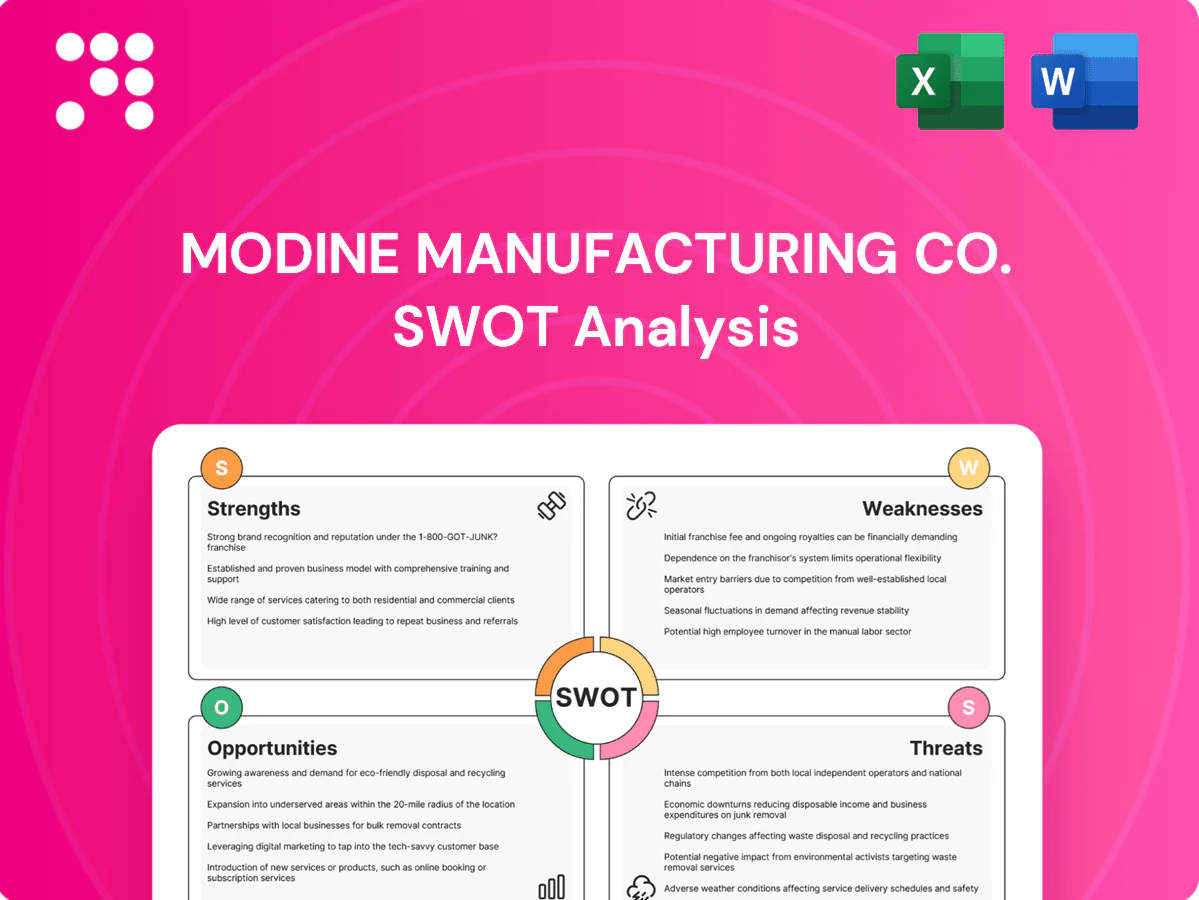
Modine Manufacturing Co. SWOT Analysis

Dive Deeper Into the Company’s Strategic Blueprint
Modine Manufacturing Co.'s SWOT highlights engineering-led strengths, exposure to cyclical end-markets, emerging electrification opportunities, and supply-chain/commodity risks. Want the full picture—detailed threats, strategic options, and financial context? Purchase the complete SWOT for a professionally written, editable Word report plus Excel tools to plan, pitch, or invest with confidence.
Strengths

Diversified thermal portfolio
Modine’s diversified thermal portfolio serves vehicular, industrial, data center and building HVAC end-markets, cutting reliance on a single cycle and supporting FY2024 revenue of about $2.0B. Its broad heat‑exchanger and integrated system suite enables technology transfer across segments, driving cross‑sell and upsell opportunities. Diversification bolsters revenue resilience and positions Modine to capture secular shifts (electrification, data‑center cooling) while preserving legacy cash flows.
Engineering depth & testing capability
Modine’s deep design, engineering and validation labs create high OEM switching costs, with proven reliability in harsh-duty thermal applications differentiating it from lower-cost rivals. This engineering strength shortens validation cycles and accelerates time-to-market for complex platforms, supporting premium pricing. Modine reported FY2024 net sales of about $1.7 billion, underpinning long-term supply awards.

Energy efficiency & emissions focus
Modine’s heat-transfer products directly address efficiency, emissions reduction and performance mandates, aligning with regulatory tailwinds and customer ESG targets across HVAC, transportation and industrial markets. Buildings account for about 40% of US energy use (US DOE), and high-efficiency heat transfer can cut HVAC energy consumption by up to 30%, delivering measurable ROI and strengthening value-based selling and specification wins.

Growing presence in data center cooling
AI and high-density computing are pushing rack power to and beyond 30 kW in many training clusters, raising thermal loads; Modine’s liquid and air-side cooling solutions target this fast-growing, margin-accretive niche and already have reference deployments with hyperscalers and colocation providers, enhancing credibility while diversifying away from automotive cyclicality.
- Racks often >30 kW
- Reference deployments with hyperscalers/colocation
- Higher-margin liquid cooling exposure
- Reduces auto revenue cyclicality
Global manufacturing footprint
Modine’s global manufacturing footprint across North America, Europe and Asia supports lower landed costs, shorter lead times and logistics efficiency; localized operations help meet regional content rules and reduce tariff exposure, while proximity to customers improves collaboration and service and enables flexible capacity allocation across demand cycles.
- Regional production: North America, Europe, Asia
- Lower landed cost and lead time
- Reduced tariff exposure via local content
- Improved customer collaboration and flexible capacity
Diversified thermal leader: ~$2B FY24, 40% building exposure, expanding >30 kW data-center cooling
Modine’s diversified thermal portfolio drove FY2024 revenue ≈ $2.0B, with FY2024 net sales ≈ $1.7B and ~40% exposure to building/industrial HVAC resilience. Deep engineering and global footprint (North America, Europe, Asia) create OEM switching costs, faster validation and local-content compliance. Reference deployments in hyperscaler/data-center liquid cooling (>30 kW racks) expand higher-margin mix.
| Metric | Value |
|---|---|
| FY2024 Revenue | $2.0B |
| FY2024 Net Sales | $1.7B |
| Building energy share (US) | ~40% |
| Data-center rack power | >30 kW |
What is included in the product
 Detailed Word Document
Delivers a strategic overview of Modine Manufacturing Co.'s internal and external business factors, outlining strengths, weaknesses, opportunities, and threats to assess its competitive position, growth drivers, operational gaps, and market risks shaping future performance.

 Customizable Excel Spreadsheet
Delivers a concise SWOT matrix tailored to Modine Manufacturing Co., pinpointing thermal-management strengths, supply-chain vulnerabilities, market opportunities, and regulatory threats to quickly relieve strategic blind spots and align action.
Weaknesses

Exposure to cyclical end-markets
Modine’s heavy exposure to cyclical transportation and industrial end-markets—about 60% of revenue—means macro slowdowns hit volumes; OEM capex pauses and project delays have periodically reduced order intake (notably in 2024), complicating forecasting and capacity planning and putting downward pressure on pricing and mix during downturns.
Commodity and input sensitivity
Modine remains highly exposed to copper, aluminum, steel, resins and energy price swings that pressure gross margins; customer surcharge and pass-through mechanisms frequently lag market moves, creating timing risk. Volatile freight rates and persistent labor tightness further compress profitability, while financial hedges and commodity contracts only partially mitigate raw-material and energy exposure.

Customer concentration risk
Large OEMs and a limited set of hyperscale or HVAC accounts account for a sizable portion of Modine’s revenue, concentrating sales risk among few buyers. This concentration increases pricing pressure and gives buyers leverage in contract terms and margins. Program wins or losses can create step-changes in volume, heightening the need for continuous platform renewal and diversification of end-markets.

Legacy product mix constraints
Legacy product mix constraints: sizable portions of Modine’s portfolio remain tied to internal-combustion powertrain components and mature HVAC technologies, exposing the company to demand declines and margin pressure as markets shift to electrification and high-efficiency systems. Shifting capacity to growth areas such as EV thermal management and advanced HVAC requires capital expenditure and time, which can dilute utilization and temporarily raise restructuring costs and operating leverage.
- Exposure: legacy ICE and mature HVAC lines
- Risk: utilization and margin dilution during transitions
- Investment: capex and retraining needed to retool capacity
- Short-term pain: elevated restructuring and conversion costs
Complex global supply chain
Modine’s multi-tier global supply chain creates coordination and continuity risks across regions; quality escapes or supplier component shortages have caused shipment disruptions historically and force higher safety stock. Compliance with evolving trade, environmental, and product standards increases overhead and extends supplier qualification timelines, raising working capital needs and operational complexity.
- Multi-tier suppliers raise coordination risk
- Quality escapes/component shortages disrupt shipments
- Compliance burdens increase overhead
- Higher working capital and complexity
Cyclical OEM exposure and commodity volatility squeeze margins, capex and execution risk
Concentration in cyclical transport/industrial end-markets and OEM dependence depresses volumes and pricing during downturns. Commodity and freight volatility squeeze gross margins with lagging pass-throughs. Legacy ICE/HVAC mix and multi-tier supply-chain complexity raise capex, conversion costs, working capital and execution risk.
| Metric | Current |
|---|---|
| Revenue concentration (top segments) | High |
| Commodity exposure | Material |
| Supply-chain risk | Elevated |
Preview Before You Purchase
Modine Manufacturing Co. SWOT Analysis
This is the actual Modine Manufacturing Co. SWOT analysis document you’ll receive upon purchase—no surprises, just professional quality. The preview below is taken directly from the full report you'll get, and once purchased the complete, editable version is unlocked. You’re viewing a live excerpt of the real file, structured and ready to use.

Dive Deeper Into the Company’s Strategic Blueprint
Modine Manufacturing Co.'s SWOT highlights engineering-led strengths, exposure to cyclical end-markets, emerging electrification opportunities, and supply-chain/commodity risks. Want the full picture—detailed threats, strategic options, and financial context? Purchase the complete SWOT for a professionally written, editable Word report plus Excel tools to plan, pitch, or invest with confidence.
Strengths
Diversified thermal portfolio
Modine’s diversified thermal portfolio serves vehicular, industrial, data center and building HVAC end-markets, cutting reliance on a single cycle and supporting FY2024 revenue of about $2.0B. Its broad heat‑exchanger and integrated system suite enables technology transfer across segments, driving cross‑sell and upsell opportunities. Diversification bolsters revenue resilience and positions Modine to capture secular shifts (electrification, data‑center cooling) while preserving legacy cash flows.
Engineering depth & testing capability
Modine’s deep design, engineering and validation labs create high OEM switching costs, with proven reliability in harsh-duty thermal applications differentiating it from lower-cost rivals. This engineering strength shortens validation cycles and accelerates time-to-market for complex platforms, supporting premium pricing. Modine reported FY2024 net sales of about $1.7 billion, underpinning long-term supply awards.
Energy efficiency & emissions focus
Modine’s heat-transfer products directly address efficiency, emissions reduction and performance mandates, aligning with regulatory tailwinds and customer ESG targets across HVAC, transportation and industrial markets. Buildings account for about 40% of US energy use (US DOE), and high-efficiency heat transfer can cut HVAC energy consumption by up to 30%, delivering measurable ROI and strengthening value-based selling and specification wins.
Growing presence in data center cooling
AI and high-density computing are pushing rack power to and beyond 30 kW in many training clusters, raising thermal loads; Modine’s liquid and air-side cooling solutions target this fast-growing, margin-accretive niche and already have reference deployments with hyperscalers and colocation providers, enhancing credibility while diversifying away from automotive cyclicality.
- Racks often >30 kW
- Reference deployments with hyperscalers/colocation
- Higher-margin liquid cooling exposure
- Reduces auto revenue cyclicality
Global manufacturing footprint
Modine’s global manufacturing footprint across North America, Europe and Asia supports lower landed costs, shorter lead times and logistics efficiency; localized operations help meet regional content rules and reduce tariff exposure, while proximity to customers improves collaboration and service and enables flexible capacity allocation across demand cycles.
- Regional production: North America, Europe, Asia
- Lower landed cost and lead time
- Reduced tariff exposure via local content
- Improved customer collaboration and flexible capacity
Diversified thermal leader: ~$2B FY24, 40% building exposure, expanding >30 kW data-center cooling
Modine’s diversified thermal portfolio drove FY2024 revenue ≈ $2.0B, with FY2024 net sales ≈ $1.7B and ~40% exposure to building/industrial HVAC resilience. Deep engineering and global footprint (North America, Europe, Asia) create OEM switching costs, faster validation and local-content compliance. Reference deployments in hyperscaler/data-center liquid cooling (>30 kW racks) expand higher-margin mix.
| Metric | Value |
|---|---|
| FY2024 Revenue | $2.0B |
| FY2024 Net Sales | $1.7B |
| Building energy share (US) | ~40% |
| Data-center rack power | >30 kW |
What is included in the product
Detailed Word Document
Delivers a strategic overview of Modine Manufacturing Co.'s internal and external business factors, outlining strengths, weaknesses, opportunities, and threats to assess its competitive position, growth drivers, operational gaps, and market risks shaping future performance.
Customizable Excel Spreadsheet
Delivers a concise SWOT matrix tailored to Modine Manufacturing Co., pinpointing thermal-management strengths, supply-chain vulnerabilities, market opportunities, and regulatory threats to quickly relieve strategic blind spots and align action.
Weaknesses
Exposure to cyclical end-markets
Modine’s heavy exposure to cyclical transportation and industrial end-markets—about 60% of revenue—means macro slowdowns hit volumes; OEM capex pauses and project delays have periodically reduced order intake (notably in 2024), complicating forecasting and capacity planning and putting downward pressure on pricing and mix during downturns.
Commodity and input sensitivity
Modine remains highly exposed to copper, aluminum, steel, resins and energy price swings that pressure gross margins; customer surcharge and pass-through mechanisms frequently lag market moves, creating timing risk. Volatile freight rates and persistent labor tightness further compress profitability, while financial hedges and commodity contracts only partially mitigate raw-material and energy exposure.
Customer concentration risk
Large OEMs and a limited set of hyperscale or HVAC accounts account for a sizable portion of Modine’s revenue, concentrating sales risk among few buyers. This concentration increases pricing pressure and gives buyers leverage in contract terms and margins. Program wins or losses can create step-changes in volume, heightening the need for continuous platform renewal and diversification of end-markets.
Legacy product mix constraints
Legacy product mix constraints: sizable portions of Modine’s portfolio remain tied to internal-combustion powertrain components and mature HVAC technologies, exposing the company to demand declines and margin pressure as markets shift to electrification and high-efficiency systems. Shifting capacity to growth areas such as EV thermal management and advanced HVAC requires capital expenditure and time, which can dilute utilization and temporarily raise restructuring costs and operating leverage.
- Exposure: legacy ICE and mature HVAC lines
- Risk: utilization and margin dilution during transitions
- Investment: capex and retraining needed to retool capacity
- Short-term pain: elevated restructuring and conversion costs
Complex global supply chain
Modine’s multi-tier global supply chain creates coordination and continuity risks across regions; quality escapes or supplier component shortages have caused shipment disruptions historically and force higher safety stock. Compliance with evolving trade, environmental, and product standards increases overhead and extends supplier qualification timelines, raising working capital needs and operational complexity.
- Multi-tier suppliers raise coordination risk
- Quality escapes/component shortages disrupt shipments
- Compliance burdens increase overhead
- Higher working capital and complexity
Cyclical OEM exposure and commodity volatility squeeze margins, capex and execution risk
Concentration in cyclical transport/industrial end-markets and OEM dependence depresses volumes and pricing during downturns. Commodity and freight volatility squeeze gross margins with lagging pass-throughs. Legacy ICE/HVAC mix and multi-tier supply-chain complexity raise capex, conversion costs, working capital and execution risk.
| Metric | Current |
|---|---|
| Revenue concentration (top segments) | High |
| Commodity exposure | Material |
| Supply-chain risk | Elevated |
Preview Before You Purchase
Modine Manufacturing Co. SWOT Analysis
This is the actual Modine Manufacturing Co. SWOT analysis document you’ll receive upon purchase—no surprises, just professional quality. The preview below is taken directly from the full report you'll get, and once purchased the complete, editable version is unlocked. You’re viewing a live excerpt of the real file, structured and ready to use.
Original: $10.00
-65%$10.00
$3.50Description
Dive Deeper Into the Company’s Strategic Blueprint
Modine Manufacturing Co.'s SWOT highlights engineering-led strengths, exposure to cyclical end-markets, emerging electrification opportunities, and supply-chain/commodity risks. Want the full picture—detailed threats, strategic options, and financial context? Purchase the complete SWOT for a professionally written, editable Word report plus Excel tools to plan, pitch, or invest with confidence.
Strengths
Diversified thermal portfolio
Modine’s diversified thermal portfolio serves vehicular, industrial, data center and building HVAC end-markets, cutting reliance on a single cycle and supporting FY2024 revenue of about $2.0B. Its broad heat‑exchanger and integrated system suite enables technology transfer across segments, driving cross‑sell and upsell opportunities. Diversification bolsters revenue resilience and positions Modine to capture secular shifts (electrification, data‑center cooling) while preserving legacy cash flows.
Engineering depth & testing capability
Modine’s deep design, engineering and validation labs create high OEM switching costs, with proven reliability in harsh-duty thermal applications differentiating it from lower-cost rivals. This engineering strength shortens validation cycles and accelerates time-to-market for complex platforms, supporting premium pricing. Modine reported FY2024 net sales of about $1.7 billion, underpinning long-term supply awards.
Energy efficiency & emissions focus
Modine’s heat-transfer products directly address efficiency, emissions reduction and performance mandates, aligning with regulatory tailwinds and customer ESG targets across HVAC, transportation and industrial markets. Buildings account for about 40% of US energy use (US DOE), and high-efficiency heat transfer can cut HVAC energy consumption by up to 30%, delivering measurable ROI and strengthening value-based selling and specification wins.
Growing presence in data center cooling
AI and high-density computing are pushing rack power to and beyond 30 kW in many training clusters, raising thermal loads; Modine’s liquid and air-side cooling solutions target this fast-growing, margin-accretive niche and already have reference deployments with hyperscalers and colocation providers, enhancing credibility while diversifying away from automotive cyclicality.
- Racks often >30 kW
- Reference deployments with hyperscalers/colocation
- Higher-margin liquid cooling exposure
- Reduces auto revenue cyclicality
Global manufacturing footprint
Modine’s global manufacturing footprint across North America, Europe and Asia supports lower landed costs, shorter lead times and logistics efficiency; localized operations help meet regional content rules and reduce tariff exposure, while proximity to customers improves collaboration and service and enables flexible capacity allocation across demand cycles.
- Regional production: North America, Europe, Asia
- Lower landed cost and lead time
- Reduced tariff exposure via local content
- Improved customer collaboration and flexible capacity
Diversified thermal leader: ~$2B FY24, 40% building exposure, expanding >30 kW data-center cooling
Modine’s diversified thermal portfolio drove FY2024 revenue ≈ $2.0B, with FY2024 net sales ≈ $1.7B and ~40% exposure to building/industrial HVAC resilience. Deep engineering and global footprint (North America, Europe, Asia) create OEM switching costs, faster validation and local-content compliance. Reference deployments in hyperscaler/data-center liquid cooling (>30 kW racks) expand higher-margin mix.
| Metric | Value |
|---|---|
| FY2024 Revenue | $2.0B |
| FY2024 Net Sales | $1.7B |
| Building energy share (US) | ~40% |
| Data-center rack power | >30 kW |
What is included in the product
Detailed Word Document
Delivers a strategic overview of Modine Manufacturing Co.'s internal and external business factors, outlining strengths, weaknesses, opportunities, and threats to assess its competitive position, growth drivers, operational gaps, and market risks shaping future performance.
Customizable Excel Spreadsheet
Delivers a concise SWOT matrix tailored to Modine Manufacturing Co., pinpointing thermal-management strengths, supply-chain vulnerabilities, market opportunities, and regulatory threats to quickly relieve strategic blind spots and align action.
Weaknesses
Exposure to cyclical end-markets
Modine’s heavy exposure to cyclical transportation and industrial end-markets—about 60% of revenue—means macro slowdowns hit volumes; OEM capex pauses and project delays have periodically reduced order intake (notably in 2024), complicating forecasting and capacity planning and putting downward pressure on pricing and mix during downturns.
Commodity and input sensitivity
Modine remains highly exposed to copper, aluminum, steel, resins and energy price swings that pressure gross margins; customer surcharge and pass-through mechanisms frequently lag market moves, creating timing risk. Volatile freight rates and persistent labor tightness further compress profitability, while financial hedges and commodity contracts only partially mitigate raw-material and energy exposure.
Customer concentration risk
Large OEMs and a limited set of hyperscale or HVAC accounts account for a sizable portion of Modine’s revenue, concentrating sales risk among few buyers. This concentration increases pricing pressure and gives buyers leverage in contract terms and margins. Program wins or losses can create step-changes in volume, heightening the need for continuous platform renewal and diversification of end-markets.
Legacy product mix constraints
Legacy product mix constraints: sizable portions of Modine’s portfolio remain tied to internal-combustion powertrain components and mature HVAC technologies, exposing the company to demand declines and margin pressure as markets shift to electrification and high-efficiency systems. Shifting capacity to growth areas such as EV thermal management and advanced HVAC requires capital expenditure and time, which can dilute utilization and temporarily raise restructuring costs and operating leverage.
- Exposure: legacy ICE and mature HVAC lines
- Risk: utilization and margin dilution during transitions
- Investment: capex and retraining needed to retool capacity
- Short-term pain: elevated restructuring and conversion costs
Complex global supply chain
Modine’s multi-tier global supply chain creates coordination and continuity risks across regions; quality escapes or supplier component shortages have caused shipment disruptions historically and force higher safety stock. Compliance with evolving trade, environmental, and product standards increases overhead and extends supplier qualification timelines, raising working capital needs and operational complexity.
- Multi-tier suppliers raise coordination risk
- Quality escapes/component shortages disrupt shipments
- Compliance burdens increase overhead
- Higher working capital and complexity
Cyclical OEM exposure and commodity volatility squeeze margins, capex and execution risk
Concentration in cyclical transport/industrial end-markets and OEM dependence depresses volumes and pricing during downturns. Commodity and freight volatility squeeze gross margins with lagging pass-throughs. Legacy ICE/HVAC mix and multi-tier supply-chain complexity raise capex, conversion costs, working capital and execution risk.
| Metric | Current |
|---|---|
| Revenue concentration (top segments) | High |
| Commodity exposure | Material |
| Supply-chain risk | Elevated |
Preview Before You Purchase
Modine Manufacturing Co. SWOT Analysis
This is the actual Modine Manufacturing Co. SWOT analysis document you’ll receive upon purchase—no surprises, just professional quality. The preview below is taken directly from the full report you'll get, and once purchased the complete, editable version is unlocked. You’re viewing a live excerpt of the real file, structured and ready to use.











