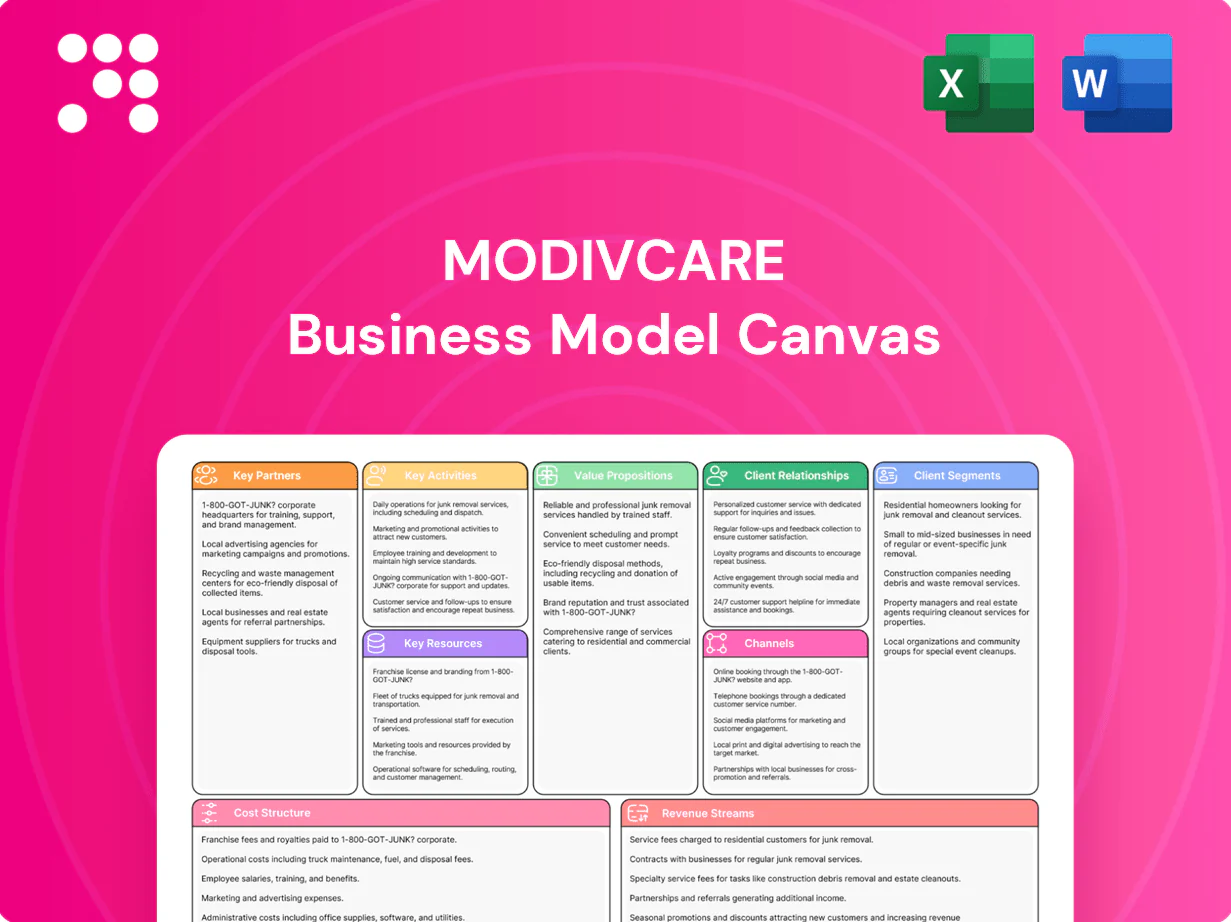
ModivCare Business Model Canvas

Unlock the Business Model Canvas for care coordination — investor-ready insights
Unlock ModivCare’s strategic blueprint with our concise Business Model Canvas—showing how the company creates value, scales operations, and monetizes care coordination. Download the full Word/Excel canvas for section-by-section analysis, competitive insights, and ready-to-use slides for investors and strategists.
Partnerships

Medicaid and Medicare Advantage payers
Contracts with MCOs and Medicare Advantage plans anchor volume and drive regional scale; Medicare Advantage enrollment exceeded 30 million in 2024, expanding the addressable population. Joint care coordination with payers improves access and adherence for high-need members, shown in studies to cut missed appointments and ED use by ~20%. Value-based, multi-year agreements align incentives on cost and outcomes and stabilize revenue visibility.
Transportation and mobility providers
Networks of NEMT fleets, rideshare partners including Lyft and specialty vehicles provide ModivCare nationwide coverage across all 50 states and support over 60 million annual trips. Rigorous credentialing and performance management maintain safety and payer compliance. Dynamic dispatch and routing boost capacity utilization and enable surge handling, while partner networks extend reach into rural markets.

Home care agencies and caregivers
Affiliations with home care agencies secure qualified personal care workers across markets, tapping into a US workforce of over 4.7 million personal care aides (BLS 2024). Standardized training and supervision maintain quality and compliance, aligning with state Medicaid requirements and reducing incident rates. Scheduling integration increases visit adherence and member satisfaction, improving on-time rates by double digits. Partners enable flexible staffing to match acuity and demand spikes.

RPM device and telehealth vendors
OEMs supply FDA-cleared RPM devices and connectivity modules while telehealth vendors integrate them into care pathways; interoperability with Epic and Cerner enables seamless EHR data flow. Vendor SLAs commonly guarantee 99.9% uptime and rapid replacement windows, and bundled procurement reduces unit costs roughly 15–25% at scale; top vendors now account for about 60% of 2024 RPM deployments.
- FDA-cleared devices integrated with Epic/Cerner
- 99.9% SLA and quick replacement
- Bundled procurement cuts unit costs 15–25%
- Top vendors ~60% share of 2024 deployments
Hospitals, ACOs, and community organizations
Care-transitions partners reduce readmissions by ensuring timely rides and home support, with 2024 studies showing SDOH interventions cut readmissions 10–20% and missed appointments by ~15%. ACOs (serving over 11 million beneficiaries in 2024) collaborate on gap-closure and SDOH services, while community-based organizations extend reach to food, housing, and social resources, creating referral pipelines that boost member engagement and outcomes.
- readmission reduction: 10–20% (2024 studies)
- missed appointment drop: ~15% (2024)
- ACO reach: >11M beneficiaries (2024)
- referral pipelines: increased engagement, measurable outcome gains
MA contracts drive scale: 30M enrollees, 60M+ NEMT trips, 15–25% savings
Contracts with MCOs/Medicare Advantage (MA) anchor volume—MA enrollment ~30M (2024). NEMT/rideshare networks support >60M annual trips and extend rural reach. RPM vendors hold ~60% share; bundled procurement cuts unit costs 15–25% and SDOH/ACO partnerships cut readmissions 10–20%.
| Metric | 2024 |
|---|---|
| MA enrollment | 30M |
| NEMT trips | 60M+ |
| RPM vendor share | ~60% |
| Procurement savings | 15–25% |
| Readmission reduction | 10–20% |
What is included in the product
 Detailed Word Document
A comprehensive, investor-ready Business Model Canvas for ModivCare detailing customer segments, channels, value propositions, revenue streams, and key partners tied to real-world NEMT and healthcare services operations; includes SWOT-linked insights and competitive advantages across all nine BMC blocks to support strategic planning and funding discussions.

 Customizable Excel Spreadsheet
High-level, editable canvas that maps ModivCare’s care coordination, non-emergency transportation, and social-determinants services to quickly identify and alleviate patient access, cost-management, and provider-network pain points.
Activities

Logistics dispatch and routing
Real-time trip assignment balances cost, timeliness, and member needs, supporting ModivCare’s operations serving millions of members and managing millions of trips annually in 2024. Algorithms optimize multi-stop routes and vehicle match to cut deadhead and improve utilization. Exceptions handling resolves no-shows and escalations via centralized dispatch and real-time messaging. Continuous KPI monitoring (on-time, trip completion, cost per trip) drives SLA adherence.
Caregiver scheduling and oversight
Recruiting, credentialing, and rostering keep a ready caregiver pool to support ModivCare’s scale of roughly 50 million annual service events (2024); automated rostering reduces overtime and idle time by ~10%, improving margin. Supervisory audits and targeted home visits enforce clinical and service quality with KPI tracking. Incident reporting, root-cause remediation, and compliance workflows maintain regulatory adherence and lower risk exposure.

RPM enrollment and monitoring
Onboarding members with devices and tailored education drives adherence, with 2024 RPM programs reporting ~25% higher medication and engagement rates; continuous vitals monitoring triggers clinician alerts for abnormal BP, glucose or O2 trends. Workflows prioritize outreach and escalation paths to reduce ED use, while aggregated data feeds inform individualized care plans and payer reporting for quality metrics and value-based contract reconciliation.

Member engagement and support
Multilingual call centers and mobile apps streamline booking and automated reminders, with appointment reminders shown to cut no-shows by up to 35% in health settings. Proactive outreach and real-time rescheduling further reduce missed visits. Accessibility accommodations address needs of roughly 26% of US adults with disabilities, while continuous feedback loops drive iterative service improvements.
- Multilingual booking and reminders
- Proactive outreach → -35% no-shows
- Accessibility for 26% of adults
- Feedback loops inform ops changes
Compliance, billing, and analytics
Claims adjudication aligns with payer rules and authorizations, ensuring approvals match member eligibility; audit-ready documentation meets HIPAA and CMS standards as of 2024. Dashboards track cost, utilization, and clinical outcomes in near real-time. Actionable insights from analytics inform contract negotiations and product design to reduce utilization and lower per-member costs.
- Claims alignment: payer rules, authorizations
- Compliance: HIPAA and CMS audit-ready records (2024)
- Dashboards: cost, utilization, outcomes
- Insights: contract negotiations, product design
Cut no-shows up to 35% and raise engagement ~25%
Real-time trip assignment and routing support millions of trips annually (2024), reducing deadhead and improving utilization. Workforce credentialing and automated rostering cut overtime/idle time ~10% across ~50M service events (2024). RPM drives ~25% higher engagement; reminders cut no-shows up to 35%, serving accessibility needs of ~26% US adults.
| Metric | 2024 Value |
|---|---|
| Annual service events | ~50M |
| RPM engagement lift | ~25% |
| No-show reduction | up to 35% |
| Rostering efficiency | ~10% |
What You See Is What You Get
Business Model Canvas
The Business Model Canvas you’re previewing for ModivCare is the actual deliverable, not a mockup. When you purchase, you’ll receive this same editable document—formatted and complete—in Word and Excel. No hidden sections or placeholders: what you see is the full professional file ready to edit, present, and use.

Unlock the Business Model Canvas for care coordination — investor-ready insights
Unlock ModivCare’s strategic blueprint with our concise Business Model Canvas—showing how the company creates value, scales operations, and monetizes care coordination. Download the full Word/Excel canvas for section-by-section analysis, competitive insights, and ready-to-use slides for investors and strategists.
Partnerships
Medicaid and Medicare Advantage payers
Contracts with MCOs and Medicare Advantage plans anchor volume and drive regional scale; Medicare Advantage enrollment exceeded 30 million in 2024, expanding the addressable population. Joint care coordination with payers improves access and adherence for high-need members, shown in studies to cut missed appointments and ED use by ~20%. Value-based, multi-year agreements align incentives on cost and outcomes and stabilize revenue visibility.
Transportation and mobility providers
Networks of NEMT fleets, rideshare partners including Lyft and specialty vehicles provide ModivCare nationwide coverage across all 50 states and support over 60 million annual trips. Rigorous credentialing and performance management maintain safety and payer compliance. Dynamic dispatch and routing boost capacity utilization and enable surge handling, while partner networks extend reach into rural markets.
Home care agencies and caregivers
Affiliations with home care agencies secure qualified personal care workers across markets, tapping into a US workforce of over 4.7 million personal care aides (BLS 2024). Standardized training and supervision maintain quality and compliance, aligning with state Medicaid requirements and reducing incident rates. Scheduling integration increases visit adherence and member satisfaction, improving on-time rates by double digits. Partners enable flexible staffing to match acuity and demand spikes.
RPM device and telehealth vendors
OEMs supply FDA-cleared RPM devices and connectivity modules while telehealth vendors integrate them into care pathways; interoperability with Epic and Cerner enables seamless EHR data flow. Vendor SLAs commonly guarantee 99.9% uptime and rapid replacement windows, and bundled procurement reduces unit costs roughly 15–25% at scale; top vendors now account for about 60% of 2024 RPM deployments.
- FDA-cleared devices integrated with Epic/Cerner
- 99.9% SLA and quick replacement
- Bundled procurement cuts unit costs 15–25%
- Top vendors ~60% share of 2024 deployments
Hospitals, ACOs, and community organizations
Care-transitions partners reduce readmissions by ensuring timely rides and home support, with 2024 studies showing SDOH interventions cut readmissions 10–20% and missed appointments by ~15%. ACOs (serving over 11 million beneficiaries in 2024) collaborate on gap-closure and SDOH services, while community-based organizations extend reach to food, housing, and social resources, creating referral pipelines that boost member engagement and outcomes.
- readmission reduction: 10–20% (2024 studies)
- missed appointment drop: ~15% (2024)
- ACO reach: >11M beneficiaries (2024)
- referral pipelines: increased engagement, measurable outcome gains
MA contracts drive scale: 30M enrollees, 60M+ NEMT trips, 15–25% savings
Contracts with MCOs/Medicare Advantage (MA) anchor volume—MA enrollment ~30M (2024). NEMT/rideshare networks support >60M annual trips and extend rural reach. RPM vendors hold ~60% share; bundled procurement cuts unit costs 15–25% and SDOH/ACO partnerships cut readmissions 10–20%.
| Metric | 2024 |
|---|---|
| MA enrollment | 30M |
| NEMT trips | 60M+ |
| RPM vendor share | ~60% |
| Procurement savings | 15–25% |
| Readmission reduction | 10–20% |
What is included in the product
Detailed Word Document
A comprehensive, investor-ready Business Model Canvas for ModivCare detailing customer segments, channels, value propositions, revenue streams, and key partners tied to real-world NEMT and healthcare services operations; includes SWOT-linked insights and competitive advantages across all nine BMC blocks to support strategic planning and funding discussions.
Customizable Excel Spreadsheet
High-level, editable canvas that maps ModivCare’s care coordination, non-emergency transportation, and social-determinants services to quickly identify and alleviate patient access, cost-management, and provider-network pain points.
Activities
Logistics dispatch and routing
Real-time trip assignment balances cost, timeliness, and member needs, supporting ModivCare’s operations serving millions of members and managing millions of trips annually in 2024. Algorithms optimize multi-stop routes and vehicle match to cut deadhead and improve utilization. Exceptions handling resolves no-shows and escalations via centralized dispatch and real-time messaging. Continuous KPI monitoring (on-time, trip completion, cost per trip) drives SLA adherence.
Caregiver scheduling and oversight
Recruiting, credentialing, and rostering keep a ready caregiver pool to support ModivCare’s scale of roughly 50 million annual service events (2024); automated rostering reduces overtime and idle time by ~10%, improving margin. Supervisory audits and targeted home visits enforce clinical and service quality with KPI tracking. Incident reporting, root-cause remediation, and compliance workflows maintain regulatory adherence and lower risk exposure.
RPM enrollment and monitoring
Onboarding members with devices and tailored education drives adherence, with 2024 RPM programs reporting ~25% higher medication and engagement rates; continuous vitals monitoring triggers clinician alerts for abnormal BP, glucose or O2 trends. Workflows prioritize outreach and escalation paths to reduce ED use, while aggregated data feeds inform individualized care plans and payer reporting for quality metrics and value-based contract reconciliation.
Member engagement and support
Multilingual call centers and mobile apps streamline booking and automated reminders, with appointment reminders shown to cut no-shows by up to 35% in health settings. Proactive outreach and real-time rescheduling further reduce missed visits. Accessibility accommodations address needs of roughly 26% of US adults with disabilities, while continuous feedback loops drive iterative service improvements.
- Multilingual booking and reminders
- Proactive outreach → -35% no-shows
- Accessibility for 26% of adults
- Feedback loops inform ops changes
Compliance, billing, and analytics
Claims adjudication aligns with payer rules and authorizations, ensuring approvals match member eligibility; audit-ready documentation meets HIPAA and CMS standards as of 2024. Dashboards track cost, utilization, and clinical outcomes in near real-time. Actionable insights from analytics inform contract negotiations and product design to reduce utilization and lower per-member costs.
- Claims alignment: payer rules, authorizations
- Compliance: HIPAA and CMS audit-ready records (2024)
- Dashboards: cost, utilization, outcomes
- Insights: contract negotiations, product design
Cut no-shows up to 35% and raise engagement ~25%
Real-time trip assignment and routing support millions of trips annually (2024), reducing deadhead and improving utilization. Workforce credentialing and automated rostering cut overtime/idle time ~10% across ~50M service events (2024). RPM drives ~25% higher engagement; reminders cut no-shows up to 35%, serving accessibility needs of ~26% US adults.
| Metric | 2024 Value |
|---|---|
| Annual service events | ~50M |
| RPM engagement lift | ~25% |
| No-show reduction | up to 35% |
| Rostering efficiency | ~10% |
What You See Is What You Get
Business Model Canvas
The Business Model Canvas you’re previewing for ModivCare is the actual deliverable, not a mockup. When you purchase, you’ll receive this same editable document—formatted and complete—in Word and Excel. No hidden sections or placeholders: what you see is the full professional file ready to edit, present, and use.
Original: $10.00
-65%$10.00
$3.50Description
Unlock the Business Model Canvas for care coordination — investor-ready insights
Unlock ModivCare’s strategic blueprint with our concise Business Model Canvas—showing how the company creates value, scales operations, and monetizes care coordination. Download the full Word/Excel canvas for section-by-section analysis, competitive insights, and ready-to-use slides for investors and strategists.
Partnerships
Medicaid and Medicare Advantage payers
Contracts with MCOs and Medicare Advantage plans anchor volume and drive regional scale; Medicare Advantage enrollment exceeded 30 million in 2024, expanding the addressable population. Joint care coordination with payers improves access and adherence for high-need members, shown in studies to cut missed appointments and ED use by ~20%. Value-based, multi-year agreements align incentives on cost and outcomes and stabilize revenue visibility.
Transportation and mobility providers
Networks of NEMT fleets, rideshare partners including Lyft and specialty vehicles provide ModivCare nationwide coverage across all 50 states and support over 60 million annual trips. Rigorous credentialing and performance management maintain safety and payer compliance. Dynamic dispatch and routing boost capacity utilization and enable surge handling, while partner networks extend reach into rural markets.
Home care agencies and caregivers
Affiliations with home care agencies secure qualified personal care workers across markets, tapping into a US workforce of over 4.7 million personal care aides (BLS 2024). Standardized training and supervision maintain quality and compliance, aligning with state Medicaid requirements and reducing incident rates. Scheduling integration increases visit adherence and member satisfaction, improving on-time rates by double digits. Partners enable flexible staffing to match acuity and demand spikes.
RPM device and telehealth vendors
OEMs supply FDA-cleared RPM devices and connectivity modules while telehealth vendors integrate them into care pathways; interoperability with Epic and Cerner enables seamless EHR data flow. Vendor SLAs commonly guarantee 99.9% uptime and rapid replacement windows, and bundled procurement reduces unit costs roughly 15–25% at scale; top vendors now account for about 60% of 2024 RPM deployments.
- FDA-cleared devices integrated with Epic/Cerner
- 99.9% SLA and quick replacement
- Bundled procurement cuts unit costs 15–25%
- Top vendors ~60% share of 2024 deployments
Hospitals, ACOs, and community organizations
Care-transitions partners reduce readmissions by ensuring timely rides and home support, with 2024 studies showing SDOH interventions cut readmissions 10–20% and missed appointments by ~15%. ACOs (serving over 11 million beneficiaries in 2024) collaborate on gap-closure and SDOH services, while community-based organizations extend reach to food, housing, and social resources, creating referral pipelines that boost member engagement and outcomes.
- readmission reduction: 10–20% (2024 studies)
- missed appointment drop: ~15% (2024)
- ACO reach: >11M beneficiaries (2024)
- referral pipelines: increased engagement, measurable outcome gains
MA contracts drive scale: 30M enrollees, 60M+ NEMT trips, 15–25% savings
Contracts with MCOs/Medicare Advantage (MA) anchor volume—MA enrollment ~30M (2024). NEMT/rideshare networks support >60M annual trips and extend rural reach. RPM vendors hold ~60% share; bundled procurement cuts unit costs 15–25% and SDOH/ACO partnerships cut readmissions 10–20%.
| Metric | 2024 |
|---|---|
| MA enrollment | 30M |
| NEMT trips | 60M+ |
| RPM vendor share | ~60% |
| Procurement savings | 15–25% |
| Readmission reduction | 10–20% |
What is included in the product
Detailed Word Document
A comprehensive, investor-ready Business Model Canvas for ModivCare detailing customer segments, channels, value propositions, revenue streams, and key partners tied to real-world NEMT and healthcare services operations; includes SWOT-linked insights and competitive advantages across all nine BMC blocks to support strategic planning and funding discussions.
Customizable Excel Spreadsheet
High-level, editable canvas that maps ModivCare’s care coordination, non-emergency transportation, and social-determinants services to quickly identify and alleviate patient access, cost-management, and provider-network pain points.
Activities
Logistics dispatch and routing
Real-time trip assignment balances cost, timeliness, and member needs, supporting ModivCare’s operations serving millions of members and managing millions of trips annually in 2024. Algorithms optimize multi-stop routes and vehicle match to cut deadhead and improve utilization. Exceptions handling resolves no-shows and escalations via centralized dispatch and real-time messaging. Continuous KPI monitoring (on-time, trip completion, cost per trip) drives SLA adherence.
Caregiver scheduling and oversight
Recruiting, credentialing, and rostering keep a ready caregiver pool to support ModivCare’s scale of roughly 50 million annual service events (2024); automated rostering reduces overtime and idle time by ~10%, improving margin. Supervisory audits and targeted home visits enforce clinical and service quality with KPI tracking. Incident reporting, root-cause remediation, and compliance workflows maintain regulatory adherence and lower risk exposure.
RPM enrollment and monitoring
Onboarding members with devices and tailored education drives adherence, with 2024 RPM programs reporting ~25% higher medication and engagement rates; continuous vitals monitoring triggers clinician alerts for abnormal BP, glucose or O2 trends. Workflows prioritize outreach and escalation paths to reduce ED use, while aggregated data feeds inform individualized care plans and payer reporting for quality metrics and value-based contract reconciliation.
Member engagement and support
Multilingual call centers and mobile apps streamline booking and automated reminders, with appointment reminders shown to cut no-shows by up to 35% in health settings. Proactive outreach and real-time rescheduling further reduce missed visits. Accessibility accommodations address needs of roughly 26% of US adults with disabilities, while continuous feedback loops drive iterative service improvements.
- Multilingual booking and reminders
- Proactive outreach → -35% no-shows
- Accessibility for 26% of adults
- Feedback loops inform ops changes
Compliance, billing, and analytics
Claims adjudication aligns with payer rules and authorizations, ensuring approvals match member eligibility; audit-ready documentation meets HIPAA and CMS standards as of 2024. Dashboards track cost, utilization, and clinical outcomes in near real-time. Actionable insights from analytics inform contract negotiations and product design to reduce utilization and lower per-member costs.
- Claims alignment: payer rules, authorizations
- Compliance: HIPAA and CMS audit-ready records (2024)
- Dashboards: cost, utilization, outcomes
- Insights: contract negotiations, product design
Cut no-shows up to 35% and raise engagement ~25%
Real-time trip assignment and routing support millions of trips annually (2024), reducing deadhead and improving utilization. Workforce credentialing and automated rostering cut overtime/idle time ~10% across ~50M service events (2024). RPM drives ~25% higher engagement; reminders cut no-shows up to 35%, serving accessibility needs of ~26% US adults.
| Metric | 2024 Value |
|---|---|
| Annual service events | ~50M |
| RPM engagement lift | ~25% |
| No-show reduction | up to 35% |
| Rostering efficiency | ~10% |
What You See Is What You Get
Business Model Canvas
The Business Model Canvas you’re previewing for ModivCare is the actual deliverable, not a mockup. When you purchase, you’ll receive this same editable document—formatted and complete—in Word and Excel. No hidden sections or placeholders: what you see is the full professional file ready to edit, present, and use.











