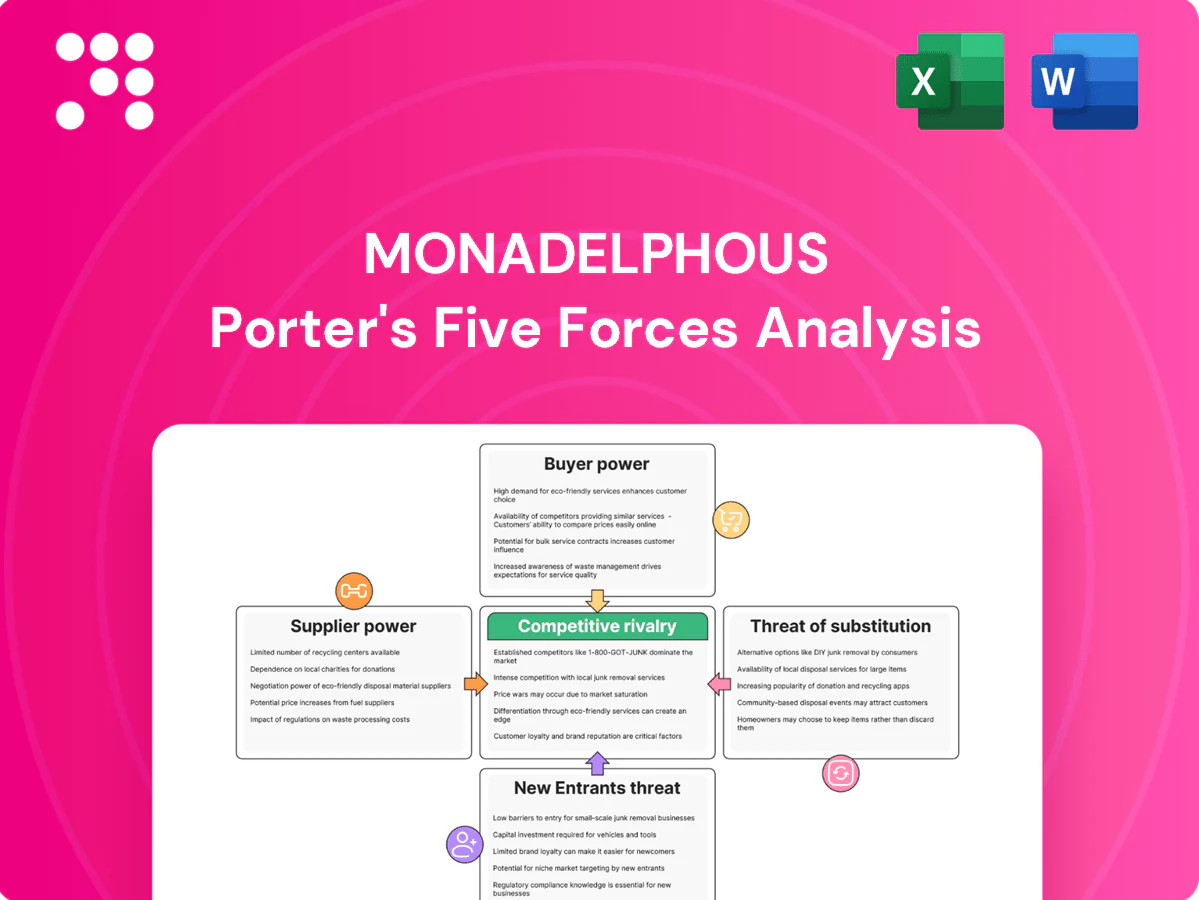
Monadelphous Porter's Five Forces Analysis

Go Beyond the Preview—Access the Full Strategic Report
Monadelphous faces moderate supplier power, cyclical client demand and high project competition that combine to shape its margins and growth prospects. This snapshot highlights key risk areas like contract concentration and entry barriers but only scratches the surface. Unlock the full Porter's Five Forces Analysis to get force-by-force ratings, visuals and actionable strategy tailored to Monadelphous.
Suppliers Bargaining Power

Skilled labor scarcity
Monadelphous depends on highly skilled trades and engineers, a segment that tightened during the 2024 resources upcycle with wage growth in remote project hubs reported at up to 8% year-on-year. Tight labor markets in remote WA and Pilbara lift turnover risk and subcontract rates, compressing margins. Prolonged industrial relations and 6–12 month training lead times further constrain supply. The net effect is higher input costs and increased schedule risk.
Specialized OEMs and spares
Critical equipment and spares for Monadelphous are sourced from a limited set of specialized OEMs, creating concentrated supplier exposure. Sole-source arrangements and lead times that can extend up to 52 weeks give suppliers notable pricing and delivery leverage. Any supplier disruption directly reduces maintenance uptime and delays project delivery, impacting cash flow and margins. Strategic sourcing and multi-vendor frameworks are essential to mitigate this supplier power.

Subcontractor dependency
Peaks in workload force Monadelphous to rely on subcontractors for niche trades and broad regional coverage, increasing bargaining power where specialist pools are thin. Concentrated local subcontractor markets can push day rates and mobilization fees higher, squeezing margins. Variable quality and safety performance raise supervision and compliance costs. Preferred panels and performance-linked incentives are used to rebalance supplier power.

Materials price volatility
Materials price volatility is high for Monadelphous as steel and cement moved roughly 20–30% 2022–24, and consumables track commodity swings; suppliers have applied surcharges up to ~8% on long‑dated contracts. Indexation and hedging typically cut exposure by about 50–60% but cannot eliminate basis risk. Monadelphous procurement scale offsets supplier leverage by roughly 15–25%.
- Steel/cement price swing 20–30% (2022–24)
- Surcharges reported up to ~8%
- Indexation/hedging reduces exposure ~50–60%
- Procurement scale offsets ~15–25% of supplier power
Remote logistics and camps
Remote site access, transport and accommodation for Monadelphous are typically provided by specialist vendors, concentrating supply near mine and energy sites and raising switching costs; in 2024 these vendors remained the primary providers for most Western Australian and Pilbara projects. Weather and limited infrastructure further amplify supplier influence, and early logistics planning can mitigate but not remove that bargaining power.
- Specialist vendors dominate supply near sites
- High switching costs for clients
- Weather/infrastructure increase supplier leverage
- Early planning reduces, not eliminates, supplier power
Supplier squeeze: 8% wage growth, long lead times, partial hedging
Skilled-labour tightness (up to 8% y/y in 2024), long OEM lead times (6–52 weeks) and remote logistics concentrate supplier power, raising costs and schedule risk; surcharges up to ~8% and material swings 20–30% (2022–24) amplify pressure, while indexation/hedging (50–60% cover) and procurement scale (offset ~15–25%) partially mitigate.
| Metric | Value |
|---|---|
| Labour wage growth 2024 | ~8% y/y |
| OEM lead times | 6–52 weeks |
| Material swings (2022–24) | 20–30% |
| Surcharges | ~8% |
| Hedging/indexation | 50–60% |
| Procurement scale offset | 15–25% |
What is included in the product
 Detailed Word Document
Dissects Monadelphous's competitive landscape, detailing rivalry, supplier and buyer power, barriers to entry, substitutes, and emerging disruptors to assess pricing and profitability pressures; includes strategic implications and industry data to inform investor and management decisions.

 Customizable Excel Spreadsheet
A clear, one-sheet Porter's Five Forces for Monadelphous—distills competitive pressures across suppliers, customers, new entrants, substitutes and industry rivalry for quick, board-ready strategic decisions.
Customers Bargaining Power

Concentrated major clients
Mining majors, energy operators and governments dominate Monadelphous demand, reflecting Australia’s resources sector which comprised roughly 60% of merchandise export value in 2024, giving these buyers outsized leverage. Their scale, professional procurement teams and panel/prequalification tenders drive intense price pressure and contract standardisation. Vendor rationalisation programs by majors can cut volumes to non-preferred suppliers, concentrating spend with a few chosen contractors.
Competitive tendering
Most Monadelphous work is awarded via open or panel tenders, and in FY2024 the group reported revenue of AUD 1.04 billion, highlighting scale exposed to competitive bidding. Comparable service offerings make price the key differentiator, with buyers using bid competition to compress margins across projects. Non-price factors such as safety record and delivery track record matter, but often only at the margin.

Switching and multi-sourcing
Frameworks in FY2024 continued to let buyers split packages across multiple contractors, enabling multi-sourcing and reducing dependence on a single provider. Switching costs remain moderate because scopes are standardized and site onboarding processes are repeatable. Performance KPIs trigger reallocation when service slips, with many clients enforcing remedial KPIs and liquidated damages. This dynamic keeps contractors’ pricing and delivery disciplined.

Cyclical spend control
Cyclical spend control heightens customer bargaining power as capex and opex swing with commodity cycles and energy prices; in FY2024 Monadelphous reported ~AUD 1.1bn revenue, highlighting exposure to project timing. In downturns buyers defer projects and renegotiate rates, pushing volume risk down to contractors and forcing margin compression. Suppliers must remain agile on cost and capacity to retain contracts.
- Capex/opex tied to commodity cycles
- Downturns drive deferrals and rate renegotiation
- Volume risk shifts to contractors
- Need for supplier flexibility on cost/capacity
Stringent HSE and ESG demands
Clients impose rigorous HSE, sustainability and indigenous-participation standards; failure to comply risks contract termination or financial penalties and elevates bid scrutiny.
Meeting these mandates increases project cost and delivery complexity, compressing margins for engineering and construction firms like Monadelphous.
Buyers leverage multi-dimensional scorecards—safety, emissions, indigenous engagement—so awards hinge on compliance and performance, not just price.
- HSE/ESG-linked awards
- Penalty/contract-loss risk
- Higher compliance costs
- Scorecard-driven leverage
Buyers wield leverage as Australian resources hit ~60% of export value, pressuring margins
Major buyers (mining, energy, government) hold strong leverage: Australia's resources made up ~60% of merchandise export value in 2024, and Monadelphous reported FY2024 revenue of AUD 1.04bn. Panel/framework tendering and standardized scopes drive price competition and margin pressure. Cyclical capex/opex swings let buyers defer projects and renegotiate, shifting volume risk to contractors.
| Metric | 2024 |
|---|---|
| Monadelphous FY2024 revenue | AUD 1.04bn |
| Resources share of merchandise exports | ~60% |
What You See Is What You Get
Monadelphous Porter's Five Forces Analysis
This preview shows the exact Porter’s Five Forces analysis of Monadelphous you'll receive—no surprises, no placeholders. The report evaluates competitive rivalry, supplier and buyer power, and the threats of substitutes and new entrants with concise, evidence-based conclusions. Fully formatted and ready for immediate download after purchase.

Go Beyond the Preview—Access the Full Strategic Report
Monadelphous faces moderate supplier power, cyclical client demand and high project competition that combine to shape its margins and growth prospects. This snapshot highlights key risk areas like contract concentration and entry barriers but only scratches the surface. Unlock the full Porter's Five Forces Analysis to get force-by-force ratings, visuals and actionable strategy tailored to Monadelphous.
Suppliers Bargaining Power
Skilled labor scarcity
Monadelphous depends on highly skilled trades and engineers, a segment that tightened during the 2024 resources upcycle with wage growth in remote project hubs reported at up to 8% year-on-year. Tight labor markets in remote WA and Pilbara lift turnover risk and subcontract rates, compressing margins. Prolonged industrial relations and 6–12 month training lead times further constrain supply. The net effect is higher input costs and increased schedule risk.
Specialized OEMs and spares
Critical equipment and spares for Monadelphous are sourced from a limited set of specialized OEMs, creating concentrated supplier exposure. Sole-source arrangements and lead times that can extend up to 52 weeks give suppliers notable pricing and delivery leverage. Any supplier disruption directly reduces maintenance uptime and delays project delivery, impacting cash flow and margins. Strategic sourcing and multi-vendor frameworks are essential to mitigate this supplier power.
Subcontractor dependency
Peaks in workload force Monadelphous to rely on subcontractors for niche trades and broad regional coverage, increasing bargaining power where specialist pools are thin. Concentrated local subcontractor markets can push day rates and mobilization fees higher, squeezing margins. Variable quality and safety performance raise supervision and compliance costs. Preferred panels and performance-linked incentives are used to rebalance supplier power.
Materials price volatility
Materials price volatility is high for Monadelphous as steel and cement moved roughly 20–30% 2022–24, and consumables track commodity swings; suppliers have applied surcharges up to ~8% on long‑dated contracts. Indexation and hedging typically cut exposure by about 50–60% but cannot eliminate basis risk. Monadelphous procurement scale offsets supplier leverage by roughly 15–25%.
- Steel/cement price swing 20–30% (2022–24)
- Surcharges reported up to ~8%
- Indexation/hedging reduces exposure ~50–60%
- Procurement scale offsets ~15–25% of supplier power
Remote logistics and camps
Remote site access, transport and accommodation for Monadelphous are typically provided by specialist vendors, concentrating supply near mine and energy sites and raising switching costs; in 2024 these vendors remained the primary providers for most Western Australian and Pilbara projects. Weather and limited infrastructure further amplify supplier influence, and early logistics planning can mitigate but not remove that bargaining power.
- Specialist vendors dominate supply near sites
- High switching costs for clients
- Weather/infrastructure increase supplier leverage
- Early planning reduces, not eliminates, supplier power
Supplier squeeze: 8% wage growth, long lead times, partial hedging
Skilled-labour tightness (up to 8% y/y in 2024), long OEM lead times (6–52 weeks) and remote logistics concentrate supplier power, raising costs and schedule risk; surcharges up to ~8% and material swings 20–30% (2022–24) amplify pressure, while indexation/hedging (50–60% cover) and procurement scale (offset ~15–25%) partially mitigate.
| Metric | Value |
|---|---|
| Labour wage growth 2024 | ~8% y/y |
| OEM lead times | 6–52 weeks |
| Material swings (2022–24) | 20–30% |
| Surcharges | ~8% |
| Hedging/indexation | 50–60% |
| Procurement scale offset | 15–25% |
What is included in the product
Detailed Word Document
Dissects Monadelphous's competitive landscape, detailing rivalry, supplier and buyer power, barriers to entry, substitutes, and emerging disruptors to assess pricing and profitability pressures; includes strategic implications and industry data to inform investor and management decisions.
Customizable Excel Spreadsheet
A clear, one-sheet Porter's Five Forces for Monadelphous—distills competitive pressures across suppliers, customers, new entrants, substitutes and industry rivalry for quick, board-ready strategic decisions.
Customers Bargaining Power
Concentrated major clients
Mining majors, energy operators and governments dominate Monadelphous demand, reflecting Australia’s resources sector which comprised roughly 60% of merchandise export value in 2024, giving these buyers outsized leverage. Their scale, professional procurement teams and panel/prequalification tenders drive intense price pressure and contract standardisation. Vendor rationalisation programs by majors can cut volumes to non-preferred suppliers, concentrating spend with a few chosen contractors.
Competitive tendering
Most Monadelphous work is awarded via open or panel tenders, and in FY2024 the group reported revenue of AUD 1.04 billion, highlighting scale exposed to competitive bidding. Comparable service offerings make price the key differentiator, with buyers using bid competition to compress margins across projects. Non-price factors such as safety record and delivery track record matter, but often only at the margin.
Switching and multi-sourcing
Frameworks in FY2024 continued to let buyers split packages across multiple contractors, enabling multi-sourcing and reducing dependence on a single provider. Switching costs remain moderate because scopes are standardized and site onboarding processes are repeatable. Performance KPIs trigger reallocation when service slips, with many clients enforcing remedial KPIs and liquidated damages. This dynamic keeps contractors’ pricing and delivery disciplined.
Cyclical spend control
Cyclical spend control heightens customer bargaining power as capex and opex swing with commodity cycles and energy prices; in FY2024 Monadelphous reported ~AUD 1.1bn revenue, highlighting exposure to project timing. In downturns buyers defer projects and renegotiate rates, pushing volume risk down to contractors and forcing margin compression. Suppliers must remain agile on cost and capacity to retain contracts.
- Capex/opex tied to commodity cycles
- Downturns drive deferrals and rate renegotiation
- Volume risk shifts to contractors
- Need for supplier flexibility on cost/capacity
Stringent HSE and ESG demands
Clients impose rigorous HSE, sustainability and indigenous-participation standards; failure to comply risks contract termination or financial penalties and elevates bid scrutiny.
Meeting these mandates increases project cost and delivery complexity, compressing margins for engineering and construction firms like Monadelphous.
Buyers leverage multi-dimensional scorecards—safety, emissions, indigenous engagement—so awards hinge on compliance and performance, not just price.
- HSE/ESG-linked awards
- Penalty/contract-loss risk
- Higher compliance costs
- Scorecard-driven leverage
Buyers wield leverage as Australian resources hit ~60% of export value, pressuring margins
Major buyers (mining, energy, government) hold strong leverage: Australia's resources made up ~60% of merchandise export value in 2024, and Monadelphous reported FY2024 revenue of AUD 1.04bn. Panel/framework tendering and standardized scopes drive price competition and margin pressure. Cyclical capex/opex swings let buyers defer projects and renegotiate, shifting volume risk to contractors.
| Metric | 2024 |
|---|---|
| Monadelphous FY2024 revenue | AUD 1.04bn |
| Resources share of merchandise exports | ~60% |
What You See Is What You Get
Monadelphous Porter's Five Forces Analysis
This preview shows the exact Porter’s Five Forces analysis of Monadelphous you'll receive—no surprises, no placeholders. The report evaluates competitive rivalry, supplier and buyer power, and the threats of substitutes and new entrants with concise, evidence-based conclusions. Fully formatted and ready for immediate download after purchase.
Original: $10.00
-65%$10.00
$3.50Description
Go Beyond the Preview—Access the Full Strategic Report
Monadelphous faces moderate supplier power, cyclical client demand and high project competition that combine to shape its margins and growth prospects. This snapshot highlights key risk areas like contract concentration and entry barriers but only scratches the surface. Unlock the full Porter's Five Forces Analysis to get force-by-force ratings, visuals and actionable strategy tailored to Monadelphous.
Suppliers Bargaining Power
Skilled labor scarcity
Monadelphous depends on highly skilled trades and engineers, a segment that tightened during the 2024 resources upcycle with wage growth in remote project hubs reported at up to 8% year-on-year. Tight labor markets in remote WA and Pilbara lift turnover risk and subcontract rates, compressing margins. Prolonged industrial relations and 6–12 month training lead times further constrain supply. The net effect is higher input costs and increased schedule risk.
Specialized OEMs and spares
Critical equipment and spares for Monadelphous are sourced from a limited set of specialized OEMs, creating concentrated supplier exposure. Sole-source arrangements and lead times that can extend up to 52 weeks give suppliers notable pricing and delivery leverage. Any supplier disruption directly reduces maintenance uptime and delays project delivery, impacting cash flow and margins. Strategic sourcing and multi-vendor frameworks are essential to mitigate this supplier power.
Subcontractor dependency
Peaks in workload force Monadelphous to rely on subcontractors for niche trades and broad regional coverage, increasing bargaining power where specialist pools are thin. Concentrated local subcontractor markets can push day rates and mobilization fees higher, squeezing margins. Variable quality and safety performance raise supervision and compliance costs. Preferred panels and performance-linked incentives are used to rebalance supplier power.
Materials price volatility
Materials price volatility is high for Monadelphous as steel and cement moved roughly 20–30% 2022–24, and consumables track commodity swings; suppliers have applied surcharges up to ~8% on long‑dated contracts. Indexation and hedging typically cut exposure by about 50–60% but cannot eliminate basis risk. Monadelphous procurement scale offsets supplier leverage by roughly 15–25%.
- Steel/cement price swing 20–30% (2022–24)
- Surcharges reported up to ~8%
- Indexation/hedging reduces exposure ~50–60%
- Procurement scale offsets ~15–25% of supplier power
Remote logistics and camps
Remote site access, transport and accommodation for Monadelphous are typically provided by specialist vendors, concentrating supply near mine and energy sites and raising switching costs; in 2024 these vendors remained the primary providers for most Western Australian and Pilbara projects. Weather and limited infrastructure further amplify supplier influence, and early logistics planning can mitigate but not remove that bargaining power.
- Specialist vendors dominate supply near sites
- High switching costs for clients
- Weather/infrastructure increase supplier leverage
- Early planning reduces, not eliminates, supplier power
Supplier squeeze: 8% wage growth, long lead times, partial hedging
Skilled-labour tightness (up to 8% y/y in 2024), long OEM lead times (6–52 weeks) and remote logistics concentrate supplier power, raising costs and schedule risk; surcharges up to ~8% and material swings 20–30% (2022–24) amplify pressure, while indexation/hedging (50–60% cover) and procurement scale (offset ~15–25%) partially mitigate.
| Metric | Value |
|---|---|
| Labour wage growth 2024 | ~8% y/y |
| OEM lead times | 6–52 weeks |
| Material swings (2022–24) | 20–30% |
| Surcharges | ~8% |
| Hedging/indexation | 50–60% |
| Procurement scale offset | 15–25% |
What is included in the product
Detailed Word Document
Dissects Monadelphous's competitive landscape, detailing rivalry, supplier and buyer power, barriers to entry, substitutes, and emerging disruptors to assess pricing and profitability pressures; includes strategic implications and industry data to inform investor and management decisions.
Customizable Excel Spreadsheet
A clear, one-sheet Porter's Five Forces for Monadelphous—distills competitive pressures across suppliers, customers, new entrants, substitutes and industry rivalry for quick, board-ready strategic decisions.
Customers Bargaining Power
Concentrated major clients
Mining majors, energy operators and governments dominate Monadelphous demand, reflecting Australia’s resources sector which comprised roughly 60% of merchandise export value in 2024, giving these buyers outsized leverage. Their scale, professional procurement teams and panel/prequalification tenders drive intense price pressure and contract standardisation. Vendor rationalisation programs by majors can cut volumes to non-preferred suppliers, concentrating spend with a few chosen contractors.
Competitive tendering
Most Monadelphous work is awarded via open or panel tenders, and in FY2024 the group reported revenue of AUD 1.04 billion, highlighting scale exposed to competitive bidding. Comparable service offerings make price the key differentiator, with buyers using bid competition to compress margins across projects. Non-price factors such as safety record and delivery track record matter, but often only at the margin.
Switching and multi-sourcing
Frameworks in FY2024 continued to let buyers split packages across multiple contractors, enabling multi-sourcing and reducing dependence on a single provider. Switching costs remain moderate because scopes are standardized and site onboarding processes are repeatable. Performance KPIs trigger reallocation when service slips, with many clients enforcing remedial KPIs and liquidated damages. This dynamic keeps contractors’ pricing and delivery disciplined.
Cyclical spend control
Cyclical spend control heightens customer bargaining power as capex and opex swing with commodity cycles and energy prices; in FY2024 Monadelphous reported ~AUD 1.1bn revenue, highlighting exposure to project timing. In downturns buyers defer projects and renegotiate rates, pushing volume risk down to contractors and forcing margin compression. Suppliers must remain agile on cost and capacity to retain contracts.
- Capex/opex tied to commodity cycles
- Downturns drive deferrals and rate renegotiation
- Volume risk shifts to contractors
- Need for supplier flexibility on cost/capacity
Stringent HSE and ESG demands
Clients impose rigorous HSE, sustainability and indigenous-participation standards; failure to comply risks contract termination or financial penalties and elevates bid scrutiny.
Meeting these mandates increases project cost and delivery complexity, compressing margins for engineering and construction firms like Monadelphous.
Buyers leverage multi-dimensional scorecards—safety, emissions, indigenous engagement—so awards hinge on compliance and performance, not just price.
- HSE/ESG-linked awards
- Penalty/contract-loss risk
- Higher compliance costs
- Scorecard-driven leverage
Buyers wield leverage as Australian resources hit ~60% of export value, pressuring margins
Major buyers (mining, energy, government) hold strong leverage: Australia's resources made up ~60% of merchandise export value in 2024, and Monadelphous reported FY2024 revenue of AUD 1.04bn. Panel/framework tendering and standardized scopes drive price competition and margin pressure. Cyclical capex/opex swings let buyers defer projects and renegotiate, shifting volume risk to contractors.
| Metric | 2024 |
|---|---|
| Monadelphous FY2024 revenue | AUD 1.04bn |
| Resources share of merchandise exports | ~60% |
What You See Is What You Get
Monadelphous Porter's Five Forces Analysis
This preview shows the exact Porter’s Five Forces analysis of Monadelphous you'll receive—no surprises, no placeholders. The report evaluates competitive rivalry, supplier and buyer power, and the threats of substitutes and new entrants with concise, evidence-based conclusions. Fully formatted and ready for immediate download after purchase.











