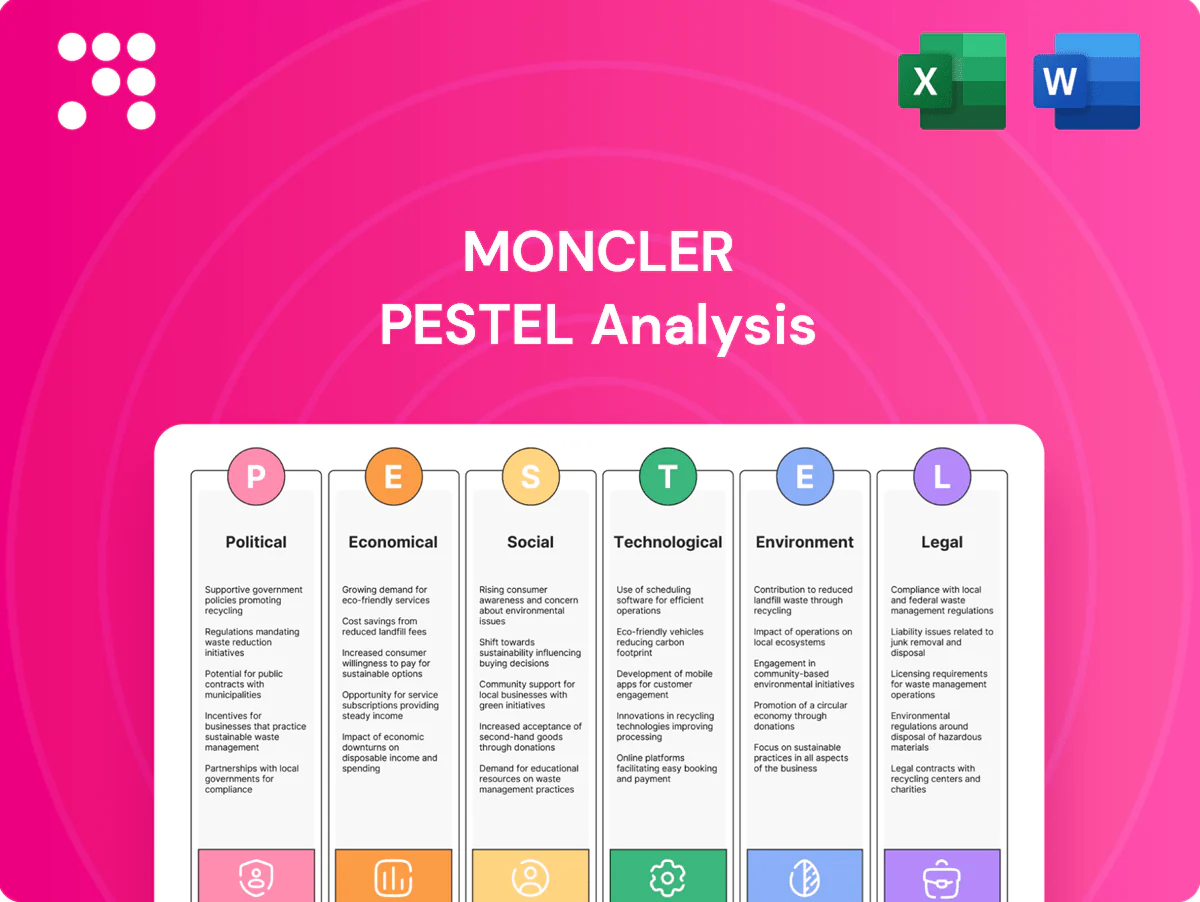
Moncler PESTLE Analysis

Make Smarter Strategic Decisions with a Complete PESTEL View
Discover how political shifts, economic cycles, social trends, technological advances, legal changes, and environmental pressures are reshaping Moncler's strategy and growth prospects. Our concise PESTLE highlights key risks and opportunities for investors and strategists. Purchase the full analysis to access the detailed, actionable insights you need now.
Political factors

Trade policy volatility
Shifts in EU–US–China trade relations can change tariffs on apparel and luxury goods, with duties often exceeding 10% on certain items, raising cost pressures. Moncler’s global sourcing and sales across over 70 countries expose it to customs delays and higher duties. Political tensions or sanctions can disrupt distribution in key markets, while diversified logistics and proactive customs planning help mitigate exposure.
Geopolitical instability
Geopolitical instability, including conflicts and sanctions, can cut demand from affected regions and disrupt supply routes, threatening Moncler’s global sales after reported 2023 revenues around €2.0bn. Tourism to European luxury hubs recovered to roughly 88% of 2019 levels by 2024, but can drop sharply in crises, hitting store traffic and wholesale partners. Store operations in sensitive markets face heightened risk; scenario planning and flexible inventories are critical.

Industrial policy in Europe
EU industrial policy—backed by the NextGenerationEU recovery package of €806.9bn and the 2021–27 MFF of €1.074tn—drives nearshoring, sustainability and digitalisation that shape Moncler’s manufacturing choices. Italian and EU grants and tax incentives for innovation and craftsmanship support premium supply chains. Compliance with EU Green Deal targets (climate neutrality by 2050) and emerging due‑diligence rules raises costs but boosts brand reputation. Local manufacturing clusters also lower geopolitical and supply‑chain risk.

Tourism and visa regimes
Outbound travel from China, the Middle East and the US drives luxury spending in Europe and Asia; Bain & Company 2024 reports Chinese tourist luxury spending recovered to about 90% of 2019 levels. Visa policies and bilateral relations directly affect shopper traffic, and airports plus flagship stores are highly sensitive to tourist flows. Moncler must balance travel-retail focus with domestic demand in its marketing mix.
- Travel-driven sales: high share in gateway cities
- Visa barriers: reduce tourist footfall quickly
- Airports/flagships: peak exposure to international spend
- Marketing: allocate between travel retail and local channels
Public health preparedness
Pandemic responses and border controls can abruptly shut retail and supply chains despite WHO ending the COVID-19 PHEIC on 5 May 2023; sudden restrictions still risk regional store closures and freight delays. Shifts in limits on gatherings and retail hours directly reduce footfall; government support schemes such as EU SURE (about 89.6 billion euros) have temporarily cushioned labor costs. Building online and omnichannel resilience offsets policy shocks as global e-commerce reached roughly 24.3% of retail sales in 2024.
- PHEIC end: 5 May 2023
- EU SURE: ~89.6 billion EUR
- Global e-commerce: ~24.3% of retail sales (2024)
- Risk: sudden border/store closures reduce footfall and disrupt supply chains
Tariffs >10% and sanctions hit 70+ markets; 2023 revenue €2.0bn; e-commerce 24.3%
Trade tensions, tariffs >10% and sanctions raise costs and disrupt distribution across 70+ markets; 2023 revenues ~€2.0bn increase exposure. Tourism recovery (~88–90% of 2019) and visas drive store traffic; e‑commerce ~24.3% of retail sales (2024) cushions shocks.
| Indicator | Value |
|---|---|
| Tariffs | >10% |
| 2023 revenue | €2.0bn |
| Tourism recovery | 88–90% |
| E‑commerce (2024) | 24.3% |
What is included in the product
 Detailed Word Document
Explores how Political, Economic, Social, Technological, Environmental and Legal forces uniquely affect Moncler, using data-driven subpoints and market-specific examples; designed for executives and investors to identify risks, opportunities and forward-looking scenarios ready for decks and strategic plans.

 Customizable Excel Spreadsheet
A concise, visually segmented Moncler PESTLE summary that can be dropped into presentations or planning sessions to quickly align teams on external risks, market positioning and strategic implications.
Economic factors

Luxury demand cycles
High-end apparel is cyclical and tied to wealth effects and equity markets; Bain & Company estimated the personal luxury goods market near €350bn in 2023 with a mid-single-digit growth outlook for 2024. Slowdowns in the US, China, or Europe can defer discretionary purchases and dent near-term volumes. Moncler’s strong brand equity and core outerwear are more resilient than many fashion peers, and capsule drops plus pricing power help defend margins.
FX and inflation pressures
Euro strength (around EUR/USD ~1.10 mid-2025) compresses reported revenues from USD and CNY sales, reducing euro-denominated top line when translating key markets. Input-cost inflation in fabrics, energy and logistics—with euro-area inflation about 2.5% in 2024 (Eurostat)—squeezes gross margins. Pricing, product mix and active hedging are essential to protect margins, while localized production and long-term contracts reduce FX and input volatility.

China consumer normalization
China's 2024 recovery, with IMF projecting GDP growth near 5.2%, and Hainan duty‑free sales exceeding RMB 66.7bn in 2023, is pivotal for Moncler; a slower rebound or ongoing property stress could dampen aspirational demand. Diversifying expansion into the US, Korea and Middle East reduces concentration risk, while targeted collections tailored to regional preferences boost resilience and spend per customer.

Wholesale vs DTC mix
Directly operated stores and e‑commerce support margin and brand control; Moncler reported net revenues of €2,069.6m in 2023, with DTC the majority channel per the 2023 Annual Report. Wholesale rationalization lowers near‑term volumes but improves positioning and ASPs. Omnichannel services raise conversion and basket size while inventory discipline preserves exclusivity.
- DTC focus: majority channel in 2023
- 2023 revenue: €2,069.6m
- Wholesale cut improves brand control
- Omnichannel increases conversion & basket
- Inventory discipline protects pricing
Tourist vs local spend
Currency differentials drive shoppers from home markets to stronger-currency destinations; UNWTO reports 2023 international arrivals recovered to about 85% of 2019, amplifying cross-border luxury spend. Repatriation of spend demands localized assortments and CRM to convert tourists into locals year-round. Destination flagships must capture peak seasons and data-driven allocation smooths inventory and revenue volatility.
- currency-shift
- local-assortment
- CRM-repatriation
- peak-capture
- data-allocation
Tariffs >10% and sanctions hit 70+ markets; 2023 revenue €2.0bn; e-commerce 24.3%
High-end apparel is cyclical; Bain estimated personal luxury ~€350bn in 2023, Moncler revenue €2,069.6m (2023) and pricing power cushions downturns. Euro ~1.10 (mid-2025) and 2024 euro-area inflation ~2.5% squeeze margins; hedging, local sourcing and pricing protect gross margin. China growth ~5.2% (IMF 2024) and Hainan RMB66.7bn duty‑free drive demand; DTC and omnichannel reduce wholesale risk.
| Metric | Value |
|---|---|
| 2023 revenue | €2,069.6m |
| Luxury market 2023 | €350bn |
| EUR/USD mid‑2025 | ~1.10 |
| Euro area inflation 2024 | ~2.5% |
| China GDP 2024 (IMF) | ~5.2% |
What You See Is What You Get
Moncler PESTLE Analysis
The preview shown here is the exact Moncler PESTLE document you’ll receive after purchase—fully formatted and ready to use. It contains the same structured political, economic, social, technological, legal and environmental analysis visible now. No placeholders, no surprises. You’ll download this finished file immediately after payment.

Make Smarter Strategic Decisions with a Complete PESTEL View
Discover how political shifts, economic cycles, social trends, technological advances, legal changes, and environmental pressures are reshaping Moncler's strategy and growth prospects. Our concise PESTLE highlights key risks and opportunities for investors and strategists. Purchase the full analysis to access the detailed, actionable insights you need now.
Political factors
Trade policy volatility
Shifts in EU–US–China trade relations can change tariffs on apparel and luxury goods, with duties often exceeding 10% on certain items, raising cost pressures. Moncler’s global sourcing and sales across over 70 countries expose it to customs delays and higher duties. Political tensions or sanctions can disrupt distribution in key markets, while diversified logistics and proactive customs planning help mitigate exposure.
Geopolitical instability
Geopolitical instability, including conflicts and sanctions, can cut demand from affected regions and disrupt supply routes, threatening Moncler’s global sales after reported 2023 revenues around €2.0bn. Tourism to European luxury hubs recovered to roughly 88% of 2019 levels by 2024, but can drop sharply in crises, hitting store traffic and wholesale partners. Store operations in sensitive markets face heightened risk; scenario planning and flexible inventories are critical.
Industrial policy in Europe
EU industrial policy—backed by the NextGenerationEU recovery package of €806.9bn and the 2021–27 MFF of €1.074tn—drives nearshoring, sustainability and digitalisation that shape Moncler’s manufacturing choices. Italian and EU grants and tax incentives for innovation and craftsmanship support premium supply chains. Compliance with EU Green Deal targets (climate neutrality by 2050) and emerging due‑diligence rules raises costs but boosts brand reputation. Local manufacturing clusters also lower geopolitical and supply‑chain risk.
Tourism and visa regimes
Outbound travel from China, the Middle East and the US drives luxury spending in Europe and Asia; Bain & Company 2024 reports Chinese tourist luxury spending recovered to about 90% of 2019 levels. Visa policies and bilateral relations directly affect shopper traffic, and airports plus flagship stores are highly sensitive to tourist flows. Moncler must balance travel-retail focus with domestic demand in its marketing mix.
- Travel-driven sales: high share in gateway cities
- Visa barriers: reduce tourist footfall quickly
- Airports/flagships: peak exposure to international spend
- Marketing: allocate between travel retail and local channels
Public health preparedness
Pandemic responses and border controls can abruptly shut retail and supply chains despite WHO ending the COVID-19 PHEIC on 5 May 2023; sudden restrictions still risk regional store closures and freight delays. Shifts in limits on gatherings and retail hours directly reduce footfall; government support schemes such as EU SURE (about 89.6 billion euros) have temporarily cushioned labor costs. Building online and omnichannel resilience offsets policy shocks as global e-commerce reached roughly 24.3% of retail sales in 2024.
- PHEIC end: 5 May 2023
- EU SURE: ~89.6 billion EUR
- Global e-commerce: ~24.3% of retail sales (2024)
- Risk: sudden border/store closures reduce footfall and disrupt supply chains
Tariffs >10% and sanctions hit 70+ markets; 2023 revenue €2.0bn; e-commerce 24.3%
Trade tensions, tariffs >10% and sanctions raise costs and disrupt distribution across 70+ markets; 2023 revenues ~€2.0bn increase exposure. Tourism recovery (~88–90% of 2019) and visas drive store traffic; e‑commerce ~24.3% of retail sales (2024) cushions shocks.
| Indicator | Value |
|---|---|
| Tariffs | >10% |
| 2023 revenue | €2.0bn |
| Tourism recovery | 88–90% |
| E‑commerce (2024) | 24.3% |
What is included in the product
Detailed Word Document
Explores how Political, Economic, Social, Technological, Environmental and Legal forces uniquely affect Moncler, using data-driven subpoints and market-specific examples; designed for executives and investors to identify risks, opportunities and forward-looking scenarios ready for decks and strategic plans.
Customizable Excel Spreadsheet
A concise, visually segmented Moncler PESTLE summary that can be dropped into presentations or planning sessions to quickly align teams on external risks, market positioning and strategic implications.
Economic factors
Luxury demand cycles
High-end apparel is cyclical and tied to wealth effects and equity markets; Bain & Company estimated the personal luxury goods market near €350bn in 2023 with a mid-single-digit growth outlook for 2024. Slowdowns in the US, China, or Europe can defer discretionary purchases and dent near-term volumes. Moncler’s strong brand equity and core outerwear are more resilient than many fashion peers, and capsule drops plus pricing power help defend margins.
FX and inflation pressures
Euro strength (around EUR/USD ~1.10 mid-2025) compresses reported revenues from USD and CNY sales, reducing euro-denominated top line when translating key markets. Input-cost inflation in fabrics, energy and logistics—with euro-area inflation about 2.5% in 2024 (Eurostat)—squeezes gross margins. Pricing, product mix and active hedging are essential to protect margins, while localized production and long-term contracts reduce FX and input volatility.
China consumer normalization
China's 2024 recovery, with IMF projecting GDP growth near 5.2%, and Hainan duty‑free sales exceeding RMB 66.7bn in 2023, is pivotal for Moncler; a slower rebound or ongoing property stress could dampen aspirational demand. Diversifying expansion into the US, Korea and Middle East reduces concentration risk, while targeted collections tailored to regional preferences boost resilience and spend per customer.
Wholesale vs DTC mix
Directly operated stores and e‑commerce support margin and brand control; Moncler reported net revenues of €2,069.6m in 2023, with DTC the majority channel per the 2023 Annual Report. Wholesale rationalization lowers near‑term volumes but improves positioning and ASPs. Omnichannel services raise conversion and basket size while inventory discipline preserves exclusivity.
- DTC focus: majority channel in 2023
- 2023 revenue: €2,069.6m
- Wholesale cut improves brand control
- Omnichannel increases conversion & basket
- Inventory discipline protects pricing
Tourist vs local spend
Currency differentials drive shoppers from home markets to stronger-currency destinations; UNWTO reports 2023 international arrivals recovered to about 85% of 2019, amplifying cross-border luxury spend. Repatriation of spend demands localized assortments and CRM to convert tourists into locals year-round. Destination flagships must capture peak seasons and data-driven allocation smooths inventory and revenue volatility.
- currency-shift
- local-assortment
- CRM-repatriation
- peak-capture
- data-allocation
Tariffs >10% and sanctions hit 70+ markets; 2023 revenue €2.0bn; e-commerce 24.3%
High-end apparel is cyclical; Bain estimated personal luxury ~€350bn in 2023, Moncler revenue €2,069.6m (2023) and pricing power cushions downturns. Euro ~1.10 (mid-2025) and 2024 euro-area inflation ~2.5% squeeze margins; hedging, local sourcing and pricing protect gross margin. China growth ~5.2% (IMF 2024) and Hainan RMB66.7bn duty‑free drive demand; DTC and omnichannel reduce wholesale risk.
| Metric | Value |
|---|---|
| 2023 revenue | €2,069.6m |
| Luxury market 2023 | €350bn |
| EUR/USD mid‑2025 | ~1.10 |
| Euro area inflation 2024 | ~2.5% |
| China GDP 2024 (IMF) | ~5.2% |
What You See Is What You Get
Moncler PESTLE Analysis
The preview shown here is the exact Moncler PESTLE document you’ll receive after purchase—fully formatted and ready to use. It contains the same structured political, economic, social, technological, legal and environmental analysis visible now. No placeholders, no surprises. You’ll download this finished file immediately after payment.
Original: $10.00
-65%$10.00
$3.50Description
Make Smarter Strategic Decisions with a Complete PESTEL View
Discover how political shifts, economic cycles, social trends, technological advances, legal changes, and environmental pressures are reshaping Moncler's strategy and growth prospects. Our concise PESTLE highlights key risks and opportunities for investors and strategists. Purchase the full analysis to access the detailed, actionable insights you need now.
Political factors
Trade policy volatility
Shifts in EU–US–China trade relations can change tariffs on apparel and luxury goods, with duties often exceeding 10% on certain items, raising cost pressures. Moncler’s global sourcing and sales across over 70 countries expose it to customs delays and higher duties. Political tensions or sanctions can disrupt distribution in key markets, while diversified logistics and proactive customs planning help mitigate exposure.
Geopolitical instability
Geopolitical instability, including conflicts and sanctions, can cut demand from affected regions and disrupt supply routes, threatening Moncler’s global sales after reported 2023 revenues around €2.0bn. Tourism to European luxury hubs recovered to roughly 88% of 2019 levels by 2024, but can drop sharply in crises, hitting store traffic and wholesale partners. Store operations in sensitive markets face heightened risk; scenario planning and flexible inventories are critical.
Industrial policy in Europe
EU industrial policy—backed by the NextGenerationEU recovery package of €806.9bn and the 2021–27 MFF of €1.074tn—drives nearshoring, sustainability and digitalisation that shape Moncler’s manufacturing choices. Italian and EU grants and tax incentives for innovation and craftsmanship support premium supply chains. Compliance with EU Green Deal targets (climate neutrality by 2050) and emerging due‑diligence rules raises costs but boosts brand reputation. Local manufacturing clusters also lower geopolitical and supply‑chain risk.
Tourism and visa regimes
Outbound travel from China, the Middle East and the US drives luxury spending in Europe and Asia; Bain & Company 2024 reports Chinese tourist luxury spending recovered to about 90% of 2019 levels. Visa policies and bilateral relations directly affect shopper traffic, and airports plus flagship stores are highly sensitive to tourist flows. Moncler must balance travel-retail focus with domestic demand in its marketing mix.
- Travel-driven sales: high share in gateway cities
- Visa barriers: reduce tourist footfall quickly
- Airports/flagships: peak exposure to international spend
- Marketing: allocate between travel retail and local channels
Public health preparedness
Pandemic responses and border controls can abruptly shut retail and supply chains despite WHO ending the COVID-19 PHEIC on 5 May 2023; sudden restrictions still risk regional store closures and freight delays. Shifts in limits on gatherings and retail hours directly reduce footfall; government support schemes such as EU SURE (about 89.6 billion euros) have temporarily cushioned labor costs. Building online and omnichannel resilience offsets policy shocks as global e-commerce reached roughly 24.3% of retail sales in 2024.
- PHEIC end: 5 May 2023
- EU SURE: ~89.6 billion EUR
- Global e-commerce: ~24.3% of retail sales (2024)
- Risk: sudden border/store closures reduce footfall and disrupt supply chains
Tariffs >10% and sanctions hit 70+ markets; 2023 revenue €2.0bn; e-commerce 24.3%
Trade tensions, tariffs >10% and sanctions raise costs and disrupt distribution across 70+ markets; 2023 revenues ~€2.0bn increase exposure. Tourism recovery (~88–90% of 2019) and visas drive store traffic; e‑commerce ~24.3% of retail sales (2024) cushions shocks.
| Indicator | Value |
|---|---|
| Tariffs | >10% |
| 2023 revenue | €2.0bn |
| Tourism recovery | 88–90% |
| E‑commerce (2024) | 24.3% |
What is included in the product
Detailed Word Document
Explores how Political, Economic, Social, Technological, Environmental and Legal forces uniquely affect Moncler, using data-driven subpoints and market-specific examples; designed for executives and investors to identify risks, opportunities and forward-looking scenarios ready for decks and strategic plans.
Customizable Excel Spreadsheet
A concise, visually segmented Moncler PESTLE summary that can be dropped into presentations or planning sessions to quickly align teams on external risks, market positioning and strategic implications.
Economic factors
Luxury demand cycles
High-end apparel is cyclical and tied to wealth effects and equity markets; Bain & Company estimated the personal luxury goods market near €350bn in 2023 with a mid-single-digit growth outlook for 2024. Slowdowns in the US, China, or Europe can defer discretionary purchases and dent near-term volumes. Moncler’s strong brand equity and core outerwear are more resilient than many fashion peers, and capsule drops plus pricing power help defend margins.
FX and inflation pressures
Euro strength (around EUR/USD ~1.10 mid-2025) compresses reported revenues from USD and CNY sales, reducing euro-denominated top line when translating key markets. Input-cost inflation in fabrics, energy and logistics—with euro-area inflation about 2.5% in 2024 (Eurostat)—squeezes gross margins. Pricing, product mix and active hedging are essential to protect margins, while localized production and long-term contracts reduce FX and input volatility.
China consumer normalization
China's 2024 recovery, with IMF projecting GDP growth near 5.2%, and Hainan duty‑free sales exceeding RMB 66.7bn in 2023, is pivotal for Moncler; a slower rebound or ongoing property stress could dampen aspirational demand. Diversifying expansion into the US, Korea and Middle East reduces concentration risk, while targeted collections tailored to regional preferences boost resilience and spend per customer.
Wholesale vs DTC mix
Directly operated stores and e‑commerce support margin and brand control; Moncler reported net revenues of €2,069.6m in 2023, with DTC the majority channel per the 2023 Annual Report. Wholesale rationalization lowers near‑term volumes but improves positioning and ASPs. Omnichannel services raise conversion and basket size while inventory discipline preserves exclusivity.
- DTC focus: majority channel in 2023
- 2023 revenue: €2,069.6m
- Wholesale cut improves brand control
- Omnichannel increases conversion & basket
- Inventory discipline protects pricing
Tourist vs local spend
Currency differentials drive shoppers from home markets to stronger-currency destinations; UNWTO reports 2023 international arrivals recovered to about 85% of 2019, amplifying cross-border luxury spend. Repatriation of spend demands localized assortments and CRM to convert tourists into locals year-round. Destination flagships must capture peak seasons and data-driven allocation smooths inventory and revenue volatility.
- currency-shift
- local-assortment
- CRM-repatriation
- peak-capture
- data-allocation
Tariffs >10% and sanctions hit 70+ markets; 2023 revenue €2.0bn; e-commerce 24.3%
High-end apparel is cyclical; Bain estimated personal luxury ~€350bn in 2023, Moncler revenue €2,069.6m (2023) and pricing power cushions downturns. Euro ~1.10 (mid-2025) and 2024 euro-area inflation ~2.5% squeeze margins; hedging, local sourcing and pricing protect gross margin. China growth ~5.2% (IMF 2024) and Hainan RMB66.7bn duty‑free drive demand; DTC and omnichannel reduce wholesale risk.
| Metric | Value |
|---|---|
| 2023 revenue | €2,069.6m |
| Luxury market 2023 | €350bn |
| EUR/USD mid‑2025 | ~1.10 |
| Euro area inflation 2024 | ~2.5% |
| China GDP 2024 (IMF) | ~5.2% |
What You See Is What You Get
Moncler PESTLE Analysis
The preview shown here is the exact Moncler PESTLE document you’ll receive after purchase—fully formatted and ready to use. It contains the same structured political, economic, social, technological, legal and environmental analysis visible now. No placeholders, no surprises. You’ll download this finished file immediately after payment.











