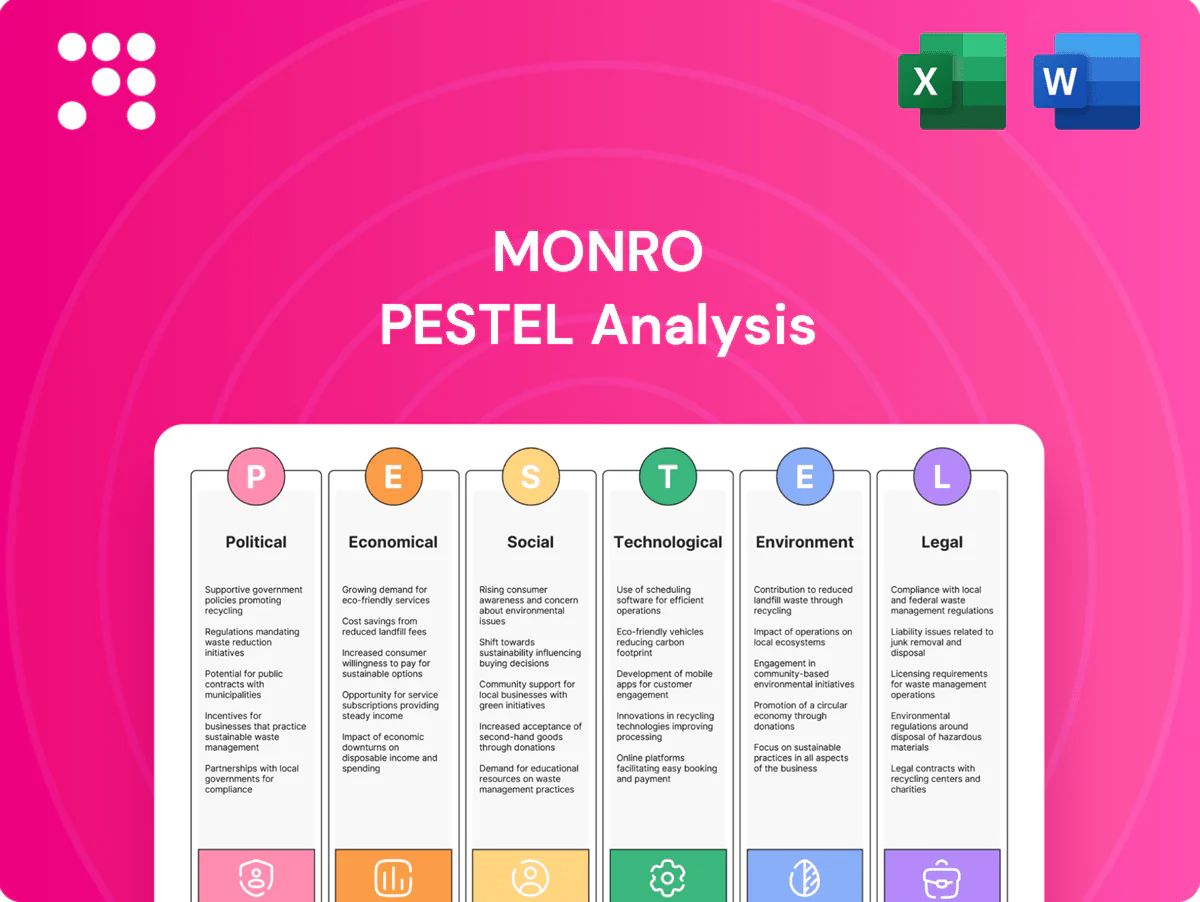
Monro PESTLE Analysis

Skip the Research. Get the Strategy.
Gain a strategic advantage with our PESTLE analysis of Monro. Uncover how political, economic, social, technological, legal and environmental forces shape the company’s path and risk exposure. Ideal for investors and strategists—buy the full report for actionable, ready-to-use insights.
Political factors

Federal transportation policy shifts
Changes in federal transportation policy, notably the $1.2 trillion Infrastructure Investment and Jobs Act, and DOT/NHTSA rulemaking, can alter inspection requirements and vehicle maintenance patterns. Increased road funding has supported a rebound in vehicle miles traveled to roughly 3.27 trillion miles (2023), likely boosting service demand. Stricter efficiency and safety targets will shift parts mix and technician training needs, so Monro must monitor DOT and NHTSA agendas closely.
State-level regulation variability
State-level variability in emissions, safety inspection and right-to-repair laws forces Monro to adjust service offerings and compliance costs across its approximately 1,200 locations in 24 states (2024), raising legal and training expenses in stricter jurisdictions. States mandating inspections drive recurring visits and parts sales, while states easing inspections can reduce predictable foot traffic. Monro’s multi-brand footprint requires tailored compliance programs and jurisdiction-specific pricing to protect margins.

Trade and tariff exposure on tires
Anti-dumping duties and tariffs on imported tires drive wholesale and retail pricing for Monro, with US actions since 2015 and evolving 2024 measures keeping import duties in focus; sudden rate changes can compress margins or force price passes to price-sensitive customers. Diversifying suppliers and hedging inventory are critical operational levers as Asia remains the dominant exporter, moving COGS directly when policy shifts occur.

Labor and apprenticeship incentives
Government incentives for vocational training can ease Monro's technician shortages; US registered apprentices surpassed 600,000 in 2023, reflecting growing program scale. Grants and tax credits lower workforce development costs, while lack of policy support amplifies wage pressures and capacity constraints. Active engagement with state programs can stabilize staffing pipelines and reduce hiring volatility.
Local zoning and permitting
New Monro service center openings require municipal approvals, environmental permits, and community alignment; pro-growth municipalities accelerate rollouts and remodels while restrictive zoning can delay expansion and raise carrying costs, increasing timeline risk for site activation.
- Factor: political receptivity
- Risk: permitting delays
- Impact: higher holding costs
Policy and tariffs raise inspection compliance and technician staffing amid US VMT surge
Political shifts—federal Infrastructure Investment and Jobs Act and DOT/NHTSA rulemaking—affect inspection standards and technician training, supporting demand after US VMT ~3.27T miles (2023). State inspection/right-to-repair variance across Monro ~1,200 stores in 24 states (2024) raises compliance costs. Tariffs on imported tires and apprenticeships (>600,000 registered apprentices 2023) influence COGS and staffing.
| Factor | Metric | Impact |
|---|---|---|
| Federal policy | Infrastructure Act, NHTSA rules | Higher service demand, training needs |
| State laws | 24 states, ~1,200 stores | Variable compliance costs |
| Tariffs | Ongoing import duties | COGS volatility |
What is included in the product
 Detailed Word Document
Explores how macro-environmental factors uniquely affect Monro across Political, Economic, Social, Technological, Environmental and Legal dimensions, with data-backed, region-specific insights, actionable subpoints and forward-looking scenarios to help executives, investors and consultants identify risks, opportunities and strategic priorities.

 Customizable Excel Spreadsheet
A concise, visually segmented PESTLE summary for Monro that relieves briefing fatigue by fitting directly into presentations or strategy decks; easily shared and annotated for regional or business-line specifics to speed alignment across teams.
Economic factors

Consumer discretionary cycles
Service demand for brakes, tires and oil changes closely tracks income, consumer confidence and employment — US unemployment averaged about 3.7% in 2024 (BLS) while Consumer Confidence hovered near 100, moderating discretionary spend. In downturns customers defer non‑critical preventive maintenance and trade down to value tiers, though essential repairs persist. Monro’s value positioning and broad footprint lets it capture budget‑conscious traffic and offset volume declines.
Inflation and parts cost dynamics
Parts, tires and oil inflation—with oil averaging about $85/bbl in 2024 and industry tire price inflation in the mid-single digits—squeezes Monro gross margins and raises cost of goods sold. Pricing power varies by local competition and demand elasticity; markets with heavy retailer density limit pass-through. Effective national sourcing, increased private-label mix and supplier contracts can blunt cost spikes. Transparent quotes and financing options preserve conversion and average ticket.

Vehicle parc age and miles driven
US light-vehicle average age reached about 12.6 years in 2024 (IHS Markit/S&P), while total VMT rebounded to roughly 3.3 trillion miles in 2023 and climbed further in 2024 (FHWA), boosting wear-and-tear service demand. Economic recovery or lower fuel prices can lift driving activity, and EVs/hybrids (~2% of the parc in 2024) shift service mix, but overall parc age remains the primary demand driver that benefits Monro.

Labor market tightness
Technician scarcity is increasing recruiting costs and wages amid a tight U.S. labor market (U.S. unemployment ~4.0% in 2024), pressuring Monro’s service margins. Productivity now hinges on retention, targeted training and scheduling efficiency to protect throughput. Wage inflation must be offset through higher technician throughput, selective pricing and operational efficiency; hub-and-spoke staffing smooths demand peaks.
- Technician scarcity: higher recruiting costs
- Retention/training: key to productivity
- Offset wages via throughput/pricing
- Hub-and-spoke: evens peak demand
Credit availability and consumer finance
Access to Monro store cards and BNPL raises ticket sizes and approval rates; BNPL made up roughly 10% of point-of-sale transactions in 2024, lifting average ticket by ~15%. Tight consumer credit in 2024 cut acceptance and lowered average repair order (RO). Flexible payment plans sustained 8–12% more repair authorizations.
- store-card uplift ~15%
- BNPL share ~10% (2024)
- flex plans sustain +8–12% ROs
- lender partnerships buffer approval volatility
Policy and tariffs raise inspection compliance and technician staffing amid US VMT surge
Service demand tracks income/employment (US unemployment ~3.8% in 2024) and aging parc (avg vehicle age ~12.6 yrs), supporting steady RO volumes; parts/oil inflation (oil ~$85/bbl in 2024) compresses margins while technician scarcity raises labor costs. BNPL/store cards (~10%/~15% uplift) boost tickets but tighten approvals in weak credit cycles.
| Metric | 2024 |
|---|---|
| Unemployment | ~3.8% |
| Avg vehicle age | 12.6 yrs |
| Oil | $85/bbl |
| BNPL share | ~10% |
What You See Is What You Get
Monro PESTLE Analysis
The Monro PESTLE Analysis preview shown here is the exact document you’ll receive after purchase—fully formatted and ready to use. The content, structure, and layout visible are the final version with no placeholders. After checkout you’ll instantly download this professionally structured file. What you see is what you’ll own.

Skip the Research. Get the Strategy.
Gain a strategic advantage with our PESTLE analysis of Monro. Uncover how political, economic, social, technological, legal and environmental forces shape the company’s path and risk exposure. Ideal for investors and strategists—buy the full report for actionable, ready-to-use insights.
Political factors
Federal transportation policy shifts
Changes in federal transportation policy, notably the $1.2 trillion Infrastructure Investment and Jobs Act, and DOT/NHTSA rulemaking, can alter inspection requirements and vehicle maintenance patterns. Increased road funding has supported a rebound in vehicle miles traveled to roughly 3.27 trillion miles (2023), likely boosting service demand. Stricter efficiency and safety targets will shift parts mix and technician training needs, so Monro must monitor DOT and NHTSA agendas closely.
State-level regulation variability
State-level variability in emissions, safety inspection and right-to-repair laws forces Monro to adjust service offerings and compliance costs across its approximately 1,200 locations in 24 states (2024), raising legal and training expenses in stricter jurisdictions. States mandating inspections drive recurring visits and parts sales, while states easing inspections can reduce predictable foot traffic. Monro’s multi-brand footprint requires tailored compliance programs and jurisdiction-specific pricing to protect margins.
Trade and tariff exposure on tires
Anti-dumping duties and tariffs on imported tires drive wholesale and retail pricing for Monro, with US actions since 2015 and evolving 2024 measures keeping import duties in focus; sudden rate changes can compress margins or force price passes to price-sensitive customers. Diversifying suppliers and hedging inventory are critical operational levers as Asia remains the dominant exporter, moving COGS directly when policy shifts occur.
Labor and apprenticeship incentives
Government incentives for vocational training can ease Monro's technician shortages; US registered apprentices surpassed 600,000 in 2023, reflecting growing program scale. Grants and tax credits lower workforce development costs, while lack of policy support amplifies wage pressures and capacity constraints. Active engagement with state programs can stabilize staffing pipelines and reduce hiring volatility.
Local zoning and permitting
New Monro service center openings require municipal approvals, environmental permits, and community alignment; pro-growth municipalities accelerate rollouts and remodels while restrictive zoning can delay expansion and raise carrying costs, increasing timeline risk for site activation.
- Factor: political receptivity
- Risk: permitting delays
- Impact: higher holding costs
Policy and tariffs raise inspection compliance and technician staffing amid US VMT surge
Political shifts—federal Infrastructure Investment and Jobs Act and DOT/NHTSA rulemaking—affect inspection standards and technician training, supporting demand after US VMT ~3.27T miles (2023). State inspection/right-to-repair variance across Monro ~1,200 stores in 24 states (2024) raises compliance costs. Tariffs on imported tires and apprenticeships (>600,000 registered apprentices 2023) influence COGS and staffing.
| Factor | Metric | Impact |
|---|---|---|
| Federal policy | Infrastructure Act, NHTSA rules | Higher service demand, training needs |
| State laws | 24 states, ~1,200 stores | Variable compliance costs |
| Tariffs | Ongoing import duties | COGS volatility |
What is included in the product
Detailed Word Document
Explores how macro-environmental factors uniquely affect Monro across Political, Economic, Social, Technological, Environmental and Legal dimensions, with data-backed, region-specific insights, actionable subpoints and forward-looking scenarios to help executives, investors and consultants identify risks, opportunities and strategic priorities.
Customizable Excel Spreadsheet
A concise, visually segmented PESTLE summary for Monro that relieves briefing fatigue by fitting directly into presentations or strategy decks; easily shared and annotated for regional or business-line specifics to speed alignment across teams.
Economic factors
Consumer discretionary cycles
Service demand for brakes, tires and oil changes closely tracks income, consumer confidence and employment — US unemployment averaged about 3.7% in 2024 (BLS) while Consumer Confidence hovered near 100, moderating discretionary spend. In downturns customers defer non‑critical preventive maintenance and trade down to value tiers, though essential repairs persist. Monro’s value positioning and broad footprint lets it capture budget‑conscious traffic and offset volume declines.
Inflation and parts cost dynamics
Parts, tires and oil inflation—with oil averaging about $85/bbl in 2024 and industry tire price inflation in the mid-single digits—squeezes Monro gross margins and raises cost of goods sold. Pricing power varies by local competition and demand elasticity; markets with heavy retailer density limit pass-through. Effective national sourcing, increased private-label mix and supplier contracts can blunt cost spikes. Transparent quotes and financing options preserve conversion and average ticket.
Vehicle parc age and miles driven
US light-vehicle average age reached about 12.6 years in 2024 (IHS Markit/S&P), while total VMT rebounded to roughly 3.3 trillion miles in 2023 and climbed further in 2024 (FHWA), boosting wear-and-tear service demand. Economic recovery or lower fuel prices can lift driving activity, and EVs/hybrids (~2% of the parc in 2024) shift service mix, but overall parc age remains the primary demand driver that benefits Monro.
Labor market tightness
Technician scarcity is increasing recruiting costs and wages amid a tight U.S. labor market (U.S. unemployment ~4.0% in 2024), pressuring Monro’s service margins. Productivity now hinges on retention, targeted training and scheduling efficiency to protect throughput. Wage inflation must be offset through higher technician throughput, selective pricing and operational efficiency; hub-and-spoke staffing smooths demand peaks.
- Technician scarcity: higher recruiting costs
- Retention/training: key to productivity
- Offset wages via throughput/pricing
- Hub-and-spoke: evens peak demand
Credit availability and consumer finance
Access to Monro store cards and BNPL raises ticket sizes and approval rates; BNPL made up roughly 10% of point-of-sale transactions in 2024, lifting average ticket by ~15%. Tight consumer credit in 2024 cut acceptance and lowered average repair order (RO). Flexible payment plans sustained 8–12% more repair authorizations.
- store-card uplift ~15%
- BNPL share ~10% (2024)
- flex plans sustain +8–12% ROs
- lender partnerships buffer approval volatility
Policy and tariffs raise inspection compliance and technician staffing amid US VMT surge
Service demand tracks income/employment (US unemployment ~3.8% in 2024) and aging parc (avg vehicle age ~12.6 yrs), supporting steady RO volumes; parts/oil inflation (oil ~$85/bbl in 2024) compresses margins while technician scarcity raises labor costs. BNPL/store cards (~10%/~15% uplift) boost tickets but tighten approvals in weak credit cycles.
| Metric | 2024 |
|---|---|
| Unemployment | ~3.8% |
| Avg vehicle age | 12.6 yrs |
| Oil | $85/bbl |
| BNPL share | ~10% |
What You See Is What You Get
Monro PESTLE Analysis
The Monro PESTLE Analysis preview shown here is the exact document you’ll receive after purchase—fully formatted and ready to use. The content, structure, and layout visible are the final version with no placeholders. After checkout you’ll instantly download this professionally structured file. What you see is what you’ll own.
Description
Skip the Research. Get the Strategy.
Gain a strategic advantage with our PESTLE analysis of Monro. Uncover how political, economic, social, technological, legal and environmental forces shape the company’s path and risk exposure. Ideal for investors and strategists—buy the full report for actionable, ready-to-use insights.
Political factors
Federal transportation policy shifts
Changes in federal transportation policy, notably the $1.2 trillion Infrastructure Investment and Jobs Act, and DOT/NHTSA rulemaking, can alter inspection requirements and vehicle maintenance patterns. Increased road funding has supported a rebound in vehicle miles traveled to roughly 3.27 trillion miles (2023), likely boosting service demand. Stricter efficiency and safety targets will shift parts mix and technician training needs, so Monro must monitor DOT and NHTSA agendas closely.
State-level regulation variability
State-level variability in emissions, safety inspection and right-to-repair laws forces Monro to adjust service offerings and compliance costs across its approximately 1,200 locations in 24 states (2024), raising legal and training expenses in stricter jurisdictions. States mandating inspections drive recurring visits and parts sales, while states easing inspections can reduce predictable foot traffic. Monro’s multi-brand footprint requires tailored compliance programs and jurisdiction-specific pricing to protect margins.
Trade and tariff exposure on tires
Anti-dumping duties and tariffs on imported tires drive wholesale and retail pricing for Monro, with US actions since 2015 and evolving 2024 measures keeping import duties in focus; sudden rate changes can compress margins or force price passes to price-sensitive customers. Diversifying suppliers and hedging inventory are critical operational levers as Asia remains the dominant exporter, moving COGS directly when policy shifts occur.
Labor and apprenticeship incentives
Government incentives for vocational training can ease Monro's technician shortages; US registered apprentices surpassed 600,000 in 2023, reflecting growing program scale. Grants and tax credits lower workforce development costs, while lack of policy support amplifies wage pressures and capacity constraints. Active engagement with state programs can stabilize staffing pipelines and reduce hiring volatility.
Local zoning and permitting
New Monro service center openings require municipal approvals, environmental permits, and community alignment; pro-growth municipalities accelerate rollouts and remodels while restrictive zoning can delay expansion and raise carrying costs, increasing timeline risk for site activation.
- Factor: political receptivity
- Risk: permitting delays
- Impact: higher holding costs
Policy and tariffs raise inspection compliance and technician staffing amid US VMT surge
Political shifts—federal Infrastructure Investment and Jobs Act and DOT/NHTSA rulemaking—affect inspection standards and technician training, supporting demand after US VMT ~3.27T miles (2023). State inspection/right-to-repair variance across Monro ~1,200 stores in 24 states (2024) raises compliance costs. Tariffs on imported tires and apprenticeships (>600,000 registered apprentices 2023) influence COGS and staffing.
| Factor | Metric | Impact |
|---|---|---|
| Federal policy | Infrastructure Act, NHTSA rules | Higher service demand, training needs |
| State laws | 24 states, ~1,200 stores | Variable compliance costs |
| Tariffs | Ongoing import duties | COGS volatility |
What is included in the product
Detailed Word Document
Explores how macro-environmental factors uniquely affect Monro across Political, Economic, Social, Technological, Environmental and Legal dimensions, with data-backed, region-specific insights, actionable subpoints and forward-looking scenarios to help executives, investors and consultants identify risks, opportunities and strategic priorities.
Customizable Excel Spreadsheet
A concise, visually segmented PESTLE summary for Monro that relieves briefing fatigue by fitting directly into presentations or strategy decks; easily shared and annotated for regional or business-line specifics to speed alignment across teams.
Economic factors
Consumer discretionary cycles
Service demand for brakes, tires and oil changes closely tracks income, consumer confidence and employment — US unemployment averaged about 3.7% in 2024 (BLS) while Consumer Confidence hovered near 100, moderating discretionary spend. In downturns customers defer non‑critical preventive maintenance and trade down to value tiers, though essential repairs persist. Monro’s value positioning and broad footprint lets it capture budget‑conscious traffic and offset volume declines.
Inflation and parts cost dynamics
Parts, tires and oil inflation—with oil averaging about $85/bbl in 2024 and industry tire price inflation in the mid-single digits—squeezes Monro gross margins and raises cost of goods sold. Pricing power varies by local competition and demand elasticity; markets with heavy retailer density limit pass-through. Effective national sourcing, increased private-label mix and supplier contracts can blunt cost spikes. Transparent quotes and financing options preserve conversion and average ticket.
Vehicle parc age and miles driven
US light-vehicle average age reached about 12.6 years in 2024 (IHS Markit/S&P), while total VMT rebounded to roughly 3.3 trillion miles in 2023 and climbed further in 2024 (FHWA), boosting wear-and-tear service demand. Economic recovery or lower fuel prices can lift driving activity, and EVs/hybrids (~2% of the parc in 2024) shift service mix, but overall parc age remains the primary demand driver that benefits Monro.
Labor market tightness
Technician scarcity is increasing recruiting costs and wages amid a tight U.S. labor market (U.S. unemployment ~4.0% in 2024), pressuring Monro’s service margins. Productivity now hinges on retention, targeted training and scheduling efficiency to protect throughput. Wage inflation must be offset through higher technician throughput, selective pricing and operational efficiency; hub-and-spoke staffing smooths demand peaks.
- Technician scarcity: higher recruiting costs
- Retention/training: key to productivity
- Offset wages via throughput/pricing
- Hub-and-spoke: evens peak demand
Credit availability and consumer finance
Access to Monro store cards and BNPL raises ticket sizes and approval rates; BNPL made up roughly 10% of point-of-sale transactions in 2024, lifting average ticket by ~15%. Tight consumer credit in 2024 cut acceptance and lowered average repair order (RO). Flexible payment plans sustained 8–12% more repair authorizations.
- store-card uplift ~15%
- BNPL share ~10% (2024)
- flex plans sustain +8–12% ROs
- lender partnerships buffer approval volatility
Policy and tariffs raise inspection compliance and technician staffing amid US VMT surge
Service demand tracks income/employment (US unemployment ~3.8% in 2024) and aging parc (avg vehicle age ~12.6 yrs), supporting steady RO volumes; parts/oil inflation (oil ~$85/bbl in 2024) compresses margins while technician scarcity raises labor costs. BNPL/store cards (~10%/~15% uplift) boost tickets but tighten approvals in weak credit cycles.
| Metric | 2024 |
|---|---|
| Unemployment | ~3.8% |
| Avg vehicle age | 12.6 yrs |
| Oil | $85/bbl |
| BNPL share | ~10% |
What You See Is What You Get
Monro PESTLE Analysis
The Monro PESTLE Analysis preview shown here is the exact document you’ll receive after purchase—fully formatted and ready to use. The content, structure, and layout visible are the final version with no placeholders. After checkout you’ll instantly download this professionally structured file. What you see is what you’ll own.











