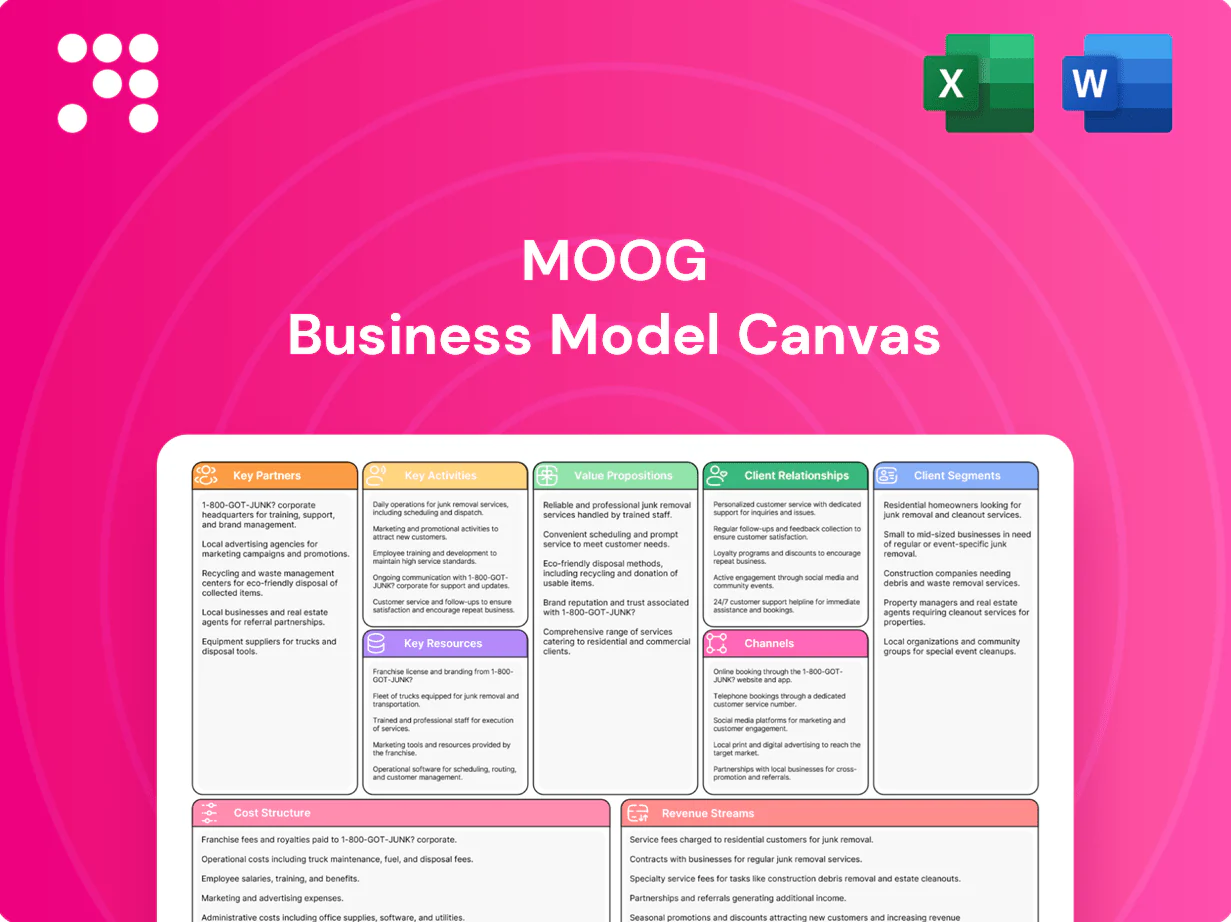
Moog Business Model Canvas

Unlock the strategic Business Model Canvas for aerospace & defense innovators
Unlock Moog's strategic blueprint with the full Business Model Canvas. This in-depth, editable document reveals value propositions, revenue streams, key partners and cost structure to show how Moog scales and competes. Ideal for investors, consultants and founders—download the Word/Excel files to benchmark and act.
Partnerships

Aerospace and defense OEM alliances
Collaborations with aircraft, rotorcraft and missile OEMs ensure early design-in of Moog motion control systems, aligning joint roadmaps on performance targets, certification timelines and obsolescence planning. These alliances de-risk programs and secure multi-year production volumes (often hundreds to thousands of units across 5–15 year runs). Co-location and integrated product teams accelerate problem resolution and keep schedule risk low.
Prime contractors and defense agencies
Partnerships with prime contractors and defense agencies grant access to classified programs and multi-decade platforms such as F-35 sustainment planned into the 2070s, aligned with a US defense budget of about 858 billion USD in 2024. They coordinate requirements, cybersecurity, and export controls for mission-critical systems. Framework agreements and IDIQ-style contracts streamline bidding and sustainment, while shared test regimes validate performance in extreme environments.

Specialized suppliers and material partners
Sourcing precision components, sensors, specialty alloys and avionics-grade electronics under AS9100 and NADCAP controls is vital, supporting Moog’s 2024 revenue base of about $3.3 billion and mission-critical performance demands. Strategic dual-sourcing and long-term agreements (LTAs) cut lead-time volatility and capex exposure, often stabilizing costs by double-digit percentages in aerospace supply chains. Supplier co-engineering reduces rework and improves manufacturability and MTBF, while advanced-materials partners enable weight, temperature and fatigue targets for high-G, high-temp applications.

Universities and research institutes
Universities and research institutes drive R&D collaborations at Moog, advancing control algorithms, AI diagnostics, and additive manufacturing through sponsored labs that supply novel test methods and talent pipelines; in 2024 joint projects and grants often underwrite up to 50% of early-stage development costs, lowering technical risk.
- Joint IP frameworks speed tech transfer
- Sponsored labs = talent pipeline
- Grants/consortia reduce early-stage risk
Systems integrators and software ecosystem
Integration with avionics, PLC/SCADA and simulation platforms ensures interoperability across Moog systems. Middleware and standards bodies such as ARINC and FACE, plus DO-178C-focused certification consultants in 2024, streamline regulatory compliance. Partner toolchains enable model-based design and HIL testing, lowering customer integration cost.
- Interoperability
- Standards: ARINC / FACE / DO-178C
- Model-based design & HIL
- Reduced integration cost
OEM and prime partnerships secure 5-15yr runs and up to 50% R&D funding
Key partnerships with OEMs, primes and suppliers secure early design-in, multi-year production (5–15 year runs) and access to classified platforms (F-35 sustainment into 2070s), supporting Moog’s ~3.3B USD 2024 revenue. R&D alliances/grants can underwrite up to 50% of early-stage costs; LTAs and dual-sourcing cut lead-time and cost volatility.
| Partner | Impact | 2024 metric |
|---|---|---|
| OEMs | Design‑in, volumes | 5–15 yr runs |
| Primes/Defense | Classified access | F-35 sustain to 2070s |
| Suppliers | Supply stability | Reduce lead-time |
| Academia | R&D, talent | ≤50% early funding |
What is included in the product
 Detailed Word Document
A comprehensive, pre-written business model tailored to Moog’s aerospace, defense, and industrial controls strategy. Organized into the 9 classic BMC blocks with customer segments, channels, value propositions, revenue streams, cost structure, competitive advantages and linked SWOT insights—designed for presentations, investor discussions, and strategic decision-making.

 Customizable Excel Spreadsheet
Condenses Moog’s complex aerospace and industrial strategies into a one-page, editable Business Model Canvas that saves hours of structuring and accelerates alignment across teams.
Activities

Advanced R&D and engineering design
Development of servo valves, actuators, drive electronics and embedded controls is core to Moog, supported by a 2024 R&D investment of $125 million to accelerate avionics and motion-control platforms. Model-based engineering optimizes dynamics, thermal behavior and reliability, shortening design cycles and improving MTBF. Rapid prototyping and iterative testing de-risk certification, while active IP generation secures product differentiation.
Precision manufacturing and quality assurance
Precision tight-tolerance machining, clean-room assembly and in-house electronics production underpin Moog’s performance by enabling predictable flight-critical characteristics.
Statistical process control with ±3σ control limits and targeted nondestructive testing (ultrasonic, eddy-current, X-ray) ensure dimensional and functional repeatability.
AS9100D (2016) quality systems drive end-to-end traceability, while Lean Six Sigma continuous-improvement initiatives focus on lowering scrap and cycle times.

System integration and validation testing
Hardware-in-the-loop plus environmental, vibration and endurance tests verify robustness and reduced field-failure rates; Moog reported fiscal 2024 sales of $3.45 billion supporting expanded test investments. Software verification follows safety standards and DO-178/DO-254 where applicable. Interface integration with aircraft, spacecraft and industrial machinery is executed during system-level trials. Test data feed reliability models and service plans, informing lifecycle forecasts and spare provisioning.

Program management and certification
Program management coordinates schedules, budgets, and risks across multi-year contracts, aligning to contractual milestones and cost baselines. For US DoD programs, earned value management is required on contracts exceeding $20,000,000, and gated reviews maintain phase‑gate compliance. Certification planning with authorities such as FAA and EASA secures approvals. Configuration management controls engineering changes throughout the lifecycle.
- Coordinated schedules, budgets, risks
- Earned value on >20,000,000 DoD contracts
- Certification planning with FAA/EASA
- Configuration management, gated reviews
Aftermarket service, MRO, and upgrades
Aftermarket repair, overhaul and spares sustain fleet readiness through rapid turnarounds and inventory support; retrofit kits and performance upgrades extend platform life and reduce lifecycle costs. Field engineering resolves operational issues on-site, while data-driven predictive maintenance (2024 global commercial MRO market ~86 billion USD) lowers downtime and cost per flight hour.
- Repair & overhaul: fleet availability
- Retrofits: life-extension kits
- Field engineering: rapid resolution
- Data-driven Mx: reduced downtime/cost
Aerospace controls: $3.45B 2024 sales; $125M R&D; $86B MRO
Moog focuses on development of servo valves, actuators, electronics and embedded controls (2024 R&D $125M), precision machining and AS9100D quality to support fiscal 2024 sales $3.45B; test, HIL and DO-178/DO-254 verification reduce failures; aftermarket MRO and Mx address fleet readiness (2024 global MRO ~$86B).
| Metric | 2024 |
|---|---|
| R&D spend | $125M |
| Sales | $3.45B |
| Global MRO | $86B |
| DoD EVM threshold | $20,000,000 |
Full Document Unlocks After Purchase
Business Model Canvas
The Moog Business Model Canvas you’re previewing is the actual deliverable, not a mockup or sample. When you purchase, you’ll receive this exact document—complete, fully editable and formatted for immediate use. No surprises: what you see is what you’ll download and apply.

Unlock the strategic Business Model Canvas for aerospace & defense innovators
Unlock Moog's strategic blueprint with the full Business Model Canvas. This in-depth, editable document reveals value propositions, revenue streams, key partners and cost structure to show how Moog scales and competes. Ideal for investors, consultants and founders—download the Word/Excel files to benchmark and act.
Partnerships
Aerospace and defense OEM alliances
Collaborations with aircraft, rotorcraft and missile OEMs ensure early design-in of Moog motion control systems, aligning joint roadmaps on performance targets, certification timelines and obsolescence planning. These alliances de-risk programs and secure multi-year production volumes (often hundreds to thousands of units across 5–15 year runs). Co-location and integrated product teams accelerate problem resolution and keep schedule risk low.
Prime contractors and defense agencies
Partnerships with prime contractors and defense agencies grant access to classified programs and multi-decade platforms such as F-35 sustainment planned into the 2070s, aligned with a US defense budget of about 858 billion USD in 2024. They coordinate requirements, cybersecurity, and export controls for mission-critical systems. Framework agreements and IDIQ-style contracts streamline bidding and sustainment, while shared test regimes validate performance in extreme environments.
Specialized suppliers and material partners
Sourcing precision components, sensors, specialty alloys and avionics-grade electronics under AS9100 and NADCAP controls is vital, supporting Moog’s 2024 revenue base of about $3.3 billion and mission-critical performance demands. Strategic dual-sourcing and long-term agreements (LTAs) cut lead-time volatility and capex exposure, often stabilizing costs by double-digit percentages in aerospace supply chains. Supplier co-engineering reduces rework and improves manufacturability and MTBF, while advanced-materials partners enable weight, temperature and fatigue targets for high-G, high-temp applications.
Universities and research institutes
Universities and research institutes drive R&D collaborations at Moog, advancing control algorithms, AI diagnostics, and additive manufacturing through sponsored labs that supply novel test methods and talent pipelines; in 2024 joint projects and grants often underwrite up to 50% of early-stage development costs, lowering technical risk.
- Joint IP frameworks speed tech transfer
- Sponsored labs = talent pipeline
- Grants/consortia reduce early-stage risk
Systems integrators and software ecosystem
Integration with avionics, PLC/SCADA and simulation platforms ensures interoperability across Moog systems. Middleware and standards bodies such as ARINC and FACE, plus DO-178C-focused certification consultants in 2024, streamline regulatory compliance. Partner toolchains enable model-based design and HIL testing, lowering customer integration cost.
- Interoperability
- Standards: ARINC / FACE / DO-178C
- Model-based design & HIL
- Reduced integration cost
OEM and prime partnerships secure 5-15yr runs and up to 50% R&D funding
Key partnerships with OEMs, primes and suppliers secure early design-in, multi-year production (5–15 year runs) and access to classified platforms (F-35 sustainment into 2070s), supporting Moog’s ~3.3B USD 2024 revenue. R&D alliances/grants can underwrite up to 50% of early-stage costs; LTAs and dual-sourcing cut lead-time and cost volatility.
| Partner | Impact | 2024 metric |
|---|---|---|
| OEMs | Design‑in, volumes | 5–15 yr runs |
| Primes/Defense | Classified access | F-35 sustain to 2070s |
| Suppliers | Supply stability | Reduce lead-time |
| Academia | R&D, talent | ≤50% early funding |
What is included in the product
Detailed Word Document
A comprehensive, pre-written business model tailored to Moog’s aerospace, defense, and industrial controls strategy. Organized into the 9 classic BMC blocks with customer segments, channels, value propositions, revenue streams, cost structure, competitive advantages and linked SWOT insights—designed for presentations, investor discussions, and strategic decision-making.
Customizable Excel Spreadsheet
Condenses Moog’s complex aerospace and industrial strategies into a one-page, editable Business Model Canvas that saves hours of structuring and accelerates alignment across teams.
Activities
Advanced R&D and engineering design
Development of servo valves, actuators, drive electronics and embedded controls is core to Moog, supported by a 2024 R&D investment of $125 million to accelerate avionics and motion-control platforms. Model-based engineering optimizes dynamics, thermal behavior and reliability, shortening design cycles and improving MTBF. Rapid prototyping and iterative testing de-risk certification, while active IP generation secures product differentiation.
Precision manufacturing and quality assurance
Precision tight-tolerance machining, clean-room assembly and in-house electronics production underpin Moog’s performance by enabling predictable flight-critical characteristics.
Statistical process control with ±3σ control limits and targeted nondestructive testing (ultrasonic, eddy-current, X-ray) ensure dimensional and functional repeatability.
AS9100D (2016) quality systems drive end-to-end traceability, while Lean Six Sigma continuous-improvement initiatives focus on lowering scrap and cycle times.
System integration and validation testing
Hardware-in-the-loop plus environmental, vibration and endurance tests verify robustness and reduced field-failure rates; Moog reported fiscal 2024 sales of $3.45 billion supporting expanded test investments. Software verification follows safety standards and DO-178/DO-254 where applicable. Interface integration with aircraft, spacecraft and industrial machinery is executed during system-level trials. Test data feed reliability models and service plans, informing lifecycle forecasts and spare provisioning.
Program management and certification
Program management coordinates schedules, budgets, and risks across multi-year contracts, aligning to contractual milestones and cost baselines. For US DoD programs, earned value management is required on contracts exceeding $20,000,000, and gated reviews maintain phase‑gate compliance. Certification planning with authorities such as FAA and EASA secures approvals. Configuration management controls engineering changes throughout the lifecycle.
- Coordinated schedules, budgets, risks
- Earned value on >20,000,000 DoD contracts
- Certification planning with FAA/EASA
- Configuration management, gated reviews
Aftermarket service, MRO, and upgrades
Aftermarket repair, overhaul and spares sustain fleet readiness through rapid turnarounds and inventory support; retrofit kits and performance upgrades extend platform life and reduce lifecycle costs. Field engineering resolves operational issues on-site, while data-driven predictive maintenance (2024 global commercial MRO market ~86 billion USD) lowers downtime and cost per flight hour.
- Repair & overhaul: fleet availability
- Retrofits: life-extension kits
- Field engineering: rapid resolution
- Data-driven Mx: reduced downtime/cost
Aerospace controls: $3.45B 2024 sales; $125M R&D; $86B MRO
Moog focuses on development of servo valves, actuators, electronics and embedded controls (2024 R&D $125M), precision machining and AS9100D quality to support fiscal 2024 sales $3.45B; test, HIL and DO-178/DO-254 verification reduce failures; aftermarket MRO and Mx address fleet readiness (2024 global MRO ~$86B).
| Metric | 2024 |
|---|---|
| R&D spend | $125M |
| Sales | $3.45B |
| Global MRO | $86B |
| DoD EVM threshold | $20,000,000 |
Full Document Unlocks After Purchase
Business Model Canvas
The Moog Business Model Canvas you’re previewing is the actual deliverable, not a mockup or sample. When you purchase, you’ll receive this exact document—complete, fully editable and formatted for immediate use. No surprises: what you see is what you’ll download and apply.
Original: $10.00
-65%$10.00
$3.50Description
Unlock the strategic Business Model Canvas for aerospace & defense innovators
Unlock Moog's strategic blueprint with the full Business Model Canvas. This in-depth, editable document reveals value propositions, revenue streams, key partners and cost structure to show how Moog scales and competes. Ideal for investors, consultants and founders—download the Word/Excel files to benchmark and act.
Partnerships
Aerospace and defense OEM alliances
Collaborations with aircraft, rotorcraft and missile OEMs ensure early design-in of Moog motion control systems, aligning joint roadmaps on performance targets, certification timelines and obsolescence planning. These alliances de-risk programs and secure multi-year production volumes (often hundreds to thousands of units across 5–15 year runs). Co-location and integrated product teams accelerate problem resolution and keep schedule risk low.
Prime contractors and defense agencies
Partnerships with prime contractors and defense agencies grant access to classified programs and multi-decade platforms such as F-35 sustainment planned into the 2070s, aligned with a US defense budget of about 858 billion USD in 2024. They coordinate requirements, cybersecurity, and export controls for mission-critical systems. Framework agreements and IDIQ-style contracts streamline bidding and sustainment, while shared test regimes validate performance in extreme environments.
Specialized suppliers and material partners
Sourcing precision components, sensors, specialty alloys and avionics-grade electronics under AS9100 and NADCAP controls is vital, supporting Moog’s 2024 revenue base of about $3.3 billion and mission-critical performance demands. Strategic dual-sourcing and long-term agreements (LTAs) cut lead-time volatility and capex exposure, often stabilizing costs by double-digit percentages in aerospace supply chains. Supplier co-engineering reduces rework and improves manufacturability and MTBF, while advanced-materials partners enable weight, temperature and fatigue targets for high-G, high-temp applications.
Universities and research institutes
Universities and research institutes drive R&D collaborations at Moog, advancing control algorithms, AI diagnostics, and additive manufacturing through sponsored labs that supply novel test methods and talent pipelines; in 2024 joint projects and grants often underwrite up to 50% of early-stage development costs, lowering technical risk.
- Joint IP frameworks speed tech transfer
- Sponsored labs = talent pipeline
- Grants/consortia reduce early-stage risk
Systems integrators and software ecosystem
Integration with avionics, PLC/SCADA and simulation platforms ensures interoperability across Moog systems. Middleware and standards bodies such as ARINC and FACE, plus DO-178C-focused certification consultants in 2024, streamline regulatory compliance. Partner toolchains enable model-based design and HIL testing, lowering customer integration cost.
- Interoperability
- Standards: ARINC / FACE / DO-178C
- Model-based design & HIL
- Reduced integration cost
OEM and prime partnerships secure 5-15yr runs and up to 50% R&D funding
Key partnerships with OEMs, primes and suppliers secure early design-in, multi-year production (5–15 year runs) and access to classified platforms (F-35 sustainment into 2070s), supporting Moog’s ~3.3B USD 2024 revenue. R&D alliances/grants can underwrite up to 50% of early-stage costs; LTAs and dual-sourcing cut lead-time and cost volatility.
| Partner | Impact | 2024 metric |
|---|---|---|
| OEMs | Design‑in, volumes | 5–15 yr runs |
| Primes/Defense | Classified access | F-35 sustain to 2070s |
| Suppliers | Supply stability | Reduce lead-time |
| Academia | R&D, talent | ≤50% early funding |
What is included in the product
Detailed Word Document
A comprehensive, pre-written business model tailored to Moog’s aerospace, defense, and industrial controls strategy. Organized into the 9 classic BMC blocks with customer segments, channels, value propositions, revenue streams, cost structure, competitive advantages and linked SWOT insights—designed for presentations, investor discussions, and strategic decision-making.
Customizable Excel Spreadsheet
Condenses Moog’s complex aerospace and industrial strategies into a one-page, editable Business Model Canvas that saves hours of structuring and accelerates alignment across teams.
Activities
Advanced R&D and engineering design
Development of servo valves, actuators, drive electronics and embedded controls is core to Moog, supported by a 2024 R&D investment of $125 million to accelerate avionics and motion-control platforms. Model-based engineering optimizes dynamics, thermal behavior and reliability, shortening design cycles and improving MTBF. Rapid prototyping and iterative testing de-risk certification, while active IP generation secures product differentiation.
Precision manufacturing and quality assurance
Precision tight-tolerance machining, clean-room assembly and in-house electronics production underpin Moog’s performance by enabling predictable flight-critical characteristics.
Statistical process control with ±3σ control limits and targeted nondestructive testing (ultrasonic, eddy-current, X-ray) ensure dimensional and functional repeatability.
AS9100D (2016) quality systems drive end-to-end traceability, while Lean Six Sigma continuous-improvement initiatives focus on lowering scrap and cycle times.
System integration and validation testing
Hardware-in-the-loop plus environmental, vibration and endurance tests verify robustness and reduced field-failure rates; Moog reported fiscal 2024 sales of $3.45 billion supporting expanded test investments. Software verification follows safety standards and DO-178/DO-254 where applicable. Interface integration with aircraft, spacecraft and industrial machinery is executed during system-level trials. Test data feed reliability models and service plans, informing lifecycle forecasts and spare provisioning.
Program management and certification
Program management coordinates schedules, budgets, and risks across multi-year contracts, aligning to contractual milestones and cost baselines. For US DoD programs, earned value management is required on contracts exceeding $20,000,000, and gated reviews maintain phase‑gate compliance. Certification planning with authorities such as FAA and EASA secures approvals. Configuration management controls engineering changes throughout the lifecycle.
- Coordinated schedules, budgets, risks
- Earned value on >20,000,000 DoD contracts
- Certification planning with FAA/EASA
- Configuration management, gated reviews
Aftermarket service, MRO, and upgrades
Aftermarket repair, overhaul and spares sustain fleet readiness through rapid turnarounds and inventory support; retrofit kits and performance upgrades extend platform life and reduce lifecycle costs. Field engineering resolves operational issues on-site, while data-driven predictive maintenance (2024 global commercial MRO market ~86 billion USD) lowers downtime and cost per flight hour.
- Repair & overhaul: fleet availability
- Retrofits: life-extension kits
- Field engineering: rapid resolution
- Data-driven Mx: reduced downtime/cost
Aerospace controls: $3.45B 2024 sales; $125M R&D; $86B MRO
Moog focuses on development of servo valves, actuators, electronics and embedded controls (2024 R&D $125M), precision machining and AS9100D quality to support fiscal 2024 sales $3.45B; test, HIL and DO-178/DO-254 verification reduce failures; aftermarket MRO and Mx address fleet readiness (2024 global MRO ~$86B).
| Metric | 2024 |
|---|---|
| R&D spend | $125M |
| Sales | $3.45B |
| Global MRO | $86B |
| DoD EVM threshold | $20,000,000 |
Full Document Unlocks After Purchase
Business Model Canvas
The Moog Business Model Canvas you’re previewing is the actual deliverable, not a mockup or sample. When you purchase, you’ll receive this exact document—complete, fully editable and formatted for immediate use. No surprises: what you see is what you’ll download and apply.











