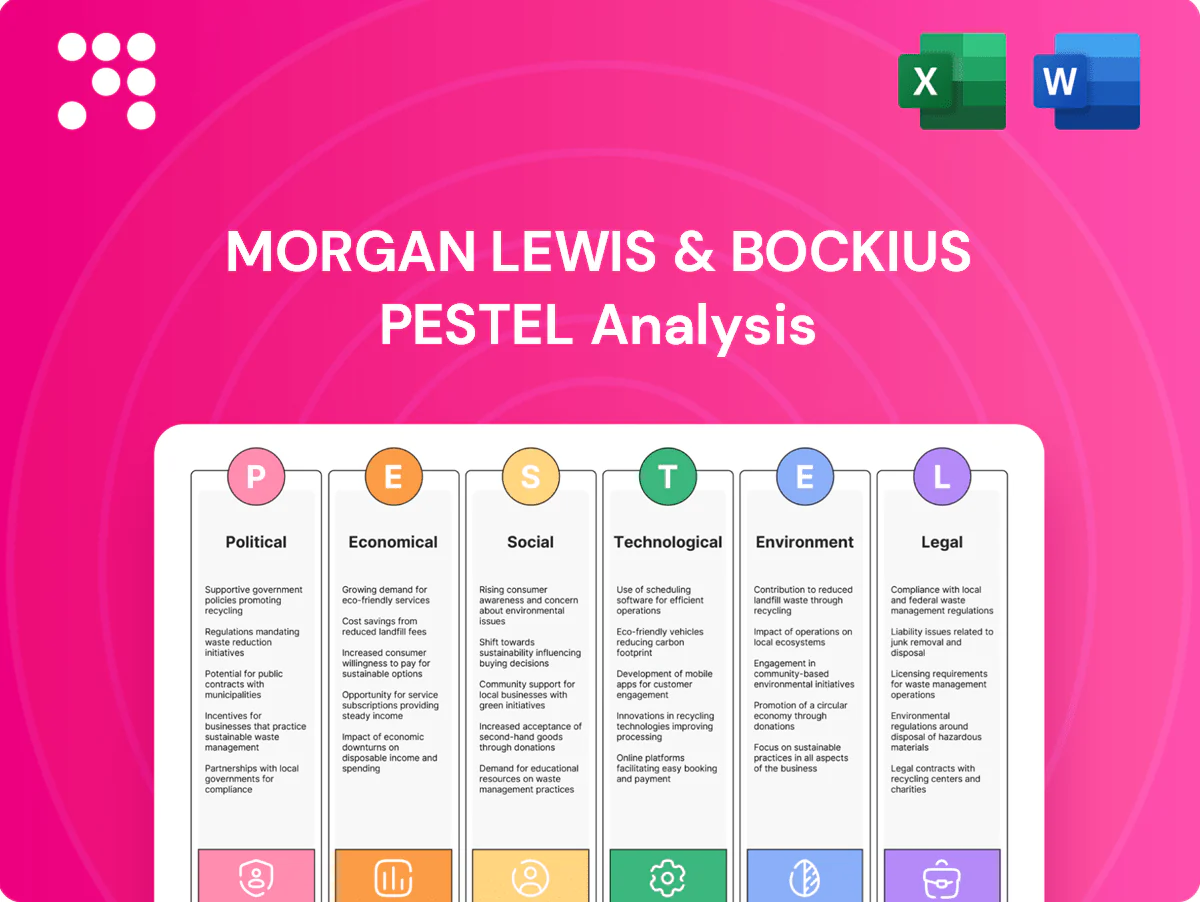
Morgan Lewis & Bockius PESTLE Analysis

Your Competitive Advantage Starts with This Report
Our PESTLE Analysis for Morgan Lewis & Bockius reveals how political, regulatory and technological shifts affect strategy and risk exposure. Ideal for investors, advisors and executives, it translates external trends into actionable recommendations. Buy the full, editable report to access detailed insights and ready-to-use deliverables for immediate decision-making.
Political factors

Geopolitical instability
Shifts in U.S.–China relations—with U.S. goods exports to China near $150 billion in 2023—regional conflicts and expanding sanctions regimes materially reshape cross-border deals and disputes. Clients require proactive political risk assessments and bespoke deal structuring. The firm must align matter strategies with fast-moving foreign policy and OFAC/other lists. Coordinated advice across key capitals is essential for multijurisdictional exposure.
Trade and industrial policy
Export controls expanded on advanced semiconductors and AI chips since 2022, while CHIPS Act incentives of $52.7 billion and IRA climate/energy provisions of about $369 billion are accelerating reshoring, coinciding with global FDI falling to roughly $1.3 trillion in 2023 (UNCTAD). Clients need guidance on compliance and subsidy eligibility, lengthening transaction timelines and due diligence scopes, making the firm’s regulatory depth a clear competitive differentiator.

Public sector and procurement
Government contracting rules and bid protests shape work for tech, defense and healthcare clients as public procurement accounts for about 15% of global GDP—roughly US$11 trillion annually (World Bank); US defense spending (FY2025 request ~US$842 billion) drives award volumes. Political priorities shift funding cycles and enforcement intensity, while counsel handles formation, performance disputes and investigations, with local content and security requirements adding transactional complexity.

Lobbying and policy advocacy
Policy shifts in antitrust, labor, and data privacy have increased demand for Morgan Lewis’s advocacy as US federal lobbying totaled about $4.98 billion in 2023; the firm must navigate lobbying rules, gift bans, and transparency obligations while using coordinated legal-policy strategies to shape client outcomes and maintain a clear separation of legal and lobbying services to mitigate risk.
- Antitrust focus
- Labor & compliance
- Data privacy enforcement
- Lobbying rules & transparency
- Separation of services
Sanctions and AML enforcement
Expanded sanctions lists and rising AML standards have increased exposure for financial and corporate clients; FATF counts 39 member jurisdictions as of 2025, reflecting heightened global coordination. Rapid screening, licensing and strengthened internal controls are critical to avoid enforcement and transactional freezes. Morgan Lewis guides clients on risk mapping, remediation and voluntary disclosures, leveraging cross-border coordination to limit disruption.
- FATF: 39 members (2025)
- Priority: rapid screening & licensing
- Services: risk mapping, remediation, voluntary disclosures
- Goal: reduce cross-border transactional disruption
Subsidies, sanctions and defense spending reshape cross-border dealmaking and compliance
Geopolitical shifts (US–China trade ~$150B in 2023) and sanctions drive cross-border risk work and bespoke deal structuring. Subsidy regimes (CHIPS $52.7B; IRA ~$369B) and export controls lengthen diligence and boost advisory demand. Public procurement (~15% global GDP) and US defense (~$842B FY2025 request) sustain government-contracting work; lobbying ($4.98B 2023) and FATF (39 members 2025) heighten compliance needs.
| Metric | Value |
|---|---|
| US–China exports (2023) | $150B |
| CHIPS/IRA | $52.7B / $369B |
| Global FDI (2023) | $1.3T |
| US defense (FY2025) | $842B |
| Lobbying (2023) | $4.98B |
| FATF (2025) | 39 members |
What is included in the product
 Detailed Word Document
Explores how Political, Economic, Social, Technological, Environmental and Legal factors uniquely affect Morgan Lewis & Bockius, with data-backed insights, forward-looking scenario implications, and practical recommendations designed for executives, consultants and investors to identify risks, opportunities and strategic priorities.

 Customizable Excel Spreadsheet
A clean, summarized Morgan Lewis & Bockius PESTLE that’s visually segmented by category for quick interpretation, easily dropped into presentations or shared across teams to streamline risk discussions and strategic planning.
Economic factors

Deal cycle volatility
Deal cycle volatility at Morgan Lewis tracks interest-rate sensitivity—US federal funds were 5.25–5.50% in mid-2025, tightening IPO windows and valuations and reducing headline M&A volume. As deal origination ebbs, workload shifts toward restructurings and distressed financings. The firm deliberately balances its transactional and restructuring practices to stabilize revenue. Deep sector specialization (life sciences, energy, technology) helps capture more resilient deal flow.
Interest rates and credit
Tighter credit conditions — reflected in the Fed funds target of 5.25–5.50% in mid‑2025 and net tightening in the Fed SLOOS since 2023 — force changes to leverage and covenant packages, driving client demand for refinancing, liability management and restructuring advice. Rate trajectories fuel disputes over pricing and performance, while financing innovation (e.g., structured and ESG-linked deals) increases complex documentation needs.

Client cost pressure
Client cost pressure in 2024 drove corporate legal budgets toward alternative fee arrangements and efficiency mandates, forcing Morgan Lewis to emphasize matter staffing, process rigor, and tech adoption to protect margins. Transparent value metrics and fixed- or outcome-based pricing have strengthened client retention by aligning outcomes with spend. Portfolio-based arrangements are increasingly used to smooth utilization and predict revenue across matter pipelines.

Currency and macro exposure
Morgan Lewis’s global footprint (31 offices, ~2,200 lawyers as of 2024) creates material FX and macro exposure affecting pricing and collections; engagement letters and billing-currency clauses determine transfer of FX risk. Hedging programs and local resourcing reduce volatility; demand-linked forecasting aligns hiring and capex with expected fee flows.
- 31 offices
- ~2,200 lawyers (2024)
- Use billing-currency clauses
- Hedge and localize to mitigate FX
Talent market cycles
Talent market cycles drive compensation and lateral hiring swings; Big Law starting associate pay stayed near $215,000 in 2024 while firms report training costs of roughly $30,000 per lawyer annually, and voluntary associate attrition hovers around 20%, so productivity and leverage models must flex with demand. Retention depends on clear career paths and workload balance; operational excellence preserves margins and profitability.
- Compensation pressure: $215,000 entry pay (2024)
- Training burden: ≈$30,000/attorney/year
- Attrition: ~20% voluntary turnover
- Focus: adaptability of leverage and operational efficiency
Subsidies, sanctions and defense spending reshape cross-border dealmaking and compliance
Deal cycle volatility tracks Fed funds 5.25–5.50% (mid‑2025), tightening IPOs/M&A and lifting restructurings; the firm balances transactional and restructuring to stabilize revenue. Credit tightening and net SLOOS tightening since 2023 drive refinancing, covenant work and ESG-linked financing documentation. Cost pressure forces AFAs, staffing efficiency and tech adoption across 31 offices and ~2,200 lawyers.
| Metric | Value |
|---|---|
| Fed funds (mid‑2025) | 5.25–5.50% |
| Offices (2024) | 31 |
| Lawyers (2024) | ~2,200 |
| Entry pay (2024) | $215,000 |
| Training/attorney | ≈$30,000/yr |
| Attrition | ~20% |
Preview the Actual Deliverable
Morgan Lewis & Bockius PESTLE Analysis
The Morgan Lewis & Bockius PESTLE Analysis previewed here is the exact, fully formatted document you’ll receive after purchase. The content, layout, and structure are final and ready to use. No placeholders or teasers—this is the real file delivered as shown. Downloadable immediately after payment.

Your Competitive Advantage Starts with This Report
Our PESTLE Analysis for Morgan Lewis & Bockius reveals how political, regulatory and technological shifts affect strategy and risk exposure. Ideal for investors, advisors and executives, it translates external trends into actionable recommendations. Buy the full, editable report to access detailed insights and ready-to-use deliverables for immediate decision-making.
Political factors
Geopolitical instability
Shifts in U.S.–China relations—with U.S. goods exports to China near $150 billion in 2023—regional conflicts and expanding sanctions regimes materially reshape cross-border deals and disputes. Clients require proactive political risk assessments and bespoke deal structuring. The firm must align matter strategies with fast-moving foreign policy and OFAC/other lists. Coordinated advice across key capitals is essential for multijurisdictional exposure.
Trade and industrial policy
Export controls expanded on advanced semiconductors and AI chips since 2022, while CHIPS Act incentives of $52.7 billion and IRA climate/energy provisions of about $369 billion are accelerating reshoring, coinciding with global FDI falling to roughly $1.3 trillion in 2023 (UNCTAD). Clients need guidance on compliance and subsidy eligibility, lengthening transaction timelines and due diligence scopes, making the firm’s regulatory depth a clear competitive differentiator.
Public sector and procurement
Government contracting rules and bid protests shape work for tech, defense and healthcare clients as public procurement accounts for about 15% of global GDP—roughly US$11 trillion annually (World Bank); US defense spending (FY2025 request ~US$842 billion) drives award volumes. Political priorities shift funding cycles and enforcement intensity, while counsel handles formation, performance disputes and investigations, with local content and security requirements adding transactional complexity.
Lobbying and policy advocacy
Policy shifts in antitrust, labor, and data privacy have increased demand for Morgan Lewis’s advocacy as US federal lobbying totaled about $4.98 billion in 2023; the firm must navigate lobbying rules, gift bans, and transparency obligations while using coordinated legal-policy strategies to shape client outcomes and maintain a clear separation of legal and lobbying services to mitigate risk.
- Antitrust focus
- Labor & compliance
- Data privacy enforcement
- Lobbying rules & transparency
- Separation of services
Sanctions and AML enforcement
Expanded sanctions lists and rising AML standards have increased exposure for financial and corporate clients; FATF counts 39 member jurisdictions as of 2025, reflecting heightened global coordination. Rapid screening, licensing and strengthened internal controls are critical to avoid enforcement and transactional freezes. Morgan Lewis guides clients on risk mapping, remediation and voluntary disclosures, leveraging cross-border coordination to limit disruption.
- FATF: 39 members (2025)
- Priority: rapid screening & licensing
- Services: risk mapping, remediation, voluntary disclosures
- Goal: reduce cross-border transactional disruption
Subsidies, sanctions and defense spending reshape cross-border dealmaking and compliance
Geopolitical shifts (US–China trade ~$150B in 2023) and sanctions drive cross-border risk work and bespoke deal structuring. Subsidy regimes (CHIPS $52.7B; IRA ~$369B) and export controls lengthen diligence and boost advisory demand. Public procurement (~15% global GDP) and US defense (~$842B FY2025 request) sustain government-contracting work; lobbying ($4.98B 2023) and FATF (39 members 2025) heighten compliance needs.
| Metric | Value |
|---|---|
| US–China exports (2023) | $150B |
| CHIPS/IRA | $52.7B / $369B |
| Global FDI (2023) | $1.3T |
| US defense (FY2025) | $842B |
| Lobbying (2023) | $4.98B |
| FATF (2025) | 39 members |
What is included in the product
Detailed Word Document
Explores how Political, Economic, Social, Technological, Environmental and Legal factors uniquely affect Morgan Lewis & Bockius, with data-backed insights, forward-looking scenario implications, and practical recommendations designed for executives, consultants and investors to identify risks, opportunities and strategic priorities.
Customizable Excel Spreadsheet
A clean, summarized Morgan Lewis & Bockius PESTLE that’s visually segmented by category for quick interpretation, easily dropped into presentations or shared across teams to streamline risk discussions and strategic planning.
Economic factors
Deal cycle volatility
Deal cycle volatility at Morgan Lewis tracks interest-rate sensitivity—US federal funds were 5.25–5.50% in mid-2025, tightening IPO windows and valuations and reducing headline M&A volume. As deal origination ebbs, workload shifts toward restructurings and distressed financings. The firm deliberately balances its transactional and restructuring practices to stabilize revenue. Deep sector specialization (life sciences, energy, technology) helps capture more resilient deal flow.
Interest rates and credit
Tighter credit conditions — reflected in the Fed funds target of 5.25–5.50% in mid‑2025 and net tightening in the Fed SLOOS since 2023 — force changes to leverage and covenant packages, driving client demand for refinancing, liability management and restructuring advice. Rate trajectories fuel disputes over pricing and performance, while financing innovation (e.g., structured and ESG-linked deals) increases complex documentation needs.
Client cost pressure
Client cost pressure in 2024 drove corporate legal budgets toward alternative fee arrangements and efficiency mandates, forcing Morgan Lewis to emphasize matter staffing, process rigor, and tech adoption to protect margins. Transparent value metrics and fixed- or outcome-based pricing have strengthened client retention by aligning outcomes with spend. Portfolio-based arrangements are increasingly used to smooth utilization and predict revenue across matter pipelines.
Currency and macro exposure
Morgan Lewis’s global footprint (31 offices, ~2,200 lawyers as of 2024) creates material FX and macro exposure affecting pricing and collections; engagement letters and billing-currency clauses determine transfer of FX risk. Hedging programs and local resourcing reduce volatility; demand-linked forecasting aligns hiring and capex with expected fee flows.
- 31 offices
- ~2,200 lawyers (2024)
- Use billing-currency clauses
- Hedge and localize to mitigate FX
Talent market cycles
Talent market cycles drive compensation and lateral hiring swings; Big Law starting associate pay stayed near $215,000 in 2024 while firms report training costs of roughly $30,000 per lawyer annually, and voluntary associate attrition hovers around 20%, so productivity and leverage models must flex with demand. Retention depends on clear career paths and workload balance; operational excellence preserves margins and profitability.
- Compensation pressure: $215,000 entry pay (2024)
- Training burden: ≈$30,000/attorney/year
- Attrition: ~20% voluntary turnover
- Focus: adaptability of leverage and operational efficiency
Subsidies, sanctions and defense spending reshape cross-border dealmaking and compliance
Deal cycle volatility tracks Fed funds 5.25–5.50% (mid‑2025), tightening IPOs/M&A and lifting restructurings; the firm balances transactional and restructuring to stabilize revenue. Credit tightening and net SLOOS tightening since 2023 drive refinancing, covenant work and ESG-linked financing documentation. Cost pressure forces AFAs, staffing efficiency and tech adoption across 31 offices and ~2,200 lawyers.
| Metric | Value |
|---|---|
| Fed funds (mid‑2025) | 5.25–5.50% |
| Offices (2024) | 31 |
| Lawyers (2024) | ~2,200 |
| Entry pay (2024) | $215,000 |
| Training/attorney | ≈$30,000/yr |
| Attrition | ~20% |
Preview the Actual Deliverable
Morgan Lewis & Bockius PESTLE Analysis
The Morgan Lewis & Bockius PESTLE Analysis previewed here is the exact, fully formatted document you’ll receive after purchase. The content, layout, and structure are final and ready to use. No placeholders or teasers—this is the real file delivered as shown. Downloadable immediately after payment.
Original: $10.00
-65%$10.00
$3.50Description
Your Competitive Advantage Starts with This Report
Our PESTLE Analysis for Morgan Lewis & Bockius reveals how political, regulatory and technological shifts affect strategy and risk exposure. Ideal for investors, advisors and executives, it translates external trends into actionable recommendations. Buy the full, editable report to access detailed insights and ready-to-use deliverables for immediate decision-making.
Political factors
Geopolitical instability
Shifts in U.S.–China relations—with U.S. goods exports to China near $150 billion in 2023—regional conflicts and expanding sanctions regimes materially reshape cross-border deals and disputes. Clients require proactive political risk assessments and bespoke deal structuring. The firm must align matter strategies with fast-moving foreign policy and OFAC/other lists. Coordinated advice across key capitals is essential for multijurisdictional exposure.
Trade and industrial policy
Export controls expanded on advanced semiconductors and AI chips since 2022, while CHIPS Act incentives of $52.7 billion and IRA climate/energy provisions of about $369 billion are accelerating reshoring, coinciding with global FDI falling to roughly $1.3 trillion in 2023 (UNCTAD). Clients need guidance on compliance and subsidy eligibility, lengthening transaction timelines and due diligence scopes, making the firm’s regulatory depth a clear competitive differentiator.
Public sector and procurement
Government contracting rules and bid protests shape work for tech, defense and healthcare clients as public procurement accounts for about 15% of global GDP—roughly US$11 trillion annually (World Bank); US defense spending (FY2025 request ~US$842 billion) drives award volumes. Political priorities shift funding cycles and enforcement intensity, while counsel handles formation, performance disputes and investigations, with local content and security requirements adding transactional complexity.
Lobbying and policy advocacy
Policy shifts in antitrust, labor, and data privacy have increased demand for Morgan Lewis’s advocacy as US federal lobbying totaled about $4.98 billion in 2023; the firm must navigate lobbying rules, gift bans, and transparency obligations while using coordinated legal-policy strategies to shape client outcomes and maintain a clear separation of legal and lobbying services to mitigate risk.
- Antitrust focus
- Labor & compliance
- Data privacy enforcement
- Lobbying rules & transparency
- Separation of services
Sanctions and AML enforcement
Expanded sanctions lists and rising AML standards have increased exposure for financial and corporate clients; FATF counts 39 member jurisdictions as of 2025, reflecting heightened global coordination. Rapid screening, licensing and strengthened internal controls are critical to avoid enforcement and transactional freezes. Morgan Lewis guides clients on risk mapping, remediation and voluntary disclosures, leveraging cross-border coordination to limit disruption.
- FATF: 39 members (2025)
- Priority: rapid screening & licensing
- Services: risk mapping, remediation, voluntary disclosures
- Goal: reduce cross-border transactional disruption
Subsidies, sanctions and defense spending reshape cross-border dealmaking and compliance
Geopolitical shifts (US–China trade ~$150B in 2023) and sanctions drive cross-border risk work and bespoke deal structuring. Subsidy regimes (CHIPS $52.7B; IRA ~$369B) and export controls lengthen diligence and boost advisory demand. Public procurement (~15% global GDP) and US defense (~$842B FY2025 request) sustain government-contracting work; lobbying ($4.98B 2023) and FATF (39 members 2025) heighten compliance needs.
| Metric | Value |
|---|---|
| US–China exports (2023) | $150B |
| CHIPS/IRA | $52.7B / $369B |
| Global FDI (2023) | $1.3T |
| US defense (FY2025) | $842B |
| Lobbying (2023) | $4.98B |
| FATF (2025) | 39 members |
What is included in the product
Detailed Word Document
Explores how Political, Economic, Social, Technological, Environmental and Legal factors uniquely affect Morgan Lewis & Bockius, with data-backed insights, forward-looking scenario implications, and practical recommendations designed for executives, consultants and investors to identify risks, opportunities and strategic priorities.
Customizable Excel Spreadsheet
A clean, summarized Morgan Lewis & Bockius PESTLE that’s visually segmented by category for quick interpretation, easily dropped into presentations or shared across teams to streamline risk discussions and strategic planning.
Economic factors
Deal cycle volatility
Deal cycle volatility at Morgan Lewis tracks interest-rate sensitivity—US federal funds were 5.25–5.50% in mid-2025, tightening IPO windows and valuations and reducing headline M&A volume. As deal origination ebbs, workload shifts toward restructurings and distressed financings. The firm deliberately balances its transactional and restructuring practices to stabilize revenue. Deep sector specialization (life sciences, energy, technology) helps capture more resilient deal flow.
Interest rates and credit
Tighter credit conditions — reflected in the Fed funds target of 5.25–5.50% in mid‑2025 and net tightening in the Fed SLOOS since 2023 — force changes to leverage and covenant packages, driving client demand for refinancing, liability management and restructuring advice. Rate trajectories fuel disputes over pricing and performance, while financing innovation (e.g., structured and ESG-linked deals) increases complex documentation needs.
Client cost pressure
Client cost pressure in 2024 drove corporate legal budgets toward alternative fee arrangements and efficiency mandates, forcing Morgan Lewis to emphasize matter staffing, process rigor, and tech adoption to protect margins. Transparent value metrics and fixed- or outcome-based pricing have strengthened client retention by aligning outcomes with spend. Portfolio-based arrangements are increasingly used to smooth utilization and predict revenue across matter pipelines.
Currency and macro exposure
Morgan Lewis’s global footprint (31 offices, ~2,200 lawyers as of 2024) creates material FX and macro exposure affecting pricing and collections; engagement letters and billing-currency clauses determine transfer of FX risk. Hedging programs and local resourcing reduce volatility; demand-linked forecasting aligns hiring and capex with expected fee flows.
- 31 offices
- ~2,200 lawyers (2024)
- Use billing-currency clauses
- Hedge and localize to mitigate FX
Talent market cycles
Talent market cycles drive compensation and lateral hiring swings; Big Law starting associate pay stayed near $215,000 in 2024 while firms report training costs of roughly $30,000 per lawyer annually, and voluntary associate attrition hovers around 20%, so productivity and leverage models must flex with demand. Retention depends on clear career paths and workload balance; operational excellence preserves margins and profitability.
- Compensation pressure: $215,000 entry pay (2024)
- Training burden: ≈$30,000/attorney/year
- Attrition: ~20% voluntary turnover
- Focus: adaptability of leverage and operational efficiency
Subsidies, sanctions and defense spending reshape cross-border dealmaking and compliance
Deal cycle volatility tracks Fed funds 5.25–5.50% (mid‑2025), tightening IPOs/M&A and lifting restructurings; the firm balances transactional and restructuring to stabilize revenue. Credit tightening and net SLOOS tightening since 2023 drive refinancing, covenant work and ESG-linked financing documentation. Cost pressure forces AFAs, staffing efficiency and tech adoption across 31 offices and ~2,200 lawyers.
| Metric | Value |
|---|---|
| Fed funds (mid‑2025) | 5.25–5.50% |
| Offices (2024) | 31 |
| Lawyers (2024) | ~2,200 |
| Entry pay (2024) | $215,000 |
| Training/attorney | ≈$30,000/yr |
| Attrition | ~20% |
Preview the Actual Deliverable
Morgan Lewis & Bockius PESTLE Analysis
The Morgan Lewis & Bockius PESTLE Analysis previewed here is the exact, fully formatted document you’ll receive after purchase. The content, layout, and structure are final and ready to use. No placeholders or teasers—this is the real file delivered as shown. Downloadable immediately after payment.











