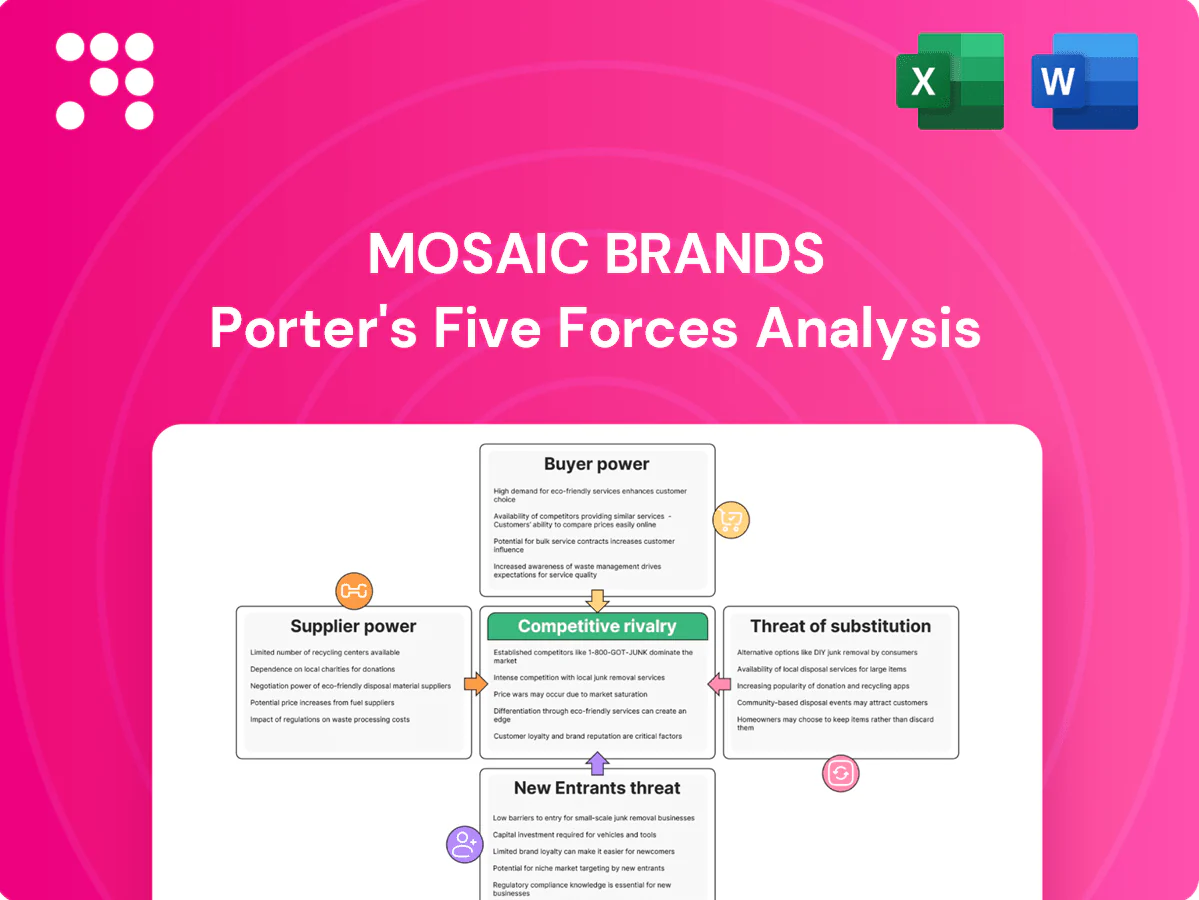
Mosaic Brands Porter's Five Forces Analysis

Go Beyond the Preview—Access the Full Strategic Report
Mosaic Brands faces intense buyer power, rising online substitution, moderate supplier leverage, and steady competitive rivalry that squeeze margins and demand strategic differentiation. New entrants pose a limited threat but omni-channel execution is critical to defend share. This brief snapshot only scratches the surface — unlock the full Porter's Five Forces Analysis to access force-by-force ratings, visuals, and actionable strategy guidance.
Suppliers Bargaining Power

Fragmented sourcing base
Mosaic Brands sources apparel from numerous manufacturers across Asia, creating a broadly substitutable supplier pool that aligns with Asia supplying roughly 60% of global apparel manufacturing. This fragmentation generally limits any single supplier’s leverage. However, specialized categories and compliant factories narrow choices for quality and ESG needs, concentrating power in certified facilities. Occasional capacity bottlenecks during peak seasons can temporarily raise supplier power by up to 10%.
Private-label leverage
Private-label leverage at Mosaic Brands (ASX: MOZ) gives the group design control and easier supplier switching across its multiple apparel labels, supporting cost management and SKU differentiation. Aggregating volumes across brands improves negotiating power with manufacturers, though scale remains mid-market compared with global fast-fashion giants. Supplier partnerships must therefore trade lower unit cost for reliability and lead-time to protect in-season availability. As of 2024 the group continues prioritising private label to control margins and assortment.

Input and freight volatility
Volatility in fabric, cotton, energy and freight passes bargaining power to upstream vendors during spikes, and continued freight swings in 2024 kept suppliers able to demand premiums or longer lead times. Post-pandemic logistics variability in 2024 forced higher spot rates or extended transit windows for apparel imports. Hedging and diversified lanes reduce but do not remove exposure. AUD movements in 2024 also shifted landed costs for Mosaic Brands.

Compliance and ESG requirements
Australian ESG and compliance standards, including the Modern Slavery Act 2018 requirement for entities with consolidated revenue ≥ AUD 100 million, shrink the pool of acceptable suppliers and raise onboarding friction through mandatory reporting, audits and traceability. Suppliers meeting these standards can command a premium, while non‑compliance creates clear reputational and operational risk for Mosaic Brands.
- Modern Slavery Act threshold: ≥ AUD 100m
- Compliance audits increase switching costs
- Certified suppliers can charge higher margins
Lead-time and design cadence
Fashion cycles demand speed-to-market, elevating the value of agile suppliers; in 2024 Asia-to-Australia apparel lead times averaged roughly 8–12 weeks while fast-turn models target 2–4 week cadences, boosting supplier leverage on quick turns.
- Shorter lead times → higher supplier bargaining power
- Longer committed orders → less flexibility, greater markdown risk
- Nearshoring/dual-sourcing in 2024 reduced lead-time exposure and rebalanced power
Asia ~60%; lead 8-12 wks; costs +10%
Mosaic Brands faces low supplier concentration thanks to Asia supplying ~60% of global apparel manufacturing, but ESG-compliant and quick-turn factories increase supplier leverage; 2024 lead times 8–12 weeks vs fast-turn 2–4 weeks. Freight and cotton volatility in 2024 shifted landed costs and can raise supplier power ~10% during peaks.
| Metric | 2024 |
|---|---|
| Asia share of apparel mfg | ~60% |
| Lead times (Asia→AU) | 8–12 weeks |
| Modern Slavery Act threshold | AUD 100m |
What is included in the product
 Detailed Word Document
Concise Porter's Five Forces analysis tailored to Mosaic Brands, uncovering competitive intensity, buyer and supplier leverage, threat of new entrants and substitutes, and highlighting disruptive trends and strategic levers to protect market share and profitability.

 Customizable Excel Spreadsheet
A one-sheet Porter's Five Forces for Mosaic Brands that highlights key competitive pressures and relieves analysis bottlenecks for rapid strategy calls. Editable pressure levels and a ready-to-use radar chart make it simple to update and drop into board decks.
Customers Bargaining Power

Many alternatives, low switching
Australian consumers face abundant choices across chains, department stores and online platforms, with online retail sales topping AUD 50 billion in 2024, intensifying competition. Switching costs are minimal, boosting buyer power as consumers easily move between brands. Easy online price comparisons and marketplaces force Mosaic to compete on value, assortment and convenience to protect margins.
Price sensitivity and promotions
Value-oriented segments of Mosaic Brands (ASX: MOZ) — which manages a portfolio of 25+ fashion and lifestyle labels — respond strongly to discounts and bundles, driving short-term volume. Frequent promotions train buyers to wait for sales, compressing margins and elevating buyer leverage. This price sensitivity forces margin compression across the portfolio. Clear value propositions and curated assortments help defend price and reduce promo dependency.

Omnichannel expectations
Shoppers now demand seamless store-online inventory visibility and hassle-free returns, with Salesforce 2024 finding roughly 79% of consumers expect consistent cross-channel experiences. Failures in click-and-collect or slow delivery drive immediate churn and push buyers to competitors. A strong omnichannel execution can lower buyer power by increasing loyalty and repeat purchase frequency. Weak execution amplifies customer bargaining leverage and margin pressure.

Loyalty programs and data
Mosaic’s brand communities and loyalty schemes reduce price elasticity among core shoppers by increasing repeat purchases and retention. Personalization and targeted offers elevate perceived value and wallet share, but reward programs weighted toward discounts can entrench price sensitivity. Effective behavioral segmentation is essential to sustainably lower buyer power.
- Segmentation: focus on recency-frequency-monetary cohorts
- Value drivers: personalized offers over blanket discounts
- Retention: community engagement > transactional rewards
Reviews and social influence
Digital reviews and social media rapidly amplify fit and quality issues for Mosaic Brands; 2024 surveys show over 70% of apparel shoppers consult reviews before buying, increasing return rates and customer bargaining power when negative feedback spreads.
Positive advocacy reduces price sensitivity and drives repeat purchases, so managing user-generated content and responsive customer care is critical to contain returns and protect margins.
- reviews: >70% shoppers consult (2024)
- negative feedback → higher returns, more bargaining power
- positive advocacy → repeat buys, less price pressure
- UGC moderation + customer care = strategic priority
Omnichannel competition intensifies as online retail hits AUD 50bn
Customers hold high bargaining power: abundant choice and low switching costs (online retail AUD 50bn 2024) force Mosaic (25+ brands) to compete on price, assortment and omnichannel service. 79% expect consistent cross‑channel experiences; >70% consult reviews before purchase, raising return risk and promo dependence. Loyalty programs and personalization can reduce price elasticity but must avoid discount-heavy rewards.
| Metric | 2024 |
|---|---|
| Online retail (AU) | AUD 50bn |
| Cross‑channel expectation | 79% |
| Shoppers consulting reviews | >70% |
| Mosaic brands | 25+ |
Preview the Actual Deliverable
Mosaic Brands Porter's Five Forces Analysis
This preview shows the exact Mosaic Brands Porter's Five Forces analysis you'll receive immediately after purchase—no surprises, no placeholders. The document is professionally written, fully formatted and ready for download and use the moment you buy. It provides a concise assessment of competitive rivalry, supplier and buyer power, threats of new entrants and substitutes, plus strategic implications.

Go Beyond the Preview—Access the Full Strategic Report
Mosaic Brands faces intense buyer power, rising online substitution, moderate supplier leverage, and steady competitive rivalry that squeeze margins and demand strategic differentiation. New entrants pose a limited threat but omni-channel execution is critical to defend share. This brief snapshot only scratches the surface — unlock the full Porter's Five Forces Analysis to access force-by-force ratings, visuals, and actionable strategy guidance.
Suppliers Bargaining Power
Fragmented sourcing base
Mosaic Brands sources apparel from numerous manufacturers across Asia, creating a broadly substitutable supplier pool that aligns with Asia supplying roughly 60% of global apparel manufacturing. This fragmentation generally limits any single supplier’s leverage. However, specialized categories and compliant factories narrow choices for quality and ESG needs, concentrating power in certified facilities. Occasional capacity bottlenecks during peak seasons can temporarily raise supplier power by up to 10%.
Private-label leverage
Private-label leverage at Mosaic Brands (ASX: MOZ) gives the group design control and easier supplier switching across its multiple apparel labels, supporting cost management and SKU differentiation. Aggregating volumes across brands improves negotiating power with manufacturers, though scale remains mid-market compared with global fast-fashion giants. Supplier partnerships must therefore trade lower unit cost for reliability and lead-time to protect in-season availability. As of 2024 the group continues prioritising private label to control margins and assortment.
Input and freight volatility
Volatility in fabric, cotton, energy and freight passes bargaining power to upstream vendors during spikes, and continued freight swings in 2024 kept suppliers able to demand premiums or longer lead times. Post-pandemic logistics variability in 2024 forced higher spot rates or extended transit windows for apparel imports. Hedging and diversified lanes reduce but do not remove exposure. AUD movements in 2024 also shifted landed costs for Mosaic Brands.
Compliance and ESG requirements
Australian ESG and compliance standards, including the Modern Slavery Act 2018 requirement for entities with consolidated revenue ≥ AUD 100 million, shrink the pool of acceptable suppliers and raise onboarding friction through mandatory reporting, audits and traceability. Suppliers meeting these standards can command a premium, while non‑compliance creates clear reputational and operational risk for Mosaic Brands.
- Modern Slavery Act threshold: ≥ AUD 100m
- Compliance audits increase switching costs
- Certified suppliers can charge higher margins
Lead-time and design cadence
Fashion cycles demand speed-to-market, elevating the value of agile suppliers; in 2024 Asia-to-Australia apparel lead times averaged roughly 8–12 weeks while fast-turn models target 2–4 week cadences, boosting supplier leverage on quick turns.
- Shorter lead times → higher supplier bargaining power
- Longer committed orders → less flexibility, greater markdown risk
- Nearshoring/dual-sourcing in 2024 reduced lead-time exposure and rebalanced power
Asia ~60%; lead 8-12 wks; costs +10%
Mosaic Brands faces low supplier concentration thanks to Asia supplying ~60% of global apparel manufacturing, but ESG-compliant and quick-turn factories increase supplier leverage; 2024 lead times 8–12 weeks vs fast-turn 2–4 weeks. Freight and cotton volatility in 2024 shifted landed costs and can raise supplier power ~10% during peaks.
| Metric | 2024 |
|---|---|
| Asia share of apparel mfg | ~60% |
| Lead times (Asia→AU) | 8–12 weeks |
| Modern Slavery Act threshold | AUD 100m |
What is included in the product
Detailed Word Document
Concise Porter's Five Forces analysis tailored to Mosaic Brands, uncovering competitive intensity, buyer and supplier leverage, threat of new entrants and substitutes, and highlighting disruptive trends and strategic levers to protect market share and profitability.
Customizable Excel Spreadsheet
A one-sheet Porter's Five Forces for Mosaic Brands that highlights key competitive pressures and relieves analysis bottlenecks for rapid strategy calls. Editable pressure levels and a ready-to-use radar chart make it simple to update and drop into board decks.
Customers Bargaining Power
Many alternatives, low switching
Australian consumers face abundant choices across chains, department stores and online platforms, with online retail sales topping AUD 50 billion in 2024, intensifying competition. Switching costs are minimal, boosting buyer power as consumers easily move between brands. Easy online price comparisons and marketplaces force Mosaic to compete on value, assortment and convenience to protect margins.
Price sensitivity and promotions
Value-oriented segments of Mosaic Brands (ASX: MOZ) — which manages a portfolio of 25+ fashion and lifestyle labels — respond strongly to discounts and bundles, driving short-term volume. Frequent promotions train buyers to wait for sales, compressing margins and elevating buyer leverage. This price sensitivity forces margin compression across the portfolio. Clear value propositions and curated assortments help defend price and reduce promo dependency.
Omnichannel expectations
Shoppers now demand seamless store-online inventory visibility and hassle-free returns, with Salesforce 2024 finding roughly 79% of consumers expect consistent cross-channel experiences. Failures in click-and-collect or slow delivery drive immediate churn and push buyers to competitors. A strong omnichannel execution can lower buyer power by increasing loyalty and repeat purchase frequency. Weak execution amplifies customer bargaining leverage and margin pressure.
Loyalty programs and data
Mosaic’s brand communities and loyalty schemes reduce price elasticity among core shoppers by increasing repeat purchases and retention. Personalization and targeted offers elevate perceived value and wallet share, but reward programs weighted toward discounts can entrench price sensitivity. Effective behavioral segmentation is essential to sustainably lower buyer power.
- Segmentation: focus on recency-frequency-monetary cohorts
- Value drivers: personalized offers over blanket discounts
- Retention: community engagement > transactional rewards
Reviews and social influence
Digital reviews and social media rapidly amplify fit and quality issues for Mosaic Brands; 2024 surveys show over 70% of apparel shoppers consult reviews before buying, increasing return rates and customer bargaining power when negative feedback spreads.
Positive advocacy reduces price sensitivity and drives repeat purchases, so managing user-generated content and responsive customer care is critical to contain returns and protect margins.
- reviews: >70% shoppers consult (2024)
- negative feedback → higher returns, more bargaining power
- positive advocacy → repeat buys, less price pressure
- UGC moderation + customer care = strategic priority
Omnichannel competition intensifies as online retail hits AUD 50bn
Customers hold high bargaining power: abundant choice and low switching costs (online retail AUD 50bn 2024) force Mosaic (25+ brands) to compete on price, assortment and omnichannel service. 79% expect consistent cross‑channel experiences; >70% consult reviews before purchase, raising return risk and promo dependence. Loyalty programs and personalization can reduce price elasticity but must avoid discount-heavy rewards.
| Metric | 2024 |
|---|---|
| Online retail (AU) | AUD 50bn |
| Cross‑channel expectation | 79% |
| Shoppers consulting reviews | >70% |
| Mosaic brands | 25+ |
Preview the Actual Deliverable
Mosaic Brands Porter's Five Forces Analysis
This preview shows the exact Mosaic Brands Porter's Five Forces analysis you'll receive immediately after purchase—no surprises, no placeholders. The document is professionally written, fully formatted and ready for download and use the moment you buy. It provides a concise assessment of competitive rivalry, supplier and buyer power, threats of new entrants and substitutes, plus strategic implications.
Original: $10.00
-65%$10.00
$3.50Description
Go Beyond the Preview—Access the Full Strategic Report
Mosaic Brands faces intense buyer power, rising online substitution, moderate supplier leverage, and steady competitive rivalry that squeeze margins and demand strategic differentiation. New entrants pose a limited threat but omni-channel execution is critical to defend share. This brief snapshot only scratches the surface — unlock the full Porter's Five Forces Analysis to access force-by-force ratings, visuals, and actionable strategy guidance.
Suppliers Bargaining Power
Fragmented sourcing base
Mosaic Brands sources apparel from numerous manufacturers across Asia, creating a broadly substitutable supplier pool that aligns with Asia supplying roughly 60% of global apparel manufacturing. This fragmentation generally limits any single supplier’s leverage. However, specialized categories and compliant factories narrow choices for quality and ESG needs, concentrating power in certified facilities. Occasional capacity bottlenecks during peak seasons can temporarily raise supplier power by up to 10%.
Private-label leverage
Private-label leverage at Mosaic Brands (ASX: MOZ) gives the group design control and easier supplier switching across its multiple apparel labels, supporting cost management and SKU differentiation. Aggregating volumes across brands improves negotiating power with manufacturers, though scale remains mid-market compared with global fast-fashion giants. Supplier partnerships must therefore trade lower unit cost for reliability and lead-time to protect in-season availability. As of 2024 the group continues prioritising private label to control margins and assortment.
Input and freight volatility
Volatility in fabric, cotton, energy and freight passes bargaining power to upstream vendors during spikes, and continued freight swings in 2024 kept suppliers able to demand premiums or longer lead times. Post-pandemic logistics variability in 2024 forced higher spot rates or extended transit windows for apparel imports. Hedging and diversified lanes reduce but do not remove exposure. AUD movements in 2024 also shifted landed costs for Mosaic Brands.
Compliance and ESG requirements
Australian ESG and compliance standards, including the Modern Slavery Act 2018 requirement for entities with consolidated revenue ≥ AUD 100 million, shrink the pool of acceptable suppliers and raise onboarding friction through mandatory reporting, audits and traceability. Suppliers meeting these standards can command a premium, while non‑compliance creates clear reputational and operational risk for Mosaic Brands.
- Modern Slavery Act threshold: ≥ AUD 100m
- Compliance audits increase switching costs
- Certified suppliers can charge higher margins
Lead-time and design cadence
Fashion cycles demand speed-to-market, elevating the value of agile suppliers; in 2024 Asia-to-Australia apparel lead times averaged roughly 8–12 weeks while fast-turn models target 2–4 week cadences, boosting supplier leverage on quick turns.
- Shorter lead times → higher supplier bargaining power
- Longer committed orders → less flexibility, greater markdown risk
- Nearshoring/dual-sourcing in 2024 reduced lead-time exposure and rebalanced power
Asia ~60%; lead 8-12 wks; costs +10%
Mosaic Brands faces low supplier concentration thanks to Asia supplying ~60% of global apparel manufacturing, but ESG-compliant and quick-turn factories increase supplier leverage; 2024 lead times 8–12 weeks vs fast-turn 2–4 weeks. Freight and cotton volatility in 2024 shifted landed costs and can raise supplier power ~10% during peaks.
| Metric | 2024 |
|---|---|
| Asia share of apparel mfg | ~60% |
| Lead times (Asia→AU) | 8–12 weeks |
| Modern Slavery Act threshold | AUD 100m |
What is included in the product
Detailed Word Document
Concise Porter's Five Forces analysis tailored to Mosaic Brands, uncovering competitive intensity, buyer and supplier leverage, threat of new entrants and substitutes, and highlighting disruptive trends and strategic levers to protect market share and profitability.
Customizable Excel Spreadsheet
A one-sheet Porter's Five Forces for Mosaic Brands that highlights key competitive pressures and relieves analysis bottlenecks for rapid strategy calls. Editable pressure levels and a ready-to-use radar chart make it simple to update and drop into board decks.
Customers Bargaining Power
Many alternatives, low switching
Australian consumers face abundant choices across chains, department stores and online platforms, with online retail sales topping AUD 50 billion in 2024, intensifying competition. Switching costs are minimal, boosting buyer power as consumers easily move between brands. Easy online price comparisons and marketplaces force Mosaic to compete on value, assortment and convenience to protect margins.
Price sensitivity and promotions
Value-oriented segments of Mosaic Brands (ASX: MOZ) — which manages a portfolio of 25+ fashion and lifestyle labels — respond strongly to discounts and bundles, driving short-term volume. Frequent promotions train buyers to wait for sales, compressing margins and elevating buyer leverage. This price sensitivity forces margin compression across the portfolio. Clear value propositions and curated assortments help defend price and reduce promo dependency.
Omnichannel expectations
Shoppers now demand seamless store-online inventory visibility and hassle-free returns, with Salesforce 2024 finding roughly 79% of consumers expect consistent cross-channel experiences. Failures in click-and-collect or slow delivery drive immediate churn and push buyers to competitors. A strong omnichannel execution can lower buyer power by increasing loyalty and repeat purchase frequency. Weak execution amplifies customer bargaining leverage and margin pressure.
Loyalty programs and data
Mosaic’s brand communities and loyalty schemes reduce price elasticity among core shoppers by increasing repeat purchases and retention. Personalization and targeted offers elevate perceived value and wallet share, but reward programs weighted toward discounts can entrench price sensitivity. Effective behavioral segmentation is essential to sustainably lower buyer power.
- Segmentation: focus on recency-frequency-monetary cohorts
- Value drivers: personalized offers over blanket discounts
- Retention: community engagement > transactional rewards
Reviews and social influence
Digital reviews and social media rapidly amplify fit and quality issues for Mosaic Brands; 2024 surveys show over 70% of apparel shoppers consult reviews before buying, increasing return rates and customer bargaining power when negative feedback spreads.
Positive advocacy reduces price sensitivity and drives repeat purchases, so managing user-generated content and responsive customer care is critical to contain returns and protect margins.
- reviews: >70% shoppers consult (2024)
- negative feedback → higher returns, more bargaining power
- positive advocacy → repeat buys, less price pressure
- UGC moderation + customer care = strategic priority
Omnichannel competition intensifies as online retail hits AUD 50bn
Customers hold high bargaining power: abundant choice and low switching costs (online retail AUD 50bn 2024) force Mosaic (25+ brands) to compete on price, assortment and omnichannel service. 79% expect consistent cross‑channel experiences; >70% consult reviews before purchase, raising return risk and promo dependence. Loyalty programs and personalization can reduce price elasticity but must avoid discount-heavy rewards.
| Metric | 2024 |
|---|---|
| Online retail (AU) | AUD 50bn |
| Cross‑channel expectation | 79% |
| Shoppers consulting reviews | >70% |
| Mosaic brands | 25+ |
Preview the Actual Deliverable
Mosaic Brands Porter's Five Forces Analysis
This preview shows the exact Mosaic Brands Porter's Five Forces analysis you'll receive immediately after purchase—no surprises, no placeholders. The document is professionally written, fully formatted and ready for download and use the moment you buy. It provides a concise assessment of competitive rivalry, supplier and buyer power, threats of new entrants and substitutes, plus strategic implications.











