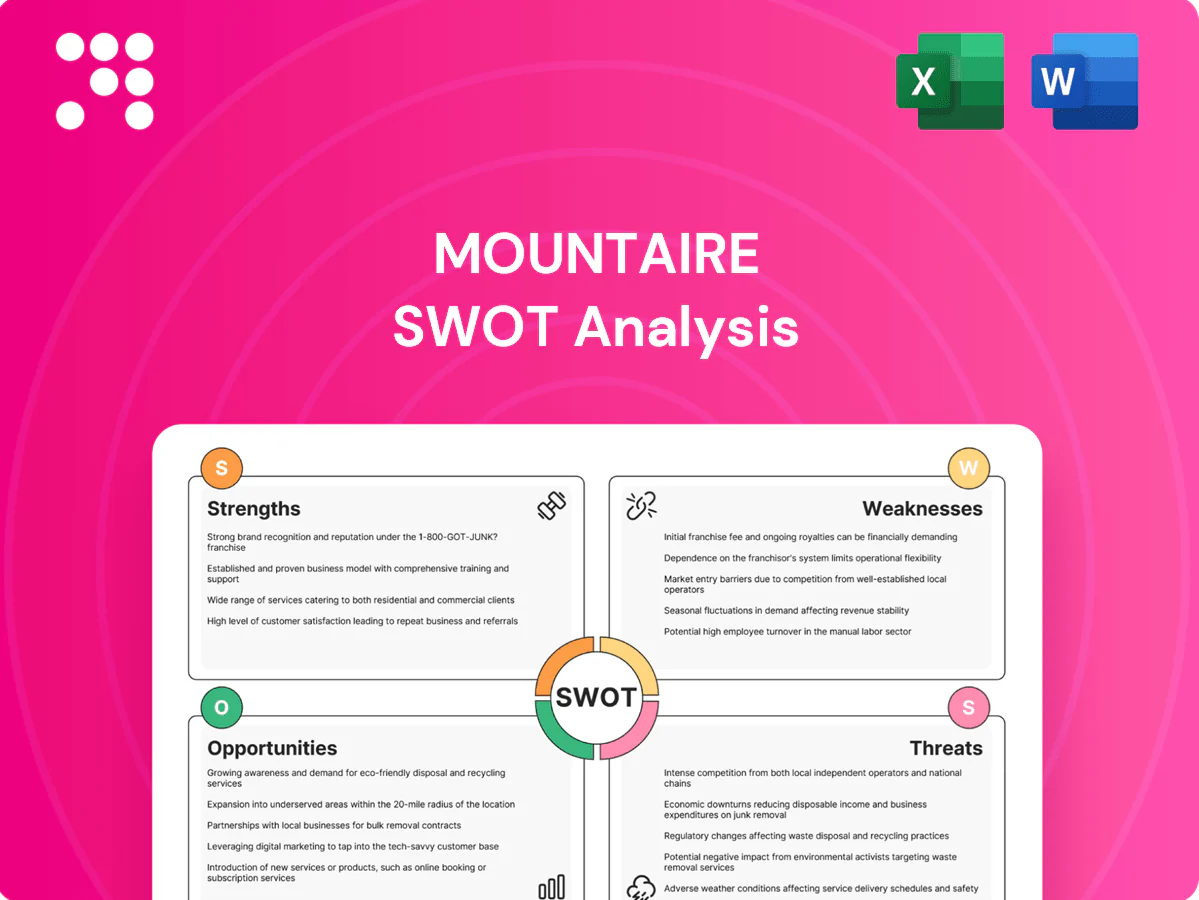
Mountaire SWOT Analysis

Make Insightful Decisions Backed by Expert Research
Mountaire’s vertical integration, strong regional footprint, and branded product growth support resilience, but commodity volatility, labor pressures, and regulatory risks could constrain margins. Want the full picture with financial context and editable Word + Excel deliverables? Purchase the complete SWOT analysis to plan, pitch, or invest with confidence.
Strengths

Fully integrated poultry value chain
Owning feed mills, hatcheries, grow-out and processing gives Mountaire tight cost control and consistent product quality, lowering procurement and coordination risk while improving supply reliability. Integration enables faster responses to demand swings and strict biosecurity, helping protect margins through production cycles.
Scale as a top U.S. chicken producer
As a leading U.S. poultry integrator, Mountaire's large volumes enable strong purchasing leverage in grain, packaging and logistics, capturing scale benefits against an industry backdrop of roughly 53 billion pounds of broiler production in 2024. Scale supports high plant utilization and lowers unit costs through fixed-cost absorption. It strengthens bargaining power with major retailers and foodservice buyers and bolsters brand credibility via national customer relationships.

Diverse product and channel mix
Mountaire's sales across retail, foodservice and further processors spreads demand risk and taps a US broiler market of roughly 44.9 billion pounds in 2024. Offering fresh, frozen and value-added SKUs broadens margin pools, with value-added products often commanding premium pricing. Channel balance stabilizes throughput in volatile markets and enables tailored specifications for key accounts.

Strong farmer partnerships
Mountaire leverages extensive contract grower networks to secure steady live supply and aligned incentives; over 95% of US broiler production runs under contract (USDA ERS 2023), supporting predictable throughput. Long-term grower ties raise animal welfare and performance metrics; localized sourcing trims logistics and lead times while reinforcing community labor pools—Mountaire is the sixth-largest US integrator (WATT 2023).
- Steady supply: >95% broilers under contract (USDA 2023)
- Industry scale: Mountaire ranked 6th (WATT 2023)
- Lower logistics costs via local sourcing
- Improved welfare, performance, community ties
Operational expertise in quality and safety
Established QA, HACCP, and end-to-end traceability systems underpin strong customer trust and supplier approvals; consistent yields and cut accuracy enhance margin realization and lower waste. A recognized food-safety reputation differentiates Mountaire with large retail and foodservice buyers, while disciplined processes enable repeatable, scalable execution across multiple plants.
- QA/HACCP: stronger buyer approvals
- Traceability: faster recall containment
- Yield consistency: lower unit costs
- Process discipline: scalable plant performance
Vertical integration and scale boost margins amid ~53bn lb US broiler output
Vertically integrated operations (feed-to-processing) give Mountaire tight cost control, biosecurity and faster demand response, supporting margin resilience. Scale (6th largest US integrator) and national accounts secure purchasing leverage amid ~53bn lb US broiler output (2024). Diversified channels and >95% contract grower coverage stabilize throughput and reduce supply volatility.
| Metric | Value |
|---|---|
| US broiler output (2024) | ~53 billion lb |
| Mountaire rank | 6th (WATT 2023) |
| Contracted broilers | >95% (USDA ERS 2023) |
What is included in the product
 Detailed Word Document
Provides a concise SWOT framework analyzing Mountaire’s internal strengths and weaknesses alongside external opportunities and threats, highlighting operational capabilities, market positioning, growth drivers, and key risks shaping its strategic outlook.

 Customizable Excel Spreadsheet
Provides a concise Mountaire SWOT matrix to quickly surface operational risks and growth levers for faster strategic response. Editable format lets teams update inputs as supply chain or market conditions change for timely decision-making.
Weaknesses

High exposure to feed-cost volatility
Mountaire faces high exposure to feed-cost volatility: corn averaged about $5.60/bu and soybean meal near $380/short ton in 2024–25, directly lifting COGS. Hedging programs can smooth cash flow but could not prevent multi-month spikes in 2024 that pressured margins. When input costs rise faster than contract and wholesale price resets, margin compression follows. Pricing power varies widely by channel and product, limiting pass-through.
Commodity-like pricing pressure
Chicken is often sold on spot markets and index-linked formulas, constraining Mountaire's pricing power and pass-through where brand differentiation is limited. As the fifth-largest U.S. chicken processor, Mountaire faces competitors who can rapidly match price moves, compressing margins. Differentiation thus depends on service, reliability, and value-add offerings to protect profitability.

Labor-intensive processing footprint
Plants depend on stable, skilled labor for yields and safety, yet tight U.S. labor markets (unemployment near 3.7% in 2024) have driven wage inflation and higher turnover costs for processors. Training gaps reduce line efficiency and raise waste rates, while required automation capex to mitigate labor risk can be significant relative to plant margins.

Geographic concentration risks
Regional clustering of Mountaire operations—concentrated mainly in the Delmarva, North Carolina and Arkansas regions—heightens exposure to localized weather, disease outbreaks and logistics disruptions; supply chain shocks can ripple across nearby plants, and local regulatory shifts (state labor/environmental rules) can hit multiple facilities simultaneously. Diversification to reduce this concentration requires significant capital and multi-year execution; Mountaire reported roughly $3.4bn revenue and operates about 8 processing plants in 2024.
- Exposure: clustered plants in Delmarva/NC/AR
- Impact: weather, avian disease, transport shocks
- Regulatory risk: state-level changes affect multiple sites
- Mitigation: diversification needs large CAPEX and time
Brand visibility lower than largest peers
Mountaire's consumer recognition trails national household names, with largest peers reporting revenues in the tens of billions in 2024, highlighting a scale gap. Heavy private-label and B2B emphasis limits direct brand equity and retail shelf presence. This weakens pricing power at retail and forces tighter margins, so marketing spend must be highly targeted to deliver measurable ROI.
- Consumer recognition lag vs. national brands
- Private-label/B2B focus limits brand equity
- Reduced retail pricing power and margin pressure
- Marketing must be targeted to achieve ROI
Feed-cost volatility and tight labor compress poultry margins; regional clustering raises risk
Mountaire faces feed-cost volatility (corn ~$5.60/bu, soybean meal ~$380/short ton in 2024–25) that raised COGS and squeezed margins; pricing power is limited by spot/index-linked contracts and strong competitors. Labor tightness (U.S. unemployment ~3.7% in 2024) drives wage inflation and automation capex needs. Regional plant clustering amplifies disease, weather and regulatory risks.
| Metric | 2024/25 |
|---|---|
| Revenue | $3.4bn |
| Processing plants | ~8 |
| Corn price | $5.60/bu |
| Soybean meal | $380/short ton |
| Unemployment | 3.7% |
Full Version Awaits
Mountaire SWOT Analysis
This is the actual SWOT analysis document you’ll receive upon purchase—no surprises, just professional quality. The preview below is taken directly from the full Mountaire SWOT report you'll get; purchasing unlocks the complete, editable version. You’re viewing a live excerpt of the file—buy now to download the full, detailed report.

Make Insightful Decisions Backed by Expert Research
Mountaire’s vertical integration, strong regional footprint, and branded product growth support resilience, but commodity volatility, labor pressures, and regulatory risks could constrain margins. Want the full picture with financial context and editable Word + Excel deliverables? Purchase the complete SWOT analysis to plan, pitch, or invest with confidence.
Strengths
Fully integrated poultry value chain
Owning feed mills, hatcheries, grow-out and processing gives Mountaire tight cost control and consistent product quality, lowering procurement and coordination risk while improving supply reliability. Integration enables faster responses to demand swings and strict biosecurity, helping protect margins through production cycles.
Scale as a top U.S. chicken producer
As a leading U.S. poultry integrator, Mountaire's large volumes enable strong purchasing leverage in grain, packaging and logistics, capturing scale benefits against an industry backdrop of roughly 53 billion pounds of broiler production in 2024. Scale supports high plant utilization and lowers unit costs through fixed-cost absorption. It strengthens bargaining power with major retailers and foodservice buyers and bolsters brand credibility via national customer relationships.
Diverse product and channel mix
Mountaire's sales across retail, foodservice and further processors spreads demand risk and taps a US broiler market of roughly 44.9 billion pounds in 2024. Offering fresh, frozen and value-added SKUs broadens margin pools, with value-added products often commanding premium pricing. Channel balance stabilizes throughput in volatile markets and enables tailored specifications for key accounts.
Strong farmer partnerships
Mountaire leverages extensive contract grower networks to secure steady live supply and aligned incentives; over 95% of US broiler production runs under contract (USDA ERS 2023), supporting predictable throughput. Long-term grower ties raise animal welfare and performance metrics; localized sourcing trims logistics and lead times while reinforcing community labor pools—Mountaire is the sixth-largest US integrator (WATT 2023).
- Steady supply: >95% broilers under contract (USDA 2023)
- Industry scale: Mountaire ranked 6th (WATT 2023)
- Lower logistics costs via local sourcing
- Improved welfare, performance, community ties
Operational expertise in quality and safety
Established QA, HACCP, and end-to-end traceability systems underpin strong customer trust and supplier approvals; consistent yields and cut accuracy enhance margin realization and lower waste. A recognized food-safety reputation differentiates Mountaire with large retail and foodservice buyers, while disciplined processes enable repeatable, scalable execution across multiple plants.
- QA/HACCP: stronger buyer approvals
- Traceability: faster recall containment
- Yield consistency: lower unit costs
- Process discipline: scalable plant performance
Vertical integration and scale boost margins amid ~53bn lb US broiler output
Vertically integrated operations (feed-to-processing) give Mountaire tight cost control, biosecurity and faster demand response, supporting margin resilience. Scale (6th largest US integrator) and national accounts secure purchasing leverage amid ~53bn lb US broiler output (2024). Diversified channels and >95% contract grower coverage stabilize throughput and reduce supply volatility.
| Metric | Value |
|---|---|
| US broiler output (2024) | ~53 billion lb |
| Mountaire rank | 6th (WATT 2023) |
| Contracted broilers | >95% (USDA ERS 2023) |
What is included in the product
Detailed Word Document
Provides a concise SWOT framework analyzing Mountaire’s internal strengths and weaknesses alongside external opportunities and threats, highlighting operational capabilities, market positioning, growth drivers, and key risks shaping its strategic outlook.
Customizable Excel Spreadsheet
Provides a concise Mountaire SWOT matrix to quickly surface operational risks and growth levers for faster strategic response. Editable format lets teams update inputs as supply chain or market conditions change for timely decision-making.
Weaknesses
High exposure to feed-cost volatility
Mountaire faces high exposure to feed-cost volatility: corn averaged about $5.60/bu and soybean meal near $380/short ton in 2024–25, directly lifting COGS. Hedging programs can smooth cash flow but could not prevent multi-month spikes in 2024 that pressured margins. When input costs rise faster than contract and wholesale price resets, margin compression follows. Pricing power varies widely by channel and product, limiting pass-through.
Commodity-like pricing pressure
Chicken is often sold on spot markets and index-linked formulas, constraining Mountaire's pricing power and pass-through where brand differentiation is limited. As the fifth-largest U.S. chicken processor, Mountaire faces competitors who can rapidly match price moves, compressing margins. Differentiation thus depends on service, reliability, and value-add offerings to protect profitability.
Labor-intensive processing footprint
Plants depend on stable, skilled labor for yields and safety, yet tight U.S. labor markets (unemployment near 3.7% in 2024) have driven wage inflation and higher turnover costs for processors. Training gaps reduce line efficiency and raise waste rates, while required automation capex to mitigate labor risk can be significant relative to plant margins.
Geographic concentration risks
Regional clustering of Mountaire operations—concentrated mainly in the Delmarva, North Carolina and Arkansas regions—heightens exposure to localized weather, disease outbreaks and logistics disruptions; supply chain shocks can ripple across nearby plants, and local regulatory shifts (state labor/environmental rules) can hit multiple facilities simultaneously. Diversification to reduce this concentration requires significant capital and multi-year execution; Mountaire reported roughly $3.4bn revenue and operates about 8 processing plants in 2024.
- Exposure: clustered plants in Delmarva/NC/AR
- Impact: weather, avian disease, transport shocks
- Regulatory risk: state-level changes affect multiple sites
- Mitigation: diversification needs large CAPEX and time
Brand visibility lower than largest peers
Mountaire's consumer recognition trails national household names, with largest peers reporting revenues in the tens of billions in 2024, highlighting a scale gap. Heavy private-label and B2B emphasis limits direct brand equity and retail shelf presence. This weakens pricing power at retail and forces tighter margins, so marketing spend must be highly targeted to deliver measurable ROI.
- Consumer recognition lag vs. national brands
- Private-label/B2B focus limits brand equity
- Reduced retail pricing power and margin pressure
- Marketing must be targeted to achieve ROI
Feed-cost volatility and tight labor compress poultry margins; regional clustering raises risk
Mountaire faces feed-cost volatility (corn ~$5.60/bu, soybean meal ~$380/short ton in 2024–25) that raised COGS and squeezed margins; pricing power is limited by spot/index-linked contracts and strong competitors. Labor tightness (U.S. unemployment ~3.7% in 2024) drives wage inflation and automation capex needs. Regional plant clustering amplifies disease, weather and regulatory risks.
| Metric | 2024/25 |
|---|---|
| Revenue | $3.4bn |
| Processing plants | ~8 |
| Corn price | $5.60/bu |
| Soybean meal | $380/short ton |
| Unemployment | 3.7% |
Full Version Awaits
Mountaire SWOT Analysis
This is the actual SWOT analysis document you’ll receive upon purchase—no surprises, just professional quality. The preview below is taken directly from the full Mountaire SWOT report you'll get; purchasing unlocks the complete, editable version. You’re viewing a live excerpt of the file—buy now to download the full, detailed report.
Description
Make Insightful Decisions Backed by Expert Research
Mountaire’s vertical integration, strong regional footprint, and branded product growth support resilience, but commodity volatility, labor pressures, and regulatory risks could constrain margins. Want the full picture with financial context and editable Word + Excel deliverables? Purchase the complete SWOT analysis to plan, pitch, or invest with confidence.
Strengths
Fully integrated poultry value chain
Owning feed mills, hatcheries, grow-out and processing gives Mountaire tight cost control and consistent product quality, lowering procurement and coordination risk while improving supply reliability. Integration enables faster responses to demand swings and strict biosecurity, helping protect margins through production cycles.
Scale as a top U.S. chicken producer
As a leading U.S. poultry integrator, Mountaire's large volumes enable strong purchasing leverage in grain, packaging and logistics, capturing scale benefits against an industry backdrop of roughly 53 billion pounds of broiler production in 2024. Scale supports high plant utilization and lowers unit costs through fixed-cost absorption. It strengthens bargaining power with major retailers and foodservice buyers and bolsters brand credibility via national customer relationships.
Diverse product and channel mix
Mountaire's sales across retail, foodservice and further processors spreads demand risk and taps a US broiler market of roughly 44.9 billion pounds in 2024. Offering fresh, frozen and value-added SKUs broadens margin pools, with value-added products often commanding premium pricing. Channel balance stabilizes throughput in volatile markets and enables tailored specifications for key accounts.
Strong farmer partnerships
Mountaire leverages extensive contract grower networks to secure steady live supply and aligned incentives; over 95% of US broiler production runs under contract (USDA ERS 2023), supporting predictable throughput. Long-term grower ties raise animal welfare and performance metrics; localized sourcing trims logistics and lead times while reinforcing community labor pools—Mountaire is the sixth-largest US integrator (WATT 2023).
- Steady supply: >95% broilers under contract (USDA 2023)
- Industry scale: Mountaire ranked 6th (WATT 2023)
- Lower logistics costs via local sourcing
- Improved welfare, performance, community ties
Operational expertise in quality and safety
Established QA, HACCP, and end-to-end traceability systems underpin strong customer trust and supplier approvals; consistent yields and cut accuracy enhance margin realization and lower waste. A recognized food-safety reputation differentiates Mountaire with large retail and foodservice buyers, while disciplined processes enable repeatable, scalable execution across multiple plants.
- QA/HACCP: stronger buyer approvals
- Traceability: faster recall containment
- Yield consistency: lower unit costs
- Process discipline: scalable plant performance
Vertical integration and scale boost margins amid ~53bn lb US broiler output
Vertically integrated operations (feed-to-processing) give Mountaire tight cost control, biosecurity and faster demand response, supporting margin resilience. Scale (6th largest US integrator) and national accounts secure purchasing leverage amid ~53bn lb US broiler output (2024). Diversified channels and >95% contract grower coverage stabilize throughput and reduce supply volatility.
| Metric | Value |
|---|---|
| US broiler output (2024) | ~53 billion lb |
| Mountaire rank | 6th (WATT 2023) |
| Contracted broilers | >95% (USDA ERS 2023) |
What is included in the product
Detailed Word Document
Provides a concise SWOT framework analyzing Mountaire’s internal strengths and weaknesses alongside external opportunities and threats, highlighting operational capabilities, market positioning, growth drivers, and key risks shaping its strategic outlook.
Customizable Excel Spreadsheet
Provides a concise Mountaire SWOT matrix to quickly surface operational risks and growth levers for faster strategic response. Editable format lets teams update inputs as supply chain or market conditions change for timely decision-making.
Weaknesses
High exposure to feed-cost volatility
Mountaire faces high exposure to feed-cost volatility: corn averaged about $5.60/bu and soybean meal near $380/short ton in 2024–25, directly lifting COGS. Hedging programs can smooth cash flow but could not prevent multi-month spikes in 2024 that pressured margins. When input costs rise faster than contract and wholesale price resets, margin compression follows. Pricing power varies widely by channel and product, limiting pass-through.
Commodity-like pricing pressure
Chicken is often sold on spot markets and index-linked formulas, constraining Mountaire's pricing power and pass-through where brand differentiation is limited. As the fifth-largest U.S. chicken processor, Mountaire faces competitors who can rapidly match price moves, compressing margins. Differentiation thus depends on service, reliability, and value-add offerings to protect profitability.
Labor-intensive processing footprint
Plants depend on stable, skilled labor for yields and safety, yet tight U.S. labor markets (unemployment near 3.7% in 2024) have driven wage inflation and higher turnover costs for processors. Training gaps reduce line efficiency and raise waste rates, while required automation capex to mitigate labor risk can be significant relative to plant margins.
Geographic concentration risks
Regional clustering of Mountaire operations—concentrated mainly in the Delmarva, North Carolina and Arkansas regions—heightens exposure to localized weather, disease outbreaks and logistics disruptions; supply chain shocks can ripple across nearby plants, and local regulatory shifts (state labor/environmental rules) can hit multiple facilities simultaneously. Diversification to reduce this concentration requires significant capital and multi-year execution; Mountaire reported roughly $3.4bn revenue and operates about 8 processing plants in 2024.
- Exposure: clustered plants in Delmarva/NC/AR
- Impact: weather, avian disease, transport shocks
- Regulatory risk: state-level changes affect multiple sites
- Mitigation: diversification needs large CAPEX and time
Brand visibility lower than largest peers
Mountaire's consumer recognition trails national household names, with largest peers reporting revenues in the tens of billions in 2024, highlighting a scale gap. Heavy private-label and B2B emphasis limits direct brand equity and retail shelf presence. This weakens pricing power at retail and forces tighter margins, so marketing spend must be highly targeted to deliver measurable ROI.
- Consumer recognition lag vs. national brands
- Private-label/B2B focus limits brand equity
- Reduced retail pricing power and margin pressure
- Marketing must be targeted to achieve ROI
Feed-cost volatility and tight labor compress poultry margins; regional clustering raises risk
Mountaire faces feed-cost volatility (corn ~$5.60/bu, soybean meal ~$380/short ton in 2024–25) that raised COGS and squeezed margins; pricing power is limited by spot/index-linked contracts and strong competitors. Labor tightness (U.S. unemployment ~3.7% in 2024) drives wage inflation and automation capex needs. Regional plant clustering amplifies disease, weather and regulatory risks.
| Metric | 2024/25 |
|---|---|
| Revenue | $3.4bn |
| Processing plants | ~8 |
| Corn price | $5.60/bu |
| Soybean meal | $380/short ton |
| Unemployment | 3.7% |
Full Version Awaits
Mountaire SWOT Analysis
This is the actual SWOT analysis document you’ll receive upon purchase—no surprises, just professional quality. The preview below is taken directly from the full Mountaire SWOT report you'll get; purchasing unlocks the complete, editable version. You’re viewing a live excerpt of the file—buy now to download the full, detailed report.











