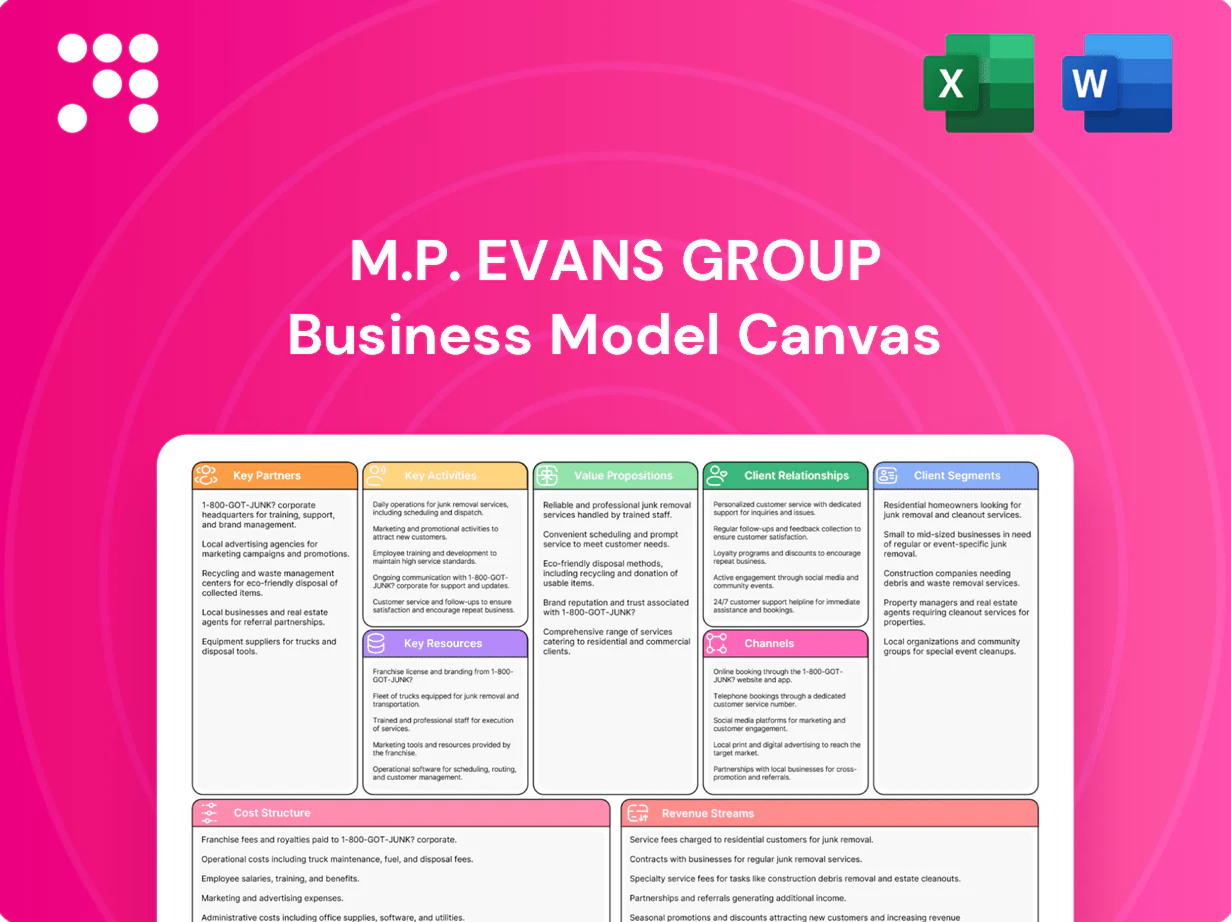
M.P. Evans Group Business Model Canvas

Complete Business Model Canvas: 3-5 page strategic blueprint for investors and advisors
Unlock the complete strategic blueprint behind M.P. Evans Group with our full Business Model Canvas—three to five precise, actionable pages revealing value propositions, key partners, revenue streams and cost structure. Perfect for investors, consultants and entrepreneurs ready to benchmark or adapt proven strategies; download the editable Word and Excel files to apply insights immediately.
Partnerships

Certified smallholder cooperatives
Partnering with certified smallholder cooperatives secures steady FFB supply and community inclusion; smallholders produce about 40% of global palm oil (2024). The Group supplies seedlings, agronomy and fair-pricing schemes—raising yields 20–30%—while formal RSPO/NDPE-aligned schemes de-risk supply chains and bolster social license to operate.
Equipment and agrochemical suppliers
Strategic relationships with machinery, fertilizer and crop‑protection providers secure bulk inputs and priority supply, enabling scalable planting and harvesting operations. Vendors deliver preventive maintenance and precision-application support that reduce downtime, lower input costs and cut field emissions through targeted use. Co-development of yield-enhancing inputs focuses on improving oil extraction rates (OER), while long-term contracts stabilise pricing and ensure equipment uptime.

Sustainability certifiers and NGOs
Collaborations with RSPO auditors and environmental NGOs validate M.P. Evans Group sustainable practices and formalize traceability across estates; RSPO reported over 4,000 members in 2024. Joint initiatives advance deforestation-free, peat-free and labor-compliant operations while supporting biodiversity and HCV/HCS conservation on company lands. Third-party verification enhances market access and can unlock price premiums through certified supply chains.

Logistics and port operators
- Timely shipments
- Reduced transit losses
- Lower carbon intensity
- Improved reliability
Government and local communities
Engagement with Indonesian authorities secures permits, land titles and regulatory compliance, reducing project delay and legal exposure.
Community partnerships enable coordinated land development, grievance mechanisms and shared infrastructure; social programs develop local workforce pipelines and stability, mitigating regulatory and operational risk.
- Permits and land titles: regulatory certainty
- Community ties: infrastructure and grievance resolution
- Social programs: local hiring and stability
Secure FFB via certified smallholders - ~40% supply, traceable trade
Partnering with certified smallholder cooperatives secures steady FFB supply and community inclusion; smallholders produce ~40% of global palm oil (2024). Supplier and vendor ties reduce input costs, improve uptime and boost OER while long-term contracts stabilise pricing. RSPO/NGO collaboration plus logistics partners enhance traceability, market access and lower carbon intensity amid ~78 million t global trade (2024).
| Partnership | Role | 2024 metric |
|---|---|---|
| Smallholders | FFB supply | ~40% global |
| RSPO/NGOs | Certification/traceability | 4,000+ members |
| Logistics | Export reliability | ~78M t global trade |
What is included in the product
 Detailed Word Document
A comprehensive Business Model Canvas for M.P. Evans Group detailing customer segments, channels, value propositions, key activities (plantation cultivation, milling, trading), resources, partners, cost/revenue structures and risks; organized into 9 BMC blocks with SWOT-linked insights to support investor presentations and strategic decision-making.

 Customizable Excel Spreadsheet
High-level, editable Business Model Canvas for M.P. Evans Group that condenses its agricultural and plantation strategy into a one-page, shareable snapshot—saves hours of structuring and makes boardroom-ready comparisons and team collaboration effortless.
Activities

Estate development and replanting
Estate development and systematic replanting sustain long-term yields by combining greenfield expansion with phased replanting programs to smooth capex and output profiles. Best-practice land preparation avoids HCS/HCV areas and peat, aligning with RSPO and local regulatory frameworks. High-yield, disease-resistant seedlings are deployed to improve tonnage per hectare and reduce disease losses. Phased implementation optimises cash flow and yield ramp-up.
Cultivation and harvesting
Day-to-day agronomy at M.P. Evans optimizes pruning, fertilizing and integrated pest management to sustain yield and plant health. Timely harvesting preserves fresh fruit bunch quality and oil extraction rates, while mechanization and targeted training raise productivity and safety. Field data from routine monitoring feed continuous improvement cycles across estates and mills.

Mill operations and quality control
On-site mills process fresh fruit bunches rapidly to keep free fatty acids typically below 5%, protecting quality and refining yield. Process control targets industry oil extraction rates of about 20–24% and kernel recovery near 4–5% to maximise revenue per tonne. Energy efficiency and methane capture from POME supply over half of mill energy needs and cut emissions significantly. Certifications (RSPO, ISCC) ensure traceability and premium market access.

Sustainability management and compliance
Monitoring NDPE commitments ensures deforestation-free supply chains and aligns M.P. Evans with market expectations as global palm oil production reached about 77 million tonnes in 2023/24; social and environmental impact assessments guide mitigation and community remediation; audits, traceability and grievance handling protect reputation and buyer access; reporting follows RSPO (≈4,900 members in 2024), ISPO and major global buyer requirements.
- NDPE
- Deforestation-free supply
- Impact assessments
- Audits & traceability
- Grievance handling
- RSPO & ISPO reporting
Sales and customer relationship management
Sales and customer relationship management secures offtake via long-term contracts with refiners and traders, locking pricing and volumes; in 2024 the Malaysian CPO benchmark averaged about MYR 4,000/tonne, underpinning contract terms. Hedging and market intelligence limit CPO price volatility, while tailored specs and delivery schedules match buyer needs and sustain margin. Certification claims are upheld across the chain of custody to retain premium access.
- Offtake: long-term contracts with refiners/traders
- Price: 2024 benchmark ~MYR 4,000/t
- Risk: hedging + market intel
- Service: customized specs/delivery
- Compliance: certified chain of custody
Sustainable palm: OER 20–24%, FFA less than 5%, POME biogas over 50%, 2024 CPO MYR 4,000/t
Estate development, phased replanting and high-yield seedlings sustain yields and smooth capex; agronomy, timely harvests and mechanization raise productivity. On-site mills target OER 20–24% and FFA <5%, with POME biogas supplying >50% mill energy. NDPE/RSPO compliance, audits and traceability protect market access; 2024 Malaysian CPO ~MYR 4,000/t.
| Metric | 2024 |
|---|---|
| OER | 20–24% |
| FFA | <5% |
| CPO price | MYR 4,000/t |
| RSPO members | ≈4,900 |
Delivered as Displayed
Business Model Canvas
The M.P. Evans Group Business Model Canvas shown here is the actual deliverable, not a mockup, and reflects the full structure and content you’ll receive after purchase. When you complete your order you’ll download the identical, ready-to-edit file in Word and Excel formats. Use it immediately for presentations, strategy workshops, or operational planning with no surprises.

Complete Business Model Canvas: 3-5 page strategic blueprint for investors and advisors
Unlock the complete strategic blueprint behind M.P. Evans Group with our full Business Model Canvas—three to five precise, actionable pages revealing value propositions, key partners, revenue streams and cost structure. Perfect for investors, consultants and entrepreneurs ready to benchmark or adapt proven strategies; download the editable Word and Excel files to apply insights immediately.
Partnerships
Certified smallholder cooperatives
Partnering with certified smallholder cooperatives secures steady FFB supply and community inclusion; smallholders produce about 40% of global palm oil (2024). The Group supplies seedlings, agronomy and fair-pricing schemes—raising yields 20–30%—while formal RSPO/NDPE-aligned schemes de-risk supply chains and bolster social license to operate.
Equipment and agrochemical suppliers
Strategic relationships with machinery, fertilizer and crop‑protection providers secure bulk inputs and priority supply, enabling scalable planting and harvesting operations. Vendors deliver preventive maintenance and precision-application support that reduce downtime, lower input costs and cut field emissions through targeted use. Co-development of yield-enhancing inputs focuses on improving oil extraction rates (OER), while long-term contracts stabilise pricing and ensure equipment uptime.
Sustainability certifiers and NGOs
Collaborations with RSPO auditors and environmental NGOs validate M.P. Evans Group sustainable practices and formalize traceability across estates; RSPO reported over 4,000 members in 2024. Joint initiatives advance deforestation-free, peat-free and labor-compliant operations while supporting biodiversity and HCV/HCS conservation on company lands. Third-party verification enhances market access and can unlock price premiums through certified supply chains.
Logistics and port operators
- Timely shipments
- Reduced transit losses
- Lower carbon intensity
- Improved reliability
Government and local communities
Engagement with Indonesian authorities secures permits, land titles and regulatory compliance, reducing project delay and legal exposure.
Community partnerships enable coordinated land development, grievance mechanisms and shared infrastructure; social programs develop local workforce pipelines and stability, mitigating regulatory and operational risk.
- Permits and land titles: regulatory certainty
- Community ties: infrastructure and grievance resolution
- Social programs: local hiring and stability
Secure FFB via certified smallholders - ~40% supply, traceable trade
Partnering with certified smallholder cooperatives secures steady FFB supply and community inclusion; smallholders produce ~40% of global palm oil (2024). Supplier and vendor ties reduce input costs, improve uptime and boost OER while long-term contracts stabilise pricing. RSPO/NGO collaboration plus logistics partners enhance traceability, market access and lower carbon intensity amid ~78 million t global trade (2024).
| Partnership | Role | 2024 metric |
|---|---|---|
| Smallholders | FFB supply | ~40% global |
| RSPO/NGOs | Certification/traceability | 4,000+ members |
| Logistics | Export reliability | ~78M t global trade |
What is included in the product
Detailed Word Document
A comprehensive Business Model Canvas for M.P. Evans Group detailing customer segments, channels, value propositions, key activities (plantation cultivation, milling, trading), resources, partners, cost/revenue structures and risks; organized into 9 BMC blocks with SWOT-linked insights to support investor presentations and strategic decision-making.
Customizable Excel Spreadsheet
High-level, editable Business Model Canvas for M.P. Evans Group that condenses its agricultural and plantation strategy into a one-page, shareable snapshot—saves hours of structuring and makes boardroom-ready comparisons and team collaboration effortless.
Activities
Estate development and replanting
Estate development and systematic replanting sustain long-term yields by combining greenfield expansion with phased replanting programs to smooth capex and output profiles. Best-practice land preparation avoids HCS/HCV areas and peat, aligning with RSPO and local regulatory frameworks. High-yield, disease-resistant seedlings are deployed to improve tonnage per hectare and reduce disease losses. Phased implementation optimises cash flow and yield ramp-up.
Cultivation and harvesting
Day-to-day agronomy at M.P. Evans optimizes pruning, fertilizing and integrated pest management to sustain yield and plant health. Timely harvesting preserves fresh fruit bunch quality and oil extraction rates, while mechanization and targeted training raise productivity and safety. Field data from routine monitoring feed continuous improvement cycles across estates and mills.
Mill operations and quality control
On-site mills process fresh fruit bunches rapidly to keep free fatty acids typically below 5%, protecting quality and refining yield. Process control targets industry oil extraction rates of about 20–24% and kernel recovery near 4–5% to maximise revenue per tonne. Energy efficiency and methane capture from POME supply over half of mill energy needs and cut emissions significantly. Certifications (RSPO, ISCC) ensure traceability and premium market access.
Sustainability management and compliance
Monitoring NDPE commitments ensures deforestation-free supply chains and aligns M.P. Evans with market expectations as global palm oil production reached about 77 million tonnes in 2023/24; social and environmental impact assessments guide mitigation and community remediation; audits, traceability and grievance handling protect reputation and buyer access; reporting follows RSPO (≈4,900 members in 2024), ISPO and major global buyer requirements.
- NDPE
- Deforestation-free supply
- Impact assessments
- Audits & traceability
- Grievance handling
- RSPO & ISPO reporting
Sales and customer relationship management
Sales and customer relationship management secures offtake via long-term contracts with refiners and traders, locking pricing and volumes; in 2024 the Malaysian CPO benchmark averaged about MYR 4,000/tonne, underpinning contract terms. Hedging and market intelligence limit CPO price volatility, while tailored specs and delivery schedules match buyer needs and sustain margin. Certification claims are upheld across the chain of custody to retain premium access.
- Offtake: long-term contracts with refiners/traders
- Price: 2024 benchmark ~MYR 4,000/t
- Risk: hedging + market intel
- Service: customized specs/delivery
- Compliance: certified chain of custody
Sustainable palm: OER 20–24%, FFA less than 5%, POME biogas over 50%, 2024 CPO MYR 4,000/t
Estate development, phased replanting and high-yield seedlings sustain yields and smooth capex; agronomy, timely harvests and mechanization raise productivity. On-site mills target OER 20–24% and FFA <5%, with POME biogas supplying >50% mill energy. NDPE/RSPO compliance, audits and traceability protect market access; 2024 Malaysian CPO ~MYR 4,000/t.
| Metric | 2024 |
|---|---|
| OER | 20–24% |
| FFA | <5% |
| CPO price | MYR 4,000/t |
| RSPO members | ≈4,900 |
Delivered as Displayed
Business Model Canvas
The M.P. Evans Group Business Model Canvas shown here is the actual deliverable, not a mockup, and reflects the full structure and content you’ll receive after purchase. When you complete your order you’ll download the identical, ready-to-edit file in Word and Excel formats. Use it immediately for presentations, strategy workshops, or operational planning with no surprises.
Original: $10.00
-65%$10.00
$3.50Description
Complete Business Model Canvas: 3-5 page strategic blueprint for investors and advisors
Unlock the complete strategic blueprint behind M.P. Evans Group with our full Business Model Canvas—three to five precise, actionable pages revealing value propositions, key partners, revenue streams and cost structure. Perfect for investors, consultants and entrepreneurs ready to benchmark or adapt proven strategies; download the editable Word and Excel files to apply insights immediately.
Partnerships
Certified smallholder cooperatives
Partnering with certified smallholder cooperatives secures steady FFB supply and community inclusion; smallholders produce about 40% of global palm oil (2024). The Group supplies seedlings, agronomy and fair-pricing schemes—raising yields 20–30%—while formal RSPO/NDPE-aligned schemes de-risk supply chains and bolster social license to operate.
Equipment and agrochemical suppliers
Strategic relationships with machinery, fertilizer and crop‑protection providers secure bulk inputs and priority supply, enabling scalable planting and harvesting operations. Vendors deliver preventive maintenance and precision-application support that reduce downtime, lower input costs and cut field emissions through targeted use. Co-development of yield-enhancing inputs focuses on improving oil extraction rates (OER), while long-term contracts stabilise pricing and ensure equipment uptime.
Sustainability certifiers and NGOs
Collaborations with RSPO auditors and environmental NGOs validate M.P. Evans Group sustainable practices and formalize traceability across estates; RSPO reported over 4,000 members in 2024. Joint initiatives advance deforestation-free, peat-free and labor-compliant operations while supporting biodiversity and HCV/HCS conservation on company lands. Third-party verification enhances market access and can unlock price premiums through certified supply chains.
Logistics and port operators
- Timely shipments
- Reduced transit losses
- Lower carbon intensity
- Improved reliability
Government and local communities
Engagement with Indonesian authorities secures permits, land titles and regulatory compliance, reducing project delay and legal exposure.
Community partnerships enable coordinated land development, grievance mechanisms and shared infrastructure; social programs develop local workforce pipelines and stability, mitigating regulatory and operational risk.
- Permits and land titles: regulatory certainty
- Community ties: infrastructure and grievance resolution
- Social programs: local hiring and stability
Secure FFB via certified smallholders - ~40% supply, traceable trade
Partnering with certified smallholder cooperatives secures steady FFB supply and community inclusion; smallholders produce ~40% of global palm oil (2024). Supplier and vendor ties reduce input costs, improve uptime and boost OER while long-term contracts stabilise pricing. RSPO/NGO collaboration plus logistics partners enhance traceability, market access and lower carbon intensity amid ~78 million t global trade (2024).
| Partnership | Role | 2024 metric |
|---|---|---|
| Smallholders | FFB supply | ~40% global |
| RSPO/NGOs | Certification/traceability | 4,000+ members |
| Logistics | Export reliability | ~78M t global trade |
What is included in the product
Detailed Word Document
A comprehensive Business Model Canvas for M.P. Evans Group detailing customer segments, channels, value propositions, key activities (plantation cultivation, milling, trading), resources, partners, cost/revenue structures and risks; organized into 9 BMC blocks with SWOT-linked insights to support investor presentations and strategic decision-making.
Customizable Excel Spreadsheet
High-level, editable Business Model Canvas for M.P. Evans Group that condenses its agricultural and plantation strategy into a one-page, shareable snapshot—saves hours of structuring and makes boardroom-ready comparisons and team collaboration effortless.
Activities
Estate development and replanting
Estate development and systematic replanting sustain long-term yields by combining greenfield expansion with phased replanting programs to smooth capex and output profiles. Best-practice land preparation avoids HCS/HCV areas and peat, aligning with RSPO and local regulatory frameworks. High-yield, disease-resistant seedlings are deployed to improve tonnage per hectare and reduce disease losses. Phased implementation optimises cash flow and yield ramp-up.
Cultivation and harvesting
Day-to-day agronomy at M.P. Evans optimizes pruning, fertilizing and integrated pest management to sustain yield and plant health. Timely harvesting preserves fresh fruit bunch quality and oil extraction rates, while mechanization and targeted training raise productivity and safety. Field data from routine monitoring feed continuous improvement cycles across estates and mills.
Mill operations and quality control
On-site mills process fresh fruit bunches rapidly to keep free fatty acids typically below 5%, protecting quality and refining yield. Process control targets industry oil extraction rates of about 20–24% and kernel recovery near 4–5% to maximise revenue per tonne. Energy efficiency and methane capture from POME supply over half of mill energy needs and cut emissions significantly. Certifications (RSPO, ISCC) ensure traceability and premium market access.
Sustainability management and compliance
Monitoring NDPE commitments ensures deforestation-free supply chains and aligns M.P. Evans with market expectations as global palm oil production reached about 77 million tonnes in 2023/24; social and environmental impact assessments guide mitigation and community remediation; audits, traceability and grievance handling protect reputation and buyer access; reporting follows RSPO (≈4,900 members in 2024), ISPO and major global buyer requirements.
- NDPE
- Deforestation-free supply
- Impact assessments
- Audits & traceability
- Grievance handling
- RSPO & ISPO reporting
Sales and customer relationship management
Sales and customer relationship management secures offtake via long-term contracts with refiners and traders, locking pricing and volumes; in 2024 the Malaysian CPO benchmark averaged about MYR 4,000/tonne, underpinning contract terms. Hedging and market intelligence limit CPO price volatility, while tailored specs and delivery schedules match buyer needs and sustain margin. Certification claims are upheld across the chain of custody to retain premium access.
- Offtake: long-term contracts with refiners/traders
- Price: 2024 benchmark ~MYR 4,000/t
- Risk: hedging + market intel
- Service: customized specs/delivery
- Compliance: certified chain of custody
Sustainable palm: OER 20–24%, FFA less than 5%, POME biogas over 50%, 2024 CPO MYR 4,000/t
Estate development, phased replanting and high-yield seedlings sustain yields and smooth capex; agronomy, timely harvests and mechanization raise productivity. On-site mills target OER 20–24% and FFA <5%, with POME biogas supplying >50% mill energy. NDPE/RSPO compliance, audits and traceability protect market access; 2024 Malaysian CPO ~MYR 4,000/t.
| Metric | 2024 |
|---|---|
| OER | 20–24% |
| FFA | <5% |
| CPO price | MYR 4,000/t |
| RSPO members | ≈4,900 |
Delivered as Displayed
Business Model Canvas
The M.P. Evans Group Business Model Canvas shown here is the actual deliverable, not a mockup, and reflects the full structure and content you’ll receive after purchase. When you complete your order you’ll download the identical, ready-to-edit file in Word and Excel formats. Use it immediately for presentations, strategy workshops, or operational planning with no surprises.











