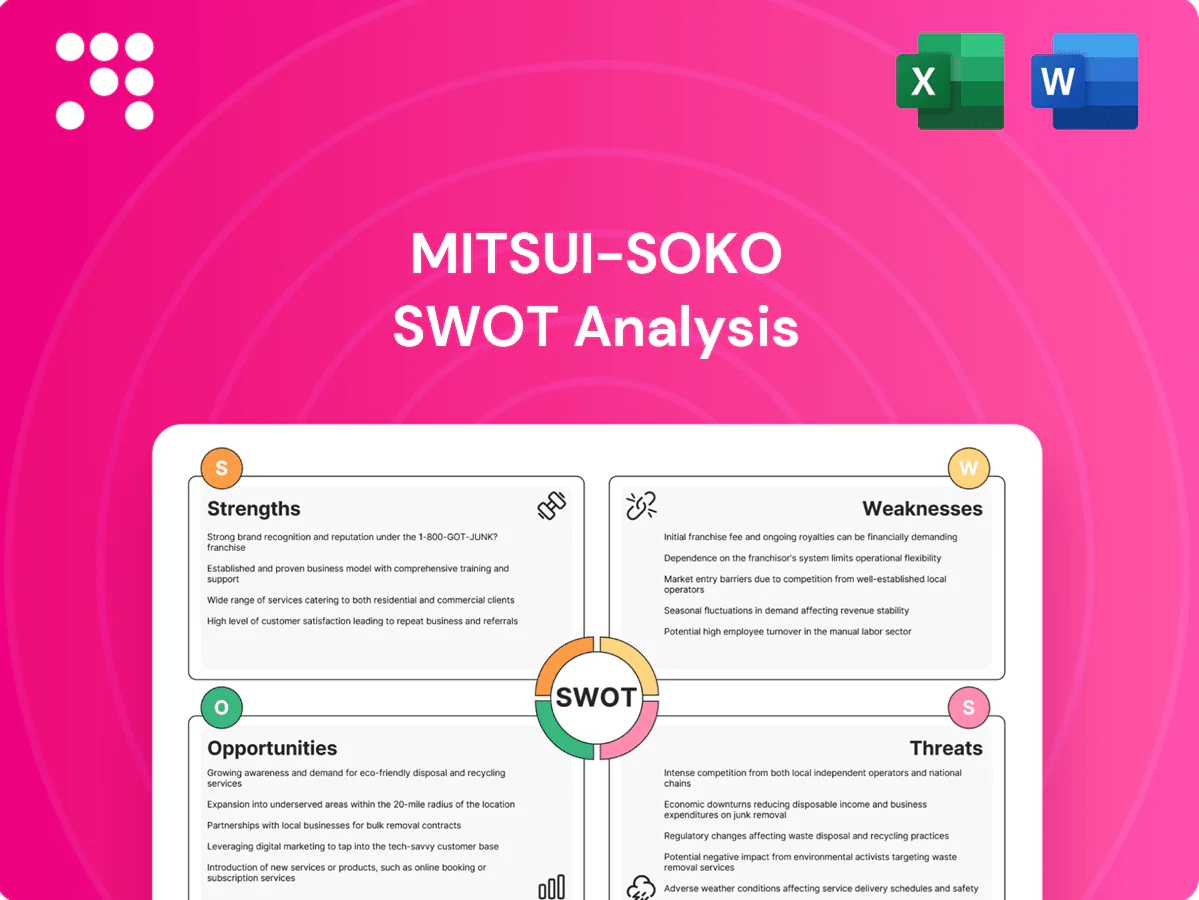
Mitsui-Soko SWOT Analysis

Go Beyond the Preview—Access the Full Strategic Report
Mitsui-Soko’s SWOT highlights its logistics scale, integrated network, and regional reach against rising costs and regulatory risks. Want deeper strategic, financial, and operational insights? Purchase the full SWOT report—editable Word and Excel deliverables to support investment or planning.
Strengths

End-to-end logistics suite
Mitsui-Soko’s end-to-end logistics suite spans warehousing, land transport, international air/ocean/rail forwarding and port/harbor operations, enabling one-stop solutions that cut handoffs and improve visibility. This breadth lets clients optimize total landed cost across nodes and supports cross-industry customization, producing stickier contracts and higher retention. The integrated model aligns with a 3PL market worth about 1.1 trillion USD in 2023, reinforcing scale advantages.
Technology and systems capability
In-house information system development strengthens Mitsui-Soko by tightly integrating WMS/TMS for end-to-end data visibility and process automation, enabling tailored proprietary tools that align with client workflows and differentiate from off-the-shelf stacks. Rich operational data improves forecasting and network optimization, and the company’s tech depth underpins 4PL/LLP offerings and control-tower services.

Asset-backed network and real estate
Owned and managed logistics real estate underpins Mitsui-Soko’s service reliability and capacity control, with the group operating roughly 140 facilities and about 1.1 million m2 of warehouse space as of 2024. Strategic hubs near major ports and urban nodes shorten lead times and secure slot availability for peak seasons. Real estate income—around ¥20 billion in recent annualized rental and property returns—diversifies revenue and supports capex efficiency, while the physical footprint creates significant barriers to entry.

Asia-focused heritage with global reach
Mitsui-Soko’s Japan-rooted credibility and decades of industrial relationships underpin trusted logistics in automotive, electronics and precision sectors, while a steadily expanding overseas network links Asian supply hubs to major trade lanes. Cultural fluency, strict quality controls and JIS-aligned processes drive high service levels that match Asia-centric supply chain flows.
- Heritage: strong Japanese industrial ties
- Global reach: expanding overseas footprint
- Service: quality and cultural fluency
- Alignment: optimized for Asia supply chains
Diversified industry exposure
Serving multiple verticals smooths volume volatility across sectors. Specialized capabilities (port services, regulated handling) enable premium pricing in niche contracts. Cross-selling increases wallet share per client, and broad diversification enhances resilience through trade cycles.
- Diversified vertical exposure
- Premium niche services
- Higher wallet share via cross-sell
End-to-end logistics with control tower and ~140 owned facilities
Mitsui-Soko offers integrated end-to-end logistics (warehousing, land/air/ocean/rail, ports), reducing handoffs and improving visibility, supporting sticky, cross-industry contracts. Proprietary WMS/TMS and control-tower capabilities drive forecasting and 4PL services. Ownership of ~140 facilities (≈1.1M m2) and ~¥20B annual property returns secures capacity and barriers to entry.
| Metric | Value |
|---|---|
| 3PL market (2023) | ~1.1 trillion USD |
| Facilities (2024) | ~140 |
| Warehouse area | ≈1.1M m2 |
| Property returns (annual) | ≈¥20B |
What is included in the product
 Detailed Word Document
Provides a concise SWOT analysis of Mitsui-Soko, highlighting its logistical strengths, operational weaknesses, market opportunities in regional trade and technology adoption, and external threats from competition, regulatory shifts, and supply chain disruption.

 Customizable Excel Spreadsheet
Provides a concise, visual SWOT matrix for Mitsui-Soko to align logistics and warehousing strategy quickly, relieving analysis bottlenecks.
Weaknesses

Margin pressure in commoditized lanes
Freight forwarding and basic trucking are highly price-competitive, with basic trucking operating margins often compressed to roughly 2–5% in mature markets. Scale leaders can undercut rates or bundle services to win tenders, forcing Mitsui-Soko to invest in differentiation to protect yields. Commoditization drives higher customer churn and squeezes gross margins, pressuring margin recovery without clear premium services.
Asset intensity and capex needs
Warehouses, vehicles and port equipment demand continuous reinvestment, keeping Mitsui-Soko capital intensive and exposed to asset depreciation. High fixed costs amplify operating leverage, pressuring margins during volume downturns. Upgrades for automation and ESG compliance further increase capex burdens. In weak cycles this can constrain balance-sheet flexibility and limit strategic spending.

Brand visibility versus global giants
Global 3PL leaders command stronger brand recognition and procurement power, with many incumbents reporting annual logistics revenues above $10 billion and the global logistics market estimated at about $7 trillion in 2024. This scale can restrict Mitsui-Soko’s access to mega-RFQs and global master service agreements dominated by top providers. Marketing reach and perceived scale lag in some regions, and closing the gap demands sustained multi-year investment.

Operational complexity across services
Managing Mitsui-Soko’s multi-modal, multi-country operations increases coordination risk, raising chances of route delays and contractual mismatches. Process standardization and KPI governance remain challenging across diverse business units, hindering transparent performance tracking. Integration of IT and compliance frameworks demands constant oversight, which elevates error rates and operating costs.
- Coordination risk
- KPI fragmentation
- IT/compliance overhead
- Higher error and cost exposure
Exposure to carrier and port dependencies
Reliance on third-party ocean and air carriers and terminal capacity can constrain Mitsui-Soko service quality, with carrier-driven schedule and capacity shifts lowering on-time performance; container spot rates fell roughly 70% from 2022 peaks by 2024, intensifying margin pressure. Disruptions or strikes at key ports quickly ripple across networks, and negotiating power tightens on capacity-constrained lanes.
- Carrier dependence: limits control over schedules and service
- Rate volatility: ~70% fall in spot rates since 2022 hit margins
- Port disruptions: strikes/congestion cause cascading delays
- Weak bargaining: limited leverage on tight/high-demand lanes
3PL margin squeeze: trucking 2-5%, containers down 70%
Mitsui-Soko faces margin pressure from commoditized trucking (operating margins ~2–5%) and a ~70% drop in container spot rates from 2022 peaks to 2024, squeezing yields. Capital intensity and rising automation/ESG capex worsen balance-sheet strain. Scale gap vs global 3PLs (> $10bn revenues) limits access to mega-RFQs and increases procurement disadvantage.
| Weakness | Impact | 2024 metric |
|---|---|---|
| Price competition | Margin compression | Trucking margins 2–5% |
| Asset intensity | High capex | Automation/ESG capex rising (2024) |
| Scale deficit | Lost RFQs | Top 3PLs > $10bn |
| Carrier dependence | Service volatility | Spot rates -70% vs 2022 |
Same Document Delivered
Mitsui-Soko SWOT Analysis
This is the actual SWOT analysis document you’ll receive upon purchase—no surprises, just professional quality. The preview below is taken directly from the full SWOT report you'll get; purchase unlocks the entire in-depth version. The file is editable and formatted for immediate use after checkout.

Go Beyond the Preview—Access the Full Strategic Report
Mitsui-Soko’s SWOT highlights its logistics scale, integrated network, and regional reach against rising costs and regulatory risks. Want deeper strategic, financial, and operational insights? Purchase the full SWOT report—editable Word and Excel deliverables to support investment or planning.
Strengths
End-to-end logistics suite
Mitsui-Soko’s end-to-end logistics suite spans warehousing, land transport, international air/ocean/rail forwarding and port/harbor operations, enabling one-stop solutions that cut handoffs and improve visibility. This breadth lets clients optimize total landed cost across nodes and supports cross-industry customization, producing stickier contracts and higher retention. The integrated model aligns with a 3PL market worth about 1.1 trillion USD in 2023, reinforcing scale advantages.
Technology and systems capability
In-house information system development strengthens Mitsui-Soko by tightly integrating WMS/TMS for end-to-end data visibility and process automation, enabling tailored proprietary tools that align with client workflows and differentiate from off-the-shelf stacks. Rich operational data improves forecasting and network optimization, and the company’s tech depth underpins 4PL/LLP offerings and control-tower services.
Asset-backed network and real estate
Owned and managed logistics real estate underpins Mitsui-Soko’s service reliability and capacity control, with the group operating roughly 140 facilities and about 1.1 million m2 of warehouse space as of 2024. Strategic hubs near major ports and urban nodes shorten lead times and secure slot availability for peak seasons. Real estate income—around ¥20 billion in recent annualized rental and property returns—diversifies revenue and supports capex efficiency, while the physical footprint creates significant barriers to entry.
Asia-focused heritage with global reach
Mitsui-Soko’s Japan-rooted credibility and decades of industrial relationships underpin trusted logistics in automotive, electronics and precision sectors, while a steadily expanding overseas network links Asian supply hubs to major trade lanes. Cultural fluency, strict quality controls and JIS-aligned processes drive high service levels that match Asia-centric supply chain flows.
- Heritage: strong Japanese industrial ties
- Global reach: expanding overseas footprint
- Service: quality and cultural fluency
- Alignment: optimized for Asia supply chains
Diversified industry exposure
Serving multiple verticals smooths volume volatility across sectors. Specialized capabilities (port services, regulated handling) enable premium pricing in niche contracts. Cross-selling increases wallet share per client, and broad diversification enhances resilience through trade cycles.
- Diversified vertical exposure
- Premium niche services
- Higher wallet share via cross-sell
End-to-end logistics with control tower and ~140 owned facilities
Mitsui-Soko offers integrated end-to-end logistics (warehousing, land/air/ocean/rail, ports), reducing handoffs and improving visibility, supporting sticky, cross-industry contracts. Proprietary WMS/TMS and control-tower capabilities drive forecasting and 4PL services. Ownership of ~140 facilities (≈1.1M m2) and ~¥20B annual property returns secures capacity and barriers to entry.
| Metric | Value |
|---|---|
| 3PL market (2023) | ~1.1 trillion USD |
| Facilities (2024) | ~140 |
| Warehouse area | ≈1.1M m2 |
| Property returns (annual) | ≈¥20B |
What is included in the product
Detailed Word Document
Provides a concise SWOT analysis of Mitsui-Soko, highlighting its logistical strengths, operational weaknesses, market opportunities in regional trade and technology adoption, and external threats from competition, regulatory shifts, and supply chain disruption.
Customizable Excel Spreadsheet
Provides a concise, visual SWOT matrix for Mitsui-Soko to align logistics and warehousing strategy quickly, relieving analysis bottlenecks.
Weaknesses
Margin pressure in commoditized lanes
Freight forwarding and basic trucking are highly price-competitive, with basic trucking operating margins often compressed to roughly 2–5% in mature markets. Scale leaders can undercut rates or bundle services to win tenders, forcing Mitsui-Soko to invest in differentiation to protect yields. Commoditization drives higher customer churn and squeezes gross margins, pressuring margin recovery without clear premium services.
Asset intensity and capex needs
Warehouses, vehicles and port equipment demand continuous reinvestment, keeping Mitsui-Soko capital intensive and exposed to asset depreciation. High fixed costs amplify operating leverage, pressuring margins during volume downturns. Upgrades for automation and ESG compliance further increase capex burdens. In weak cycles this can constrain balance-sheet flexibility and limit strategic spending.
Brand visibility versus global giants
Global 3PL leaders command stronger brand recognition and procurement power, with many incumbents reporting annual logistics revenues above $10 billion and the global logistics market estimated at about $7 trillion in 2024. This scale can restrict Mitsui-Soko’s access to mega-RFQs and global master service agreements dominated by top providers. Marketing reach and perceived scale lag in some regions, and closing the gap demands sustained multi-year investment.
Operational complexity across services
Managing Mitsui-Soko’s multi-modal, multi-country operations increases coordination risk, raising chances of route delays and contractual mismatches. Process standardization and KPI governance remain challenging across diverse business units, hindering transparent performance tracking. Integration of IT and compliance frameworks demands constant oversight, which elevates error rates and operating costs.
- Coordination risk
- KPI fragmentation
- IT/compliance overhead
- Higher error and cost exposure
Exposure to carrier and port dependencies
Reliance on third-party ocean and air carriers and terminal capacity can constrain Mitsui-Soko service quality, with carrier-driven schedule and capacity shifts lowering on-time performance; container spot rates fell roughly 70% from 2022 peaks by 2024, intensifying margin pressure. Disruptions or strikes at key ports quickly ripple across networks, and negotiating power tightens on capacity-constrained lanes.
- Carrier dependence: limits control over schedules and service
- Rate volatility: ~70% fall in spot rates since 2022 hit margins
- Port disruptions: strikes/congestion cause cascading delays
- Weak bargaining: limited leverage on tight/high-demand lanes
3PL margin squeeze: trucking 2-5%, containers down 70%
Mitsui-Soko faces margin pressure from commoditized trucking (operating margins ~2–5%) and a ~70% drop in container spot rates from 2022 peaks to 2024, squeezing yields. Capital intensity and rising automation/ESG capex worsen balance-sheet strain. Scale gap vs global 3PLs (> $10bn revenues) limits access to mega-RFQs and increases procurement disadvantage.
| Weakness | Impact | 2024 metric |
|---|---|---|
| Price competition | Margin compression | Trucking margins 2–5% |
| Asset intensity | High capex | Automation/ESG capex rising (2024) |
| Scale deficit | Lost RFQs | Top 3PLs > $10bn |
| Carrier dependence | Service volatility | Spot rates -70% vs 2022 |
Same Document Delivered
Mitsui-Soko SWOT Analysis
This is the actual SWOT analysis document you’ll receive upon purchase—no surprises, just professional quality. The preview below is taken directly from the full SWOT report you'll get; purchase unlocks the entire in-depth version. The file is editable and formatted for immediate use after checkout.
Original: $10.00
-65%$10.00
$3.50Description
Go Beyond the Preview—Access the Full Strategic Report
Mitsui-Soko’s SWOT highlights its logistics scale, integrated network, and regional reach against rising costs and regulatory risks. Want deeper strategic, financial, and operational insights? Purchase the full SWOT report—editable Word and Excel deliverables to support investment or planning.
Strengths
End-to-end logistics suite
Mitsui-Soko’s end-to-end logistics suite spans warehousing, land transport, international air/ocean/rail forwarding and port/harbor operations, enabling one-stop solutions that cut handoffs and improve visibility. This breadth lets clients optimize total landed cost across nodes and supports cross-industry customization, producing stickier contracts and higher retention. The integrated model aligns with a 3PL market worth about 1.1 trillion USD in 2023, reinforcing scale advantages.
Technology and systems capability
In-house information system development strengthens Mitsui-Soko by tightly integrating WMS/TMS for end-to-end data visibility and process automation, enabling tailored proprietary tools that align with client workflows and differentiate from off-the-shelf stacks. Rich operational data improves forecasting and network optimization, and the company’s tech depth underpins 4PL/LLP offerings and control-tower services.
Asset-backed network and real estate
Owned and managed logistics real estate underpins Mitsui-Soko’s service reliability and capacity control, with the group operating roughly 140 facilities and about 1.1 million m2 of warehouse space as of 2024. Strategic hubs near major ports and urban nodes shorten lead times and secure slot availability for peak seasons. Real estate income—around ¥20 billion in recent annualized rental and property returns—diversifies revenue and supports capex efficiency, while the physical footprint creates significant barriers to entry.
Asia-focused heritage with global reach
Mitsui-Soko’s Japan-rooted credibility and decades of industrial relationships underpin trusted logistics in automotive, electronics and precision sectors, while a steadily expanding overseas network links Asian supply hubs to major trade lanes. Cultural fluency, strict quality controls and JIS-aligned processes drive high service levels that match Asia-centric supply chain flows.
- Heritage: strong Japanese industrial ties
- Global reach: expanding overseas footprint
- Service: quality and cultural fluency
- Alignment: optimized for Asia supply chains
Diversified industry exposure
Serving multiple verticals smooths volume volatility across sectors. Specialized capabilities (port services, regulated handling) enable premium pricing in niche contracts. Cross-selling increases wallet share per client, and broad diversification enhances resilience through trade cycles.
- Diversified vertical exposure
- Premium niche services
- Higher wallet share via cross-sell
End-to-end logistics with control tower and ~140 owned facilities
Mitsui-Soko offers integrated end-to-end logistics (warehousing, land/air/ocean/rail, ports), reducing handoffs and improving visibility, supporting sticky, cross-industry contracts. Proprietary WMS/TMS and control-tower capabilities drive forecasting and 4PL services. Ownership of ~140 facilities (≈1.1M m2) and ~¥20B annual property returns secures capacity and barriers to entry.
| Metric | Value |
|---|---|
| 3PL market (2023) | ~1.1 trillion USD |
| Facilities (2024) | ~140 |
| Warehouse area | ≈1.1M m2 |
| Property returns (annual) | ≈¥20B |
What is included in the product
Detailed Word Document
Provides a concise SWOT analysis of Mitsui-Soko, highlighting its logistical strengths, operational weaknesses, market opportunities in regional trade and technology adoption, and external threats from competition, regulatory shifts, and supply chain disruption.
Customizable Excel Spreadsheet
Provides a concise, visual SWOT matrix for Mitsui-Soko to align logistics and warehousing strategy quickly, relieving analysis bottlenecks.
Weaknesses
Margin pressure in commoditized lanes
Freight forwarding and basic trucking are highly price-competitive, with basic trucking operating margins often compressed to roughly 2–5% in mature markets. Scale leaders can undercut rates or bundle services to win tenders, forcing Mitsui-Soko to invest in differentiation to protect yields. Commoditization drives higher customer churn and squeezes gross margins, pressuring margin recovery without clear premium services.
Asset intensity and capex needs
Warehouses, vehicles and port equipment demand continuous reinvestment, keeping Mitsui-Soko capital intensive and exposed to asset depreciation. High fixed costs amplify operating leverage, pressuring margins during volume downturns. Upgrades for automation and ESG compliance further increase capex burdens. In weak cycles this can constrain balance-sheet flexibility and limit strategic spending.
Brand visibility versus global giants
Global 3PL leaders command stronger brand recognition and procurement power, with many incumbents reporting annual logistics revenues above $10 billion and the global logistics market estimated at about $7 trillion in 2024. This scale can restrict Mitsui-Soko’s access to mega-RFQs and global master service agreements dominated by top providers. Marketing reach and perceived scale lag in some regions, and closing the gap demands sustained multi-year investment.
Operational complexity across services
Managing Mitsui-Soko’s multi-modal, multi-country operations increases coordination risk, raising chances of route delays and contractual mismatches. Process standardization and KPI governance remain challenging across diverse business units, hindering transparent performance tracking. Integration of IT and compliance frameworks demands constant oversight, which elevates error rates and operating costs.
- Coordination risk
- KPI fragmentation
- IT/compliance overhead
- Higher error and cost exposure
Exposure to carrier and port dependencies
Reliance on third-party ocean and air carriers and terminal capacity can constrain Mitsui-Soko service quality, with carrier-driven schedule and capacity shifts lowering on-time performance; container spot rates fell roughly 70% from 2022 peaks by 2024, intensifying margin pressure. Disruptions or strikes at key ports quickly ripple across networks, and negotiating power tightens on capacity-constrained lanes.
- Carrier dependence: limits control over schedules and service
- Rate volatility: ~70% fall in spot rates since 2022 hit margins
- Port disruptions: strikes/congestion cause cascading delays
- Weak bargaining: limited leverage on tight/high-demand lanes
3PL margin squeeze: trucking 2-5%, containers down 70%
Mitsui-Soko faces margin pressure from commoditized trucking (operating margins ~2–5%) and a ~70% drop in container spot rates from 2022 peaks to 2024, squeezing yields. Capital intensity and rising automation/ESG capex worsen balance-sheet strain. Scale gap vs global 3PLs (> $10bn revenues) limits access to mega-RFQs and increases procurement disadvantage.
| Weakness | Impact | 2024 metric |
|---|---|---|
| Price competition | Margin compression | Trucking margins 2–5% |
| Asset intensity | High capex | Automation/ESG capex rising (2024) |
| Scale deficit | Lost RFQs | Top 3PLs > $10bn |
| Carrier dependence | Service volatility | Spot rates -70% vs 2022 |
Same Document Delivered
Mitsui-Soko SWOT Analysis
This is the actual SWOT analysis document you’ll receive upon purchase—no surprises, just professional quality. The preview below is taken directly from the full SWOT report you'll get; purchase unlocks the entire in-depth version. The file is editable and formatted for immediate use after checkout.











