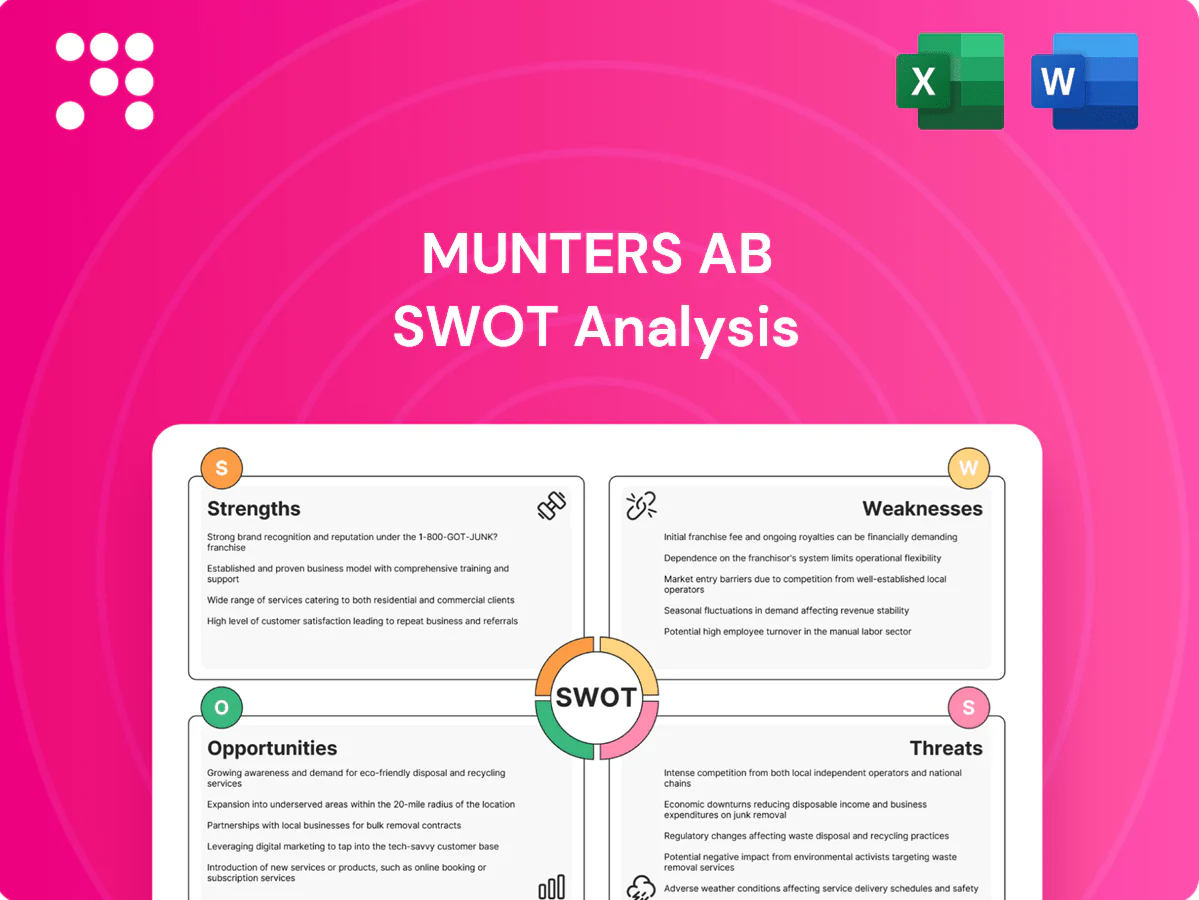
Munters AB SWOT Analysis

Your Strategic Toolkit Starts Here
Munters AB shows strong niche leadership in climate solutions but faces supply-chain pressures and market cyclicality; its innovation pipeline and global footprint are clear growth levers. Want deeper, research-backed insights and actionable strategies? Purchase the full SWOT analysis—editable Word and Excel deliverables to inform investment, planning, and presentations.
Strengths

Global leader in energy-efficient air treatment
Munters’ recognized expertise in dehumidification, evaporative cooling and air purification underpins strong brand equity; the company is listed on Nasdaq Stockholm (MTRS) and operates in 30+ countries with over 2,500 employees. Its desiccant-based technologies deliver materially better energy performance versus traditional HVAC in documented food, pharma and high-spec industrial projects. These proof points reinforce credibility, support pricing power and preferred-vendor status on complex projects.
Diverse end-market exposure
Munters serves five distinct end-markets—data centers, battery manufacturing, pharmaceuticals, food processing and agriculture—lowering dependence on any single sector and enhancing cross-cycle resilience for steadier revenue streams. This sector diversity enables cross-selling of standardized modules and services, improving margin leverage, and supports smoother capacity utilization across geographies.

Proprietary desiccant and climate-control know-how
Munters, founded in 1955 (70 years in 2025), leverages proprietary desiccant rotors and ultra‑low dew‑point systems (capable of <−40°C dew points) that are hard to replicate; engineering depth across 30+ countries enables tailored cleanroom and dry‑room solutions meeting tight specs, while continuous R&D drives compliance and efficiency gains, supporting a durable margin moat versus commodity HVAC.

Large installed base and aftermarket
Large global installed base generates recurring services, parts sales and upgrades that smooth cash flow; long-lived dehumidification equipment fosters multi-year service relationships and contract renewals. Performance contracts and remote monitoring increase customer stickiness and uptime-focused billing, while a strong aftermarket mix cushions cyclicality in new equipment orders.
- Recurring services: steady revenue stream
- Long lifecycle: multi-year contracts
- Performance contracts: higher retention
- Aftermarket mix: downside protection
Sustainability-aligned value proposition
Munters AB leverages energy-saving climate solutions that enable customers to meet tightening decarbonization and efficiency requirements while lowering total cost of ownership, strengthening ROI cases for capex approval and specification in tenders; the company is listed on Nasdaq Stockholm (ticker MTRS).
- Decarbonization alignment
- Lower TCO → easier capex approval
- Access to green financing
- Premium tender positioning
70-yr desiccant specialist, global in 30+ countries, sub-40°C dew points
Munters’ 70-year history (founded 1955) and Nasdaq Stockholm listing (MTRS) underpin strong brand and global reach across 30+ countries with 2,500+ employees. Proprietary desiccant rotors deliver ultra‑low dew points (<−40°C) and documented energy savings in food, pharma and data center projects, supporting pricing power and recurring service revenue.
| Metric | Value |
|---|---|
| Countries | 30+ |
| Employees | 2,500+ |
| Founded | 1955 (70 yrs in 2025) |
| Ticker | MTRS |
| Dew point | <−40°C |
What is included in the product
 Detailed Word Document
Provides a strategic overview of Munters AB’s internal strengths and weaknesses and external opportunities and threats, highlighting operational capabilities, market growth drivers, regulatory and competitive risks.

 Customizable Excel Spreadsheet
Provides a concise SWOT matrix for Munters AB to quickly identify strategic risks and growth opportunities in climate-control and energy-efficiency markets, enabling faster decision-making; editable format lets teams update priorities as market conditions change.
Weaknesses

Project-centric revenue and execution risk
Large, highly customized Munters projects create material timeline, scope and cost-overrun risk, with milestone billing patterns that can stretch cash conversion and increase working-capital needs. Project concentration can cause sharp quarterly revenue swings, while complex commissioning raises dependency on availability of skilled engineers and service crews, amplifying execution risk across global operations.
Exposure to cyclical capex
Munters (listed on Nasdaq Stockholm, ticker MTRS) faces revenue volatility because orders for data centers, semiconductors, battery plants and pharma follow heavy investment cycles. Slowdowns or delays in mega-projects create visible revenue gaps and contributed to historically lumpy quarter-to-quarter performance. Budget freezes typically hit high-ticket climate systems first, complicating capacity planning and utilization.

Input cost and supply-chain sensitivities
Munters faces input-cost volatility from steel, aluminum, filters and electronic components that drives COGS swings and complicates margin planning; supply-chain shocks have pushed component lead times from weeks into months in recent years. Logistics disruptions increase working-capital needs as inventory and receivables build. Passing cost inflation often lags by quarters, pressuring margins, while multi-region coordination adds operational complexity.

Currency and geographic complexity
Global sales and sourcing across 30+ countries expose Munters results to FX swings versus SEK; hedging programs reduce but do not eliminate earnings volatility, especially with multi-currency contracts in 2024. Differing regulatory regimes increase compliance and reporting costs, while uneven regional demand risks leaving production capacity underutilized.
- FX exposure vs SEK: multi-currency revenues
- Hedging reduces but not all volatility
- Compliance cost from diverse regulations
- Risk of underutilized regional capacity
Narrow brand recognition beyond core niches
Munters is strong in industrial air treatment and listed on Nasdaq Stockholm (ticker MTRS), but brand visibility remains limited among general HVAC buyers and facility managers, slowing expansion into adjacent categories and requiring higher sales effort and customer education to enter new verticals.
- Operates in over 30 countries
- Higher per-deal sales effort vs diversified HVAC peers
- Marketing scale lags large conglomerates
Large projects and cyclical markets drive volatile revenue; FX and input-cost inflation squeeze margins
Large, bespoke projects create material schedule, cost and cash-conversion risk and drive quarter-to-quarter revenue volatility. Heavy exposure to cyclical end-markets (data centers, semiconductors, pharma) amplifies demand lumpiness; multi-currency sales (operates in 30+ countries) and input-cost inflation pressure margins. Brand reach in mainstream HVAC remains limited, increasing sales effort for adjacent markets.
| Metric | Value |
|---|---|
| Countries | 30+ |
| Exchange listing | Nasdaq Stockholm (MTRS) |
| Key risk | Project concentration, FX, input-costs |
Preview Before You Purchase
Munters AB SWOT Analysis
This is the actual Munters AB SWOT analysis document you’ll receive upon purchase—no surprises, just professional quality. The preview below is taken directly from the full report and reflects the complete structure and findings. Buy now to unlock the editable, in-depth version for download.

Your Strategic Toolkit Starts Here
Munters AB shows strong niche leadership in climate solutions but faces supply-chain pressures and market cyclicality; its innovation pipeline and global footprint are clear growth levers. Want deeper, research-backed insights and actionable strategies? Purchase the full SWOT analysis—editable Word and Excel deliverables to inform investment, planning, and presentations.
Strengths
Global leader in energy-efficient air treatment
Munters’ recognized expertise in dehumidification, evaporative cooling and air purification underpins strong brand equity; the company is listed on Nasdaq Stockholm (MTRS) and operates in 30+ countries with over 2,500 employees. Its desiccant-based technologies deliver materially better energy performance versus traditional HVAC in documented food, pharma and high-spec industrial projects. These proof points reinforce credibility, support pricing power and preferred-vendor status on complex projects.
Diverse end-market exposure
Munters serves five distinct end-markets—data centers, battery manufacturing, pharmaceuticals, food processing and agriculture—lowering dependence on any single sector and enhancing cross-cycle resilience for steadier revenue streams. This sector diversity enables cross-selling of standardized modules and services, improving margin leverage, and supports smoother capacity utilization across geographies.
Proprietary desiccant and climate-control know-how
Munters, founded in 1955 (70 years in 2025), leverages proprietary desiccant rotors and ultra‑low dew‑point systems (capable of <−40°C dew points) that are hard to replicate; engineering depth across 30+ countries enables tailored cleanroom and dry‑room solutions meeting tight specs, while continuous R&D drives compliance and efficiency gains, supporting a durable margin moat versus commodity HVAC.
Large installed base and aftermarket
Large global installed base generates recurring services, parts sales and upgrades that smooth cash flow; long-lived dehumidification equipment fosters multi-year service relationships and contract renewals. Performance contracts and remote monitoring increase customer stickiness and uptime-focused billing, while a strong aftermarket mix cushions cyclicality in new equipment orders.
- Recurring services: steady revenue stream
- Long lifecycle: multi-year contracts
- Performance contracts: higher retention
- Aftermarket mix: downside protection
Sustainability-aligned value proposition
Munters AB leverages energy-saving climate solutions that enable customers to meet tightening decarbonization and efficiency requirements while lowering total cost of ownership, strengthening ROI cases for capex approval and specification in tenders; the company is listed on Nasdaq Stockholm (ticker MTRS).
- Decarbonization alignment
- Lower TCO → easier capex approval
- Access to green financing
- Premium tender positioning
70-yr desiccant specialist, global in 30+ countries, sub-40°C dew points
Munters’ 70-year history (founded 1955) and Nasdaq Stockholm listing (MTRS) underpin strong brand and global reach across 30+ countries with 2,500+ employees. Proprietary desiccant rotors deliver ultra‑low dew points (<−40°C) and documented energy savings in food, pharma and data center projects, supporting pricing power and recurring service revenue.
| Metric | Value |
|---|---|
| Countries | 30+ |
| Employees | 2,500+ |
| Founded | 1955 (70 yrs in 2025) |
| Ticker | MTRS |
| Dew point | <−40°C |
What is included in the product
Detailed Word Document
Provides a strategic overview of Munters AB’s internal strengths and weaknesses and external opportunities and threats, highlighting operational capabilities, market growth drivers, regulatory and competitive risks.
Customizable Excel Spreadsheet
Provides a concise SWOT matrix for Munters AB to quickly identify strategic risks and growth opportunities in climate-control and energy-efficiency markets, enabling faster decision-making; editable format lets teams update priorities as market conditions change.
Weaknesses
Project-centric revenue and execution risk
Large, highly customized Munters projects create material timeline, scope and cost-overrun risk, with milestone billing patterns that can stretch cash conversion and increase working-capital needs. Project concentration can cause sharp quarterly revenue swings, while complex commissioning raises dependency on availability of skilled engineers and service crews, amplifying execution risk across global operations.
Exposure to cyclical capex
Munters (listed on Nasdaq Stockholm, ticker MTRS) faces revenue volatility because orders for data centers, semiconductors, battery plants and pharma follow heavy investment cycles. Slowdowns or delays in mega-projects create visible revenue gaps and contributed to historically lumpy quarter-to-quarter performance. Budget freezes typically hit high-ticket climate systems first, complicating capacity planning and utilization.
Input cost and supply-chain sensitivities
Munters faces input-cost volatility from steel, aluminum, filters and electronic components that drives COGS swings and complicates margin planning; supply-chain shocks have pushed component lead times from weeks into months in recent years. Logistics disruptions increase working-capital needs as inventory and receivables build. Passing cost inflation often lags by quarters, pressuring margins, while multi-region coordination adds operational complexity.
Currency and geographic complexity
Global sales and sourcing across 30+ countries expose Munters results to FX swings versus SEK; hedging programs reduce but do not eliminate earnings volatility, especially with multi-currency contracts in 2024. Differing regulatory regimes increase compliance and reporting costs, while uneven regional demand risks leaving production capacity underutilized.
- FX exposure vs SEK: multi-currency revenues
- Hedging reduces but not all volatility
- Compliance cost from diverse regulations
- Risk of underutilized regional capacity
Narrow brand recognition beyond core niches
Munters is strong in industrial air treatment and listed on Nasdaq Stockholm (ticker MTRS), but brand visibility remains limited among general HVAC buyers and facility managers, slowing expansion into adjacent categories and requiring higher sales effort and customer education to enter new verticals.
- Operates in over 30 countries
- Higher per-deal sales effort vs diversified HVAC peers
- Marketing scale lags large conglomerates
Large projects and cyclical markets drive volatile revenue; FX and input-cost inflation squeeze margins
Large, bespoke projects create material schedule, cost and cash-conversion risk and drive quarter-to-quarter revenue volatility. Heavy exposure to cyclical end-markets (data centers, semiconductors, pharma) amplifies demand lumpiness; multi-currency sales (operates in 30+ countries) and input-cost inflation pressure margins. Brand reach in mainstream HVAC remains limited, increasing sales effort for adjacent markets.
| Metric | Value |
|---|---|
| Countries | 30+ |
| Exchange listing | Nasdaq Stockholm (MTRS) |
| Key risk | Project concentration, FX, input-costs |
Preview Before You Purchase
Munters AB SWOT Analysis
This is the actual Munters AB SWOT analysis document you’ll receive upon purchase—no surprises, just professional quality. The preview below is taken directly from the full report and reflects the complete structure and findings. Buy now to unlock the editable, in-depth version for download.
Original: $10.00
-65%$10.00
$3.50Description
Your Strategic Toolkit Starts Here
Munters AB shows strong niche leadership in climate solutions but faces supply-chain pressures and market cyclicality; its innovation pipeline and global footprint are clear growth levers. Want deeper, research-backed insights and actionable strategies? Purchase the full SWOT analysis—editable Word and Excel deliverables to inform investment, planning, and presentations.
Strengths
Global leader in energy-efficient air treatment
Munters’ recognized expertise in dehumidification, evaporative cooling and air purification underpins strong brand equity; the company is listed on Nasdaq Stockholm (MTRS) and operates in 30+ countries with over 2,500 employees. Its desiccant-based technologies deliver materially better energy performance versus traditional HVAC in documented food, pharma and high-spec industrial projects. These proof points reinforce credibility, support pricing power and preferred-vendor status on complex projects.
Diverse end-market exposure
Munters serves five distinct end-markets—data centers, battery manufacturing, pharmaceuticals, food processing and agriculture—lowering dependence on any single sector and enhancing cross-cycle resilience for steadier revenue streams. This sector diversity enables cross-selling of standardized modules and services, improving margin leverage, and supports smoother capacity utilization across geographies.
Proprietary desiccant and climate-control know-how
Munters, founded in 1955 (70 years in 2025), leverages proprietary desiccant rotors and ultra‑low dew‑point systems (capable of <−40°C dew points) that are hard to replicate; engineering depth across 30+ countries enables tailored cleanroom and dry‑room solutions meeting tight specs, while continuous R&D drives compliance and efficiency gains, supporting a durable margin moat versus commodity HVAC.
Large installed base and aftermarket
Large global installed base generates recurring services, parts sales and upgrades that smooth cash flow; long-lived dehumidification equipment fosters multi-year service relationships and contract renewals. Performance contracts and remote monitoring increase customer stickiness and uptime-focused billing, while a strong aftermarket mix cushions cyclicality in new equipment orders.
- Recurring services: steady revenue stream
- Long lifecycle: multi-year contracts
- Performance contracts: higher retention
- Aftermarket mix: downside protection
Sustainability-aligned value proposition
Munters AB leverages energy-saving climate solutions that enable customers to meet tightening decarbonization and efficiency requirements while lowering total cost of ownership, strengthening ROI cases for capex approval and specification in tenders; the company is listed on Nasdaq Stockholm (ticker MTRS).
- Decarbonization alignment
- Lower TCO → easier capex approval
- Access to green financing
- Premium tender positioning
70-yr desiccant specialist, global in 30+ countries, sub-40°C dew points
Munters’ 70-year history (founded 1955) and Nasdaq Stockholm listing (MTRS) underpin strong brand and global reach across 30+ countries with 2,500+ employees. Proprietary desiccant rotors deliver ultra‑low dew points (<−40°C) and documented energy savings in food, pharma and data center projects, supporting pricing power and recurring service revenue.
| Metric | Value |
|---|---|
| Countries | 30+ |
| Employees | 2,500+ |
| Founded | 1955 (70 yrs in 2025) |
| Ticker | MTRS |
| Dew point | <−40°C |
What is included in the product
Detailed Word Document
Provides a strategic overview of Munters AB’s internal strengths and weaknesses and external opportunities and threats, highlighting operational capabilities, market growth drivers, regulatory and competitive risks.
Customizable Excel Spreadsheet
Provides a concise SWOT matrix for Munters AB to quickly identify strategic risks and growth opportunities in climate-control and energy-efficiency markets, enabling faster decision-making; editable format lets teams update priorities as market conditions change.
Weaknesses
Project-centric revenue and execution risk
Large, highly customized Munters projects create material timeline, scope and cost-overrun risk, with milestone billing patterns that can stretch cash conversion and increase working-capital needs. Project concentration can cause sharp quarterly revenue swings, while complex commissioning raises dependency on availability of skilled engineers and service crews, amplifying execution risk across global operations.
Exposure to cyclical capex
Munters (listed on Nasdaq Stockholm, ticker MTRS) faces revenue volatility because orders for data centers, semiconductors, battery plants and pharma follow heavy investment cycles. Slowdowns or delays in mega-projects create visible revenue gaps and contributed to historically lumpy quarter-to-quarter performance. Budget freezes typically hit high-ticket climate systems first, complicating capacity planning and utilization.
Input cost and supply-chain sensitivities
Munters faces input-cost volatility from steel, aluminum, filters and electronic components that drives COGS swings and complicates margin planning; supply-chain shocks have pushed component lead times from weeks into months in recent years. Logistics disruptions increase working-capital needs as inventory and receivables build. Passing cost inflation often lags by quarters, pressuring margins, while multi-region coordination adds operational complexity.
Currency and geographic complexity
Global sales and sourcing across 30+ countries expose Munters results to FX swings versus SEK; hedging programs reduce but do not eliminate earnings volatility, especially with multi-currency contracts in 2024. Differing regulatory regimes increase compliance and reporting costs, while uneven regional demand risks leaving production capacity underutilized.
- FX exposure vs SEK: multi-currency revenues
- Hedging reduces but not all volatility
- Compliance cost from diverse regulations
- Risk of underutilized regional capacity
Narrow brand recognition beyond core niches
Munters is strong in industrial air treatment and listed on Nasdaq Stockholm (ticker MTRS), but brand visibility remains limited among general HVAC buyers and facility managers, slowing expansion into adjacent categories and requiring higher sales effort and customer education to enter new verticals.
- Operates in over 30 countries
- Higher per-deal sales effort vs diversified HVAC peers
- Marketing scale lags large conglomerates
Large projects and cyclical markets drive volatile revenue; FX and input-cost inflation squeeze margins
Large, bespoke projects create material schedule, cost and cash-conversion risk and drive quarter-to-quarter revenue volatility. Heavy exposure to cyclical end-markets (data centers, semiconductors, pharma) amplifies demand lumpiness; multi-currency sales (operates in 30+ countries) and input-cost inflation pressure margins. Brand reach in mainstream HVAC remains limited, increasing sales effort for adjacent markets.
| Metric | Value |
|---|---|
| Countries | 30+ |
| Exchange listing | Nasdaq Stockholm (MTRS) |
| Key risk | Project concentration, FX, input-costs |
Preview Before You Purchase
Munters AB SWOT Analysis
This is the actual Munters AB SWOT analysis document you’ll receive upon purchase—no surprises, just professional quality. The preview below is taken directly from the full report and reflects the complete structure and findings. Buy now to unlock the editable, in-depth version for download.











