musicMagpie PESTLE Analysis

Make Smarter Strategic Decisions with a Complete PESTEL View
Discover how political, economic, social, technological, legal and environmental forces shape musicMagpie’s strategy and risk profile in our concise PESTLE snapshot. Ideal for investors, consultants and planners, it highlights actionable trends and blind spots you can’t ignore. Purchase the full PESTLE to access the complete, editable analysis and make smarter strategic decisions today.
Political factors

E-waste policy direction
Stronger national and local e-waste strategies—driven by the UN Global E-waste Monitor reporting 57.4 Mt of e-waste in 2021—can expand take-back volumes while raising compliance costs for processors like musicMagpie. Extended producer responsibility schemes in the EU/UK are increasingly shifting end-of-life costs to platforms handling used electronics. Alignment with circular economy roadmaps can unlock public grants and partner programs. Policy volatility complicates capacity planning for collection and refurbishment.
Trade and customs changes
Import/export rules for used tech and parts affect turnaround times and costs, with waste electrical equipment and second‑hand electronics subject to specific UK and EU controls. Post‑Brexit customs processes introduced from 1 January 2021 add friction to cross‑border sourcing and sales, increasing documentation and checks. Tariffs and duties on some electronics inputs can compress refurbishment margins, while stable customs corridors enable more reliable inventory flows.

Digital marketplace taxation
Platform rules like EU DAC7 (reporting from Jan 2023) force greater transaction reporting and VAT collection, increasing compliance workload for marketplaces such as musicMagpie. Changes to digital services taxes and global minimum tax (OECD Pillar Two, 15% GloBE adopted by many jurisdictions by 2024) can raise operating costs in affected markets. Harmonized e‑commerce tax regimes lower compliance complexity, and clearer rules improve pricing transparency and speed seller onboarding.

Government recycling incentives
Government subsidies or trade-in vouchers can materially boost device supply to musicMagpie, helping divert parts from the 57.4 Mt of global e-waste generated in 2023 (Global E-waste Monitor 2024). Public campaigns raise reuse awareness, municipal partnerships cut acquisition and logistics costs, while withdrawal of incentives risks sharp intake declines.
- Subsidies: increase trade-ins
- Campaigns: raise reuse rates
- Municipal partnerships: lower costs
- Withdrawal: reduces intake volumes
Public procurement and ESG
Government buyers prioritizing refurbished tech create institutional demand, supported by public procurement representing roughly 12% of GDP on average according to OECD, making tenders a meaningful channel for firms like musicMagpie.
ESG-driven procurement and the UK public sector net-zero commitment to 2050 reward circular providers in tenders, though rising reporting expectations increase administrative overhead for compliance and traceability.
Preferential treatment in tenders can stabilize large-volume resale channels, reducing demand volatility and improving revenue visibility for certified refurbishers.
- procurement_share: ~12% of GDP (OECD)
- policy_target: UK public sector net-zero by 2050
- impact: higher compliance/admin costs
- benefit: stable, large-volume resale channels
Stricter e-waste, tax and customs rules squeeze margins as public procurement steadies demand
Stronger e‑waste laws (Global E‑waste Monitor: 57.4 Mt in 2021) expand take‑back but raise compliance costs for musicMagpie. EPR and post‑Brexit customs (from 1 Jan 2021) add friction to cross‑border flows, squeezing margins. Platform reporting (DAC7 from Jan 2023) and OECD Pillar Two (15% GloBE by 2024) increase tax/compliance burdens yet public procurement (~12% of GDP, OECD) creates stable demand.
| Metric | Value | Year/Note |
|---|---|---|
| Global e‑waste | 57.4 Mt | 2021 |
| Public procurement | ~12% GDP | OECD |
| GloBE rate | 15% | Adopted by many by 2024 |
| Post‑Brexit customs | Increased friction | From 1 Jan 2021 |
What is included in the product
 Detailed Word Document
Explores how macro-environmental factors uniquely affect musicMagpie across Political, Economic, Social, Technological, Environmental and Legal dimensions, with data-backed, forward-looking insights and detailed sub-points to support executives, consultants and entrepreneurs in identifying risks, opportunities and strategic actions ready for decks and plans.

 Customizable Excel Spreadsheet
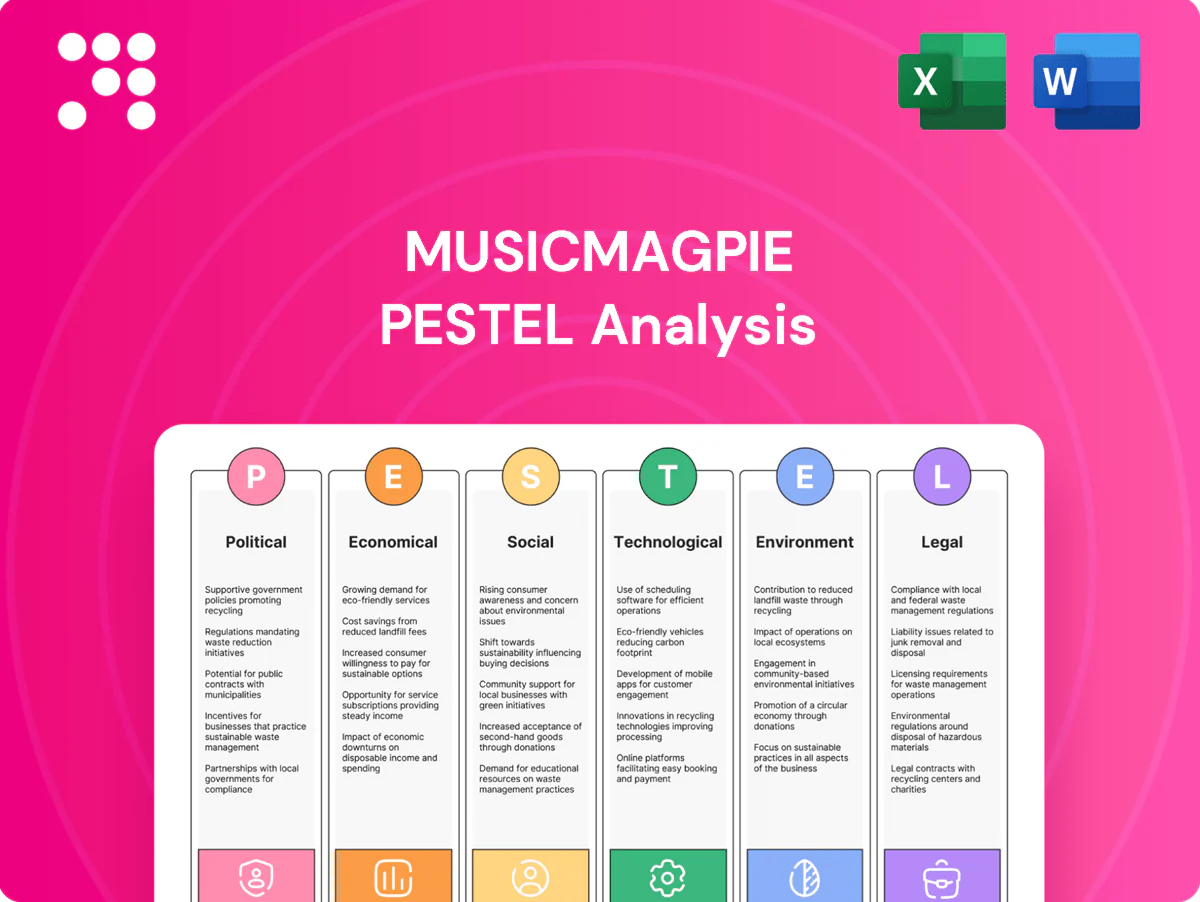
A concise, visually segmented musicMagpie PESTLE summary that relieves meeting friction by highlighting external risks and opportunities for rapid sharing, note-taking and slide-ready use across teams.
Economic factors

Consumer spending cycles
Shifts in discretionary income directly drive demand for musicMagpie’s discounted refurbished devices; the global refurbished electronics market was valued at about $52.5bn in 2023, highlighting structural demand for lower-cost alternatives. In economic downturns the value proposition strengthens and volumes can rise, while in booms new device sales can crowd out trade-in demand. Pricing agility across cycles is therefore crucial to capture margin and volume swings.
Inflation and cost pressures
Component, labor and logistics inflation have squeezed musicMagpie refurbishment margins, with UK inflation sliding from double digits in 2022 to roughly 3–4% by 2024, pressuring input costs; passing increases risks volume loss among price-sensitive buyers. Process efficiency gains have partly offset margins, while hedging and supplier diversification reduced supply-cost volatility.

FX and cross-border sales
Currency swings affect sourcing costs and resale competitiveness for musicMagpie; GBP averaged about 1.25 USD in 2024, so a 10% weaker pound would lift USD-priced import costs similarly and compress margins. FX volatility complicates multi-market pricing and customer competitiveness across UK, EU and US channels. Balanced inflows and outflows act as natural hedges, reducing net exposure.

Used device supply dynamics
OEM launches such as Samsung Galaxy S24 (Feb 2024) and ongoing iPhone upgrade cycles generate predictable trade-in waves; carrier promotions shift volume and quality mix toward newer models. Periodic scarcity increases acquisition costs and extends lead times, while strong buyback programs (increasing direct-to-retailer intake) stabilize input flow for musicMagpie.
- Trade-in waves: OEM launches
- Carrier promos: affect quality mix
- Scarcity: higher costs, longer lead times
- Buybacks: stabilize supply
Resale price elasticity
Buyers are highly price-sensitive versus new products, so sub-5% price differentials can drive measurable shifts in conversion. Small price moves materially affect sell-through, making dynamic pricing and granular grading critical to margin management. Clear warranties enable higher-tier pricing and reduce return friction, improving lifetime value.
- price-sensitivity
- dynamic-pricing
- grading-for-margin
- warranty-driven-value
Stricter e-waste, tax and customs rules squeeze margins as public procurement steadies demand
Shifts in discretionary income drive demand for musicMagpie; global refurbished electronics market $52.5bn (2023). UK inflation ~3–4% (2024) squeezed margins; GBP ~1.25 USD (2024) adds FX risk. Sub-5% price gaps shift conversion, OEM launch waves (iPhone/Samsung 2024) create predictable trade-ins and supply volatility.
| Metric | Value |
|---|---|
| Refurb market (2023) | $52.5bn |
| UK inflation (2024) | 3–4% |
| GBP/USD (2024) | 1.25 |
| Price sensitivity | <5% |
Same Document Delivered
musicMagpie PESTLE Analysis
The preview shown here is the exact musicMagpie PESTLE Analysis document you’ll receive after purchase—fully formatted and ready to use. The layout, content, and structure visible are exactly what you’ll download immediately after payment. No placeholders or teasers—this is the final, professionally structured file you’ll own upon checkout.

Make Smarter Strategic Decisions with a Complete PESTEL View
Discover how political, economic, social, technological, legal and environmental forces shape musicMagpie’s strategy and risk profile in our concise PESTLE snapshot. Ideal for investors, consultants and planners, it highlights actionable trends and blind spots you can’t ignore. Purchase the full PESTLE to access the complete, editable analysis and make smarter strategic decisions today.
Political factors
E-waste policy direction
Stronger national and local e-waste strategies—driven by the UN Global E-waste Monitor reporting 57.4 Mt of e-waste in 2021—can expand take-back volumes while raising compliance costs for processors like musicMagpie. Extended producer responsibility schemes in the EU/UK are increasingly shifting end-of-life costs to platforms handling used electronics. Alignment with circular economy roadmaps can unlock public grants and partner programs. Policy volatility complicates capacity planning for collection and refurbishment.
Trade and customs changes
Import/export rules for used tech and parts affect turnaround times and costs, with waste electrical equipment and second‑hand electronics subject to specific UK and EU controls. Post‑Brexit customs processes introduced from 1 January 2021 add friction to cross‑border sourcing and sales, increasing documentation and checks. Tariffs and duties on some electronics inputs can compress refurbishment margins, while stable customs corridors enable more reliable inventory flows.
Digital marketplace taxation
Platform rules like EU DAC7 (reporting from Jan 2023) force greater transaction reporting and VAT collection, increasing compliance workload for marketplaces such as musicMagpie. Changes to digital services taxes and global minimum tax (OECD Pillar Two, 15% GloBE adopted by many jurisdictions by 2024) can raise operating costs in affected markets. Harmonized e‑commerce tax regimes lower compliance complexity, and clearer rules improve pricing transparency and speed seller onboarding.
Government recycling incentives
Government subsidies or trade-in vouchers can materially boost device supply to musicMagpie, helping divert parts from the 57.4 Mt of global e-waste generated in 2023 (Global E-waste Monitor 2024). Public campaigns raise reuse awareness, municipal partnerships cut acquisition and logistics costs, while withdrawal of incentives risks sharp intake declines.
- Subsidies: increase trade-ins
- Campaigns: raise reuse rates
- Municipal partnerships: lower costs
- Withdrawal: reduces intake volumes
Public procurement and ESG
Government buyers prioritizing refurbished tech create institutional demand, supported by public procurement representing roughly 12% of GDP on average according to OECD, making tenders a meaningful channel for firms like musicMagpie.
ESG-driven procurement and the UK public sector net-zero commitment to 2050 reward circular providers in tenders, though rising reporting expectations increase administrative overhead for compliance and traceability.
Preferential treatment in tenders can stabilize large-volume resale channels, reducing demand volatility and improving revenue visibility for certified refurbishers.
- procurement_share: ~12% of GDP (OECD)
- policy_target: UK public sector net-zero by 2050
- impact: higher compliance/admin costs
- benefit: stable, large-volume resale channels
Stricter e-waste, tax and customs rules squeeze margins as public procurement steadies demand
Stronger e‑waste laws (Global E‑waste Monitor: 57.4 Mt in 2021) expand take‑back but raise compliance costs for musicMagpie. EPR and post‑Brexit customs (from 1 Jan 2021) add friction to cross‑border flows, squeezing margins. Platform reporting (DAC7 from Jan 2023) and OECD Pillar Two (15% GloBE by 2024) increase tax/compliance burdens yet public procurement (~12% of GDP, OECD) creates stable demand.
| Metric | Value | Year/Note |
|---|---|---|
| Global e‑waste | 57.4 Mt | 2021 |
| Public procurement | ~12% GDP | OECD |
| GloBE rate | 15% | Adopted by many by 2024 |
| Post‑Brexit customs | Increased friction | From 1 Jan 2021 |
What is included in the product
Detailed Word Document
Explores how macro-environmental factors uniquely affect musicMagpie across Political, Economic, Social, Technological, Environmental and Legal dimensions, with data-backed, forward-looking insights and detailed sub-points to support executives, consultants and entrepreneurs in identifying risks, opportunities and strategic actions ready for decks and plans.
Customizable Excel Spreadsheet
A concise, visually segmented musicMagpie PESTLE summary that relieves meeting friction by highlighting external risks and opportunities for rapid sharing, note-taking and slide-ready use across teams.
Economic factors
Consumer spending cycles
Shifts in discretionary income directly drive demand for musicMagpie’s discounted refurbished devices; the global refurbished electronics market was valued at about $52.5bn in 2023, highlighting structural demand for lower-cost alternatives. In economic downturns the value proposition strengthens and volumes can rise, while in booms new device sales can crowd out trade-in demand. Pricing agility across cycles is therefore crucial to capture margin and volume swings.
Inflation and cost pressures
Component, labor and logistics inflation have squeezed musicMagpie refurbishment margins, with UK inflation sliding from double digits in 2022 to roughly 3–4% by 2024, pressuring input costs; passing increases risks volume loss among price-sensitive buyers. Process efficiency gains have partly offset margins, while hedging and supplier diversification reduced supply-cost volatility.
FX and cross-border sales
Currency swings affect sourcing costs and resale competitiveness for musicMagpie; GBP averaged about 1.25 USD in 2024, so a 10% weaker pound would lift USD-priced import costs similarly and compress margins. FX volatility complicates multi-market pricing and customer competitiveness across UK, EU and US channels. Balanced inflows and outflows act as natural hedges, reducing net exposure.
Used device supply dynamics
OEM launches such as Samsung Galaxy S24 (Feb 2024) and ongoing iPhone upgrade cycles generate predictable trade-in waves; carrier promotions shift volume and quality mix toward newer models. Periodic scarcity increases acquisition costs and extends lead times, while strong buyback programs (increasing direct-to-retailer intake) stabilize input flow for musicMagpie.
- Trade-in waves: OEM launches
- Carrier promos: affect quality mix
- Scarcity: higher costs, longer lead times
- Buybacks: stabilize supply
Resale price elasticity
Buyers are highly price-sensitive versus new products, so sub-5% price differentials can drive measurable shifts in conversion. Small price moves materially affect sell-through, making dynamic pricing and granular grading critical to margin management. Clear warranties enable higher-tier pricing and reduce return friction, improving lifetime value.
- price-sensitivity
- dynamic-pricing
- grading-for-margin
- warranty-driven-value
Stricter e-waste, tax and customs rules squeeze margins as public procurement steadies demand
Shifts in discretionary income drive demand for musicMagpie; global refurbished electronics market $52.5bn (2023). UK inflation ~3–4% (2024) squeezed margins; GBP ~1.25 USD (2024) adds FX risk. Sub-5% price gaps shift conversion, OEM launch waves (iPhone/Samsung 2024) create predictable trade-ins and supply volatility.
| Metric | Value |
|---|---|
| Refurb market (2023) | $52.5bn |
| UK inflation (2024) | 3–4% |
| GBP/USD (2024) | 1.25 |
| Price sensitivity | <5% |
Same Document Delivered
musicMagpie PESTLE Analysis
The preview shown here is the exact musicMagpie PESTLE Analysis document you’ll receive after purchase—fully formatted and ready to use. The layout, content, and structure visible are exactly what you’ll download immediately after payment. No placeholders or teasers—this is the final, professionally structured file you’ll own upon checkout.
Original: $10.00
-65%$10.00
$3.50Description
Make Smarter Strategic Decisions with a Complete PESTEL View
Discover how political, economic, social, technological, legal and environmental forces shape musicMagpie’s strategy and risk profile in our concise PESTLE snapshot. Ideal for investors, consultants and planners, it highlights actionable trends and blind spots you can’t ignore. Purchase the full PESTLE to access the complete, editable analysis and make smarter strategic decisions today.
Political factors
E-waste policy direction
Stronger national and local e-waste strategies—driven by the UN Global E-waste Monitor reporting 57.4 Mt of e-waste in 2021—can expand take-back volumes while raising compliance costs for processors like musicMagpie. Extended producer responsibility schemes in the EU/UK are increasingly shifting end-of-life costs to platforms handling used electronics. Alignment with circular economy roadmaps can unlock public grants and partner programs. Policy volatility complicates capacity planning for collection and refurbishment.
Trade and customs changes
Import/export rules for used tech and parts affect turnaround times and costs, with waste electrical equipment and second‑hand electronics subject to specific UK and EU controls. Post‑Brexit customs processes introduced from 1 January 2021 add friction to cross‑border sourcing and sales, increasing documentation and checks. Tariffs and duties on some electronics inputs can compress refurbishment margins, while stable customs corridors enable more reliable inventory flows.
Digital marketplace taxation
Platform rules like EU DAC7 (reporting from Jan 2023) force greater transaction reporting and VAT collection, increasing compliance workload for marketplaces such as musicMagpie. Changes to digital services taxes and global minimum tax (OECD Pillar Two, 15% GloBE adopted by many jurisdictions by 2024) can raise operating costs in affected markets. Harmonized e‑commerce tax regimes lower compliance complexity, and clearer rules improve pricing transparency and speed seller onboarding.
Government recycling incentives
Government subsidies or trade-in vouchers can materially boost device supply to musicMagpie, helping divert parts from the 57.4 Mt of global e-waste generated in 2023 (Global E-waste Monitor 2024). Public campaigns raise reuse awareness, municipal partnerships cut acquisition and logistics costs, while withdrawal of incentives risks sharp intake declines.
- Subsidies: increase trade-ins
- Campaigns: raise reuse rates
- Municipal partnerships: lower costs
- Withdrawal: reduces intake volumes
Public procurement and ESG
Government buyers prioritizing refurbished tech create institutional demand, supported by public procurement representing roughly 12% of GDP on average according to OECD, making tenders a meaningful channel for firms like musicMagpie.
ESG-driven procurement and the UK public sector net-zero commitment to 2050 reward circular providers in tenders, though rising reporting expectations increase administrative overhead for compliance and traceability.
Preferential treatment in tenders can stabilize large-volume resale channels, reducing demand volatility and improving revenue visibility for certified refurbishers.
- procurement_share: ~12% of GDP (OECD)
- policy_target: UK public sector net-zero by 2050
- impact: higher compliance/admin costs
- benefit: stable, large-volume resale channels
Stricter e-waste, tax and customs rules squeeze margins as public procurement steadies demand
Stronger e‑waste laws (Global E‑waste Monitor: 57.4 Mt in 2021) expand take‑back but raise compliance costs for musicMagpie. EPR and post‑Brexit customs (from 1 Jan 2021) add friction to cross‑border flows, squeezing margins. Platform reporting (DAC7 from Jan 2023) and OECD Pillar Two (15% GloBE by 2024) increase tax/compliance burdens yet public procurement (~12% of GDP, OECD) creates stable demand.
| Metric | Value | Year/Note |
|---|---|---|
| Global e‑waste | 57.4 Mt | 2021 |
| Public procurement | ~12% GDP | OECD |
| GloBE rate | 15% | Adopted by many by 2024 |
| Post‑Brexit customs | Increased friction | From 1 Jan 2021 |
What is included in the product
Detailed Word Document
Explores how macro-environmental factors uniquely affect musicMagpie across Political, Economic, Social, Technological, Environmental and Legal dimensions, with data-backed, forward-looking insights and detailed sub-points to support executives, consultants and entrepreneurs in identifying risks, opportunities and strategic actions ready for decks and plans.
Customizable Excel Spreadsheet
A concise, visually segmented musicMagpie PESTLE summary that relieves meeting friction by highlighting external risks and opportunities for rapid sharing, note-taking and slide-ready use across teams.
Economic factors
Consumer spending cycles
Shifts in discretionary income directly drive demand for musicMagpie’s discounted refurbished devices; the global refurbished electronics market was valued at about $52.5bn in 2023, highlighting structural demand for lower-cost alternatives. In economic downturns the value proposition strengthens and volumes can rise, while in booms new device sales can crowd out trade-in demand. Pricing agility across cycles is therefore crucial to capture margin and volume swings.
Inflation and cost pressures
Component, labor and logistics inflation have squeezed musicMagpie refurbishment margins, with UK inflation sliding from double digits in 2022 to roughly 3–4% by 2024, pressuring input costs; passing increases risks volume loss among price-sensitive buyers. Process efficiency gains have partly offset margins, while hedging and supplier diversification reduced supply-cost volatility.
FX and cross-border sales
Currency swings affect sourcing costs and resale competitiveness for musicMagpie; GBP averaged about 1.25 USD in 2024, so a 10% weaker pound would lift USD-priced import costs similarly and compress margins. FX volatility complicates multi-market pricing and customer competitiveness across UK, EU and US channels. Balanced inflows and outflows act as natural hedges, reducing net exposure.
Used device supply dynamics
OEM launches such as Samsung Galaxy S24 (Feb 2024) and ongoing iPhone upgrade cycles generate predictable trade-in waves; carrier promotions shift volume and quality mix toward newer models. Periodic scarcity increases acquisition costs and extends lead times, while strong buyback programs (increasing direct-to-retailer intake) stabilize input flow for musicMagpie.
- Trade-in waves: OEM launches
- Carrier promos: affect quality mix
- Scarcity: higher costs, longer lead times
- Buybacks: stabilize supply
Resale price elasticity
Buyers are highly price-sensitive versus new products, so sub-5% price differentials can drive measurable shifts in conversion. Small price moves materially affect sell-through, making dynamic pricing and granular grading critical to margin management. Clear warranties enable higher-tier pricing and reduce return friction, improving lifetime value.
- price-sensitivity
- dynamic-pricing
- grading-for-margin
- warranty-driven-value
Stricter e-waste, tax and customs rules squeeze margins as public procurement steadies demand
Shifts in discretionary income drive demand for musicMagpie; global refurbished electronics market $52.5bn (2023). UK inflation ~3–4% (2024) squeezed margins; GBP ~1.25 USD (2024) adds FX risk. Sub-5% price gaps shift conversion, OEM launch waves (iPhone/Samsung 2024) create predictable trade-ins and supply volatility.
| Metric | Value |
|---|---|
| Refurb market (2023) | $52.5bn |
| UK inflation (2024) | 3–4% |
| GBP/USD (2024) | 1.25 |
| Price sensitivity | <5% |
Same Document Delivered
musicMagpie PESTLE Analysis
The preview shown here is the exact musicMagpie PESTLE Analysis document you’ll receive after purchase—fully formatted and ready to use. The layout, content, and structure visible are exactly what you’ll download immediately after payment. No placeholders or teasers—this is the final, professionally structured file you’ll own upon checkout.











