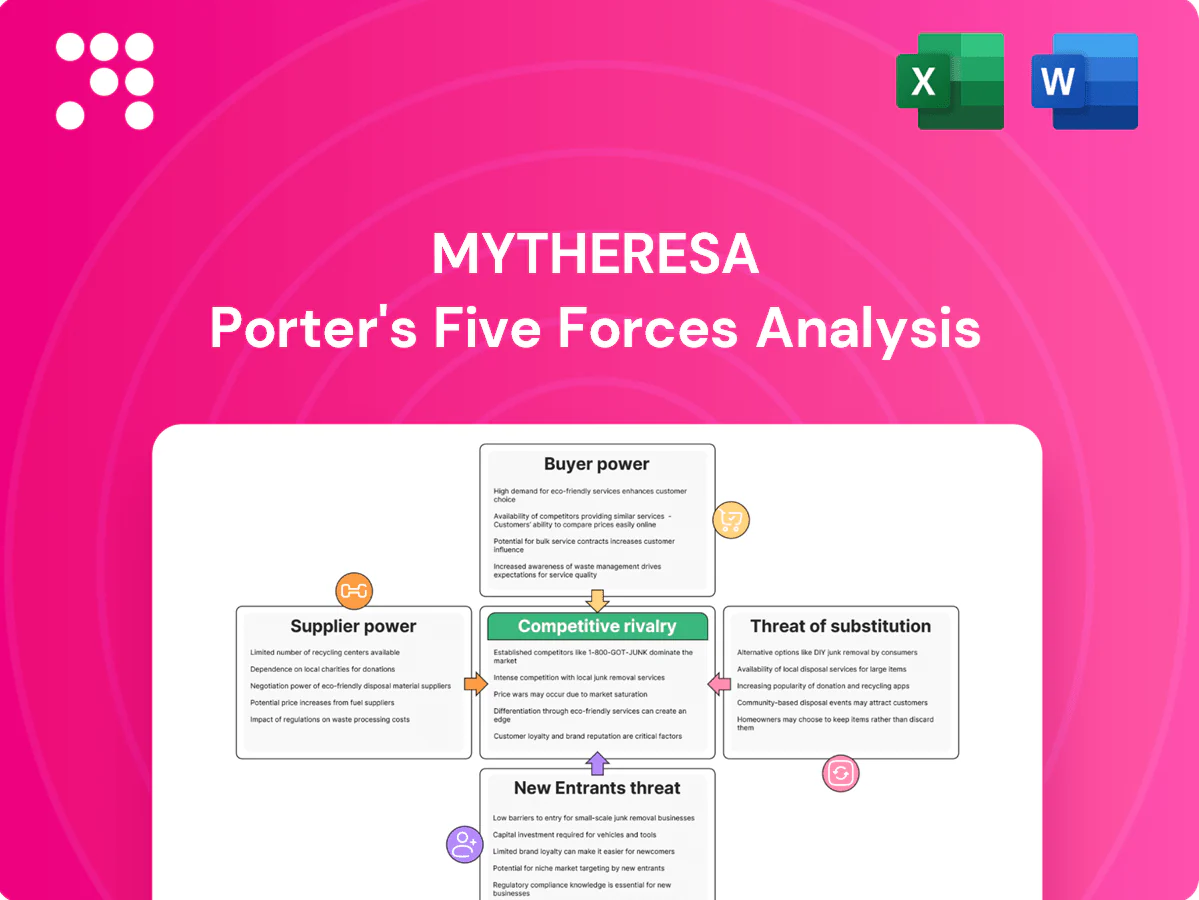
Mytheresa Porter's Five Forces Analysis

Go Beyond the Preview—Access the Full Strategic Report
Mytheresa faces high buyer power from affluent, brand-savvy customers, moderate supplier leverage due to designer partnerships, intense rivalry among luxury e-tailers, limited threat from substitutes, and barriers that temper new entrants; strategic pricing and exclusive assortments are key. This brief snapshot only scratches the surface. Unlock the full Porter's Five Forces Analysis to explore Mytheresa’s competitive dynamics in detail.
Suppliers Bargaining Power

Iconic brand concentration
Supply is concentrated among a handful of luxury houses that command premium positioning and can dictate wholesale terms, allocations and markdown windows; Mytheresa reported revenue of about €1.17bn in FY 2023, underscoring reliance on marquee labels. Dependence on their catalogs raises switching costs for the retailer, and losing one marquee label can materially dent traffic and average order value, sometimes by double-digit percentages on promoted categories.
Exclusive capsules leverage
Brands grant limited exclusives that drive traffic but increase dependence; Mytheresa reported roughly €1.07bn net sales in FY 2023 and top brands account for a large share of revenue, amplifying supplier leverage.

DTC channel pressure
Luxury brands are aggressively scaling direct-to-consumer stores and e-commerce, with online sales reaching about 30% of personal luxury goods by 2023 per Bain 2024; this shifts control and data upstream. As DTC grows, wholesale partners face tighter buys and stricter terms, raising channel conflict and risk of margin compression for retailers. To survive, retailers must prove value through curated clientele services and demonstrable incremental demand.

Allocation and seasonality risk
Scarcity-driven allocation lets brands steer inventory to preferred partners, giving vendors leverage over placement, marketing support and data-sharing; seasonality concentrates risk on wholesalers that must carry depth and face sell-through pressure that often forces heavier markdowns.
- Allocation as leverage: placement, marketing, data
- Seasonality risk: wholesalers absorb depth
- Sell-through pressure: markdown-driven margin erosion
Quality and compliance standards
Luxury suppliers force strict imagery, packaging and CX rules; non-compliance can trigger penalties or reduced assortment, raising Mytheresa’s operating costs and constraining UX or promo experiments. Luxury e-commerce accounted for about 30% of luxury sales in 2024, amplifying supplier leverage over platform presentation.
- Rigorous brand standards
- Penalties or reduced access
- Higher operating costs
- Limits on UX/promotions
Concentrated luxury supply grants brands allocation power; DTC climbs to ~30%
Supply is concentrated in a few luxury houses, giving brands leverage over allocations, markdown windows and presentation; Mytheresa reported ~€1.17bn revenue and ~€1.07bn net sales in FY2023. Top-label dependence raises switching costs and material traffic/AOV risk. DTC expansion and luxury e‑commerce at ~30% of sales (Bain 2024) shift control upstream and intensify supplier power.
| Metric | Value |
|---|---|
| Mytheresa FY2023 revenue | €1.17bn |
| Mytheresa FY2023 net sales | €1.07bn |
| Luxury e‑commerce share | ~30% (Bain 2024) |
What is included in the product
 Detailed Word Document
Concise Porter’s Five Forces analysis for Mytheresa, assessing rivalry, supplier and buyer power, threat of entrants and substitutes, and identifying key competitive pressures, margin drivers, and strategic vulnerabilities in the luxury e‑commerce segment.

 Customizable Excel Spreadsheet
Concise one-sheet Porter's Five Forces for Mytheresa that clarifies competitive pressures and relieves strategic uncertainty—ready to drop into decks, customize with your own data, or pair with deeper analysis.
Customers Bargaining Power

Low switching costs
Affluent shoppers can instantly compare prices and availability across platforms, and with online luxury sales reaching about 29% of the market in McKinsey 2024, switching to a rival site or DTC brand is effectively frictionless. This intensifies pressure on service standards, delivery speed and generous return policies. The result constrains take-rates and limits gross margin expansion as platforms compete on fulfillment and returns.
High service expectations
High service expectations—white-glove treatment, fast shipping and seamless returns—drive Mytheresa to invest heavily in logistics and customer care; Mytheresa reported €1.53bn revenue in FY2024, highlighting scale-sensitive service costs. Any service lapse risks churn to competitors; retention pressure forces ongoing spend on personalization and clienteling to protect ARPU and lifetime value.

Moderate price sensitivity
Luxury buyers exhibit lower price elasticity but remain sensitive to exclusivity and perceived value; Mytheresa reported revenue of €1.27bn in 2023, underscoring retained pricing power. Curated access and limited editions help offset discount pressure by preserving scarcity and full-price mix. In macro softness, demand shifts toward timeless SKUs and promotions, creating episodic leverage for buyers who time purchases around sales.

Global comparison shopping
Global comparison shopping raises customer bargaining power as international shoppers exploit price arbitrage, taxes and currency moves; cross-border price transparency drives demand for harmonized pricing and can cause cart abandonment—Baymard Institute reports a 69.8% average checkout abandonment rate—while localized payment options and landed-cost handling have become baseline expectations.
- arbitrage: price, tax, FX sensitivity
- transparency: demand for harmonized pricing
- risk: inconsistencies → cart abandonment (69.8%)
- baseline: localized payments and duties handling
Loyalty and data leverage
Power users—often the top 10% of Mytheresa buyers—drive an outsized share of GMV and expect VIP treatment; Mytheresa reported group revenue around €1.1bn in 2023, highlighting dependency on high-value customers in 2024 strategies. Loyalty tiers, early access and personal shoppers demonstrably reduce churn, but elite customers frequently multi-home across platforms, increasing their bargaining power as order frequency and basket size rise.
- Top buyers: outsized GMV concentration
- Retention tools: tiers, early access, personal shoppers
Seamless luxury comparison boosts buyer power, forcing higher service and exclusivity spend
Affluent shoppers' frictionless comparison (online luxury ~29% of market, McKinsey 2024) raises bargaining power, pressuring service, delivery and returns. Mytheresa's scale (€1.53bn revenue FY2024) forces heavy investment in logistics and personalization to retain ARPU. Price sensitivity centers on exclusivity; transparency and cross-border arbitrage amplify churn risk.
| Metric | Value | Source/Year |
|---|---|---|
| Online luxury share | 29% | McKinsey 2024 |
| Mytheresa revenue | €1.53bn | FY2024 |
| Checkout abandonment | 69.8% | Baymard 2024 |
Preview Before You Purchase
Mytheresa Porter's Five Forces Analysis
This preview shows the exact Mytheresa Porter’s Five Forces Analysis you’ll receive after purchase—no placeholders or mockups. The file is fully formatted, professionally written, and ready for immediate download and use the moment you buy. You’re seeing the final deliverable exactly as it will appear in your account.

Go Beyond the Preview—Access the Full Strategic Report
Mytheresa faces high buyer power from affluent, brand-savvy customers, moderate supplier leverage due to designer partnerships, intense rivalry among luxury e-tailers, limited threat from substitutes, and barriers that temper new entrants; strategic pricing and exclusive assortments are key. This brief snapshot only scratches the surface. Unlock the full Porter's Five Forces Analysis to explore Mytheresa’s competitive dynamics in detail.
Suppliers Bargaining Power
Iconic brand concentration
Supply is concentrated among a handful of luxury houses that command premium positioning and can dictate wholesale terms, allocations and markdown windows; Mytheresa reported revenue of about €1.17bn in FY 2023, underscoring reliance on marquee labels. Dependence on their catalogs raises switching costs for the retailer, and losing one marquee label can materially dent traffic and average order value, sometimes by double-digit percentages on promoted categories.
Exclusive capsules leverage
Brands grant limited exclusives that drive traffic but increase dependence; Mytheresa reported roughly €1.07bn net sales in FY 2023 and top brands account for a large share of revenue, amplifying supplier leverage.
DTC channel pressure
Luxury brands are aggressively scaling direct-to-consumer stores and e-commerce, with online sales reaching about 30% of personal luxury goods by 2023 per Bain 2024; this shifts control and data upstream. As DTC grows, wholesale partners face tighter buys and stricter terms, raising channel conflict and risk of margin compression for retailers. To survive, retailers must prove value through curated clientele services and demonstrable incremental demand.
Allocation and seasonality risk
Scarcity-driven allocation lets brands steer inventory to preferred partners, giving vendors leverage over placement, marketing support and data-sharing; seasonality concentrates risk on wholesalers that must carry depth and face sell-through pressure that often forces heavier markdowns.
- Allocation as leverage: placement, marketing, data
- Seasonality risk: wholesalers absorb depth
- Sell-through pressure: markdown-driven margin erosion
Quality and compliance standards
Luxury suppliers force strict imagery, packaging and CX rules; non-compliance can trigger penalties or reduced assortment, raising Mytheresa’s operating costs and constraining UX or promo experiments. Luxury e-commerce accounted for about 30% of luxury sales in 2024, amplifying supplier leverage over platform presentation.
- Rigorous brand standards
- Penalties or reduced access
- Higher operating costs
- Limits on UX/promotions
Concentrated luxury supply grants brands allocation power; DTC climbs to ~30%
Supply is concentrated in a few luxury houses, giving brands leverage over allocations, markdown windows and presentation; Mytheresa reported ~€1.17bn revenue and ~€1.07bn net sales in FY2023. Top-label dependence raises switching costs and material traffic/AOV risk. DTC expansion and luxury e‑commerce at ~30% of sales (Bain 2024) shift control upstream and intensify supplier power.
| Metric | Value |
|---|---|
| Mytheresa FY2023 revenue | €1.17bn |
| Mytheresa FY2023 net sales | €1.07bn |
| Luxury e‑commerce share | ~30% (Bain 2024) |
What is included in the product
Detailed Word Document
Concise Porter’s Five Forces analysis for Mytheresa, assessing rivalry, supplier and buyer power, threat of entrants and substitutes, and identifying key competitive pressures, margin drivers, and strategic vulnerabilities in the luxury e‑commerce segment.
Customizable Excel Spreadsheet
Concise one-sheet Porter's Five Forces for Mytheresa that clarifies competitive pressures and relieves strategic uncertainty—ready to drop into decks, customize with your own data, or pair with deeper analysis.
Customers Bargaining Power
Low switching costs
Affluent shoppers can instantly compare prices and availability across platforms, and with online luxury sales reaching about 29% of the market in McKinsey 2024, switching to a rival site or DTC brand is effectively frictionless. This intensifies pressure on service standards, delivery speed and generous return policies. The result constrains take-rates and limits gross margin expansion as platforms compete on fulfillment and returns.
High service expectations
High service expectations—white-glove treatment, fast shipping and seamless returns—drive Mytheresa to invest heavily in logistics and customer care; Mytheresa reported €1.53bn revenue in FY2024, highlighting scale-sensitive service costs. Any service lapse risks churn to competitors; retention pressure forces ongoing spend on personalization and clienteling to protect ARPU and lifetime value.
Moderate price sensitivity
Luxury buyers exhibit lower price elasticity but remain sensitive to exclusivity and perceived value; Mytheresa reported revenue of €1.27bn in 2023, underscoring retained pricing power. Curated access and limited editions help offset discount pressure by preserving scarcity and full-price mix. In macro softness, demand shifts toward timeless SKUs and promotions, creating episodic leverage for buyers who time purchases around sales.
Global comparison shopping
Global comparison shopping raises customer bargaining power as international shoppers exploit price arbitrage, taxes and currency moves; cross-border price transparency drives demand for harmonized pricing and can cause cart abandonment—Baymard Institute reports a 69.8% average checkout abandonment rate—while localized payment options and landed-cost handling have become baseline expectations.
- arbitrage: price, tax, FX sensitivity
- transparency: demand for harmonized pricing
- risk: inconsistencies → cart abandonment (69.8%)
- baseline: localized payments and duties handling
Loyalty and data leverage
Power users—often the top 10% of Mytheresa buyers—drive an outsized share of GMV and expect VIP treatment; Mytheresa reported group revenue around €1.1bn in 2023, highlighting dependency on high-value customers in 2024 strategies. Loyalty tiers, early access and personal shoppers demonstrably reduce churn, but elite customers frequently multi-home across platforms, increasing their bargaining power as order frequency and basket size rise.
- Top buyers: outsized GMV concentration
- Retention tools: tiers, early access, personal shoppers
Seamless luxury comparison boosts buyer power, forcing higher service and exclusivity spend
Affluent shoppers' frictionless comparison (online luxury ~29% of market, McKinsey 2024) raises bargaining power, pressuring service, delivery and returns. Mytheresa's scale (€1.53bn revenue FY2024) forces heavy investment in logistics and personalization to retain ARPU. Price sensitivity centers on exclusivity; transparency and cross-border arbitrage amplify churn risk.
| Metric | Value | Source/Year |
|---|---|---|
| Online luxury share | 29% | McKinsey 2024 |
| Mytheresa revenue | €1.53bn | FY2024 |
| Checkout abandonment | 69.8% | Baymard 2024 |
Preview Before You Purchase
Mytheresa Porter's Five Forces Analysis
This preview shows the exact Mytheresa Porter’s Five Forces Analysis you’ll receive after purchase—no placeholders or mockups. The file is fully formatted, professionally written, and ready for immediate download and use the moment you buy. You’re seeing the final deliverable exactly as it will appear in your account.
Description
Go Beyond the Preview—Access the Full Strategic Report
Mytheresa faces high buyer power from affluent, brand-savvy customers, moderate supplier leverage due to designer partnerships, intense rivalry among luxury e-tailers, limited threat from substitutes, and barriers that temper new entrants; strategic pricing and exclusive assortments are key. This brief snapshot only scratches the surface. Unlock the full Porter's Five Forces Analysis to explore Mytheresa’s competitive dynamics in detail.
Suppliers Bargaining Power
Iconic brand concentration
Supply is concentrated among a handful of luxury houses that command premium positioning and can dictate wholesale terms, allocations and markdown windows; Mytheresa reported revenue of about €1.17bn in FY 2023, underscoring reliance on marquee labels. Dependence on their catalogs raises switching costs for the retailer, and losing one marquee label can materially dent traffic and average order value, sometimes by double-digit percentages on promoted categories.
Exclusive capsules leverage
Brands grant limited exclusives that drive traffic but increase dependence; Mytheresa reported roughly €1.07bn net sales in FY 2023 and top brands account for a large share of revenue, amplifying supplier leverage.
DTC channel pressure
Luxury brands are aggressively scaling direct-to-consumer stores and e-commerce, with online sales reaching about 30% of personal luxury goods by 2023 per Bain 2024; this shifts control and data upstream. As DTC grows, wholesale partners face tighter buys and stricter terms, raising channel conflict and risk of margin compression for retailers. To survive, retailers must prove value through curated clientele services and demonstrable incremental demand.
Allocation and seasonality risk
Scarcity-driven allocation lets brands steer inventory to preferred partners, giving vendors leverage over placement, marketing support and data-sharing; seasonality concentrates risk on wholesalers that must carry depth and face sell-through pressure that often forces heavier markdowns.
- Allocation as leverage: placement, marketing, data
- Seasonality risk: wholesalers absorb depth
- Sell-through pressure: markdown-driven margin erosion
Quality and compliance standards
Luxury suppliers force strict imagery, packaging and CX rules; non-compliance can trigger penalties or reduced assortment, raising Mytheresa’s operating costs and constraining UX or promo experiments. Luxury e-commerce accounted for about 30% of luxury sales in 2024, amplifying supplier leverage over platform presentation.
- Rigorous brand standards
- Penalties or reduced access
- Higher operating costs
- Limits on UX/promotions
Concentrated luxury supply grants brands allocation power; DTC climbs to ~30%
Supply is concentrated in a few luxury houses, giving brands leverage over allocations, markdown windows and presentation; Mytheresa reported ~€1.17bn revenue and ~€1.07bn net sales in FY2023. Top-label dependence raises switching costs and material traffic/AOV risk. DTC expansion and luxury e‑commerce at ~30% of sales (Bain 2024) shift control upstream and intensify supplier power.
| Metric | Value |
|---|---|
| Mytheresa FY2023 revenue | €1.17bn |
| Mytheresa FY2023 net sales | €1.07bn |
| Luxury e‑commerce share | ~30% (Bain 2024) |
What is included in the product
Detailed Word Document
Concise Porter’s Five Forces analysis for Mytheresa, assessing rivalry, supplier and buyer power, threat of entrants and substitutes, and identifying key competitive pressures, margin drivers, and strategic vulnerabilities in the luxury e‑commerce segment.
Customizable Excel Spreadsheet
Concise one-sheet Porter's Five Forces for Mytheresa that clarifies competitive pressures and relieves strategic uncertainty—ready to drop into decks, customize with your own data, or pair with deeper analysis.
Customers Bargaining Power
Low switching costs
Affluent shoppers can instantly compare prices and availability across platforms, and with online luxury sales reaching about 29% of the market in McKinsey 2024, switching to a rival site or DTC brand is effectively frictionless. This intensifies pressure on service standards, delivery speed and generous return policies. The result constrains take-rates and limits gross margin expansion as platforms compete on fulfillment and returns.
High service expectations
High service expectations—white-glove treatment, fast shipping and seamless returns—drive Mytheresa to invest heavily in logistics and customer care; Mytheresa reported €1.53bn revenue in FY2024, highlighting scale-sensitive service costs. Any service lapse risks churn to competitors; retention pressure forces ongoing spend on personalization and clienteling to protect ARPU and lifetime value.
Moderate price sensitivity
Luxury buyers exhibit lower price elasticity but remain sensitive to exclusivity and perceived value; Mytheresa reported revenue of €1.27bn in 2023, underscoring retained pricing power. Curated access and limited editions help offset discount pressure by preserving scarcity and full-price mix. In macro softness, demand shifts toward timeless SKUs and promotions, creating episodic leverage for buyers who time purchases around sales.
Global comparison shopping
Global comparison shopping raises customer bargaining power as international shoppers exploit price arbitrage, taxes and currency moves; cross-border price transparency drives demand for harmonized pricing and can cause cart abandonment—Baymard Institute reports a 69.8% average checkout abandonment rate—while localized payment options and landed-cost handling have become baseline expectations.
- arbitrage: price, tax, FX sensitivity
- transparency: demand for harmonized pricing
- risk: inconsistencies → cart abandonment (69.8%)
- baseline: localized payments and duties handling
Loyalty and data leverage
Power users—often the top 10% of Mytheresa buyers—drive an outsized share of GMV and expect VIP treatment; Mytheresa reported group revenue around €1.1bn in 2023, highlighting dependency on high-value customers in 2024 strategies. Loyalty tiers, early access and personal shoppers demonstrably reduce churn, but elite customers frequently multi-home across platforms, increasing their bargaining power as order frequency and basket size rise.
- Top buyers: outsized GMV concentration
- Retention tools: tiers, early access, personal shoppers
Seamless luxury comparison boosts buyer power, forcing higher service and exclusivity spend
Affluent shoppers' frictionless comparison (online luxury ~29% of market, McKinsey 2024) raises bargaining power, pressuring service, delivery and returns. Mytheresa's scale (€1.53bn revenue FY2024) forces heavy investment in logistics and personalization to retain ARPU. Price sensitivity centers on exclusivity; transparency and cross-border arbitrage amplify churn risk.
| Metric | Value | Source/Year |
|---|---|---|
| Online luxury share | 29% | McKinsey 2024 |
| Mytheresa revenue | €1.53bn | FY2024 |
| Checkout abandonment | 69.8% | Baymard 2024 |
Preview Before You Purchase
Mytheresa Porter's Five Forces Analysis
This preview shows the exact Mytheresa Porter’s Five Forces Analysis you’ll receive after purchase—no placeholders or mockups. The file is fully formatted, professionally written, and ready for immediate download and use the moment you buy. You’re seeing the final deliverable exactly as it will appear in your account.











