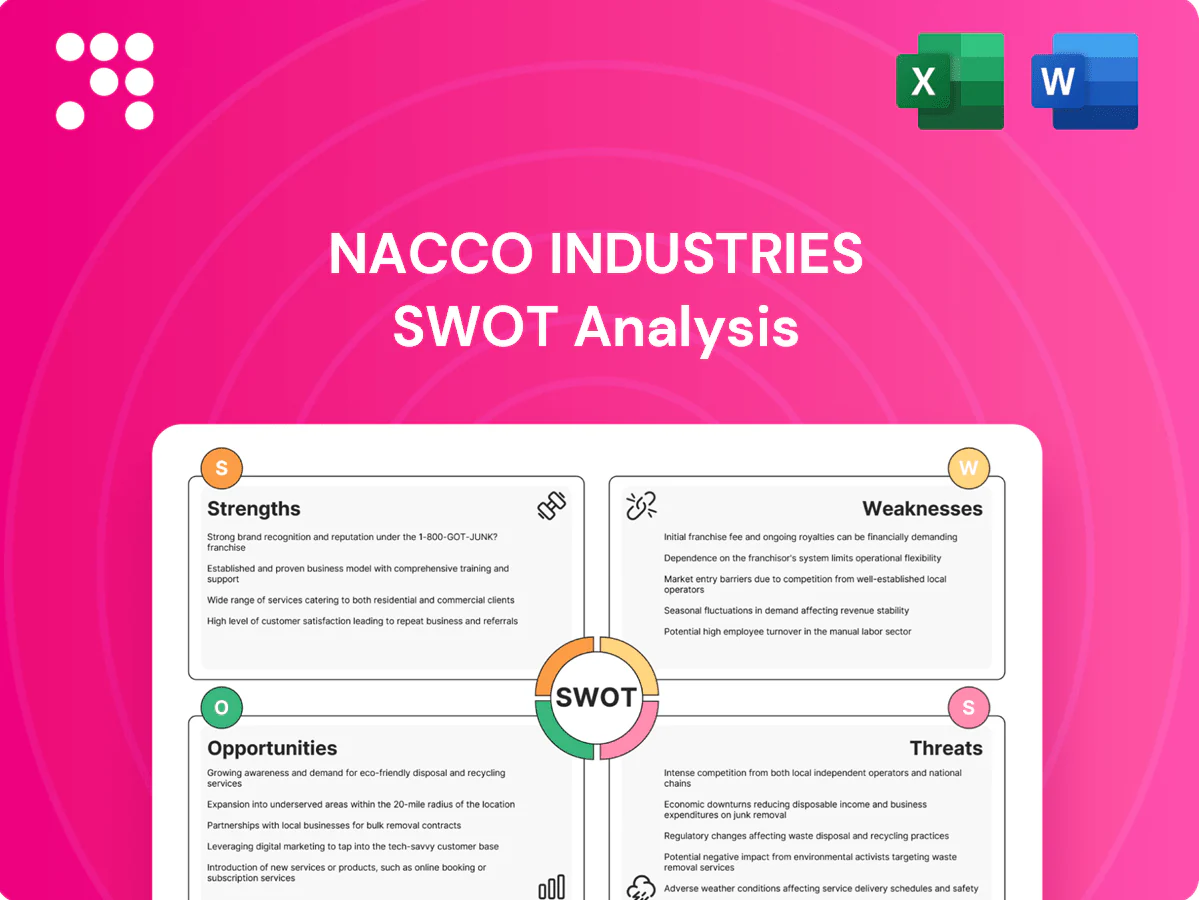
NACCO Industries SWOT Analysis

Go Beyond the Preview—Access the Full Strategic Report
NACCO Industries stands out with stable cash flows from its natural resources and a lean operational footprint, but faces commodity exposure and regulatory headwinds that could pressure margins. Our concise preview highlights key risks and growth levers. Want the full strategic picture? Purchase the complete SWOT analysis for a research-backed, editable Word and Excel package to plan and pitch with confidence.
Strengths

Contract mining model with cost-plus/take-or-pay
Contract mining under cost-plus and take-or-pay arrangements insulates NACCO Industries revenue from commodity-price swings, stabilizing cash flows across cycles and supporting multi-year planning. These contracts limit working-capital volatility by shifting fuel-price and volume exposure to counterparty utilities, which carry most of that risk. The model improves predictability for capital allocation and debt servicing.
Deep expertise in lignite surface mining
Decades of lignite surface-mining know-how at NACCO (founded 1913; over 112 years in operation) drive high productivity and lower unit costs through optimized fleets and processes. Site-specific geological familiarity across North Dakota and Texas improves mine planning and reliability. Embedded safety and compliance systems reduce operational risk. This operational edge raises barriers for new entrants.

Embedded relationships with power utilities
Long-standing, multi-year contracts (typically 5–15 years) create switching costs and mutual dependence with utilities, with NACCO reporting coal sales to utility customers accounting for the majority of segment revenue; proximity of mine-mouth plants trims transport and handling costs roughly 20–30%, locking in economics and enabling cooperative outage planning that reduces unplanned downtime risk and supports contract renewals and incremental scope.

Limited capital intensity per contract
Contract structuring at NACCO often enables customer-funded or recoverable capex, supporting higher returns on invested capital and allowing inflationary costs to be largely passed through to clients; this lowers funded capex needs and preserves capital discipline. NACCO trades under NC on NYSE American, and disciplined capital allocation reduces balance-sheet risk and preserves flexibility for selective growth.
- Customer-funded/recoverable capex
- Pass-through inflation protection
- Improved ROIC and lower leverage
- Flexibility for selective expansion
Diversifying minerals and services footprint
Diversification into aggregates, industrial minerals and reclamation/mitigation services broadens NACCO Industries revenue streams and reduces dependence on lignite cycles. These adjacencies reuse existing heavy equipment, operational skills and customer relationships, lowering incremental capex. They typically have lower carbon intensity than lignite operations, and a gradual mix shift can materially de-risk earnings volatility over time.
- Broadened revenue base via aggregates, industrial minerals, reclamation
- Economies from shared equipment and skills
- Lower carbon exposure vs lignite
- Mix shift reduces earnings cyclicality
Contract mining and take-or-pay deals stabilize cash flows; mine-mouth scale cuts unit costs
Contract mining with cost-plus and take-or-pay terms stabilizes NACCO cash flows and limits commodity exposure. Over 110 years since 1913, deep lignite expertise and mine-mouth proximity cut unit costs and raise entry barriers. Long-term 5–15 year contracts and customer-funded capex support ROIC and capital discipline. Diversification into aggregates and reclamation reduces earnings cyclicality.
| Founded | Ticker | Contract length | Transport saving |
|---|---|---|---|
| 1913 | NC | 5–15 yrs | 20–30% |
What is included in the product
 Detailed Word Document
Provides a strategic overview of NACCO Industries’ internal strengths and weaknesses and external opportunities and threats, highlighting its diversified coal-mining services and equipment operations, stable cash flows from legacy businesses, growth potential in environmental and rental segments, alongside operational cost pressures, cyclical demand and regulatory and commodity-price risks.

 Customizable Excel Spreadsheet
Provides a concise, NACCO Industries–focused SWOT matrix for fast strategic alignment and executive snapshots, easily editable for quick updates and seamless integration into reports and presentations.
Weaknesses

High customer and asset concentration
NACCO’s revenue is heavily tied to a small set of mine-mouth power plants, so closure or curtailment at any one facility can materially depress results. Replacement sales and redeployment of coal assets are not immediate, creating revenue timing and receipt risk. Geographic concentration in a single region amplifies exposure to local regulatory, demand, and operational shocks. This customer and asset concentration constrains flexibility and increases earnings volatility.
Exposure to coal-fired generation lifecycle
NACCO's lignite demand is highly concentrated in the operating life of a few coal-fired units, leaving volumes vulnerable as U.S. coal-fired generation fell to about 19% of electricity generation in 2023 (EIA). Aging fleets and decarbonization targets across utilities exert downward pressure on off-take over time, and contract buffers provide partial protection but cannot eliminate concentrated counterparty and end-of-life risk. Visibility on volumes shortens materially as plants approach retirement.

ESG stigma and capital access constraints
ESG stigma compresses valuation multiples for coal-related businesses as investor and lender appetite wanes; hundreds of banks and asset managers have adopted coal-financing limits and Lloyds moved to restrict coal underwriting in 2021, tightening insurance capacity and raising premiums. U.S. coal mining employment fell from ~90,000 in 2010 to ~40,000 in 2023 (BLS), complicating talent attraction and raising labor costs for NACCO.

Reclamation and environmental liabilities
Reclamation, permitting, bonding and closure obligations create long-tail environmental liabilities for NACCO, exposing the company to rising cash needs if cost overruns or regulatory changes occur. Any incident can trigger substantial remediation expenses and lasting reputational damage that weigh on investor confidence. Strong execution discipline in permitting, cost control and reclamation is therefore critical.
Limited scale after prior portfolio streamlining
Streamlining left NACCO smaller, reducing operating leverage and bargaining power versus larger materials and real‑estate peers; this compresses margin upside and supplier negotiation leeway.
Its public float and liquidity remain thin, limiting price discovery and raising execution risk for equity raises or activist moves.
Higher per‑unit overhead absorption and constrained M&A firepower slow diversification and scale growth.
- Smaller scale
- Thin public float/liquidity
- Poorer overhead absorption
- Limited M&A capacity
High customer concentration amid ~19% US coal share
NACCO’s revenue is concentrated in a few mine‑mouth contracts, raising volatility and redeployment lag risk. U.S. coal generation was ~19% in 2023 (EIA), pressuring off-take as retirements accelerate. ESG/finance limits and insurance constraints reduce valuation and access to capital; U.S. coal employment fell to ~40,000 in 2023 (BLS), tightening labor supply.
| Metric | Value | Source |
|---|---|---|
| US coal share | ~19% | EIA 2023 |
| US coal employment | ~40,000 | BLS 2023 |
| Customer concentration | High (few plant off-takers) | NACCO filings |
Preview the Actual Deliverable
NACCO Industries SWOT Analysis
This is the actual NACCO Industries SWOT analysis document you’ll receive upon purchase—no surprises, just professional quality. The preview below is taken directly from the full report you'll get; buy to unlock the complete, editable version. You’re viewing a live excerpt of the final file ready for download after checkout.

Go Beyond the Preview—Access the Full Strategic Report
NACCO Industries stands out with stable cash flows from its natural resources and a lean operational footprint, but faces commodity exposure and regulatory headwinds that could pressure margins. Our concise preview highlights key risks and growth levers. Want the full strategic picture? Purchase the complete SWOT analysis for a research-backed, editable Word and Excel package to plan and pitch with confidence.
Strengths
Contract mining model with cost-plus/take-or-pay
Contract mining under cost-plus and take-or-pay arrangements insulates NACCO Industries revenue from commodity-price swings, stabilizing cash flows across cycles and supporting multi-year planning. These contracts limit working-capital volatility by shifting fuel-price and volume exposure to counterparty utilities, which carry most of that risk. The model improves predictability for capital allocation and debt servicing.
Deep expertise in lignite surface mining
Decades of lignite surface-mining know-how at NACCO (founded 1913; over 112 years in operation) drive high productivity and lower unit costs through optimized fleets and processes. Site-specific geological familiarity across North Dakota and Texas improves mine planning and reliability. Embedded safety and compliance systems reduce operational risk. This operational edge raises barriers for new entrants.
Embedded relationships with power utilities
Long-standing, multi-year contracts (typically 5–15 years) create switching costs and mutual dependence with utilities, with NACCO reporting coal sales to utility customers accounting for the majority of segment revenue; proximity of mine-mouth plants trims transport and handling costs roughly 20–30%, locking in economics and enabling cooperative outage planning that reduces unplanned downtime risk and supports contract renewals and incremental scope.
Limited capital intensity per contract
Contract structuring at NACCO often enables customer-funded or recoverable capex, supporting higher returns on invested capital and allowing inflationary costs to be largely passed through to clients; this lowers funded capex needs and preserves capital discipline. NACCO trades under NC on NYSE American, and disciplined capital allocation reduces balance-sheet risk and preserves flexibility for selective growth.
- Customer-funded/recoverable capex
- Pass-through inflation protection
- Improved ROIC and lower leverage
- Flexibility for selective expansion
Diversifying minerals and services footprint
Diversification into aggregates, industrial minerals and reclamation/mitigation services broadens NACCO Industries revenue streams and reduces dependence on lignite cycles. These adjacencies reuse existing heavy equipment, operational skills and customer relationships, lowering incremental capex. They typically have lower carbon intensity than lignite operations, and a gradual mix shift can materially de-risk earnings volatility over time.
- Broadened revenue base via aggregates, industrial minerals, reclamation
- Economies from shared equipment and skills
- Lower carbon exposure vs lignite
- Mix shift reduces earnings cyclicality
Contract mining and take-or-pay deals stabilize cash flows; mine-mouth scale cuts unit costs
Contract mining with cost-plus and take-or-pay terms stabilizes NACCO cash flows and limits commodity exposure. Over 110 years since 1913, deep lignite expertise and mine-mouth proximity cut unit costs and raise entry barriers. Long-term 5–15 year contracts and customer-funded capex support ROIC and capital discipline. Diversification into aggregates and reclamation reduces earnings cyclicality.
| Founded | Ticker | Contract length | Transport saving |
|---|---|---|---|
| 1913 | NC | 5–15 yrs | 20–30% |
What is included in the product
Detailed Word Document
Provides a strategic overview of NACCO Industries’ internal strengths and weaknesses and external opportunities and threats, highlighting its diversified coal-mining services and equipment operations, stable cash flows from legacy businesses, growth potential in environmental and rental segments, alongside operational cost pressures, cyclical demand and regulatory and commodity-price risks.
Customizable Excel Spreadsheet
Provides a concise, NACCO Industries–focused SWOT matrix for fast strategic alignment and executive snapshots, easily editable for quick updates and seamless integration into reports and presentations.
Weaknesses
High customer and asset concentration
NACCO’s revenue is heavily tied to a small set of mine-mouth power plants, so closure or curtailment at any one facility can materially depress results. Replacement sales and redeployment of coal assets are not immediate, creating revenue timing and receipt risk. Geographic concentration in a single region amplifies exposure to local regulatory, demand, and operational shocks. This customer and asset concentration constrains flexibility and increases earnings volatility.
Exposure to coal-fired generation lifecycle
NACCO's lignite demand is highly concentrated in the operating life of a few coal-fired units, leaving volumes vulnerable as U.S. coal-fired generation fell to about 19% of electricity generation in 2023 (EIA). Aging fleets and decarbonization targets across utilities exert downward pressure on off-take over time, and contract buffers provide partial protection but cannot eliminate concentrated counterparty and end-of-life risk. Visibility on volumes shortens materially as plants approach retirement.
ESG stigma and capital access constraints
ESG stigma compresses valuation multiples for coal-related businesses as investor and lender appetite wanes; hundreds of banks and asset managers have adopted coal-financing limits and Lloyds moved to restrict coal underwriting in 2021, tightening insurance capacity and raising premiums. U.S. coal mining employment fell from ~90,000 in 2010 to ~40,000 in 2023 (BLS), complicating talent attraction and raising labor costs for NACCO.
Reclamation and environmental liabilities
Reclamation, permitting, bonding and closure obligations create long-tail environmental liabilities for NACCO, exposing the company to rising cash needs if cost overruns or regulatory changes occur. Any incident can trigger substantial remediation expenses and lasting reputational damage that weigh on investor confidence. Strong execution discipline in permitting, cost control and reclamation is therefore critical.
Limited scale after prior portfolio streamlining
Streamlining left NACCO smaller, reducing operating leverage and bargaining power versus larger materials and real‑estate peers; this compresses margin upside and supplier negotiation leeway.
Its public float and liquidity remain thin, limiting price discovery and raising execution risk for equity raises or activist moves.
Higher per‑unit overhead absorption and constrained M&A firepower slow diversification and scale growth.
- Smaller scale
- Thin public float/liquidity
- Poorer overhead absorption
- Limited M&A capacity
High customer concentration amid ~19% US coal share
NACCO’s revenue is concentrated in a few mine‑mouth contracts, raising volatility and redeployment lag risk. U.S. coal generation was ~19% in 2023 (EIA), pressuring off-take as retirements accelerate. ESG/finance limits and insurance constraints reduce valuation and access to capital; U.S. coal employment fell to ~40,000 in 2023 (BLS), tightening labor supply.
| Metric | Value | Source |
|---|---|---|
| US coal share | ~19% | EIA 2023 |
| US coal employment | ~40,000 | BLS 2023 |
| Customer concentration | High (few plant off-takers) | NACCO filings |
Preview the Actual Deliverable
NACCO Industries SWOT Analysis
This is the actual NACCO Industries SWOT analysis document you’ll receive upon purchase—no surprises, just professional quality. The preview below is taken directly from the full report you'll get; buy to unlock the complete, editable version. You’re viewing a live excerpt of the final file ready for download after checkout.
Original: $10.00
-65%$10.00
$3.50Description
Go Beyond the Preview—Access the Full Strategic Report
NACCO Industries stands out with stable cash flows from its natural resources and a lean operational footprint, but faces commodity exposure and regulatory headwinds that could pressure margins. Our concise preview highlights key risks and growth levers. Want the full strategic picture? Purchase the complete SWOT analysis for a research-backed, editable Word and Excel package to plan and pitch with confidence.
Strengths
Contract mining model with cost-plus/take-or-pay
Contract mining under cost-plus and take-or-pay arrangements insulates NACCO Industries revenue from commodity-price swings, stabilizing cash flows across cycles and supporting multi-year planning. These contracts limit working-capital volatility by shifting fuel-price and volume exposure to counterparty utilities, which carry most of that risk. The model improves predictability for capital allocation and debt servicing.
Deep expertise in lignite surface mining
Decades of lignite surface-mining know-how at NACCO (founded 1913; over 112 years in operation) drive high productivity and lower unit costs through optimized fleets and processes. Site-specific geological familiarity across North Dakota and Texas improves mine planning and reliability. Embedded safety and compliance systems reduce operational risk. This operational edge raises barriers for new entrants.
Embedded relationships with power utilities
Long-standing, multi-year contracts (typically 5–15 years) create switching costs and mutual dependence with utilities, with NACCO reporting coal sales to utility customers accounting for the majority of segment revenue; proximity of mine-mouth plants trims transport and handling costs roughly 20–30%, locking in economics and enabling cooperative outage planning that reduces unplanned downtime risk and supports contract renewals and incremental scope.
Limited capital intensity per contract
Contract structuring at NACCO often enables customer-funded or recoverable capex, supporting higher returns on invested capital and allowing inflationary costs to be largely passed through to clients; this lowers funded capex needs and preserves capital discipline. NACCO trades under NC on NYSE American, and disciplined capital allocation reduces balance-sheet risk and preserves flexibility for selective growth.
- Customer-funded/recoverable capex
- Pass-through inflation protection
- Improved ROIC and lower leverage
- Flexibility for selective expansion
Diversifying minerals and services footprint
Diversification into aggregates, industrial minerals and reclamation/mitigation services broadens NACCO Industries revenue streams and reduces dependence on lignite cycles. These adjacencies reuse existing heavy equipment, operational skills and customer relationships, lowering incremental capex. They typically have lower carbon intensity than lignite operations, and a gradual mix shift can materially de-risk earnings volatility over time.
- Broadened revenue base via aggregates, industrial minerals, reclamation
- Economies from shared equipment and skills
- Lower carbon exposure vs lignite
- Mix shift reduces earnings cyclicality
Contract mining and take-or-pay deals stabilize cash flows; mine-mouth scale cuts unit costs
Contract mining with cost-plus and take-or-pay terms stabilizes NACCO cash flows and limits commodity exposure. Over 110 years since 1913, deep lignite expertise and mine-mouth proximity cut unit costs and raise entry barriers. Long-term 5–15 year contracts and customer-funded capex support ROIC and capital discipline. Diversification into aggregates and reclamation reduces earnings cyclicality.
| Founded | Ticker | Contract length | Transport saving |
|---|---|---|---|
| 1913 | NC | 5–15 yrs | 20–30% |
What is included in the product
Detailed Word Document
Provides a strategic overview of NACCO Industries’ internal strengths and weaknesses and external opportunities and threats, highlighting its diversified coal-mining services and equipment operations, stable cash flows from legacy businesses, growth potential in environmental and rental segments, alongside operational cost pressures, cyclical demand and regulatory and commodity-price risks.
Customizable Excel Spreadsheet
Provides a concise, NACCO Industries–focused SWOT matrix for fast strategic alignment and executive snapshots, easily editable for quick updates and seamless integration into reports and presentations.
Weaknesses
High customer and asset concentration
NACCO’s revenue is heavily tied to a small set of mine-mouth power plants, so closure or curtailment at any one facility can materially depress results. Replacement sales and redeployment of coal assets are not immediate, creating revenue timing and receipt risk. Geographic concentration in a single region amplifies exposure to local regulatory, demand, and operational shocks. This customer and asset concentration constrains flexibility and increases earnings volatility.
Exposure to coal-fired generation lifecycle
NACCO's lignite demand is highly concentrated in the operating life of a few coal-fired units, leaving volumes vulnerable as U.S. coal-fired generation fell to about 19% of electricity generation in 2023 (EIA). Aging fleets and decarbonization targets across utilities exert downward pressure on off-take over time, and contract buffers provide partial protection but cannot eliminate concentrated counterparty and end-of-life risk. Visibility on volumes shortens materially as plants approach retirement.
ESG stigma and capital access constraints
ESG stigma compresses valuation multiples for coal-related businesses as investor and lender appetite wanes; hundreds of banks and asset managers have adopted coal-financing limits and Lloyds moved to restrict coal underwriting in 2021, tightening insurance capacity and raising premiums. U.S. coal mining employment fell from ~90,000 in 2010 to ~40,000 in 2023 (BLS), complicating talent attraction and raising labor costs for NACCO.
Reclamation and environmental liabilities
Reclamation, permitting, bonding and closure obligations create long-tail environmental liabilities for NACCO, exposing the company to rising cash needs if cost overruns or regulatory changes occur. Any incident can trigger substantial remediation expenses and lasting reputational damage that weigh on investor confidence. Strong execution discipline in permitting, cost control and reclamation is therefore critical.
Limited scale after prior portfolio streamlining
Streamlining left NACCO smaller, reducing operating leverage and bargaining power versus larger materials and real‑estate peers; this compresses margin upside and supplier negotiation leeway.
Its public float and liquidity remain thin, limiting price discovery and raising execution risk for equity raises or activist moves.
Higher per‑unit overhead absorption and constrained M&A firepower slow diversification and scale growth.
- Smaller scale
- Thin public float/liquidity
- Poorer overhead absorption
- Limited M&A capacity
High customer concentration amid ~19% US coal share
NACCO’s revenue is concentrated in a few mine‑mouth contracts, raising volatility and redeployment lag risk. U.S. coal generation was ~19% in 2023 (EIA), pressuring off-take as retirements accelerate. ESG/finance limits and insurance constraints reduce valuation and access to capital; U.S. coal employment fell to ~40,000 in 2023 (BLS), tightening labor supply.
| Metric | Value | Source |
|---|---|---|
| US coal share | ~19% | EIA 2023 |
| US coal employment | ~40,000 | BLS 2023 |
| Customer concentration | High (few plant off-takers) | NACCO filings |
Preview the Actual Deliverable
NACCO Industries SWOT Analysis
This is the actual NACCO Industries SWOT analysis document you’ll receive upon purchase—no surprises, just professional quality. The preview below is taken directly from the full report you'll get; buy to unlock the complete, editable version. You’re viewing a live excerpt of the final file ready for download after checkout.











