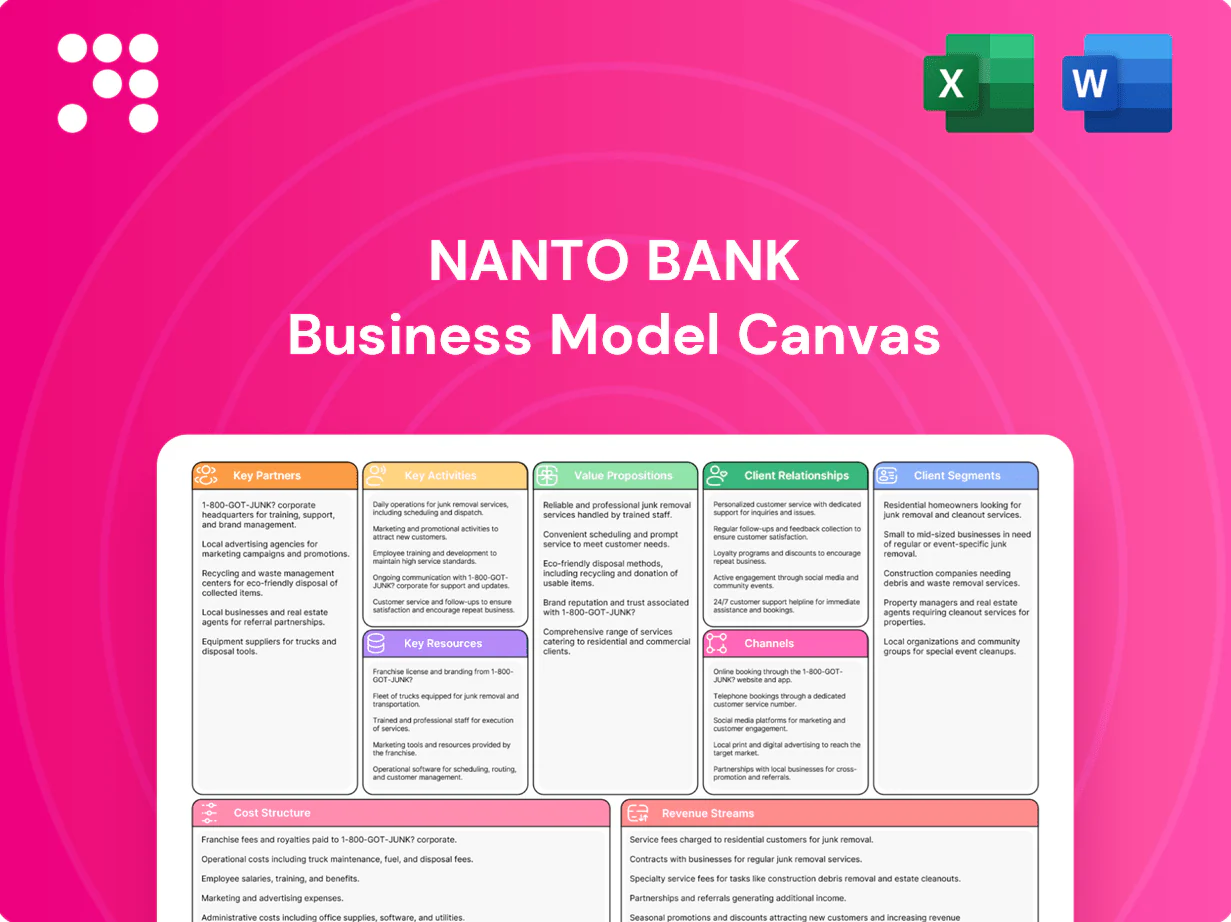
Nanto Bank Business Model Canvas

Unlock the strategic Business Model Canvas of a leading bank - download editable templates
Unlock the full strategic blueprint behind Nanto Bank's business model. This in-depth Business Model Canvas explains value propositions, customer segments, channels and revenue drivers, revealing how Nanto captures market share and scales profitably. Ideal for investors and strategists. Download the complete, editable Word & Excel canvas to benchmark and act.
Partnerships

Local SMEs and corporates
Partnerships with regional SMEs and corporates drive demand for working capital, payroll, and cash management services and, per World Bank data, SMEs represent roughly 90% of businesses and over 50% of employment globally (2024). Co-developing lending programs aligns credit tenor and covenants with local industry cycles, boosting repayment performance. These ties deepen relationship banking and cross-sell potential and help secure stable, low-cost deposit inflows.
Municipal and prefectural bodies
Collaboration with Nara Prefecture (population ~1.26 million in 2024) and local municipalities secures public deposits and underpins infrastructure financing and subsidy-linked loans. Public programs channel targeted funding to SMEs—which make up 99.7% of Japanese firms—and households. Joint financial literacy and disaster-relief initiatives expand social impact. This partnership boosts reputational capital and priority access to public projects.

Fintech and core IT vendors
Alliances with fintech and core IT vendors enable mobile onboarding, eKYC, analytics and payment rails, cutting onboarding times and dropout rates—eKYC implementations reduced average onboarding time by as much as 70% in many 2024 deployments. API integrations improve user experience and operational efficiency, with banks reporting up to 30% lower processing costs after API rollouts. Vendors also supply cybersecurity, core upgrades and cloud adoption support as 2024 saw accelerated cloud migration across retail banks. Co-innovation with vendors shortens time-to-market for new services, often by 30–40% in recent pilots.

Payment networks and card issuers
Ties with card schemes and processors underpin Nanto Bank’s credit/debit issuance and acceptance, supporting settlement across networks that processed over 45 trillion USD in card transactions by 2024; interchange settlement and risk tools cut fraud and disputes, lowering chargeback rates materially. Co-branded programs drive higher spend and fee income, while network marketing expands merchant ecosystems for customers.
- Networks processed >45T USD (2024)
- Interchange enables settlement & fraud tooling
- Co-branded cards = higher spend/fee income
- Network marketing grows merchant acceptance
Insurers and real estate partners
Bancassurance integrates protection products into Nanto Bank retail and SME portfolios, with 2024 industry reports showing bancassurance accounts for about 40% of life premiums in key markets; real estate brokers feed roughly 30% of mortgage pipelines and supply appraisal insights that tighten credit pricing. Cross-referrals lift conversion rates by 15–25% and increase wallet share, while risk-sharing structures can cut capital requirements and RWA by up to 20%, optimizing capital usage.
- Bancassurance ~40% of life premiums (2024)
- Broker-originated mortgage pipeline ~30%
- Cross-referral conversion +15–25%
- Risk-sharing reduces RWA/capital need up to 20%
SME + fintech partnerships drive deposits, loans & fees — SMEs 99.7%
Partnerships with SMEs, Nara Prefecture, fintechs, card schemes and insurers drive deposits, fees and loan origination; SMEs 99.7% of Japanese firms, Nara pop ~1.26M (2024). Fintech APIs cut onboarding times up to 70% and lower processing costs ~30%. Bancassurance ~40% of life premiums; broker-originated mortgages ~30%.
| Partner | Metric (2024) |
|---|---|
| SMEs | 99.7% firms |
| Nara Prefecture | Pop 1.26M |
| Fintech/APIs | -70% onboarding, -30% costs |
| Bancassurance | ~40% life prem |
What is included in the product
 Detailed Word Document
A comprehensive, pre-written Business Model Canvas for Nanto Bank that maps all nine BMC blocks—customer segments, value propositions, channels, customer relationships, revenue streams, key resources, key activities, key partners, and cost structure—reflecting real-world operations, competitive advantages, and linked SWOT insights to support presentations, investor discussions, and strategic decision-making.

 Customizable Excel Spreadsheet
High-level view of Nanto Bank’s business model with editable cells to quickly surface core banking strengths and pain points for rapid decision-making. Perfect for teams needing a clean, shareable one-page snapshot that saves hours and supports boardroom discussions or competitive comparisons.
Activities

Deposit gathering
Attracting retail and corporate deposits provides Nanto Bank with low-cost, stable funding by focusing product design across current, savings, and time deposits to match client cash flows. Campaigns calibrate rate competitiveness and loyalty incentives to optimize acquisition versus margin. Active liquidity management, including funding diversification and stress testing, preserves stability through interest-rate and credit cycles.
Lending and credit underwriting
Lending origination covers mortgages, consumer loans, SME facilities and corporate loans. Risk assessment combines credit scoring (FICO 300–850), collateral valuation and cash-flow analysis under IFRS 9 expected credit loss frameworks. Pricing reflects assessed risk, tenor and capital costs (Basel III CET1 minimum 4.5%). Ongoing monitoring aims to limit delinquencies and provisions.

Treasury and ALM
Treasury and ALM manage interest-rate risk, liquidity buffers and investment portfolios to align with market rates (US federal funds ended 2024 at 5.25–5.50%) while matching asset‑liability durations and hedges. They optimize yield within regulatory limits such as LCR and NSFR at or above 100% and the bank’s risk appetite. Execution occurs across money, bond and FX markets as needed to rebalance positions and capture spreads.

Digital service delivery
Operate secure, intuitive online and mobile banking with 99.9% availability, enabling payments, transfers, remote account opening and granular card controls; use data analytics and ML for personalization and fraud detection, supporting over 4 billion global mobile banking users in 2024; continuously improve UX via biweekly agile releases.
- Secure online/mobile journeys
- Payments, transfers, remote KYC, card controls
- Analytics for personalization & fraud
- Biweekly agile UX releases
Advisory and consulting
Nanto Bank provides financial consulting to SMEs and retail investors, delivering cash management, succession planning and investment guidance; workshops and one-on-one reviews deepen relationships and enable cross-sell. World Bank reports SMEs represent about 90% of businesses and 50% of employment globally (2024), underscoring advisory reach. Advisory services target measurable fee-income growth and non-interest income diversification.
- Provide financial consulting to SMEs and retail investors
- Solutions: cash management, succession planning, investment guidance
- Workshops and one-on-one reviews deepen relationships
- Advisory drives fee income and cross-sell; targets non-interest income growth
Low-cost deposits, robust liquidity and resilient digital banking
Nanto Bank secures low‑cost deposits (CET1 4.5% min), manages liquidity (LCR/NSFR ≥100%) and hedges rates (Fed funds 5.25–5.50% end‑2024). Lending spans mortgages, consumer, SME and corporate with IFRS 9 ECL risk models to limit delinquencies. Treasury/ALM optimize duration and yields; digital banking 99.9% uptime, ML fraud controls; SME advisory targets fee income, reflecting SMEs ~90% of firms (2024).
| Activity | KPI | 2024 |
|---|---|---|
| Deposits | CET1 min | 4.5% |
| Liquidity | LCR/NSFR | ≥100% |
| Digital | Uptime | 99.9% |
Full Document Unlocks After Purchase
Business Model Canvas
The Nanto Bank Business Model Canvas you see here is the actual deliverable, not a mockup. When you purchase, you’ll receive this same document in full—formatted and editable in Word and Excel. No placeholders, no surprises—exactly what’s previewed, ready to present and use.

Unlock the strategic Business Model Canvas of a leading bank - download editable templates
Unlock the full strategic blueprint behind Nanto Bank's business model. This in-depth Business Model Canvas explains value propositions, customer segments, channels and revenue drivers, revealing how Nanto captures market share and scales profitably. Ideal for investors and strategists. Download the complete, editable Word & Excel canvas to benchmark and act.
Partnerships
Local SMEs and corporates
Partnerships with regional SMEs and corporates drive demand for working capital, payroll, and cash management services and, per World Bank data, SMEs represent roughly 90% of businesses and over 50% of employment globally (2024). Co-developing lending programs aligns credit tenor and covenants with local industry cycles, boosting repayment performance. These ties deepen relationship banking and cross-sell potential and help secure stable, low-cost deposit inflows.
Municipal and prefectural bodies
Collaboration with Nara Prefecture (population ~1.26 million in 2024) and local municipalities secures public deposits and underpins infrastructure financing and subsidy-linked loans. Public programs channel targeted funding to SMEs—which make up 99.7% of Japanese firms—and households. Joint financial literacy and disaster-relief initiatives expand social impact. This partnership boosts reputational capital and priority access to public projects.
Fintech and core IT vendors
Alliances with fintech and core IT vendors enable mobile onboarding, eKYC, analytics and payment rails, cutting onboarding times and dropout rates—eKYC implementations reduced average onboarding time by as much as 70% in many 2024 deployments. API integrations improve user experience and operational efficiency, with banks reporting up to 30% lower processing costs after API rollouts. Vendors also supply cybersecurity, core upgrades and cloud adoption support as 2024 saw accelerated cloud migration across retail banks. Co-innovation with vendors shortens time-to-market for new services, often by 30–40% in recent pilots.
Payment networks and card issuers
Ties with card schemes and processors underpin Nanto Bank’s credit/debit issuance and acceptance, supporting settlement across networks that processed over 45 trillion USD in card transactions by 2024; interchange settlement and risk tools cut fraud and disputes, lowering chargeback rates materially. Co-branded programs drive higher spend and fee income, while network marketing expands merchant ecosystems for customers.
- Networks processed >45T USD (2024)
- Interchange enables settlement & fraud tooling
- Co-branded cards = higher spend/fee income
- Network marketing grows merchant acceptance
Insurers and real estate partners
Bancassurance integrates protection products into Nanto Bank retail and SME portfolios, with 2024 industry reports showing bancassurance accounts for about 40% of life premiums in key markets; real estate brokers feed roughly 30% of mortgage pipelines and supply appraisal insights that tighten credit pricing. Cross-referrals lift conversion rates by 15–25% and increase wallet share, while risk-sharing structures can cut capital requirements and RWA by up to 20%, optimizing capital usage.
- Bancassurance ~40% of life premiums (2024)
- Broker-originated mortgage pipeline ~30%
- Cross-referral conversion +15–25%
- Risk-sharing reduces RWA/capital need up to 20%
SME + fintech partnerships drive deposits, loans & fees — SMEs 99.7%
Partnerships with SMEs, Nara Prefecture, fintechs, card schemes and insurers drive deposits, fees and loan origination; SMEs 99.7% of Japanese firms, Nara pop ~1.26M (2024). Fintech APIs cut onboarding times up to 70% and lower processing costs ~30%. Bancassurance ~40% of life premiums; broker-originated mortgages ~30%.
| Partner | Metric (2024) |
|---|---|
| SMEs | 99.7% firms |
| Nara Prefecture | Pop 1.26M |
| Fintech/APIs | -70% onboarding, -30% costs |
| Bancassurance | ~40% life prem |
What is included in the product
Detailed Word Document
A comprehensive, pre-written Business Model Canvas for Nanto Bank that maps all nine BMC blocks—customer segments, value propositions, channels, customer relationships, revenue streams, key resources, key activities, key partners, and cost structure—reflecting real-world operations, competitive advantages, and linked SWOT insights to support presentations, investor discussions, and strategic decision-making.
Customizable Excel Spreadsheet
High-level view of Nanto Bank’s business model with editable cells to quickly surface core banking strengths and pain points for rapid decision-making. Perfect for teams needing a clean, shareable one-page snapshot that saves hours and supports boardroom discussions or competitive comparisons.
Activities
Deposit gathering
Attracting retail and corporate deposits provides Nanto Bank with low-cost, stable funding by focusing product design across current, savings, and time deposits to match client cash flows. Campaigns calibrate rate competitiveness and loyalty incentives to optimize acquisition versus margin. Active liquidity management, including funding diversification and stress testing, preserves stability through interest-rate and credit cycles.
Lending and credit underwriting
Lending origination covers mortgages, consumer loans, SME facilities and corporate loans. Risk assessment combines credit scoring (FICO 300–850), collateral valuation and cash-flow analysis under IFRS 9 expected credit loss frameworks. Pricing reflects assessed risk, tenor and capital costs (Basel III CET1 minimum 4.5%). Ongoing monitoring aims to limit delinquencies and provisions.
Treasury and ALM
Treasury and ALM manage interest-rate risk, liquidity buffers and investment portfolios to align with market rates (US federal funds ended 2024 at 5.25–5.50%) while matching asset‑liability durations and hedges. They optimize yield within regulatory limits such as LCR and NSFR at or above 100% and the bank’s risk appetite. Execution occurs across money, bond and FX markets as needed to rebalance positions and capture spreads.
Digital service delivery
Operate secure, intuitive online and mobile banking with 99.9% availability, enabling payments, transfers, remote account opening and granular card controls; use data analytics and ML for personalization and fraud detection, supporting over 4 billion global mobile banking users in 2024; continuously improve UX via biweekly agile releases.
- Secure online/mobile journeys
- Payments, transfers, remote KYC, card controls
- Analytics for personalization & fraud
- Biweekly agile UX releases
Advisory and consulting
Nanto Bank provides financial consulting to SMEs and retail investors, delivering cash management, succession planning and investment guidance; workshops and one-on-one reviews deepen relationships and enable cross-sell. World Bank reports SMEs represent about 90% of businesses and 50% of employment globally (2024), underscoring advisory reach. Advisory services target measurable fee-income growth and non-interest income diversification.
- Provide financial consulting to SMEs and retail investors
- Solutions: cash management, succession planning, investment guidance
- Workshops and one-on-one reviews deepen relationships
- Advisory drives fee income and cross-sell; targets non-interest income growth
Low-cost deposits, robust liquidity and resilient digital banking
Nanto Bank secures low‑cost deposits (CET1 4.5% min), manages liquidity (LCR/NSFR ≥100%) and hedges rates (Fed funds 5.25–5.50% end‑2024). Lending spans mortgages, consumer, SME and corporate with IFRS 9 ECL risk models to limit delinquencies. Treasury/ALM optimize duration and yields; digital banking 99.9% uptime, ML fraud controls; SME advisory targets fee income, reflecting SMEs ~90% of firms (2024).
| Activity | KPI | 2024 |
|---|---|---|
| Deposits | CET1 min | 4.5% |
| Liquidity | LCR/NSFR | ≥100% |
| Digital | Uptime | 99.9% |
Full Document Unlocks After Purchase
Business Model Canvas
The Nanto Bank Business Model Canvas you see here is the actual deliverable, not a mockup. When you purchase, you’ll receive this same document in full—formatted and editable in Word and Excel. No placeholders, no surprises—exactly what’s previewed, ready to present and use.
Original: $10.00
-65%$10.00
$3.50Description
Unlock the strategic Business Model Canvas of a leading bank - download editable templates
Unlock the full strategic blueprint behind Nanto Bank's business model. This in-depth Business Model Canvas explains value propositions, customer segments, channels and revenue drivers, revealing how Nanto captures market share and scales profitably. Ideal for investors and strategists. Download the complete, editable Word & Excel canvas to benchmark and act.
Partnerships
Local SMEs and corporates
Partnerships with regional SMEs and corporates drive demand for working capital, payroll, and cash management services and, per World Bank data, SMEs represent roughly 90% of businesses and over 50% of employment globally (2024). Co-developing lending programs aligns credit tenor and covenants with local industry cycles, boosting repayment performance. These ties deepen relationship banking and cross-sell potential and help secure stable, low-cost deposit inflows.
Municipal and prefectural bodies
Collaboration with Nara Prefecture (population ~1.26 million in 2024) and local municipalities secures public deposits and underpins infrastructure financing and subsidy-linked loans. Public programs channel targeted funding to SMEs—which make up 99.7% of Japanese firms—and households. Joint financial literacy and disaster-relief initiatives expand social impact. This partnership boosts reputational capital and priority access to public projects.
Fintech and core IT vendors
Alliances with fintech and core IT vendors enable mobile onboarding, eKYC, analytics and payment rails, cutting onboarding times and dropout rates—eKYC implementations reduced average onboarding time by as much as 70% in many 2024 deployments. API integrations improve user experience and operational efficiency, with banks reporting up to 30% lower processing costs after API rollouts. Vendors also supply cybersecurity, core upgrades and cloud adoption support as 2024 saw accelerated cloud migration across retail banks. Co-innovation with vendors shortens time-to-market for new services, often by 30–40% in recent pilots.
Payment networks and card issuers
Ties with card schemes and processors underpin Nanto Bank’s credit/debit issuance and acceptance, supporting settlement across networks that processed over 45 trillion USD in card transactions by 2024; interchange settlement and risk tools cut fraud and disputes, lowering chargeback rates materially. Co-branded programs drive higher spend and fee income, while network marketing expands merchant ecosystems for customers.
- Networks processed >45T USD (2024)
- Interchange enables settlement & fraud tooling
- Co-branded cards = higher spend/fee income
- Network marketing grows merchant acceptance
Insurers and real estate partners
Bancassurance integrates protection products into Nanto Bank retail and SME portfolios, with 2024 industry reports showing bancassurance accounts for about 40% of life premiums in key markets; real estate brokers feed roughly 30% of mortgage pipelines and supply appraisal insights that tighten credit pricing. Cross-referrals lift conversion rates by 15–25% and increase wallet share, while risk-sharing structures can cut capital requirements and RWA by up to 20%, optimizing capital usage.
- Bancassurance ~40% of life premiums (2024)
- Broker-originated mortgage pipeline ~30%
- Cross-referral conversion +15–25%
- Risk-sharing reduces RWA/capital need up to 20%
SME + fintech partnerships drive deposits, loans & fees — SMEs 99.7%
Partnerships with SMEs, Nara Prefecture, fintechs, card schemes and insurers drive deposits, fees and loan origination; SMEs 99.7% of Japanese firms, Nara pop ~1.26M (2024). Fintech APIs cut onboarding times up to 70% and lower processing costs ~30%. Bancassurance ~40% of life premiums; broker-originated mortgages ~30%.
| Partner | Metric (2024) |
|---|---|
| SMEs | 99.7% firms |
| Nara Prefecture | Pop 1.26M |
| Fintech/APIs | -70% onboarding, -30% costs |
| Bancassurance | ~40% life prem |
What is included in the product
Detailed Word Document
A comprehensive, pre-written Business Model Canvas for Nanto Bank that maps all nine BMC blocks—customer segments, value propositions, channels, customer relationships, revenue streams, key resources, key activities, key partners, and cost structure—reflecting real-world operations, competitive advantages, and linked SWOT insights to support presentations, investor discussions, and strategic decision-making.
Customizable Excel Spreadsheet
High-level view of Nanto Bank’s business model with editable cells to quickly surface core banking strengths and pain points for rapid decision-making. Perfect for teams needing a clean, shareable one-page snapshot that saves hours and supports boardroom discussions or competitive comparisons.
Activities
Deposit gathering
Attracting retail and corporate deposits provides Nanto Bank with low-cost, stable funding by focusing product design across current, savings, and time deposits to match client cash flows. Campaigns calibrate rate competitiveness and loyalty incentives to optimize acquisition versus margin. Active liquidity management, including funding diversification and stress testing, preserves stability through interest-rate and credit cycles.
Lending and credit underwriting
Lending origination covers mortgages, consumer loans, SME facilities and corporate loans. Risk assessment combines credit scoring (FICO 300–850), collateral valuation and cash-flow analysis under IFRS 9 expected credit loss frameworks. Pricing reflects assessed risk, tenor and capital costs (Basel III CET1 minimum 4.5%). Ongoing monitoring aims to limit delinquencies and provisions.
Treasury and ALM
Treasury and ALM manage interest-rate risk, liquidity buffers and investment portfolios to align with market rates (US federal funds ended 2024 at 5.25–5.50%) while matching asset‑liability durations and hedges. They optimize yield within regulatory limits such as LCR and NSFR at or above 100% and the bank’s risk appetite. Execution occurs across money, bond and FX markets as needed to rebalance positions and capture spreads.
Digital service delivery
Operate secure, intuitive online and mobile banking with 99.9% availability, enabling payments, transfers, remote account opening and granular card controls; use data analytics and ML for personalization and fraud detection, supporting over 4 billion global mobile banking users in 2024; continuously improve UX via biweekly agile releases.
- Secure online/mobile journeys
- Payments, transfers, remote KYC, card controls
- Analytics for personalization & fraud
- Biweekly agile UX releases
Advisory and consulting
Nanto Bank provides financial consulting to SMEs and retail investors, delivering cash management, succession planning and investment guidance; workshops and one-on-one reviews deepen relationships and enable cross-sell. World Bank reports SMEs represent about 90% of businesses and 50% of employment globally (2024), underscoring advisory reach. Advisory services target measurable fee-income growth and non-interest income diversification.
- Provide financial consulting to SMEs and retail investors
- Solutions: cash management, succession planning, investment guidance
- Workshops and one-on-one reviews deepen relationships
- Advisory drives fee income and cross-sell; targets non-interest income growth
Low-cost deposits, robust liquidity and resilient digital banking
Nanto Bank secures low‑cost deposits (CET1 4.5% min), manages liquidity (LCR/NSFR ≥100%) and hedges rates (Fed funds 5.25–5.50% end‑2024). Lending spans mortgages, consumer, SME and corporate with IFRS 9 ECL risk models to limit delinquencies. Treasury/ALM optimize duration and yields; digital banking 99.9% uptime, ML fraud controls; SME advisory targets fee income, reflecting SMEs ~90% of firms (2024).
| Activity | KPI | 2024 |
|---|---|---|
| Deposits | CET1 min | 4.5% |
| Liquidity | LCR/NSFR | ≥100% |
| Digital | Uptime | 99.9% |
Full Document Unlocks After Purchase
Business Model Canvas
The Nanto Bank Business Model Canvas you see here is the actual deliverable, not a mockup. When you purchase, you’ll receive this same document in full—formatted and editable in Word and Excel. No placeholders, no surprises—exactly what’s previewed, ready to present and use.











