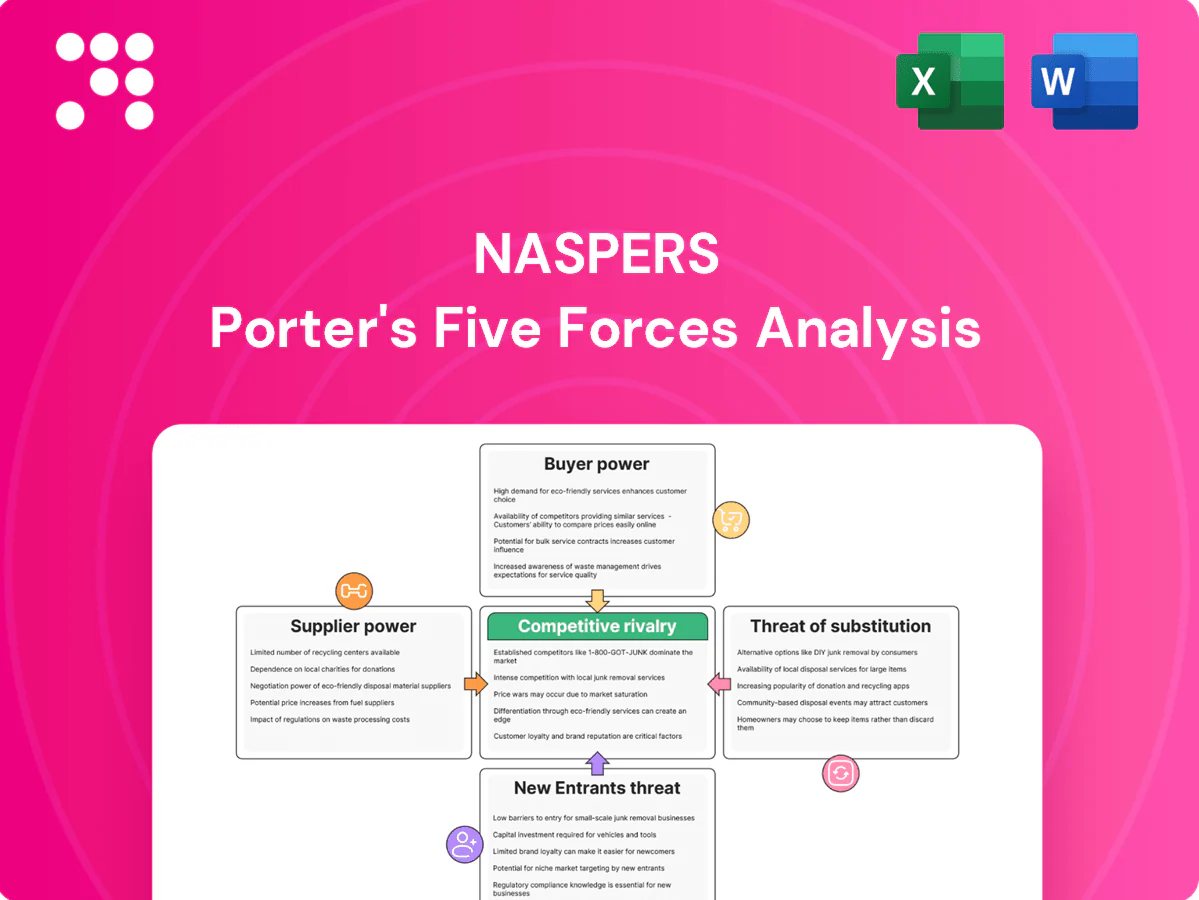
Naspers Porter's Five Forces Analysis

A Must-Have Tool for Decision-Makers
Naspers faces intense digital competition, high buyer expectations, and evolving substitute threats that pressure margins and growth. Supplier and platform partner leverage shape strategic options. New entrants and regulation add uncertainty to its ecosystem. This brief scratches the surface—unlock the full Porter's Five Forces Analysis for force-by-force ratings, visuals and actionable strategy.
Suppliers Bargaining Power

Platform gatekeepers
Platform gatekeepers — app stores, search engines and mobile OS ecosystems — can levy commissions (Apple/Google commissions range 15–30%, with 15% tiers for developers under $1M) and enact policy or ranking changes that squeeze distribution and margins. Review fee structures and guideline shifts regularly; diversify channels and build direct user relationships to reduce dependency. Progressive web apps and web acquisition can partially offset platform power by lowering install friction and reliance on store algorithms.
Cloud & infra vendors
Reliance on hyperscale cloud/CDN suppliers concentrates buying power — AWS (32.9%), Microsoft Azure (22.6%) and Google Cloud (10.1%) together dominated the 2024 market (Gartner), creating switching costs and risk of price escalation. Long‑term contracts can stabilize costs but limit flexibility. Multi‑cloud adoption (Flexera 2024: ~92% of enterprises) and edge optimizations improve leverage. Continuous cost engineering is required to protect unit economics.

Content & data sources
Third-party data, mapping, KYC/AML tools and ad-tech inputs are potential chokepoints for Naspers, as vendor consolidation or policy shifts can abruptly remove features or raise costs; building proprietary data assets and user-first KYC reduces exposure, while strategic partnerships with SLAs and diversified vendors ensure continuity and faster remediation in service disruptions.

Merchant & restaurant supply
In 2024 high-demand restaurants and vertical pros in classifieds exercised significant local clout, enabling fee negotiations and promotional terms, while selective exclusive partnerships raised supplier acquisition costs but increased demand density on Naspers platforms. Diversified merchant portfolios lowered overreliance on marquee suppliers, and enablement tools in 2024 improved supplier stickiness, reducing overall bargaining power.
- Local clout: restaurants negotiate fees
- Exclusives: higher costs, higher density
- Portfolio balance: lowers concentration risk
- Enablement tools: increase stickiness, cut bargaining power
Logistics & workforce
Courier fleets and third-party logistics partners largely determine Naspers’ last-mile service quality and cost exposure; the global 3PL market reached about $1.3 trillion in 2024. Tight labor markets and regulatory shifts elevate payout pressure for couriers and drivers. Investing in routing algorithms and stronger courier value propositions reduces unit costs and improves retention. Hybrid in-house/3PL models add resilience across cycles.
- 3PL market: $1.3T (2024)
- Routing tech: lowers unit costs
- Labor risk: wage/regulation exposure
- Hybrid model: flexibility & resilience
Moderate supplier power: app commissions, cloud concentration, 3PL last-mile risk
Suppliers exert moderate power: platform gatekeepers can take 15–30% commission (15% tier < $1M) and cloud providers concentrate share (AWS 32.9%, Azure 22.6%, GCP 10.1% in 2024). 3PLs operate in a $1.3T market (2024) and local merchants/couriers can negotiate fees. Diversification, proprietary data and hybrid logistics reduce supplier leverage.
| Supplier | 2024 metric | Impact |
|---|---|---|
| App stores | 15–30% commission | Distribution/margin pressure |
| Cloud | AWS 32.9%/Azure 22.6%/GCP 10.1% | Switching costs |
| 3PL | $1.3T market | Last‑mile pricing risk |
| Local merchants | High local clout | Fee negotiation |
What is included in the product
 Detailed Word Document
Provides a tailored Porter’s Five Forces overview for Naspers, identifying competitive rivalry, buyer and supplier leverage, threat of new entrants and substitutes, and regulatory/market risks; highlights disruptive digital rivals, platform dynamics, and strategic levers that shape pricing, margins and long‑term competitiveness.

 Customizable Excel Spreadsheet
A one-sheet Porter's Five Forces for Naspers—quickly visualize competitive pressure with an editable radar chart and customizable force levels, ready to drop into pitch decks or Excel dashboards.
Customers Bargaining Power

Low switching costs
Low switching costs let consumers and merchants multi-home across apps with minimal friction, amplified by price transparency and frequent promos that boost bargaining power; global smartphone users exceeded 6 billion in 2024, widening choice. Loyalty programs, subscriptions and superior UX trim churn. Differentiated selection and reliability let Naspers sustain pricing despite competitive pressure.
Price sensitivity
Fees, delivery charges and take-rates for Naspers platforms are highly visible to users, with marketplace take-rates in the sector running roughly 5–15% in 2024, shaping purchase decisions. Price elasticity drives promo intensity and can compress contribution margins by an estimated 5–12% on promotional periods. Dynamic pricing and segmentation protect yield, while bundles and wallets mute headline price sensitivity by shifting focus to net-of-discount value.

Network effects
Buyers gain value from denser supply and faster fulfillment, creating inertia that reduces churn; Prosus/Naspers portfolio reached c.1.3 billion users in 2024, amplifying this effect. Strong network effects across marketplaces and delivery platforms limit individual customer bargaining power. Early liquidity advantages in classifieds and delivery (millions of listings and orders monthly) secure market share. Continuous curation and platform matching keep the flywheel spinning.

Enterprise/SMB merchants
Larger enterprise merchants secure materially lower take-rates and preferred placement, while fragmented SMBs remain highly price- and ROI-sensitive; platform tooling and analytics in 2024 increased merchant reliance by enabling measurable lift in conversion and AOV. Long-term contracts and deep integrations progressively raise switching costs, concentrating negotiating power with high-volume accounts.
- Enterprises: negotiate lower take-rates, better placement
- SMBs: fragmented, ROI-sensitive
- Tooling/analytics: increases dependence
- Contracts/integrations: raise switching costs over time
Service quality expectations
Customers demand speed, reliability and payment safety; delivery or payment failures trigger rapid switching and negative reviews, putting heavy bargaining power on Naspers' platforms. Investing in trust, 24/7 support and recovery credits preserves loyalty and mitigates churn. Consistent SLAs and uptime guarantees reduce buyer leverage and stabilize margins.
- Service speed: delivery/payment expectations
- Reputation risk: fast switching, negative reviews
- Retention tools: trust, support, recovery credits
- SLA consistency: lowers customer bargaining power
>6bn phones vs c.1.3bn platform; take-rates 5–15%
Low switching costs and >6bn smartphone users in 2024 raise customer choice, but Naspers’ c.1.3bn users and network effects limit individual bargaining power. Visible take-rates (5–15% in 2024) and promo-driven margin compression (5–12%) amplify price sensitivity for SMBs. Large merchants secure lower fees and integrations, raising switching costs for high-volume accounts.
| Metric | 2024 |
|---|---|
| Smartphone users | >6 bn |
| Prosus/Naspers users | c.1.3 bn |
| Marketplace take-rates | 5–15% |
| Promo margin hit | 5–12% |
Preview the Actual Deliverable
Naspers Porter's Five Forces Analysis
This preview shows the exact Porter's Five Forces analysis of Naspers you'll receive—no placeholders or mockups. The file provides a professional, ready-to-use assessment of competitive rivalry, supplier and buyer power, threats of entry and substitutes, and strategic implications. After purchase you get this same document instantly for download.

A Must-Have Tool for Decision-Makers
Naspers faces intense digital competition, high buyer expectations, and evolving substitute threats that pressure margins and growth. Supplier and platform partner leverage shape strategic options. New entrants and regulation add uncertainty to its ecosystem. This brief scratches the surface—unlock the full Porter's Five Forces Analysis for force-by-force ratings, visuals and actionable strategy.
Suppliers Bargaining Power
Platform gatekeepers
Platform gatekeepers — app stores, search engines and mobile OS ecosystems — can levy commissions (Apple/Google commissions range 15–30%, with 15% tiers for developers under $1M) and enact policy or ranking changes that squeeze distribution and margins. Review fee structures and guideline shifts regularly; diversify channels and build direct user relationships to reduce dependency. Progressive web apps and web acquisition can partially offset platform power by lowering install friction and reliance on store algorithms.
Cloud & infra vendors
Reliance on hyperscale cloud/CDN suppliers concentrates buying power — AWS (32.9%), Microsoft Azure (22.6%) and Google Cloud (10.1%) together dominated the 2024 market (Gartner), creating switching costs and risk of price escalation. Long‑term contracts can stabilize costs but limit flexibility. Multi‑cloud adoption (Flexera 2024: ~92% of enterprises) and edge optimizations improve leverage. Continuous cost engineering is required to protect unit economics.
Content & data sources
Third-party data, mapping, KYC/AML tools and ad-tech inputs are potential chokepoints for Naspers, as vendor consolidation or policy shifts can abruptly remove features or raise costs; building proprietary data assets and user-first KYC reduces exposure, while strategic partnerships with SLAs and diversified vendors ensure continuity and faster remediation in service disruptions.
Merchant & restaurant supply
In 2024 high-demand restaurants and vertical pros in classifieds exercised significant local clout, enabling fee negotiations and promotional terms, while selective exclusive partnerships raised supplier acquisition costs but increased demand density on Naspers platforms. Diversified merchant portfolios lowered overreliance on marquee suppliers, and enablement tools in 2024 improved supplier stickiness, reducing overall bargaining power.
- Local clout: restaurants negotiate fees
- Exclusives: higher costs, higher density
- Portfolio balance: lowers concentration risk
- Enablement tools: increase stickiness, cut bargaining power
Logistics & workforce
Courier fleets and third-party logistics partners largely determine Naspers’ last-mile service quality and cost exposure; the global 3PL market reached about $1.3 trillion in 2024. Tight labor markets and regulatory shifts elevate payout pressure for couriers and drivers. Investing in routing algorithms and stronger courier value propositions reduces unit costs and improves retention. Hybrid in-house/3PL models add resilience across cycles.
- 3PL market: $1.3T (2024)
- Routing tech: lowers unit costs
- Labor risk: wage/regulation exposure
- Hybrid model: flexibility & resilience
Moderate supplier power: app commissions, cloud concentration, 3PL last-mile risk
Suppliers exert moderate power: platform gatekeepers can take 15–30% commission (15% tier < $1M) and cloud providers concentrate share (AWS 32.9%, Azure 22.6%, GCP 10.1% in 2024). 3PLs operate in a $1.3T market (2024) and local merchants/couriers can negotiate fees. Diversification, proprietary data and hybrid logistics reduce supplier leverage.
| Supplier | 2024 metric | Impact |
|---|---|---|
| App stores | 15–30% commission | Distribution/margin pressure |
| Cloud | AWS 32.9%/Azure 22.6%/GCP 10.1% | Switching costs |
| 3PL | $1.3T market | Last‑mile pricing risk |
| Local merchants | High local clout | Fee negotiation |
What is included in the product
Detailed Word Document
Provides a tailored Porter’s Five Forces overview for Naspers, identifying competitive rivalry, buyer and supplier leverage, threat of new entrants and substitutes, and regulatory/market risks; highlights disruptive digital rivals, platform dynamics, and strategic levers that shape pricing, margins and long‑term competitiveness.
Customizable Excel Spreadsheet
A one-sheet Porter's Five Forces for Naspers—quickly visualize competitive pressure with an editable radar chart and customizable force levels, ready to drop into pitch decks or Excel dashboards.
Customers Bargaining Power
Low switching costs
Low switching costs let consumers and merchants multi-home across apps with minimal friction, amplified by price transparency and frequent promos that boost bargaining power; global smartphone users exceeded 6 billion in 2024, widening choice. Loyalty programs, subscriptions and superior UX trim churn. Differentiated selection and reliability let Naspers sustain pricing despite competitive pressure.
Price sensitivity
Fees, delivery charges and take-rates for Naspers platforms are highly visible to users, with marketplace take-rates in the sector running roughly 5–15% in 2024, shaping purchase decisions. Price elasticity drives promo intensity and can compress contribution margins by an estimated 5–12% on promotional periods. Dynamic pricing and segmentation protect yield, while bundles and wallets mute headline price sensitivity by shifting focus to net-of-discount value.
Network effects
Buyers gain value from denser supply and faster fulfillment, creating inertia that reduces churn; Prosus/Naspers portfolio reached c.1.3 billion users in 2024, amplifying this effect. Strong network effects across marketplaces and delivery platforms limit individual customer bargaining power. Early liquidity advantages in classifieds and delivery (millions of listings and orders monthly) secure market share. Continuous curation and platform matching keep the flywheel spinning.
Enterprise/SMB merchants
Larger enterprise merchants secure materially lower take-rates and preferred placement, while fragmented SMBs remain highly price- and ROI-sensitive; platform tooling and analytics in 2024 increased merchant reliance by enabling measurable lift in conversion and AOV. Long-term contracts and deep integrations progressively raise switching costs, concentrating negotiating power with high-volume accounts.
- Enterprises: negotiate lower take-rates, better placement
- SMBs: fragmented, ROI-sensitive
- Tooling/analytics: increases dependence
- Contracts/integrations: raise switching costs over time
Service quality expectations
Customers demand speed, reliability and payment safety; delivery or payment failures trigger rapid switching and negative reviews, putting heavy bargaining power on Naspers' platforms. Investing in trust, 24/7 support and recovery credits preserves loyalty and mitigates churn. Consistent SLAs and uptime guarantees reduce buyer leverage and stabilize margins.
- Service speed: delivery/payment expectations
- Reputation risk: fast switching, negative reviews
- Retention tools: trust, support, recovery credits
- SLA consistency: lowers customer bargaining power
>6bn phones vs c.1.3bn platform; take-rates 5–15%
Low switching costs and >6bn smartphone users in 2024 raise customer choice, but Naspers’ c.1.3bn users and network effects limit individual bargaining power. Visible take-rates (5–15% in 2024) and promo-driven margin compression (5–12%) amplify price sensitivity for SMBs. Large merchants secure lower fees and integrations, raising switching costs for high-volume accounts.
| Metric | 2024 |
|---|---|
| Smartphone users | >6 bn |
| Prosus/Naspers users | c.1.3 bn |
| Marketplace take-rates | 5–15% |
| Promo margin hit | 5–12% |
Preview the Actual Deliverable
Naspers Porter's Five Forces Analysis
This preview shows the exact Porter's Five Forces analysis of Naspers you'll receive—no placeholders or mockups. The file provides a professional, ready-to-use assessment of competitive rivalry, supplier and buyer power, threats of entry and substitutes, and strategic implications. After purchase you get this same document instantly for download.
Original: $10.00
-65%$10.00
$3.50Description
A Must-Have Tool for Decision-Makers
Naspers faces intense digital competition, high buyer expectations, and evolving substitute threats that pressure margins and growth. Supplier and platform partner leverage shape strategic options. New entrants and regulation add uncertainty to its ecosystem. This brief scratches the surface—unlock the full Porter's Five Forces Analysis for force-by-force ratings, visuals and actionable strategy.
Suppliers Bargaining Power
Platform gatekeepers
Platform gatekeepers — app stores, search engines and mobile OS ecosystems — can levy commissions (Apple/Google commissions range 15–30%, with 15% tiers for developers under $1M) and enact policy or ranking changes that squeeze distribution and margins. Review fee structures and guideline shifts regularly; diversify channels and build direct user relationships to reduce dependency. Progressive web apps and web acquisition can partially offset platform power by lowering install friction and reliance on store algorithms.
Cloud & infra vendors
Reliance on hyperscale cloud/CDN suppliers concentrates buying power — AWS (32.9%), Microsoft Azure (22.6%) and Google Cloud (10.1%) together dominated the 2024 market (Gartner), creating switching costs and risk of price escalation. Long‑term contracts can stabilize costs but limit flexibility. Multi‑cloud adoption (Flexera 2024: ~92% of enterprises) and edge optimizations improve leverage. Continuous cost engineering is required to protect unit economics.
Content & data sources
Third-party data, mapping, KYC/AML tools and ad-tech inputs are potential chokepoints for Naspers, as vendor consolidation or policy shifts can abruptly remove features or raise costs; building proprietary data assets and user-first KYC reduces exposure, while strategic partnerships with SLAs and diversified vendors ensure continuity and faster remediation in service disruptions.
Merchant & restaurant supply
In 2024 high-demand restaurants and vertical pros in classifieds exercised significant local clout, enabling fee negotiations and promotional terms, while selective exclusive partnerships raised supplier acquisition costs but increased demand density on Naspers platforms. Diversified merchant portfolios lowered overreliance on marquee suppliers, and enablement tools in 2024 improved supplier stickiness, reducing overall bargaining power.
- Local clout: restaurants negotiate fees
- Exclusives: higher costs, higher density
- Portfolio balance: lowers concentration risk
- Enablement tools: increase stickiness, cut bargaining power
Logistics & workforce
Courier fleets and third-party logistics partners largely determine Naspers’ last-mile service quality and cost exposure; the global 3PL market reached about $1.3 trillion in 2024. Tight labor markets and regulatory shifts elevate payout pressure for couriers and drivers. Investing in routing algorithms and stronger courier value propositions reduces unit costs and improves retention. Hybrid in-house/3PL models add resilience across cycles.
- 3PL market: $1.3T (2024)
- Routing tech: lowers unit costs
- Labor risk: wage/regulation exposure
- Hybrid model: flexibility & resilience
Moderate supplier power: app commissions, cloud concentration, 3PL last-mile risk
Suppliers exert moderate power: platform gatekeepers can take 15–30% commission (15% tier < $1M) and cloud providers concentrate share (AWS 32.9%, Azure 22.6%, GCP 10.1% in 2024). 3PLs operate in a $1.3T market (2024) and local merchants/couriers can negotiate fees. Diversification, proprietary data and hybrid logistics reduce supplier leverage.
| Supplier | 2024 metric | Impact |
|---|---|---|
| App stores | 15–30% commission | Distribution/margin pressure |
| Cloud | AWS 32.9%/Azure 22.6%/GCP 10.1% | Switching costs |
| 3PL | $1.3T market | Last‑mile pricing risk |
| Local merchants | High local clout | Fee negotiation |
What is included in the product
Detailed Word Document
Provides a tailored Porter’s Five Forces overview for Naspers, identifying competitive rivalry, buyer and supplier leverage, threat of new entrants and substitutes, and regulatory/market risks; highlights disruptive digital rivals, platform dynamics, and strategic levers that shape pricing, margins and long‑term competitiveness.
Customizable Excel Spreadsheet
A one-sheet Porter's Five Forces for Naspers—quickly visualize competitive pressure with an editable radar chart and customizable force levels, ready to drop into pitch decks or Excel dashboards.
Customers Bargaining Power
Low switching costs
Low switching costs let consumers and merchants multi-home across apps with minimal friction, amplified by price transparency and frequent promos that boost bargaining power; global smartphone users exceeded 6 billion in 2024, widening choice. Loyalty programs, subscriptions and superior UX trim churn. Differentiated selection and reliability let Naspers sustain pricing despite competitive pressure.
Price sensitivity
Fees, delivery charges and take-rates for Naspers platforms are highly visible to users, with marketplace take-rates in the sector running roughly 5–15% in 2024, shaping purchase decisions. Price elasticity drives promo intensity and can compress contribution margins by an estimated 5–12% on promotional periods. Dynamic pricing and segmentation protect yield, while bundles and wallets mute headline price sensitivity by shifting focus to net-of-discount value.
Network effects
Buyers gain value from denser supply and faster fulfillment, creating inertia that reduces churn; Prosus/Naspers portfolio reached c.1.3 billion users in 2024, amplifying this effect. Strong network effects across marketplaces and delivery platforms limit individual customer bargaining power. Early liquidity advantages in classifieds and delivery (millions of listings and orders monthly) secure market share. Continuous curation and platform matching keep the flywheel spinning.
Enterprise/SMB merchants
Larger enterprise merchants secure materially lower take-rates and preferred placement, while fragmented SMBs remain highly price- and ROI-sensitive; platform tooling and analytics in 2024 increased merchant reliance by enabling measurable lift in conversion and AOV. Long-term contracts and deep integrations progressively raise switching costs, concentrating negotiating power with high-volume accounts.
- Enterprises: negotiate lower take-rates, better placement
- SMBs: fragmented, ROI-sensitive
- Tooling/analytics: increases dependence
- Contracts/integrations: raise switching costs over time
Service quality expectations
Customers demand speed, reliability and payment safety; delivery or payment failures trigger rapid switching and negative reviews, putting heavy bargaining power on Naspers' platforms. Investing in trust, 24/7 support and recovery credits preserves loyalty and mitigates churn. Consistent SLAs and uptime guarantees reduce buyer leverage and stabilize margins.
- Service speed: delivery/payment expectations
- Reputation risk: fast switching, negative reviews
- Retention tools: trust, support, recovery credits
- SLA consistency: lowers customer bargaining power
>6bn phones vs c.1.3bn platform; take-rates 5–15%
Low switching costs and >6bn smartphone users in 2024 raise customer choice, but Naspers’ c.1.3bn users and network effects limit individual bargaining power. Visible take-rates (5–15% in 2024) and promo-driven margin compression (5–12%) amplify price sensitivity for SMBs. Large merchants secure lower fees and integrations, raising switching costs for high-volume accounts.
| Metric | 2024 |
|---|---|
| Smartphone users | >6 bn |
| Prosus/Naspers users | c.1.3 bn |
| Marketplace take-rates | 5–15% |
| Promo margin hit | 5–12% |
Preview the Actual Deliverable
Naspers Porter's Five Forces Analysis
This preview shows the exact Porter's Five Forces analysis of Naspers you'll receive—no placeholders or mockups. The file provides a professional, ready-to-use assessment of competitive rivalry, supplier and buyer power, threats of entry and substitutes, and strategic implications. After purchase you get this same document instantly for download.











