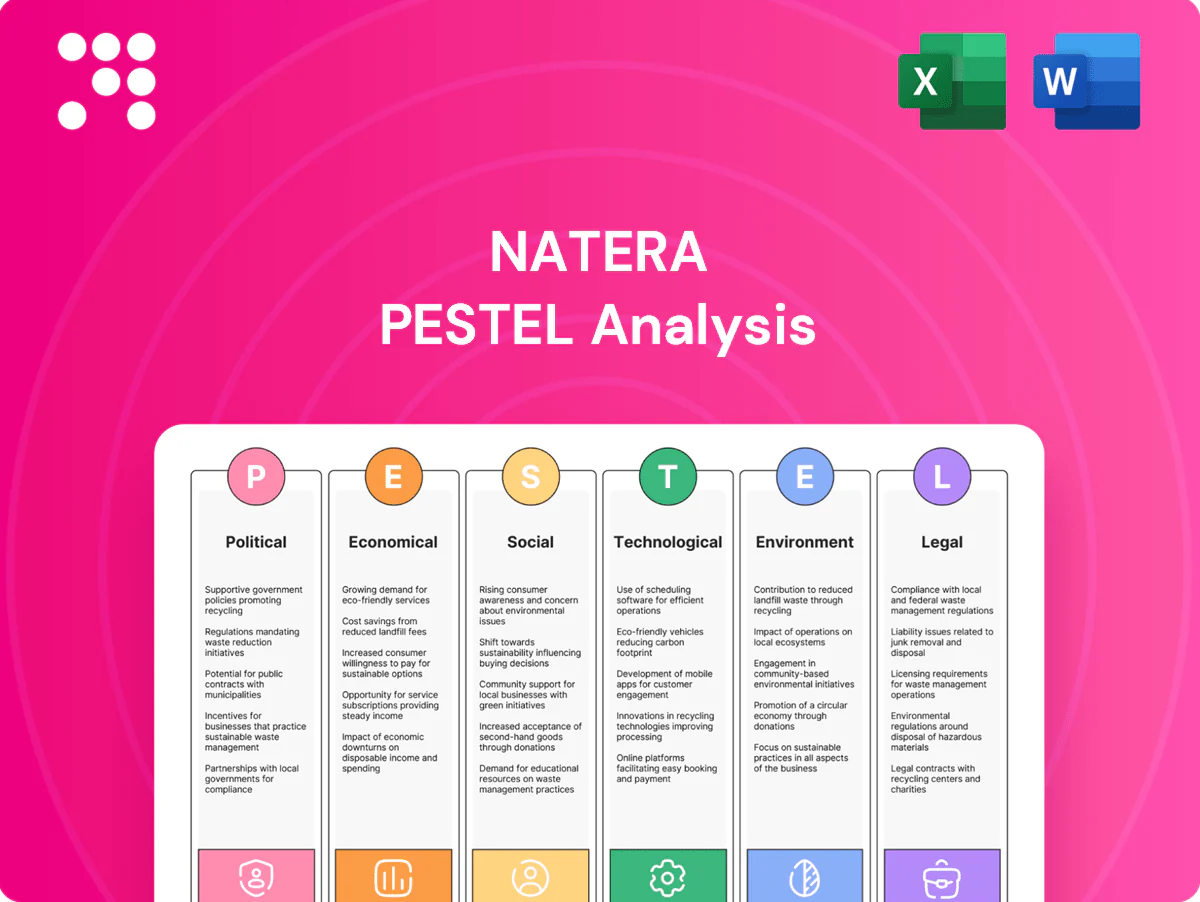
Natera PESTLE Analysis

Your Shortcut to Market Insight Starts Here
Our PESTLE Analysis of Natera reveals how political regulation, reimbursement pressures, and rapid biotech innovation converge to shape its strategic risks and opportunities. Ideal for investors and strategists, this concise briefing highlights actionable implications you can use today. Buy the full, editable PESTLE to access the complete, data-backed breakdown instantly.
Political factors

Healthcare reimbursement policy shifts
Public payers and national health systems set coverage criteria and reimbursement rates that determine test adoption and volumes; Medicare covers about 64 million beneficiaries (2024), so CMS decisions materially impact Natera prenatal, oncology MRD and transplant assay utilization. Policy emphasis on value‑based care favors tests with strong clinical utility and cost‑offset evidence. Active lobbying and inclusion in clinical guidelines shape long‑term political support and reimbursement stability.
FDA oversight of laboratory-developed tests
Heightened FDA regulation of laboratory-developed tests raises compliance burdens, longer review timelines, and greater evidence requirements, affecting Natera's product cadence; the US hosts over 10,000 LDTs, underscoring scale. Stricter oversight can raise barriers to entry while validating high-quality assays and deterring low-quality competitors. Transition policies and phased enforcement create near-term roadmap uncertainty. Proactive regulatory engagement becomes a strategic necessity.

State-level reproductive health policies
Varying state reproductive policies since Dobbs have reshaped demand and access pathways for NIPT, influencing referral volumes and payer coverage; Natera reported FY2024 revenue of ~1.0B, underscoring exposure to US policy shifts. Constraints in certain jurisdictions alter provider counseling and referral patterns, raising operational complexity across 50 states. Advocacy and neutral clinical positioning help mitigate polarization and sustain provider networks amid a NIPT market projected near 6.9B by 2027.

Government funding and public health priorities
Grants and public initiatives in cancer screening, precision medicine and transplant outcomes catalyze adoption; NIH funding near $49B and NCI ~$7.6B in FY2024 underpin biomarker and early-detection research. Prioritization of early detection supports cell-free DNA programs in oncology and women’s health, while austerity or reallocations can stall pilots and evidence generation. Partnerships with academic consortia align Natera with evolving national agendas.
- NIH ~$49B FY2024
- NCI ~$7.6B FY2024
- Early-detection priority boosts cfDNA adoption; budget cuts risk slowing pilots
Geopolitics and supply chain resilience
- Risk: tariffs up to 25%
- Mitigation: supplier diversification
- Opportunity: 52 billion USD CHIPS Act
Medicare, FDA and post-Dobbs rules reshape NIPT adoption; NIH, NCI and CHIPS fund R&D
Public payers (Medicare ~64M beneficiaries 2024) and CMS reimbursement drive test adoption; FDA scrutiny of LDTs raises evidence and compliance demands; state reproductive laws post‑Dobbs affect NIPT volumes (Natera FY2024 revenue ~1.0B); grants (NIH ~$49B, NCI ~$7.6B FY2024) and CHIPS $52B shape supply and R&D access.
| Item | Value |
|---|---|
| Medicare | ~64M (2024) |
| Natera rev | ~$1.0B FY2024 |
| NIH / NCI | $49B / $7.6B FY2024 |
| CHIPS Act | $52B |
What is included in the product
 Detailed Word Document
Provides a concise PESTLE assessment of how political, economic, social, technological, environmental, and legal forces uniquely impact Natera’s diagnostics and genomics business, with data-backed trends and forward-looking insights to inform strategy, risk mitigation, and investor communications.

 Customizable Excel Spreadsheet
A concise, visually segmented PESTLE summary for Natera that can be dropped into presentations or planning sessions, enabling quick alignment across teams and supporting discussions on external risks and market positioning.
Economic factors

Macroeconomic cycles and testing demand
Recessions tend to pressure elective and out-of-pocket genetic testing while reimbursed indications remain resilient, with Natera’s reimbursed services historically comprising the majority of revenue; hospital budget tightening can delay new test adoption or pilots, slowing sales cycles by months. Oncology and transplant monitoring demonstrate relative inelasticity, stabilizing the revenue mix, and clear ROI data—reduced readmission and avoided transplant costs—supports procurement even in downturns.
Payer mix and reimbursement rates
Revenue hinges on coverage determinations and contracted rates with public and private payers; the global genomics diagnostics market was estimated at about $22.2 billion in 2024, shaping payer leverage. Prior authorization and medical-necessity criteria materially constrain realized yield per test through denials and delays. Strengthening evidence dossiers has reduced denials in peers by double digits, expanding coverage. International price referencing can cut ex-US reimbursement 30–50%, affecting expansion economics.

Cost of capital and scaling
Rising US policy rates (federal funds about 5.25–5.50% through 2024–25) increases financing costs for Natera’s lab expansion, automation and trials, raising hurdle rates on new projects. Tight working capital is essential given long billing cycles and appeals in diagnostics. Economies of scale in sequencing and bioinformatics reduce unit costs as volumes grow, and strategic partnerships can offset capex via shared infrastructure.

Competitive pricing and market entry
Intense competition in NIPT and liquid biopsy in 2024 put downward pressure on list prices and margins, while Natera preserves pricing power through demonstrated clinical validity, utility, and faster TATs; bundled women’s health and oncology offerings help defend share, but international entrants in 2024 can reset price anchors in new markets.
- Pricing pressure: multiple entrants expanded in 2024
- Defenses: clinical validity, utility, turnaround time
- Strategy: bundled pathway offerings
- Risk: international price anchoring
Demographics and procedure volumes
Aging populations drive higher cancer incidence and transplant monitoring needs—global cancer cases projected to rise from 19.3M (2020) toward ~30.2M by 2040 (IARC), increasing demand for Natera’s oncology and cfDNA surveillance. Maternal age trends sustain prenatal screening volumes—US mean age at first birth reached 30 in 2020 (CDC). US organ transplants remain ~41,000/year (OPTN), with improving graft survival expanding longitudinal testing. Consolidation—≈60% of US hospitals in systems (AHA)—strengthens payer/provider contracting leverage and pushes test standardization.
- Aging → higher cancer & transplant testing demand
- Maternal age → sustained prenatal screening volumes
- ~41,000 US transplants/year → rising longitudinal monitoring
- ~60% hospitals in systems → greater contracting power, standardization
Medicare, FDA and post-Dobbs rules reshape NIPT adoption; NIH, NCI and CHIPS fund R&D
Reimbursed testing remains the revenue backbone while elective NIPT is recession-sensitive; global genomics market ~22.2B (2024) and payer coverage drives realized yield. Fed funds ~5.25–5.50% (2024–25) raises financing costs; economies of scale lower unit costs as volumes grow. Aging population and cancer rise (IARC → ~30.2M by 2040) boost long-term demand.
| Metric | 2024/25 |
|---|---|
| Genomics market | $22.2B (2024) |
| Fed funds | 5.25–5.50% |
| US transplants/year | ~41,000 |
What You See Is What You Get
Natera PESTLE Analysis
The preview shown here is the exact document you’ll receive after purchase—fully formatted and ready to use. This Natera PESTLE Analysis delivers clear political, economic, social, technological, legal, and environmental insights specific to Natera’s market position. No placeholders or teasers; it’s the final, professionally structured file ready to download immediately.

Your Shortcut to Market Insight Starts Here
Our PESTLE Analysis of Natera reveals how political regulation, reimbursement pressures, and rapid biotech innovation converge to shape its strategic risks and opportunities. Ideal for investors and strategists, this concise briefing highlights actionable implications you can use today. Buy the full, editable PESTLE to access the complete, data-backed breakdown instantly.
Political factors
Healthcare reimbursement policy shifts
Public payers and national health systems set coverage criteria and reimbursement rates that determine test adoption and volumes; Medicare covers about 64 million beneficiaries (2024), so CMS decisions materially impact Natera prenatal, oncology MRD and transplant assay utilization. Policy emphasis on value‑based care favors tests with strong clinical utility and cost‑offset evidence. Active lobbying and inclusion in clinical guidelines shape long‑term political support and reimbursement stability.
FDA oversight of laboratory-developed tests
Heightened FDA regulation of laboratory-developed tests raises compliance burdens, longer review timelines, and greater evidence requirements, affecting Natera's product cadence; the US hosts over 10,000 LDTs, underscoring scale. Stricter oversight can raise barriers to entry while validating high-quality assays and deterring low-quality competitors. Transition policies and phased enforcement create near-term roadmap uncertainty. Proactive regulatory engagement becomes a strategic necessity.
State-level reproductive health policies
Varying state reproductive policies since Dobbs have reshaped demand and access pathways for NIPT, influencing referral volumes and payer coverage; Natera reported FY2024 revenue of ~1.0B, underscoring exposure to US policy shifts. Constraints in certain jurisdictions alter provider counseling and referral patterns, raising operational complexity across 50 states. Advocacy and neutral clinical positioning help mitigate polarization and sustain provider networks amid a NIPT market projected near 6.9B by 2027.
Government funding and public health priorities
Grants and public initiatives in cancer screening, precision medicine and transplant outcomes catalyze adoption; NIH funding near $49B and NCI ~$7.6B in FY2024 underpin biomarker and early-detection research. Prioritization of early detection supports cell-free DNA programs in oncology and women’s health, while austerity or reallocations can stall pilots and evidence generation. Partnerships with academic consortia align Natera with evolving national agendas.
- NIH ~$49B FY2024
- NCI ~$7.6B FY2024
- Early-detection priority boosts cfDNA adoption; budget cuts risk slowing pilots
Geopolitics and supply chain resilience
- Risk: tariffs up to 25%
- Mitigation: supplier diversification
- Opportunity: 52 billion USD CHIPS Act
Medicare, FDA and post-Dobbs rules reshape NIPT adoption; NIH, NCI and CHIPS fund R&D
Public payers (Medicare ~64M beneficiaries 2024) and CMS reimbursement drive test adoption; FDA scrutiny of LDTs raises evidence and compliance demands; state reproductive laws post‑Dobbs affect NIPT volumes (Natera FY2024 revenue ~1.0B); grants (NIH ~$49B, NCI ~$7.6B FY2024) and CHIPS $52B shape supply and R&D access.
| Item | Value |
|---|---|
| Medicare | ~64M (2024) |
| Natera rev | ~$1.0B FY2024 |
| NIH / NCI | $49B / $7.6B FY2024 |
| CHIPS Act | $52B |
What is included in the product
Detailed Word Document
Provides a concise PESTLE assessment of how political, economic, social, technological, environmental, and legal forces uniquely impact Natera’s diagnostics and genomics business, with data-backed trends and forward-looking insights to inform strategy, risk mitigation, and investor communications.
Customizable Excel Spreadsheet
A concise, visually segmented PESTLE summary for Natera that can be dropped into presentations or planning sessions, enabling quick alignment across teams and supporting discussions on external risks and market positioning.
Economic factors
Macroeconomic cycles and testing demand
Recessions tend to pressure elective and out-of-pocket genetic testing while reimbursed indications remain resilient, with Natera’s reimbursed services historically comprising the majority of revenue; hospital budget tightening can delay new test adoption or pilots, slowing sales cycles by months. Oncology and transplant monitoring demonstrate relative inelasticity, stabilizing the revenue mix, and clear ROI data—reduced readmission and avoided transplant costs—supports procurement even in downturns.
Payer mix and reimbursement rates
Revenue hinges on coverage determinations and contracted rates with public and private payers; the global genomics diagnostics market was estimated at about $22.2 billion in 2024, shaping payer leverage. Prior authorization and medical-necessity criteria materially constrain realized yield per test through denials and delays. Strengthening evidence dossiers has reduced denials in peers by double digits, expanding coverage. International price referencing can cut ex-US reimbursement 30–50%, affecting expansion economics.
Cost of capital and scaling
Rising US policy rates (federal funds about 5.25–5.50% through 2024–25) increases financing costs for Natera’s lab expansion, automation and trials, raising hurdle rates on new projects. Tight working capital is essential given long billing cycles and appeals in diagnostics. Economies of scale in sequencing and bioinformatics reduce unit costs as volumes grow, and strategic partnerships can offset capex via shared infrastructure.
Competitive pricing and market entry
Intense competition in NIPT and liquid biopsy in 2024 put downward pressure on list prices and margins, while Natera preserves pricing power through demonstrated clinical validity, utility, and faster TATs; bundled women’s health and oncology offerings help defend share, but international entrants in 2024 can reset price anchors in new markets.
- Pricing pressure: multiple entrants expanded in 2024
- Defenses: clinical validity, utility, turnaround time
- Strategy: bundled pathway offerings
- Risk: international price anchoring
Demographics and procedure volumes
Aging populations drive higher cancer incidence and transplant monitoring needs—global cancer cases projected to rise from 19.3M (2020) toward ~30.2M by 2040 (IARC), increasing demand for Natera’s oncology and cfDNA surveillance. Maternal age trends sustain prenatal screening volumes—US mean age at first birth reached 30 in 2020 (CDC). US organ transplants remain ~41,000/year (OPTN), with improving graft survival expanding longitudinal testing. Consolidation—≈60% of US hospitals in systems (AHA)—strengthens payer/provider contracting leverage and pushes test standardization.
- Aging → higher cancer & transplant testing demand
- Maternal age → sustained prenatal screening volumes
- ~41,000 US transplants/year → rising longitudinal monitoring
- ~60% hospitals in systems → greater contracting power, standardization
Medicare, FDA and post-Dobbs rules reshape NIPT adoption; NIH, NCI and CHIPS fund R&D
Reimbursed testing remains the revenue backbone while elective NIPT is recession-sensitive; global genomics market ~22.2B (2024) and payer coverage drives realized yield. Fed funds ~5.25–5.50% (2024–25) raises financing costs; economies of scale lower unit costs as volumes grow. Aging population and cancer rise (IARC → ~30.2M by 2040) boost long-term demand.
| Metric | 2024/25 |
|---|---|
| Genomics market | $22.2B (2024) |
| Fed funds | 5.25–5.50% |
| US transplants/year | ~41,000 |
What You See Is What You Get
Natera PESTLE Analysis
The preview shown here is the exact document you’ll receive after purchase—fully formatted and ready to use. This Natera PESTLE Analysis delivers clear political, economic, social, technological, legal, and environmental insights specific to Natera’s market position. No placeholders or teasers; it’s the final, professionally structured file ready to download immediately.
Description
Your Shortcut to Market Insight Starts Here
Our PESTLE Analysis of Natera reveals how political regulation, reimbursement pressures, and rapid biotech innovation converge to shape its strategic risks and opportunities. Ideal for investors and strategists, this concise briefing highlights actionable implications you can use today. Buy the full, editable PESTLE to access the complete, data-backed breakdown instantly.
Political factors
Healthcare reimbursement policy shifts
Public payers and national health systems set coverage criteria and reimbursement rates that determine test adoption and volumes; Medicare covers about 64 million beneficiaries (2024), so CMS decisions materially impact Natera prenatal, oncology MRD and transplant assay utilization. Policy emphasis on value‑based care favors tests with strong clinical utility and cost‑offset evidence. Active lobbying and inclusion in clinical guidelines shape long‑term political support and reimbursement stability.
FDA oversight of laboratory-developed tests
Heightened FDA regulation of laboratory-developed tests raises compliance burdens, longer review timelines, and greater evidence requirements, affecting Natera's product cadence; the US hosts over 10,000 LDTs, underscoring scale. Stricter oversight can raise barriers to entry while validating high-quality assays and deterring low-quality competitors. Transition policies and phased enforcement create near-term roadmap uncertainty. Proactive regulatory engagement becomes a strategic necessity.
State-level reproductive health policies
Varying state reproductive policies since Dobbs have reshaped demand and access pathways for NIPT, influencing referral volumes and payer coverage; Natera reported FY2024 revenue of ~1.0B, underscoring exposure to US policy shifts. Constraints in certain jurisdictions alter provider counseling and referral patterns, raising operational complexity across 50 states. Advocacy and neutral clinical positioning help mitigate polarization and sustain provider networks amid a NIPT market projected near 6.9B by 2027.
Government funding and public health priorities
Grants and public initiatives in cancer screening, precision medicine and transplant outcomes catalyze adoption; NIH funding near $49B and NCI ~$7.6B in FY2024 underpin biomarker and early-detection research. Prioritization of early detection supports cell-free DNA programs in oncology and women’s health, while austerity or reallocations can stall pilots and evidence generation. Partnerships with academic consortia align Natera with evolving national agendas.
- NIH ~$49B FY2024
- NCI ~$7.6B FY2024
- Early-detection priority boosts cfDNA adoption; budget cuts risk slowing pilots
Geopolitics and supply chain resilience
- Risk: tariffs up to 25%
- Mitigation: supplier diversification
- Opportunity: 52 billion USD CHIPS Act
Medicare, FDA and post-Dobbs rules reshape NIPT adoption; NIH, NCI and CHIPS fund R&D
Public payers (Medicare ~64M beneficiaries 2024) and CMS reimbursement drive test adoption; FDA scrutiny of LDTs raises evidence and compliance demands; state reproductive laws post‑Dobbs affect NIPT volumes (Natera FY2024 revenue ~1.0B); grants (NIH ~$49B, NCI ~$7.6B FY2024) and CHIPS $52B shape supply and R&D access.
| Item | Value |
|---|---|
| Medicare | ~64M (2024) |
| Natera rev | ~$1.0B FY2024 |
| NIH / NCI | $49B / $7.6B FY2024 |
| CHIPS Act | $52B |
What is included in the product
Detailed Word Document
Provides a concise PESTLE assessment of how political, economic, social, technological, environmental, and legal forces uniquely impact Natera’s diagnostics and genomics business, with data-backed trends and forward-looking insights to inform strategy, risk mitigation, and investor communications.
Customizable Excel Spreadsheet
A concise, visually segmented PESTLE summary for Natera that can be dropped into presentations or planning sessions, enabling quick alignment across teams and supporting discussions on external risks and market positioning.
Economic factors
Macroeconomic cycles and testing demand
Recessions tend to pressure elective and out-of-pocket genetic testing while reimbursed indications remain resilient, with Natera’s reimbursed services historically comprising the majority of revenue; hospital budget tightening can delay new test adoption or pilots, slowing sales cycles by months. Oncology and transplant monitoring demonstrate relative inelasticity, stabilizing the revenue mix, and clear ROI data—reduced readmission and avoided transplant costs—supports procurement even in downturns.
Payer mix and reimbursement rates
Revenue hinges on coverage determinations and contracted rates with public and private payers; the global genomics diagnostics market was estimated at about $22.2 billion in 2024, shaping payer leverage. Prior authorization and medical-necessity criteria materially constrain realized yield per test through denials and delays. Strengthening evidence dossiers has reduced denials in peers by double digits, expanding coverage. International price referencing can cut ex-US reimbursement 30–50%, affecting expansion economics.
Cost of capital and scaling
Rising US policy rates (federal funds about 5.25–5.50% through 2024–25) increases financing costs for Natera’s lab expansion, automation and trials, raising hurdle rates on new projects. Tight working capital is essential given long billing cycles and appeals in diagnostics. Economies of scale in sequencing and bioinformatics reduce unit costs as volumes grow, and strategic partnerships can offset capex via shared infrastructure.
Competitive pricing and market entry
Intense competition in NIPT and liquid biopsy in 2024 put downward pressure on list prices and margins, while Natera preserves pricing power through demonstrated clinical validity, utility, and faster TATs; bundled women’s health and oncology offerings help defend share, but international entrants in 2024 can reset price anchors in new markets.
- Pricing pressure: multiple entrants expanded in 2024
- Defenses: clinical validity, utility, turnaround time
- Strategy: bundled pathway offerings
- Risk: international price anchoring
Demographics and procedure volumes
Aging populations drive higher cancer incidence and transplant monitoring needs—global cancer cases projected to rise from 19.3M (2020) toward ~30.2M by 2040 (IARC), increasing demand for Natera’s oncology and cfDNA surveillance. Maternal age trends sustain prenatal screening volumes—US mean age at first birth reached 30 in 2020 (CDC). US organ transplants remain ~41,000/year (OPTN), with improving graft survival expanding longitudinal testing. Consolidation—≈60% of US hospitals in systems (AHA)—strengthens payer/provider contracting leverage and pushes test standardization.
- Aging → higher cancer & transplant testing demand
- Maternal age → sustained prenatal screening volumes
- ~41,000 US transplants/year → rising longitudinal monitoring
- ~60% hospitals in systems → greater contracting power, standardization
Medicare, FDA and post-Dobbs rules reshape NIPT adoption; NIH, NCI and CHIPS fund R&D
Reimbursed testing remains the revenue backbone while elective NIPT is recession-sensitive; global genomics market ~22.2B (2024) and payer coverage drives realized yield. Fed funds ~5.25–5.50% (2024–25) raises financing costs; economies of scale lower unit costs as volumes grow. Aging population and cancer rise (IARC → ~30.2M by 2040) boost long-term demand.
| Metric | 2024/25 |
|---|---|
| Genomics market | $22.2B (2024) |
| Fed funds | 5.25–5.50% |
| US transplants/year | ~41,000 |
What You See Is What You Get
Natera PESTLE Analysis
The preview shown here is the exact document you’ll receive after purchase—fully formatted and ready to use. This Natera PESTLE Analysis delivers clear political, economic, social, technological, legal, and environmental insights specific to Natera’s market position. No placeholders or teasers; it’s the final, professionally structured file ready to download immediately.











