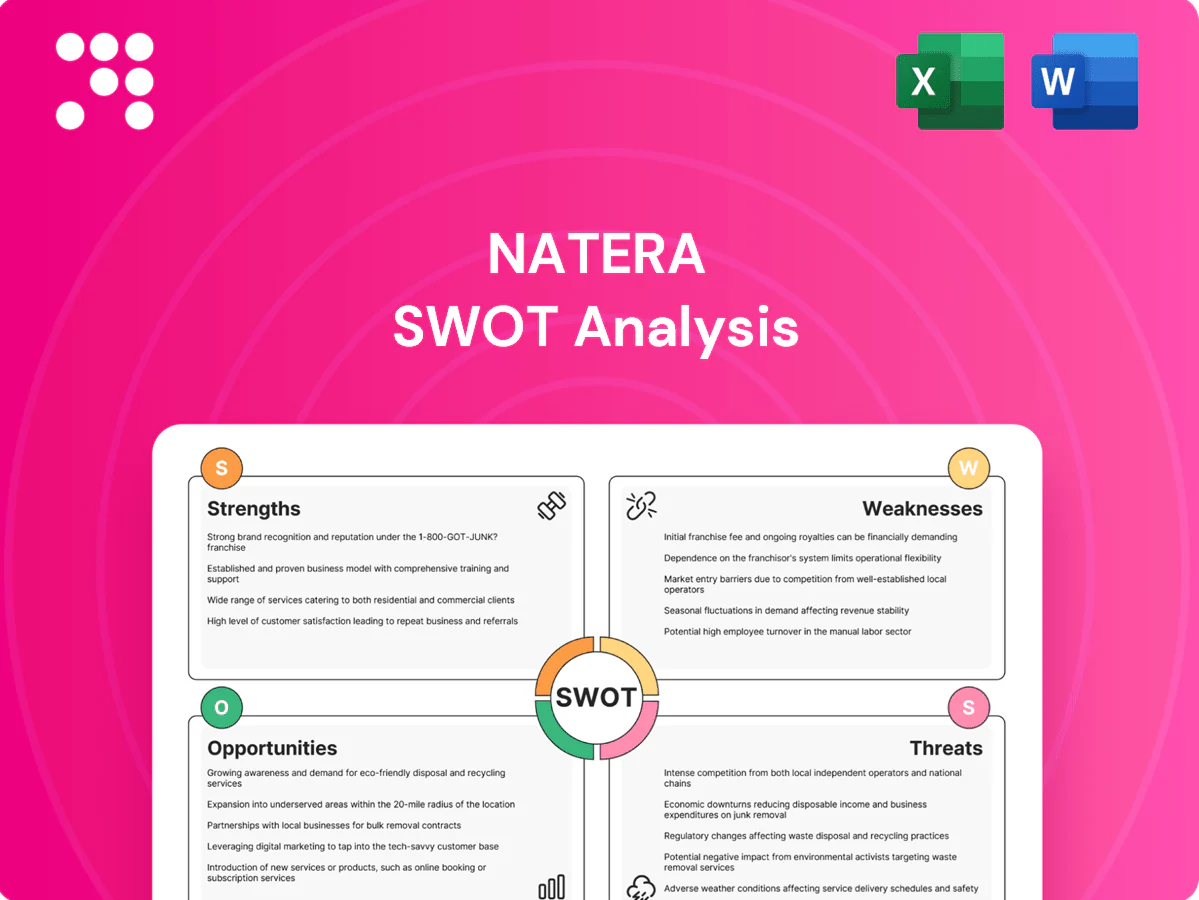
Natera SWOT Analysis

Dive Deeper Into the Company’s Strategic Blueprint
Natera’s SWOT highlights strengths in proprietary genetic testing and growing lab infrastructure, balanced by reimbursement pressures and competitive diagnostics markets. Key opportunities include global expansion and partnerships, while regulatory shifts and rivals pose clear threats. Purchase the full SWOT to get a research-backed, editable Word and Excel report for strategy or investment decisions.
Strengths

Leadership in cfDNA testing
Natera's first-mover status in cfDNA testing—millions of prenatal Panorama tests and broad Signatera MRD and Prospera transplant use—drives strong brand recognition and physician familiarity. High sample volumes enhance assay performance through learning curves and data scale. CLIA/CAP-validated workflows and centralized labs enable consistent turnaround times. This entrenched leadership creates tangible switching costs for clinicians and biopharma partners.
Diverse portfolio across three verticals
Diverse portfolio across women’s health, oncology and organ health drives multiple revenue streams with differing cycles; Natera reported over $600 million in revenue in 2024, underscoring scale. Cross-vertical tech and lab synergies lower unit costs and accelerate assay development. Portfolio balance cushions reimbursement or volume swings and enables bundled offerings and deeper provider partnerships.

Strong clinical evidence and publications
Peer-reviewed studies and real-world evidence underpin Natera tests' sensitivity, specificity and demonstrated clinical utility across oncology and prenatal applications.
This evidence base has supported payer coverage decisions and inclusion in clinical guidelines for select indications.
Robust clinical data enable pharma partnerships for therapy monitoring and trial enrichment, attracting CRO and sponsor collaboration.
Continuous publication cadence across journals sustains credibility and competitive differentiation.

Growing reimbursement footprint
Expanding Medicare and commercial coverage for Natera tests has increased provider adoption and improved price realization by lowering patient cost barriers and enabling broader use in oncology and prenatal care.
Clear coding and contracted rates have streamlined billing, reducing denials and accelerating cash collection, while wider coverage gives more predictable demand for lab capacity and supply chain planning.
- Reduced patient OOP improves uptake
- Contracted rates boost billing efficiency
- Coding clarity lowers claim denials
- Broader coverage aids capacity planning
Scalable lab and bioinformatics platform
Scalable centralized lab and bioinformatics platform (NTRA) drives lower per-test costs as throughput increases, with proprietary algorithms and pipelines enhancing detection limits and error correction to support expanded clinical sensitivity across assays. Platform reuse accelerates launches into adjacent indications, reinforcing a scale-based competitive moat and potential margin expansion.
- Centralized high-throughput processing
- Proprietary algorithmic accuracy
- Rapid assay rollouts
- Scale-driven margin upside
cfDNA pioneer: millions of tests and >$600M 2024 revenue, expanding payer coverage
Natera's first-mover cfDNA leadership and millions of Panorama/Signatera/Prospera tests drive strong clinician trust and data-scale advantages. A diversified women’s health, oncology and transplant portfolio generated >$600M revenue in 2024, reducing cyclical risk and enabling cross-vertical synergies. Robust peer-reviewed evidence and expanding Medicare/commercial coverage, plus a centralized NTRA lab platform, support reimbursement, margins and partnership pull.
| Metric | Value |
|---|---|
| 2024 Revenue | >$600M |
| Panorama/Signatera/Prospera volume | Millions of tests |
| Payer coverage | Growing Medicare & commercial |
| Platform | Centralized NTRA high-throughput labs |
What is included in the product
 Detailed Word Document
Provides a concise SWOT analysis of Natera, highlighting internal strengths and weaknesses alongside external opportunities and threats that shape its competitive position and strategic outlook.

 Customizable Excel Spreadsheet
Provides a concise SWOT snapshot of Natera to quickly highlight competitive strengths, regulatory and reimbursement risks, and market opportunities in genetic testing, enabling faster strategy alignment and decision-making for executives and investors.
Weaknesses

High operating losses and cash burn
Rapid growth has driven heavy R&D, sales and lab investments that have pressured profitability and produced sustained operating losses and cash burn. Dependence on external financing or dwindling cash reserves raises financial risk if market conditions worsen. Margin improvement hinges on volume ramp and favorable payer mix shifts that may take multiple quarters to materialize. Prolonged negative free cash flow could heighten investor sensitivity and valuation pressure.
Reimbursement complexity and ASP pressure
Payer policies vary by indication, stage, and geography, creating billing friction that complicates Natera’s commercial rollout and reimbursement predictability.
Price compression risks rise as volumes scale or competitors discount, exerting downward pressure on ASPs and margins.
Prior authorization hurdles slow clinical adoption and add administrative cost and cycle time.
Revenue recognition can become lumpy due to appeals, denials, and delayed payments.

Concentration in LDT regulatory model
Reliance on the laboratory-developed test pathway leaves Natera vulnerable to regulatory shifts; FDA scrutiny since 2023 could force LDTs toward premarket review, a transition that often costs >$30–$100M and takes 2–5 years. Upgrading quality systems and running pivotal clinical studies can strain cash flow (Natera reported ~ $700M revenue in 2024 but continued operating losses). Regulatory uncertainty can slow provider uptake and payer coverage decisions, delaying revenue realization.

Litigation and IP dispute exposure
The genomics sector is highly litigious, and Natera faces patent and marketing-claim suits that drive unpredictable legal expenses and potential damages, creating earnings volatility. Such disputes consume management attention, can delay or derail partnerships and commercialization, and adverse rulings could restrict features or bar entry to specific markets. Litigation outcomes may force product changes or licensing costs that compress margins.
- Litigation risk: patent and marketing-claim suits
- Financial impact: legal costs and damage awards increase earnings volatility
- Strategic impact: management distraction and slowed partnerships
- Operational risk: adverse rulings can limit features/markets
Limited international penetration
Natera's revenue remains heavily concentrated in the U.S., leaving substantial global demand under‑tapped.
Expansion faces diverse regulatory and reimbursement regimes that slow rollouts and raise compliance costs.
Building local labs or partnerships raises capex and operational complexity, and delayed international scale limits geographic diversification benefits.
- Revenue skew: U.S. concentration
- Regulatory/reimbursement complexity
- Need for local labs/partners raises costs
- Slower global scale reduces diversification
Rapid-scale lab player: 2024 revenue $702M, ongoing cash burn and $30-$100M FDA risk
Rapid scale has driven heavy R&D/lab spend, producing sustained operating losses and cash burn; 2024 revenue ~$702M but negative operating cash flow. Reimbursement variability and prior auths slow adoption and create billing friction. Regulatory/LDT uncertainty and active litigation raise compliance costs and potential multi‑year, $30–$100M FDA transition risks.
| Metric | 2024 | Note |
|---|---|---|
| Revenue | $702M | Company report |
| FDA transition cost | $30–$100M | Industry estimate |
Same Document Delivered
Natera SWOT Analysis
This is the actual Natera SWOT analysis document you’ll receive upon purchase—no surprises, just professional quality. The preview below is taken directly from the full report and reflects the same structured, editable file delivered after checkout. Buy to unlock the complete, in-depth version ready for use in strategy or investment decisions.

Dive Deeper Into the Company’s Strategic Blueprint
Natera’s SWOT highlights strengths in proprietary genetic testing and growing lab infrastructure, balanced by reimbursement pressures and competitive diagnostics markets. Key opportunities include global expansion and partnerships, while regulatory shifts and rivals pose clear threats. Purchase the full SWOT to get a research-backed, editable Word and Excel report for strategy or investment decisions.
Strengths
Leadership in cfDNA testing
Natera's first-mover status in cfDNA testing—millions of prenatal Panorama tests and broad Signatera MRD and Prospera transplant use—drives strong brand recognition and physician familiarity. High sample volumes enhance assay performance through learning curves and data scale. CLIA/CAP-validated workflows and centralized labs enable consistent turnaround times. This entrenched leadership creates tangible switching costs for clinicians and biopharma partners.
Diverse portfolio across three verticals
Diverse portfolio across women’s health, oncology and organ health drives multiple revenue streams with differing cycles; Natera reported over $600 million in revenue in 2024, underscoring scale. Cross-vertical tech and lab synergies lower unit costs and accelerate assay development. Portfolio balance cushions reimbursement or volume swings and enables bundled offerings and deeper provider partnerships.
Strong clinical evidence and publications
Peer-reviewed studies and real-world evidence underpin Natera tests' sensitivity, specificity and demonstrated clinical utility across oncology and prenatal applications.
This evidence base has supported payer coverage decisions and inclusion in clinical guidelines for select indications.
Robust clinical data enable pharma partnerships for therapy monitoring and trial enrichment, attracting CRO and sponsor collaboration.
Continuous publication cadence across journals sustains credibility and competitive differentiation.
Growing reimbursement footprint
Expanding Medicare and commercial coverage for Natera tests has increased provider adoption and improved price realization by lowering patient cost barriers and enabling broader use in oncology and prenatal care.
Clear coding and contracted rates have streamlined billing, reducing denials and accelerating cash collection, while wider coverage gives more predictable demand for lab capacity and supply chain planning.
- Reduced patient OOP improves uptake
- Contracted rates boost billing efficiency
- Coding clarity lowers claim denials
- Broader coverage aids capacity planning
Scalable lab and bioinformatics platform
Scalable centralized lab and bioinformatics platform (NTRA) drives lower per-test costs as throughput increases, with proprietary algorithms and pipelines enhancing detection limits and error correction to support expanded clinical sensitivity across assays. Platform reuse accelerates launches into adjacent indications, reinforcing a scale-based competitive moat and potential margin expansion.
- Centralized high-throughput processing
- Proprietary algorithmic accuracy
- Rapid assay rollouts
- Scale-driven margin upside
cfDNA pioneer: millions of tests and >$600M 2024 revenue, expanding payer coverage
Natera's first-mover cfDNA leadership and millions of Panorama/Signatera/Prospera tests drive strong clinician trust and data-scale advantages. A diversified women’s health, oncology and transplant portfolio generated >$600M revenue in 2024, reducing cyclical risk and enabling cross-vertical synergies. Robust peer-reviewed evidence and expanding Medicare/commercial coverage, plus a centralized NTRA lab platform, support reimbursement, margins and partnership pull.
| Metric | Value |
|---|---|
| 2024 Revenue | >$600M |
| Panorama/Signatera/Prospera volume | Millions of tests |
| Payer coverage | Growing Medicare & commercial |
| Platform | Centralized NTRA high-throughput labs |
What is included in the product
Detailed Word Document
Provides a concise SWOT analysis of Natera, highlighting internal strengths and weaknesses alongside external opportunities and threats that shape its competitive position and strategic outlook.
Customizable Excel Spreadsheet
Provides a concise SWOT snapshot of Natera to quickly highlight competitive strengths, regulatory and reimbursement risks, and market opportunities in genetic testing, enabling faster strategy alignment and decision-making for executives and investors.
Weaknesses
High operating losses and cash burn
Rapid growth has driven heavy R&D, sales and lab investments that have pressured profitability and produced sustained operating losses and cash burn. Dependence on external financing or dwindling cash reserves raises financial risk if market conditions worsen. Margin improvement hinges on volume ramp and favorable payer mix shifts that may take multiple quarters to materialize. Prolonged negative free cash flow could heighten investor sensitivity and valuation pressure.
Reimbursement complexity and ASP pressure
Payer policies vary by indication, stage, and geography, creating billing friction that complicates Natera’s commercial rollout and reimbursement predictability.
Price compression risks rise as volumes scale or competitors discount, exerting downward pressure on ASPs and margins.
Prior authorization hurdles slow clinical adoption and add administrative cost and cycle time.
Revenue recognition can become lumpy due to appeals, denials, and delayed payments.
Concentration in LDT regulatory model
Reliance on the laboratory-developed test pathway leaves Natera vulnerable to regulatory shifts; FDA scrutiny since 2023 could force LDTs toward premarket review, a transition that often costs >$30–$100M and takes 2–5 years. Upgrading quality systems and running pivotal clinical studies can strain cash flow (Natera reported ~ $700M revenue in 2024 but continued operating losses). Regulatory uncertainty can slow provider uptake and payer coverage decisions, delaying revenue realization.
Litigation and IP dispute exposure
The genomics sector is highly litigious, and Natera faces patent and marketing-claim suits that drive unpredictable legal expenses and potential damages, creating earnings volatility. Such disputes consume management attention, can delay or derail partnerships and commercialization, and adverse rulings could restrict features or bar entry to specific markets. Litigation outcomes may force product changes or licensing costs that compress margins.
- Litigation risk: patent and marketing-claim suits
- Financial impact: legal costs and damage awards increase earnings volatility
- Strategic impact: management distraction and slowed partnerships
- Operational risk: adverse rulings can limit features/markets
Limited international penetration
Natera's revenue remains heavily concentrated in the U.S., leaving substantial global demand under‑tapped.
Expansion faces diverse regulatory and reimbursement regimes that slow rollouts and raise compliance costs.
Building local labs or partnerships raises capex and operational complexity, and delayed international scale limits geographic diversification benefits.
- Revenue skew: U.S. concentration
- Regulatory/reimbursement complexity
- Need for local labs/partners raises costs
- Slower global scale reduces diversification
Rapid-scale lab player: 2024 revenue $702M, ongoing cash burn and $30-$100M FDA risk
Rapid scale has driven heavy R&D/lab spend, producing sustained operating losses and cash burn; 2024 revenue ~$702M but negative operating cash flow. Reimbursement variability and prior auths slow adoption and create billing friction. Regulatory/LDT uncertainty and active litigation raise compliance costs and potential multi‑year, $30–$100M FDA transition risks.
| Metric | 2024 | Note |
|---|---|---|
| Revenue | $702M | Company report |
| FDA transition cost | $30–$100M | Industry estimate |
Same Document Delivered
Natera SWOT Analysis
This is the actual Natera SWOT analysis document you’ll receive upon purchase—no surprises, just professional quality. The preview below is taken directly from the full report and reflects the same structured, editable file delivered after checkout. Buy to unlock the complete, in-depth version ready for use in strategy or investment decisions.
Description
Dive Deeper Into the Company’s Strategic Blueprint
Natera’s SWOT highlights strengths in proprietary genetic testing and growing lab infrastructure, balanced by reimbursement pressures and competitive diagnostics markets. Key opportunities include global expansion and partnerships, while regulatory shifts and rivals pose clear threats. Purchase the full SWOT to get a research-backed, editable Word and Excel report for strategy or investment decisions.
Strengths
Leadership in cfDNA testing
Natera's first-mover status in cfDNA testing—millions of prenatal Panorama tests and broad Signatera MRD and Prospera transplant use—drives strong brand recognition and physician familiarity. High sample volumes enhance assay performance through learning curves and data scale. CLIA/CAP-validated workflows and centralized labs enable consistent turnaround times. This entrenched leadership creates tangible switching costs for clinicians and biopharma partners.
Diverse portfolio across three verticals
Diverse portfolio across women’s health, oncology and organ health drives multiple revenue streams with differing cycles; Natera reported over $600 million in revenue in 2024, underscoring scale. Cross-vertical tech and lab synergies lower unit costs and accelerate assay development. Portfolio balance cushions reimbursement or volume swings and enables bundled offerings and deeper provider partnerships.
Strong clinical evidence and publications
Peer-reviewed studies and real-world evidence underpin Natera tests' sensitivity, specificity and demonstrated clinical utility across oncology and prenatal applications.
This evidence base has supported payer coverage decisions and inclusion in clinical guidelines for select indications.
Robust clinical data enable pharma partnerships for therapy monitoring and trial enrichment, attracting CRO and sponsor collaboration.
Continuous publication cadence across journals sustains credibility and competitive differentiation.
Growing reimbursement footprint
Expanding Medicare and commercial coverage for Natera tests has increased provider adoption and improved price realization by lowering patient cost barriers and enabling broader use in oncology and prenatal care.
Clear coding and contracted rates have streamlined billing, reducing denials and accelerating cash collection, while wider coverage gives more predictable demand for lab capacity and supply chain planning.
- Reduced patient OOP improves uptake
- Contracted rates boost billing efficiency
- Coding clarity lowers claim denials
- Broader coverage aids capacity planning
Scalable lab and bioinformatics platform
Scalable centralized lab and bioinformatics platform (NTRA) drives lower per-test costs as throughput increases, with proprietary algorithms and pipelines enhancing detection limits and error correction to support expanded clinical sensitivity across assays. Platform reuse accelerates launches into adjacent indications, reinforcing a scale-based competitive moat and potential margin expansion.
- Centralized high-throughput processing
- Proprietary algorithmic accuracy
- Rapid assay rollouts
- Scale-driven margin upside
cfDNA pioneer: millions of tests and >$600M 2024 revenue, expanding payer coverage
Natera's first-mover cfDNA leadership and millions of Panorama/Signatera/Prospera tests drive strong clinician trust and data-scale advantages. A diversified women’s health, oncology and transplant portfolio generated >$600M revenue in 2024, reducing cyclical risk and enabling cross-vertical synergies. Robust peer-reviewed evidence and expanding Medicare/commercial coverage, plus a centralized NTRA lab platform, support reimbursement, margins and partnership pull.
| Metric | Value |
|---|---|
| 2024 Revenue | >$600M |
| Panorama/Signatera/Prospera volume | Millions of tests |
| Payer coverage | Growing Medicare & commercial |
| Platform | Centralized NTRA high-throughput labs |
What is included in the product
Detailed Word Document
Provides a concise SWOT analysis of Natera, highlighting internal strengths and weaknesses alongside external opportunities and threats that shape its competitive position and strategic outlook.
Customizable Excel Spreadsheet
Provides a concise SWOT snapshot of Natera to quickly highlight competitive strengths, regulatory and reimbursement risks, and market opportunities in genetic testing, enabling faster strategy alignment and decision-making for executives and investors.
Weaknesses
High operating losses and cash burn
Rapid growth has driven heavy R&D, sales and lab investments that have pressured profitability and produced sustained operating losses and cash burn. Dependence on external financing or dwindling cash reserves raises financial risk if market conditions worsen. Margin improvement hinges on volume ramp and favorable payer mix shifts that may take multiple quarters to materialize. Prolonged negative free cash flow could heighten investor sensitivity and valuation pressure.
Reimbursement complexity and ASP pressure
Payer policies vary by indication, stage, and geography, creating billing friction that complicates Natera’s commercial rollout and reimbursement predictability.
Price compression risks rise as volumes scale or competitors discount, exerting downward pressure on ASPs and margins.
Prior authorization hurdles slow clinical adoption and add administrative cost and cycle time.
Revenue recognition can become lumpy due to appeals, denials, and delayed payments.
Concentration in LDT regulatory model
Reliance on the laboratory-developed test pathway leaves Natera vulnerable to regulatory shifts; FDA scrutiny since 2023 could force LDTs toward premarket review, a transition that often costs >$30–$100M and takes 2–5 years. Upgrading quality systems and running pivotal clinical studies can strain cash flow (Natera reported ~ $700M revenue in 2024 but continued operating losses). Regulatory uncertainty can slow provider uptake and payer coverage decisions, delaying revenue realization.
Litigation and IP dispute exposure
The genomics sector is highly litigious, and Natera faces patent and marketing-claim suits that drive unpredictable legal expenses and potential damages, creating earnings volatility. Such disputes consume management attention, can delay or derail partnerships and commercialization, and adverse rulings could restrict features or bar entry to specific markets. Litigation outcomes may force product changes or licensing costs that compress margins.
- Litigation risk: patent and marketing-claim suits
- Financial impact: legal costs and damage awards increase earnings volatility
- Strategic impact: management distraction and slowed partnerships
- Operational risk: adverse rulings can limit features/markets
Limited international penetration
Natera's revenue remains heavily concentrated in the U.S., leaving substantial global demand under‑tapped.
Expansion faces diverse regulatory and reimbursement regimes that slow rollouts and raise compliance costs.
Building local labs or partnerships raises capex and operational complexity, and delayed international scale limits geographic diversification benefits.
- Revenue skew: U.S. concentration
- Regulatory/reimbursement complexity
- Need for local labs/partners raises costs
- Slower global scale reduces diversification
Rapid-scale lab player: 2024 revenue $702M, ongoing cash burn and $30-$100M FDA risk
Rapid scale has driven heavy R&D/lab spend, producing sustained operating losses and cash burn; 2024 revenue ~$702M but negative operating cash flow. Reimbursement variability and prior auths slow adoption and create billing friction. Regulatory/LDT uncertainty and active litigation raise compliance costs and potential multi‑year, $30–$100M FDA transition risks.
| Metric | 2024 | Note |
|---|---|---|
| Revenue | $702M | Company report |
| FDA transition cost | $30–$100M | Industry estimate |
Same Document Delivered
Natera SWOT Analysis
This is the actual Natera SWOT analysis document you’ll receive upon purchase—no surprises, just professional quality. The preview below is taken directly from the full report and reflects the same structured, editable file delivered after checkout. Buy to unlock the complete, in-depth version ready for use in strategy or investment decisions.











