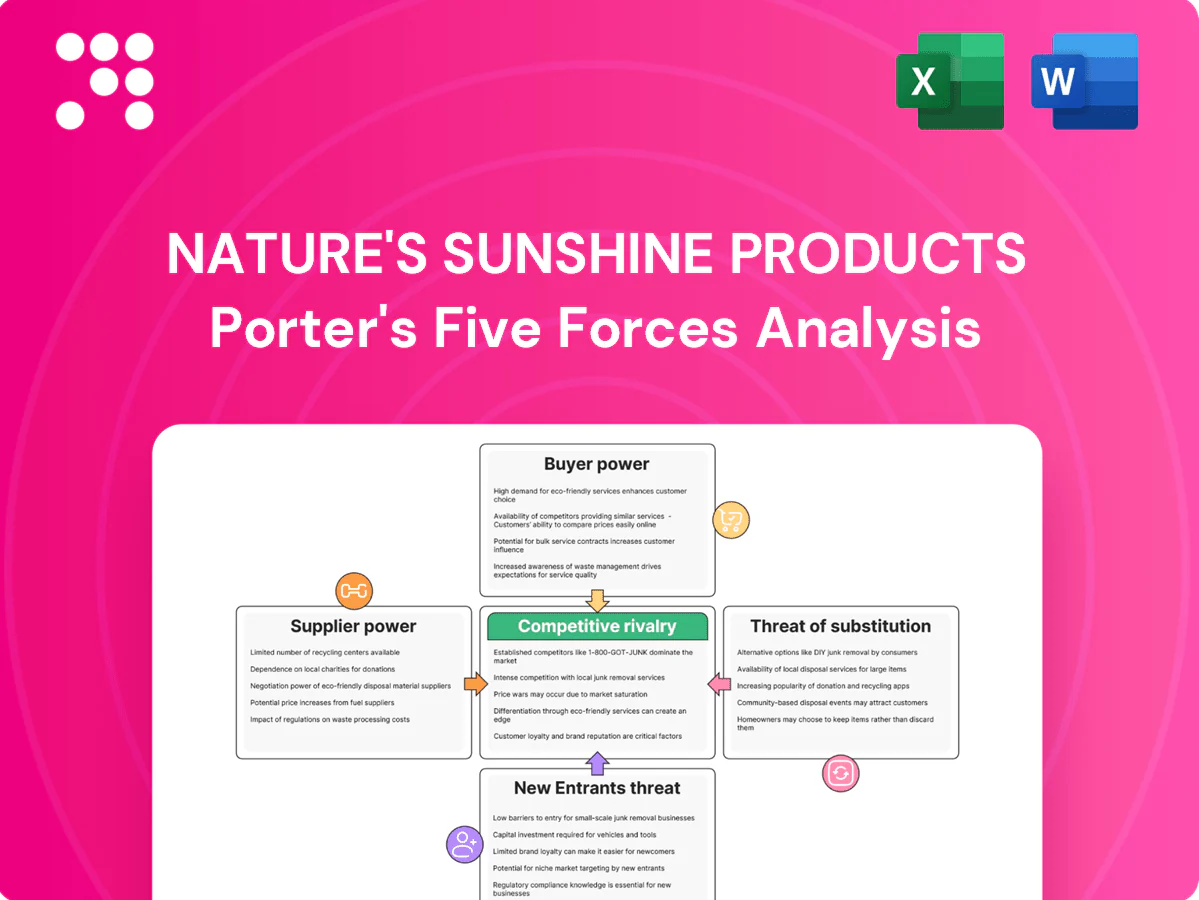
Nature's Sunshine Products Porter's Five Forces Analysis

Elevate Your Analysis with the Complete Porter's Five Forces Analysis
Nature's Sunshine Products faces moderate supplier power, niche buyer segments, threats from private-label substitutes and regulatory shifts that compress margins and demand strategic differentiation. Competitive rivalry is intensified by established herbal brands and e‑commerce entrants, while barriers to entry remain moderate. This snapshot only scratches the surface. Unlock the full Porter's Five Forces Analysis to explore force-by-force ratings, visuals, and actionable strategy.
Suppliers Bargaining Power

Diverse botanical inputs but niche herb reliance
NSP sources common vitamins and bulk botanicals from broad suppliers, but niche herbs tied to limited geographies and growers saw 2024 seasonal shortages that pushed some SKU prices up roughly 15–30%, increasing supplier leverage on those lines. Bulk commodities remain competitive with slim margins, while concentration in specialty inputs elevates risk for specific SKUs. Dual-sourcing and inventory buffers have reduced—but not eliminated—volatility.
Quality and compliance requirements raise switching costs
Strict cGMP (21 CFR part 111), rigorous testing and traceability requirements narrow the pool of qualified suppliers for Nature’s Sunshine, raising supplier bargaining power. Audits, validation, and potential reformulation introduce time and cost frictions that deter switching. Suppliers able to meet pharmacopeial standards (USP) secure stronger negotiating leverage, and any quality incident would heighten dependence on proven vendors.

Contract manufacturing and packaging capacity constraints
Specialized encapsulation, blending, and essential-oil handling demand certified contract partners with GMP/ISO credentials, concentrating supply among fewer qualified vendors and raising supplier leverage.
Tight capacity during demand spikes in 2024 allowed some contract manufacturers to extend lead times by weeks and seek premium pricing, squeezing margins for Nature's Sunshine.
Multi-year agreements can lock in capacity but create commitment risk if demand falls; in 2024 many supplement firms balanced this with flex capacity arrangements to reduce bargaining power of suppliers.

Currency and commodity price exposure
Herb, oil, and excipient prices move with harvest yields and FX; in 2024 global agricultural supply shocks and a roughly 5% year-to-date US dollar appreciation increased input cost pass-through risk, squeezing margins as suppliers can raise prices quickly. Hedging and forwards used by Nature's Sunshine can blunt spikes but lock in rates and limit sourcing agility, while global sourcing diversifies inputs at the cost of added logistics and tariff complexity.
- Price exposure: harvest-driven and FX-sensitive
- Margin risk: suppliers pass costs quickly
- Mitigation: hedges/forwards reduce volatility, reduce flexibility
- Sourcing: global diversification increases logistics complexity
ESG and sustainability premiums
Certified organic, fair‑trade and wildcrafted inputs often command premiums (commonly cited at ~20–30%), forcing Nature's Sunshine to pay up to preserve brand equity; limited certified supply concentrates supplier leverage over timing and contract terms. ESG claims require provenance documentation that only select suppliers can provide, strengthening supplier bargaining power and raising COGS pressure.
- premium-rate: ~20–30%
- supplier-leverage: limited certified supply
- ESG-docs: exclusive capability
- brand-cost: paying premiums raises supplier power
Supplier risk: niche herb SKUs 15–30% shocks; cert premium 20–30%; FX +5%, 2–4wk delays
Supplier power is moderate-high: niche herbs saw 2024 SKU price shocks of ~15–30% while bulk inputs stayed competitive. Regulatory cGMP/USP bars out many vendors, concentrating specialty inputs and certified organic supply (premium ~20–30%). FX (+~5% YTD) and 2–4 week lead‑time spikes in 2024 increased pass‑through risk despite dual‑sourcing and hedging.
| Metric | 2024 Value |
|---|---|
| SKU price shocks | 15–30% |
| USD movement YTD | +5% |
| Certified premium | 20–30% |
| Lead‑time spikes | 2–4 weeks |
What is included in the product
 Detailed Word Document
Tailored exclusively for Nature's Sunshine Products, this Porter's Five Forces overview uncovers key competitive drivers, supplier and buyer power, entry barriers, substitutes, and emerging disruptive threats shaping its pricing, profitability, and strategic positioning.

 Customizable Excel Spreadsheet
A concise one-sheet Porter's Five Forces for Nature's Sunshine that pinpoints supplier, buyer and competitive pressures to reveal strategic pain points and relief actions; easy to customize, copy into decks, and integrate into reports.
Customers Bargaining Power

Distributor network sensitivity to margin and incentives
Independent distributors for Nature's Sunshine routinely benchmark compensation against other direct sellers, and industry sensitivity means even 1–3% shifts in wholesale pricing or bonus rates can prompt churn among reps; this was evident in 2024 distributor turnover trends across the sector. Their power to steer end-customer demand gives them leverage in program design, while training programs and tight community ties partially offset switching.
End customers face low switching costs
End customers face low switching costs as vitamin and herbal SKUs are widely available across retail and e-commerce; the global dietary supplement market was about $178 billion in 2024 and e-commerce now represents roughly 25% of channels, making price, convenience and reviews enable easy brand substitution. Loyalty hinges on perceived quality, efficacy and service; autoship discounts cut churn materially (around 20%) but can be cancelled quickly.

High price transparency via online marketplaces
High price transparency on comparison sites and marketplaces exposes real-time pricing and promotions, intensifying implicit buyer negotiation through choice and cart abandonment, which averaged about 70% in 2024. Discounting pressure spikes during peak promotion windows with deals commonly reaching 20–40%, squeezing margins. For Nature's Sunshine, premium positioning therefore requires clear differentiators, clinical evidence and ongoing customer education to justify higher ASPs.

Demand fragmentation by health goals
Reputation and reviews amplify influence
User-generated reviews now swing purchase decisions fast; in 2024 social proof studies show online ratings shift demand and can cut price elasticity—high ratings lower price sensitivity while low ratings force discounts and promotions. Rapid product response and reformulation protect Nature's Sunshine's share as platforms amplify sentiment within days, turning reviews into direct negotiating leverage for buyers.
- Review influence: 2024 surveys report ~85% of buyers consult reviews before supplement purchases
- Price leverage: 높은 ratings reduce discounting needs, low ratings increase promotional spend
- Response time: reformulation/recall windows now measured in weeks to defend market share
Customers wield power: low switching costs, reviews drive demand; autoship cuts churn 20%
Customers hold strong bargaining power: low switching costs and wide SKU availability (global supplements $178B, e‑commerce ~25% in 2024) drive price sensitivity and high churn pressure; autoship cuts churn ~20% but is easily canceled. Distributor benchmarking means 1–3% margin shifts trigger rep churn risk. Reviews (≈85% consult in 2024) amplify immediate demand swings and force promotions.
| Metric | 2024 |
|---|---|
| Global market | $178B |
| US sales | >$60B |
| E‑commerce | ~25% |
| Cart abandonment | ~70% |
| Reviews consulted | ~85% |
Same Document Delivered
Nature's Sunshine Products Porter's Five Forces Analysis
The Porter's Five Forces analysis for Nature's Sunshine Products evaluates supplier and buyer power, threat of new entrants, substitutes, and competitive rivalry to assess industry profitability and strategic positioning. It highlights key pressures from retail consolidation, private-label supplements, regulatory scrutiny, and digital channel shifts. This preview shows the exact document you'll receive immediately after purchase—no surprises, no placeholders.

Elevate Your Analysis with the Complete Porter's Five Forces Analysis
Nature's Sunshine Products faces moderate supplier power, niche buyer segments, threats from private-label substitutes and regulatory shifts that compress margins and demand strategic differentiation. Competitive rivalry is intensified by established herbal brands and e‑commerce entrants, while barriers to entry remain moderate. This snapshot only scratches the surface. Unlock the full Porter's Five Forces Analysis to explore force-by-force ratings, visuals, and actionable strategy.
Suppliers Bargaining Power
Diverse botanical inputs but niche herb reliance
NSP sources common vitamins and bulk botanicals from broad suppliers, but niche herbs tied to limited geographies and growers saw 2024 seasonal shortages that pushed some SKU prices up roughly 15–30%, increasing supplier leverage on those lines. Bulk commodities remain competitive with slim margins, while concentration in specialty inputs elevates risk for specific SKUs. Dual-sourcing and inventory buffers have reduced—but not eliminated—volatility.
Quality and compliance requirements raise switching costs
Strict cGMP (21 CFR part 111), rigorous testing and traceability requirements narrow the pool of qualified suppliers for Nature’s Sunshine, raising supplier bargaining power. Audits, validation, and potential reformulation introduce time and cost frictions that deter switching. Suppliers able to meet pharmacopeial standards (USP) secure stronger negotiating leverage, and any quality incident would heighten dependence on proven vendors.
Contract manufacturing and packaging capacity constraints
Specialized encapsulation, blending, and essential-oil handling demand certified contract partners with GMP/ISO credentials, concentrating supply among fewer qualified vendors and raising supplier leverage.
Tight capacity during demand spikes in 2024 allowed some contract manufacturers to extend lead times by weeks and seek premium pricing, squeezing margins for Nature's Sunshine.
Multi-year agreements can lock in capacity but create commitment risk if demand falls; in 2024 many supplement firms balanced this with flex capacity arrangements to reduce bargaining power of suppliers.
Currency and commodity price exposure
Herb, oil, and excipient prices move with harvest yields and FX; in 2024 global agricultural supply shocks and a roughly 5% year-to-date US dollar appreciation increased input cost pass-through risk, squeezing margins as suppliers can raise prices quickly. Hedging and forwards used by Nature's Sunshine can blunt spikes but lock in rates and limit sourcing agility, while global sourcing diversifies inputs at the cost of added logistics and tariff complexity.
- Price exposure: harvest-driven and FX-sensitive
- Margin risk: suppliers pass costs quickly
- Mitigation: hedges/forwards reduce volatility, reduce flexibility
- Sourcing: global diversification increases logistics complexity
ESG and sustainability premiums
Certified organic, fair‑trade and wildcrafted inputs often command premiums (commonly cited at ~20–30%), forcing Nature's Sunshine to pay up to preserve brand equity; limited certified supply concentrates supplier leverage over timing and contract terms. ESG claims require provenance documentation that only select suppliers can provide, strengthening supplier bargaining power and raising COGS pressure.
- premium-rate: ~20–30%
- supplier-leverage: limited certified supply
- ESG-docs: exclusive capability
- brand-cost: paying premiums raises supplier power
Supplier risk: niche herb SKUs 15–30% shocks; cert premium 20–30%; FX +5%, 2–4wk delays
Supplier power is moderate-high: niche herbs saw 2024 SKU price shocks of ~15–30% while bulk inputs stayed competitive. Regulatory cGMP/USP bars out many vendors, concentrating specialty inputs and certified organic supply (premium ~20–30%). FX (+~5% YTD) and 2–4 week lead‑time spikes in 2024 increased pass‑through risk despite dual‑sourcing and hedging.
| Metric | 2024 Value |
|---|---|
| SKU price shocks | 15–30% |
| USD movement YTD | +5% |
| Certified premium | 20–30% |
| Lead‑time spikes | 2–4 weeks |
What is included in the product
Detailed Word Document
Tailored exclusively for Nature's Sunshine Products, this Porter's Five Forces overview uncovers key competitive drivers, supplier and buyer power, entry barriers, substitutes, and emerging disruptive threats shaping its pricing, profitability, and strategic positioning.
Customizable Excel Spreadsheet
A concise one-sheet Porter's Five Forces for Nature's Sunshine that pinpoints supplier, buyer and competitive pressures to reveal strategic pain points and relief actions; easy to customize, copy into decks, and integrate into reports.
Customers Bargaining Power
Distributor network sensitivity to margin and incentives
Independent distributors for Nature's Sunshine routinely benchmark compensation against other direct sellers, and industry sensitivity means even 1–3% shifts in wholesale pricing or bonus rates can prompt churn among reps; this was evident in 2024 distributor turnover trends across the sector. Their power to steer end-customer demand gives them leverage in program design, while training programs and tight community ties partially offset switching.
End customers face low switching costs
End customers face low switching costs as vitamin and herbal SKUs are widely available across retail and e-commerce; the global dietary supplement market was about $178 billion in 2024 and e-commerce now represents roughly 25% of channels, making price, convenience and reviews enable easy brand substitution. Loyalty hinges on perceived quality, efficacy and service; autoship discounts cut churn materially (around 20%) but can be cancelled quickly.
High price transparency via online marketplaces
High price transparency on comparison sites and marketplaces exposes real-time pricing and promotions, intensifying implicit buyer negotiation through choice and cart abandonment, which averaged about 70% in 2024. Discounting pressure spikes during peak promotion windows with deals commonly reaching 20–40%, squeezing margins. For Nature's Sunshine, premium positioning therefore requires clear differentiators, clinical evidence and ongoing customer education to justify higher ASPs.
Demand fragmentation by health goals
Reputation and reviews amplify influence
User-generated reviews now swing purchase decisions fast; in 2024 social proof studies show online ratings shift demand and can cut price elasticity—high ratings lower price sensitivity while low ratings force discounts and promotions. Rapid product response and reformulation protect Nature's Sunshine's share as platforms amplify sentiment within days, turning reviews into direct negotiating leverage for buyers.
- Review influence: 2024 surveys report ~85% of buyers consult reviews before supplement purchases
- Price leverage: 높은 ratings reduce discounting needs, low ratings increase promotional spend
- Response time: reformulation/recall windows now measured in weeks to defend market share
Customers wield power: low switching costs, reviews drive demand; autoship cuts churn 20%
Customers hold strong bargaining power: low switching costs and wide SKU availability (global supplements $178B, e‑commerce ~25% in 2024) drive price sensitivity and high churn pressure; autoship cuts churn ~20% but is easily canceled. Distributor benchmarking means 1–3% margin shifts trigger rep churn risk. Reviews (≈85% consult in 2024) amplify immediate demand swings and force promotions.
| Metric | 2024 |
|---|---|
| Global market | $178B |
| US sales | >$60B |
| E‑commerce | ~25% |
| Cart abandonment | ~70% |
| Reviews consulted | ~85% |
Same Document Delivered
Nature's Sunshine Products Porter's Five Forces Analysis
The Porter's Five Forces analysis for Nature's Sunshine Products evaluates supplier and buyer power, threat of new entrants, substitutes, and competitive rivalry to assess industry profitability and strategic positioning. It highlights key pressures from retail consolidation, private-label supplements, regulatory scrutiny, and digital channel shifts. This preview shows the exact document you'll receive immediately after purchase—no surprises, no placeholders.
Original: $10.00
-65%$10.00
$3.50Description
Elevate Your Analysis with the Complete Porter's Five Forces Analysis
Nature's Sunshine Products faces moderate supplier power, niche buyer segments, threats from private-label substitutes and regulatory shifts that compress margins and demand strategic differentiation. Competitive rivalry is intensified by established herbal brands and e‑commerce entrants, while barriers to entry remain moderate. This snapshot only scratches the surface. Unlock the full Porter's Five Forces Analysis to explore force-by-force ratings, visuals, and actionable strategy.
Suppliers Bargaining Power
Diverse botanical inputs but niche herb reliance
NSP sources common vitamins and bulk botanicals from broad suppliers, but niche herbs tied to limited geographies and growers saw 2024 seasonal shortages that pushed some SKU prices up roughly 15–30%, increasing supplier leverage on those lines. Bulk commodities remain competitive with slim margins, while concentration in specialty inputs elevates risk for specific SKUs. Dual-sourcing and inventory buffers have reduced—but not eliminated—volatility.
Quality and compliance requirements raise switching costs
Strict cGMP (21 CFR part 111), rigorous testing and traceability requirements narrow the pool of qualified suppliers for Nature’s Sunshine, raising supplier bargaining power. Audits, validation, and potential reformulation introduce time and cost frictions that deter switching. Suppliers able to meet pharmacopeial standards (USP) secure stronger negotiating leverage, and any quality incident would heighten dependence on proven vendors.
Contract manufacturing and packaging capacity constraints
Specialized encapsulation, blending, and essential-oil handling demand certified contract partners with GMP/ISO credentials, concentrating supply among fewer qualified vendors and raising supplier leverage.
Tight capacity during demand spikes in 2024 allowed some contract manufacturers to extend lead times by weeks and seek premium pricing, squeezing margins for Nature's Sunshine.
Multi-year agreements can lock in capacity but create commitment risk if demand falls; in 2024 many supplement firms balanced this with flex capacity arrangements to reduce bargaining power of suppliers.
Currency and commodity price exposure
Herb, oil, and excipient prices move with harvest yields and FX; in 2024 global agricultural supply shocks and a roughly 5% year-to-date US dollar appreciation increased input cost pass-through risk, squeezing margins as suppliers can raise prices quickly. Hedging and forwards used by Nature's Sunshine can blunt spikes but lock in rates and limit sourcing agility, while global sourcing diversifies inputs at the cost of added logistics and tariff complexity.
- Price exposure: harvest-driven and FX-sensitive
- Margin risk: suppliers pass costs quickly
- Mitigation: hedges/forwards reduce volatility, reduce flexibility
- Sourcing: global diversification increases logistics complexity
ESG and sustainability premiums
Certified organic, fair‑trade and wildcrafted inputs often command premiums (commonly cited at ~20–30%), forcing Nature's Sunshine to pay up to preserve brand equity; limited certified supply concentrates supplier leverage over timing and contract terms. ESG claims require provenance documentation that only select suppliers can provide, strengthening supplier bargaining power and raising COGS pressure.
- premium-rate: ~20–30%
- supplier-leverage: limited certified supply
- ESG-docs: exclusive capability
- brand-cost: paying premiums raises supplier power
Supplier risk: niche herb SKUs 15–30% shocks; cert premium 20–30%; FX +5%, 2–4wk delays
Supplier power is moderate-high: niche herbs saw 2024 SKU price shocks of ~15–30% while bulk inputs stayed competitive. Regulatory cGMP/USP bars out many vendors, concentrating specialty inputs and certified organic supply (premium ~20–30%). FX (+~5% YTD) and 2–4 week lead‑time spikes in 2024 increased pass‑through risk despite dual‑sourcing and hedging.
| Metric | 2024 Value |
|---|---|
| SKU price shocks | 15–30% |
| USD movement YTD | +5% |
| Certified premium | 20–30% |
| Lead‑time spikes | 2–4 weeks |
What is included in the product
Detailed Word Document
Tailored exclusively for Nature's Sunshine Products, this Porter's Five Forces overview uncovers key competitive drivers, supplier and buyer power, entry barriers, substitutes, and emerging disruptive threats shaping its pricing, profitability, and strategic positioning.
Customizable Excel Spreadsheet
A concise one-sheet Porter's Five Forces for Nature's Sunshine that pinpoints supplier, buyer and competitive pressures to reveal strategic pain points and relief actions; easy to customize, copy into decks, and integrate into reports.
Customers Bargaining Power
Distributor network sensitivity to margin and incentives
Independent distributors for Nature's Sunshine routinely benchmark compensation against other direct sellers, and industry sensitivity means even 1–3% shifts in wholesale pricing or bonus rates can prompt churn among reps; this was evident in 2024 distributor turnover trends across the sector. Their power to steer end-customer demand gives them leverage in program design, while training programs and tight community ties partially offset switching.
End customers face low switching costs
End customers face low switching costs as vitamin and herbal SKUs are widely available across retail and e-commerce; the global dietary supplement market was about $178 billion in 2024 and e-commerce now represents roughly 25% of channels, making price, convenience and reviews enable easy brand substitution. Loyalty hinges on perceived quality, efficacy and service; autoship discounts cut churn materially (around 20%) but can be cancelled quickly.
High price transparency via online marketplaces
High price transparency on comparison sites and marketplaces exposes real-time pricing and promotions, intensifying implicit buyer negotiation through choice and cart abandonment, which averaged about 70% in 2024. Discounting pressure spikes during peak promotion windows with deals commonly reaching 20–40%, squeezing margins. For Nature's Sunshine, premium positioning therefore requires clear differentiators, clinical evidence and ongoing customer education to justify higher ASPs.
Demand fragmentation by health goals
Reputation and reviews amplify influence
User-generated reviews now swing purchase decisions fast; in 2024 social proof studies show online ratings shift demand and can cut price elasticity—high ratings lower price sensitivity while low ratings force discounts and promotions. Rapid product response and reformulation protect Nature's Sunshine's share as platforms amplify sentiment within days, turning reviews into direct negotiating leverage for buyers.
- Review influence: 2024 surveys report ~85% of buyers consult reviews before supplement purchases
- Price leverage: 높은 ratings reduce discounting needs, low ratings increase promotional spend
- Response time: reformulation/recall windows now measured in weeks to defend market share
Customers wield power: low switching costs, reviews drive demand; autoship cuts churn 20%
Customers hold strong bargaining power: low switching costs and wide SKU availability (global supplements $178B, e‑commerce ~25% in 2024) drive price sensitivity and high churn pressure; autoship cuts churn ~20% but is easily canceled. Distributor benchmarking means 1–3% margin shifts trigger rep churn risk. Reviews (≈85% consult in 2024) amplify immediate demand swings and force promotions.
| Metric | 2024 |
|---|---|
| Global market | $178B |
| US sales | >$60B |
| E‑commerce | ~25% |
| Cart abandonment | ~70% |
| Reviews consulted | ~85% |
Same Document Delivered
Nature's Sunshine Products Porter's Five Forces Analysis
The Porter's Five Forces analysis for Nature's Sunshine Products evaluates supplier and buyer power, threat of new entrants, substitutes, and competitive rivalry to assess industry profitability and strategic positioning. It highlights key pressures from retail consolidation, private-label supplements, regulatory scrutiny, and digital channel shifts. This preview shows the exact document you'll receive immediately after purchase—no surprises, no placeholders.











