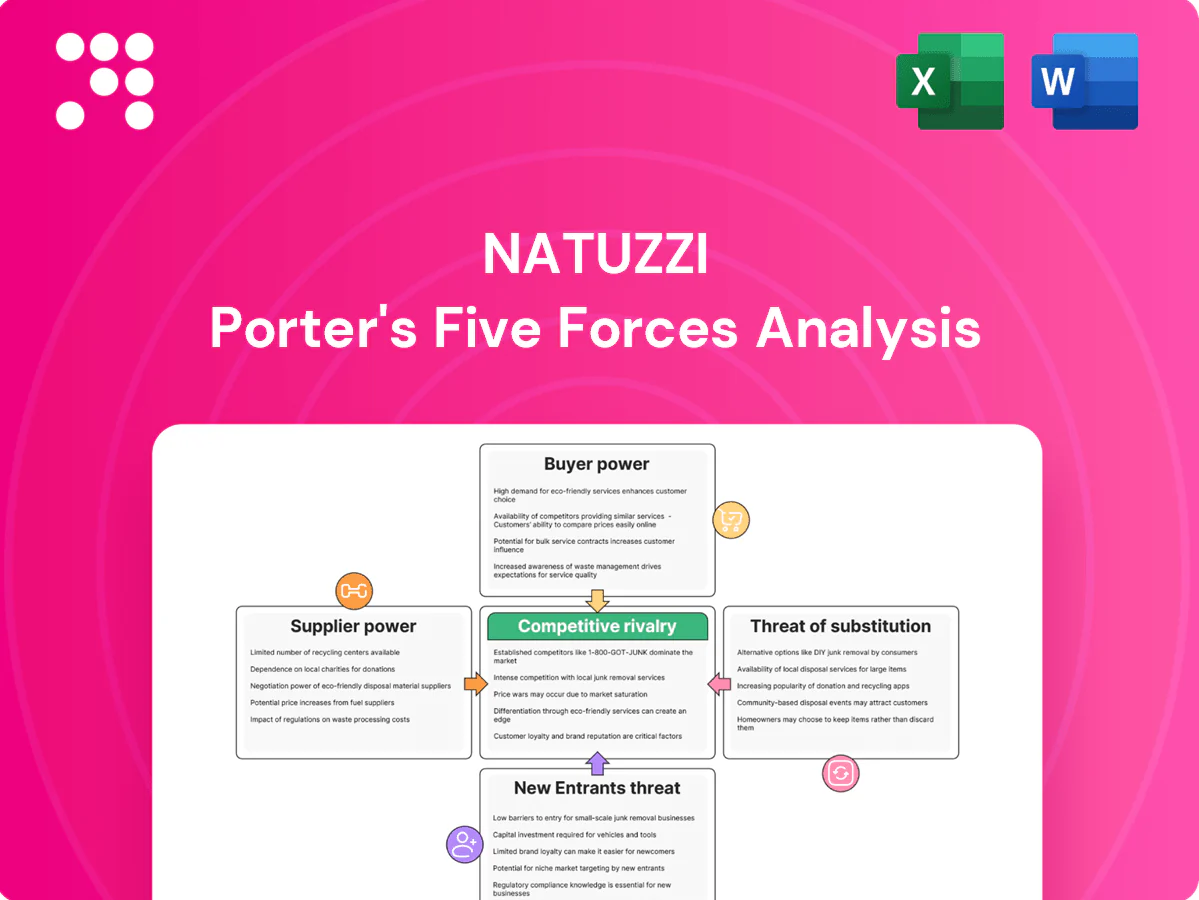
Natuzzi Porter's Five Forces Analysis

A Must-Have Tool for Decision-Makers
Natuzzi's Porter's Five Forces shows how supplier power, buyer bargaining, rivalry, substitutes, and entry threats shape its furniture market position. Strong brand and channel relationships mitigate some risks, while raw-material costs and low-cost competitors heighten pressure. This brief snapshot only scratches the surface. Unlock the full Porter's Five Forces Analysis to explore Natuzzi’s competitive dynamics, market pressures, and strategic advantages in detail.
Suppliers Bargaining Power

Leather and fabric concentration
Premium hides and technical fabrics for Natuzzi come from a relatively concentrated, quality-vetted pool, giving key suppliers notable leverage. Natuzzi’s strict color and finish consistency increases dependency on select vendors and raises barriers to substitution. Long qualification cycles in the furniture industry typically span 6–12 months, heightening switching costs. Multi-sourcing and regional production hubs can partly offset this supplier power.
Specialized inputs and standards
High-resilience foams, engineered frames and certified hardware for Natuzzi must meet durability and safety norms, limiting viable substitutes and increasing supplier leverage. Compliance with REACH, CARB and fire-retardancy regimes narrows the qualified supplier pool and raises switching costs. This technical specificity elevates supplier bargaining power, though multi-year volume contracts are used to exchange price concessions for assured supply and compliance continuity.

Commodity volatility pass-through
Leather, PU foam chemicals and timber have exhibited cyclical price swings often reaching +/-30% in recent cycles, prompting key suppliers to insist on pass-through clauses that shift cost volatility onto Natuzzi and compress gross margins.
EUR/USD volatility (roughly 1.05–1.10 in 2024) amplifies import cost exposure for Italian sourcing, while targeted commodity hedging and design-to-cost initiatives have been used to dampen price spikes and stabilize margins.

Geographic and logistics risk
Global sourcing exposes Natuzzi to freight-rate volatility and disruptions; Drewry reported container rates collapsed from 2021 peaks to roughly $1,500–2,000 per 40ft in 2024, stretching lead times and inventory costs.
Suppliers closer to Italian production hubs gain reliability and lower logistics costs, while bottlenecks force premium air/expedited freight or costly re-sourcing.
Dual-continent supply maps (Europe + Asia) reduce single-point failure risk and cut contingency spend by enabling modal shifts and regional buffer stock.
- Lead-time exposure: freight-rate swings ~2024 WCI ~$1,500–2,000/40ft
- Local supplier edge: lower transit variability
- Bottleneck cost: premium freight or re-source at higher unit cost
- Mitigation: dual-continent sourcing reduces single-point failure
ESG and traceability demands
ESG and traceability raise supplier power as responsible leather (Leather Working Group has over 1,000 members) and FSC-certified wood (over 200 million hectares certified globally) narrow qualified vendors and increase verification needs, which upstream suppliers can pass through as higher input costs. Natuzzi’s reliance on Italian craftsmanship subjects suppliers to heightened brand scrutiny, while partnership programs can secure priority supply and more stable terms.
- Responsible sourcing: LWG, FSC
- Supplier pricing power: compliance-driven cost pass-through
- Mitigation: partnership programs for priority/stability
Supply squeeze: 6–12m quals, ±30% commodities, freight $1.5–2k
Concentrated, vetted suppliers for hides, technical fabrics and engineered components give suppliers meaningful leverage; qualification cycles of 6–12 months and limited substitutes raise switching costs. Commodity swings +/-30% and EUR/USD ~1.05–1.10 in 2024 amplify cost pass-through; container rates ~$1,500–2,000/40ft increase lead-time risk. ESG rules (LWG >1,000 members; FSC ~200M ha) further narrow qualified vendors, partially mitigated by multi-sourcing and long-term contracts.
| Item | 2024 Metric | Impact |
|---|---|---|
| Qualification | 6–12 months | High switching cost |
| Commodities | ±30% | Margin volatility |
| FX | EUR/USD 1.05–1.10 | Import cost exposure |
| Freight | $1,500–2,000/40ft | Lead-time & inventory cost |
| ESG | LWG >1,000; FSC ~200M ha | Narrowed supplier pool |
What is included in the product
 Detailed Word Document
Uncovers key drivers of competition, customer influence, and market entry risks tailored to Natuzzi, detailing supplier and buyer power, threats from substitutes and new entrants, and intensity of rivalry, with strategic insights on disruptive forces and protective market dynamics.

 Customizable Excel Spreadsheet
A one-sheet Porter's Five Forces for Natuzzi—instantly map supplier, buyer, substitute, entrant, and rivalry pressures with customizable levels for fast, boardroom-ready strategic decisions.
Customers Bargaining Power

Fragmented end consumers
Individual buyers for Natuzzi are numerous and price-sensitive, with roughly 70% of furniture shoppers consulting online reviews in 2024, enabling easy price comparison. Style and comfort reduce pure price bargaining power by differentiating products. Financing offers and promotions, including rising BNPL usage, shape expectations. Reviews and social media amplify switching ease.
Retail intermediaries’ leverage
Multi-brand retailers and franchisees negotiate margins, floor space and co-op marketing, with large accounts able to delist brands or push private labels to force price concessions; they commonly secure payment terms of 60–90 days. Such intermediaries can account for a material share of Natuzzi channel sales, pressuring ASPs and promo activity. Natuzzi’s ~300 company-owned and franchise stores help partially counterbalance this buying power by retaining direct retail control and higher-margin sales.

High transparency and comparability
Digital catalogs and AR tools let buyers compare Natuzzi designs and prices across brands instantly, and over 60% of furniture shoppers use online comparison tools as of 2024, raising price sensitivity. Visible lead times and delivery fees, often adding 10–15% to purchase cost, intensify demands for transparency. Customization is weighed against wait times, so clear value communication and upfront total-cost messaging are critical to retain buyers.

Switching costs are modest
Most sofas and beds offer functional parity across premium peers, so if aesthetics or comfort disappoint customers can readily switch, making customer bargaining power high; warranties and after-sales service provide measurable stickiness, while loyalty programs and curated in-store experiences raise retention.
- Functional parity: increases switching
- Warranties/after-sales: moderate stickiness
- Loyalty/in-store curation: boosts retention
Demand cyclicality
Price-sensitive buyers rely on reviews/comparisons; delivery fees and retailers shape choices
Buyers are price-sensitive but influenced by style/comfort; ~70% consult reviews and ~60% use comparison tools in 2024, raising switching risk. Large retailers (60–90 day payment terms) and private labels press margins; delivery fees (10–15%) and lead times shape purchase decisions. Natuzzi’s ~300 stores and warranties/loyalty partially offset bargaining power.
| Metric | 2024 |
|---|---|
| Review use | ~70% |
| Comparison tools | ~60% |
| Delivery fees | 10–15% |
| Stores | ~300 |
| Payment terms (retailers) | 60–90 days |
Preview the Actual Deliverable
Natuzzi Porter's Five Forces Analysis
This preview shows the exact Natuzzi Porter's Five Forces Analysis you'll receive immediately after purchase—no placeholders or mockups. The file displayed here is the full, professionally formatted document ready for download and use the moment you buy. You’re viewing the final deliverable; completing payment grants instant access to this same document.

A Must-Have Tool for Decision-Makers
Natuzzi's Porter's Five Forces shows how supplier power, buyer bargaining, rivalry, substitutes, and entry threats shape its furniture market position. Strong brand and channel relationships mitigate some risks, while raw-material costs and low-cost competitors heighten pressure. This brief snapshot only scratches the surface. Unlock the full Porter's Five Forces Analysis to explore Natuzzi’s competitive dynamics, market pressures, and strategic advantages in detail.
Suppliers Bargaining Power
Leather and fabric concentration
Premium hides and technical fabrics for Natuzzi come from a relatively concentrated, quality-vetted pool, giving key suppliers notable leverage. Natuzzi’s strict color and finish consistency increases dependency on select vendors and raises barriers to substitution. Long qualification cycles in the furniture industry typically span 6–12 months, heightening switching costs. Multi-sourcing and regional production hubs can partly offset this supplier power.
Specialized inputs and standards
High-resilience foams, engineered frames and certified hardware for Natuzzi must meet durability and safety norms, limiting viable substitutes and increasing supplier leverage. Compliance with REACH, CARB and fire-retardancy regimes narrows the qualified supplier pool and raises switching costs. This technical specificity elevates supplier bargaining power, though multi-year volume contracts are used to exchange price concessions for assured supply and compliance continuity.
Commodity volatility pass-through
Leather, PU foam chemicals and timber have exhibited cyclical price swings often reaching +/-30% in recent cycles, prompting key suppliers to insist on pass-through clauses that shift cost volatility onto Natuzzi and compress gross margins.
EUR/USD volatility (roughly 1.05–1.10 in 2024) amplifies import cost exposure for Italian sourcing, while targeted commodity hedging and design-to-cost initiatives have been used to dampen price spikes and stabilize margins.
Geographic and logistics risk
Global sourcing exposes Natuzzi to freight-rate volatility and disruptions; Drewry reported container rates collapsed from 2021 peaks to roughly $1,500–2,000 per 40ft in 2024, stretching lead times and inventory costs.
Suppliers closer to Italian production hubs gain reliability and lower logistics costs, while bottlenecks force premium air/expedited freight or costly re-sourcing.
Dual-continent supply maps (Europe + Asia) reduce single-point failure risk and cut contingency spend by enabling modal shifts and regional buffer stock.
- Lead-time exposure: freight-rate swings ~2024 WCI ~$1,500–2,000/40ft
- Local supplier edge: lower transit variability
- Bottleneck cost: premium freight or re-source at higher unit cost
- Mitigation: dual-continent sourcing reduces single-point failure
ESG and traceability demands
ESG and traceability raise supplier power as responsible leather (Leather Working Group has over 1,000 members) and FSC-certified wood (over 200 million hectares certified globally) narrow qualified vendors and increase verification needs, which upstream suppliers can pass through as higher input costs. Natuzzi’s reliance on Italian craftsmanship subjects suppliers to heightened brand scrutiny, while partnership programs can secure priority supply and more stable terms.
- Responsible sourcing: LWG, FSC
- Supplier pricing power: compliance-driven cost pass-through
- Mitigation: partnership programs for priority/stability
Supply squeeze: 6–12m quals, ±30% commodities, freight $1.5–2k
Concentrated, vetted suppliers for hides, technical fabrics and engineered components give suppliers meaningful leverage; qualification cycles of 6–12 months and limited substitutes raise switching costs. Commodity swings +/-30% and EUR/USD ~1.05–1.10 in 2024 amplify cost pass-through; container rates ~$1,500–2,000/40ft increase lead-time risk. ESG rules (LWG >1,000 members; FSC ~200M ha) further narrow qualified vendors, partially mitigated by multi-sourcing and long-term contracts.
| Item | 2024 Metric | Impact |
|---|---|---|
| Qualification | 6–12 months | High switching cost |
| Commodities | ±30% | Margin volatility |
| FX | EUR/USD 1.05–1.10 | Import cost exposure |
| Freight | $1,500–2,000/40ft | Lead-time & inventory cost |
| ESG | LWG >1,000; FSC ~200M ha | Narrowed supplier pool |
What is included in the product
Detailed Word Document
Uncovers key drivers of competition, customer influence, and market entry risks tailored to Natuzzi, detailing supplier and buyer power, threats from substitutes and new entrants, and intensity of rivalry, with strategic insights on disruptive forces and protective market dynamics.
Customizable Excel Spreadsheet
A one-sheet Porter's Five Forces for Natuzzi—instantly map supplier, buyer, substitute, entrant, and rivalry pressures with customizable levels for fast, boardroom-ready strategic decisions.
Customers Bargaining Power
Fragmented end consumers
Individual buyers for Natuzzi are numerous and price-sensitive, with roughly 70% of furniture shoppers consulting online reviews in 2024, enabling easy price comparison. Style and comfort reduce pure price bargaining power by differentiating products. Financing offers and promotions, including rising BNPL usage, shape expectations. Reviews and social media amplify switching ease.
Retail intermediaries’ leverage
Multi-brand retailers and franchisees negotiate margins, floor space and co-op marketing, with large accounts able to delist brands or push private labels to force price concessions; they commonly secure payment terms of 60–90 days. Such intermediaries can account for a material share of Natuzzi channel sales, pressuring ASPs and promo activity. Natuzzi’s ~300 company-owned and franchise stores help partially counterbalance this buying power by retaining direct retail control and higher-margin sales.
High transparency and comparability
Digital catalogs and AR tools let buyers compare Natuzzi designs and prices across brands instantly, and over 60% of furniture shoppers use online comparison tools as of 2024, raising price sensitivity. Visible lead times and delivery fees, often adding 10–15% to purchase cost, intensify demands for transparency. Customization is weighed against wait times, so clear value communication and upfront total-cost messaging are critical to retain buyers.
Switching costs are modest
Most sofas and beds offer functional parity across premium peers, so if aesthetics or comfort disappoint customers can readily switch, making customer bargaining power high; warranties and after-sales service provide measurable stickiness, while loyalty programs and curated in-store experiences raise retention.
- Functional parity: increases switching
- Warranties/after-sales: moderate stickiness
- Loyalty/in-store curation: boosts retention
Demand cyclicality
Price-sensitive buyers rely on reviews/comparisons; delivery fees and retailers shape choices
Buyers are price-sensitive but influenced by style/comfort; ~70% consult reviews and ~60% use comparison tools in 2024, raising switching risk. Large retailers (60–90 day payment terms) and private labels press margins; delivery fees (10–15%) and lead times shape purchase decisions. Natuzzi’s ~300 stores and warranties/loyalty partially offset bargaining power.
| Metric | 2024 |
|---|---|
| Review use | ~70% |
| Comparison tools | ~60% |
| Delivery fees | 10–15% |
| Stores | ~300 |
| Payment terms (retailers) | 60–90 days |
Preview the Actual Deliverable
Natuzzi Porter's Five Forces Analysis
This preview shows the exact Natuzzi Porter's Five Forces Analysis you'll receive immediately after purchase—no placeholders or mockups. The file displayed here is the full, professionally formatted document ready for download and use the moment you buy. You’re viewing the final deliverable; completing payment grants instant access to this same document.
Description
A Must-Have Tool for Decision-Makers
Natuzzi's Porter's Five Forces shows how supplier power, buyer bargaining, rivalry, substitutes, and entry threats shape its furniture market position. Strong brand and channel relationships mitigate some risks, while raw-material costs and low-cost competitors heighten pressure. This brief snapshot only scratches the surface. Unlock the full Porter's Five Forces Analysis to explore Natuzzi’s competitive dynamics, market pressures, and strategic advantages in detail.
Suppliers Bargaining Power
Leather and fabric concentration
Premium hides and technical fabrics for Natuzzi come from a relatively concentrated, quality-vetted pool, giving key suppliers notable leverage. Natuzzi’s strict color and finish consistency increases dependency on select vendors and raises barriers to substitution. Long qualification cycles in the furniture industry typically span 6–12 months, heightening switching costs. Multi-sourcing and regional production hubs can partly offset this supplier power.
Specialized inputs and standards
High-resilience foams, engineered frames and certified hardware for Natuzzi must meet durability and safety norms, limiting viable substitutes and increasing supplier leverage. Compliance with REACH, CARB and fire-retardancy regimes narrows the qualified supplier pool and raises switching costs. This technical specificity elevates supplier bargaining power, though multi-year volume contracts are used to exchange price concessions for assured supply and compliance continuity.
Commodity volatility pass-through
Leather, PU foam chemicals and timber have exhibited cyclical price swings often reaching +/-30% in recent cycles, prompting key suppliers to insist on pass-through clauses that shift cost volatility onto Natuzzi and compress gross margins.
EUR/USD volatility (roughly 1.05–1.10 in 2024) amplifies import cost exposure for Italian sourcing, while targeted commodity hedging and design-to-cost initiatives have been used to dampen price spikes and stabilize margins.
Geographic and logistics risk
Global sourcing exposes Natuzzi to freight-rate volatility and disruptions; Drewry reported container rates collapsed from 2021 peaks to roughly $1,500–2,000 per 40ft in 2024, stretching lead times and inventory costs.
Suppliers closer to Italian production hubs gain reliability and lower logistics costs, while bottlenecks force premium air/expedited freight or costly re-sourcing.
Dual-continent supply maps (Europe + Asia) reduce single-point failure risk and cut contingency spend by enabling modal shifts and regional buffer stock.
- Lead-time exposure: freight-rate swings ~2024 WCI ~$1,500–2,000/40ft
- Local supplier edge: lower transit variability
- Bottleneck cost: premium freight or re-source at higher unit cost
- Mitigation: dual-continent sourcing reduces single-point failure
ESG and traceability demands
ESG and traceability raise supplier power as responsible leather (Leather Working Group has over 1,000 members) and FSC-certified wood (over 200 million hectares certified globally) narrow qualified vendors and increase verification needs, which upstream suppliers can pass through as higher input costs. Natuzzi’s reliance on Italian craftsmanship subjects suppliers to heightened brand scrutiny, while partnership programs can secure priority supply and more stable terms.
- Responsible sourcing: LWG, FSC
- Supplier pricing power: compliance-driven cost pass-through
- Mitigation: partnership programs for priority/stability
Supply squeeze: 6–12m quals, ±30% commodities, freight $1.5–2k
Concentrated, vetted suppliers for hides, technical fabrics and engineered components give suppliers meaningful leverage; qualification cycles of 6–12 months and limited substitutes raise switching costs. Commodity swings +/-30% and EUR/USD ~1.05–1.10 in 2024 amplify cost pass-through; container rates ~$1,500–2,000/40ft increase lead-time risk. ESG rules (LWG >1,000 members; FSC ~200M ha) further narrow qualified vendors, partially mitigated by multi-sourcing and long-term contracts.
| Item | 2024 Metric | Impact |
|---|---|---|
| Qualification | 6–12 months | High switching cost |
| Commodities | ±30% | Margin volatility |
| FX | EUR/USD 1.05–1.10 | Import cost exposure |
| Freight | $1,500–2,000/40ft | Lead-time & inventory cost |
| ESG | LWG >1,000; FSC ~200M ha | Narrowed supplier pool |
What is included in the product
Detailed Word Document
Uncovers key drivers of competition, customer influence, and market entry risks tailored to Natuzzi, detailing supplier and buyer power, threats from substitutes and new entrants, and intensity of rivalry, with strategic insights on disruptive forces and protective market dynamics.
Customizable Excel Spreadsheet
A one-sheet Porter's Five Forces for Natuzzi—instantly map supplier, buyer, substitute, entrant, and rivalry pressures with customizable levels for fast, boardroom-ready strategic decisions.
Customers Bargaining Power
Fragmented end consumers
Individual buyers for Natuzzi are numerous and price-sensitive, with roughly 70% of furniture shoppers consulting online reviews in 2024, enabling easy price comparison. Style and comfort reduce pure price bargaining power by differentiating products. Financing offers and promotions, including rising BNPL usage, shape expectations. Reviews and social media amplify switching ease.
Retail intermediaries’ leverage
Multi-brand retailers and franchisees negotiate margins, floor space and co-op marketing, with large accounts able to delist brands or push private labels to force price concessions; they commonly secure payment terms of 60–90 days. Such intermediaries can account for a material share of Natuzzi channel sales, pressuring ASPs and promo activity. Natuzzi’s ~300 company-owned and franchise stores help partially counterbalance this buying power by retaining direct retail control and higher-margin sales.
High transparency and comparability
Digital catalogs and AR tools let buyers compare Natuzzi designs and prices across brands instantly, and over 60% of furniture shoppers use online comparison tools as of 2024, raising price sensitivity. Visible lead times and delivery fees, often adding 10–15% to purchase cost, intensify demands for transparency. Customization is weighed against wait times, so clear value communication and upfront total-cost messaging are critical to retain buyers.
Switching costs are modest
Most sofas and beds offer functional parity across premium peers, so if aesthetics or comfort disappoint customers can readily switch, making customer bargaining power high; warranties and after-sales service provide measurable stickiness, while loyalty programs and curated in-store experiences raise retention.
- Functional parity: increases switching
- Warranties/after-sales: moderate stickiness
- Loyalty/in-store curation: boosts retention
Demand cyclicality
Price-sensitive buyers rely on reviews/comparisons; delivery fees and retailers shape choices
Buyers are price-sensitive but influenced by style/comfort; ~70% consult reviews and ~60% use comparison tools in 2024, raising switching risk. Large retailers (60–90 day payment terms) and private labels press margins; delivery fees (10–15%) and lead times shape purchase decisions. Natuzzi’s ~300 stores and warranties/loyalty partially offset bargaining power.
| Metric | 2024 |
|---|---|
| Review use | ~70% |
| Comparison tools | ~60% |
| Delivery fees | 10–15% |
| Stores | ~300 |
| Payment terms (retailers) | 60–90 days |
Preview the Actual Deliverable
Natuzzi Porter's Five Forces Analysis
This preview shows the exact Natuzzi Porter's Five Forces Analysis you'll receive immediately after purchase—no placeholders or mockups. The file displayed here is the full, professionally formatted document ready for download and use the moment you buy. You’re viewing the final deliverable; completing payment grants instant access to this same document.











