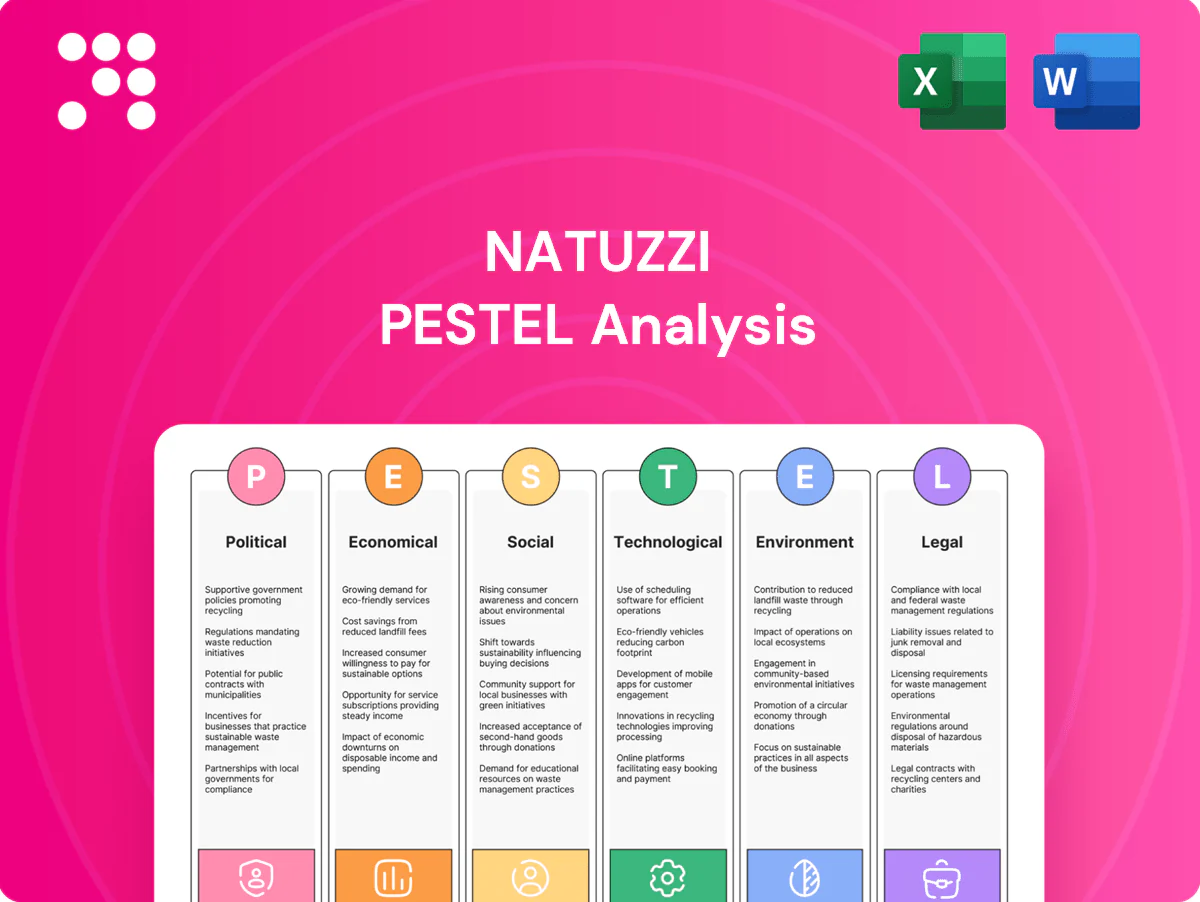
Natuzzi PESTLE Analysis

Your Competitive Advantage Starts with This Report
Gain a competitive edge with our focused PESTLE Analysis of Natuzzi—three to five concise insights bring political, economic, social, technological, legal and environmental factors into sharp relief. Use this to anticipate risks, spot growth levers, and refine strategy. Buy the full analysis for the complete, editable report and actionable recommendations.
Political factors

Trade policy, tariffs, and customs on furniture and leather
Shifts in EU, US and UK tariff regimes can materially alter landed costs for sofas and leather goods; the EU-UK Trade and Cooperation Agreement allows zero tariffs for qualifying originating goods while US Section 301 measures have imposed additional duties of up to 25% on some Chinese-sourced products. Anti-dumping or safeguard measures in key markets would compress Natuzzi pricing power and margins. Preferential trade deals and route optimization reduce duty exposure and logistic costs.
EU policy alignment and Italian industrial support
EU industrial, sustainability and energy directives, including Fit for 55 (55% GHG cut by 2030), reshape manufacturing economics in Italy by raising compliance baselines and operational costs. Italy’s PNRR mobilises €191.5bn and national Industria 4.0 schemes plus regional grants fund plant upgrades and digitalisation. Compliance costs can be offset by EU/Italian subsidies and tax credits, improving project bankability and enabling predictable long‑term capex planning.

Geopolitical tensions and supply chain resilience
Geopolitical tensions and sanctions can constrain leather, foam, wood and chemical inputs, while chokepoints like the Suez Canal (about 12% of global trade) force rerouting that raises lead times and freight costs. Nearshoring or dual-sourcing lowers exposure to hotspots. Scenario planning remains critical to ensure uninterrupted store replenishment and protect margins.

Local content and sourcing expectations
Some markets enforce local content thresholds that typically range from 20% to 60%, and meeting these rules can accelerate approvals and improve public perception for import-reliant brands like Natuzzi.
Compliance may require selective assembly hubs near key regions to preserve Italian-made equity while satisfying localization rules and avoiding tariff or procurement barriers.
Strategically balancing Italian heritage with regional sourcing can reduce time-to-market and strengthen access to public and private tenders in markets with strict local-content expectations.
Labor relations and policy in production regions
Labor policy shifts such as minimum wage rises (typical range 3–8% in key markets) and tighter collective bargaining increase Natuzzi production costs and reduce scheduling flexibility; political stability in Italy, Romania and Vietnam correlates with lower turnover and higher productivity, while constructive union engagement cuts strike risk and workforce skilling programs—often co-funded—improve output quality.
- Minimum wage impact: +3–8% labor cost
- Collective bargaining: higher rigidity, strike risk down with engagement
- Skilling: co-funding reduces hiring costs
- Political stability: boosts retention/productivity
Tariffs (US duties 25%), local content and PNRR reshape landed costs
Tariff shifts (US duties up to 25%) and local-content rules (20–60%) materially affect landed costs and market access; preferential deals and route optimisation reduce duty exposure. EU Fit for 55 and Italy PNRR (€191.5bn) raise compliance/capex but offer subsidies. Geopolitical chokepoints (Suez ~12% of trade) and sanctions threaten inputs; nearshoring/dual‑sourcing mitigate risk. Labour moves (min wage +3–8%) lift operating costs.
| Metric | Value |
|---|---|
| PNRR | €191.5bn |
| Fit for 55 | -55% GHG by 2030 |
| Suez share | ~12% |
| US duties | up to 25% |
| Local content | 20–60% |
| Min wage impact | +3–8% |
What is included in the product
 Detailed Word Document
Explores how external macro-environmental factors uniquely affect Natuzzi across Political, Economic, Social, Technological, Environmental and Legal dimensions, with data-backed trends, forward-looking insights and practical implications to guide executives, investors and strategists in managing risks and seizing opportunities.

 Customizable Excel Spreadsheet
A concise, visually segmented PESTLE summary for Natuzzi that distills external risks and opportunities into clear, shareable insights for meetings or presentations. Easily editable for regional or business-line notes, it supports quick alignment across teams and decision-making during planning sessions.
Economic factors

Consumer cycle sensitivity in discretionary home goods
Large-ticket furniture purchases track housing turnover and consumer confidence, with Natuzzi sales typically lagging property transactions; 2024 saw softer housing churn that delayed replacements and compressed the premium mix. Downcycles pushed consumers toward value ranges, reducing average selling prices and custom orders, while 2024–H1 2025 upswings lifted ASPs and bespoke demand. Inventory agility and flexible production helped Natuzzi absorb these demand shocks by reallocating stock between channels and geographies.
Interest rates, mortgages, and housing starts
Higher rates curb home moves and renovations, dampening sofa demand as the US 30-year mortgage averaged about 6.9% (Freddie Mac, Jul 2025), reducing discretionary spend and showroom traffic. Lower rates revive mortgage originations and footfall, lifting short-term sales. US housing starts averaged ~1.41M annualized in 2024 (U.S. Census), guiding entry-to-mid segment demand. Aligning promotions with rate cycles sustains throughput.

FX volatility across euro, USD, GBP, and emerging currencies
Natuzzi’s revenue diversification exposes it to translation and transaction risks as EUR/USD stood near 1.09 and GBP/USD around 1.27 in July 2025, while EUR/GBP traded near 0.86, altering export margins when the euro strengthens. A weak euro improves competitiveness in dollar markets; emerging market currencies showed annualized FX volatility near 15% in 2024, amplifying local pricing risk. Hedging smooths gross margin but adds costs, so local pricing must be continuously adjusted to currency swings.

Input cost inflation: leather, foam, textiles, wood, freight
Input-cost inflation in leather, foam, textiles, wood and freight continues to squeeze margins; Natuzzi cited raw-material and logistics pressures in its 2024 interim report as a primary headwind to profitability.
Supplier indexing, longer contracts and design-to-cost initiatives, plus shifting mix toward fabric or engineered materials and continuous cost engineering, have been used to protect price points and preserve perceived value.
- commodity spikes reduce gross margin
- indexing/contracts mitigate timing risk
- mix shift to fabric/engineered protects ASPs
- ongoing cost engineering sustains value
Channel economics: DTC, franchise, and multi-brand
Owned Natuzzi stores typically raise gross margin by capturing retail markup but increase fixed operating costs and capex, influencing cash flow and break-even thresholds.
Franchising accelerates footprint expansion with lower capital exposure and operating risk while reducing direct control over customer experience and pricing.
Multi-brand wholesale widens market reach but compresses margins; actively adjusting channel mix to market cycles is essential to maximize ROIC.
- Owned: higher margin, higher fixed costs
- Franchise: scalable, lower capex, less control
- Wholesale: broader reach, tighter margins
- Channel mix optimization: maximizes ROIC
Tariffs (US duties 25%), local content and PNRR reshape landed costs
Higher US 30-yr mortgage ~6.9% (Freddie Mac, Jul 2025) and 2024 housing starts ~1.41M dampened large-ticket demand; EUR/USD ~1.09 and 2024 EM FX vol ~15% add translation/transaction risk; raw-material and freight inflation in 2024 compressed gross margins despite cost-engineering and channel mix actions.
| Metric | Value | Impact |
|---|---|---|
| US 30-yr | 6.9% | Lower moves/sales |
| Housing starts | 1.41M (2024) | Demand signal |
| EUR/USD | 1.09 (Jul 2025) | Margin FX |
| EM FX vol | ~15% (2024) | Pricing risk |
Preview the Actual Deliverable
Natuzzi PESTLE Analysis
The Natuzzi PESTLE Analysis preview shown here is the exact document you’ll receive after purchase—fully formatted and ready to use. It contains the same content, structure, and professional layout visible now, with no placeholders or surprises. After checkout you’ll instantly download this final, ready-to-use file.

Your Competitive Advantage Starts with This Report
Gain a competitive edge with our focused PESTLE Analysis of Natuzzi—three to five concise insights bring political, economic, social, technological, legal and environmental factors into sharp relief. Use this to anticipate risks, spot growth levers, and refine strategy. Buy the full analysis for the complete, editable report and actionable recommendations.
Political factors
Trade policy, tariffs, and customs on furniture and leather
Shifts in EU, US and UK tariff regimes can materially alter landed costs for sofas and leather goods; the EU-UK Trade and Cooperation Agreement allows zero tariffs for qualifying originating goods while US Section 301 measures have imposed additional duties of up to 25% on some Chinese-sourced products. Anti-dumping or safeguard measures in key markets would compress Natuzzi pricing power and margins. Preferential trade deals and route optimization reduce duty exposure and logistic costs.
EU policy alignment and Italian industrial support
EU industrial, sustainability and energy directives, including Fit for 55 (55% GHG cut by 2030), reshape manufacturing economics in Italy by raising compliance baselines and operational costs. Italy’s PNRR mobilises €191.5bn and national Industria 4.0 schemes plus regional grants fund plant upgrades and digitalisation. Compliance costs can be offset by EU/Italian subsidies and tax credits, improving project bankability and enabling predictable long‑term capex planning.
Geopolitical tensions and supply chain resilience
Geopolitical tensions and sanctions can constrain leather, foam, wood and chemical inputs, while chokepoints like the Suez Canal (about 12% of global trade) force rerouting that raises lead times and freight costs. Nearshoring or dual-sourcing lowers exposure to hotspots. Scenario planning remains critical to ensure uninterrupted store replenishment and protect margins.
Local content and sourcing expectations
Some markets enforce local content thresholds that typically range from 20% to 60%, and meeting these rules can accelerate approvals and improve public perception for import-reliant brands like Natuzzi.
Compliance may require selective assembly hubs near key regions to preserve Italian-made equity while satisfying localization rules and avoiding tariff or procurement barriers.
Strategically balancing Italian heritage with regional sourcing can reduce time-to-market and strengthen access to public and private tenders in markets with strict local-content expectations.
Labor relations and policy in production regions
Labor policy shifts such as minimum wage rises (typical range 3–8% in key markets) and tighter collective bargaining increase Natuzzi production costs and reduce scheduling flexibility; political stability in Italy, Romania and Vietnam correlates with lower turnover and higher productivity, while constructive union engagement cuts strike risk and workforce skilling programs—often co-funded—improve output quality.
- Minimum wage impact: +3–8% labor cost
- Collective bargaining: higher rigidity, strike risk down with engagement
- Skilling: co-funding reduces hiring costs
- Political stability: boosts retention/productivity
Tariffs (US duties 25%), local content and PNRR reshape landed costs
Tariff shifts (US duties up to 25%) and local-content rules (20–60%) materially affect landed costs and market access; preferential deals and route optimisation reduce duty exposure. EU Fit for 55 and Italy PNRR (€191.5bn) raise compliance/capex but offer subsidies. Geopolitical chokepoints (Suez ~12% of trade) and sanctions threaten inputs; nearshoring/dual‑sourcing mitigate risk. Labour moves (min wage +3–8%) lift operating costs.
| Metric | Value |
|---|---|
| PNRR | €191.5bn |
| Fit for 55 | -55% GHG by 2030 |
| Suez share | ~12% |
| US duties | up to 25% |
| Local content | 20–60% |
| Min wage impact | +3–8% |
What is included in the product
Detailed Word Document
Explores how external macro-environmental factors uniquely affect Natuzzi across Political, Economic, Social, Technological, Environmental and Legal dimensions, with data-backed trends, forward-looking insights and practical implications to guide executives, investors and strategists in managing risks and seizing opportunities.
Customizable Excel Spreadsheet
A concise, visually segmented PESTLE summary for Natuzzi that distills external risks and opportunities into clear, shareable insights for meetings or presentations. Easily editable for regional or business-line notes, it supports quick alignment across teams and decision-making during planning sessions.
Economic factors
Consumer cycle sensitivity in discretionary home goods
Large-ticket furniture purchases track housing turnover and consumer confidence, with Natuzzi sales typically lagging property transactions; 2024 saw softer housing churn that delayed replacements and compressed the premium mix. Downcycles pushed consumers toward value ranges, reducing average selling prices and custom orders, while 2024–H1 2025 upswings lifted ASPs and bespoke demand. Inventory agility and flexible production helped Natuzzi absorb these demand shocks by reallocating stock between channels and geographies.
Interest rates, mortgages, and housing starts
Higher rates curb home moves and renovations, dampening sofa demand as the US 30-year mortgage averaged about 6.9% (Freddie Mac, Jul 2025), reducing discretionary spend and showroom traffic. Lower rates revive mortgage originations and footfall, lifting short-term sales. US housing starts averaged ~1.41M annualized in 2024 (U.S. Census), guiding entry-to-mid segment demand. Aligning promotions with rate cycles sustains throughput.
FX volatility across euro, USD, GBP, and emerging currencies
Natuzzi’s revenue diversification exposes it to translation and transaction risks as EUR/USD stood near 1.09 and GBP/USD around 1.27 in July 2025, while EUR/GBP traded near 0.86, altering export margins when the euro strengthens. A weak euro improves competitiveness in dollar markets; emerging market currencies showed annualized FX volatility near 15% in 2024, amplifying local pricing risk. Hedging smooths gross margin but adds costs, so local pricing must be continuously adjusted to currency swings.
Input cost inflation: leather, foam, textiles, wood, freight
Input-cost inflation in leather, foam, textiles, wood and freight continues to squeeze margins; Natuzzi cited raw-material and logistics pressures in its 2024 interim report as a primary headwind to profitability.
Supplier indexing, longer contracts and design-to-cost initiatives, plus shifting mix toward fabric or engineered materials and continuous cost engineering, have been used to protect price points and preserve perceived value.
- commodity spikes reduce gross margin
- indexing/contracts mitigate timing risk
- mix shift to fabric/engineered protects ASPs
- ongoing cost engineering sustains value
Channel economics: DTC, franchise, and multi-brand
Owned Natuzzi stores typically raise gross margin by capturing retail markup but increase fixed operating costs and capex, influencing cash flow and break-even thresholds.
Franchising accelerates footprint expansion with lower capital exposure and operating risk while reducing direct control over customer experience and pricing.
Multi-brand wholesale widens market reach but compresses margins; actively adjusting channel mix to market cycles is essential to maximize ROIC.
- Owned: higher margin, higher fixed costs
- Franchise: scalable, lower capex, less control
- Wholesale: broader reach, tighter margins
- Channel mix optimization: maximizes ROIC
Tariffs (US duties 25%), local content and PNRR reshape landed costs
Higher US 30-yr mortgage ~6.9% (Freddie Mac, Jul 2025) and 2024 housing starts ~1.41M dampened large-ticket demand; EUR/USD ~1.09 and 2024 EM FX vol ~15% add translation/transaction risk; raw-material and freight inflation in 2024 compressed gross margins despite cost-engineering and channel mix actions.
| Metric | Value | Impact |
|---|---|---|
| US 30-yr | 6.9% | Lower moves/sales |
| Housing starts | 1.41M (2024) | Demand signal |
| EUR/USD | 1.09 (Jul 2025) | Margin FX |
| EM FX vol | ~15% (2024) | Pricing risk |
Preview the Actual Deliverable
Natuzzi PESTLE Analysis
The Natuzzi PESTLE Analysis preview shown here is the exact document you’ll receive after purchase—fully formatted and ready to use. It contains the same content, structure, and professional layout visible now, with no placeholders or surprises. After checkout you’ll instantly download this final, ready-to-use file.
Original: $10.00
-65%$10.00
$3.50Description
Your Competitive Advantage Starts with This Report
Gain a competitive edge with our focused PESTLE Analysis of Natuzzi—three to five concise insights bring political, economic, social, technological, legal and environmental factors into sharp relief. Use this to anticipate risks, spot growth levers, and refine strategy. Buy the full analysis for the complete, editable report and actionable recommendations.
Political factors
Trade policy, tariffs, and customs on furniture and leather
Shifts in EU, US and UK tariff regimes can materially alter landed costs for sofas and leather goods; the EU-UK Trade and Cooperation Agreement allows zero tariffs for qualifying originating goods while US Section 301 measures have imposed additional duties of up to 25% on some Chinese-sourced products. Anti-dumping or safeguard measures in key markets would compress Natuzzi pricing power and margins. Preferential trade deals and route optimization reduce duty exposure and logistic costs.
EU policy alignment and Italian industrial support
EU industrial, sustainability and energy directives, including Fit for 55 (55% GHG cut by 2030), reshape manufacturing economics in Italy by raising compliance baselines and operational costs. Italy’s PNRR mobilises €191.5bn and national Industria 4.0 schemes plus regional grants fund plant upgrades and digitalisation. Compliance costs can be offset by EU/Italian subsidies and tax credits, improving project bankability and enabling predictable long‑term capex planning.
Geopolitical tensions and supply chain resilience
Geopolitical tensions and sanctions can constrain leather, foam, wood and chemical inputs, while chokepoints like the Suez Canal (about 12% of global trade) force rerouting that raises lead times and freight costs. Nearshoring or dual-sourcing lowers exposure to hotspots. Scenario planning remains critical to ensure uninterrupted store replenishment and protect margins.
Local content and sourcing expectations
Some markets enforce local content thresholds that typically range from 20% to 60%, and meeting these rules can accelerate approvals and improve public perception for import-reliant brands like Natuzzi.
Compliance may require selective assembly hubs near key regions to preserve Italian-made equity while satisfying localization rules and avoiding tariff or procurement barriers.
Strategically balancing Italian heritage with regional sourcing can reduce time-to-market and strengthen access to public and private tenders in markets with strict local-content expectations.
Labor relations and policy in production regions
Labor policy shifts such as minimum wage rises (typical range 3–8% in key markets) and tighter collective bargaining increase Natuzzi production costs and reduce scheduling flexibility; political stability in Italy, Romania and Vietnam correlates with lower turnover and higher productivity, while constructive union engagement cuts strike risk and workforce skilling programs—often co-funded—improve output quality.
- Minimum wage impact: +3–8% labor cost
- Collective bargaining: higher rigidity, strike risk down with engagement
- Skilling: co-funding reduces hiring costs
- Political stability: boosts retention/productivity
Tariffs (US duties 25%), local content and PNRR reshape landed costs
Tariff shifts (US duties up to 25%) and local-content rules (20–60%) materially affect landed costs and market access; preferential deals and route optimisation reduce duty exposure. EU Fit for 55 and Italy PNRR (€191.5bn) raise compliance/capex but offer subsidies. Geopolitical chokepoints (Suez ~12% of trade) and sanctions threaten inputs; nearshoring/dual‑sourcing mitigate risk. Labour moves (min wage +3–8%) lift operating costs.
| Metric | Value |
|---|---|
| PNRR | €191.5bn |
| Fit for 55 | -55% GHG by 2030 |
| Suez share | ~12% |
| US duties | up to 25% |
| Local content | 20–60% |
| Min wage impact | +3–8% |
What is included in the product
Detailed Word Document
Explores how external macro-environmental factors uniquely affect Natuzzi across Political, Economic, Social, Technological, Environmental and Legal dimensions, with data-backed trends, forward-looking insights and practical implications to guide executives, investors and strategists in managing risks and seizing opportunities.
Customizable Excel Spreadsheet
A concise, visually segmented PESTLE summary for Natuzzi that distills external risks and opportunities into clear, shareable insights for meetings or presentations. Easily editable for regional or business-line notes, it supports quick alignment across teams and decision-making during planning sessions.
Economic factors
Consumer cycle sensitivity in discretionary home goods
Large-ticket furniture purchases track housing turnover and consumer confidence, with Natuzzi sales typically lagging property transactions; 2024 saw softer housing churn that delayed replacements and compressed the premium mix. Downcycles pushed consumers toward value ranges, reducing average selling prices and custom orders, while 2024–H1 2025 upswings lifted ASPs and bespoke demand. Inventory agility and flexible production helped Natuzzi absorb these demand shocks by reallocating stock between channels and geographies.
Interest rates, mortgages, and housing starts
Higher rates curb home moves and renovations, dampening sofa demand as the US 30-year mortgage averaged about 6.9% (Freddie Mac, Jul 2025), reducing discretionary spend and showroom traffic. Lower rates revive mortgage originations and footfall, lifting short-term sales. US housing starts averaged ~1.41M annualized in 2024 (U.S. Census), guiding entry-to-mid segment demand. Aligning promotions with rate cycles sustains throughput.
FX volatility across euro, USD, GBP, and emerging currencies
Natuzzi’s revenue diversification exposes it to translation and transaction risks as EUR/USD stood near 1.09 and GBP/USD around 1.27 in July 2025, while EUR/GBP traded near 0.86, altering export margins when the euro strengthens. A weak euro improves competitiveness in dollar markets; emerging market currencies showed annualized FX volatility near 15% in 2024, amplifying local pricing risk. Hedging smooths gross margin but adds costs, so local pricing must be continuously adjusted to currency swings.
Input cost inflation: leather, foam, textiles, wood, freight
Input-cost inflation in leather, foam, textiles, wood and freight continues to squeeze margins; Natuzzi cited raw-material and logistics pressures in its 2024 interim report as a primary headwind to profitability.
Supplier indexing, longer contracts and design-to-cost initiatives, plus shifting mix toward fabric or engineered materials and continuous cost engineering, have been used to protect price points and preserve perceived value.
- commodity spikes reduce gross margin
- indexing/contracts mitigate timing risk
- mix shift to fabric/engineered protects ASPs
- ongoing cost engineering sustains value
Channel economics: DTC, franchise, and multi-brand
Owned Natuzzi stores typically raise gross margin by capturing retail markup but increase fixed operating costs and capex, influencing cash flow and break-even thresholds.
Franchising accelerates footprint expansion with lower capital exposure and operating risk while reducing direct control over customer experience and pricing.
Multi-brand wholesale widens market reach but compresses margins; actively adjusting channel mix to market cycles is essential to maximize ROIC.
- Owned: higher margin, higher fixed costs
- Franchise: scalable, lower capex, less control
- Wholesale: broader reach, tighter margins
- Channel mix optimization: maximizes ROIC
Tariffs (US duties 25%), local content and PNRR reshape landed costs
Higher US 30-yr mortgage ~6.9% (Freddie Mac, Jul 2025) and 2024 housing starts ~1.41M dampened large-ticket demand; EUR/USD ~1.09 and 2024 EM FX vol ~15% add translation/transaction risk; raw-material and freight inflation in 2024 compressed gross margins despite cost-engineering and channel mix actions.
| Metric | Value | Impact |
|---|---|---|
| US 30-yr | 6.9% | Lower moves/sales |
| Housing starts | 1.41M (2024) | Demand signal |
| EUR/USD | 1.09 (Jul 2025) | Margin FX |
| EM FX vol | ~15% (2024) | Pricing risk |
Preview the Actual Deliverable
Natuzzi PESTLE Analysis
The Natuzzi PESTLE Analysis preview shown here is the exact document you’ll receive after purchase—fully formatted and ready to use. It contains the same content, structure, and professional layout visible now, with no placeholders or surprises. After checkout you’ll instantly download this final, ready-to-use file.











