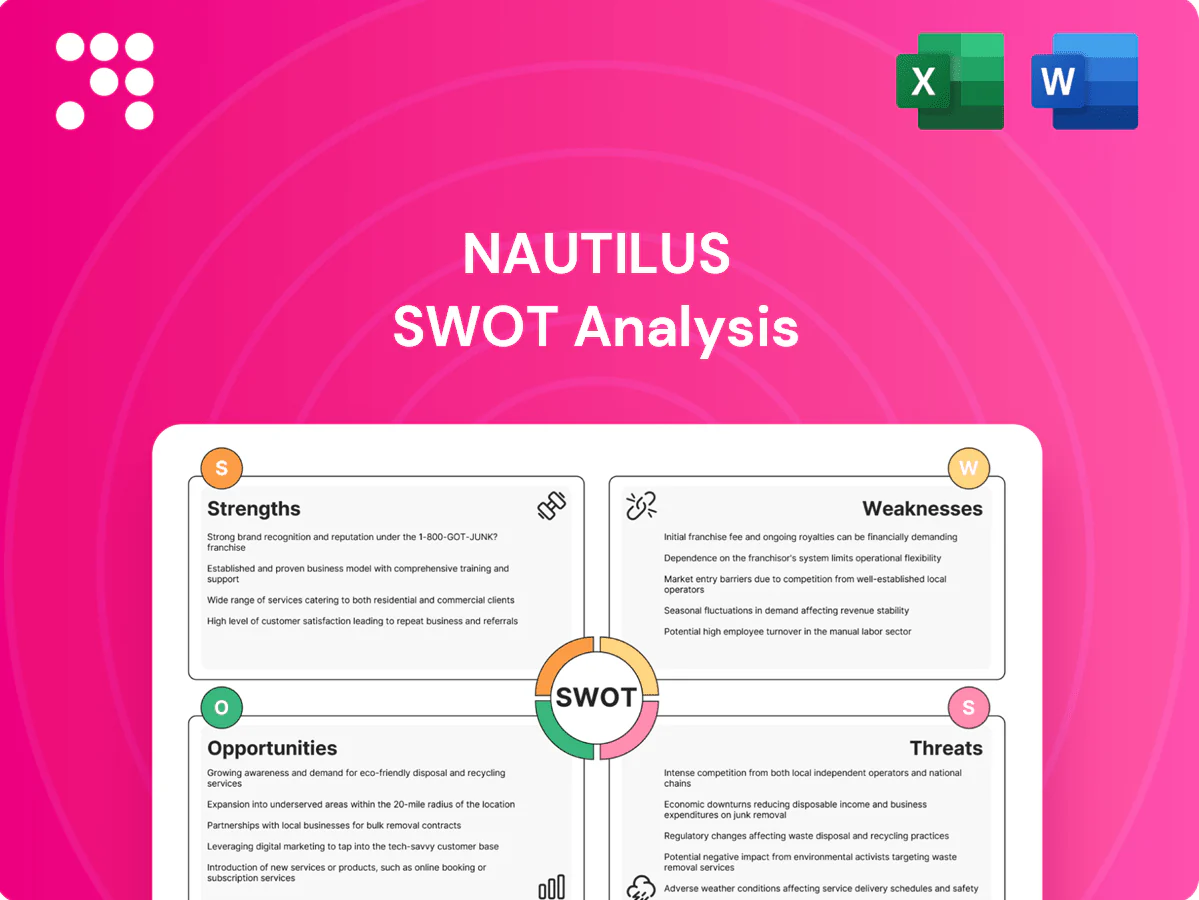
Nautilus SWOT Analysis

Go Beyond the Preview—Access the Full Strategic Report
Nautilus SWOT Analysis reveals key strengths, vulnerabilities, and market opportunities for the fitness-equipment leader. This snapshot highlights brand power, cost pressures, and growth levers. Want the full picture? Purchase the complete, editable SWOT (Word + Excel) for strategy and investment-ready insights.
Strengths

Multi-brand portfolio
Operating Bowflex, Schwinn Fitness, and Nautilus lets the company cover entry, mid and premium price tiers and diverse user needs, supporting cross-selling and reducing reliance on any single marque. The multi-brand breadth enables placement across big-box, specialty retail and e-commerce channels such as Amazon and direct-to-consumer, widening distribution. This diversification helps stabilize revenue across economic cycles and seasonal swings.
Home fitness focus
Deep specialization in at-home cardio and strength gives Nautilus strong product fit for space-constrained users, with designs emphasizing compactness and convenience such as foldable treadmills and all-in-one resistance systems. This aligns with sustained hybrid workout habits and differentiates Nautilus from gym-only equipment makers by targeting apartment and home-office consumers. The focus supports recurring accessory and subscription opportunities.

Connected ecosystem
Nautilus leverages a connected ecosystem where digital subscriptions and content layer coaching, metrics, and engagement onto equipment, mirroring the broader market that surpassed roughly 300 million fitness app users by 2023; this hardware-plus-software model increases stickiness and upsell potential. Continuous data feedback loops drive faster product iteration, and recurring subscription revenue complements one-time equipment sales, smoothing cash flow and LTV.

Omnichannel distribution
Omnichannel distribution lets Nautilus sell direct-to-consumer, via online marketplaces and through retail partners, widening reach and reducing dependence on any single channel. Multiple routes mitigate channel risk and inventory bottlenecks while enabling targeted promotions by customer segment. Cross-channel visibility strengthens brand awareness and supports coordinated marketing and replenishment.
Brand recognition
As of 2024 the Nautilus name carries over 50 years of recognition, supporting trust and consideration, lowering customer acquisition costs through heritage-driven awareness; established service and support networks across retail and service partners improve post-purchase satisfaction and help drive repeat purchases and referrals.
- Legacy brand: >50 years
- Lower CAC via brand trust
- Established service/support network
- Drives repeat purchases & referrals
Multi-brand fitness portfolio: compact connected equipment for hybrid, space-constrained users
Multi-brand portfolio (Bowflex, Schwinn, Nautilus) covers entry-to-premium tiers, enabling cross-sell and channel breadth. Deep focus on compact at-home cardio/strength fits hybrid, space-constrained users. Connected hardware-plus-software increases stickiness alongside >300 million global fitness app users (2023) and a legacy brand of over 50 years.
| Metric | Value |
|---|---|
| Brand age | >50 years |
| Fitness app users | ~300M (2023) |
| Channels | DTC / Marketplaces / Retail |
What is included in the product
 Detailed Word Document
Provides a concise SWOT analysis of Nautilus, highlighting internal strengths and weaknesses alongside external opportunities and threats that shape its competitive position and strategic outlook.

 Customizable Excel Spreadsheet
Provides a focused Nautilus SWOT matrix that quickly identifies strengths, weaknesses, opportunities and threats to resolve strategic bottlenecks. Editable layout and visual clarity streamline stakeholder alignment and enable fast, actionable decisions.
Weaknesses

Consumer cyclicality
Demand for Nautilus home-fitness gear is highly cyclical, tied to discretionary spending; sales jumped during the COVID peak but fell thereafter, with net sales slipping from about $464.9 million in FY2021 to roughly $315.4 million in FY2023, highlighting sensitivity to consumer spending shifts.
Macroeconomic slowdowns and weakened consumer confidence can defer purchases, creating revenue volatility and planning challenges for product launches and marketing cadence.
Inventory builds and stretched receivables in downturns compress cash flow and working capital, increasing financing needs and margin pressure during off-cycle periods.
Hardware margin pressure
Large, heavy equipment drives high manufacturing and freight costs, and Nautilus reported gross margin pressure in FY2024 as promotional intensity compressed margins by several hundred basis points; servicing warranties and returns further raise unit economics, and profit mix increasingly depends on scaling subscription and recurring-revenue services to offset lower hardware profitability.

Post-boom normalization
Pandemic-era spikes in demand have eased after the 2020–21 peak, reducing one-time volume tailwinds for Nautilus. Replacement cycles for durable fitness equipment are long, typically 7–12 years, which can slow reorder cadence. Slower repeat purchases and uneven consumer demand make forecasting harder without a stable baseline. This increases revenue volatility and planning risk.

Tech parity risk
Tech parity risk: connected features are now table stakes across competitors, with Peloton reporting about 2.8 million connected fitness subscribers in 2024, raising customer expectations and compressing differentiation.
Rapid innovation cycles make devices feel dated within 12–18 months; maintaining software quality across multiple SKUs strains R&D and support budgets and risks fragmentation that hinders seamless UX.
- Market expectation: connected features table stakes
- Peloton ~2.8M subscribers (2024)
- Innovation cycle: 12–18 months
- SKU fragmentation → UX inconsistency
Supply chain complexity
Global sourcing, bulky shipping and congested port logistics increase transit risk for Nautilus, raising lead-time variability and exposure to carrier delays.
Tariffs and freight-rate volatility pressure margins and pricing flexibility, while component shortages have pushed product launch timelines and inventory rebalancing.
Quality control across multiple vendors demands continuous audits and inspection to protect brand reputation.
- Global sourcing risk
- Freight/tariff margin pressure
- Component shortage delays
- Vendor QC burden
Sales slid from $464.9M to $315.4M; margins down ~300 bps
Sales fell from $464.9M (FY2021) to $315.4M (FY2023), showing high cyclicality and demand sensitivity. FY2024 gross margin compressed ~300 bps amid promotions and higher freight; inventory builds strained cash flow. Long replacement cycles (7–12 years) and tech parity (Peloton ~2.8M connected subs in 2024) limit repeat purchases and differentiation.
| Metric | Value |
|---|---|
| FY2021 Net Sales | $464.9M |
| FY2023 Net Sales | $315.4M |
| FY2024 GM change | ≈-300 bps |
| Replacement cycle | 7–12 yrs |
| Peloton connected subs (2024) | ≈2.8M |
Same Document Delivered
Nautilus SWOT Analysis
This is the actual Nautilus SWOT analysis document you’ll receive upon purchase—no surprises, just professional quality. The preview below is taken directly from the full SWOT report you'll get. Once purchased, the complete, editable version is unlocked for immediate download.

Go Beyond the Preview—Access the Full Strategic Report
Nautilus SWOT Analysis reveals key strengths, vulnerabilities, and market opportunities for the fitness-equipment leader. This snapshot highlights brand power, cost pressures, and growth levers. Want the full picture? Purchase the complete, editable SWOT (Word + Excel) for strategy and investment-ready insights.
Strengths
Multi-brand portfolio
Operating Bowflex, Schwinn Fitness, and Nautilus lets the company cover entry, mid and premium price tiers and diverse user needs, supporting cross-selling and reducing reliance on any single marque. The multi-brand breadth enables placement across big-box, specialty retail and e-commerce channels such as Amazon and direct-to-consumer, widening distribution. This diversification helps stabilize revenue across economic cycles and seasonal swings.
Home fitness focus
Deep specialization in at-home cardio and strength gives Nautilus strong product fit for space-constrained users, with designs emphasizing compactness and convenience such as foldable treadmills and all-in-one resistance systems. This aligns with sustained hybrid workout habits and differentiates Nautilus from gym-only equipment makers by targeting apartment and home-office consumers. The focus supports recurring accessory and subscription opportunities.
Connected ecosystem
Nautilus leverages a connected ecosystem where digital subscriptions and content layer coaching, metrics, and engagement onto equipment, mirroring the broader market that surpassed roughly 300 million fitness app users by 2023; this hardware-plus-software model increases stickiness and upsell potential. Continuous data feedback loops drive faster product iteration, and recurring subscription revenue complements one-time equipment sales, smoothing cash flow and LTV.
Omnichannel distribution
Omnichannel distribution lets Nautilus sell direct-to-consumer, via online marketplaces and through retail partners, widening reach and reducing dependence on any single channel. Multiple routes mitigate channel risk and inventory bottlenecks while enabling targeted promotions by customer segment. Cross-channel visibility strengthens brand awareness and supports coordinated marketing and replenishment.
Brand recognition
As of 2024 the Nautilus name carries over 50 years of recognition, supporting trust and consideration, lowering customer acquisition costs through heritage-driven awareness; established service and support networks across retail and service partners improve post-purchase satisfaction and help drive repeat purchases and referrals.
- Legacy brand: >50 years
- Lower CAC via brand trust
- Established service/support network
- Drives repeat purchases & referrals
Multi-brand fitness portfolio: compact connected equipment for hybrid, space-constrained users
Multi-brand portfolio (Bowflex, Schwinn, Nautilus) covers entry-to-premium tiers, enabling cross-sell and channel breadth. Deep focus on compact at-home cardio/strength fits hybrid, space-constrained users. Connected hardware-plus-software increases stickiness alongside >300 million global fitness app users (2023) and a legacy brand of over 50 years.
| Metric | Value |
|---|---|
| Brand age | >50 years |
| Fitness app users | ~300M (2023) |
| Channels | DTC / Marketplaces / Retail |
What is included in the product
Detailed Word Document
Provides a concise SWOT analysis of Nautilus, highlighting internal strengths and weaknesses alongside external opportunities and threats that shape its competitive position and strategic outlook.
Customizable Excel Spreadsheet
Provides a focused Nautilus SWOT matrix that quickly identifies strengths, weaknesses, opportunities and threats to resolve strategic bottlenecks. Editable layout and visual clarity streamline stakeholder alignment and enable fast, actionable decisions.
Weaknesses
Consumer cyclicality
Demand for Nautilus home-fitness gear is highly cyclical, tied to discretionary spending; sales jumped during the COVID peak but fell thereafter, with net sales slipping from about $464.9 million in FY2021 to roughly $315.4 million in FY2023, highlighting sensitivity to consumer spending shifts.
Macroeconomic slowdowns and weakened consumer confidence can defer purchases, creating revenue volatility and planning challenges for product launches and marketing cadence.
Inventory builds and stretched receivables in downturns compress cash flow and working capital, increasing financing needs and margin pressure during off-cycle periods.
Hardware margin pressure
Large, heavy equipment drives high manufacturing and freight costs, and Nautilus reported gross margin pressure in FY2024 as promotional intensity compressed margins by several hundred basis points; servicing warranties and returns further raise unit economics, and profit mix increasingly depends on scaling subscription and recurring-revenue services to offset lower hardware profitability.
Post-boom normalization
Pandemic-era spikes in demand have eased after the 2020–21 peak, reducing one-time volume tailwinds for Nautilus. Replacement cycles for durable fitness equipment are long, typically 7–12 years, which can slow reorder cadence. Slower repeat purchases and uneven consumer demand make forecasting harder without a stable baseline. This increases revenue volatility and planning risk.
Tech parity risk
Tech parity risk: connected features are now table stakes across competitors, with Peloton reporting about 2.8 million connected fitness subscribers in 2024, raising customer expectations and compressing differentiation.
Rapid innovation cycles make devices feel dated within 12–18 months; maintaining software quality across multiple SKUs strains R&D and support budgets and risks fragmentation that hinders seamless UX.
- Market expectation: connected features table stakes
- Peloton ~2.8M subscribers (2024)
- Innovation cycle: 12–18 months
- SKU fragmentation → UX inconsistency
Supply chain complexity
Global sourcing, bulky shipping and congested port logistics increase transit risk for Nautilus, raising lead-time variability and exposure to carrier delays.
Tariffs and freight-rate volatility pressure margins and pricing flexibility, while component shortages have pushed product launch timelines and inventory rebalancing.
Quality control across multiple vendors demands continuous audits and inspection to protect brand reputation.
- Global sourcing risk
- Freight/tariff margin pressure
- Component shortage delays
- Vendor QC burden
Sales slid from $464.9M to $315.4M; margins down ~300 bps
Sales fell from $464.9M (FY2021) to $315.4M (FY2023), showing high cyclicality and demand sensitivity. FY2024 gross margin compressed ~300 bps amid promotions and higher freight; inventory builds strained cash flow. Long replacement cycles (7–12 years) and tech parity (Peloton ~2.8M connected subs in 2024) limit repeat purchases and differentiation.
| Metric | Value |
|---|---|
| FY2021 Net Sales | $464.9M |
| FY2023 Net Sales | $315.4M |
| FY2024 GM change | ≈-300 bps |
| Replacement cycle | 7–12 yrs |
| Peloton connected subs (2024) | ≈2.8M |
Same Document Delivered
Nautilus SWOT Analysis
This is the actual Nautilus SWOT analysis document you’ll receive upon purchase—no surprises, just professional quality. The preview below is taken directly from the full SWOT report you'll get. Once purchased, the complete, editable version is unlocked for immediate download.
Original: $10.00
-65%$10.00
$3.50Description
Go Beyond the Preview—Access the Full Strategic Report
Nautilus SWOT Analysis reveals key strengths, vulnerabilities, and market opportunities for the fitness-equipment leader. This snapshot highlights brand power, cost pressures, and growth levers. Want the full picture? Purchase the complete, editable SWOT (Word + Excel) for strategy and investment-ready insights.
Strengths
Multi-brand portfolio
Operating Bowflex, Schwinn Fitness, and Nautilus lets the company cover entry, mid and premium price tiers and diverse user needs, supporting cross-selling and reducing reliance on any single marque. The multi-brand breadth enables placement across big-box, specialty retail and e-commerce channels such as Amazon and direct-to-consumer, widening distribution. This diversification helps stabilize revenue across economic cycles and seasonal swings.
Home fitness focus
Deep specialization in at-home cardio and strength gives Nautilus strong product fit for space-constrained users, with designs emphasizing compactness and convenience such as foldable treadmills and all-in-one resistance systems. This aligns with sustained hybrid workout habits and differentiates Nautilus from gym-only equipment makers by targeting apartment and home-office consumers. The focus supports recurring accessory and subscription opportunities.
Connected ecosystem
Nautilus leverages a connected ecosystem where digital subscriptions and content layer coaching, metrics, and engagement onto equipment, mirroring the broader market that surpassed roughly 300 million fitness app users by 2023; this hardware-plus-software model increases stickiness and upsell potential. Continuous data feedback loops drive faster product iteration, and recurring subscription revenue complements one-time equipment sales, smoothing cash flow and LTV.
Omnichannel distribution
Omnichannel distribution lets Nautilus sell direct-to-consumer, via online marketplaces and through retail partners, widening reach and reducing dependence on any single channel. Multiple routes mitigate channel risk and inventory bottlenecks while enabling targeted promotions by customer segment. Cross-channel visibility strengthens brand awareness and supports coordinated marketing and replenishment.
Brand recognition
As of 2024 the Nautilus name carries over 50 years of recognition, supporting trust and consideration, lowering customer acquisition costs through heritage-driven awareness; established service and support networks across retail and service partners improve post-purchase satisfaction and help drive repeat purchases and referrals.
- Legacy brand: >50 years
- Lower CAC via brand trust
- Established service/support network
- Drives repeat purchases & referrals
Multi-brand fitness portfolio: compact connected equipment for hybrid, space-constrained users
Multi-brand portfolio (Bowflex, Schwinn, Nautilus) covers entry-to-premium tiers, enabling cross-sell and channel breadth. Deep focus on compact at-home cardio/strength fits hybrid, space-constrained users. Connected hardware-plus-software increases stickiness alongside >300 million global fitness app users (2023) and a legacy brand of over 50 years.
| Metric | Value |
|---|---|
| Brand age | >50 years |
| Fitness app users | ~300M (2023) |
| Channels | DTC / Marketplaces / Retail |
What is included in the product
Detailed Word Document
Provides a concise SWOT analysis of Nautilus, highlighting internal strengths and weaknesses alongside external opportunities and threats that shape its competitive position and strategic outlook.
Customizable Excel Spreadsheet
Provides a focused Nautilus SWOT matrix that quickly identifies strengths, weaknesses, opportunities and threats to resolve strategic bottlenecks. Editable layout and visual clarity streamline stakeholder alignment and enable fast, actionable decisions.
Weaknesses
Consumer cyclicality
Demand for Nautilus home-fitness gear is highly cyclical, tied to discretionary spending; sales jumped during the COVID peak but fell thereafter, with net sales slipping from about $464.9 million in FY2021 to roughly $315.4 million in FY2023, highlighting sensitivity to consumer spending shifts.
Macroeconomic slowdowns and weakened consumer confidence can defer purchases, creating revenue volatility and planning challenges for product launches and marketing cadence.
Inventory builds and stretched receivables in downturns compress cash flow and working capital, increasing financing needs and margin pressure during off-cycle periods.
Hardware margin pressure
Large, heavy equipment drives high manufacturing and freight costs, and Nautilus reported gross margin pressure in FY2024 as promotional intensity compressed margins by several hundred basis points; servicing warranties and returns further raise unit economics, and profit mix increasingly depends on scaling subscription and recurring-revenue services to offset lower hardware profitability.
Post-boom normalization
Pandemic-era spikes in demand have eased after the 2020–21 peak, reducing one-time volume tailwinds for Nautilus. Replacement cycles for durable fitness equipment are long, typically 7–12 years, which can slow reorder cadence. Slower repeat purchases and uneven consumer demand make forecasting harder without a stable baseline. This increases revenue volatility and planning risk.
Tech parity risk
Tech parity risk: connected features are now table stakes across competitors, with Peloton reporting about 2.8 million connected fitness subscribers in 2024, raising customer expectations and compressing differentiation.
Rapid innovation cycles make devices feel dated within 12–18 months; maintaining software quality across multiple SKUs strains R&D and support budgets and risks fragmentation that hinders seamless UX.
- Market expectation: connected features table stakes
- Peloton ~2.8M subscribers (2024)
- Innovation cycle: 12–18 months
- SKU fragmentation → UX inconsistency
Supply chain complexity
Global sourcing, bulky shipping and congested port logistics increase transit risk for Nautilus, raising lead-time variability and exposure to carrier delays.
Tariffs and freight-rate volatility pressure margins and pricing flexibility, while component shortages have pushed product launch timelines and inventory rebalancing.
Quality control across multiple vendors demands continuous audits and inspection to protect brand reputation.
- Global sourcing risk
- Freight/tariff margin pressure
- Component shortage delays
- Vendor QC burden
Sales slid from $464.9M to $315.4M; margins down ~300 bps
Sales fell from $464.9M (FY2021) to $315.4M (FY2023), showing high cyclicality and demand sensitivity. FY2024 gross margin compressed ~300 bps amid promotions and higher freight; inventory builds strained cash flow. Long replacement cycles (7–12 years) and tech parity (Peloton ~2.8M connected subs in 2024) limit repeat purchases and differentiation.
| Metric | Value |
|---|---|
| FY2021 Net Sales | $464.9M |
| FY2023 Net Sales | $315.4M |
| FY2024 GM change | ≈-300 bps |
| Replacement cycle | 7–12 yrs |
| Peloton connected subs (2024) | ≈2.8M |
Same Document Delivered
Nautilus SWOT Analysis
This is the actual Nautilus SWOT analysis document you’ll receive upon purchase—no surprises, just professional quality. The preview below is taken directly from the full SWOT report you'll get. Once purchased, the complete, editable version is unlocked for immediate download.











