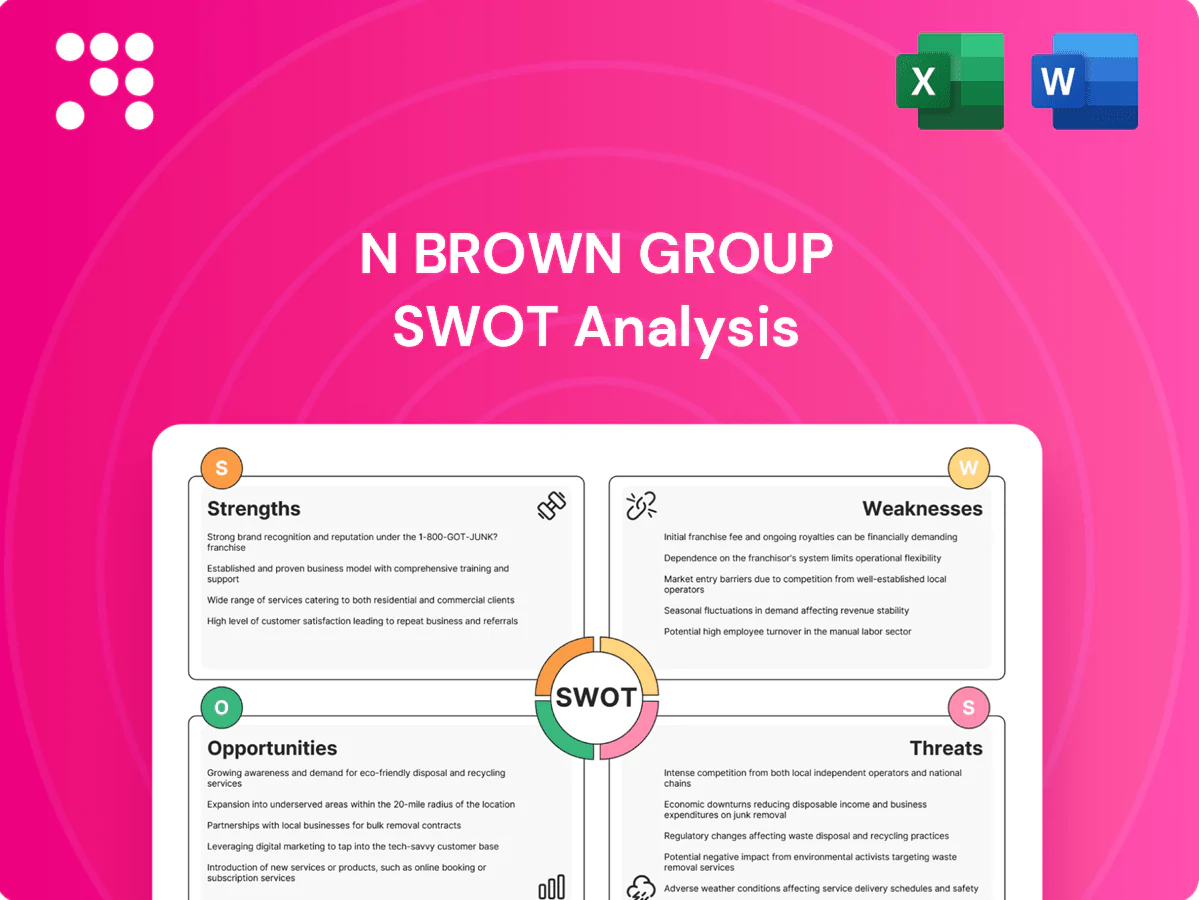
N Brown Group SWOT Analysis

Go Beyond the Preview—Access the Full Strategic Report
N Brown Group's SWOT analysis highlights its strong online retail expertise and loyal customer base, weighed against fashion market volatility and legacy operational costs. Our full report drills into financial implications, competitive threats, and clear strategic levers to accelerate recovery and growth. Purchase the complete, editable SWOT—Word and Excel deliverables—to get research-backed insights and actionable recommendations for investors, strategists, and advisors.
Strengths

Niche size-inclusive focus
Specialization in plus-size and age-appropriate apparel (brands including Simply Be and Jacamo) differentiates N Brown’s offer and reduces head-to-head clashes with mass-market fashion. Deep sizing expertise drives better fit and satisfaction, supporting higher repeat purchase rates and weaker churn. The focus builds community trust and brand loyalty across over 3 million active customers, strengthening a defensible niche.
Diversified brand portfolio
N Brown’s five-brand portfolio (JD Williams, Simply Be, Jacamo, Ambrose Wilson, and Homebase? ) enables tailored propositions by style, age and price point, serving c.3 million active customers. The breadth spreads risk across segments and categories, supporting FY2024 group revenue of £458.8m. Cross-selling across brands lifts basket size and lifetime value, while distinct brand positioning avoids dilution of individual identities.

Digital-first direct model
N Brown’s digital-first direct model, serving about 3 million active customers, removes store overhead and enables rapid online iteration across product and UX. Direct-to-consumer control lets the group set pricing, tailor merchandising and retain customer data for personalization. Faster feedback loops improve product-market fit and support higher gross margins versus wholesale-reliant peers.

Homeware adjacency
Homeware adjacency lets N Brown extend share of wallet beyond apparel, smoothing seasonality and broadening average order values; cross-category bundles commonly lift conversion and AOV. The category attracts older shoppers aligned with N Brown's core 50+ customer base, supporting higher retention and lifetime value.
- Broadens AOV and reduces seasonality
- Cross-sell uplifts typically 10–20%
- Targets 50+ demographic, core for N Brown
Customer data and personalization
N Brown’s end-to-end digital journeys across JD Williams, Jacamo and other brands capture rich behavioural and size data that enables hyper-personalization, which McKinsey (2021) estimates can lift revenues by 10–15% and improve conversion. Personalization reduces returns and increases conversion through better fit and targeted offers; segmented campaigns lower acquisition costs and improve ROI while insights inform inventory, fit curves and product design decisions.
- data: end-to-end behavioural & size signals
- impact: personalization can boost revenue 10–15% (McKinsey 2021)
- outcomes: fewer returns, higher conversion, lower acquisition cost
- use: guides inventory, fit curves, design
Plus-size DTC: c.3m customers, £458.8m FY24, personalization 10–15%
N Brown specialises in plus-size/age-appropriate apparel (Simply Be, Jacamo) serving c.3m active customers and FY2024 group revenue £458.8m, creating a defensible niche and high repeat rates. Digital-first DTC model captures sizing/behavioural data, enabling personalization (McKinsey 10–15% revenue uplift). Cross-sell/homeware smooths seasonality and lifts AOV 10–20%.
| Metric | Value |
|---|---|
| Active customers | c.3m |
| FY2024 revenue | £458.8m |
| Personalization uplift | 10–15% |
| Cross-sell AOV lift | 10–20% |
What is included in the product
 Detailed Word Document
Delivers a strategic overview of N Brown Group’s internal and external business factors, outlining strengths, weaknesses, opportunities and threats to assess competitive position, operational gaps and growth prospects.

 Customizable Excel Spreadsheet
Delivers a concise SWOT matrix tailored to N Brown Group for rapid strategic alignment and stakeholder-ready summaries; editable format allows quick updates to reflect shifting priorities and streamline decision-making.
Weaknesses

Concentration in specific demographics
N Brown (LSE: BWNG) relies heavily on plus-size and older customer segments, narrowing its addressable market relative to mainstream fashion retailers. Demand shocks in these niches—driven by changing demographics or spending patterns—can disproportionately hit sales and margins. Brand perceptions around size and age slow expansion into adjacent younger or mainstream segments, limiting growth velocity and scale benefits.
High returns in apparel e-commerce
Fit-sensitive apparel drives elevated online return rates, typically cited at c.20–40% for fashion e‑commerce, pressuring N Brown’s margins. Reverse logistics and restocking consume time and cash, eroding profitability and straining working capital. Frequent returns also degrade customer experience through sizing confusion and delays, while complicating demand forecasting and inventory planning.

Brand modernization challenges
Serving older demographics (UK 65+ cohort was 18.6% in mid-2023) can signal conservative styling to younger audiences, making modernization harder. Refreshing brand tone without alienating a core 55+ customer base is delicate and risky. Slow trend adoption risks ceding share to faster players, and effective image repositioning requires sustained multiyear investment.

Dependence on digital marketing
Performance ads and paid social are the primary drivers of N Brown Group’s traffic, leaving acquisition sensitive to rising CPMs that compress contribution margins; algorithmic platform changes can sharply reduce reach and customer acquisition overnight. Heavy reliance on paid channels increases volatility in customer growth and marketing ROI, amplifying cashflow and forecasting risk for the retailer.
- Paid channels = main traffic source
- Rising CPMs hurt margins
- Algorithm shifts reduce reach
- High reliance increases growth volatility
Supply chain and sizing complexity
Wide size curves drive SKU proliferation and inventory risk, increasing holding costs and markdown exposure as forecasting across many fits becomes less accurate and more volatile.
- SKU proliferation raises inventory and markdown risk
- Multiple fits complicate demand forecasting
- Vendor alignment on quality is critical
- Complexity slows speed-to-market vs lean assortments
Plus-size and 55+ niche narrows market; fit-driven 20–40% returns & high acquisition costs
N Brown’s focus on plus-size and older (55+) cohorts narrows addressable market and hinders expansion into younger mainstream segments, concentrating demand risk. High fit-sensitivity drives online return rates of c.20–40%, inflating reverse-logistics costs and compressing margins. Heavy reliance on paid performance channels increases acquisition volatility and CPM exposure.
| Metric | Value / Source |
|---|---|
| Fashion e‑commerce return rate | c.20–40% (industry) |
| UK 65+ population | 18.6% (mid-2023) |
Preview the Actual Deliverable
N Brown Group SWOT Analysis
This is the actual N Brown Group SWOT analysis document you’ll receive upon purchase—no surprises, just professional quality. The preview below is taken directly from the full SWOT report you'll get, and the complete, editable version is unlocked after payment. Buy now to download the full, detailed file immediately.

Go Beyond the Preview—Access the Full Strategic Report
N Brown Group's SWOT analysis highlights its strong online retail expertise and loyal customer base, weighed against fashion market volatility and legacy operational costs. Our full report drills into financial implications, competitive threats, and clear strategic levers to accelerate recovery and growth. Purchase the complete, editable SWOT—Word and Excel deliverables—to get research-backed insights and actionable recommendations for investors, strategists, and advisors.
Strengths
Niche size-inclusive focus
Specialization in plus-size and age-appropriate apparel (brands including Simply Be and Jacamo) differentiates N Brown’s offer and reduces head-to-head clashes with mass-market fashion. Deep sizing expertise drives better fit and satisfaction, supporting higher repeat purchase rates and weaker churn. The focus builds community trust and brand loyalty across over 3 million active customers, strengthening a defensible niche.
Diversified brand portfolio
N Brown’s five-brand portfolio (JD Williams, Simply Be, Jacamo, Ambrose Wilson, and Homebase? ) enables tailored propositions by style, age and price point, serving c.3 million active customers. The breadth spreads risk across segments and categories, supporting FY2024 group revenue of £458.8m. Cross-selling across brands lifts basket size and lifetime value, while distinct brand positioning avoids dilution of individual identities.
Digital-first direct model
N Brown’s digital-first direct model, serving about 3 million active customers, removes store overhead and enables rapid online iteration across product and UX. Direct-to-consumer control lets the group set pricing, tailor merchandising and retain customer data for personalization. Faster feedback loops improve product-market fit and support higher gross margins versus wholesale-reliant peers.
Homeware adjacency
Homeware adjacency lets N Brown extend share of wallet beyond apparel, smoothing seasonality and broadening average order values; cross-category bundles commonly lift conversion and AOV. The category attracts older shoppers aligned with N Brown's core 50+ customer base, supporting higher retention and lifetime value.
- Broadens AOV and reduces seasonality
- Cross-sell uplifts typically 10–20%
- Targets 50+ demographic, core for N Brown
Customer data and personalization
N Brown’s end-to-end digital journeys across JD Williams, Jacamo and other brands capture rich behavioural and size data that enables hyper-personalization, which McKinsey (2021) estimates can lift revenues by 10–15% and improve conversion. Personalization reduces returns and increases conversion through better fit and targeted offers; segmented campaigns lower acquisition costs and improve ROI while insights inform inventory, fit curves and product design decisions.
- data: end-to-end behavioural & size signals
- impact: personalization can boost revenue 10–15% (McKinsey 2021)
- outcomes: fewer returns, higher conversion, lower acquisition cost
- use: guides inventory, fit curves, design
Plus-size DTC: c.3m customers, £458.8m FY24, personalization 10–15%
N Brown specialises in plus-size/age-appropriate apparel (Simply Be, Jacamo) serving c.3m active customers and FY2024 group revenue £458.8m, creating a defensible niche and high repeat rates. Digital-first DTC model captures sizing/behavioural data, enabling personalization (McKinsey 10–15% revenue uplift). Cross-sell/homeware smooths seasonality and lifts AOV 10–20%.
| Metric | Value |
|---|---|
| Active customers | c.3m |
| FY2024 revenue | £458.8m |
| Personalization uplift | 10–15% |
| Cross-sell AOV lift | 10–20% |
What is included in the product
Detailed Word Document
Delivers a strategic overview of N Brown Group’s internal and external business factors, outlining strengths, weaknesses, opportunities and threats to assess competitive position, operational gaps and growth prospects.
Customizable Excel Spreadsheet
Delivers a concise SWOT matrix tailored to N Brown Group for rapid strategic alignment and stakeholder-ready summaries; editable format allows quick updates to reflect shifting priorities and streamline decision-making.
Weaknesses
Concentration in specific demographics
N Brown (LSE: BWNG) relies heavily on plus-size and older customer segments, narrowing its addressable market relative to mainstream fashion retailers. Demand shocks in these niches—driven by changing demographics or spending patterns—can disproportionately hit sales and margins. Brand perceptions around size and age slow expansion into adjacent younger or mainstream segments, limiting growth velocity and scale benefits.
High returns in apparel e-commerce
Fit-sensitive apparel drives elevated online return rates, typically cited at c.20–40% for fashion e‑commerce, pressuring N Brown’s margins. Reverse logistics and restocking consume time and cash, eroding profitability and straining working capital. Frequent returns also degrade customer experience through sizing confusion and delays, while complicating demand forecasting and inventory planning.
Brand modernization challenges
Serving older demographics (UK 65+ cohort was 18.6% in mid-2023) can signal conservative styling to younger audiences, making modernization harder. Refreshing brand tone without alienating a core 55+ customer base is delicate and risky. Slow trend adoption risks ceding share to faster players, and effective image repositioning requires sustained multiyear investment.
Dependence on digital marketing
Performance ads and paid social are the primary drivers of N Brown Group’s traffic, leaving acquisition sensitive to rising CPMs that compress contribution margins; algorithmic platform changes can sharply reduce reach and customer acquisition overnight. Heavy reliance on paid channels increases volatility in customer growth and marketing ROI, amplifying cashflow and forecasting risk for the retailer.
- Paid channels = main traffic source
- Rising CPMs hurt margins
- Algorithm shifts reduce reach
- High reliance increases growth volatility
Supply chain and sizing complexity
Wide size curves drive SKU proliferation and inventory risk, increasing holding costs and markdown exposure as forecasting across many fits becomes less accurate and more volatile.
- SKU proliferation raises inventory and markdown risk
- Multiple fits complicate demand forecasting
- Vendor alignment on quality is critical
- Complexity slows speed-to-market vs lean assortments
Plus-size and 55+ niche narrows market; fit-driven 20–40% returns & high acquisition costs
N Brown’s focus on plus-size and older (55+) cohorts narrows addressable market and hinders expansion into younger mainstream segments, concentrating demand risk. High fit-sensitivity drives online return rates of c.20–40%, inflating reverse-logistics costs and compressing margins. Heavy reliance on paid performance channels increases acquisition volatility and CPM exposure.
| Metric | Value / Source |
|---|---|
| Fashion e‑commerce return rate | c.20–40% (industry) |
| UK 65+ population | 18.6% (mid-2023) |
Preview the Actual Deliverable
N Brown Group SWOT Analysis
This is the actual N Brown Group SWOT analysis document you’ll receive upon purchase—no surprises, just professional quality. The preview below is taken directly from the full SWOT report you'll get, and the complete, editable version is unlocked after payment. Buy now to download the full, detailed file immediately.
Description
Go Beyond the Preview—Access the Full Strategic Report
N Brown Group's SWOT analysis highlights its strong online retail expertise and loyal customer base, weighed against fashion market volatility and legacy operational costs. Our full report drills into financial implications, competitive threats, and clear strategic levers to accelerate recovery and growth. Purchase the complete, editable SWOT—Word and Excel deliverables—to get research-backed insights and actionable recommendations for investors, strategists, and advisors.
Strengths
Niche size-inclusive focus
Specialization in plus-size and age-appropriate apparel (brands including Simply Be and Jacamo) differentiates N Brown’s offer and reduces head-to-head clashes with mass-market fashion. Deep sizing expertise drives better fit and satisfaction, supporting higher repeat purchase rates and weaker churn. The focus builds community trust and brand loyalty across over 3 million active customers, strengthening a defensible niche.
Diversified brand portfolio
N Brown’s five-brand portfolio (JD Williams, Simply Be, Jacamo, Ambrose Wilson, and Homebase? ) enables tailored propositions by style, age and price point, serving c.3 million active customers. The breadth spreads risk across segments and categories, supporting FY2024 group revenue of £458.8m. Cross-selling across brands lifts basket size and lifetime value, while distinct brand positioning avoids dilution of individual identities.
Digital-first direct model
N Brown’s digital-first direct model, serving about 3 million active customers, removes store overhead and enables rapid online iteration across product and UX. Direct-to-consumer control lets the group set pricing, tailor merchandising and retain customer data for personalization. Faster feedback loops improve product-market fit and support higher gross margins versus wholesale-reliant peers.
Homeware adjacency
Homeware adjacency lets N Brown extend share of wallet beyond apparel, smoothing seasonality and broadening average order values; cross-category bundles commonly lift conversion and AOV. The category attracts older shoppers aligned with N Brown's core 50+ customer base, supporting higher retention and lifetime value.
- Broadens AOV and reduces seasonality
- Cross-sell uplifts typically 10–20%
- Targets 50+ demographic, core for N Brown
Customer data and personalization
N Brown’s end-to-end digital journeys across JD Williams, Jacamo and other brands capture rich behavioural and size data that enables hyper-personalization, which McKinsey (2021) estimates can lift revenues by 10–15% and improve conversion. Personalization reduces returns and increases conversion through better fit and targeted offers; segmented campaigns lower acquisition costs and improve ROI while insights inform inventory, fit curves and product design decisions.
- data: end-to-end behavioural & size signals
- impact: personalization can boost revenue 10–15% (McKinsey 2021)
- outcomes: fewer returns, higher conversion, lower acquisition cost
- use: guides inventory, fit curves, design
Plus-size DTC: c.3m customers, £458.8m FY24, personalization 10–15%
N Brown specialises in plus-size/age-appropriate apparel (Simply Be, Jacamo) serving c.3m active customers and FY2024 group revenue £458.8m, creating a defensible niche and high repeat rates. Digital-first DTC model captures sizing/behavioural data, enabling personalization (McKinsey 10–15% revenue uplift). Cross-sell/homeware smooths seasonality and lifts AOV 10–20%.
| Metric | Value |
|---|---|
| Active customers | c.3m |
| FY2024 revenue | £458.8m |
| Personalization uplift | 10–15% |
| Cross-sell AOV lift | 10–20% |
What is included in the product
Detailed Word Document
Delivers a strategic overview of N Brown Group’s internal and external business factors, outlining strengths, weaknesses, opportunities and threats to assess competitive position, operational gaps and growth prospects.
Customizable Excel Spreadsheet
Delivers a concise SWOT matrix tailored to N Brown Group for rapid strategic alignment and stakeholder-ready summaries; editable format allows quick updates to reflect shifting priorities and streamline decision-making.
Weaknesses
Concentration in specific demographics
N Brown (LSE: BWNG) relies heavily on plus-size and older customer segments, narrowing its addressable market relative to mainstream fashion retailers. Demand shocks in these niches—driven by changing demographics or spending patterns—can disproportionately hit sales and margins. Brand perceptions around size and age slow expansion into adjacent younger or mainstream segments, limiting growth velocity and scale benefits.
High returns in apparel e-commerce
Fit-sensitive apparel drives elevated online return rates, typically cited at c.20–40% for fashion e‑commerce, pressuring N Brown’s margins. Reverse logistics and restocking consume time and cash, eroding profitability and straining working capital. Frequent returns also degrade customer experience through sizing confusion and delays, while complicating demand forecasting and inventory planning.
Brand modernization challenges
Serving older demographics (UK 65+ cohort was 18.6% in mid-2023) can signal conservative styling to younger audiences, making modernization harder. Refreshing brand tone without alienating a core 55+ customer base is delicate and risky. Slow trend adoption risks ceding share to faster players, and effective image repositioning requires sustained multiyear investment.
Dependence on digital marketing
Performance ads and paid social are the primary drivers of N Brown Group’s traffic, leaving acquisition sensitive to rising CPMs that compress contribution margins; algorithmic platform changes can sharply reduce reach and customer acquisition overnight. Heavy reliance on paid channels increases volatility in customer growth and marketing ROI, amplifying cashflow and forecasting risk for the retailer.
- Paid channels = main traffic source
- Rising CPMs hurt margins
- Algorithm shifts reduce reach
- High reliance increases growth volatility
Supply chain and sizing complexity
Wide size curves drive SKU proliferation and inventory risk, increasing holding costs and markdown exposure as forecasting across many fits becomes less accurate and more volatile.
- SKU proliferation raises inventory and markdown risk
- Multiple fits complicate demand forecasting
- Vendor alignment on quality is critical
- Complexity slows speed-to-market vs lean assortments
Plus-size and 55+ niche narrows market; fit-driven 20–40% returns & high acquisition costs
N Brown’s focus on plus-size and older (55+) cohorts narrows addressable market and hinders expansion into younger mainstream segments, concentrating demand risk. High fit-sensitivity drives online return rates of c.20–40%, inflating reverse-logistics costs and compressing margins. Heavy reliance on paid performance channels increases acquisition volatility and CPM exposure.
| Metric | Value / Source |
|---|---|
| Fashion e‑commerce return rate | c.20–40% (industry) |
| UK 65+ population | 18.6% (mid-2023) |
Preview the Actual Deliverable
N Brown Group SWOT Analysis
This is the actual N Brown Group SWOT analysis document you’ll receive upon purchase—no surprises, just professional quality. The preview below is taken directly from the full SWOT report you'll get, and the complete, editable version is unlocked after payment. Buy now to download the full, detailed file immediately.











