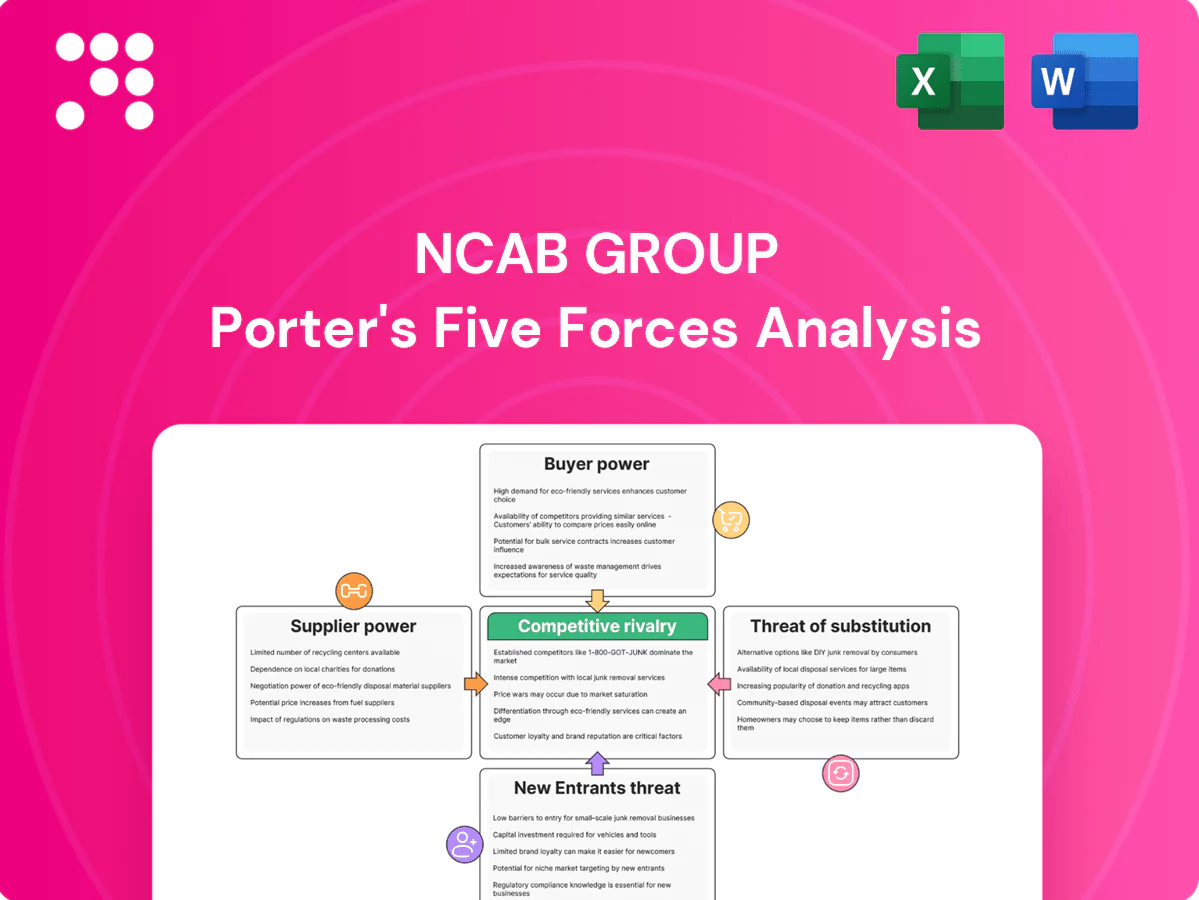
NCAB Group Porter's Five Forces Analysis

A Must-Have Tool for Decision-Makers
NCAB Group navigates a complex PCB industry landscape, where supplier power and the threat of substitutes significantly influence profitability. Understanding these dynamics is crucial for any stakeholder. This brief snapshot only scratches the surface. Unlock the full Porter's Five Forces Analysis to explore NCAB Group’s competitive dynamics, market pressures, and strategic advantages in detail.
Suppliers Bargaining Power

Concentrated Supplier Base vs. Diversified Network
NCAB Group manages its bargaining power of suppliers by cultivating a diverse, global network of manufacturing partners, primarily located in China and other cost-effective regions. This broad supplier base, spanning Asia, Europe, and the US, is crucial for mitigating the risk of any single supplier gaining excessive leverage over NCAB.
While a concentrated supplier base could theoretically empower individual manufacturers, NCAB's strategic approach emphasizes flexibility and resilience through its diversified sourcing. This allows them to shift production or find alternatives if one supplier's terms become unfavorable.
Furthermore, NCAB's commitment to stringent quality control and sustainability, enforced through a Code of Conduct and regular audits, strengthens its position. This ensures that suppliers meet NCAB's high standards, creating a more balanced relationship rather than one dictated by supplier power alone.
Switching Costs for NCAB
Switching costs for NCAB when changing a manufacturing partner are typically moderate to high. This is due to the extensive, multi-step sourcing process that includes thorough performance data analysis, on-site factory visits, and rigorous sample verification to guarantee quality and reliability.
NCAB's business model heavily relies on cultivating robust, long-term relationships with its qualified factories. While NCAB does not directly own these facilities, the significant effort invested in vetting and maintaining these partnerships makes frequent switching an unattractive proposition.

Uniqueness and Differentiation of Supplier Offerings
While printed circuit boards (PCBs) can be seen as a commodity, NCAB Group focuses on complex, high-quality, and reliable PCBs for demanding clients. This specialization means their manufacturing partners often possess unique, differentiated capabilities. Suppliers with cutting-edge technology for high-density interconnect (HDI), flexible, or rigid-flex PCBs, or those holding specific certifications for sectors like aerospace and defense, can wield greater bargaining power due to their specialized offerings.

Threat of Forward Integration by Suppliers
The threat of suppliers, specifically Printed Circuit Board (PCB) manufacturers, integrating forward and directly competing with NCAB Group is generally quite low. This is primarily because NCAB's core strength lies not just in manufacturing but in its comprehensive supply chain management, offering significant technical support and rigorous quality assurance. For a PCB manufacturer to effectively replicate NCAB's intermediary role, they would need to undertake substantial investments in building out extensive sales networks, sophisticated logistics operations, and robust customer service capabilities across numerous international markets.
NCAB’s established global presence and specialized expertise in managing complex PCB supply chains create a significant barrier to entry for direct forward integration by its manufacturing partners. For instance, in 2023, NCAB served over 10,000 customers across various industries, a testament to its broad market reach and established relationships that a single manufacturer would struggle to replicate quickly or cost-effectively. The cost and complexity associated with developing these parallel service infrastructures present a formidable challenge.
- Low Forward Integration Risk: PCB manufacturers typically lack the established global sales, logistics, and customer service infrastructure that NCAB possesses.
- NCAB's Value-Added Services: NCAB differentiates itself through extensive technical support and quality assurance, which are difficult for manufacturers to duplicate.
- Investment Barrier: Replicating NCAB's intermediary function would require significant capital investment from suppliers in sales, distribution, and customer support.
- Focus on Core Competency: Most PCB manufacturers prefer to concentrate on their manufacturing expertise rather than expanding into the complex service-oriented business model of a distributor like NCAB.
Importance of NCAB to Supplier Revenue
NCAB Group's substantial order volumes for Printed Circuit Boards (PCBs) solidify its position as a vital customer for numerous manufacturing partners. This significant demand, coupled with established long-term relationships, inherently limits the bargaining power of individual suppliers.
The sheer volume and consistent nature of the business NCAB Group offers are critical. For many PCB manufacturers, losing NCAB's partnership would translate to a substantial hit to their revenue streams, making them less inclined to push for unfavorable terms.
- Significant Customer: NCAB Group is a major buyer of PCBs, representing a substantial portion of revenue for many suppliers.
- Long-Term Relationships: Established partnerships foster loyalty and reduce supplier willingness to disrupt the status quo with aggressive demands.
- Volume Leverage: The consistent, large-scale orders NCAB places give it considerable negotiating strength.
- Revenue Dependency: Suppliers are often highly dependent on NCAB's business, diminishing their ability to dictate terms.
Maximizing Influence: Volume's Role in Supplier Bargaining
NCAB Group's bargaining power with suppliers is strengthened by its substantial order volumes, which are critical for many PCB manufacturers. This significant demand, often representing a considerable portion of a supplier's revenue, naturally limits their ability to dictate terms. For instance, NCAB's consistent, large-scale orders in 2023 provided substantial business for its partners, fostering a dependency that enhances NCAB's negotiating position.
| Metric | NCAB Group (2023 Data) | Supplier Impact |
|---|---|---|
| Customer Revenue Contribution | Significant for key partners | Reduces supplier leverage |
| Order Consistency | High | Minimizes supplier price increases |
| Supplier Dependency | High for many | Limits supplier bargaining power |
What is included in the product
 Detailed Word Document
This analysis delves into the competitive forces shaping the PCB industry, specifically for NCAB Group, examining supplier power, buyer bargaining, threat of new entrants, substitutes, and competitive rivalry.

 Customizable Excel Spreadsheet
Instantly identify and address competitive threats with a visually intuitive breakdown of NCAB Group's Porter's Five Forces, enabling proactive strategy adjustments.
Customers Bargaining Power

Customer Concentration and Volume
NCAB Group's customer base is quite broad, with about 1,650 customers spread across 45 different countries. This wide distribution means no single customer holds an overwhelming amount of power due to sheer numbers alone, which typically lessens their ability to dictate terms.
However, the sheer volume purchased by some clients can't be ignored. Even with a diverse customer pool, larger buyers or those who consistently place substantial orders can still influence pricing and contract conditions, creating a degree of bargaining leverage.
Switching Costs for Customers
Customers face moderate switching costs when considering moving away from NCAB Group. This is primarily because NCAB offers a comprehensive PCB distribution service, encompassing everything from initial design support to rigorous quality control and guaranteed on-time delivery.
This end-to-end integrated service, coupled with the assurance of defect-free and highly reliable PCBs, fosters customer loyalty and creates significant stickiness. Consequently, it makes the prospect of frequently switching to other suppliers less attractive for businesses that depend on consistent quality and dependable supply chains.

Availability of Alternative Suppliers
The Printed Circuit Board (PCB) market is indeed quite fragmented, meaning customers often have a good number of options. This includes not only other distributors like NCAB Group but also direct manufacturers. For instance, in 2023, the global PCB market was valued at approximately $75 billion, with numerous players contributing to this figure, highlighting the competitive landscape.
However, NCAB Group works to mitigate this by offering a distinct value proposition. They focus on providing robust global supply chain management, ensuring reliability and efficiency. Coupled with their rigorous quality control processes and dedicated technical support, these services set them apart from smaller competitors or those who only offer direct manufacturing, making the choice less about price alone.

Customer Price Sensitivity
While printed circuit boards (PCBs) typically represent a small fraction, around 1-3%, of an end-product's total value, customers involved in high-volume, low-mix production can exhibit significant price sensitivity. This means that even minor price fluctuations can influence their purchasing decisions for these standardized components.
NCAB Group strategically positions itself by specializing in High-Mix Low-Volume (HMLV) and technically advanced PCBs. This focus caters to customers with demanding requirements where the absolute priority is on unwavering quality and exceptional reliability, rather than solely on the lowest price.
- Price Sensitivity in High-Volume Markets: In sectors like consumer electronics, where production runs are massive and product variations are minimal, even a 1% cost saving on PCBs can translate to substantial overall savings, making customers highly attentive to pricing.
- NCAB's Niche Advantage: For instance, in the aerospace or medical device industries, where NCAB often operates, a PCB failure can have catastrophic consequences, far outweighing any minor cost difference. This inherently reduces the bargaining power of customers based purely on price.
- Reduced Price Pressure for NCAB: NCAB's commitment to technical expertise and quality assurance in HMLV segments means that its customers are less likely to switch suppliers based on price alone, as the risk associated with lower-quality alternatives is too high.
Threat of Backward Integration by Customers
The threat of customers backward integrating to produce their own Printed Circuit Boards (PCBs) for NCAB Group is generally low. This is due to the significant capital investment, intricate technical knowledge, and specialized manufacturing expertise needed, which are substantial barriers to entry for most customers.
Customers often find it more strategic and cost-effective to concentrate on their primary business operations, such as product design and marketing, rather than venturing into the complex and capital-intensive field of PCB manufacturing. They prefer to leverage the specialized capabilities of suppliers like NCAB Group.
For example, in 2024, the global PCB market, valued at approximately $75 billion, is characterized by high R&D spending and continuous technological advancements. For a typical electronics manufacturer, diverting resources to replicate this infrastructure would be a significant drain, impacting their core business performance.
- High Capital Intensity: Establishing a PCB manufacturing facility requires millions in specialized machinery and cleanroom environments.
- Technical Complexity: PCB production involves intricate processes like etching, plating, and soldering, demanding highly skilled labor.
- Specialized Expertise: Success in PCB manufacturing relies on deep knowledge of materials science, electrical engineering, and quality control.
- Focus on Core Competencies: Most customers benefit more from outsourcing to specialists like NCAB Group, allowing them to focus on innovation and market strategy.
Quality Over Price: NCAB Group's PCB Market Influence
While NCAB Group serves many customers, its focus on High-Mix Low-Volume (HMLV) and technically demanding PCBs means customers prioritize quality and reliability over price. This niche reduces direct price-based bargaining, as switching risks are high for critical applications. The global PCB market, valued around $75 billion in 2023 and projected to grow, offers alternatives, but NCAB's integrated service and quality assurance create customer stickiness, moderating overall customer power.
| Factor | NCAB Group's Position | Impact on Customer Bargaining Power |
|---|---|---|
| Customer Concentration | Broad base (1,650+ customers) | Lowers power of individual customers |
| Switching Costs | Moderate to High (due to integrated services) | Reduces customer power |
| Market Fragmentation | Fragmented PCB market (approx. $75B in 2023) | Potentially increases customer power |
| NCAB's Value Proposition | HMLV, quality, reliability, global supply chain | Mitigates price-based bargaining power |
| Price Sensitivity | Lower for HMLV/technical PCBs | Reduces customer power |
| Backward Integration Threat | Low (high capital, technical barriers) | Minimizes customer power |
Same Document Delivered
NCAB Group Porter's Five Forces Analysis
This preview shows the exact NCAB Group Porter's Five Forces Analysis you'll receive immediately after purchase, offering a comprehensive examination of the competitive landscape. You'll gain detailed insights into the bargaining power of buyers and suppliers, the threat of new entrants and substitute products, and the intensity of rivalry within the industry. This professionally formatted document is ready for your immediate use, providing a thorough understanding of the strategic factors influencing NCAB Group.

A Must-Have Tool for Decision-Makers
NCAB Group navigates a complex PCB industry landscape, where supplier power and the threat of substitutes significantly influence profitability. Understanding these dynamics is crucial for any stakeholder. This brief snapshot only scratches the surface. Unlock the full Porter's Five Forces Analysis to explore NCAB Group’s competitive dynamics, market pressures, and strategic advantages in detail.
Suppliers Bargaining Power
Concentrated Supplier Base vs. Diversified Network
NCAB Group manages its bargaining power of suppliers by cultivating a diverse, global network of manufacturing partners, primarily located in China and other cost-effective regions. This broad supplier base, spanning Asia, Europe, and the US, is crucial for mitigating the risk of any single supplier gaining excessive leverage over NCAB.
While a concentrated supplier base could theoretically empower individual manufacturers, NCAB's strategic approach emphasizes flexibility and resilience through its diversified sourcing. This allows them to shift production or find alternatives if one supplier's terms become unfavorable.
Furthermore, NCAB's commitment to stringent quality control and sustainability, enforced through a Code of Conduct and regular audits, strengthens its position. This ensures that suppliers meet NCAB's high standards, creating a more balanced relationship rather than one dictated by supplier power alone.
Switching Costs for NCAB
Switching costs for NCAB when changing a manufacturing partner are typically moderate to high. This is due to the extensive, multi-step sourcing process that includes thorough performance data analysis, on-site factory visits, and rigorous sample verification to guarantee quality and reliability.
NCAB's business model heavily relies on cultivating robust, long-term relationships with its qualified factories. While NCAB does not directly own these facilities, the significant effort invested in vetting and maintaining these partnerships makes frequent switching an unattractive proposition.
Uniqueness and Differentiation of Supplier Offerings
While printed circuit boards (PCBs) can be seen as a commodity, NCAB Group focuses on complex, high-quality, and reliable PCBs for demanding clients. This specialization means their manufacturing partners often possess unique, differentiated capabilities. Suppliers with cutting-edge technology for high-density interconnect (HDI), flexible, or rigid-flex PCBs, or those holding specific certifications for sectors like aerospace and defense, can wield greater bargaining power due to their specialized offerings.
Threat of Forward Integration by Suppliers
The threat of suppliers, specifically Printed Circuit Board (PCB) manufacturers, integrating forward and directly competing with NCAB Group is generally quite low. This is primarily because NCAB's core strength lies not just in manufacturing but in its comprehensive supply chain management, offering significant technical support and rigorous quality assurance. For a PCB manufacturer to effectively replicate NCAB's intermediary role, they would need to undertake substantial investments in building out extensive sales networks, sophisticated logistics operations, and robust customer service capabilities across numerous international markets.
NCAB’s established global presence and specialized expertise in managing complex PCB supply chains create a significant barrier to entry for direct forward integration by its manufacturing partners. For instance, in 2023, NCAB served over 10,000 customers across various industries, a testament to its broad market reach and established relationships that a single manufacturer would struggle to replicate quickly or cost-effectively. The cost and complexity associated with developing these parallel service infrastructures present a formidable challenge.
- Low Forward Integration Risk: PCB manufacturers typically lack the established global sales, logistics, and customer service infrastructure that NCAB possesses.
- NCAB's Value-Added Services: NCAB differentiates itself through extensive technical support and quality assurance, which are difficult for manufacturers to duplicate.
- Investment Barrier: Replicating NCAB's intermediary function would require significant capital investment from suppliers in sales, distribution, and customer support.
- Focus on Core Competency: Most PCB manufacturers prefer to concentrate on their manufacturing expertise rather than expanding into the complex service-oriented business model of a distributor like NCAB.
Importance of NCAB to Supplier Revenue
NCAB Group's substantial order volumes for Printed Circuit Boards (PCBs) solidify its position as a vital customer for numerous manufacturing partners. This significant demand, coupled with established long-term relationships, inherently limits the bargaining power of individual suppliers.
The sheer volume and consistent nature of the business NCAB Group offers are critical. For many PCB manufacturers, losing NCAB's partnership would translate to a substantial hit to their revenue streams, making them less inclined to push for unfavorable terms.
- Significant Customer: NCAB Group is a major buyer of PCBs, representing a substantial portion of revenue for many suppliers.
- Long-Term Relationships: Established partnerships foster loyalty and reduce supplier willingness to disrupt the status quo with aggressive demands.
- Volume Leverage: The consistent, large-scale orders NCAB places give it considerable negotiating strength.
- Revenue Dependency: Suppliers are often highly dependent on NCAB's business, diminishing their ability to dictate terms.
Maximizing Influence: Volume's Role in Supplier Bargaining
NCAB Group's bargaining power with suppliers is strengthened by its substantial order volumes, which are critical for many PCB manufacturers. This significant demand, often representing a considerable portion of a supplier's revenue, naturally limits their ability to dictate terms. For instance, NCAB's consistent, large-scale orders in 2023 provided substantial business for its partners, fostering a dependency that enhances NCAB's negotiating position.
| Metric | NCAB Group (2023 Data) | Supplier Impact |
|---|---|---|
| Customer Revenue Contribution | Significant for key partners | Reduces supplier leverage |
| Order Consistency | High | Minimizes supplier price increases |
| Supplier Dependency | High for many | Limits supplier bargaining power |
What is included in the product
Detailed Word Document
This analysis delves into the competitive forces shaping the PCB industry, specifically for NCAB Group, examining supplier power, buyer bargaining, threat of new entrants, substitutes, and competitive rivalry.
Customizable Excel Spreadsheet
Instantly identify and address competitive threats with a visually intuitive breakdown of NCAB Group's Porter's Five Forces, enabling proactive strategy adjustments.
Customers Bargaining Power
Customer Concentration and Volume
NCAB Group's customer base is quite broad, with about 1,650 customers spread across 45 different countries. This wide distribution means no single customer holds an overwhelming amount of power due to sheer numbers alone, which typically lessens their ability to dictate terms.
However, the sheer volume purchased by some clients can't be ignored. Even with a diverse customer pool, larger buyers or those who consistently place substantial orders can still influence pricing and contract conditions, creating a degree of bargaining leverage.
Switching Costs for Customers
Customers face moderate switching costs when considering moving away from NCAB Group. This is primarily because NCAB offers a comprehensive PCB distribution service, encompassing everything from initial design support to rigorous quality control and guaranteed on-time delivery.
This end-to-end integrated service, coupled with the assurance of defect-free and highly reliable PCBs, fosters customer loyalty and creates significant stickiness. Consequently, it makes the prospect of frequently switching to other suppliers less attractive for businesses that depend on consistent quality and dependable supply chains.
Availability of Alternative Suppliers
The Printed Circuit Board (PCB) market is indeed quite fragmented, meaning customers often have a good number of options. This includes not only other distributors like NCAB Group but also direct manufacturers. For instance, in 2023, the global PCB market was valued at approximately $75 billion, with numerous players contributing to this figure, highlighting the competitive landscape.
However, NCAB Group works to mitigate this by offering a distinct value proposition. They focus on providing robust global supply chain management, ensuring reliability and efficiency. Coupled with their rigorous quality control processes and dedicated technical support, these services set them apart from smaller competitors or those who only offer direct manufacturing, making the choice less about price alone.
Customer Price Sensitivity
While printed circuit boards (PCBs) typically represent a small fraction, around 1-3%, of an end-product's total value, customers involved in high-volume, low-mix production can exhibit significant price sensitivity. This means that even minor price fluctuations can influence their purchasing decisions for these standardized components.
NCAB Group strategically positions itself by specializing in High-Mix Low-Volume (HMLV) and technically advanced PCBs. This focus caters to customers with demanding requirements where the absolute priority is on unwavering quality and exceptional reliability, rather than solely on the lowest price.
- Price Sensitivity in High-Volume Markets: In sectors like consumer electronics, where production runs are massive and product variations are minimal, even a 1% cost saving on PCBs can translate to substantial overall savings, making customers highly attentive to pricing.
- NCAB's Niche Advantage: For instance, in the aerospace or medical device industries, where NCAB often operates, a PCB failure can have catastrophic consequences, far outweighing any minor cost difference. This inherently reduces the bargaining power of customers based purely on price.
- Reduced Price Pressure for NCAB: NCAB's commitment to technical expertise and quality assurance in HMLV segments means that its customers are less likely to switch suppliers based on price alone, as the risk associated with lower-quality alternatives is too high.
Threat of Backward Integration by Customers
The threat of customers backward integrating to produce their own Printed Circuit Boards (PCBs) for NCAB Group is generally low. This is due to the significant capital investment, intricate technical knowledge, and specialized manufacturing expertise needed, which are substantial barriers to entry for most customers.
Customers often find it more strategic and cost-effective to concentrate on their primary business operations, such as product design and marketing, rather than venturing into the complex and capital-intensive field of PCB manufacturing. They prefer to leverage the specialized capabilities of suppliers like NCAB Group.
For example, in 2024, the global PCB market, valued at approximately $75 billion, is characterized by high R&D spending and continuous technological advancements. For a typical electronics manufacturer, diverting resources to replicate this infrastructure would be a significant drain, impacting their core business performance.
- High Capital Intensity: Establishing a PCB manufacturing facility requires millions in specialized machinery and cleanroom environments.
- Technical Complexity: PCB production involves intricate processes like etching, plating, and soldering, demanding highly skilled labor.
- Specialized Expertise: Success in PCB manufacturing relies on deep knowledge of materials science, electrical engineering, and quality control.
- Focus on Core Competencies: Most customers benefit more from outsourcing to specialists like NCAB Group, allowing them to focus on innovation and market strategy.
Quality Over Price: NCAB Group's PCB Market Influence
While NCAB Group serves many customers, its focus on High-Mix Low-Volume (HMLV) and technically demanding PCBs means customers prioritize quality and reliability over price. This niche reduces direct price-based bargaining, as switching risks are high for critical applications. The global PCB market, valued around $75 billion in 2023 and projected to grow, offers alternatives, but NCAB's integrated service and quality assurance create customer stickiness, moderating overall customer power.
| Factor | NCAB Group's Position | Impact on Customer Bargaining Power |
|---|---|---|
| Customer Concentration | Broad base (1,650+ customers) | Lowers power of individual customers |
| Switching Costs | Moderate to High (due to integrated services) | Reduces customer power |
| Market Fragmentation | Fragmented PCB market (approx. $75B in 2023) | Potentially increases customer power |
| NCAB's Value Proposition | HMLV, quality, reliability, global supply chain | Mitigates price-based bargaining power |
| Price Sensitivity | Lower for HMLV/technical PCBs | Reduces customer power |
| Backward Integration Threat | Low (high capital, technical barriers) | Minimizes customer power |
Same Document Delivered
NCAB Group Porter's Five Forces Analysis
This preview shows the exact NCAB Group Porter's Five Forces Analysis you'll receive immediately after purchase, offering a comprehensive examination of the competitive landscape. You'll gain detailed insights into the bargaining power of buyers and suppliers, the threat of new entrants and substitute products, and the intensity of rivalry within the industry. This professionally formatted document is ready for your immediate use, providing a thorough understanding of the strategic factors influencing NCAB Group.
Original: $10.00
-65%$10.00
$3.50Description
A Must-Have Tool for Decision-Makers
NCAB Group navigates a complex PCB industry landscape, where supplier power and the threat of substitutes significantly influence profitability. Understanding these dynamics is crucial for any stakeholder. This brief snapshot only scratches the surface. Unlock the full Porter's Five Forces Analysis to explore NCAB Group’s competitive dynamics, market pressures, and strategic advantages in detail.
Suppliers Bargaining Power
Concentrated Supplier Base vs. Diversified Network
NCAB Group manages its bargaining power of suppliers by cultivating a diverse, global network of manufacturing partners, primarily located in China and other cost-effective regions. This broad supplier base, spanning Asia, Europe, and the US, is crucial for mitigating the risk of any single supplier gaining excessive leverage over NCAB.
While a concentrated supplier base could theoretically empower individual manufacturers, NCAB's strategic approach emphasizes flexibility and resilience through its diversified sourcing. This allows them to shift production or find alternatives if one supplier's terms become unfavorable.
Furthermore, NCAB's commitment to stringent quality control and sustainability, enforced through a Code of Conduct and regular audits, strengthens its position. This ensures that suppliers meet NCAB's high standards, creating a more balanced relationship rather than one dictated by supplier power alone.
Switching Costs for NCAB
Switching costs for NCAB when changing a manufacturing partner are typically moderate to high. This is due to the extensive, multi-step sourcing process that includes thorough performance data analysis, on-site factory visits, and rigorous sample verification to guarantee quality and reliability.
NCAB's business model heavily relies on cultivating robust, long-term relationships with its qualified factories. While NCAB does not directly own these facilities, the significant effort invested in vetting and maintaining these partnerships makes frequent switching an unattractive proposition.
Uniqueness and Differentiation of Supplier Offerings
While printed circuit boards (PCBs) can be seen as a commodity, NCAB Group focuses on complex, high-quality, and reliable PCBs for demanding clients. This specialization means their manufacturing partners often possess unique, differentiated capabilities. Suppliers with cutting-edge technology for high-density interconnect (HDI), flexible, or rigid-flex PCBs, or those holding specific certifications for sectors like aerospace and defense, can wield greater bargaining power due to their specialized offerings.
Threat of Forward Integration by Suppliers
The threat of suppliers, specifically Printed Circuit Board (PCB) manufacturers, integrating forward and directly competing with NCAB Group is generally quite low. This is primarily because NCAB's core strength lies not just in manufacturing but in its comprehensive supply chain management, offering significant technical support and rigorous quality assurance. For a PCB manufacturer to effectively replicate NCAB's intermediary role, they would need to undertake substantial investments in building out extensive sales networks, sophisticated logistics operations, and robust customer service capabilities across numerous international markets.
NCAB’s established global presence and specialized expertise in managing complex PCB supply chains create a significant barrier to entry for direct forward integration by its manufacturing partners. For instance, in 2023, NCAB served over 10,000 customers across various industries, a testament to its broad market reach and established relationships that a single manufacturer would struggle to replicate quickly or cost-effectively. The cost and complexity associated with developing these parallel service infrastructures present a formidable challenge.
- Low Forward Integration Risk: PCB manufacturers typically lack the established global sales, logistics, and customer service infrastructure that NCAB possesses.
- NCAB's Value-Added Services: NCAB differentiates itself through extensive technical support and quality assurance, which are difficult for manufacturers to duplicate.
- Investment Barrier: Replicating NCAB's intermediary function would require significant capital investment from suppliers in sales, distribution, and customer support.
- Focus on Core Competency: Most PCB manufacturers prefer to concentrate on their manufacturing expertise rather than expanding into the complex service-oriented business model of a distributor like NCAB.
Importance of NCAB to Supplier Revenue
NCAB Group's substantial order volumes for Printed Circuit Boards (PCBs) solidify its position as a vital customer for numerous manufacturing partners. This significant demand, coupled with established long-term relationships, inherently limits the bargaining power of individual suppliers.
The sheer volume and consistent nature of the business NCAB Group offers are critical. For many PCB manufacturers, losing NCAB's partnership would translate to a substantial hit to their revenue streams, making them less inclined to push for unfavorable terms.
- Significant Customer: NCAB Group is a major buyer of PCBs, representing a substantial portion of revenue for many suppliers.
- Long-Term Relationships: Established partnerships foster loyalty and reduce supplier willingness to disrupt the status quo with aggressive demands.
- Volume Leverage: The consistent, large-scale orders NCAB places give it considerable negotiating strength.
- Revenue Dependency: Suppliers are often highly dependent on NCAB's business, diminishing their ability to dictate terms.
Maximizing Influence: Volume's Role in Supplier Bargaining
NCAB Group's bargaining power with suppliers is strengthened by its substantial order volumes, which are critical for many PCB manufacturers. This significant demand, often representing a considerable portion of a supplier's revenue, naturally limits their ability to dictate terms. For instance, NCAB's consistent, large-scale orders in 2023 provided substantial business for its partners, fostering a dependency that enhances NCAB's negotiating position.
| Metric | NCAB Group (2023 Data) | Supplier Impact |
|---|---|---|
| Customer Revenue Contribution | Significant for key partners | Reduces supplier leverage |
| Order Consistency | High | Minimizes supplier price increases |
| Supplier Dependency | High for many | Limits supplier bargaining power |
What is included in the product
Detailed Word Document
This analysis delves into the competitive forces shaping the PCB industry, specifically for NCAB Group, examining supplier power, buyer bargaining, threat of new entrants, substitutes, and competitive rivalry.
Customizable Excel Spreadsheet
Instantly identify and address competitive threats with a visually intuitive breakdown of NCAB Group's Porter's Five Forces, enabling proactive strategy adjustments.
Customers Bargaining Power
Customer Concentration and Volume
NCAB Group's customer base is quite broad, with about 1,650 customers spread across 45 different countries. This wide distribution means no single customer holds an overwhelming amount of power due to sheer numbers alone, which typically lessens their ability to dictate terms.
However, the sheer volume purchased by some clients can't be ignored. Even with a diverse customer pool, larger buyers or those who consistently place substantial orders can still influence pricing and contract conditions, creating a degree of bargaining leverage.
Switching Costs for Customers
Customers face moderate switching costs when considering moving away from NCAB Group. This is primarily because NCAB offers a comprehensive PCB distribution service, encompassing everything from initial design support to rigorous quality control and guaranteed on-time delivery.
This end-to-end integrated service, coupled with the assurance of defect-free and highly reliable PCBs, fosters customer loyalty and creates significant stickiness. Consequently, it makes the prospect of frequently switching to other suppliers less attractive for businesses that depend on consistent quality and dependable supply chains.
Availability of Alternative Suppliers
The Printed Circuit Board (PCB) market is indeed quite fragmented, meaning customers often have a good number of options. This includes not only other distributors like NCAB Group but also direct manufacturers. For instance, in 2023, the global PCB market was valued at approximately $75 billion, with numerous players contributing to this figure, highlighting the competitive landscape.
However, NCAB Group works to mitigate this by offering a distinct value proposition. They focus on providing robust global supply chain management, ensuring reliability and efficiency. Coupled with their rigorous quality control processes and dedicated technical support, these services set them apart from smaller competitors or those who only offer direct manufacturing, making the choice less about price alone.
Customer Price Sensitivity
While printed circuit boards (PCBs) typically represent a small fraction, around 1-3%, of an end-product's total value, customers involved in high-volume, low-mix production can exhibit significant price sensitivity. This means that even minor price fluctuations can influence their purchasing decisions for these standardized components.
NCAB Group strategically positions itself by specializing in High-Mix Low-Volume (HMLV) and technically advanced PCBs. This focus caters to customers with demanding requirements where the absolute priority is on unwavering quality and exceptional reliability, rather than solely on the lowest price.
- Price Sensitivity in High-Volume Markets: In sectors like consumer electronics, where production runs are massive and product variations are minimal, even a 1% cost saving on PCBs can translate to substantial overall savings, making customers highly attentive to pricing.
- NCAB's Niche Advantage: For instance, in the aerospace or medical device industries, where NCAB often operates, a PCB failure can have catastrophic consequences, far outweighing any minor cost difference. This inherently reduces the bargaining power of customers based purely on price.
- Reduced Price Pressure for NCAB: NCAB's commitment to technical expertise and quality assurance in HMLV segments means that its customers are less likely to switch suppliers based on price alone, as the risk associated with lower-quality alternatives is too high.
Threat of Backward Integration by Customers
The threat of customers backward integrating to produce their own Printed Circuit Boards (PCBs) for NCAB Group is generally low. This is due to the significant capital investment, intricate technical knowledge, and specialized manufacturing expertise needed, which are substantial barriers to entry for most customers.
Customers often find it more strategic and cost-effective to concentrate on their primary business operations, such as product design and marketing, rather than venturing into the complex and capital-intensive field of PCB manufacturing. They prefer to leverage the specialized capabilities of suppliers like NCAB Group.
For example, in 2024, the global PCB market, valued at approximately $75 billion, is characterized by high R&D spending and continuous technological advancements. For a typical electronics manufacturer, diverting resources to replicate this infrastructure would be a significant drain, impacting their core business performance.
- High Capital Intensity: Establishing a PCB manufacturing facility requires millions in specialized machinery and cleanroom environments.
- Technical Complexity: PCB production involves intricate processes like etching, plating, and soldering, demanding highly skilled labor.
- Specialized Expertise: Success in PCB manufacturing relies on deep knowledge of materials science, electrical engineering, and quality control.
- Focus on Core Competencies: Most customers benefit more from outsourcing to specialists like NCAB Group, allowing them to focus on innovation and market strategy.
Quality Over Price: NCAB Group's PCB Market Influence
While NCAB Group serves many customers, its focus on High-Mix Low-Volume (HMLV) and technically demanding PCBs means customers prioritize quality and reliability over price. This niche reduces direct price-based bargaining, as switching risks are high for critical applications. The global PCB market, valued around $75 billion in 2023 and projected to grow, offers alternatives, but NCAB's integrated service and quality assurance create customer stickiness, moderating overall customer power.
| Factor | NCAB Group's Position | Impact on Customer Bargaining Power |
|---|---|---|
| Customer Concentration | Broad base (1,650+ customers) | Lowers power of individual customers |
| Switching Costs | Moderate to High (due to integrated services) | Reduces customer power |
| Market Fragmentation | Fragmented PCB market (approx. $75B in 2023) | Potentially increases customer power |
| NCAB's Value Proposition | HMLV, quality, reliability, global supply chain | Mitigates price-based bargaining power |
| Price Sensitivity | Lower for HMLV/technical PCBs | Reduces customer power |
| Backward Integration Threat | Low (high capital, technical barriers) | Minimizes customer power |
Same Document Delivered
NCAB Group Porter's Five Forces Analysis
This preview shows the exact NCAB Group Porter's Five Forces Analysis you'll receive immediately after purchase, offering a comprehensive examination of the competitive landscape. You'll gain detailed insights into the bargaining power of buyers and suppliers, the threat of new entrants and substitute products, and the intensity of rivalry within the industry. This professionally formatted document is ready for your immediate use, providing a thorough understanding of the strategic factors influencing NCAB Group.











