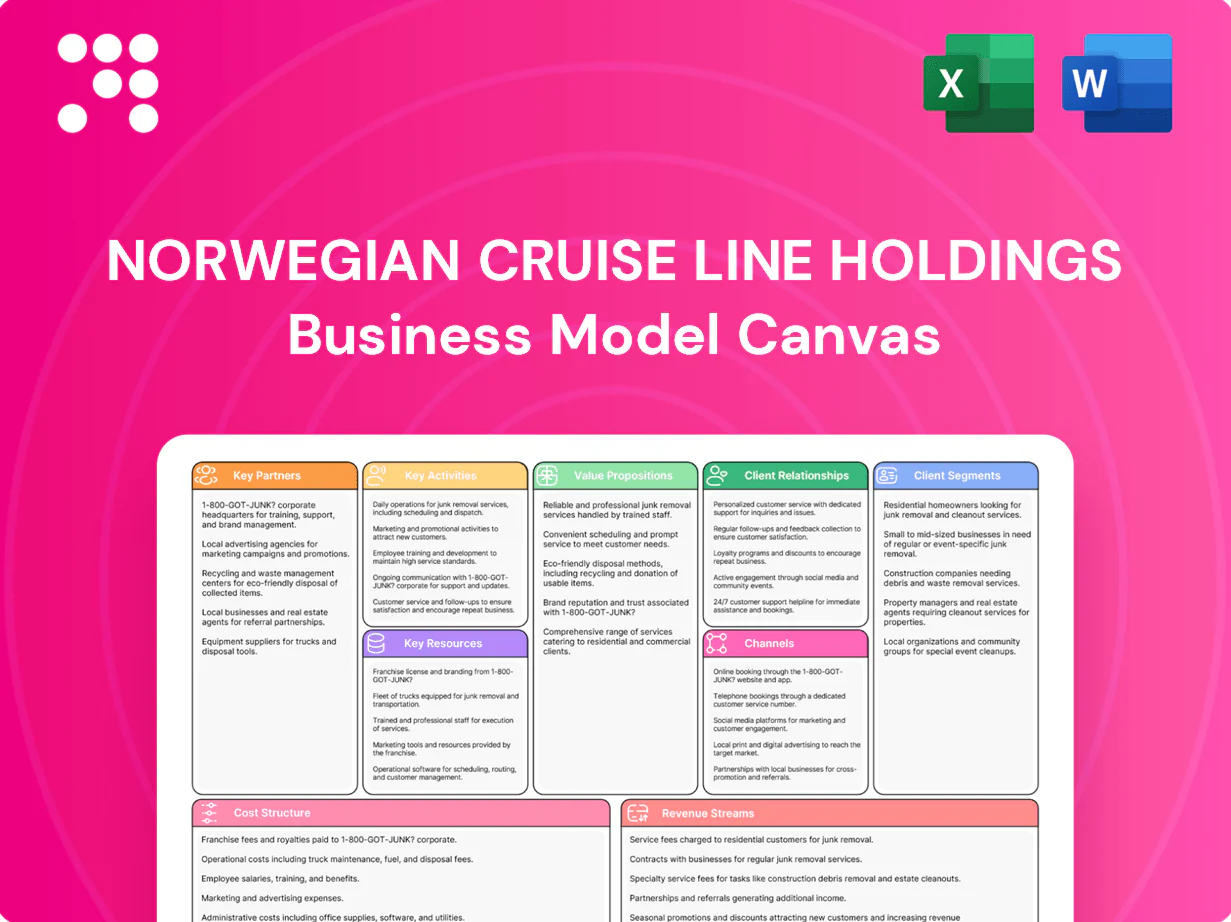
Norwegian Cruise Line Holdings Business Model Canvas

Cruise Operator Business Model Canvas: Strategy, Revenue Streams and Cost Drivers
Unlock the full strategic blueprint behind Norwegian Cruise Line Holdings with our Business Model Canvas—three concise pages that map value propositions, customer segments, revenue streams and cost drivers. Ideal for investors, consultants, and entrepreneurs seeking actionable insights. Purchase the complete Word and Excel files to benchmark strategy and accelerate decision-making.
Partnerships

Port authorities and governments
Port authorities and governments are essential for berth access, customs clearance, and predictable itineraries; Norwegian Cruise Line Holdings' 2024 fleet of 28 ships depends on these arrangements. Long-term port agreements secure priority docking windows and favorable fees, reducing turnaround delays and anchorage costs. Collaboration funds destination development and ensures compliance with local maritime and environmental regulations.
Shipyards and marine engineers
Shipyards and marine engineers design, build, refurbish and maintain vessels across Norwegian Cruise Line, Oceania and Regent Seven Seas, supporting fleet renewal and retrofits. Strategic relationships secure build slots, favorable financing and technology transfer, with typical new-builds costing $900M–$1.3B and shipyard lead times of 3–5 years. Partners deliver fuel-efficiency and safety upgrades that can cut fuel use by up to 20% and enable differentiated onboard experiences.

Destination and shore-excursion operators
Destination and shore-excursion operators co-create diversified tour packages across demographics to boost per-guest spend and guest satisfaction for Norwegian Cruise Line Holdings in 2024, spanning its three brands: Norwegian Cruise Line, Oceania and Regent. Local partners deliver authentic, safe and scalable experiences that meet regional regulations and capacity needs. Revenue-sharing agreements and strict quality standards protect brand reputation and ancillary margins.

Travel advisors, OTAs, and distribution consortia
Travel advisors, OTAs, and distribution consortia broaden NCLH’s reach, fill ships and lower acquisition costs via established networks; co-op marketing and advisor training raise booking quality. Preferred agreements secure incentives, inventory access and promotional priority, supporting NCLH’s post‑pandemic ramp (company revenue was about 8.9 billion USD in 2023 with strong 2024 booking momentum).
- Broaden reach / lower CAC
- Co-op marketing → higher-quality bookings
- Preferred agreements → incentives & inventory access
F&B, entertainment, and technology providers
Brand partnerships with premium F&B, entertainment, and tech providers supply signature dining, Broadway-style shows, and streaming/connectivity services that lift onboard spend and guest satisfaction; in 2024 NCLH returned to pre-pandemic capacity and leaned on these partners to drive ancillary revenue recovery. Integrated reservation, payment, connectivity, and personalization systems enable seamless upsells, loyalty activation, and real-time offers.
- Partners: premium chefs, producers, software vendors
- Impact: higher onboard spend, better NPS
- Systems: reservations, payments, connectivity, personalization
Ports, yards and partners lock 28-ship 2024 itineraries; long-term deals cut costs
Port authorities, shipyards, destination operators and distribution partners secure itineraries, fleet renewal and bookings for NCLH’s 28-ship 2024 fleet and $8.9B 2023 revenue; long‑term port and yard deals cut costs and lead times. Brand partners and tech vendors drive ancillary spend and NPS, aiding post‑pandemic recovery and 2024 booking momentum.
| Partner | Role | 2024 metric |
|---|---|---|
| Port authorities | Berths/fees | 28 ships access |
| Shipyards | New-builds/refits | $900M–$1.3B per ship |
| Travel agents | Distribution | Higher booking volume |
What is included in the product
 Detailed Word Document
A concise, pre-built Business Model Canvas for Norwegian Cruise Line Holdings covering customer segments, channels, value propositions, revenue streams, key resources, partners, activities, cost structure and customer relationships aligned with fleet strategy and loyalty programs. Ideal for presentations, investor discussions and strategic planning with SWOT-linked insights and competitive advantage analysis for cruise market execution.

 Customizable Excel Spreadsheet
High-level editable Business Model Canvas for Norwegian Cruise Line Holdings that quickly pinpoints revenue drivers, cost structure, and customer segments—saving hours of formatting and enabling fast, board-ready strategy reviews and cross-team collaboration.
Activities

Fleet operations and itinerary planning
Optimize deployment across NCLH's 28-ship fleet in 2024 by season, demand forecasts and port capacity, shifting vessels between Caribbean, Alaska and Europe to maximize occupancy and per-passenger yield.
Balance dynamic yield management with guest experience and local berth limits, using real-time pricing and booking curves to protect ancillary spend and satisfaction.
Continuously monitor geopolitics and weather, enabling nimble rerouting to minimize cancellations and operational disruption.
Sales, marketing, and revenue management
Drive bookings through integrated multi-channel campaigns and dynamic pricing to capture demand across direct, OTA, and agency channels. Use targeted promotions, bundle packages, and customer segmentation to maximize occupancy and yield per sailing. Actively manage travel agent commissions and onboard pre-sell strategies to increase total revenue per passenger.

Guest experience and service delivery
Deliver curated dining, entertainment, wellness and enrichment programs across Norwegian Cruise Line, Oceania and Regent Seven Seas, maintaining differentiated service standards by brand tier; as of 2024 the company operates a 28-ship fleet across these three brands. Continuous guest feedback and onboard data drive iterative product changes and targeted loyalty benefits to boost repeat bookings and ancillary spend.

Safety, compliance, and ESG initiatives
Norwegian Cruise Line Holdings ensures compliance with IMO, MARPOL and CII performance regimes and applicable health guidelines across jurisdictions, operating a 28-ship fleet (2024). The company invests in fuel-efficiency retrofits, advanced waste management and emissions-reduction technologies while conducting crew training and regular audits to minimize operational and safety risk.
- Fleet: 28 ships (2024)
- Regulations: IMO, MARPOL, CII
- Actions: fuel-efficiency retrofits, waste management, emissions tech
- Controls: crew training, audits
Maintenance, dry-dock, and refurbishments
Plan scheduled overhauls to preserve asset life and relevance across a 28-ship fleet (2024), sequencing dry-docks annually to extend service life and protect revenue-generating capacity.
Refits introduce new venues and tech during refits to boost yield per passenger and match guest expectations, targeting quick-return amenities upgrades.
Coordinate suppliers and logistics to minimize downtime and cost overruns, leveraging centralized procurement and tight project management.
- Fleet: 28 ships (2024)
- Typical refit focus: venues + tech
- Priority: minimize downtime & capex overruns
Optimize 28-ship deployment by season and port to boost occupancy, yield
Optimize deployment across NCLH's 28-ship fleet (2024) by season and port capacity to maximize occupancy and per-passenger yield. Balance dynamic yield management with guest experience and ancillary revenue protection via real-time pricing and segmentation. Execute annual dry-docks and targeted refits to preserve asset life and uplift onboard spend while ensuring regulatory compliance across IMO/MARPOL/CII.
| Metric | 2024 |
|---|---|
| Fleet | 28 ships |
| Brands | Norwegian, Oceania, Regent |
| Dry-docks | Annual per ship cycle |
Preview Before You Purchase
Business Model Canvas
The Norwegian Cruise Line Holdings Business Model Canvas shown here is a live preview of the exact document you’ll receive after purchase. It’s not a mockup—this same professionally formatted Canvas, complete with all sections, will be delivered for download in Word and Excel. Buy with confidence: what you see is the full, editable file ready for presentation and use.

Cruise Operator Business Model Canvas: Strategy, Revenue Streams and Cost Drivers
Unlock the full strategic blueprint behind Norwegian Cruise Line Holdings with our Business Model Canvas—three concise pages that map value propositions, customer segments, revenue streams and cost drivers. Ideal for investors, consultants, and entrepreneurs seeking actionable insights. Purchase the complete Word and Excel files to benchmark strategy and accelerate decision-making.
Partnerships
Port authorities and governments
Port authorities and governments are essential for berth access, customs clearance, and predictable itineraries; Norwegian Cruise Line Holdings' 2024 fleet of 28 ships depends on these arrangements. Long-term port agreements secure priority docking windows and favorable fees, reducing turnaround delays and anchorage costs. Collaboration funds destination development and ensures compliance with local maritime and environmental regulations.
Shipyards and marine engineers
Shipyards and marine engineers design, build, refurbish and maintain vessels across Norwegian Cruise Line, Oceania and Regent Seven Seas, supporting fleet renewal and retrofits. Strategic relationships secure build slots, favorable financing and technology transfer, with typical new-builds costing $900M–$1.3B and shipyard lead times of 3–5 years. Partners deliver fuel-efficiency and safety upgrades that can cut fuel use by up to 20% and enable differentiated onboard experiences.
Destination and shore-excursion operators
Destination and shore-excursion operators co-create diversified tour packages across demographics to boost per-guest spend and guest satisfaction for Norwegian Cruise Line Holdings in 2024, spanning its three brands: Norwegian Cruise Line, Oceania and Regent. Local partners deliver authentic, safe and scalable experiences that meet regional regulations and capacity needs. Revenue-sharing agreements and strict quality standards protect brand reputation and ancillary margins.
Travel advisors, OTAs, and distribution consortia
Travel advisors, OTAs, and distribution consortia broaden NCLH’s reach, fill ships and lower acquisition costs via established networks; co-op marketing and advisor training raise booking quality. Preferred agreements secure incentives, inventory access and promotional priority, supporting NCLH’s post‑pandemic ramp (company revenue was about 8.9 billion USD in 2023 with strong 2024 booking momentum).
- Broaden reach / lower CAC
- Co-op marketing → higher-quality bookings
- Preferred agreements → incentives & inventory access
F&B, entertainment, and technology providers
Brand partnerships with premium F&B, entertainment, and tech providers supply signature dining, Broadway-style shows, and streaming/connectivity services that lift onboard spend and guest satisfaction; in 2024 NCLH returned to pre-pandemic capacity and leaned on these partners to drive ancillary revenue recovery. Integrated reservation, payment, connectivity, and personalization systems enable seamless upsells, loyalty activation, and real-time offers.
- Partners: premium chefs, producers, software vendors
- Impact: higher onboard spend, better NPS
- Systems: reservations, payments, connectivity, personalization
Ports, yards and partners lock 28-ship 2024 itineraries; long-term deals cut costs
Port authorities, shipyards, destination operators and distribution partners secure itineraries, fleet renewal and bookings for NCLH’s 28-ship 2024 fleet and $8.9B 2023 revenue; long‑term port and yard deals cut costs and lead times. Brand partners and tech vendors drive ancillary spend and NPS, aiding post‑pandemic recovery and 2024 booking momentum.
| Partner | Role | 2024 metric |
|---|---|---|
| Port authorities | Berths/fees | 28 ships access |
| Shipyards | New-builds/refits | $900M–$1.3B per ship |
| Travel agents | Distribution | Higher booking volume |
What is included in the product
Detailed Word Document
A concise, pre-built Business Model Canvas for Norwegian Cruise Line Holdings covering customer segments, channels, value propositions, revenue streams, key resources, partners, activities, cost structure and customer relationships aligned with fleet strategy and loyalty programs. Ideal for presentations, investor discussions and strategic planning with SWOT-linked insights and competitive advantage analysis for cruise market execution.
Customizable Excel Spreadsheet
High-level editable Business Model Canvas for Norwegian Cruise Line Holdings that quickly pinpoints revenue drivers, cost structure, and customer segments—saving hours of formatting and enabling fast, board-ready strategy reviews and cross-team collaboration.
Activities
Fleet operations and itinerary planning
Optimize deployment across NCLH's 28-ship fleet in 2024 by season, demand forecasts and port capacity, shifting vessels between Caribbean, Alaska and Europe to maximize occupancy and per-passenger yield.
Balance dynamic yield management with guest experience and local berth limits, using real-time pricing and booking curves to protect ancillary spend and satisfaction.
Continuously monitor geopolitics and weather, enabling nimble rerouting to minimize cancellations and operational disruption.
Sales, marketing, and revenue management
Drive bookings through integrated multi-channel campaigns and dynamic pricing to capture demand across direct, OTA, and agency channels. Use targeted promotions, bundle packages, and customer segmentation to maximize occupancy and yield per sailing. Actively manage travel agent commissions and onboard pre-sell strategies to increase total revenue per passenger.
Guest experience and service delivery
Deliver curated dining, entertainment, wellness and enrichment programs across Norwegian Cruise Line, Oceania and Regent Seven Seas, maintaining differentiated service standards by brand tier; as of 2024 the company operates a 28-ship fleet across these three brands. Continuous guest feedback and onboard data drive iterative product changes and targeted loyalty benefits to boost repeat bookings and ancillary spend.
Safety, compliance, and ESG initiatives
Norwegian Cruise Line Holdings ensures compliance with IMO, MARPOL and CII performance regimes and applicable health guidelines across jurisdictions, operating a 28-ship fleet (2024). The company invests in fuel-efficiency retrofits, advanced waste management and emissions-reduction technologies while conducting crew training and regular audits to minimize operational and safety risk.
- Fleet: 28 ships (2024)
- Regulations: IMO, MARPOL, CII
- Actions: fuel-efficiency retrofits, waste management, emissions tech
- Controls: crew training, audits
Maintenance, dry-dock, and refurbishments
Plan scheduled overhauls to preserve asset life and relevance across a 28-ship fleet (2024), sequencing dry-docks annually to extend service life and protect revenue-generating capacity.
Refits introduce new venues and tech during refits to boost yield per passenger and match guest expectations, targeting quick-return amenities upgrades.
Coordinate suppliers and logistics to minimize downtime and cost overruns, leveraging centralized procurement and tight project management.
- Fleet: 28 ships (2024)
- Typical refit focus: venues + tech
- Priority: minimize downtime & capex overruns
Optimize 28-ship deployment by season and port to boost occupancy, yield
Optimize deployment across NCLH's 28-ship fleet (2024) by season and port capacity to maximize occupancy and per-passenger yield. Balance dynamic yield management with guest experience and ancillary revenue protection via real-time pricing and segmentation. Execute annual dry-docks and targeted refits to preserve asset life and uplift onboard spend while ensuring regulatory compliance across IMO/MARPOL/CII.
| Metric | 2024 |
|---|---|
| Fleet | 28 ships |
| Brands | Norwegian, Oceania, Regent |
| Dry-docks | Annual per ship cycle |
Preview Before You Purchase
Business Model Canvas
The Norwegian Cruise Line Holdings Business Model Canvas shown here is a live preview of the exact document you’ll receive after purchase. It’s not a mockup—this same professionally formatted Canvas, complete with all sections, will be delivered for download in Word and Excel. Buy with confidence: what you see is the full, editable file ready for presentation and use.
Description
Cruise Operator Business Model Canvas: Strategy, Revenue Streams and Cost Drivers
Unlock the full strategic blueprint behind Norwegian Cruise Line Holdings with our Business Model Canvas—three concise pages that map value propositions, customer segments, revenue streams and cost drivers. Ideal for investors, consultants, and entrepreneurs seeking actionable insights. Purchase the complete Word and Excel files to benchmark strategy and accelerate decision-making.
Partnerships
Port authorities and governments
Port authorities and governments are essential for berth access, customs clearance, and predictable itineraries; Norwegian Cruise Line Holdings' 2024 fleet of 28 ships depends on these arrangements. Long-term port agreements secure priority docking windows and favorable fees, reducing turnaround delays and anchorage costs. Collaboration funds destination development and ensures compliance with local maritime and environmental regulations.
Shipyards and marine engineers
Shipyards and marine engineers design, build, refurbish and maintain vessels across Norwegian Cruise Line, Oceania and Regent Seven Seas, supporting fleet renewal and retrofits. Strategic relationships secure build slots, favorable financing and technology transfer, with typical new-builds costing $900M–$1.3B and shipyard lead times of 3–5 years. Partners deliver fuel-efficiency and safety upgrades that can cut fuel use by up to 20% and enable differentiated onboard experiences.
Destination and shore-excursion operators
Destination and shore-excursion operators co-create diversified tour packages across demographics to boost per-guest spend and guest satisfaction for Norwegian Cruise Line Holdings in 2024, spanning its three brands: Norwegian Cruise Line, Oceania and Regent. Local partners deliver authentic, safe and scalable experiences that meet regional regulations and capacity needs. Revenue-sharing agreements and strict quality standards protect brand reputation and ancillary margins.
Travel advisors, OTAs, and distribution consortia
Travel advisors, OTAs, and distribution consortia broaden NCLH’s reach, fill ships and lower acquisition costs via established networks; co-op marketing and advisor training raise booking quality. Preferred agreements secure incentives, inventory access and promotional priority, supporting NCLH’s post‑pandemic ramp (company revenue was about 8.9 billion USD in 2023 with strong 2024 booking momentum).
- Broaden reach / lower CAC
- Co-op marketing → higher-quality bookings
- Preferred agreements → incentives & inventory access
F&B, entertainment, and technology providers
Brand partnerships with premium F&B, entertainment, and tech providers supply signature dining, Broadway-style shows, and streaming/connectivity services that lift onboard spend and guest satisfaction; in 2024 NCLH returned to pre-pandemic capacity and leaned on these partners to drive ancillary revenue recovery. Integrated reservation, payment, connectivity, and personalization systems enable seamless upsells, loyalty activation, and real-time offers.
- Partners: premium chefs, producers, software vendors
- Impact: higher onboard spend, better NPS
- Systems: reservations, payments, connectivity, personalization
Ports, yards and partners lock 28-ship 2024 itineraries; long-term deals cut costs
Port authorities, shipyards, destination operators and distribution partners secure itineraries, fleet renewal and bookings for NCLH’s 28-ship 2024 fleet and $8.9B 2023 revenue; long‑term port and yard deals cut costs and lead times. Brand partners and tech vendors drive ancillary spend and NPS, aiding post‑pandemic recovery and 2024 booking momentum.
| Partner | Role | 2024 metric |
|---|---|---|
| Port authorities | Berths/fees | 28 ships access |
| Shipyards | New-builds/refits | $900M–$1.3B per ship |
| Travel agents | Distribution | Higher booking volume |
What is included in the product
Detailed Word Document
A concise, pre-built Business Model Canvas for Norwegian Cruise Line Holdings covering customer segments, channels, value propositions, revenue streams, key resources, partners, activities, cost structure and customer relationships aligned with fleet strategy and loyalty programs. Ideal for presentations, investor discussions and strategic planning with SWOT-linked insights and competitive advantage analysis for cruise market execution.
Customizable Excel Spreadsheet
High-level editable Business Model Canvas for Norwegian Cruise Line Holdings that quickly pinpoints revenue drivers, cost structure, and customer segments—saving hours of formatting and enabling fast, board-ready strategy reviews and cross-team collaboration.
Activities
Fleet operations and itinerary planning
Optimize deployment across NCLH's 28-ship fleet in 2024 by season, demand forecasts and port capacity, shifting vessels between Caribbean, Alaska and Europe to maximize occupancy and per-passenger yield.
Balance dynamic yield management with guest experience and local berth limits, using real-time pricing and booking curves to protect ancillary spend and satisfaction.
Continuously monitor geopolitics and weather, enabling nimble rerouting to minimize cancellations and operational disruption.
Sales, marketing, and revenue management
Drive bookings through integrated multi-channel campaigns and dynamic pricing to capture demand across direct, OTA, and agency channels. Use targeted promotions, bundle packages, and customer segmentation to maximize occupancy and yield per sailing. Actively manage travel agent commissions and onboard pre-sell strategies to increase total revenue per passenger.
Guest experience and service delivery
Deliver curated dining, entertainment, wellness and enrichment programs across Norwegian Cruise Line, Oceania and Regent Seven Seas, maintaining differentiated service standards by brand tier; as of 2024 the company operates a 28-ship fleet across these three brands. Continuous guest feedback and onboard data drive iterative product changes and targeted loyalty benefits to boost repeat bookings and ancillary spend.
Safety, compliance, and ESG initiatives
Norwegian Cruise Line Holdings ensures compliance with IMO, MARPOL and CII performance regimes and applicable health guidelines across jurisdictions, operating a 28-ship fleet (2024). The company invests in fuel-efficiency retrofits, advanced waste management and emissions-reduction technologies while conducting crew training and regular audits to minimize operational and safety risk.
- Fleet: 28 ships (2024)
- Regulations: IMO, MARPOL, CII
- Actions: fuel-efficiency retrofits, waste management, emissions tech
- Controls: crew training, audits
Maintenance, dry-dock, and refurbishments
Plan scheduled overhauls to preserve asset life and relevance across a 28-ship fleet (2024), sequencing dry-docks annually to extend service life and protect revenue-generating capacity.
Refits introduce new venues and tech during refits to boost yield per passenger and match guest expectations, targeting quick-return amenities upgrades.
Coordinate suppliers and logistics to minimize downtime and cost overruns, leveraging centralized procurement and tight project management.
- Fleet: 28 ships (2024)
- Typical refit focus: venues + tech
- Priority: minimize downtime & capex overruns
Optimize 28-ship deployment by season and port to boost occupancy, yield
Optimize deployment across NCLH's 28-ship fleet (2024) by season and port capacity to maximize occupancy and per-passenger yield. Balance dynamic yield management with guest experience and ancillary revenue protection via real-time pricing and segmentation. Execute annual dry-docks and targeted refits to preserve asset life and uplift onboard spend while ensuring regulatory compliance across IMO/MARPOL/CII.
| Metric | 2024 |
|---|---|
| Fleet | 28 ships |
| Brands | Norwegian, Oceania, Regent |
| Dry-docks | Annual per ship cycle |
Preview Before You Purchase
Business Model Canvas
The Norwegian Cruise Line Holdings Business Model Canvas shown here is a live preview of the exact document you’ll receive after purchase. It’s not a mockup—this same professionally formatted Canvas, complete with all sections, will be delivered for download in Word and Excel. Buy with confidence: what you see is the full, editable file ready for presentation and use.











