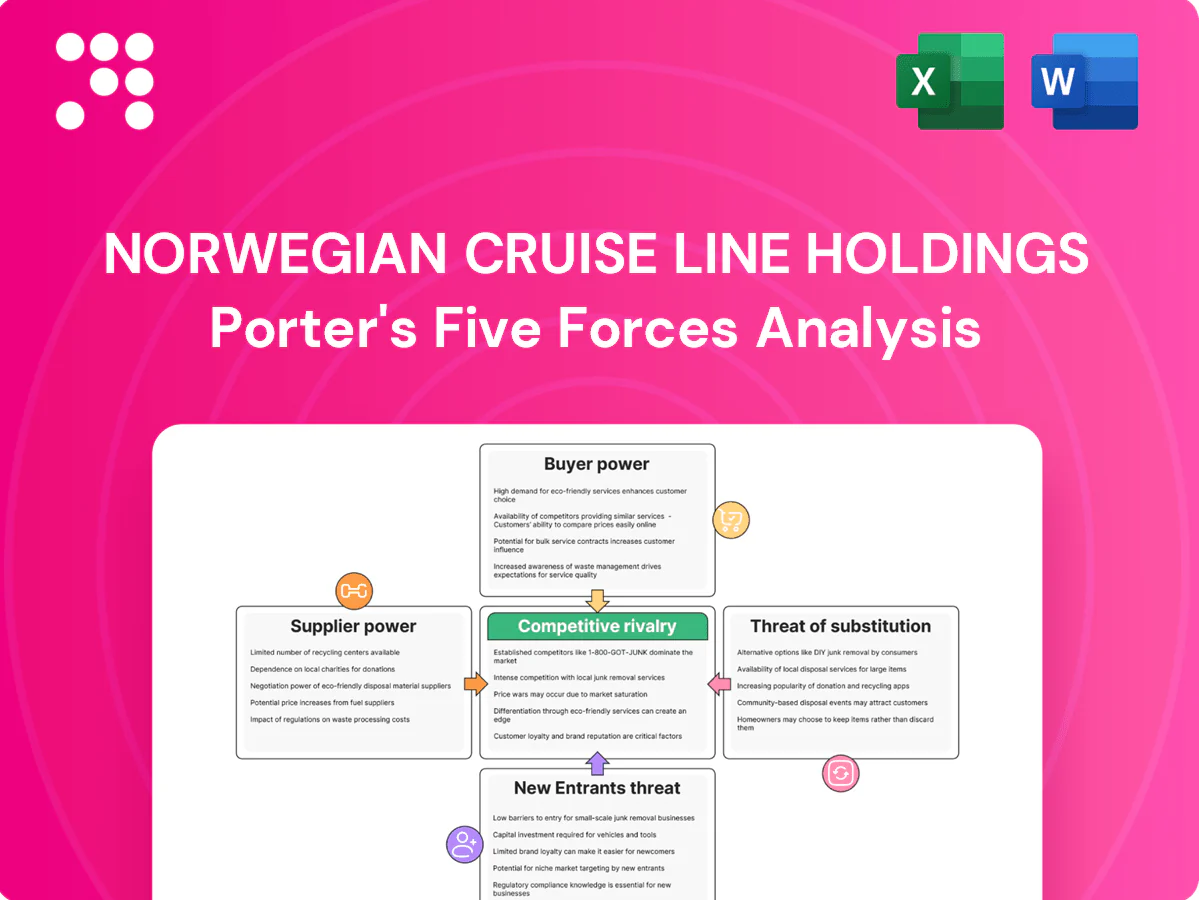
Norwegian Cruise Line Holdings Porter's Five Forces Analysis

Elevate Your Analysis with the Complete Porter's Five Forces Analysis
Norwegian Cruise Line Holdings faces moderate rivalry, strong buyer sensitivity, and supplier leverage in fuel and shipbuilding, while high capital requirements limit new entrants and substitutes pose a growing threat from land-based and short-haul alternatives. This brief snapshot only scratches the surface. Unlock the full Porter's Five Forces Analysis to explore force-by-force ratings, visuals, and actionable strategy tailored to NCLH.
Suppliers Bargaining Power

Concentrated shipbuilders
Newbuilds come from a handful of European yards, with lead times of 3–5 years and slots often booked 4–6 years ahead, concentrating leverage with suppliers. Specialized engineering raises switching costs; delays or cost overruns can shift capacity plans by months. NCLH staggers orders and uses multiple yards to mitigate risk, but supplier bargaining power remains high.
Fuel and marine logistics
Bunker fuel, LNG readiness and lubricants for NCLH are sourced from global energy majors, leaving few scale alternatives at port calls and giving suppliers leverage; shipping accounts for about 3% of global CO2 emissions, underscoring sector dependence. Hedging programs reduce short-term price swings but not structural supplier reliance. Upcoming decarbonization mandates will tighten fuel specs and likely increase supplier power.

Port access and destination services
Berth priority, terminal slots and tendering at marquee ports are scarce, giving port authorities and private operators leverage to set fees and operational conditions that raise NCLH’s cost to serve. Shore excursion partners add coordination and margin pressure. In 2024 NCLH operated private destinations Great Stirrup Cay and Harvest Caye, and long-term port agreements partially offset supplier power.

Crewing, training, and unions
Crew sourcing agencies and specialized maritime talent are concentrated (Philippines + India ≈ 38% of seafarers), with regulation raising entry barriers. Wage inflation and stricter compliance lifted industry crew costs by about 9% YoY in 2024, squeezing margins. Visa constraints or agent disruptions can degrade service levels and force itinerary changes; in-house training and multi-flag flexibility mitigate but do not remove the risk.
- Crew concentration: Philippines+India ≈ 38%
- Crew cost inflation: ≈ 9% YoY (2024)
- Visa/disruption risk: service/itinerary impact
- Mitigation: in-house training, multi-flag flexibility
Food, beverage, and entertainment IP
Premium F&B vendors, branded partnerships, and show licensors exert meaningful negotiating power over Norwegian Cruise Line Holdings because differentiated onboard experiences—driven by brand and quality—are hard to substitute; NCLH's fleet of 28 ships (2024) gives volume leverage, but bespoke specs increase dependency and supply-chain shocks can rapidly degrade guest satisfaction.
Suppliers' leverage and ~9% crew inflation squeeze cruise margins
Suppliers hold high leverage across newbuild yards (3–5yr lead times), fuel/LNG markets and premium F&B/licensors, raising switching costs and capex volatility. Ports and excursion operators capture fees; NCLH offsets via private destinations and staggered orders. Crew concentration (Philippines+India ≈ 38%) and ~9% YoY crew cost inflation (2024) sustain supplier pressure.
| Factor | 2024 Metric |
|---|---|
| Fleet | 28 ships |
| Crew concentration | ≈38% |
| Crew cost inflation | ≈9% YoY |
What is included in the product
 Detailed Word Document
Tailored Porter’s Five Forces analysis for Norwegian Cruise Line Holdings revealing competitive drivers, buyer/supplier power, entry barriers, substitutes and disruptive threats, with strategic commentary for investor and management use.

 Customizable Excel Spreadsheet
Clear one-sheet Porter's Five Forces for Norwegian Cruise Line Holdings—instantly highlights competitive pressures and strategic levers to calm investor uncertainty and accelerate board-level decisions.
Customers Bargaining Power

Price-sensitive mass market
Leisure travelers routinely compare fares across lines and dates using transparent online pricing, increasing customer bargaining power. Switching costs remain low outside of typical deposits (often around 10% of fare) and loyalty status, making price-driven churn common. Promotions and onboard credit offers further intensify leverage, which NCLH counters by promoting bundled value propositions and targeted upsells to protect yields.
Travel agents and OTAs
Intermediaries such as travel agents and OTAs aggregate demand and materially influence itinerary selection, with 2024 CLIA and industry commentary noting agents still drive the majority of cruise bookings. Commission structures and preferred-partner tiers (higher payouts and marketing funds) give these intermediaries clear leverage over Norwegian Cruise Line Holdings. Consolidation among large agency networks and OTA platforms (eg, Expedia Group) amplifies negotiating power, while co-op marketing and direct-booking incentives are used to rebalance channel mix.

Premium and luxury expectations
Oceania and Regent guests demand consistent, high-touch service and broader inclusions, and in 2024 luxury passengers generated up to twice the onboard spend of mainstream cruisers according to industry analyses. Their higher willingness to pay comes with elevated standards, so service lapses trigger amplified complaints and rapid reputation shifts across reviews and social media. Personalized service, curated experiences and enriched inclusions remain primary defenses for maintaining premium pricing and repeat bookings.

Group, charter, and MICE buyers
Group, charter, and MICE buyers win episodic bargaining power by securing large blocks and custom terms, often obtaining discounts of 10–20% in 2024; their volume helps fill shoulder seasons but compresses per-passenger margins. Contract timing constrains itinerary flexibility for NCLH, while tailored packages and add-ons (F&B, excursions, Wi‑Fi) improve overall economics.
- Volume leverage: large blocks
- Discounts: ~10–20% (2024)
- Seasonal fill vs margin compression
- Contracts dictate itinerary flexibility
- Tailored add-ons boost yield
Loyalty and switching dynamics
Loyalty programs like Latitudes Rewards provide mild stickiness but rarely prevent switching when competitors offer superior itineraries or pricing; NCLH reported fleetwide repeat-booking trends in 2024 that remained below peak-prepandemic loyalty levels.
Comparable product and pricing across Norwegian, Oceania and Regent keep buyers in control, while ancillary onboard spend can be diverted if pre-cruise perceived value is weak.
Data-driven targeted offers introduced in 2024 improved short-term retention and uplifted onboard spend among segmented cohorts.
- Repeat-booking pressure: below peak-prepandemic 2024 levels
- Brands: Norwegian, Oceania, Regent
- Ancillary spend at risk without pre-cruise value
- Data-driven offers => measurable retention uplift in 2024
Strong Customer Bargaining: Agents Lead, 10–20% Groups, Luxury Spend ~2x
Customers hold strong bargaining power: transparent online pricing, low switching costs, travel-agent/OTA dominance (agents still drive majority of bookings in 2024) and group discounts (~10–20% in 2024) compress yields; luxury guests spend ~2x onboard but demand premium service; loyalty remains below peak-prepandemic 2024 levels.
| Metric | 2024 |
|---|---|
| Agent share | Majority |
| Group discounts | 10–20% |
| Luxury onboard spend | ~2x mainstream |
| Repeat bookings | Below peak-prepandemic |
Same Document Delivered
Norwegian Cruise Line Holdings Porter's Five Forces Analysis
This Porter's Five Forces analysis of Norwegian Cruise Line Holdings evaluates competitive rivalry, supplier and buyer power, threat of new entrants, and substitute services to quantify industry attractiveness and strategic pressure points. You're looking at the actual document. Once you complete your purchase, you’ll get instant access to this exact file. The file is fully formatted and ready for immediate use.

Elevate Your Analysis with the Complete Porter's Five Forces Analysis
Norwegian Cruise Line Holdings faces moderate rivalry, strong buyer sensitivity, and supplier leverage in fuel and shipbuilding, while high capital requirements limit new entrants and substitutes pose a growing threat from land-based and short-haul alternatives. This brief snapshot only scratches the surface. Unlock the full Porter's Five Forces Analysis to explore force-by-force ratings, visuals, and actionable strategy tailored to NCLH.
Suppliers Bargaining Power
Concentrated shipbuilders
Newbuilds come from a handful of European yards, with lead times of 3–5 years and slots often booked 4–6 years ahead, concentrating leverage with suppliers. Specialized engineering raises switching costs; delays or cost overruns can shift capacity plans by months. NCLH staggers orders and uses multiple yards to mitigate risk, but supplier bargaining power remains high.
Fuel and marine logistics
Bunker fuel, LNG readiness and lubricants for NCLH are sourced from global energy majors, leaving few scale alternatives at port calls and giving suppliers leverage; shipping accounts for about 3% of global CO2 emissions, underscoring sector dependence. Hedging programs reduce short-term price swings but not structural supplier reliance. Upcoming decarbonization mandates will tighten fuel specs and likely increase supplier power.
Port access and destination services
Berth priority, terminal slots and tendering at marquee ports are scarce, giving port authorities and private operators leverage to set fees and operational conditions that raise NCLH’s cost to serve. Shore excursion partners add coordination and margin pressure. In 2024 NCLH operated private destinations Great Stirrup Cay and Harvest Caye, and long-term port agreements partially offset supplier power.
Crewing, training, and unions
Crew sourcing agencies and specialized maritime talent are concentrated (Philippines + India ≈ 38% of seafarers), with regulation raising entry barriers. Wage inflation and stricter compliance lifted industry crew costs by about 9% YoY in 2024, squeezing margins. Visa constraints or agent disruptions can degrade service levels and force itinerary changes; in-house training and multi-flag flexibility mitigate but do not remove the risk.
- Crew concentration: Philippines+India ≈ 38%
- Crew cost inflation: ≈ 9% YoY (2024)
- Visa/disruption risk: service/itinerary impact
- Mitigation: in-house training, multi-flag flexibility
Food, beverage, and entertainment IP
Premium F&B vendors, branded partnerships, and show licensors exert meaningful negotiating power over Norwegian Cruise Line Holdings because differentiated onboard experiences—driven by brand and quality—are hard to substitute; NCLH's fleet of 28 ships (2024) gives volume leverage, but bespoke specs increase dependency and supply-chain shocks can rapidly degrade guest satisfaction.
Suppliers' leverage and ~9% crew inflation squeeze cruise margins
Suppliers hold high leverage across newbuild yards (3–5yr lead times), fuel/LNG markets and premium F&B/licensors, raising switching costs and capex volatility. Ports and excursion operators capture fees; NCLH offsets via private destinations and staggered orders. Crew concentration (Philippines+India ≈ 38%) and ~9% YoY crew cost inflation (2024) sustain supplier pressure.
| Factor | 2024 Metric |
|---|---|
| Fleet | 28 ships |
| Crew concentration | ≈38% |
| Crew cost inflation | ≈9% YoY |
What is included in the product
Detailed Word Document
Tailored Porter’s Five Forces analysis for Norwegian Cruise Line Holdings revealing competitive drivers, buyer/supplier power, entry barriers, substitutes and disruptive threats, with strategic commentary for investor and management use.
Customizable Excel Spreadsheet
Clear one-sheet Porter's Five Forces for Norwegian Cruise Line Holdings—instantly highlights competitive pressures and strategic levers to calm investor uncertainty and accelerate board-level decisions.
Customers Bargaining Power
Price-sensitive mass market
Leisure travelers routinely compare fares across lines and dates using transparent online pricing, increasing customer bargaining power. Switching costs remain low outside of typical deposits (often around 10% of fare) and loyalty status, making price-driven churn common. Promotions and onboard credit offers further intensify leverage, which NCLH counters by promoting bundled value propositions and targeted upsells to protect yields.
Travel agents and OTAs
Intermediaries such as travel agents and OTAs aggregate demand and materially influence itinerary selection, with 2024 CLIA and industry commentary noting agents still drive the majority of cruise bookings. Commission structures and preferred-partner tiers (higher payouts and marketing funds) give these intermediaries clear leverage over Norwegian Cruise Line Holdings. Consolidation among large agency networks and OTA platforms (eg, Expedia Group) amplifies negotiating power, while co-op marketing and direct-booking incentives are used to rebalance channel mix.
Premium and luxury expectations
Oceania and Regent guests demand consistent, high-touch service and broader inclusions, and in 2024 luxury passengers generated up to twice the onboard spend of mainstream cruisers according to industry analyses. Their higher willingness to pay comes with elevated standards, so service lapses trigger amplified complaints and rapid reputation shifts across reviews and social media. Personalized service, curated experiences and enriched inclusions remain primary defenses for maintaining premium pricing and repeat bookings.
Group, charter, and MICE buyers
Group, charter, and MICE buyers win episodic bargaining power by securing large blocks and custom terms, often obtaining discounts of 10–20% in 2024; their volume helps fill shoulder seasons but compresses per-passenger margins. Contract timing constrains itinerary flexibility for NCLH, while tailored packages and add-ons (F&B, excursions, Wi‑Fi) improve overall economics.
- Volume leverage: large blocks
- Discounts: ~10–20% (2024)
- Seasonal fill vs margin compression
- Contracts dictate itinerary flexibility
- Tailored add-ons boost yield
Loyalty and switching dynamics
Loyalty programs like Latitudes Rewards provide mild stickiness but rarely prevent switching when competitors offer superior itineraries or pricing; NCLH reported fleetwide repeat-booking trends in 2024 that remained below peak-prepandemic loyalty levels.
Comparable product and pricing across Norwegian, Oceania and Regent keep buyers in control, while ancillary onboard spend can be diverted if pre-cruise perceived value is weak.
Data-driven targeted offers introduced in 2024 improved short-term retention and uplifted onboard spend among segmented cohorts.
- Repeat-booking pressure: below peak-prepandemic 2024 levels
- Brands: Norwegian, Oceania, Regent
- Ancillary spend at risk without pre-cruise value
- Data-driven offers => measurable retention uplift in 2024
Strong Customer Bargaining: Agents Lead, 10–20% Groups, Luxury Spend ~2x
Customers hold strong bargaining power: transparent online pricing, low switching costs, travel-agent/OTA dominance (agents still drive majority of bookings in 2024) and group discounts (~10–20% in 2024) compress yields; luxury guests spend ~2x onboard but demand premium service; loyalty remains below peak-prepandemic 2024 levels.
| Metric | 2024 |
|---|---|
| Agent share | Majority |
| Group discounts | 10–20% |
| Luxury onboard spend | ~2x mainstream |
| Repeat bookings | Below peak-prepandemic |
Same Document Delivered
Norwegian Cruise Line Holdings Porter's Five Forces Analysis
This Porter's Five Forces analysis of Norwegian Cruise Line Holdings evaluates competitive rivalry, supplier and buyer power, threat of new entrants, and substitute services to quantify industry attractiveness and strategic pressure points. You're looking at the actual document. Once you complete your purchase, you’ll get instant access to this exact file. The file is fully formatted and ready for immediate use.
Original: $10.00
-65%$10.00
$3.50Description
Elevate Your Analysis with the Complete Porter's Five Forces Analysis
Norwegian Cruise Line Holdings faces moderate rivalry, strong buyer sensitivity, and supplier leverage in fuel and shipbuilding, while high capital requirements limit new entrants and substitutes pose a growing threat from land-based and short-haul alternatives. This brief snapshot only scratches the surface. Unlock the full Porter's Five Forces Analysis to explore force-by-force ratings, visuals, and actionable strategy tailored to NCLH.
Suppliers Bargaining Power
Concentrated shipbuilders
Newbuilds come from a handful of European yards, with lead times of 3–5 years and slots often booked 4–6 years ahead, concentrating leverage with suppliers. Specialized engineering raises switching costs; delays or cost overruns can shift capacity plans by months. NCLH staggers orders and uses multiple yards to mitigate risk, but supplier bargaining power remains high.
Fuel and marine logistics
Bunker fuel, LNG readiness and lubricants for NCLH are sourced from global energy majors, leaving few scale alternatives at port calls and giving suppliers leverage; shipping accounts for about 3% of global CO2 emissions, underscoring sector dependence. Hedging programs reduce short-term price swings but not structural supplier reliance. Upcoming decarbonization mandates will tighten fuel specs and likely increase supplier power.
Port access and destination services
Berth priority, terminal slots and tendering at marquee ports are scarce, giving port authorities and private operators leverage to set fees and operational conditions that raise NCLH’s cost to serve. Shore excursion partners add coordination and margin pressure. In 2024 NCLH operated private destinations Great Stirrup Cay and Harvest Caye, and long-term port agreements partially offset supplier power.
Crewing, training, and unions
Crew sourcing agencies and specialized maritime talent are concentrated (Philippines + India ≈ 38% of seafarers), with regulation raising entry barriers. Wage inflation and stricter compliance lifted industry crew costs by about 9% YoY in 2024, squeezing margins. Visa constraints or agent disruptions can degrade service levels and force itinerary changes; in-house training and multi-flag flexibility mitigate but do not remove the risk.
- Crew concentration: Philippines+India ≈ 38%
- Crew cost inflation: ≈ 9% YoY (2024)
- Visa/disruption risk: service/itinerary impact
- Mitigation: in-house training, multi-flag flexibility
Food, beverage, and entertainment IP
Premium F&B vendors, branded partnerships, and show licensors exert meaningful negotiating power over Norwegian Cruise Line Holdings because differentiated onboard experiences—driven by brand and quality—are hard to substitute; NCLH's fleet of 28 ships (2024) gives volume leverage, but bespoke specs increase dependency and supply-chain shocks can rapidly degrade guest satisfaction.
Suppliers' leverage and ~9% crew inflation squeeze cruise margins
Suppliers hold high leverage across newbuild yards (3–5yr lead times), fuel/LNG markets and premium F&B/licensors, raising switching costs and capex volatility. Ports and excursion operators capture fees; NCLH offsets via private destinations and staggered orders. Crew concentration (Philippines+India ≈ 38%) and ~9% YoY crew cost inflation (2024) sustain supplier pressure.
| Factor | 2024 Metric |
|---|---|
| Fleet | 28 ships |
| Crew concentration | ≈38% |
| Crew cost inflation | ≈9% YoY |
What is included in the product
Detailed Word Document
Tailored Porter’s Five Forces analysis for Norwegian Cruise Line Holdings revealing competitive drivers, buyer/supplier power, entry barriers, substitutes and disruptive threats, with strategic commentary for investor and management use.
Customizable Excel Spreadsheet
Clear one-sheet Porter's Five Forces for Norwegian Cruise Line Holdings—instantly highlights competitive pressures and strategic levers to calm investor uncertainty and accelerate board-level decisions.
Customers Bargaining Power
Price-sensitive mass market
Leisure travelers routinely compare fares across lines and dates using transparent online pricing, increasing customer bargaining power. Switching costs remain low outside of typical deposits (often around 10% of fare) and loyalty status, making price-driven churn common. Promotions and onboard credit offers further intensify leverage, which NCLH counters by promoting bundled value propositions and targeted upsells to protect yields.
Travel agents and OTAs
Intermediaries such as travel agents and OTAs aggregate demand and materially influence itinerary selection, with 2024 CLIA and industry commentary noting agents still drive the majority of cruise bookings. Commission structures and preferred-partner tiers (higher payouts and marketing funds) give these intermediaries clear leverage over Norwegian Cruise Line Holdings. Consolidation among large agency networks and OTA platforms (eg, Expedia Group) amplifies negotiating power, while co-op marketing and direct-booking incentives are used to rebalance channel mix.
Premium and luxury expectations
Oceania and Regent guests demand consistent, high-touch service and broader inclusions, and in 2024 luxury passengers generated up to twice the onboard spend of mainstream cruisers according to industry analyses. Their higher willingness to pay comes with elevated standards, so service lapses trigger amplified complaints and rapid reputation shifts across reviews and social media. Personalized service, curated experiences and enriched inclusions remain primary defenses for maintaining premium pricing and repeat bookings.
Group, charter, and MICE buyers
Group, charter, and MICE buyers win episodic bargaining power by securing large blocks and custom terms, often obtaining discounts of 10–20% in 2024; their volume helps fill shoulder seasons but compresses per-passenger margins. Contract timing constrains itinerary flexibility for NCLH, while tailored packages and add-ons (F&B, excursions, Wi‑Fi) improve overall economics.
- Volume leverage: large blocks
- Discounts: ~10–20% (2024)
- Seasonal fill vs margin compression
- Contracts dictate itinerary flexibility
- Tailored add-ons boost yield
Loyalty and switching dynamics
Loyalty programs like Latitudes Rewards provide mild stickiness but rarely prevent switching when competitors offer superior itineraries or pricing; NCLH reported fleetwide repeat-booking trends in 2024 that remained below peak-prepandemic loyalty levels.
Comparable product and pricing across Norwegian, Oceania and Regent keep buyers in control, while ancillary onboard spend can be diverted if pre-cruise perceived value is weak.
Data-driven targeted offers introduced in 2024 improved short-term retention and uplifted onboard spend among segmented cohorts.
- Repeat-booking pressure: below peak-prepandemic 2024 levels
- Brands: Norwegian, Oceania, Regent
- Ancillary spend at risk without pre-cruise value
- Data-driven offers => measurable retention uplift in 2024
Strong Customer Bargaining: Agents Lead, 10–20% Groups, Luxury Spend ~2x
Customers hold strong bargaining power: transparent online pricing, low switching costs, travel-agent/OTA dominance (agents still drive majority of bookings in 2024) and group discounts (~10–20% in 2024) compress yields; luxury guests spend ~2x onboard but demand premium service; loyalty remains below peak-prepandemic 2024 levels.
| Metric | 2024 |
|---|---|
| Agent share | Majority |
| Group discounts | 10–20% |
| Luxury onboard spend | ~2x mainstream |
| Repeat bookings | Below peak-prepandemic |
Same Document Delivered
Norwegian Cruise Line Holdings Porter's Five Forces Analysis
This Porter's Five Forces analysis of Norwegian Cruise Line Holdings evaluates competitive rivalry, supplier and buyer power, threat of new entrants, and substitute services to quantify industry attractiveness and strategic pressure points. You're looking at the actual document. Once you complete your purchase, you’ll get instant access to this exact file. The file is fully formatted and ready for immediate use.











