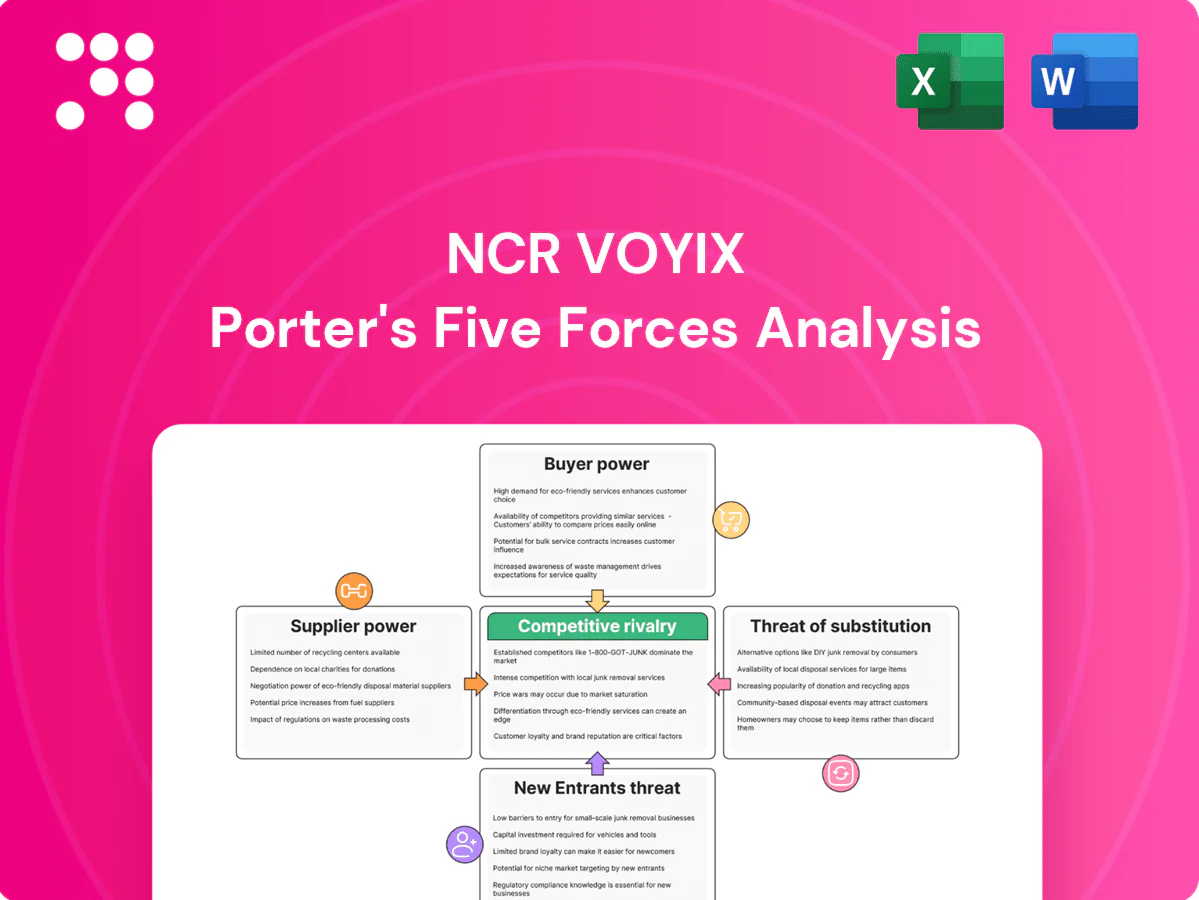
NCR Voyix Porter's Five Forces Analysis

From Overview to Strategy Blueprint
NCR Voyix’s Porter's Five Forces snapshot highlights competitive rivalry, buyer and supplier leverage, substitute threats, and entry barriers that shape strategic choices; it reveals signaling of margin pressure and niche opportunity. This brief scratches the surface—unlock the full Porter's Five Forces Analysis for force-by-force ratings, visuals, and actionable recommendations.
Suppliers Bargaining Power

Specialized hardware components
POS terminals, scanners, printers and kiosks rely on a concentrated set of OEMs (Worldline/Ingenico, Verifone, PAX) and silicon/touch suppliers (NXP, Qualcomm, BOE), raising supplier leverage. Limited sources for touchscreens, payment readers and embedded CPUs drove lead times of 12–20 weeks in 2024, increasing switching costs. Supply tightness or design changes enable vendors to push price and terms. NCR Voyix mitigates via multi-sourcing and module standardization.
Payment networks and processors
Card schemes, acquirers and gateway partners are essential to enterprise payments: Visa and Mastercard together held roughly 80% of global card network share in 2024, giving them pricing leverage. Scheme fee structures and certification requirements (EMV/PCI) create fixed-cost barriers and bargaining power over vendors like NCR Voyix. Interoperability demands limit Voyix’s ability to bypass these partners, though multi-year alliances and volume commitments can reduce fee pressure.

Cloud and software infrastructure
Reliance on hyperscalers for compute, storage and analytics (AWS ~32%, Microsoft Azure ~22%, Google Cloud ~11% market share in 2024) exposes NCR Voyix to usage-based cost escalations as consumption rises. Data residency rules and uptime SLAs (typically 99.95–99.99%) further lock workloads to top providers. While cloud switching is possible, re-architecture and migration can cost millions; multi-cloud and reserved capacity discounts (commonly 30–70%) reduce supplier power.

Software IP and third‑party integrations
Integrations with tax engines, inventory systems, security, and authentication vendors create sticky dependencies for NCR Voyix; API changes or license shifts can force roadmap rework and add development and compliance costs. Proprietary protocols from key partners further increase supplier leverage and switching costs, slowing product agility. Prioritizing open standards and building reusable adapters reduces lock-in and total cost of ownership.
- Sticky integrations: tax, inventory, security, auth
- Risk drivers: API changes, licensing shifts
- Dependence: proprietary protocols raise switching costs
- Mitigants: adapters and open standards lower lock-in
Logistics and field services
Logistics and field services for NCR Voyix rely on regional partners across 50+ countries, creating dependence for global installation, maintenance and depot repair. Labor constraints and parts shortages in 2024 pushed service SLAs and pricing upward, while inconsistent field quality amplifies customer churn risk. Developing certified partner networks and selective in-house centers reduces supplier leverage.
- Regional coverage: 50+ countries
- Risk: labor & parts shortages 2024
- Impact: SLA/pricing pressure
- Mitigation: certified partners + in-house centers
Supplier concentration, hyperscaler leverage raise lead times; modularity and multi-sourcing mitigate
NCR Voyix faces elevated supplier power from concentrated OEMs (Worldline/Ingenico, Verifone, PAX) and silicon/touch vendors causing 12–20 week lead times in 2024, raising switching costs. Card networks (Visa+Mastercard ~80% share in 2024) and hyperscalers (AWS 32%, Azure 22%, GCP 11%) exert pricing and SLA leverage. Regional service partners across 50+ countries and proprietary integrations further increase lock-in; multi-sourcing, modular design and adapters mitigate risk.
| Supplier | 2024 metric |
|---|---|
| OEMs/touch | Lead times 12–20 wks |
| Card schemes | Visa+MC ~80% share |
| Hyperscalers | AWS 32%/Azure 22%/GCP 11% |
| Field services | Coverage 50+ countries |
What is included in the product
 Detailed Word Document
Tailored Porter’s Five Forces analysis for NCR Voyix, uncovering competitive drivers, buyer and supplier power, entry barriers, substitutes and disruptive threats—ready to embed in investor decks or strategy reports.

 Customizable Excel Spreadsheet
A concise Porter's Five Forces one-sheet for NCR Voyix that instantly clarifies competitive pressure and strategic risks, with customizable ratings and a ready-to-copy radar chart for decks and boardrooms.
Customers Bargaining Power

Enterprise retailers and QSR chains
Enterprise retailers and QSR chains buy at scale, forcing multi-year discounts, custom integrations and stringent SLAs, and they routinely run competitive RFPs across major POS vendors which intensifies price pressure. Switching costs are real but typically managed within planned hardware and software refresh cycles. Co-innovation partnerships and outcome-based pricing models can reduce buyer leverage by aligning incentives and sharing implementation risk. These customers also demand analytics and uptime guarantees tied to revenue performance.
Banks and fintech-driven institutions
Banks and fintech clients mandate SOC 2, PCI-DSS and ISO 27001-level controls, increasing negotiating leverage. Many maintain internal IT or competing vendor stacks and face enterprise sales cycles of 12–24 months, raising customer acquisition costs and buyer power. Proven metrics—99.99% uptime SLAs and vendor-reported fraud reductions often in the 30–50% range—help defend pricing.

SMBs via channel partners
SMBs accessed via channel partners are highly price sensitive and can churn rapidly to simplified SaaS POS, with churn among small merchants often cited in industry surveys as elevated versus enterprise cohorts. Channels aggregate demand and commonly negotiate margins and MDF support—MDF typically ranges 2–5% of partner revenue (2024 channel benchmarks). Ease of onboarding and hardware financing options materially sway purchase decisions, while bundled offers and usage‑tiered plans reduce direct price comparisons and lower churn risk.

Demand for interoperability
Buyers now demand open APIs to connect ERP, loyalty, delivery and e-commerce; in 2024 about 72% of retail and hospitality customers ranked API openness as a renewal-critical feature, pushing leverage toward customers and raising replacement risk for vendors that resist openness.
Providing robust SDKs and certified integrations reduces switching intent and can cut churn risk; vendors offering certified connectors report faster renewals and higher integration adoption.
- API openness: 72% (2024)
- Renewal risk rises if closed: replacement threat
- SDKs/certified integrations: lower switching intent
Data ownership and analytics value
Clients increasingly demand control over transaction and shopper data; the EU Data Act was adopted in 2024, reinforcing portability and raising buyer leverage via credible exit options. Proprietary analytics and AI ops intelligence from Voyix can create stickiness, while clear data rights and export tooling balance trust and retention.
- Data portability: raises buyer power
- AI analytics: increases switch costs
- Data rights/tooling: trust vs retention
Scale buyers want 99.99% uptime; 72% insist on open APIs
Large retailers/QSRs and banks exert high leverage via scale, multi-year RFPs and compliance demands (SOC2/PCI/ISO) driving discounts; enterprise SLAs (99.99% uptime) and outcome pricing defend value. SMBs are price-sensitive with high churn; channels push 2–5% MDF. 72% of customers (2024) view API openness as renewal-critical; EU Data Act 2024 increases data-portability leverage.
| Metric | 2024 |
|---|---|
| API openness | 72% |
| MDF range | 2–5% |
| Enterprise SLA | 99.99% uptime |
What You See Is What You Get
NCR Voyix Porter's Five Forces Analysis
This preview shows the exact NCR Voyix Porter's Five Forces Analysis you'll receive immediately after purchase—no surprises, no placeholders. The document displayed here is the full, professionally written analysis, fully formatted and ready for download and use the moment you buy. You're viewing the same deliverable that will be available to you instantly after payment.

From Overview to Strategy Blueprint
NCR Voyix’s Porter's Five Forces snapshot highlights competitive rivalry, buyer and supplier leverage, substitute threats, and entry barriers that shape strategic choices; it reveals signaling of margin pressure and niche opportunity. This brief scratches the surface—unlock the full Porter's Five Forces Analysis for force-by-force ratings, visuals, and actionable recommendations.
Suppliers Bargaining Power
Specialized hardware components
POS terminals, scanners, printers and kiosks rely on a concentrated set of OEMs (Worldline/Ingenico, Verifone, PAX) and silicon/touch suppliers (NXP, Qualcomm, BOE), raising supplier leverage. Limited sources for touchscreens, payment readers and embedded CPUs drove lead times of 12–20 weeks in 2024, increasing switching costs. Supply tightness or design changes enable vendors to push price and terms. NCR Voyix mitigates via multi-sourcing and module standardization.
Payment networks and processors
Card schemes, acquirers and gateway partners are essential to enterprise payments: Visa and Mastercard together held roughly 80% of global card network share in 2024, giving them pricing leverage. Scheme fee structures and certification requirements (EMV/PCI) create fixed-cost barriers and bargaining power over vendors like NCR Voyix. Interoperability demands limit Voyix’s ability to bypass these partners, though multi-year alliances and volume commitments can reduce fee pressure.
Cloud and software infrastructure
Reliance on hyperscalers for compute, storage and analytics (AWS ~32%, Microsoft Azure ~22%, Google Cloud ~11% market share in 2024) exposes NCR Voyix to usage-based cost escalations as consumption rises. Data residency rules and uptime SLAs (typically 99.95–99.99%) further lock workloads to top providers. While cloud switching is possible, re-architecture and migration can cost millions; multi-cloud and reserved capacity discounts (commonly 30–70%) reduce supplier power.
Software IP and third‑party integrations
Integrations with tax engines, inventory systems, security, and authentication vendors create sticky dependencies for NCR Voyix; API changes or license shifts can force roadmap rework and add development and compliance costs. Proprietary protocols from key partners further increase supplier leverage and switching costs, slowing product agility. Prioritizing open standards and building reusable adapters reduces lock-in and total cost of ownership.
- Sticky integrations: tax, inventory, security, auth
- Risk drivers: API changes, licensing shifts
- Dependence: proprietary protocols raise switching costs
- Mitigants: adapters and open standards lower lock-in
Logistics and field services
Logistics and field services for NCR Voyix rely on regional partners across 50+ countries, creating dependence for global installation, maintenance and depot repair. Labor constraints and parts shortages in 2024 pushed service SLAs and pricing upward, while inconsistent field quality amplifies customer churn risk. Developing certified partner networks and selective in-house centers reduces supplier leverage.
- Regional coverage: 50+ countries
- Risk: labor & parts shortages 2024
- Impact: SLA/pricing pressure
- Mitigation: certified partners + in-house centers
Supplier concentration, hyperscaler leverage raise lead times; modularity and multi-sourcing mitigate
NCR Voyix faces elevated supplier power from concentrated OEMs (Worldline/Ingenico, Verifone, PAX) and silicon/touch vendors causing 12–20 week lead times in 2024, raising switching costs. Card networks (Visa+Mastercard ~80% share in 2024) and hyperscalers (AWS 32%, Azure 22%, GCP 11%) exert pricing and SLA leverage. Regional service partners across 50+ countries and proprietary integrations further increase lock-in; multi-sourcing, modular design and adapters mitigate risk.
| Supplier | 2024 metric |
|---|---|
| OEMs/touch | Lead times 12–20 wks |
| Card schemes | Visa+MC ~80% share |
| Hyperscalers | AWS 32%/Azure 22%/GCP 11% |
| Field services | Coverage 50+ countries |
What is included in the product
Detailed Word Document
Tailored Porter’s Five Forces analysis for NCR Voyix, uncovering competitive drivers, buyer and supplier power, entry barriers, substitutes and disruptive threats—ready to embed in investor decks or strategy reports.
Customizable Excel Spreadsheet
A concise Porter's Five Forces one-sheet for NCR Voyix that instantly clarifies competitive pressure and strategic risks, with customizable ratings and a ready-to-copy radar chart for decks and boardrooms.
Customers Bargaining Power
Enterprise retailers and QSR chains
Enterprise retailers and QSR chains buy at scale, forcing multi-year discounts, custom integrations and stringent SLAs, and they routinely run competitive RFPs across major POS vendors which intensifies price pressure. Switching costs are real but typically managed within planned hardware and software refresh cycles. Co-innovation partnerships and outcome-based pricing models can reduce buyer leverage by aligning incentives and sharing implementation risk. These customers also demand analytics and uptime guarantees tied to revenue performance.
Banks and fintech-driven institutions
Banks and fintech clients mandate SOC 2, PCI-DSS and ISO 27001-level controls, increasing negotiating leverage. Many maintain internal IT or competing vendor stacks and face enterprise sales cycles of 12–24 months, raising customer acquisition costs and buyer power. Proven metrics—99.99% uptime SLAs and vendor-reported fraud reductions often in the 30–50% range—help defend pricing.
SMBs via channel partners
SMBs accessed via channel partners are highly price sensitive and can churn rapidly to simplified SaaS POS, with churn among small merchants often cited in industry surveys as elevated versus enterprise cohorts. Channels aggregate demand and commonly negotiate margins and MDF support—MDF typically ranges 2–5% of partner revenue (2024 channel benchmarks). Ease of onboarding and hardware financing options materially sway purchase decisions, while bundled offers and usage‑tiered plans reduce direct price comparisons and lower churn risk.
Demand for interoperability
Buyers now demand open APIs to connect ERP, loyalty, delivery and e-commerce; in 2024 about 72% of retail and hospitality customers ranked API openness as a renewal-critical feature, pushing leverage toward customers and raising replacement risk for vendors that resist openness.
Providing robust SDKs and certified integrations reduces switching intent and can cut churn risk; vendors offering certified connectors report faster renewals and higher integration adoption.
- API openness: 72% (2024)
- Renewal risk rises if closed: replacement threat
- SDKs/certified integrations: lower switching intent
Data ownership and analytics value
Clients increasingly demand control over transaction and shopper data; the EU Data Act was adopted in 2024, reinforcing portability and raising buyer leverage via credible exit options. Proprietary analytics and AI ops intelligence from Voyix can create stickiness, while clear data rights and export tooling balance trust and retention.
- Data portability: raises buyer power
- AI analytics: increases switch costs
- Data rights/tooling: trust vs retention
Scale buyers want 99.99% uptime; 72% insist on open APIs
Large retailers/QSRs and banks exert high leverage via scale, multi-year RFPs and compliance demands (SOC2/PCI/ISO) driving discounts; enterprise SLAs (99.99% uptime) and outcome pricing defend value. SMBs are price-sensitive with high churn; channels push 2–5% MDF. 72% of customers (2024) view API openness as renewal-critical; EU Data Act 2024 increases data-portability leverage.
| Metric | 2024 |
|---|---|
| API openness | 72% |
| MDF range | 2–5% |
| Enterprise SLA | 99.99% uptime |
What You See Is What You Get
NCR Voyix Porter's Five Forces Analysis
This preview shows the exact NCR Voyix Porter's Five Forces Analysis you'll receive immediately after purchase—no surprises, no placeholders. The document displayed here is the full, professionally written analysis, fully formatted and ready for download and use the moment you buy. You're viewing the same deliverable that will be available to you instantly after payment.
Description
From Overview to Strategy Blueprint
NCR Voyix’s Porter's Five Forces snapshot highlights competitive rivalry, buyer and supplier leverage, substitute threats, and entry barriers that shape strategic choices; it reveals signaling of margin pressure and niche opportunity. This brief scratches the surface—unlock the full Porter's Five Forces Analysis for force-by-force ratings, visuals, and actionable recommendations.
Suppliers Bargaining Power
Specialized hardware components
POS terminals, scanners, printers and kiosks rely on a concentrated set of OEMs (Worldline/Ingenico, Verifone, PAX) and silicon/touch suppliers (NXP, Qualcomm, BOE), raising supplier leverage. Limited sources for touchscreens, payment readers and embedded CPUs drove lead times of 12–20 weeks in 2024, increasing switching costs. Supply tightness or design changes enable vendors to push price and terms. NCR Voyix mitigates via multi-sourcing and module standardization.
Payment networks and processors
Card schemes, acquirers and gateway partners are essential to enterprise payments: Visa and Mastercard together held roughly 80% of global card network share in 2024, giving them pricing leverage. Scheme fee structures and certification requirements (EMV/PCI) create fixed-cost barriers and bargaining power over vendors like NCR Voyix. Interoperability demands limit Voyix’s ability to bypass these partners, though multi-year alliances and volume commitments can reduce fee pressure.
Cloud and software infrastructure
Reliance on hyperscalers for compute, storage and analytics (AWS ~32%, Microsoft Azure ~22%, Google Cloud ~11% market share in 2024) exposes NCR Voyix to usage-based cost escalations as consumption rises. Data residency rules and uptime SLAs (typically 99.95–99.99%) further lock workloads to top providers. While cloud switching is possible, re-architecture and migration can cost millions; multi-cloud and reserved capacity discounts (commonly 30–70%) reduce supplier power.
Software IP and third‑party integrations
Integrations with tax engines, inventory systems, security, and authentication vendors create sticky dependencies for NCR Voyix; API changes or license shifts can force roadmap rework and add development and compliance costs. Proprietary protocols from key partners further increase supplier leverage and switching costs, slowing product agility. Prioritizing open standards and building reusable adapters reduces lock-in and total cost of ownership.
- Sticky integrations: tax, inventory, security, auth
- Risk drivers: API changes, licensing shifts
- Dependence: proprietary protocols raise switching costs
- Mitigants: adapters and open standards lower lock-in
Logistics and field services
Logistics and field services for NCR Voyix rely on regional partners across 50+ countries, creating dependence for global installation, maintenance and depot repair. Labor constraints and parts shortages in 2024 pushed service SLAs and pricing upward, while inconsistent field quality amplifies customer churn risk. Developing certified partner networks and selective in-house centers reduces supplier leverage.
- Regional coverage: 50+ countries
- Risk: labor & parts shortages 2024
- Impact: SLA/pricing pressure
- Mitigation: certified partners + in-house centers
Supplier concentration, hyperscaler leverage raise lead times; modularity and multi-sourcing mitigate
NCR Voyix faces elevated supplier power from concentrated OEMs (Worldline/Ingenico, Verifone, PAX) and silicon/touch vendors causing 12–20 week lead times in 2024, raising switching costs. Card networks (Visa+Mastercard ~80% share in 2024) and hyperscalers (AWS 32%, Azure 22%, GCP 11%) exert pricing and SLA leverage. Regional service partners across 50+ countries and proprietary integrations further increase lock-in; multi-sourcing, modular design and adapters mitigate risk.
| Supplier | 2024 metric |
|---|---|
| OEMs/touch | Lead times 12–20 wks |
| Card schemes | Visa+MC ~80% share |
| Hyperscalers | AWS 32%/Azure 22%/GCP 11% |
| Field services | Coverage 50+ countries |
What is included in the product
Detailed Word Document
Tailored Porter’s Five Forces analysis for NCR Voyix, uncovering competitive drivers, buyer and supplier power, entry barriers, substitutes and disruptive threats—ready to embed in investor decks or strategy reports.
Customizable Excel Spreadsheet
A concise Porter's Five Forces one-sheet for NCR Voyix that instantly clarifies competitive pressure and strategic risks, with customizable ratings and a ready-to-copy radar chart for decks and boardrooms.
Customers Bargaining Power
Enterprise retailers and QSR chains
Enterprise retailers and QSR chains buy at scale, forcing multi-year discounts, custom integrations and stringent SLAs, and they routinely run competitive RFPs across major POS vendors which intensifies price pressure. Switching costs are real but typically managed within planned hardware and software refresh cycles. Co-innovation partnerships and outcome-based pricing models can reduce buyer leverage by aligning incentives and sharing implementation risk. These customers also demand analytics and uptime guarantees tied to revenue performance.
Banks and fintech-driven institutions
Banks and fintech clients mandate SOC 2, PCI-DSS and ISO 27001-level controls, increasing negotiating leverage. Many maintain internal IT or competing vendor stacks and face enterprise sales cycles of 12–24 months, raising customer acquisition costs and buyer power. Proven metrics—99.99% uptime SLAs and vendor-reported fraud reductions often in the 30–50% range—help defend pricing.
SMBs via channel partners
SMBs accessed via channel partners are highly price sensitive and can churn rapidly to simplified SaaS POS, with churn among small merchants often cited in industry surveys as elevated versus enterprise cohorts. Channels aggregate demand and commonly negotiate margins and MDF support—MDF typically ranges 2–5% of partner revenue (2024 channel benchmarks). Ease of onboarding and hardware financing options materially sway purchase decisions, while bundled offers and usage‑tiered plans reduce direct price comparisons and lower churn risk.
Demand for interoperability
Buyers now demand open APIs to connect ERP, loyalty, delivery and e-commerce; in 2024 about 72% of retail and hospitality customers ranked API openness as a renewal-critical feature, pushing leverage toward customers and raising replacement risk for vendors that resist openness.
Providing robust SDKs and certified integrations reduces switching intent and can cut churn risk; vendors offering certified connectors report faster renewals and higher integration adoption.
- API openness: 72% (2024)
- Renewal risk rises if closed: replacement threat
- SDKs/certified integrations: lower switching intent
Data ownership and analytics value
Clients increasingly demand control over transaction and shopper data; the EU Data Act was adopted in 2024, reinforcing portability and raising buyer leverage via credible exit options. Proprietary analytics and AI ops intelligence from Voyix can create stickiness, while clear data rights and export tooling balance trust and retention.
- Data portability: raises buyer power
- AI analytics: increases switch costs
- Data rights/tooling: trust vs retention
Scale buyers want 99.99% uptime; 72% insist on open APIs
Large retailers/QSRs and banks exert high leverage via scale, multi-year RFPs and compliance demands (SOC2/PCI/ISO) driving discounts; enterprise SLAs (99.99% uptime) and outcome pricing defend value. SMBs are price-sensitive with high churn; channels push 2–5% MDF. 72% of customers (2024) view API openness as renewal-critical; EU Data Act 2024 increases data-portability leverage.
| Metric | 2024 |
|---|---|
| API openness | 72% |
| MDF range | 2–5% |
| Enterprise SLA | 99.99% uptime |
What You See Is What You Get
NCR Voyix Porter's Five Forces Analysis
This preview shows the exact NCR Voyix Porter's Five Forces Analysis you'll receive immediately after purchase—no surprises, no placeholders. The document displayed here is the full, professionally written analysis, fully formatted and ready for download and use the moment you buy. You're viewing the same deliverable that will be available to you instantly after payment.











