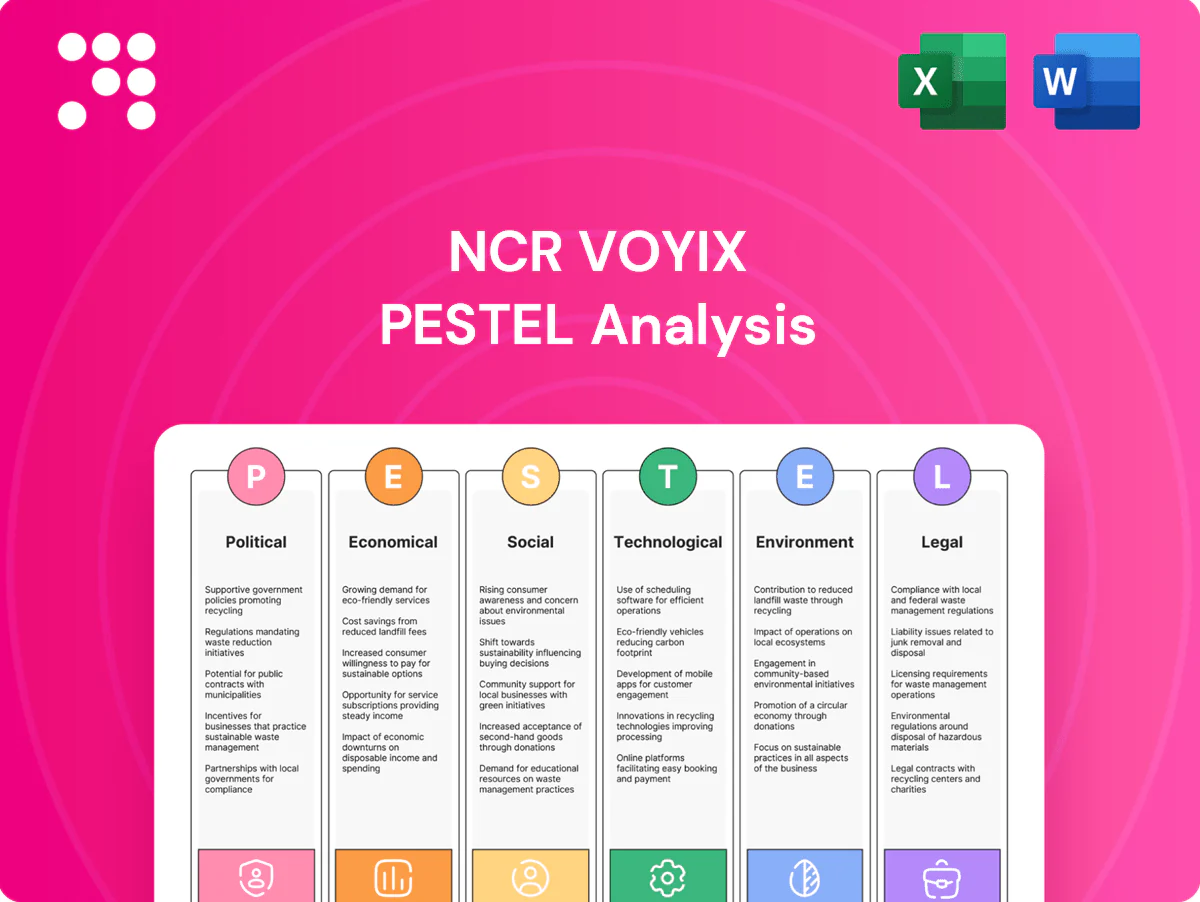
NCR Voyix PESTLE Analysis

Plan Smarter. Present Sharper. Compete Stronger.
Unlock how political shifts, economic trends, and tech disruptions are shaping NCR Voyix with our concise PESTLE snapshot—perfect for investors and strategists. This overview points to regulatory risks, market opportunities, and sustainability pressures affecting growth today. Purchase the full PESTLE analysis to get the complete, actionable intelligence you need to make confident decisions.
Political factors

Digital payments policy shifts
Governments push cashless economies—over 100 countries had instant payment systems by 2024, boosting demand for POS, kiosks and enterprise payment platforms. Subsidies and mandates for electronic invoicing and real-time payments are accelerating adoption in retail, restaurants and banking, with instant-payment volumes rising double digits in many markets. NCR Voyix must align product roadmaps to national instant-pay and central bank initiatives and keep close public-sector engagement to anticipate tenders and compliance.
Trade tensions and supply chains
Semiconductor and hardware component trade restrictions, including 2022-24 US export controls on advanced chips, can raise costs and delay terminal deliveries for NCR Voyix, increasing lead times and component pricing pressure. Tariffs and export controls directly affect sourcing for kiosks and POS devices, squeezing margins and inventory. Diversifying contract manufacturers and nearshoring, supported by the US CHIPS Act (about $52 billion), reduces geopolitical exposure, while scenario planning to protect 99.9%+ SLAs preserves service continuity during shocks.

Data localization and sovereignty
Many jurisdictions now require financial and consumer data to remain onshore; for example the Reserve Bank of India’s 2018 directive mandates domestic storage of payments data for a market of roughly 1.4 billion people. Cloud deployment models must support local hosting and sovereign-cloud partners, so NCR Voyix needs configurable data residency, strong encryption and immutable audit trails. Non-compliance risks losing contracts with state-linked banks and large retailers.

Public safety and labor policies
Rising minimum wages—US federal rate still $7.25/hr (unchanged since 2009) while many states increased local minima by 2024—plus labor reforms push retailers toward self-service and automation; retail shrink was about 1.6% of sales in 2023 (NRF), increasing demand for secure payment and loss-prevention tech; modular features allow rapid policy-driven updates for overtime tracking and compliance.
- automation: respond to wage pressure
- security: reduce 1.6% shrink
- compliance: overtime tracking
- modularity: adapt to policy volatility
Government procurement and standards
Winning public contracts demands adherence to open standards and certification schemes; procurement rules increasingly favor certified, interoperable solutions. Domestic-vendor preferences mean local partnerships or subsidiaries are often required. NCR Voyix gains advantage from interoperable APIs and certification portfolios; transparent pricing and ESG credentials boost tender competitiveness; OECD estimates public procurement ~12% of GDP.
- Standards: open APIs, certifications
- Local presence: partnerships/subsidiaries
- Competitive edge: transparent pricing
- ESG: strengthens bids
Cashless mandates and data-residency rules boost demand for compliant POS and sovereign cloud
Governments pushing cashless payments (100+ instant-pay systems by 2024) and data-residency mandates (eg Reserve Bank of India) drive demand for compliant POS, kiosks and sovereign-cloud options. Trade controls and CHIPS Act ($52B) raise sourcing and lead-time risks, favouring nearshoring and diversified CMOs. Public procurement (~12% GDP) and local-vendor rules make certifications, APIs and ESG essential for tenders.
| Metric | Value |
|---|---|
| Instant-pay adopters (2024) | 100+ |
| CHIPS Act funding | $52B |
| Public procurement | ~12% GDP |
| Retail shrink (2023) | 1.6% |
What is included in the product
 Detailed Word Document
Explores how macro-environmental factors uniquely affect NCR Voyix across Political, Economic, Social, Technological, Environmental and Legal dimensions, with data-backed trends and forward-looking insights to identify threats, opportunities and scenario-ready strategies for executives, investors and consultants.

 Customizable Excel Spreadsheet
Visually segmented by PESTEL categories for rapid interpretation, the NCR Voyix PESTLE summary strips complex external factors into clear, presentation-ready points you can drop into PowerPoints or use in planning sessions.
Economic factors

Consumer spending cycles
Consumer discretionary spending—which drives transaction volumes at retail and restaurants—matters because household consumption represents about 70% of US GDP, so downturns blunt merchant expansion and POS refresh cycles while recoveries spur upgrades. NCR Voyix can hedge cyclicality via recurring software revenues and value-added services, and flexible pricing plus ROI cases help sustain sales across cycles.
Interest rates and capex
Higher policy rates (federal funds ~5.25–5.50% mid‑2025) raise financing costs for store remodels and hardware rollouts, pushing merchants toward OPEX models. Demand shifts favor device‑as‑a‑service and SaaS bundles; NCR Voyix can expand subscription ARR by offering DaaS with clear TCO and faster payback to accelerate procurement decisions.

Inflation and cost pressures
Input inflation raised hardware, logistics and labor costs by roughly 6% YoY in 2023–24, forcing price discipline and procurement optimization; passing costs requires tiered offerings to protect volume-sensitive accounts. NCR Voyix can offset margin pressure via a higher software and managed-services mix (around 60% of revenue in FY2024), payments monetization and subscription pricing. Automation features that cut merchant labor costs by up to 30% increase ROI and adoption urgency.

Foreign exchange exposure
Global operations expose NCR Voyix to foreign exchange risk on both revenues and input costs; BIS reports global FX daily turnover at about 7.5 trillion USD (2022), underscoring market volatility that can swing reported results and pricing competitiveness. Currency moves have required multi-currency contracts, natural hedges and active hedging programs to stabilize margins, while localized pricing and billing help adoption in emerging markets.
- FX turnover: BIS 7.5 trillion USD daily (2022)
- Mitigants: natural hedges, multi-currency contracts, hedging programs
- Sales tactic: localized pricing and billing for emerging markets
SMB vs enterprise demand
SMBs, which represent about 99% of US firms and roughly 44% of US private-sector GDP (SBA), are more rate- and cash-flow-sensitive, favoring pay-as-you-go and lower upfront costs, while enterprises plan multi-year rollouts and prioritize platform integration and APIs. Tailored SMB packages and partner channels can boost penetration; enterprise wins drive scale, recurring revenue and ecosystem lock-in. NCR Voyix should balance pipeline across segments to stabilize growth.
- SMB sensitivity: price, cash flow
- SMB reach: partner channels, packages
- Enterprise: multi-year deals, platform lock-in
- Strategy: balanced pipeline for stability
Cashless mandates and data-residency rules boost demand for compliant POS and sovereign cloud
Consumer spending (~70% of US GDP) drives POS demand; downturns slow refresh cycles while recoveries boost upgrades. Fed funds ~5.25–5.50% (mid‑2025) favors OPEX/DaaS and subscription growth. Input inflation ~6% YoY (2023–24) and FX turnover ~7.5t USD/day (BIS 2022) pressure margins; software/managed services ~60% of FY2024 revenue cushions impact. SMBs (99% US firms; ~44% private GDP) favor pay-as-you-go.
| Metric | Value |
|---|---|
| US consumer share | ~70% GDP |
| Fed funds | 5.25–5.50% (mid‑2025) |
| Input inflation | ~6% YoY (2023–24) |
| FX turnover | 7.5t USD/day (BIS 2022) |
| SW/Mgmt svc rev | ~60% FY2024 |
What You See Is What You Get
NCR Voyix PESTLE Analysis
The preview shown here is the exact document you'll receive after purchase—fully formatted and ready to use. This NCR Voyix PESTLE Analysis screenshot reflects the complete, professionally structured report with no placeholders or teasers. After payment you’ll instantly download this identical file.

Plan Smarter. Present Sharper. Compete Stronger.
Unlock how political shifts, economic trends, and tech disruptions are shaping NCR Voyix with our concise PESTLE snapshot—perfect for investors and strategists. This overview points to regulatory risks, market opportunities, and sustainability pressures affecting growth today. Purchase the full PESTLE analysis to get the complete, actionable intelligence you need to make confident decisions.
Political factors
Digital payments policy shifts
Governments push cashless economies—over 100 countries had instant payment systems by 2024, boosting demand for POS, kiosks and enterprise payment platforms. Subsidies and mandates for electronic invoicing and real-time payments are accelerating adoption in retail, restaurants and banking, with instant-payment volumes rising double digits in many markets. NCR Voyix must align product roadmaps to national instant-pay and central bank initiatives and keep close public-sector engagement to anticipate tenders and compliance.
Trade tensions and supply chains
Semiconductor and hardware component trade restrictions, including 2022-24 US export controls on advanced chips, can raise costs and delay terminal deliveries for NCR Voyix, increasing lead times and component pricing pressure. Tariffs and export controls directly affect sourcing for kiosks and POS devices, squeezing margins and inventory. Diversifying contract manufacturers and nearshoring, supported by the US CHIPS Act (about $52 billion), reduces geopolitical exposure, while scenario planning to protect 99.9%+ SLAs preserves service continuity during shocks.
Data localization and sovereignty
Many jurisdictions now require financial and consumer data to remain onshore; for example the Reserve Bank of India’s 2018 directive mandates domestic storage of payments data for a market of roughly 1.4 billion people. Cloud deployment models must support local hosting and sovereign-cloud partners, so NCR Voyix needs configurable data residency, strong encryption and immutable audit trails. Non-compliance risks losing contracts with state-linked banks and large retailers.
Public safety and labor policies
Rising minimum wages—US federal rate still $7.25/hr (unchanged since 2009) while many states increased local minima by 2024—plus labor reforms push retailers toward self-service and automation; retail shrink was about 1.6% of sales in 2023 (NRF), increasing demand for secure payment and loss-prevention tech; modular features allow rapid policy-driven updates for overtime tracking and compliance.
- automation: respond to wage pressure
- security: reduce 1.6% shrink
- compliance: overtime tracking
- modularity: adapt to policy volatility
Government procurement and standards
Winning public contracts demands adherence to open standards and certification schemes; procurement rules increasingly favor certified, interoperable solutions. Domestic-vendor preferences mean local partnerships or subsidiaries are often required. NCR Voyix gains advantage from interoperable APIs and certification portfolios; transparent pricing and ESG credentials boost tender competitiveness; OECD estimates public procurement ~12% of GDP.
- Standards: open APIs, certifications
- Local presence: partnerships/subsidiaries
- Competitive edge: transparent pricing
- ESG: strengthens bids
Cashless mandates and data-residency rules boost demand for compliant POS and sovereign cloud
Governments pushing cashless payments (100+ instant-pay systems by 2024) and data-residency mandates (eg Reserve Bank of India) drive demand for compliant POS, kiosks and sovereign-cloud options. Trade controls and CHIPS Act ($52B) raise sourcing and lead-time risks, favouring nearshoring and diversified CMOs. Public procurement (~12% GDP) and local-vendor rules make certifications, APIs and ESG essential for tenders.
| Metric | Value |
|---|---|
| Instant-pay adopters (2024) | 100+ |
| CHIPS Act funding | $52B |
| Public procurement | ~12% GDP |
| Retail shrink (2023) | 1.6% |
What is included in the product
Detailed Word Document
Explores how macro-environmental factors uniquely affect NCR Voyix across Political, Economic, Social, Technological, Environmental and Legal dimensions, with data-backed trends and forward-looking insights to identify threats, opportunities and scenario-ready strategies for executives, investors and consultants.
Customizable Excel Spreadsheet
Visually segmented by PESTEL categories for rapid interpretation, the NCR Voyix PESTLE summary strips complex external factors into clear, presentation-ready points you can drop into PowerPoints or use in planning sessions.
Economic factors
Consumer spending cycles
Consumer discretionary spending—which drives transaction volumes at retail and restaurants—matters because household consumption represents about 70% of US GDP, so downturns blunt merchant expansion and POS refresh cycles while recoveries spur upgrades. NCR Voyix can hedge cyclicality via recurring software revenues and value-added services, and flexible pricing plus ROI cases help sustain sales across cycles.
Interest rates and capex
Higher policy rates (federal funds ~5.25–5.50% mid‑2025) raise financing costs for store remodels and hardware rollouts, pushing merchants toward OPEX models. Demand shifts favor device‑as‑a‑service and SaaS bundles; NCR Voyix can expand subscription ARR by offering DaaS with clear TCO and faster payback to accelerate procurement decisions.
Inflation and cost pressures
Input inflation raised hardware, logistics and labor costs by roughly 6% YoY in 2023–24, forcing price discipline and procurement optimization; passing costs requires tiered offerings to protect volume-sensitive accounts. NCR Voyix can offset margin pressure via a higher software and managed-services mix (around 60% of revenue in FY2024), payments monetization and subscription pricing. Automation features that cut merchant labor costs by up to 30% increase ROI and adoption urgency.
Foreign exchange exposure
Global operations expose NCR Voyix to foreign exchange risk on both revenues and input costs; BIS reports global FX daily turnover at about 7.5 trillion USD (2022), underscoring market volatility that can swing reported results and pricing competitiveness. Currency moves have required multi-currency contracts, natural hedges and active hedging programs to stabilize margins, while localized pricing and billing help adoption in emerging markets.
- FX turnover: BIS 7.5 trillion USD daily (2022)
- Mitigants: natural hedges, multi-currency contracts, hedging programs
- Sales tactic: localized pricing and billing for emerging markets
SMB vs enterprise demand
SMBs, which represent about 99% of US firms and roughly 44% of US private-sector GDP (SBA), are more rate- and cash-flow-sensitive, favoring pay-as-you-go and lower upfront costs, while enterprises plan multi-year rollouts and prioritize platform integration and APIs. Tailored SMB packages and partner channels can boost penetration; enterprise wins drive scale, recurring revenue and ecosystem lock-in. NCR Voyix should balance pipeline across segments to stabilize growth.
- SMB sensitivity: price, cash flow
- SMB reach: partner channels, packages
- Enterprise: multi-year deals, platform lock-in
- Strategy: balanced pipeline for stability
Cashless mandates and data-residency rules boost demand for compliant POS and sovereign cloud
Consumer spending (~70% of US GDP) drives POS demand; downturns slow refresh cycles while recoveries boost upgrades. Fed funds ~5.25–5.50% (mid‑2025) favors OPEX/DaaS and subscription growth. Input inflation ~6% YoY (2023–24) and FX turnover ~7.5t USD/day (BIS 2022) pressure margins; software/managed services ~60% of FY2024 revenue cushions impact. SMBs (99% US firms; ~44% private GDP) favor pay-as-you-go.
| Metric | Value |
|---|---|
| US consumer share | ~70% GDP |
| Fed funds | 5.25–5.50% (mid‑2025) |
| Input inflation | ~6% YoY (2023–24) |
| FX turnover | 7.5t USD/day (BIS 2022) |
| SW/Mgmt svc rev | ~60% FY2024 |
What You See Is What You Get
NCR Voyix PESTLE Analysis
The preview shown here is the exact document you'll receive after purchase—fully formatted and ready to use. This NCR Voyix PESTLE Analysis screenshot reflects the complete, professionally structured report with no placeholders or teasers. After payment you’ll instantly download this identical file.
Description
Plan Smarter. Present Sharper. Compete Stronger.
Unlock how political shifts, economic trends, and tech disruptions are shaping NCR Voyix with our concise PESTLE snapshot—perfect for investors and strategists. This overview points to regulatory risks, market opportunities, and sustainability pressures affecting growth today. Purchase the full PESTLE analysis to get the complete, actionable intelligence you need to make confident decisions.
Political factors
Digital payments policy shifts
Governments push cashless economies—over 100 countries had instant payment systems by 2024, boosting demand for POS, kiosks and enterprise payment platforms. Subsidies and mandates for electronic invoicing and real-time payments are accelerating adoption in retail, restaurants and banking, with instant-payment volumes rising double digits in many markets. NCR Voyix must align product roadmaps to national instant-pay and central bank initiatives and keep close public-sector engagement to anticipate tenders and compliance.
Trade tensions and supply chains
Semiconductor and hardware component trade restrictions, including 2022-24 US export controls on advanced chips, can raise costs and delay terminal deliveries for NCR Voyix, increasing lead times and component pricing pressure. Tariffs and export controls directly affect sourcing for kiosks and POS devices, squeezing margins and inventory. Diversifying contract manufacturers and nearshoring, supported by the US CHIPS Act (about $52 billion), reduces geopolitical exposure, while scenario planning to protect 99.9%+ SLAs preserves service continuity during shocks.
Data localization and sovereignty
Many jurisdictions now require financial and consumer data to remain onshore; for example the Reserve Bank of India’s 2018 directive mandates domestic storage of payments data for a market of roughly 1.4 billion people. Cloud deployment models must support local hosting and sovereign-cloud partners, so NCR Voyix needs configurable data residency, strong encryption and immutable audit trails. Non-compliance risks losing contracts with state-linked banks and large retailers.
Public safety and labor policies
Rising minimum wages—US federal rate still $7.25/hr (unchanged since 2009) while many states increased local minima by 2024—plus labor reforms push retailers toward self-service and automation; retail shrink was about 1.6% of sales in 2023 (NRF), increasing demand for secure payment and loss-prevention tech; modular features allow rapid policy-driven updates for overtime tracking and compliance.
- automation: respond to wage pressure
- security: reduce 1.6% shrink
- compliance: overtime tracking
- modularity: adapt to policy volatility
Government procurement and standards
Winning public contracts demands adherence to open standards and certification schemes; procurement rules increasingly favor certified, interoperable solutions. Domestic-vendor preferences mean local partnerships or subsidiaries are often required. NCR Voyix gains advantage from interoperable APIs and certification portfolios; transparent pricing and ESG credentials boost tender competitiveness; OECD estimates public procurement ~12% of GDP.
- Standards: open APIs, certifications
- Local presence: partnerships/subsidiaries
- Competitive edge: transparent pricing
- ESG: strengthens bids
Cashless mandates and data-residency rules boost demand for compliant POS and sovereign cloud
Governments pushing cashless payments (100+ instant-pay systems by 2024) and data-residency mandates (eg Reserve Bank of India) drive demand for compliant POS, kiosks and sovereign-cloud options. Trade controls and CHIPS Act ($52B) raise sourcing and lead-time risks, favouring nearshoring and diversified CMOs. Public procurement (~12% GDP) and local-vendor rules make certifications, APIs and ESG essential for tenders.
| Metric | Value |
|---|---|
| Instant-pay adopters (2024) | 100+ |
| CHIPS Act funding | $52B |
| Public procurement | ~12% GDP |
| Retail shrink (2023) | 1.6% |
What is included in the product
Detailed Word Document
Explores how macro-environmental factors uniquely affect NCR Voyix across Political, Economic, Social, Technological, Environmental and Legal dimensions, with data-backed trends and forward-looking insights to identify threats, opportunities and scenario-ready strategies for executives, investors and consultants.
Customizable Excel Spreadsheet
Visually segmented by PESTEL categories for rapid interpretation, the NCR Voyix PESTLE summary strips complex external factors into clear, presentation-ready points you can drop into PowerPoints or use in planning sessions.
Economic factors
Consumer spending cycles
Consumer discretionary spending—which drives transaction volumes at retail and restaurants—matters because household consumption represents about 70% of US GDP, so downturns blunt merchant expansion and POS refresh cycles while recoveries spur upgrades. NCR Voyix can hedge cyclicality via recurring software revenues and value-added services, and flexible pricing plus ROI cases help sustain sales across cycles.
Interest rates and capex
Higher policy rates (federal funds ~5.25–5.50% mid‑2025) raise financing costs for store remodels and hardware rollouts, pushing merchants toward OPEX models. Demand shifts favor device‑as‑a‑service and SaaS bundles; NCR Voyix can expand subscription ARR by offering DaaS with clear TCO and faster payback to accelerate procurement decisions.
Inflation and cost pressures
Input inflation raised hardware, logistics and labor costs by roughly 6% YoY in 2023–24, forcing price discipline and procurement optimization; passing costs requires tiered offerings to protect volume-sensitive accounts. NCR Voyix can offset margin pressure via a higher software and managed-services mix (around 60% of revenue in FY2024), payments monetization and subscription pricing. Automation features that cut merchant labor costs by up to 30% increase ROI and adoption urgency.
Foreign exchange exposure
Global operations expose NCR Voyix to foreign exchange risk on both revenues and input costs; BIS reports global FX daily turnover at about 7.5 trillion USD (2022), underscoring market volatility that can swing reported results and pricing competitiveness. Currency moves have required multi-currency contracts, natural hedges and active hedging programs to stabilize margins, while localized pricing and billing help adoption in emerging markets.
- FX turnover: BIS 7.5 trillion USD daily (2022)
- Mitigants: natural hedges, multi-currency contracts, hedging programs
- Sales tactic: localized pricing and billing for emerging markets
SMB vs enterprise demand
SMBs, which represent about 99% of US firms and roughly 44% of US private-sector GDP (SBA), are more rate- and cash-flow-sensitive, favoring pay-as-you-go and lower upfront costs, while enterprises plan multi-year rollouts and prioritize platform integration and APIs. Tailored SMB packages and partner channels can boost penetration; enterprise wins drive scale, recurring revenue and ecosystem lock-in. NCR Voyix should balance pipeline across segments to stabilize growth.
- SMB sensitivity: price, cash flow
- SMB reach: partner channels, packages
- Enterprise: multi-year deals, platform lock-in
- Strategy: balanced pipeline for stability
Cashless mandates and data-residency rules boost demand for compliant POS and sovereign cloud
Consumer spending (~70% of US GDP) drives POS demand; downturns slow refresh cycles while recoveries boost upgrades. Fed funds ~5.25–5.50% (mid‑2025) favors OPEX/DaaS and subscription growth. Input inflation ~6% YoY (2023–24) and FX turnover ~7.5t USD/day (BIS 2022) pressure margins; software/managed services ~60% of FY2024 revenue cushions impact. SMBs (99% US firms; ~44% private GDP) favor pay-as-you-go.
| Metric | Value |
|---|---|
| US consumer share | ~70% GDP |
| Fed funds | 5.25–5.50% (mid‑2025) |
| Input inflation | ~6% YoY (2023–24) |
| FX turnover | 7.5t USD/day (BIS 2022) |
| SW/Mgmt svc rev | ~60% FY2024 |
What You See Is What You Get
NCR Voyix PESTLE Analysis
The preview shown here is the exact document you'll receive after purchase—fully formatted and ready to use. This NCR Voyix PESTLE Analysis screenshot reflects the complete, professionally structured report with no placeholders or teasers. After payment you’ll instantly download this identical file.











